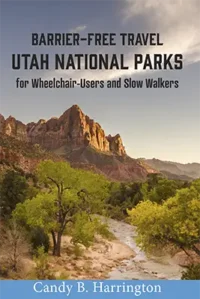
Penned by accessible travel expert Candy B. Harrington, this access guide includes detailed information about wheelchair-accessible trails, sites, lodging options, tours, restaurants and attractions in and near Zion, Bryce Canyon, Capitol Reef, Arches and Canyonlands national parks. It’s the definitive guide to wheelchair-accessible Utah National Parks. This handy resource features:
- Fly-drive trip planning information, including accessible van rentals.
- Access details and photographs of 33 wheelchair-accessible properties, including all in-park lodging options.
- Information about ranger-led tours, loaner wheelchairs and the free America the Beautiful Access Pass.
- The scoop on how to nab free accessible bus tours in Bryce Canyon National Park and Zion National Park.
- Detailed access information on trails, viewpoints, picnic areas and attractions — in and near the parks.
- Information about barrier-free camping options in all the parks.
- Insider tips on where to go for the best windshield views, accessible picnic spots and sunset photos.
This guidebook includes detailed information that will help wheelchair-users and slow walkers find an accessible room and build an accessible itinerary for any Utah national park. Barrier-Free Travel; Utah National Parks for Wheelchair-Users and Slow Walkers is a great resource for seniors, parents with stroller-aged children, Baby Boomers, folks who just like to take things a little slower and anybody who uses a cane, walker, wheelchair or scooter.
This guide will help you plan a truly accessible Utah national park road trip. A must-have resource!
Preface
Wow, They Listened!
I would never be so conceited as to believe that the Utah national parks upped their accessibility game because of something I said — or wrote; however I do think they have listened and responded to the disabled community at large. At least that’s what I see as I put the second edition of this book to bed. That’s especially satisfying to me, as I’ve been advocating for better — and even equal — access for nearly 30 years.
Let’s start with Bryce Canyon National Park. I’m happy to report that the Bryce Canyon Shared Use Path has been maintained through more than a few rough winters, and it’s still an excellent choice for wheelchair-users and slow walkers. They have also cleaned up the fire debris that was left after the Bridge Fire, and wheelchair-users are now able to once again access the Whiteman Picnic Area.
Zion National Park has also done a good job improving access. The Pa’rus Trail has always been a great accessible choice, but unfortunately the Canyon Junction trailhead was a bit steep. That’s all been fixed now, and the trail has truly accessible trailheads at both ends. Additionally they’ve added more shade structures, which is great because the sun can be harsh along that trail in the summer.
Admittedly Zion National Park has been plagued with floods and rockslides and extreme weather in the past few years. As a result, some trails have seen better days, but the crews seem to do a good job keeping up with things. That said, it’s always a good idea to check with the rangers at the visitor center to see if there are any closed trails in the park.
One of the biggest changes over in Arches National Park is the new vehicle entrance reservation requirement during peak visitation times. Although it’s a crowd control measure, with fewer visitors it’s also easier for wheelchair-users and slow walkers to navigate the trails and find accessible parking spots.
I was also impressed with the new signage at the trailheads in Arches National Park. Along with information about the length of the trail, they’ve also included details about the surface, obstructions, width, grade and cross slope. These signs give folks the information they need to determine if the trail is doable for them. And this is on all the trails, not just the accessible trails.
There are also some physical access improvements at Arches. Let’s start with the trail out to Double Rock. This has been years in the making, as they have totally redone the Windows Section of the park, and upgraded the parking and access. And although there’s a bit of an incline at the beginning of the trail to Double Rock, many folks can now manage it.
They also added a beautiful new picnic area and outdoor night sky viewing area at Panorama Point. It’s a very inclusive design with excellent access. And it’s a great spot to enjoy the night sky, even if there isn’t a formal ranger program.
Over in Canyonlands, they have added shaded ramadas for their picnic tables. This might not sound like an access improvement, but previously park visitors moved the accessible tables that were in the sun to inaccessible shady locations. I talked to the rangers about it numerous times, so they started to chain them down. Lo and behold, people cut the chains to move them. Who in the world brings bolt cutters to a national park? In any case, the new ramadas provide much needed shade, and now there’s no reason to relocate the accessible tables. There’s also a nice new picnic area with accessible ramadas at the Island in the Sky Visitor Center.
And I was thrilled to find that the curb-cut at the Petroglyph Boardwalk over at Capitol Reef National Park has been repaired. Previously it was so deteriorated that it was impossible for wheelchair-users to access part of the boardwalk. Now with the new curb-cut, everyone can get a close look at the petroglyphs.
Outside of the parks, there are some new fun theme lodges and glamping experiences. And these new properties did a great job with access. I just love their inclusive attitude. That’s another great change!
I’ve also noticed that the National Park Service is paying more attention to access, especially where trail descriptions are concerned. They seem to be moving away from that annoying “accessible with assistance” description that really means nothing. And they are training their employees better in regards to access.
Here’s a good case in point of the improved employee knowledge of access. A few years ago I was directed to an “accessible trail” by a well meaning park employee. I circled the area five or six times, and the only access to the trailhead I found was a staircase. Once we got to the top of the staircase the trail wasn’t bad. Still I was confused, so I went back and questioned the employee. Her response was that since a lot of stroller parents love that trail it must be good for wheelchairs too. I pointed out that you can carry a stroller up the stairs, but that’s not the way it works for a wheelchair. Gladly I didn’t run into that problem on this visit, and I attribute that to better training.
One of the biggest changes that I see in all the parks, is that more and more wheelchair-users are out and about enjoying the great outdoors. That change is most likely because of the improved access, as well as the availability of accurate access information. I hope to see more access changes and access upgrades in the parks in the future. And when I do, you’ll find those changes posted on the book website at EmergingHorizons.com. Additionally, if you come across some changes or improvements that I haven’t noted, please let me know about them, so I can share the information with everyone. There’s a form on the website, or you can contact me directly at my e-mail that’s listed below.
Attitudes are changing and our national parks are now more accessible than ever. I hope you enjoy all that these beautiful national lands have to offer. And let me know how your adventure went!
Candy Harrington
candy@EmergingHorizons.com
CandyHarrington.com
EmergingHorizons.com
Facebook: Candy Harrington
X: Candy B. Harrington
Pinterest: Candy Harrington
Contents
- Preface
- Wow, They Listened!
- Before You Go
- Make It A Road Trip
- Admission Fees
- Park Passes
- Information
- Authorized Park Concessionaires
- Altitude
- What is an Accessible Guestroom?
- What is an Accessible Trail?
- Service Animals in National Parks
- Zion National Park
- The Basics
- Zion Canyon
- Kolob Canyons
- Kolob Terrace Road
- Zion-Mount Carmel Scenic Highway
- Lodging Near Zion
- Zion National Park Resources
- Bryce Canyon National Park
- The Basics
- Bryce Amphitheater
- Rainbow Point Road
- Lodging & Attractions Near Bryce Canyon
- Bryce Canyon National Park Resources
- Capitol Reef National Park
- The Basics
- Highway 24 Corridor
- Fruita Historic District
- Lodging and Attractions Near Capitol Reef
- Capitol Reef National Park Resources
- Canyonlands National Park
- The Basics
- Island in the Sky District
- Needles District
- Lodging and Attractions Near Canyonlands
- Canyonlands National Park Resources
- Arches National Park
- The Basics
- Arches
- Lodging and Attractions Near Arches
- Arches National Park Resources
- Access Resources
Author Q & As
Why a second edition? What’s new?
In a few words, access is improving all over. There are access upgrades in all of the parks, and I’ve found even more accessible properties to include in this edition. The National Park Service is doing an excellent job at making sure things are accessible for all visitors, and the surrounding communities are following suit. I love seeing — and reporting on — this progress.
What’s your favorite Utah National Park for access, and why?
Well, they all have a special place in my heart, but I’m going to pick Zion National Park as my favorite. Of course the canyon drive is beautiful, but I absolutely love Zion Lodge. All of their accessible rooms are very well done, with private porches to view the red rock canyon walls, but I absolutely love accessible cabin 529. It’s located at the far end of the lodge, and it’s very quiet there, especially when the day visitors are gone. And of course there’s also a killer red rock view. The front porch is the perfect place to watch the sunset or even do a little star gazing at night. It’s a very peaceful place to spend the night, and then get an early start the next morning,
How long did it take you to research the book?
Well it’s not my first visit to the area, so if you count the cumulative knowledge that I’ve gained from all of my journeys, it took many years. In-person research for this edition took a good five months, and that doesn’t include the extensive pre-trip research and post-trip follow-up that was required. .
Did you actually visit all the hotels and lodges you included in the book?
Absolutely. I don’t write about accessible properties that I haven’t personally inspected, as I don’t think it’s a good idea to pass on second hand information. Over the years, there have been a number of times when accessible rooms didn’t exactly live up to their descriptions, so seeing is believing in my book. My goal is to adequately describe the access so my readers can make appropriate choices.
What one new accessible property stands out in your mind?
I really love the new AutoCamp Zion. To be honest, I like their whole concept of putting travel trailers in scenic spots, but the red rock views from this site are amazing. AutoCamp has always been very proactive in making sure they have accessible units, and this property is no exception. They have five accessible units and they all have large bathrooms with Continental-style showers. They are fully outfitted so you can pack along your groceries and cook there; or if you’d like the night off they also have a restaurant on site. And I absolutely love the propane firepit on the front deck, where you can sit back and enjoy some s’mores. It’s a very comfortable and accessible property.
How did you decide to include the properties you did? Are there other properties that you didn’t include, and if so why?
Well I started with the in-park properties and then added properties in nearby communities. I tried to include lodgings in a variety of price ranges. There were a few properties that I declined to cover because they had access obstacles, such as steps up to the lobby or inadequate pathway access in the rooms. And unfortunately there were a few that got the boot because the managers just had a really poor attitude about my readers. It took a lot of legwork to find a the collection of properties that made the cut.
The lodges in Zion and Bryce are pretty old. Are they really wheelchair-accessible?
Yes, they are. Even though they are historic properties, access upgrades have been added over the years. Both properties have a variety of accessible rooms, including very nice rooms with roll-in showers.
Do you need to have an entrance reservation to get into any of these parks? Will my America the Beautiful National Parks Pass allow me access if I do need a reservation?
Currently Arches National Park is the only Utah national park that requires an advance reservation. And yes, you also need one even if you have an America the Beautiful National Parks Pass — or any other pass. More information about how to obtain an entry reservation can be found at emerginghorizons.com/national-park-entrance-reservations-required-in-2024/.
What’s the best time of year to visit these parks?
I’ve visited them in all four seasons and I have to say that my least favorite time to visit them is in the summer. During that time they are very crowded, and it’s also the rainy season. I prefer fall, after Labor Day. The weather is good, and as you near the end of the month you’ll see fewer and fewer people at the parks. Generally speaking I try and avoid holidays and weekends whenever possible. And I have to say, that a dusting of snow on the hoodoos in Bryce is absolutely beautiful, so don’t rule out the winter either.
How many days should I allot to see all of the parks?
With adequate planning you can see them all in a week, but if you’d prefer a more leisurely pace then I’d allow for 10 days. And if you only have a day, pick one park and enjoy it. I’ve posted some sample itineraries on this website to give you some ideas of how to schedule your time.
Do people with a disability get a discount on admission to these parks? If so, what do you need to qualify for the discount?
Yes. US residents with a permanent disability can get an America the Beautiful Access Pass. This lifetime pass is good for admission to all national parks and it also gives the bearer a 50% discount on campsites and boat launch fees. You can get one at any national park entrance by providing proof of disability and residency. You can find out more about this pass at https://emerginghorizons.com/how-to-get-a-lifetime-national-park-pass/
Did you run into any surprises — in terms of access — when you visited the parks?
One seemingly small but significant change that surprised me involved the picnic shelters in some of the parks. On my last visit I got frustrated with the number of accessible picnic tables that were moved to inaccessible areas. This was because there was some much needed shade in those inaccessible spots. So, I was pleased to see that many of the new picnic areas have covered picnic tables, so now there’s no need to relocate the accessible tables. It’s an improvement that benefits everyone.
What was your favorite accessible trail?
Again, it’s hard to single out just one, but I’ll go with the Pa’rus Trail in Zion National Park. This 1.8-mile paved level walkway follows the Virgin River, and runs from the Zion Canyon Visitor Center to Canyon Junction. There are some great views of The Watchman from along the trail, which crosses over the river several times. It’s also a great place for sunset photos. And I was pleased to see that they fixed the Canyon Junction access point to the trail, so now it’s 100% wheelchair-accessible.
What’s next for you? Are you planning to do more national park books?
I think I will always do national park books because it’s a favorite subject of mine. Right now I’m working on a new edition to my Washington national park book; and since we relocated to The Evergreen State five years ago, it’s much easier to research. I also have a few new titles in the works.
Wheelchair-Accessible Utah National Parks Itineraries
Check out these wheelchair-accessible Utah National Parks itineraries for your nest visit to Utah’s Mighty Five.
One Day
If you only have one day, some hard choices have to be made. Although it’s not possible to visit all of the wheelchair-accessible Utah National Parks in that short time, here are some suggestions for one day in each park.
Zion
After checking out the exhibits in the Zion Canyon Visitor Center, hop on the free shuttle bus and take it to the end of the line at the Temple of Sinawava. Along the way you’ll be treated to some spectacular canyon views, as well as a short narrated tour. The trailhead for the Riverside Walk — which makes a good introductory hike — is just a short walk from the bus stop. The trail follows the Virgin River and ends at the beginning of the Zion Narrows; and although there are some rough spots on the second half, the first half-mile is doable for most wheelchair-users and slow walkers. After the hike, take the shuttle bus to The Grotto picnic area and enjoy an early lunch. There are plenty of picnic tables in the shaded grove, and you’ll get a great view of Angels Landing. After lunch, take the shuttle bus to Canyon Junction, for a gander at the iconic Watchman; then follow the 1.8-mile Pa’rus Trail back to the visitor center.
Bryce Canyon
Begin you day by viewing the short film at the Bryce Canyon Visitor Center. From there, take the free shuttle bus up to Inspiration Point. After you’ve admired the view from the lower viewpoint, take the 2.6-mile Bryce Canyon Shared Use Path back to the visitor center, stopping along the way at The Lodge at Bryce Canyon for lunch. In the afternoon, take the shuttle to Sunset Point , then follow the accessible portion of the Rim Trail to Sunrise Point. Finally, take the shuttle up to Bryce Point and enjoy the view from this 8,300 foot vantage point.
Canyonlands
Stop in at the Canyonlands Island in the Sky Visitor Center, then head out to explore this “island” mesa that rises 1,000 feet above the surrounding land. Follow the main park road to the first intersection, then go right to explore Upheaval Dome and left to go all the way out to Grandview Point. And then double back and take the other road. You’ll get the best views from Green River Overlook, Orange Cliffs Overlook and Grandview Point Overlook. White Rim Overlook makes a good lunch stop. And don’t forget to take a slow drive through the Upheaval Dome Picnic Area, for a good windshield view of this collapsed salt dome.
Arches
Start you day out with a stop at the visitor center to check out the interpretive exhibits and to pick up a park map. After that, drive out to Lower Delicate Arch Viewpoint for a look at one of the most photographed formations in the park. Next stop is Wolfe Ranch to see the remains of a historic cabin, and take a short walk out to a rock wall filled with petroglyphs. After that, head out to the windows section of the park and take the trails out to the South Window and Double Arch. Take a lunch break at the Balanced Rock Picnic Area, before taking the short trail out to the precariously perched rock. Finally, work you way back out to the visitor center and stop at Courthouse Towers Viewpoint, Las Sal Mountain Viewpoint and Park Avenue Viewpoint along the way.
Capitol Reef
After a short stop at the visitor center, continue east along Highway 24 and visit the historic Fruita Schoolhouse, take a stroll along the nearby Petroglyph Boardwalk, and then check out the view at the Hickman Bridge Trailhead. Head back towards the visitor center, and take the eight-mile scenic drive out to Capitol Gorge, stopping for lunch along the way at the Doc Inglesby Picnic Area. Take your time on the drive back, as the views are especially dramatic coming from that direction. Don’t forget to stop at the Blacksmith Shop, which has an wayside exhibit of antique tools, before you exit the park.
Three Days
There are still some choices to be made on the three-day itinerary. You can see Zion and Bryce, or Canyonlands and Arches, but not both.
Zion and Bryce
Do the Zion one-day itinerary and spend the night in nearby Springdale. The next morning head over to the west side of the park and take the Kolob Canyons Scenic Drive. After that, drive over to Bryce National Park, and stop at Fairyland Point, just before you get to the visitor center. Stop in at the visitor center and check the schedule for the ranger programs, then plan your afternoon schedule to include one of them. Plan to overnight at one of the hotels in Bryce Canyon City, located just outside of the park. The next day, continue with the one-day Bryce itinerary.
Arches and Canyonlands
Start with the Arches one-day itinerary, and spend the night in Moab. On the second day, return to Arches and drive out to the end of the scenic drive and do the first part of the Devils Garden Trail. On your way back to the visitor center stop at Sand Dune Arch, Fiery Furnace Viewpoint, Salt Valley Overlook and Panorama Point along the way. Spend the afternoon exploring the Needles District of Canyonlands National Park, located southwest of Moab. Wrap-up your visit with the one-day Canyonlands itinerary.
One Week
This one week itinerary gives you a good sampling of all five of Utah’s national parks.
Begin with the Zion and Bryce three-day Itinerary, then travel over the scenic Mt. Carmel Highway, and continue on to Capitol Reef National Park. After checking out the interpretive exhibits at the visitor center, take the eight-mile scenic drive out to Capitol Gorge. Enjoy the view, then stop for a lunch break at one of the shaded picnic tables at the end of the road. Spend the night in nearby Torrey, but don’t forget to stop for the view at Panorama Point on your way out of the park. Continue the next day with the three-day Arches and Canyonlands itinerary.
Ten Days
This ten day itinerary allows you to visit some scenic areas outside the national park boundaries. Just supplement the one week itinerary with a visit to any three of these nearby sites.
- Snow Canyon State Park, located 50 miles west of Zion
- Coral Pink San Dunes State Park, located 30 miles southeast of Zion
- The Moab Museum of Film and Western Heritage and scenic Highway 128, located near Arches
Red Canyon, located along Scenic Byway 12, northwest of Bryce Canyon City - Anasazi State Park Museum, located in Boulder, 50 miles southwest of Capitol Reef National Park
- The Burr Trail, which begins about a mile south of the Anasazi State Park Museum
- Edge of the Cedars State Park, located 70 miles southeast of the Needles Visitor Center in Canyonlands, off of Highway 191
- Dead Horse Point State Park, located near the entrance to the Island in the Sky section of Canyonlands
- Edge of the Cedars State Park, located about 70 miles southeast of the Needles Visitor Center in Canyonlands National Park
- Monument Valley, which is located 140 miles southwest of the Needles Visitor Center in Canyonlands National Park
Wheelchair-Accessible Utah National Parks Side Trips
Although there’s no shortage of accessible things to do in Utah’s national parks, many nearby areas are also good choices for wheelchair-users and slow walkers. With that in mind, here are some wheelchair-accessible Utah National Parks side trips to enjoy along the way.
Coral Pink Sand Dunes State Park
stateparks.utah.gov/parks/coral-pink/
Located 30 miles southeast of Zion National Park, off of Highway 89, Coral Pink Sand Dunes State Park is definitely worth a stop if you’re in the area. Although this small park is a favorite for off-road enthusiasts, the unique color of the sand dunes is a draw for many visitors. Surrounded by Navajo sandstone, the coral pink sand dunes get their color from the high concentration of iron oxide in the sand. Accessible parking is available in the first turnout past the park entrance, with a short level trail out to a viewing platform that overlooks a vast stretch of dunes. There’s also a paved level trail out to an accessible picnic area which has accessible tables on cement pads. Accessible restrooms are located in the parking lot.
Snow Canyon State Park
stateparks.utah.gov/parks/snow-canyon/
Located about 50 miles west of Zion National Park, Snow Canyon State Park makes a nice side trip for people staying in nearby St. George. Alternatively it’s a good place to stop en route to the national park. The three-mile Whiptail Trail begins near the park entrance and runs along the base of this sandstone canyon, before it terminates at the Upper Galoot Picnic Area. The trail is wide, paved and mostly level, and it’s a good option for most wheelchair-users and slow walkers. If you can’t manage the entire length of the trail, there are several other access points near parking areas along the main park road. It’s important to note that there’s no shade along this trail, so start early in the day and take along plenty of water.
Red Canyon
fs.usda.gov/r04/dixie/recreation/red-canyon-recreation-area
Often called “Little Bryce”, Red Canyon is located along a short stretch of Scenic Byway 12, northwest of Bryce Canyon City. It’s a lovely drive, and it makes a good stop on the way to Bryce Canyon National Park. The Red Canyon Bicycle Trail, which is located right alongside the highway, runs for eight miles through scenic Red Canyon, before it connects to the new Bryce Canyon Shared Use Path. Although the trail is paved and fairly level for most of the way, there are also a few undulating and steeper sections. It’s not technically wheelchair-accessible because of the grade, but some handcyclists and manual wheelchair-users with good upper body strength may be able to manage it. The best place to access the trail is from the parking area at the west entrance to the canyon. There’s parallel parking with room to deploy a ramp in the asphalt lot, and level access over to the trailhead. Even if you don’t want to try the trail, this spot is worth a stop for the photo op, as it offers a great shot of the canyon entrance. The other access point is located in the parking lot across from the visitor center. This lot has accessible parking with level access to the trail, and it’s a good choice if the west entrance lot is full. And if you’d like to spend the night, Red Canyon Village (emerginghorizons.com/spend-the-night-in-red-canyon-village/) has a nice accessible cabin.
Cedar Breaks National Monument
www.nps.gov/cebr
Located about an hour west of Bryce Canyon, this national monument offers a nice accessible trail, several scenic overlooks, and some magnificent windshield views. The one-mile long accessible Sunset Trail begins at the Visitor Contact Station and winds around the amphitheater before it culminates at Sunset View Overlook. And if you don’t feel like walking, then take the five-mile Cedar Breaks Scenic Drive. There are several overlooks and some great windshield views along the route. You don’t even have to get out of your car to enjoy the view!
Newspaper Rock
www.blm.gov/visit/newspaper-rock
Located about 12 miles from the intersection of Highway 191 and Highway 211, Newspaper Rock contains an impressive collection of historic petroglyphs. Accessible parking and accessible vault toilets are located in the paved lot. From there, a hard-packed dirt trail covered in crushed granite leads over to the petroglyph panel. The level trail is just 30 feet long, so it’s doable for most people. The older petroglyphs date back 1,500 years, and are attributed to the ancient Puebloan people; while the lighter petroglyphs are more recent, and are believed of Ute origin.
Anasazi State Park Museum
stateparks.utah.gov/parks/anasazi/
Located in Boulder, about 50 miles southwest of Capitol Reef National Park, the Anasazi State Park Museum offers an intimate look at the Anasazi people who once inhabited the area. There’s accessible parking in front of the museum with level access to the entrance. Inside there are accessible restrooms, as well as plenty of space to maneuver a wheelchair around the interpretive exhibits about the ancestral pueblo. Out back there’s a level pathway over to the Coombs excavation site, where 97 rooms, 10 pit structures and hundreds of thousands of artifacts were unearthed. There’s a level walkway through the excavation site, with interpretive panels about the former residents along the way. Although there’s a slight grade in a few places, most wheelchair-users will be able to access the site without assistance. And if you’d like to bring along lunch, there’s an accessible picnic table under the trees in front of the museum. Magnolia’s Street Food Truck also serves up some tasty treats near the picnic tables on the weekends.
Burr Trail
nps.gov/thingstodo/driving-the-burr-trail.htm
The Burr Trail begins near Scenic Byway 12 in Boulder, about 55 miles south of Capitol Reef National Park. This former cattle trail, which was originally blazed by John Atlantic Burr, offers a scenic drive through Grand Staircase-Escalante National Monument. Passable in dry weather the paved section of the road takes about an hour to complete. After that it turns into a dirt four-wheel-drive road. Still it’s worth the drive as you’ll get a fabulous view of Capitol Reef’s Waterpocket Fold, before you have to turn around and head back. It’s a nice side trip along the drive between Capitol Reef National Park and Bryce Canyon National Park.
Escalante Petrified Forest State Park
stateparks.utah.gov/parks/escalante-petrified-forest/
Another nice stop between Capitol Reef National Park and Bryce Canyon National Park is Escalante Petrified Forest State Park. There’s accessible parking near a covered picnic pavilion which offers a great view of the surrounding hills that are dotted with petrified wood. The short Petrified Wood Cove Trail is located nearby, and this wide level 500-foot sidewalk winds past a garden filled with petrified wood and native plants. Although it’s a small day use area, it’s a good choice for a lunch stop.
Edge of the Cedars State Park Museum
stateparks.utah.gov/parks/edge-of-the-cedars/
Named for its unique location, Edge of the Cedars State Park is about 70 miles southwest of the Needles District of Canyonlands National Park, just off Highway 191. This Blanding museum is a must-see, as not only does it boast an impressive collection of Ancestral Puebloan pottery; but it also includes a partially excavated Puebloan village out back. And the diversity of the artifacts is only surpassed by the excellent accessibility of the site for wheelchair-users and slow walkers.
Dead Horse Point State Park
stateparks.utah.gov/parks/dead-horse/
Last up on our list of wheelchair-accessible Utah National Parks side trips is Dead Horse Point State Park. This remote park makes a good stop to or from the Island in the Sky District of Canyonlands National Park. Make a quick stop at the visitor center then take the scenic drive up to Dead Horse Point. There are several impressive views along the way, but don’t miss the final overlook, which offers a panoramic view of the gooseneck of the Colorado River as it winds through Canyonlands National Park. It’s just 200 feet from the parking lot to the final overlook, with shaded benches to sit and rest along the way. And if you’d like to enjoy a picnic lunch at Dead Horse Point, there’s a small picnic area which has shaded accessible tables. Finally, if you want to spend the night in the park, Yurt 6 in the Wingate Campground is wheelchair-accessible.
Updates
Let me know of any changes you find, so I can update my readers.
Barrier-Free Travel
Utah National Parks
for Wheelchair-users and Slow Walkers