Accessible Signage; An Often Overlooked Access Feature

I’m often asked what I think is the most important element of an accessible travel destination or facility. That’s a tough call for sure, because I truly believe all access elements are important, no matter how small or inexpensive. That said, there’s one critical building block that’s consistently overlooked, when it comes to accessibility – signage.
Accessible signage seems simple enough when it’s in place, but it can lead to a lot of confusion, and maybe even injury when it’s overlooked. Here are some examples of where a little signage could of gone a long way to improve the accessibility and overall visitor experience.
Where’s the Entrance?
Accessible entrances are one of the basic building blocks for inclusion; however even in this day and age, not all businesses have them. I’ll skip the debate of why so many things are not “readily achievable” and get to the meat of the matter here – signage at inaccessible entrances.
Sure, I’ve gone to plenty of places with wheelchair-users, only to find a step or two at the entrance. For me, it’s not problem, as I can just go in and ask about the location of the accessible entrance for my friends. Sometimes they pull out a portable ramp, while other times I’m directed to an alternate entrance, usually in back. It’s time consuming, but it works. Everybody gets in the door.
But what if you’re not there with someone that can navigate the inaccessible entrance and go inside to inquire about things? That’s where accessible signage comes in. I’ve seen way too many inaccessible buildings that lack any signage as to where the accessible entrance may be. Oh, and if you’re going to put a phone number on your sign, make sure it goes to a phone that you actually answer. Don’t even get me started on that one.
You’ve Got to Be Kidding!
And then there was this shopping center in Philadelphia that had stairs up to the front entrance. Two flights of stairs, mind you. So I walked around the large building several times, but I just couldn’t see any type of accessible entrance. It was puzzling for sure, as this seemed like an establishment that had enough money to make things accessible.
So I tromped up those two flights of stairs to the entrance. And what do I find at the entrance? A sign with a phone number that says to call for information about the accessible entrance. OK, folks, this isn’t rocket science – if a person needs an accessible entrance then they are most likely not going to be able to read the sign at the top of two flights of stairs that gives them the magic phone number. Put the sign on the ground level where a person who uses a wheelchair can actually find it.
And yes, I did call the phone number. It went to voice mail and I never received a return call. Again, put a phone number that you routinely answer on all access signs, because the person that’s calling probably needs immediate assistance.
Scratching My Head
Signage is good, but to be honest, sometimes it makes me scratch my head. I’ve visited more than one place that just has blue wheelchair signs intermittently scattered around the grounds. Not at entrances, or facilities, but just haphazardly scattered. It’s like they purchased a set amount signs and they were determined to use them all. I guess it really didn’t harm anything, except it made me scratch my head. It also made me wonder if they were suppose to be used somewhere else, like an accessible entrance or a path of travel.
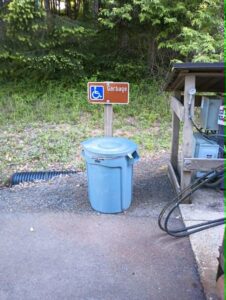
And then there was the garbage can. We were camping in Oregon and on our way out of the campground we stopped to throw out our trash. Some public garbage cans can be very complicated. At this location there was one can for plastic, one for paper, one for refuse, and the list went on. To be honest it was confusing because there was also a list of things you couldn’t put in each can. And then at the very end there was a trash can standing alone, and it had the blue wheelchair sign on it. I guess it was accessible, but so were the other 20 cans that I just passed. And to be honest, a quad would have a really difficult time getting the lid off – it was hard for me. So, I couldn’t really figure out what it was for, but since I didn’t understand the other cans either, I just put all our trash in that one.
And then there are signs, that make absolutely no sense, but have nothing to do with access. We were driving down the highway on a road trip a few weeks ago and we saw a sign that read, “Intermittent Road Work for the Next 52 Miles”. Really? Talk about being non-committal.
Don’t Forget Printed Material
And although accessible signage is important out in the real world, it’s also equally important in printed material. You want to let folks know about access to your place of business in all your printed material. Otherwise, if accessibility isn’t listed, many folks will assume your business is not accessible. And you will lose out on business; and it won’t be just wheelchair-users, but also their friends and family who want to go to an inclusive place.
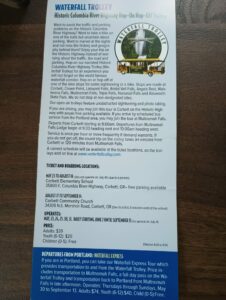
Case and point is a brochure I picked up the other day about a new shuttle service to some Oregon waterfalls. It’s a great service, as it can be difficult to find parking at some of the scenic waterfalls on the route; however there wasn’t one word about accessibility mentioned in the brochure.
They took the time – and space — to describe the routes, make notes of all the stops, and include information about bus connections to neighboring cities, but there wasn’t one word about wheelchair access. So I went to their website and it did state that they were wheelchair-accessible, and told folks to be sure and note their needs when they made reservations so appropriate vehicles could be dispatched. How hard would that be to include in the brochure? Just saying.
Where Am I?
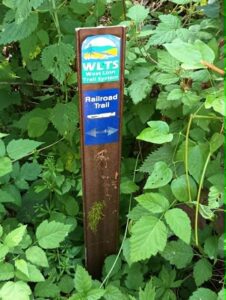
One of the most frustrating things about accessible signage, or lack thereof, is that it can turn a nice outing into a frustrating challenge. I’ve looked at hundreds of accessible trails, because it’s something that interests my readers. My goal is to give folks solid and accurate information so that they can easily access and enjoy accessible trails. But sometimes that’s a challenge for me.
Charles and I were out exploring some accessible possibilities one day, and after a nice picnic lunch we set out to find this accessible trail. It was mentioned on the park website, but the directions to the trailhead were unclear. When we got to the park we followed several signs to nowhere, and then one to a trail that branched off in three different directions, with no signage whatsoever. We then found a sign for the trail on the other side of the park, and figured if we followed it, it would lead back to the start. Wrong, it led to a a trail that wasn’t even on the map. In the end I gave up, and so will most other people.
The same is true, when we set out to find this new accessible boardwalk on a lake. Some people said it went around the lake, but we couldn’t find it. Turns out the trail goes around the lake, but the accessible boardwalk is only a portion of that trail. And with zero signage it was just by luck we found it. Now at least we can tell others where to look, as it’s a pretty cool trail. But a little signage would of helped.
They Got it Right
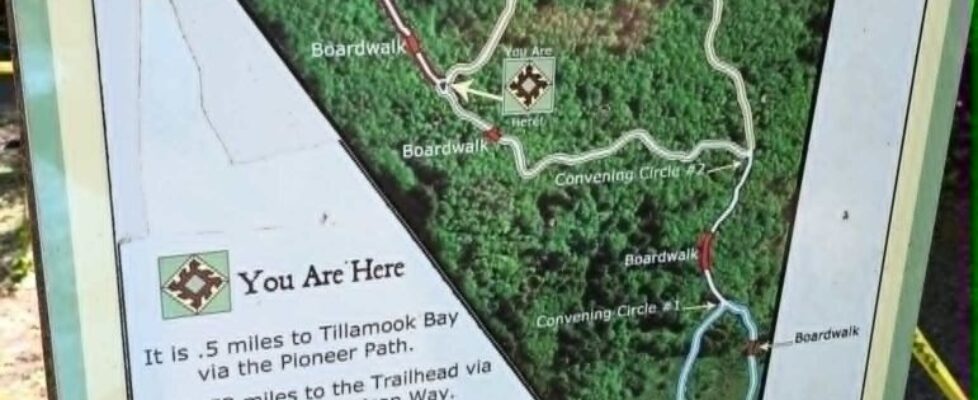
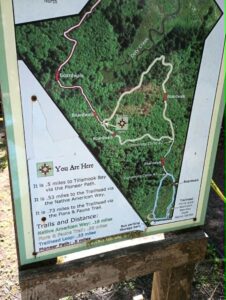
So now that I’m done with my rant about accessible signage, I’d like to point out a place that I recently visited that actually got things right in the signage department – Kilchis Point Reserve (emerginghorizons.com/kilchis-point-reserve-a-wheelchair-accessible-tillamook-county-gem).
The reserve is owned and maintained by the Tillamook County Pioneer Museum, and it’s funded through donations, grants and membership dues. And even with this limited funding, their signage is excellent. Additionally, all of their trails of wheelchair-accessible.
They way I look at things, if this small reserve can provide such excellent signage on a limited budget, then anyone can do it. It’s a beautiful preserve and you always know exactly where you are, and what trail leads where. At the trailheads there’s a large map, showing your location, and listing the length of all the trails. And every time you cross another trail, it’s clearly marked. You have absolutely no doubt where you are at any point in Kilchis Point Reserve. It’s really a great place to visit.
Finally, I’d be remiss if I didn’t also give a shoutout to the National Park Service for their excellent trail signage. They not only list the location of the trails, but also include the length, width, slope and cross-slope. So not only can you determine the accessibility of a trail, but again, you always know exactly where you are.
So see, it is possible to get the signage right. I’d really like to see more of that in the future.