2026 Update — Flying in Your Own Wheelchair? When Will it Really Happen?

Times are a changing and technology is making things possible today that we never thought could happen. But will people ever be able to board an airline in their own wheelchair and stay in it for the entire flight? Well things are moving forward, and that’s good, but it’s not going nearly as quickly as some people have hoped. So here’s an update on where we stand on flying in your own wheelchair.
The Regulations
When I last covered flying in your own wheelchair, the Federal Aviation Administration (FAA) was set to review their regulations by 2025 (https://emerginghorizons.com/flying-in-your-wheelchair-when-will-it-really-happen/). This is really the most crucial first step, as if the FAA won’t allow it, then it’s a no-go from the start.
After review, their final report on the issue (https://www.access-board.gov/news/2021/09/15/trb-issues-report-on-the-feasibility-of-wheelchair-securement-systems-on-passenger-aircraft/) included the following findings:
- The majority of airplanes have a boarding door large enough to accommodate most personal wheelchairs.
- Boeing 737 and Airbus 320 models would only require modest interior modifications to create a wheelchair securement area at the front of the cabin.
- Many personal wheelchairs comply with the crash performance standards (WC19) established by the Rehabilitation Engineering and Assistive Technology Society of North America (RESNA).
The report recommended that the U.S. Department of Transportation and the FAA establish a research program in collaboration with RESNA to test and evaluate a selection of WC19-compliant wheelchairs in accordance with applicable FAA crashworthiness and safety performance criteria. It also recommended that the Access Board sponsor further studies to assess the demand for this service. There is no timeline for these recommendations.
So, in other words, more studies, and no definitive implementation date.
By way of comparison, the creation of accessible lavatories on single aisle aircraft went through a less rigorous study, and full implementation is not expected until 2071 (https://emerginghorizons.com/new-accessible-airline-lavatory-rule-when-will-it-happen/).
So, unfortunately we are quite a ways away from the reality of anyone flying in their own wheelchair.
Airbus Progress – A Concept Design
Even though the regulations at this point are up in the air (no pun intended) one company is moving forward with a workable design to accommodate personal wheelchairs aboard their commercial aircraft – Airbus.
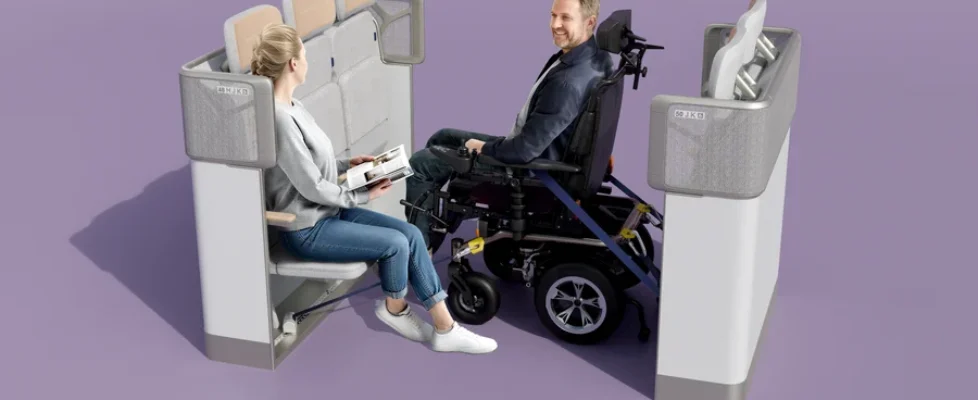
Airbus has created a new concept design — The Airspace U Suite — which would not only accommodate passengers in their own wheelchairs, but also serve as a premium space for other passengers. This universal design concept will most likely appeal to airlines who don’t want to designate valuable space for wheelchair-users, only for it to sit empty when not in use. And not only will it not sit empty, but the airlines will be able to charge a premium for this spacious seating compartment.
The Airbus U Suite will not only accommodate a person in their own wheelchair, but it’s being billed as space for.
- Travelers who want to lay down and take a nap
- A family space
- A business space for an in-flight meeting
In short, it’s universal design in the air.
The Airbus team has taken their first test flight with a wheelchair-user, and they hope to have the concept ready to produce by 2032. And their Airspace U Suite was on prominent display at the Aircraft Interiors Expo in Hamburg last month.
So the design end of things is falling together nicely; but again, that’s only one piece of of an incredibly complex puzzle. Even if they are able to produce the design as expected, it won’t be available to wheelchair-users until the FAA – and worldwide regulatory agencies – approve it. And perhaps that’s why Airbus has included the universal design concept, so it can be used for other travelers in the meantime.
The Reality
The Airspace U Suite looks like a great design, but the question is, what will it cost passengers? Will it be a premium space like first class, or will it be an affordable space for wheelchair-users? That of course remains to be seen, but it does look like it will be a premium ($$) space, located in the front of the aircraft. Still there are plenty of folks with the means to pay for this space. And maybe this is just a first step to create more affordable accessible spaces on aircraft.
And accessibility – when and if it begins – will only be for larger aircraft at first. But that’s good because it’s those longer flights can be the most problematic for wheelchair-users. Even if you use your own wheelchair cushion on the flight, it’s still not the same, and skin issues can develop.
And finally, let’s remember that there’s nothing in the Air Carrier Access Act (ACAA) that requires seating in your own wheelchair on airplanes. That would take a lot of additional work and new regulations. Most likely if anything, the Access Board would allow but not require it. Just like the fact that airlines are allowed to, but not required to, provide on-board medical oxygen.
But still, it’s a start. As the folks at Airbus said, “So we started the process” to develop more accessible solutions and “we are in the middle of it.”
But I’m happy to see research and development moving forward for flying in your own wheelchair. And to put things in perspective, in my lifetime, prior to the ACAA, airlines made wheelchair-users sit on towels because they were afraid they would soil the seats. And they made a big deal about it. So, honestly, I’m really happy with any progress. But again, it will be a while, and unfortunately, probably not in my lifetime.