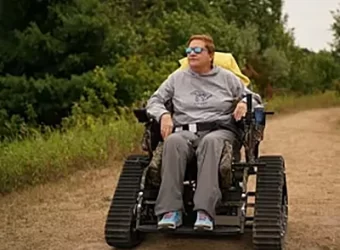
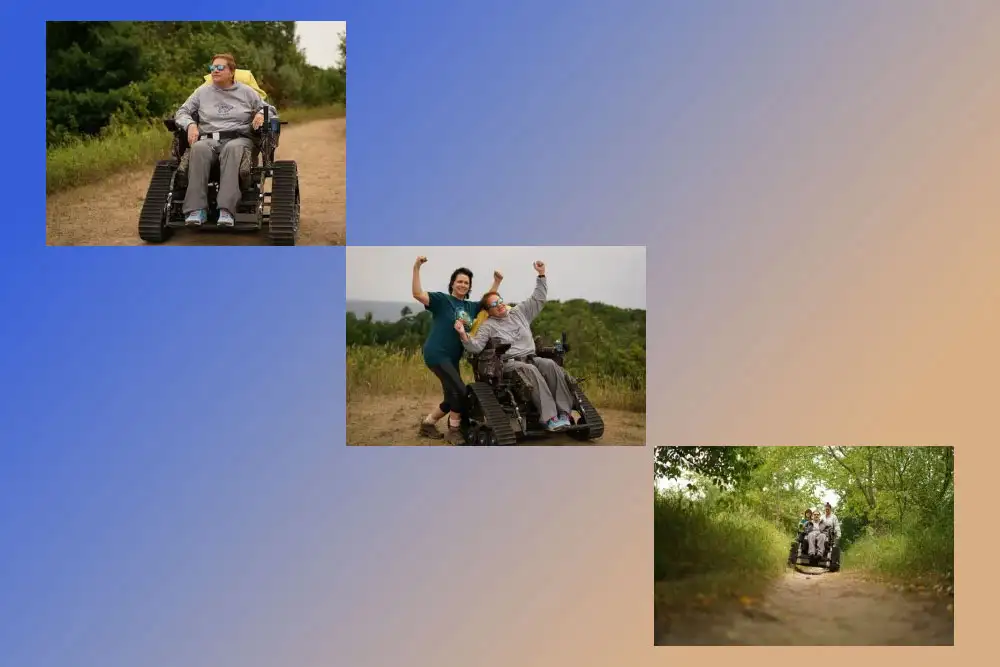
After a hunting accident left Jacob Beisecker with a spinal cord injury, he was determined to continue his active outdoor lifestyle. While he was in rehabilitation at Shepherd Center in Atlanta, Jacob discovered a mobility device that could make that dream a reality — a track chair. This offroad power wheelchair is outfitted with tank tracks instead of wheels, which allows it to navigate uneven terrain. After Jacob tried it out, he knew it was just what he needed to enjoy the outdoors. Sadly though, this expensive piece of adaptive equipment was out of his price range.
After he returned home, Jacob continued to search for an affordable offroad option, and as luck would have it he stumbled across a used track chair within his budget. He snapped it up and proceeded to explore the South Carolina outdoor areas that he had always enjoyed. But then he thought that there were probably others like him, who would benefit from a track chair but couldn’t afford one. And so, Waymaker Offroad Wheelchairs (www.waymakeroffroadwheelchairs.com) was born. Today this South Carolina non-profit provides loaner track chairs to wheelchair-users and slow walkers, who want to enjoy Mother Nature.
Pick Up a Track Chair
Headquartered in Hartsville, Waymaker Offroad Wheelchairs has a fleet of track chairs available to loan. Reserving a South Carolina track chair is easy. Just go to https://docs.google.com/forms/ and fill out the form. The track chairs are usually loaned out for a day or two, but they are available for up to a week if needed.
A small utility trailer is also available for loan; however if your vehicle cannot pull a trailer, delivery can be arranged. The delivery option is only available within 100 miles of Hartsville, on Saturdays from April to September. There’s no deposit needed to borrow a track chair; however a valid drivers license is required. The track chairs are also GPS traceable.
A number of accessories are available for the track chairs, including a headrest and an umbrella holder. They also have a four-point harness for folks who lack trunk control. And if you like to hunt or fish, don’t forget to request the gun mount, shooting rest or fishing rod holder.
Hunters will be happy to hear that track chairs are also permitted in all South Carolina Wildlife Management Areas. In the end, the choice is totally yours — you might even want to check out Myrtle Beach, which is just a few hours from the Waymaker Offroad Wheelchairs headquarters.
Track Chairs at State & County Parks
If you’re not able to pick up a track chair, you can also borrow a South Carolina track chair at many state and county parks through Waymaker Offroad Wheelchairs. These can be reserved online at https://www.waymakeroffroadwheelchairs.com/state-parks . Your drivers license will be held as a deposit when you pick up the track chair, and returned when you are through.
Track chairs are currently available at:
Huntington Beach State Park
Edisto Beach State Park
Ghivans Ferry State Park
Hampton Plantation
Hunting Island State Park
Oconee State Park
Sadlers Creek State Park
Jacob hopes to be able to expand the track chair loaner program in the future, so check the Waymaker Offroad Wheelchair website for new locations. Says Jacob, “We’re totally donor funded and are looking for corporate and individual donors to help sponsor us. These chairs made a huge difference in my recovery journey to be able to get back outdoors doing the things I love.” For more information about Waymaker Offroad Wheelchairs, visit their website, call (843) 287-7986 or e-mail WaymakerOffroadWheelchairs@gmail.com.
Barrier-Free Travel the Grand Canyon for Wheelers and Slow Walkers
If a trip to Japan is in your future, then surf on by this website with tons of accessibility information (www.accessible-japan.com). It’s a consumer-created resource with details about wheelchair-accessible attractions, transportation and lodging throughout Japan. Additionally, the website includes information about wheelchair-accessible day tours, and companies that offer wheelchair-accessible options. Essential information about getting around, accessible transfers, disability discounts, equipment rentals, voltage and suggested guide books and resources are also included. And if you’d like to know about something that isn’t listed on the website, there’s a link to a forum where you can ask additional questions.
All in all, it’s a very comprehensive resource for accessible travel in Japan.
Barrier-Free Travel Yosemite, Sequoia and Kings Canyon National Parks for Wheelers and Slow Walkers
Although many Florida state parks have beach wheelchairs, thanks to a partnership between the Florida State Parks Foundation (floridastateparksfoundation.org) and Surfing’s Evolution & Preservation Foundation (preservesurfingbeaches.org) a handful of state parks also have water wheelchairs. Unlike standard beach wheelchairs, the water wheelchairs — also called floating wheelchairs — have buoyant armrests so they can also be taken out into the surf. There’s no charge to use the water wheelchairs at Florida State Parks, but the checkout procedures vary from park to park, so contact the parks directly for more information,
Here’s where you can find the Florida State Park water wheelchairs:
If your travels take you across the pond, and you’re thinking about taking along your Hoyer lift, then think again. There is an easier solution. You can now rent a Hoyer lift in London through Ninja Mobility (ninjamobility.com). Owned by a power wheelchair-user, Ninja Mobility focuses on service, to make sure your essential equipment is available when you need it. Not only do they offer a wide range of mobility equipment choices, but they offer hotel delivery, so your equipment is waiting for you when you arrive. And they also serve the Southern UK, so it’s a good choice for a road trip too. So lighten the load on your next UK trip, leave your equipment at home, and rent a Hoyer lift in London. It’s the easy, stress-free way to travel.
Barrier-Free Travel Yosemite, Sequoia and Kings Canyon National Parks for Wheelers and Slow Walkers
A project of the Paris Convention and Visitor Bureau, this online resource offers information on visiting Paris in a wheelchair.
It includes a detailed section about getting around, including information on wheelchair-accessible bus, metro, tramway and RER routes in the City of Lights. Also included is a list of adapted taxi companies, information about hiring a wheelchair-accessible vehicle with a driver, adapted van rental resources, and even the low-down on wheelchair-accessible airport transfers. Additionally there are links to local providers that can provide personal travel assistance, as well as information on accessible car parks.
Also included is detailed information about accessible lodgings, restaurants, tours, attractions and even self-guided walks. And if you still have questions, visit their comprehensive FAQ page. This well researched guide is an excellent resource for visiting Paris in a wheelchair. parisjetaime.com/eng/article/accessibility-a646
Barrier-Free Travel Yosemite, Sequoia and Kings Canyon National Parks for Wheelers and Slow Walkers
Thanks to Friends of Sleeping Bear Dunes, the Sleeping Bear Dunes National Lakeshore offers three loaner track chairs for use by wheelchair-users and slow walkers. The Mama Bear Chair and the Baby Bear Chair can be used on the Bay View Trail. The Mama Bear Chair is 24 inches wide between the armrests and can carry up to 350 pounds; while the Baby Bear Chair is 18 inches wide between the armrests and can carry up to 300 pounds. The newest track chair, The Platte Bear Chair, is 22 inches wide between the armrests and can carry up to 300 pounds. It can be used on the Platte Plains Trail.
Reservations are required to borrow the Sleeping Bear Dunes track chairs, and they are available Friday through Monday, during the summer season. A waiver of liability must also be signed. Minors are required to be accompanied by an adult. Track chair-users must be able to transfer independently or bring a companion to assist with transfers. After a short orientation a volunteer host will accompany the track chair-user on a hike.
Although it’s possible to snag a wheelchair-accessible taxi at the port in Cozumel, it can be a hit or miss proposition. If you want to make sure you have accessible transportation while you’re in port, then it’s best to book a wheelchair-accessible Cozumel tour through This is Cozumel thisiscozumel.com/tours/packagedetails/cozumel-wheelchair-accessible-tours).
This local tour company has ramped vans with the rear seats removed, so there’s plenty of room for a wheelchair, a scooter, or even two manual wheelchairs. Tours can be customized to individual tastes, and they can include stops at the Hacienda Antiqua Tequila Center, the Discover Mexico Exhibition or an accessible beach bar and restaurant. Along the way knowledgeable English-speaking guides give visitors the low down about the local sights, history and culture. Alternatively, if you’d like to enjoy a beach day, they also offer a wheelchair-accessible beach excursion (thisiscozumel.com/tours/packagedetails/cozumel-accessible-beach-tour).
The tours depart from local hotels, cruise ship piers, or any downtown meeting place. For more information, or to book your wheelchair-accessible Cozumel tour, call (866) 677-0058 or e-mail info@thisiscozumel.com.
Barrier-Free Travel 22 Accessible Road Trips for Wheelers and Slow Walkers
Every time I book a trip these days, it seems that I’m asked if I’d like to purchase travel insurance. Some of the queries are pretty low-key, while others almost border on alarmist, as the perils and possible financial losses that could befall me on my trip are described in graphic detail. Truth be told, if I wasn’t so well traveled, I might be afraid to even venture outside of my own living room after listening to some of the high-pressure doomsday sales pitches.
To be fair though, there are valid reasons for the aggressive travel insurance sales tactics. First and foremost travel agents and providers want happy clients, and if a medical emergency happens and a client loses a lot of money when they have to cancel a trip, then they are not happy. On the other hand if a client is reimbursed for their covered expenses through travel insurance, they are happy campers.
Second, some policies also protect commissions, so agents get paid even if clients cancel. And last but certainly not least, there’s a high commission to be made on most travel insurance policies, so it only makes sense to try and upsell clients.
But do you really need travel insurance?
Well, that depends on many things. There are several types of travel insurance, so in the end it really depends on the type of coverage you need, and your own personal situation. With that in mind, here’s a short primer on the different types of travel insurance, along with a few reasons you may or may not need the coverage.
Trip Cancellation Insurance
Trip cancellation insurance is pretty straightforward. If you have to cancel the trip, you will be reimbursed for any non-refundable deposits and other expenses that result from the cancellation. Typical policies allow for cancellations due to illness, injury, weather and unforeseen disasters. Additionally, you can purchase a “cancel for any reason policy”; which offers comprehensive coverage; however that type of policy usually has to be purchased within 10 to 30 days of your initial deposit. The same is true for policies that cover pre-existing conditions.
Generally speaking, if you or any member of your family has a pre-existing condition or a chronic illness, trip cancellation insurance is prudent. That said, if you just booked a cheapie cruise and can afford to lose the deposit, then you may be ahead of the game to skip the trip cancellation insurance. Many frequent travelers “self-insure” against trip cancellation. In other words, they forego the expensive policies and instead ante up when they do have to cancel a trip. If they only have to cancel one out of every 20 trips, they’re usually still ahead of the game.
Travel Medical Insurance
Travel medical insurance covers medical costs that you incur while away from home – in most cases, at least 100 miles away from home. Typically it pays secondary to your own medical insurance; which means it covers what your personal medical insurance policy doesn’t cover. That said, it’s a good idea to find out what your personal medical plan covers, including if it offers coverage away from home, and outside the US. It’s also important to remember that Medicare does not include coverage outside the US. Some Medicare supplement plans do provide this coverage, so if you plan to travel a lot in your retirement years, then choose a Medicare supplement plan that includes overseas coverage.
It also pays to do a little research and find out if the country you plan to visit has a national healthcare plan. You’ll also need to find out if visitors are covered under that plan. If so, then you’re in good shape. Be diligent in your research though, and don’t just rely on word of mouth.
Generally speaking, it’s a good idea to purchase travel medical insurance if you or anyone in your party has a pre-existing condition. And it goes without saying that if your personal medical policy doesn’t extend outside of your home area, then travel medical insurance is also a good idea.
Additionally if you do have a pre-existing condition, make sure it’s not excluded from your travel medical insurance policy. To include pre-existing conditions, travel medical policies usually have to be purchased shortly after you make your initial deposit for the trip. Be sure and also find out what exactly constitutes a pre-existing condition, as sometimes even something as simple as seasonal allergies can disqualify you from coverage if you don’t purchase a policy that includes pre-existing conditions.
Medical Evacuation Insurance
Medical evacuation insurance covers transportation back home if your are injured or have a serious illness while you’re on the road. It should be noted that an air ambulance trip back to the US can cost $50,000 to $100,000; and air ambulance companies expect either an insurance assignment or payment-in-full at the time of service. Suffice it to say that everyone should have this coverage, because you never know when you will need it.
For example, even if you are young and healthy, a simple fall could immobilize you, and require medical evacuation in an air ambulance. I have known several people who’ve had to mortgage their homes in order to pay for air ambulance transportation, so don’t get caught unprotected.
It’s also a good idea to check to see if you have any existing coverage through work, credit cards or other travel companies. For example, I have $25,000 of medical evacuation coverage through my one of my credit cards. The extra coverage is great, but I still carry an annual $100,000 medical evacuation policy, as $25,000 won’t cover a major evacuation. And I get a better deal on my medical evacuation policy since I buy it annually rather than as I book each trip. So start digging and see what hidden benefits you can discover. You may have more coverage than you think.
My Cancellations — And Their Costs
Although I carry medical evacuation insurance, I’m in the “self-insured” group as far as trip cancellation insurance goes. In my almost 50 years as a travel writer. I’ve only cancelled my trips a handful of times. I’ve traveled while I was sick, broke my foot, and a few days after my mother passed away. This was mostly because I had to, and if I had been a leisure traveler it might have been different.
I did have to cancel a personal trip to see family once, but Delta Airlines waived my cancellation penalty because it was due to a major hurricane. That’s not unusual. The same thing happened when I was stuck in London after 9/11 – British Airways waived all cancellation and change fees. So even though trip cancellation policies insure against these perils, in many cases when there’s a big weather issue or a major disaster, most airlines step up and waive their penalties.
And after COVID shut down virtually all travel, my trip to China (Wuhan) was cancelled. I lost about $300 on that, but considering the number of trips I’ve taken, I was still ahead of the game by not buying travel cancellation insurance. Of course this may be different if you only travel once or twice a year, and you have to cancel because of sickness, a death in the family or a lost job.
As far as travel medical insurance goes, outside of being treated for cholera by a medicine man in the highlands of Thailand, I’ve never needed medical attention out of the country. That said I’m fairly healthy and I don’t have any pre-existing conditions. And I do have international medical coverage through my personal health insurance policy.
So What’s a Traveler to Do?
Of course, all travelers are different, and what works for me, might not necessarily work for you. The best thing to do is to first check with your bank, credit union, auto club and credit card companies to see if they provide any type of travel insurance as a member benefit. Once you know what you already have, you can begin shopping for additional coverage.
The best way to shop for travel insurance is to contact your insurance agent. A reputable insurance agent can point out the pros and cons of different offerings, and help you find a policy that meets your needs. Insurance agents also offer annual policies that are much more affordable than per-trip policies; in fact, you may be able to get yearly coverage for all of your trips, for less than you’d pay for single trip coverage through a travel professional.
Additionally, once you have coverage be sure to carry the insurance cards and other documentation with you. You should also know who to contact in an emergency. Some plans require that you contact them when you are hospitalized overseas, while others require relatively little paperwork. Even if you have travel coverage, if you don’t know how to use it, you still could be left out in the cold. So become an educated consumer, do your research and have a plan of action in place, in case you become injured or fall ill on the road.
Barrier-Free Travel 22 Accessible Road Trips for Wheelers and Slow Walkers
If you’re looking for a long-term wheelchair-accessible Paris apartment, then Lea Lior (www.facebook.com/lea.lior.5) may have just what you need. Located in the centrally located neighborhood of Montparnasse, this fully furnished unit is owned by a power wheelchair-user. There’s elevator access in the building, and the apartment includes an adjustable electric bed and a bathroom with a roll-in shower and a ceiling hoist. A rolling shower chair is also available. The neighborhood is accessible and flat, and there are accessible buses to Champs Elysées, the L’ouvre, Les Invalides, Marais and the Latin Quarter. The minimum rental time is one month, but it’s available for up to nine months if you’d like to extend your stay in the City of Lights. For more information about this wheelchair-accessible Paris apartment, e-mail Lea at liorlea@gmail.com
Barrier-Free Travel the Grand Canyon for Wheelers and Slow Walkers
With the evolution of the internet, information is just a few keystrokes away. On the other hand, some of that information is a far cry from accurate. This is especially true where accessible travel is concerned. Unfortunately with the emergence of Artificial Intelligence (AI) the credibility of online information has greatly decreased, and a glut of accessible travel misinformation has surfaced. With that in mind, here are some accessible travel misinformation tidbits recently found online; followed by the true facts, and topped off with a handful of accessible travel resources.
Accessible Travel Misinformation — Air Travel
Misinformation: The Americans with Disabilities Act (ADA) is the law that covers air travel for disabled passengers.
Truth: The Air Carrier Access Act (ACAA), which actually predates the ADA, covers airline and aircraft accessibility on US airlines and on foreign airlines on flights to and from the US. The ADA does not cover airline access.
Misinformation: You will get upgraded to first class when you fly if you have a disability.
Truth: Although coach seats may not have enough room for many wheelchair-users, upgrades are few and far between these days. It never hurts to ask for an upgrade, but don’t expect one unless you are a top tier frequent flyer. Occasionally wheelchair-users get upgraded, but it’s far from the norm.
Misinformation: Wheelchair-users are guaranteed bulkhead seating on airplanes.
Truth: Under the ACAA, people with a fused leg and those who travel with a service animal are the only passengers guaranteed bulkhead seating. On the other hand, some air carriers voluntarily block bulkhead seats for wheelchair-users; so check around and then deal with the air carriers that can best meet your seating needs.
Misinformation: You don’t need to make advance arrangements for accessible rooms.
Truth: Well you don’t need to make reservations for any hotel room; however that doesn’t mean there will be a room available when you arrive. The same holds true for accessible rooms. The only way to ensure your room will have the access features you need, is to make an advance reservation. In practice, only a small portion of hotel rooms have access features.
Misinformation: Making a reservation at a property assures you that the accessible room will be there when you arrive, because you have guaranteed it with your credit card.
Truth: Guaranteeing a room with your credit card only locks in a specific rate. Blocking a room sets aside a specific room for a specific guest on a specific date. All accessible rooms in the US are required to be blocked under the ADA.
Misinformation: All accessible guest rooms have roll-in showers.
Truth: In the US, only hotels with over 50 rooms are required to have accessible guest rooms with roll-in showers. Those with under 50 rooms are merely required to have tub/shower combinations with grab bars.
Misinformation: All hotels have to have shuttles that are wheelchair-accessible.
Truth: If a hotel provides free airport transfers, they must also provide accessible transfers at no charge. They don’t have to own their own accessible vehicles though. They can contract out the service or pay for an accessible cab or Uber, but they cannot charge disabled customers for a service that they provide free to other guests.
Misinformation: The ship-sponsored shore excursions on most cruises are usually accessible.
Truth: In order to take most ship-sponsored shore excursions you have to be able to walk a few steps and climb up into a bus. Most of the ship-sponsored tours do not include accessible transportation. The exception is in Alaska, but you have to specifically request an adapted vehicle there, even on tours that are designated as “accessible”.
Misinformation: Wheelchair-users can easily roll off cruise ships at all ports, so even if you don’t book a shore excursion you can still explore the area around the port.
Truth: If you can get off the ship you may be able to roll around and explore the port, but cruise ships don’t always dock at all the ports. In many cases cruise ships drop anchor offshore and shuttle passengers to and from the port in tenders. And in many cases these tenders are not wheelchair-accessible. Check with the cruise line to see what ports are tender ports, and then ask about their policy of tendering wheelchair-users. And remember that any port could become a tender port due to high traffic or other operational issues.
Misinformation: Cruise lines provide manual wheelchairs for passengers who cannot walk very far.
Truth: Most cruise lines provide manual wheelchairs and boarding assistance to slow walkers, during embarkation and disembarkation only. These manual wheelchairs are not for the exclusive use of passengers, and cannot be taken to a cabin. If you need a wheelchair during the cruise or for shore excursions, you need to rent one and have it delivered to the ship, or bring your own from home.
Misinformation: Theme parks let wheelchair-users go to the front of the line so they don’t have to wait.
Truth: In some cases, wheelchair-users are allowed to access certain attractions through the exits, because the main entrances are not accessible. The newer rides and attractions are being built with accessible entrances, so this alternative access (which results in skipping the line) is no longer needed for wheelchair-users. And under the new new Disability Access System, only “developmentally disabled guests who cannot wait in line” are eligible to get a return time for popular rides and skip the queues.
Misinformation: Under the ADA, car rental companies must also rent lift-equipped vans.
Truth: Car rental companies are not required to provide ramped or lift-equipped vans. They are however required to install hand controls on vehicles, given 48-hours notice. If you require a lift-equipped van, you need to deal with a specialty rental firm.
Finally, take a look at how the article is written, when you are ferreting out misinformation. Does it seem completely unbelievable? Does it include photos? Is it written by someone who has actually traveled to the destination? If not, then you may be reading misinformation generated by AI. Here are a few more tips to help you weed out the misinformation when you research your next trip. emerginghorizons.com/wheelchair-accessible-travel-sorting-through-the-misinformation-on-the-internet/.
Barrier-Free Travel National Park Lodges for Wheelers and Slow Walkers
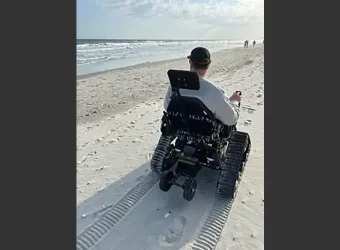

 After a hunting accident left Jacob Beisecker with a spinal cord injury, he was determined to continue his active outdoor lifestyle. While he was in rehabilitation at Shepherd Center in Atlanta, Jacob discovered a mobility device that could make that dream a reality — a track chair. This offroad power wheelchair is outfitted with tank tracks instead of wheels, which allows it to navigate uneven terrain. After Jacob tried it out, he knew it was just what he needed to enjoy the outdoors. Sadly though, this expensive piece of adaptive equipment was out of his price range.