If you’d like to explore the grounds of Grays Harbor Lighthouse in Washington, then make plans to reserve this Westport track chair. It’s available from David’s Chair, and it’s housed in the Westport by the Sea Condos, which are about a .4-mile roll from the lighthouse. There are level sidewalks with curb cuts along the way, but once you get to the lighthouse you’ll need the track chair to traverse the bumpy — and sometimes muddy — dirt trail.
This track chair needs to be reserved at least seven days in advance. Transfer assistance cannot be provided, so if you can’t transfer independently you’ll need to bring along some help. This track chair has a maximum capacity of 350 pounds. For more information, or to request the Westport track chair, visit davidschair.org/request-fixed-location-chair. And for details on some wheelchair-accessible trails and lodging suggestions in the area, visit emerginghorizons.com/westport-a-wheelchair-accessible-pacific-northwest-gem
Barrier-Free Travel
Washington National Parks
for Wheelchair-Users and Slow Walkers
If a trip to Slovenia is in your future, then check out these two helpful wheelchair-accessible Slovenia Resources.
The Roll with a Smile blog has an informative entry about travel to Slovenia at https://rollwithasmile.com/slovenia/. It includes information about transportation, wheelchair-accessible lodging and sightseeing in the country. It’s a helpful site with lots of first-hand information and tips.
Visit Ljubljana (www.visitljubljana.com/en/visitors/travel-information/essentials/accessibility-of-ljubljana-by-wheelchair) also has some helpful resources, including details on local wheelchair-accessible taxis and how to get to and from the airport. This site also includes information on where to borrow a “SPEED3X trailer” (a electric handbike attachment with a range of 40 km), to make navigating the downtown area a little easier in a wheelchair.
Barrier-Free Travel the Grand Canyon for Wheelchair-users and Slow Walkers
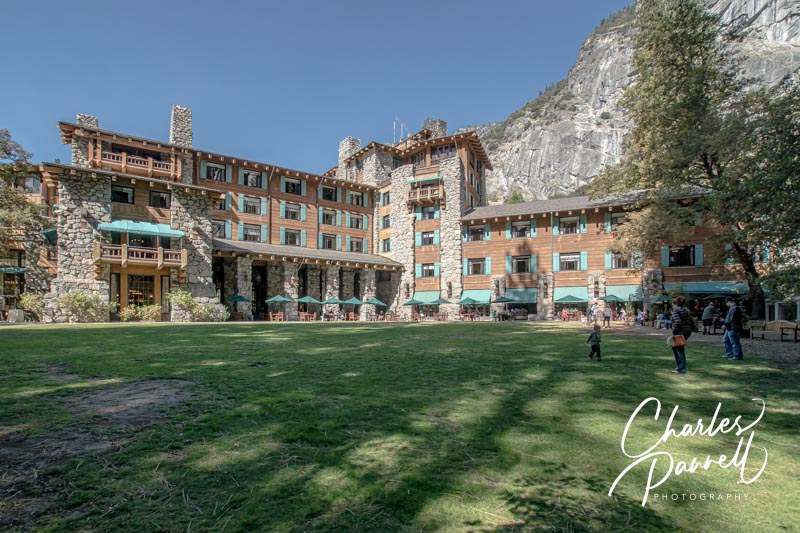
Located in Yosemite National Park, The Ahwahnee is the most luxurious property in the park. The site of fairy tale weddings and grand holiday celebrations, this historic structure boasts a subtle mix of Art Deco, Native American and Middle Eastern architectural styles. Not only is it a cornerstone in Yosemite history, but according to many accounts it’s also haunted. The good news is, in spite of its ghostly residents, numerous renovations have made to this historic property over the years; and today it’s an excellent choice for wheelchair-users and slow walkers.
An Accessible Suite to Remember
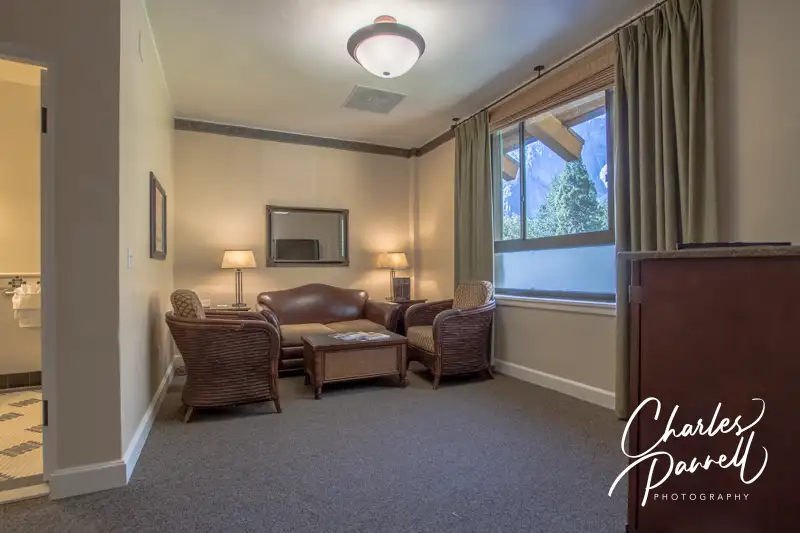
Sitting Room in Suite 206 at the Ahwahnee Hotel
Although the Ahwahnee boasts a nice variety of accessible rooms, the accessible junior suite — room 206 — is the perfect choice for any national park getaway. Access features include wide doorways, barrier-free pathways, and plenty of room in this spacious suite which occupies the space of two standard hotel rooms.
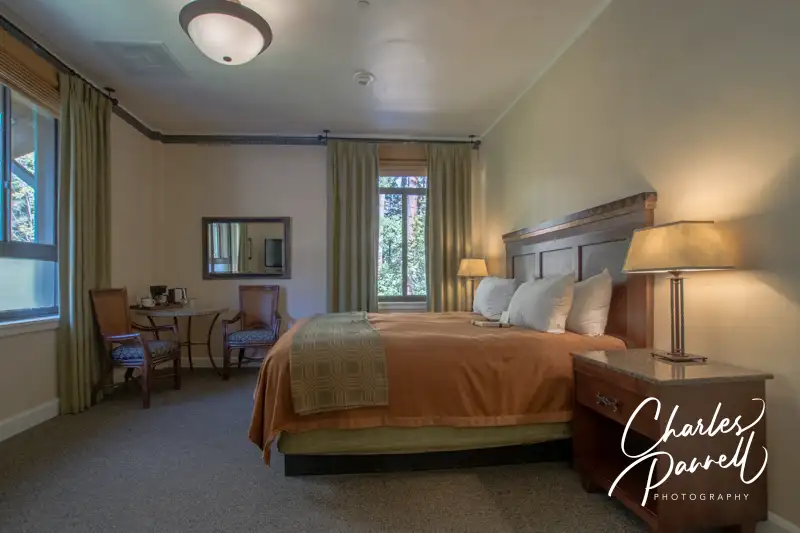
The sitting room has a 12-inch high single sofa bed, two end tables, a coffee table, two side chairs, an armoire and a mini refrigerator. There’s level access to the adjacent bedroom, which features equally good access, and is furnished with a 30-inch high king-sized bed with wheelchair-access on both sides, two bedside tables, a small table with two chairs, an armoire and a mini refrigerator.
Bedroom in Suite 206 at the Ahwahnee Hotel
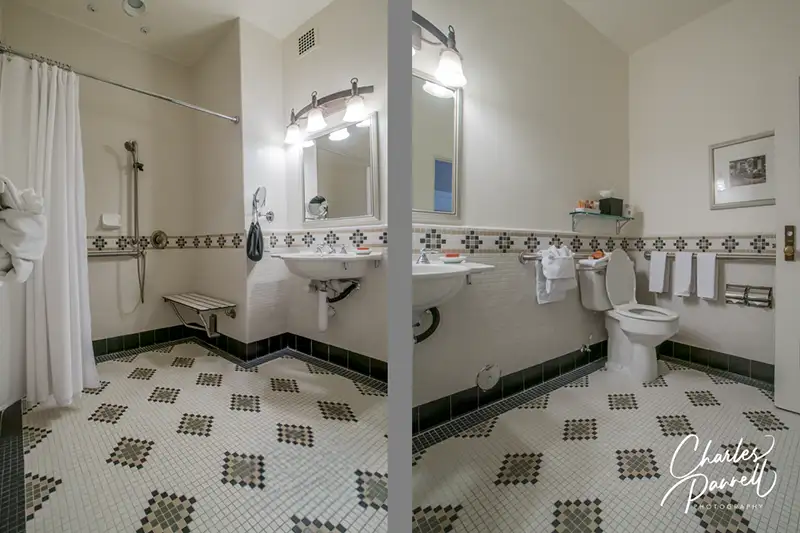
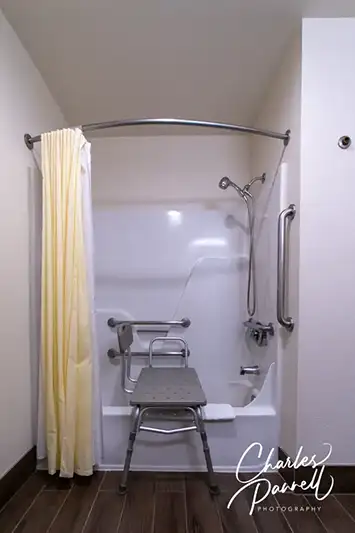
The bathroom has a full five-foot turning radius, and is equipped with a roll-in shower with grab bars, a hand-held showerhead and a fold-down shower bench. The toilet grab bars are located on the left and back walls (as seated), and the bathroom also has a roll-under sink.
Bathroom in Suite 206 at the Ahwahnee Hotel
Top it off with a lowered peephole, lever handles and a lowered clothing rod, and you have a very well designed and functional accessible room. It’s really one of the nicest accessible rooms on the property.
A Little Haunted?
The public areas of the hotel are equally accessible. As you stroll through the lobby and adjacent rooms you can’t help but notice the towering ceilings, stained glass windows and the massive fireplace in this historic property. And while we’re talking historic, lets also talk haunted.
The spirit of Mary Curry Tresidder, who once operated the hotel, is said to frequent the sixth floor. Many guests have reported feeling her presence there, and a few folks have even witnessed her dancing in the common areas. And then there’s the spirit of Mary’s husband Donald Tressider, whose footsteps are sometimes heard on the stairway. Some guests have also reported seeing figures of soldiers in the hallways; a throwback to the time when the hotel served as a convalescent hospital during World War II.
And then there’s the mysterious JFK “haunting”. The former U.S. president stayed at the hotel in 1962. He reportedly requested a rocking chair for his suite during his visit. The chair was subsequently removed after the president departed; however it’s been known to magically reappear in the suite from time to time. Ghostly shenanigans or spring cleaning furniture rearrangement? You be the judge. In the end, even if the hotel isn’t really haunted, it’s a popular stop for diehard horror movie fans, as the property served as the inspiration for the grand interior shots of the fictional Overlook Hotel in The Shining. Haunted or not, The Ahwahnee makes a great wheelchair-accessible home base for any Yosemite visit.
Barrier-Free Travel Yosemite, Sequoia and Kings Canyon National Parks for Wheelchair-users and Slow Walkers
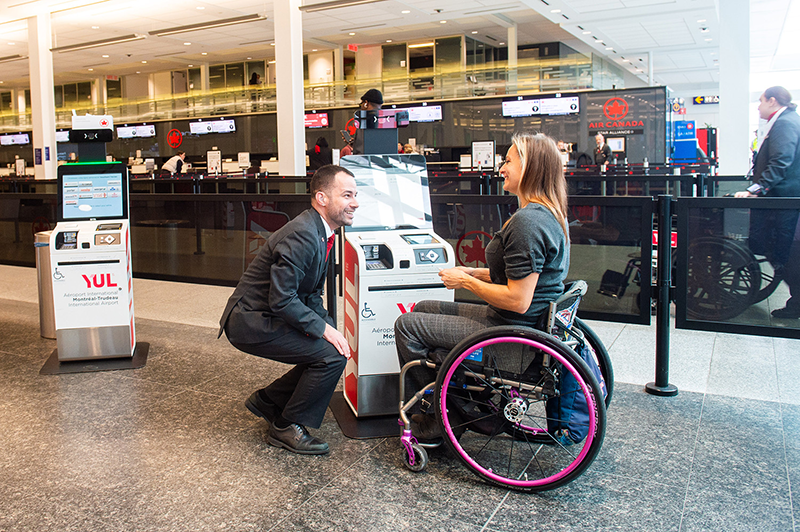
Air Canada recently updated its wheelchair policy, which will make travel easier for many wheelchair-users and slow walkers. The new Air Canada wheelchair policy gives customers more flexibility, as it allows a wider range of mobility aids and includes the ability for passengers to track them while in transit.
The new policy allows customers to bring along up to three mobility aids at no charge. These can include:
Wheelchairs, walkers and other mobility aids
Adaptive sports equipment, such as adaptive skis or handcycles
Patient lifts
Other transfer devices
Additionally, if a mobility aid is too large to travel on the same aircraft as the customer, Air Canada Cargo will complimentarily transport it within Canada.
“Travelling with a mobility aid can involve significant planning, and we recognize the uncertainty customers may feel when they are separated from equipment that is essential to their independence,” said Kerianne Wilson, Director, Customer Accessibility at Air Canada. “This new policy is about giving customers more consistent choices, clearer expectations and greater confidence when they travel with us.”
There’s been a lot of misinformation on the internet lately about the US Department of Transportation (DOT) rolling back or not enforcing wheelchair-access rules under the Air Carrier Access Act (ACAA). First and foremost, this is not true, and all protections that are in place under the ACAA will continue to be recognized by US air carriers and foreign air carriers on flights to and from the US. The misunderstanding stems from a misinterpretation of the process of updating the current ACAA.
The ACAA Update Process
The ACAA dates back to 1986, and over the years as technology and travel have evolved so have the regulations. But because they are government regulations it’s not like they can be easily updated. It’s a process. And it usually takes years.
It begins when the need for a change is recognized by the DOT. Then there are usually a series of public meetings to gather feedback on the proposed changes, and to determine the exact needs of the public. Then the proposed regulations are crafted by a committee, which usually takes years. Sometimes it takes longer, as there is a lot of input from the disabled community, airlines and other businesses.
After the proposed changes are finally agreed upon, they are published in the Federal Register. Then there is a public comment period, which can take six months or more. Then the Access Board reconvenes and considers the public comments from both consumers and the airlines. And then they may make changes if appropriate. But we’re not done yet!
The final rule is then published in the Federal Register, along with an implementation date. Depending on the complexity of the regulation that implementation date may be six months or six years in the the future.
The “Current” Proposed Changes
Which brings us to our current situation, and the most recent changes to the ACAA. They have been “in the works” for many years and they were finally released in 2024.
Most of these changes were originally scheduled to go into effect in 2025, but were subsequently delayed until December 31, 2026. The DOT recently further delayed that implementation date on four of those changes until April 30, 2027. The delayed changes are those that pertain to:
Mishandled wheelchairs
Refresher training frequency
Pre-departure notifications
Fare difference reimbursements
Additionally the DOT also extended implementation of the refreshed training frequency in the Accessible Lavatories on Single Aisle Aircraft Rule, to April 30, 2027.
But remember this delay only applies to the training. That rule will still take decades to be fully implemented.
So why did the DOT delay the implementation of the changes? Well basically some of the airlines initiated legal proceedings against the changes and that prompted the DOT to give things a closer look.
And to be honest, just about anything can happen between now and April 30, 2027, the new scheduled implementation date. The rules may go into effect as written, they may be updated, or there could be another delay. Only time will tell. After all, it is a government process.
The important thing to remember is that the current ACAA remains in full effect. Nothing has changed. These new regulations have not even been implemented yet, and only a portion of them will be delayed. And when you consider the protections that the ACAA already offers, those changes are minor.
Bottom line – slow walkers and wheelchair-users are still fully protected under the ACAA.
Know Your Rights
Of course it’s still important to know your rights under the ACAA. Here are the basics.
And remember, the DOT is NOT rolling back wheelchair access rules on airplanes, as reported by some media. It’s merely going through the routine process of updating those rules. In other words – business as usual.
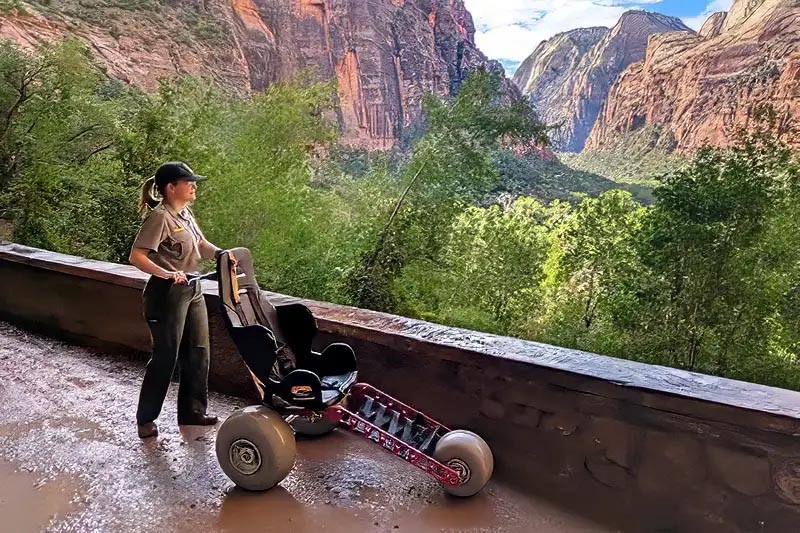
Slow walkers and wheelchair-users who want to explore a few of the more challenging trails in Zion National Park, can now borrow an Extreme Motus wheelchair. This wheelchair has a long wheelbase for maximum stability and is fitted with three balloon tires to absorb bumps on the rougher trails. It has a maximum user weight of 250 pounds and a maximum user height of 6 feet. And although the Extreme Motus gives folks a smoother ride over difficult terrain, it cannot be operated independently, so you’ll need someone to assist you if you borrow it.
The chair can be checked-out at the Zion Canyon Visitor Center on a first-come first-serve basis. A valid ID and proof of insurance is required to borrow the chair, and a brief training is provided to all users. Additionally, since the park shuttle cannot accommodate the Extreme Motus, visitors who borrow this all terrain wheelchair will also be given a pass to drive their own vehicle up Zion Canyon. And as an aside, if you have a disability that prevents you from taking the shuttle (larger wheelchair, oxygen, extra medical equipment) you can also get a pass to drive your personal vehicle up Zion Canyon (emerginghorizons.com/driving-passes-for-disabled-national-park-visitors/) even if you don’t borrow the Extreme Motus.
So where can you go with the Extreme Motus in Zion National Park? Well of course you can do the Pa’rus Trail, but to be honest you can do that in a regular wheelchair. You might want to try it on the Riverside Walk, as sometimes that trail gets rough from the extreme weather conditions. Other suggestions are the Weeping Rock Trail and Lower Emerald Pools, although you may want to have a little extra help on those. You can also give most of park’s inaccessible intermediate trails a try; however you cannot go on the more dangerous and challenging trails like the Zion Narrows or Angels Landing.
So give the Extreme Motus in Zion National Park a try on your next visit. You won’t be sorry!
Barrier-Free Travel
Utah National Parks for Wheelchair-users and Slow Walkers
Marina Sunrise viewed from Westport Marina Cottages
Westport is the quintessential Pacific Northwest fishing village. Located 130 miles southwest of Seattle, it sports a one-lane main drag that’s dominated by the marina and dotted with a chowder house, a donut shack, a few souvenir shops, several fishing charter companies and the requisite local pub. With a population of only 2,300 it’s a laid back spot to escape, recharge and relax.
Of course, this quaint fishing village also has its fair share of must-see attractions, including some scenic trails, a historic lighthouse and a gaggle of picturesque ocean views. And although at first glance this out-of-the-way locale may not appear to be an ideal choice for wheelchair-users and slow walkers, a deeper dig reveals a number of accessible haunts. So pack the car and head over to the coast for a relaxing wheelchair-accessible Westport getaway.
Stroll along the Shore
View from the Lower Level of the Westport Viewing Platform
The Westport Light Trail and Viewing Station, which borders on Half Moon Bay and the Pacific Ocean, is a good first stop. There are several spots to access the 2.4-mile wheelchair accessible oceanside trail, but the viewing station is located at the intersection of Westhaven Drive and Neddie Rose Drive near the marina.
Part of Westport Light State Park (parks.wa.gov/find-parks/state-parks/westport-light-state-park), the viewing area offers accessible parking in front, with barrier-free access to the lighthouse-like viewing platform. There’s ramped access up to the first level of the viewing station, but only stairs to the upper levels. Still you can get a nice ocean view from the first level. And if you’d like to stop for lunch, there are some picnic tables on a level grassy area near the viewing station that also have a good ocean view.
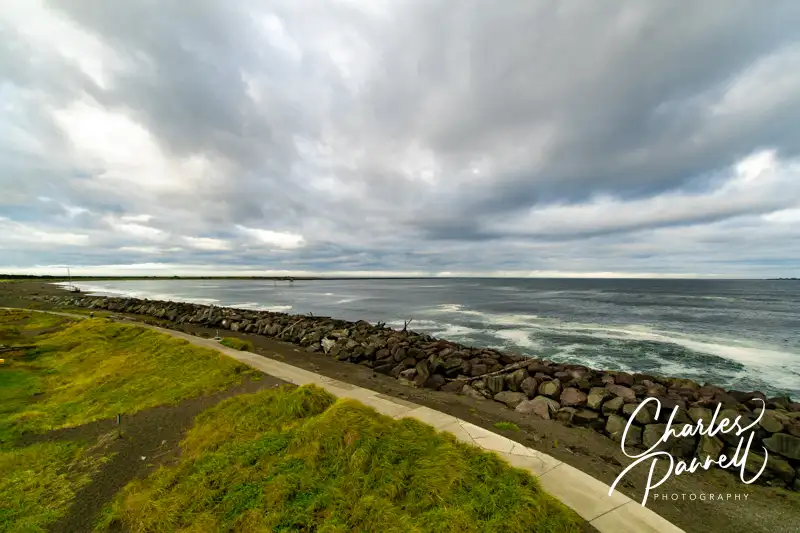
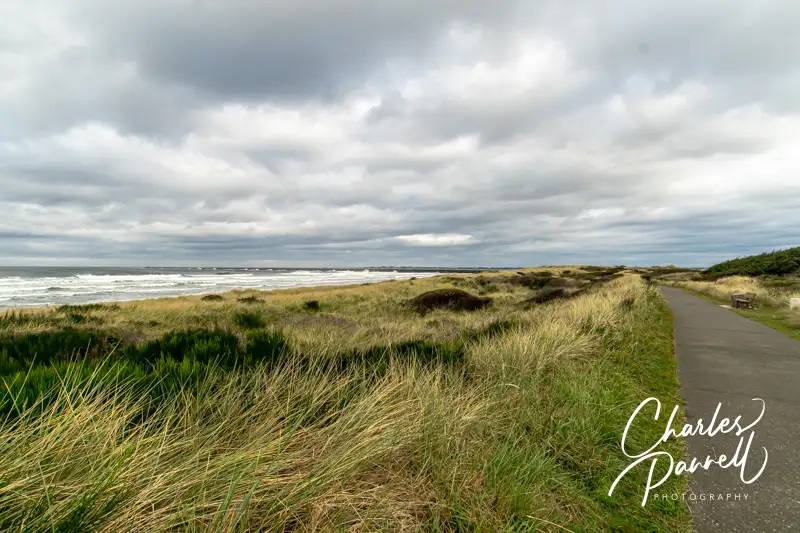
The viewing station also marks the north end of the Westport Light Trail, which winds along the beach and offers some more great views. This paved trail is wide and level, and it’s sheltered from the waves, but you can still see the breakers crash into the rocks. The whole length of the trail is wheelchair-accessible, but you can do as little or as much of it as you like.
You can also access the Westport Light Trail from two places along Jetty Haul Road. The Half Moon Bay Parking Area is located about .6 mile down the trail. There’s an accessible parking space there, with level access to the trail. Down the road another .6 miles in the Westhaven Parking Area, which is slightly more developed. There’s accessible parking with level access over to the accessible restrooms, and an accessible picnic table on a cement pad nearby. And of course, there’s level access to the Westport Light Trail.
The Historic Lighthouse
Grays Harbor Lighthouse
No trip to Westport is complete without a stop at the historic Grays Harbor Lighthouse. If you’re up for a hike, you can continue on along the Westport Light Trail for another 1.2 miles until you hit the terminus at the parking lot on Ocean Avenue. From there, just follow Ocean Avenue for another .4 mile to the lighthouse — you can’t miss it.
If, on the other hand, you’d prefer to drive, there are numerous parallel parking spots near the lighthouse along Ocean Avenue. From there it’s just a short roll to the lighthouse viewing platform. There’s a level cement pathway, with barrier-free access over to the platform, which offers an excellent view of the lighthouse.
If you’d like to get closer there’s a short dirt pathway over to the lighthouse, however it’s got a few ruts and bumps and after a rain it’s a muddy mess. Alternatively you can borrow a track chair from David’s Chair (davidschair.org/request-fixed-location-chair/). These heavy duty chairs have tank tracks for tires, and will easily navigate around the lighthouse area. Plan ahead though, as reservations must be made at least seven days in advance and the track chairs are not available every day.
Westport Light Trail ffrom the South Trailhead
And of course you can also access the south trailhead of the Westport Light Trail from the parking lot at the end of Ocean Avenue. There’s accessible parking near the accessible restrooms, with trail access just to the left of the parking area. Even if you already took a stroll on the north section of the trail, it’s still worth look here for more great ocean views.
Another Ocean Stroll
Trail at Bottle Beach State Park
Bottle Beach State Park (parks.wa.gov/find-parks/state-parks/bottle-beach-state-park) is also worth a stop while you are in the Westport area. It’s just a short drive down Highway 105, about eight miles east of Westport. And it’s easy to find too, as it located right off the highway.
There’s accessible parking near the accessible vault toilet, and level access over to the .7-mile trail. The trail begins as a boardwalk through the wetlands, which was formerly the site of the boomtown of Ocosto. Originally the railroad terminus, the town later failed and subsequently became known as Bottle Beach, because of the trash left behind by the residents. Today, there’s nary a trace of the old town; however this site is an excellent birding venue. Be on the lookout for chickadees, warblers, wrens, woodpeckers and finches as you make your way along the trail.
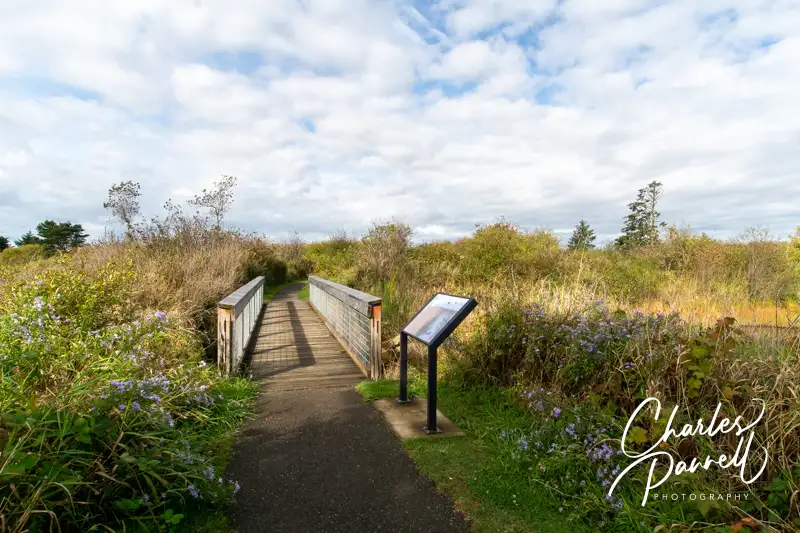
After the boardwalk ends, make a right turn and continue on the paved trail to the beach. The trail crosses a bridge, which is also a good place to spot the avian residents. When you reach the beach, make another right to continue on the hard-packed dirt trail through the wetlands. Along the way, you’ll find benches and interpretive plaques, as well as an accessible viewing blind over the marsh.
There’s also a nice ocean view along the way. At the end of the trail is another blind, with benches to sit and take a break. There’s a good view of the beach from the blind, so be on the look for peregrine falcons who like to hunt along the shoreline. This short trail makes for a pleasant stroll, and it’s a must-do for birders.
Viewing Blind at the End of the Trail
Camping Cabins at the Beach
Located about four miles south of Westport, Twin Harbors State Park (parks.wa.gov/find-parks/state-parks/twin-harbors-state-park) offers a nice picnic area as well as some wheelchair-accessible camping cabins and a yurt. It’s a nice spot for an alfresco lunch, or the perfect place to bed down for a few nights.
If you’d like to enjoy a picnic there is a small picnic area off of Schafer Road. There’s accessible parking in the lot and level access over to several accessible picnic tables on cement pads. And there’s also an accessible restroom nearby.
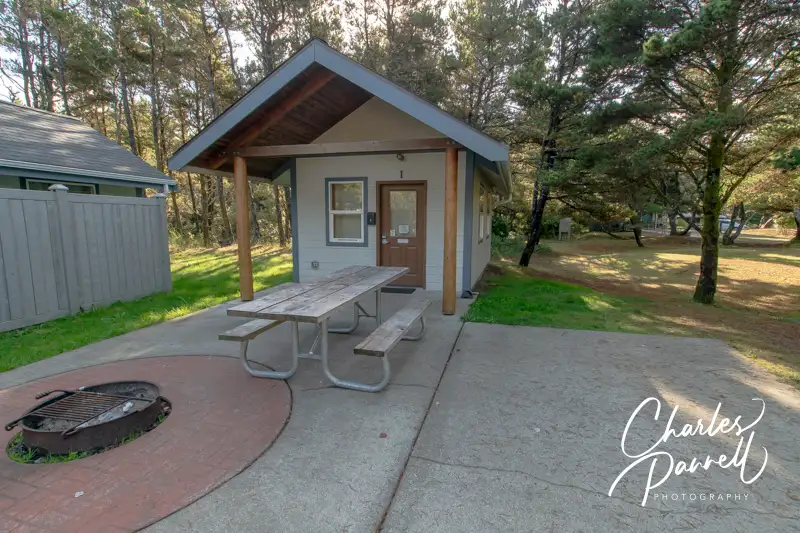
Loop A of the campground, which is located off of Highway 105, offers a few accessible overnight options that don’t involve pitching a tent. At the top of the list are five wheelchair-accessible camping cabins. Each cabin includes a level entrance and good maneuvering space, and is furnished with a queen-sized futon, a bunk bed with a single on top and a double on the the bottom, a table with four chairs and and end table. The cabins also include a heater, and outside they each have an accessible picnic table and a fire grill. They also all have a nice front porch.
Cabin 1 at Twin Harbors State Park
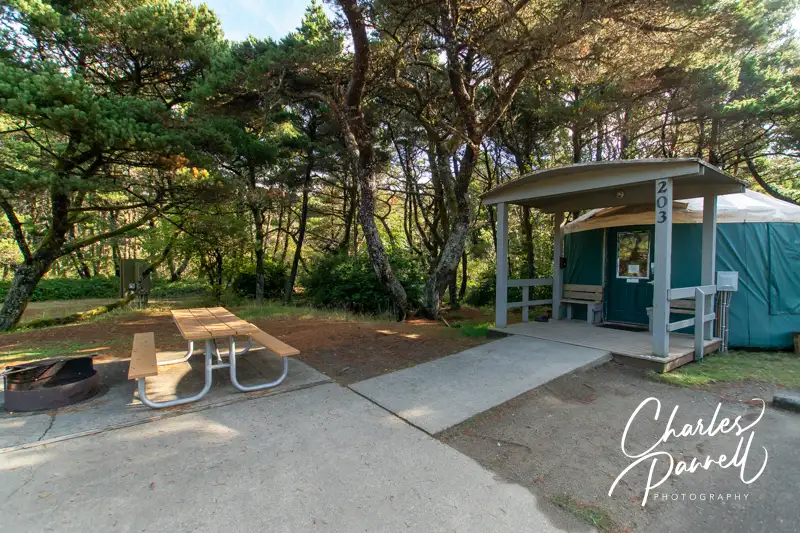
Yurt 203 is also a wheelchair-accessible choice. It has level access and is furnished with a queen-sized futon, and a bunk with a double on top and a twin on the bottom. And like the cabins it also has an accessible table and grill in front. Additionally, there’s a nearby concrete pad with a hookup for a RV that can be reserved for an extra fee.
Yurt 203 at Twin Harbors State Park
Top it off with an accessible shower house with a toilet with grab bars and a roll-in shower with a fold-down shower bench, a lowered showerhead and grab bars, and you have all the comforts of home.
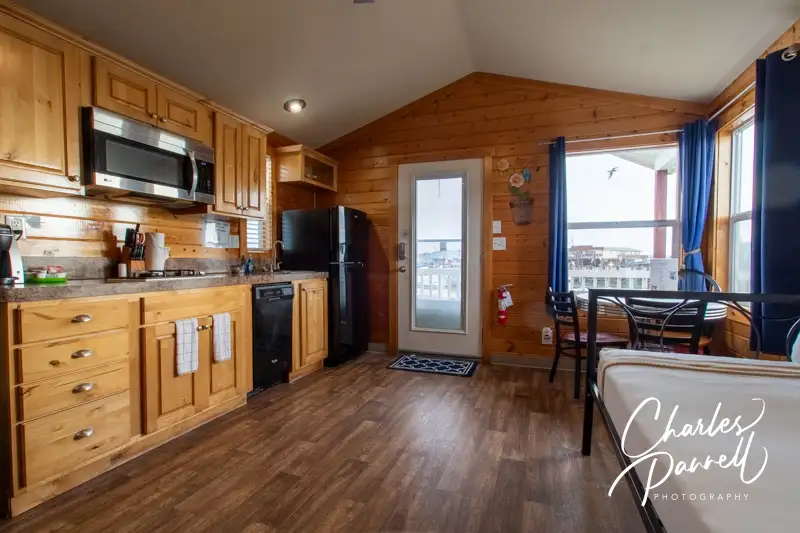
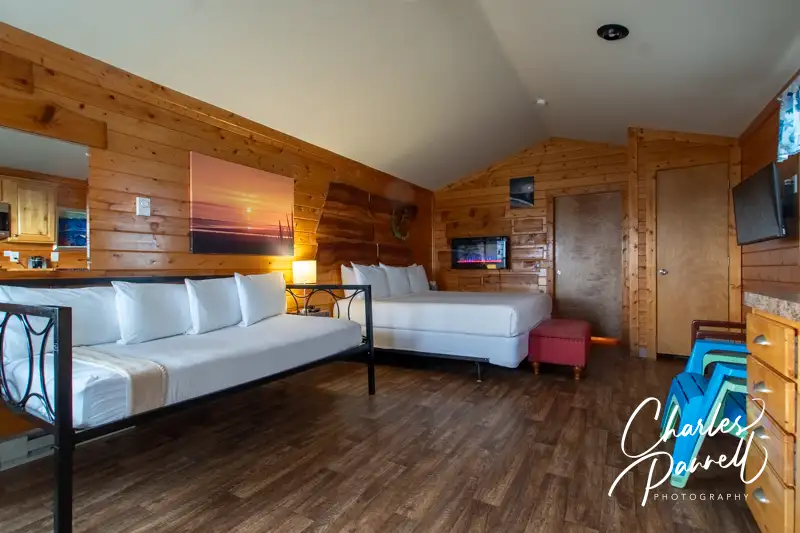
This comfy cottage (#1) features ramp access, wide doorways and good maneuvering space. The main room is furnished with a 25-inch high open-frame bed with wheelchair access on the right side (which can be moved a tad for left side access), a 20-inch high twin daybed, two side tables, and a comfy electric fireplace. There’s a dining table by the front window with a perfect marina view, and a full kitchen including a stove microwave, refrigerator and a dishwasher. Add in all the dishes and utensils you could possibly need, and you’re all set.
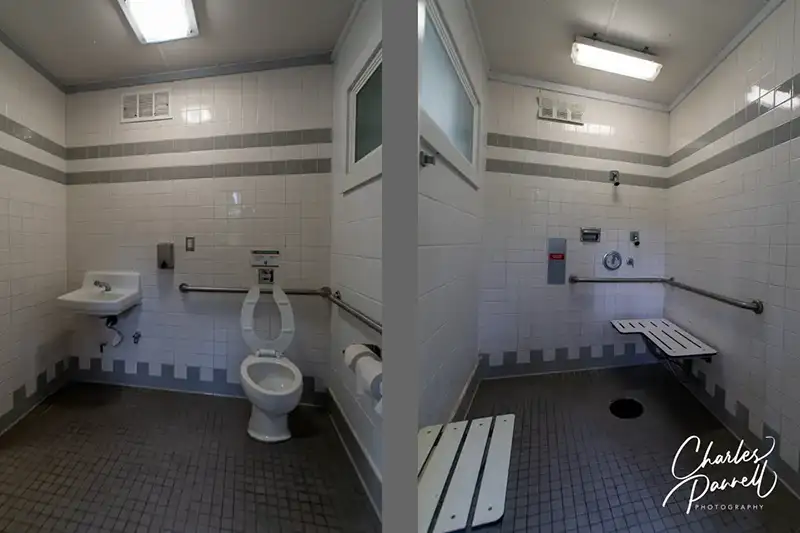
There’s a wide sliding door to the roomy bathroom, which has a full five-foot turning radius. It’s outfitted with a large roll-in shower with grab bars, a hand-held showerhead and a fold-down shower bench. Add in a toilet with grab bars on the the back and right walls (as seated) and also a roll-under sink with a lowered mirror, and you have a nicely accessible bathroom.
There are also two deck chairs that you can take outside to enjoy the marina view. And it’s a fabulous view, with fisherman filing in every morning, and then returning in the late afternoon. Add in a dog or two to assist them, and a few fish jumping out of the water and you have the quintessential waterfront view. It’s the perfect spot to relax at the end of the day, or to enjoy your coffee in the morning. With all the comforts of home, this wheelchair-accessible cottage is an ideal choice for a comfortable and accessible Westport getaway.
Westport Marina Cottages (#1)
Kitchen Area in Cottage 1
Kitchen Area in Cottage 1
Living Space and Bedroom in Cottage 1
Living Space and Bedroom in Cottage 1
Sink and Toilet in Cottage 1
Sink and Toilet in Cottage 1
Shower in Cottage 1
Shower in Cottage 1
Barrier-Free Travel Washington National Parks for Wheelers and Slow Walkers
Mount Hood is a popular Oregon landmark. To locals, the appearance of this 11,249-foot high giant is a sign of nearing home; and to visitors it’s a sight to behold at first glance. You can drive up to Timberline, ski down the slopes of this active volcano, or even attempt to scale the popular mountain. On the other hand, there are also a number of accessible ways to enjoy this scenic area. So pack your bags and leave the crowds behind, as you explore these wheelchair-accessible nearby Mount Hood stops on your next Western Oregon road trip.
Trillium Lake
Mount Hood Viewed from the Dam at Trillum Lake
At the top of the list is Trillium Lake, which is a 10 minute drive south of Government Camp off of Highway 26. You’ll need a Northwest Forest Pass (www.fs.usda.gov/r06/passes) to access this site, or you can pay the $10 day-use fee. National parks passes are not accepted.
Before you settle in for a walk on the improved boardwalk system, take some time to drive to the dam for an unforgettable Mount Hood view. There’s accessible parking near the dam, and level access over to a great Mount Hood viewpoint. And although the Trillium Lake Trail lake passes through this area, this section is rocky and bumpy, and not really a good choice for wheelchair-users..
The best place to access the Trillium Lake Trail is from the day-use area. There’s accessible parking near the boat ramp and the picnic area. There’s also an accessible vault toilet near the ramp. The accessible portion of the Trillium Lake Trail trail begins just to the right of the boat ramp, and moves towards the campground. You can also access this trail from the campground; however that area is usually only open to registered campers.
The two-mile lakeside trail begins as a hard-packed dirt trail, with older boardwalk sections here and there. After it passes the campground amphitheater, there’s a sizable new section of boardwalk with plenty of room for even the largest wheelchair. The trail continues over to the east shore of the lake for a great Mount Hood view, but loses its access due to bumps and rocks shortly after that, at about the 1.25-mile point. Still it’s a beautiful out-and back stroll.
And if you’d like to spend the night in Trillium Lake Campground, check out wheelchair-accessible campsite 35, which offers paved access to the Trillium Lake Trail.
Along the Trillium Lake Trail
Little Crater Lake
Little Crater Lake
Next up on the list of accessible scenic stops is Little Crater Lake. It’s located about 20 miles south of Trillium Lake. Just take Highway 26 and turn right on Oregon Skyline Road (NF 42). Then make another right on Abbott Road, and follow the signs to Little Crater Lake Campground. This site also only accepts the Northwest Forest Pass.
The lake is located on the far side of the campground — just follow the road around until you see the small parking area. The lot is unstriped, but there’s usually room to parallel park an adapted van. There’s an accessible vault toilet across the road, and level access over to the trailhead to Little Crater Lake.
The 250-yard paved level trail leads through the meadow, crosses a bridge, then winds through the forest. There are a few bumps along the way, but it’s definitely passable in a wheelchair. There’s a large viewing deck at the end of the trail that offers a nice view of crystal clear Little Crater Lake. It’s not a busy trail, so the viewing platform is a pleasant spot to just sit and enjoy the space.
And although the trail continues past the lake, it’s not wheelchair-accessible. The path winds through the forest for a quarter-mile, with a few roots to dodge along the way, and a step up to the bridge near the end. It may be doable for some slow walkers, as it’s level; however there are too many obstructions for wheelchair-users to dodge. Still the trek out to the viewing platform is worth the trip. And if you’d like to spend the night, most of the campsites in the adjacent campground are level.
Viewing Platform on Little Crater Lake
Another Lodging Choice
On the other hand, if you’d like to spend the night but you don’t want to pitch a tent, you can still explore the area and then spend the night in comfort at the nearby Best Western Mount Hood Inn. It’s conveniently located in Government Camp, just off Highway 26, about five miles northwest of Trillium Lake.
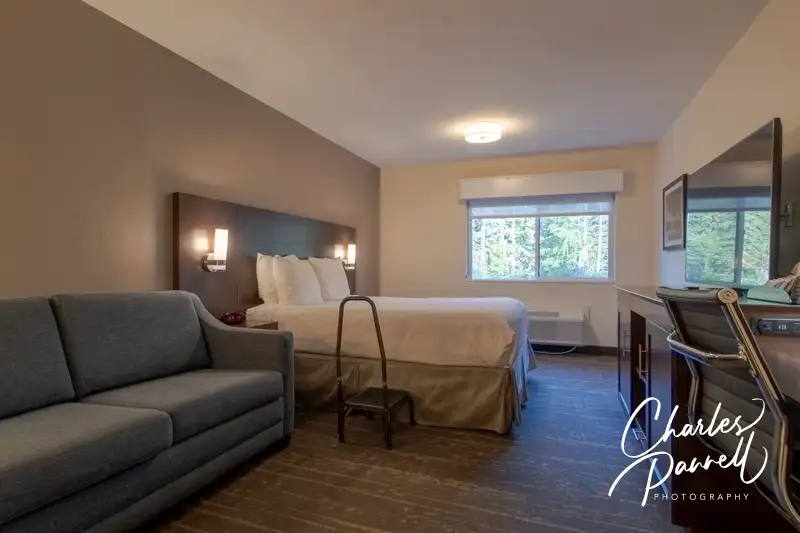
There’s accessible parking in front with level access into the spacious lobby. The property features good pathway access throughout the lobby area, and elevator access to all floors. Accessible room 217 features wide doors, lever handles, good pathway access, a lowered clothing rod, and laminate flooring and low-pile carpet for easy rolling.
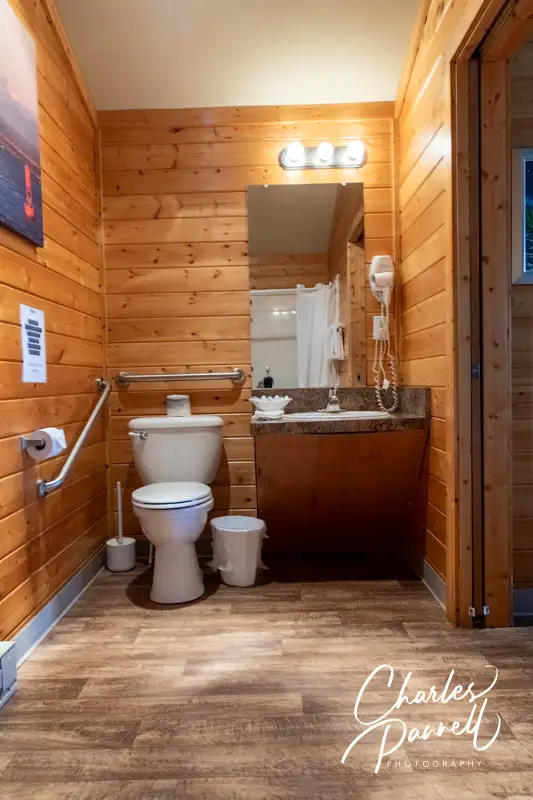
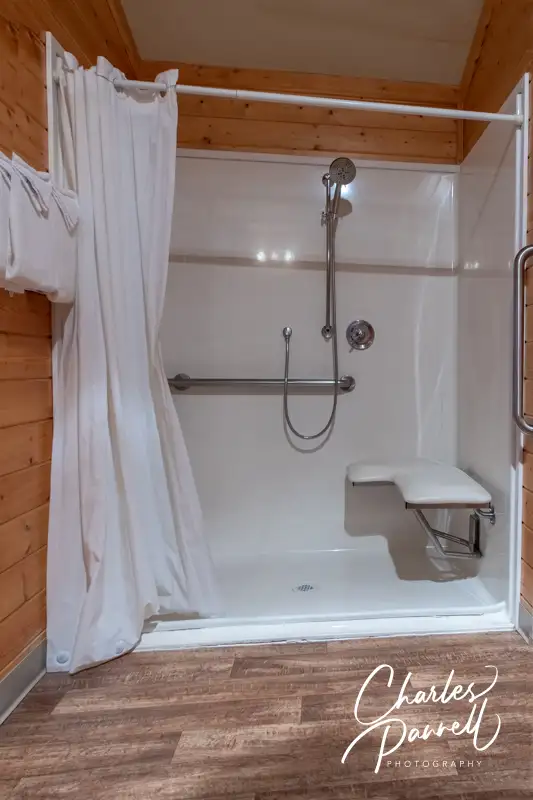
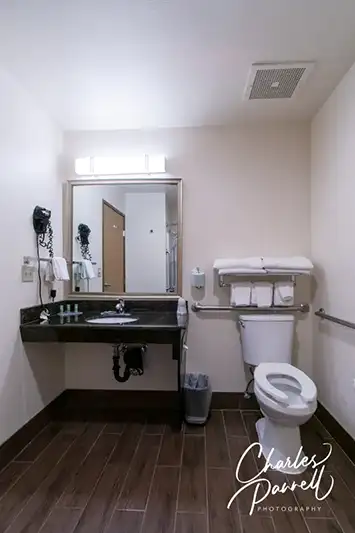
It’s furnished with a 29-inch high open-frame queen-sized bed with wheelchair access on both sides, a desk with a chair, a microwave and a refrigerator. There’s also a 13-inch high sleeper sofa in the room; and if you’d prefer two standard beds, there also an accessible room with two queens. The bathroom includes a tub/shower combination with grab bars, a hand-held showerhead and a portable shower bench . The toilet grab bars are located on the back and left walls (as seated), and there’s also a roll-under sink with a lowered mirror in the bathroom.
A full self-serve buffet breakfast is included each morning; and there’s good access to the breakfast room, which is located near the elevator. The Best Western Mount Hood Inn is a comfortable spot to overnight, after a full day of exploring the accessible outdoor areas near Mount Hood.
Room 217 at the Mount Hood Best Western
Sink and Toilet in Room 217 at the Mount Hood Best Western
Shower in Room 217 at the Mount Hood Best Western
Barrier-Free Travel Glacier, Yellowstone and Grand Teton National Parks for Wheelers and Slow Walkers
Despite all the complaints and irritations about accessible air travel these days, there’s some good news on the horizon, at least as far as Air Canada is concerned. Not only does this carrier make it a point to abide by Canada’s Accessible Transportation for Person with Disabilities Regulations, but they are also becoming more proactive about providing adequate services to passengers with disabilities. And to that end, they recently released their Air Canada Accessibility Plan for 2026 to 2029.
Plans are great, but I was impressed that they based this plan on the “nothing about us, without us” battle cry of the independent living movement. This impressive – 49 page – document addresses all disabilities and includes a lot more than just making sure there’s an aisle chair available when the plane lands. Along with training and access improvements this comprehensive plan also includes customer sensitivity issues, studies, feedback, consultations, committees, advisors, employment and sponsorships. And in the end it presents a forward view of addressing accessible air travel shortfalls.
Here are a few highlights.
Accessibility Progress
This section includes some of their access successes. They include:
The implementation of mobility aid tracking, with with real time updates and alerts on the Air Canada app
The inclusion of more detailed information about airport accessibility on the Air Canada website and app.
The availability of more support for passengers who need to use medical oxygen during flights, and the addition of discounted oxygen options.
The elimination of inconsistencies relating to equipment limits, and the reduction of physical barriers to aircraft and airports.
And what I feel is a huge improvement – the availability of transfer slings at Canadian airports, and the ability to secure many mobility aids in the cabin.
Access Barriers
Of course there are still some access issues that could use some improvement. Those are also included in the report.
Some aircraft have physical barriers, including cargo door dimensions and cabin layouts that limit the ability to accommodate some wheelchairs.
On-board lavatories need accessibility improvements.
Wheelchair damage and delays need to be eliminated.
Boarding and deplaning in uncomfortable aisle chairs needs to be improved.
Accessibility shortfalls during service interruptions need to be addressed.
Airport Accessibility
The report also addressed how they can address access airport accessibility in the long term. Here are some of the issues they plan to tackle.
Expand the availability of passenger lifts and transfer equipment to smaller airports throughout Canada.
Incorporate the use of transfer slings with third-party providers in the US.
Evaluate improved aisle chair designs which allow for greater passenger independence and comfort.
Improve boarding and deplaning options in Latin America for customers with mobility disabilities.
Improve independent wayfinding and movement through airports.
Improve the availability of ambulifts at airports, for customers who are unable to walk or navigate steps.
Upgrade the regular inspection and maintenance program for accessibility equipment.
Lobby with airport authorities for a dedicated accessibility lane at Canadian hubs.
Work with airport partners to provide more consistency on gate passes for non traveling support persons.
Mobility Aid Handling
And finally, one of the most important sections of the report addressed how to improve the reliability of mobility aid handling. Here are their plans.
Develop a system that prevents flights from departing when mobility aids are missing from the cargo hold.
Expand mobility aid tracking notifications.
Enhance hand held digital devices used in ramp operations to improve the handing of mobility devices.
Introduce automation that helps prevent the loss of mobility aids.
Enhance communication between ground handling and flight services regarding the handing of mobility aids.
Consider creating an Air Canada branded pouch for wheelchair tools and loose components that will clip to the mobility aid.
Continue to engage with mobility aid manufacturers, so they can create power mobility aids that can fit through all air cargo doors.
Include cargo do size as a factor when selecting flight partners.
Continue to refine the notification tool for mishandled mobility aids.
Continue to improve the recovery infrastructure for faster response when a mobility aid is damaged or lost.
My Take
First and foremost I’m glad that they addressed access, and in fact had an entire report that focused on the issue. My hope is that is goes further than the printed word, and that many of their goals come to fruition.
What do I think is most important? That’s a tough call, as equipment damage is one of the top complaints from wheelchair-users; however a little more comfort during the trip goes a long way to making the journey more enjoyable.
Personally. I hope they put a priority on improving the aisle chair for greater passenger comfort and independence. I get a lot of complaints about those uncomfortable aisle chairs. I know that they have to fit down the aisles, but I would think that there’s a way to make them a little more comfortable – maybe add some extra padding or something?
Of course everyone wants their wheelchair to arrive on time and unharmed, so that goes right up there with comfort in the air. I don’t really have a solution for that one, except more training for employees (I expect there is a high turnover) and just take a little more care when it comes to assistive devices. Luggage can be easily replace, but mobility aids are another issues entirely. I mean I can go out and buy some more underwear if my luggage is delayed or lost, but it’s not that easy if your wheelchair is lost or damaged.
Anyway, this is a first step. At least Air Canada has some plans and goals, so that’s good. Now I’d like to see those goals accomplished.
Although it only takes a day to complete, the Golden Circle drive is the highlight of any Iceland visit. This popular route loops past waterfalls, geysers and all the spectacular scenery that makes the country a photographer’s dream. Not only are there some fantastic windshield views on the drive, but three of Iceland’s top natural attractions are also located along the route. So pack a picnic lunch and get ready to enjoy the scenic south on this fun Reykjavik side trip.
The Basics
The good news is, the Golden Circle route is an easy drive from Reykjavik. The roads are good, and there are plenty of signs along the way. The 190-mile route includes stops at Thingvellir, Geysir and Gullfoss, and features a beautiful country drive back to the city.
The bad news is that accessible rental vans are nearly non-existent in Iceland. That said, station wagons are widely available; so if you can transfer, fold up your wheelchair and stow it in back, that might be an option.
If not, there are several tour companies that can provide accessible Golden Circle tours. Prime Tours (primetours.is/) can customize a tour to meet your specific needs and interests. Their accessible van can carry one wheelchair-user and four other people, and their guides are well versed about access needs.
Where it All Began
Waterfall in Allmanagjá Canyon, Thingvellir National Park
Located just 31 miles east of Reykjavik, Thingvellir National Park (www.thingvellir.is/en) is the first stop on most Golden Circle tours. Noted for both its beauty and geological value, this UNESCO World Heritage site is where the oldest existing Parliament first met.
People traveled to the Parliament sessions from all over the country and erected stone and turf shelters to protect them from the elements. Today, ruins of those structures can be seen in the surrounding fields. The assembly, which was held outside, took place at the Logberg (Law Rock) and the Logretta (Law Council). Unfortunately their precise locations are unknown, however interpretive panels that outline the history of the site are located throughout this national shrine.
The site was also designated as a national park in 1928 because of its tectonic and volcanic features. The continental drift on the North American and Eurasian tectonic plates can clearly be seen in the cracks and faults that are found in the area.
Access is variable throughout the site. Although paved pathways lead past the interpretive panels, there are a lot of rocks on the paths. Still, it depends on the time of year, and how recently the paths have been cleared. Some of the walkways may be a little steep, but there’s no harm in just doing as much as you can. It’s still a great stop as the drive around Lake Thingvallavatn is absolutely beautiful.
Thingvallakirkja Church in Thingvellir National Park
Geothermal Activity
Strokkur Geyser
From Thingvellir, the route continues east to Highway 35, where you’ll find Geysir, a site of high geothermal activity. There’s level access to the Visitor Center, which has automatic doors and barrier-free access throughout the building. Inside there’s a restaurant, a cafeteria, a gift shop and a small collection of interpretive exhibits about the geothermal area. An accessible family restroom is also located in the building.
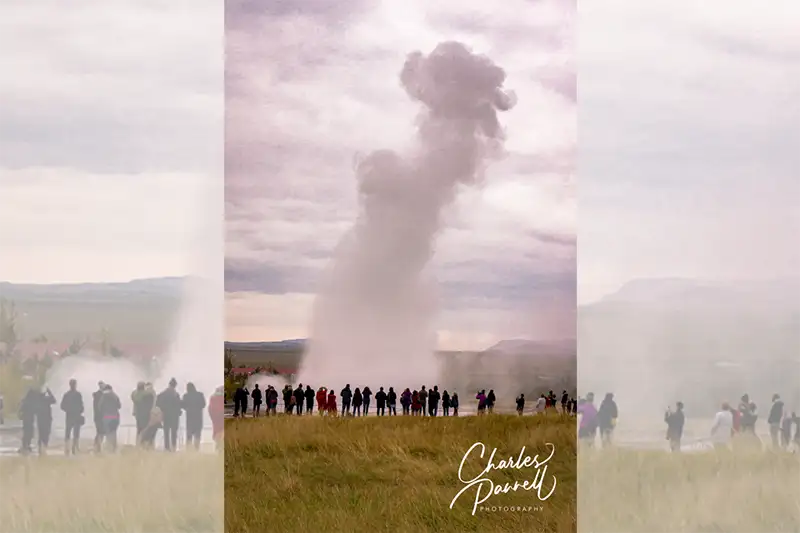
The geothermal area is located across the street, where a paved brick pathway leads around the Haukadalur geothermal area, which contains mud pools, fumaroles, algal deposits and geysers. The highlight of the geothermal area is the Strokkur geyser, which erupts every four-to-eight minutes. And although this Old Faithful of Iceland erupts regularly, some eruptions are more spectacular than others, so stick around until you catch one of the 30-foot high displays.
Steaming Grounds in Geysir
Cascading Waters
Gullfoss Waterfall
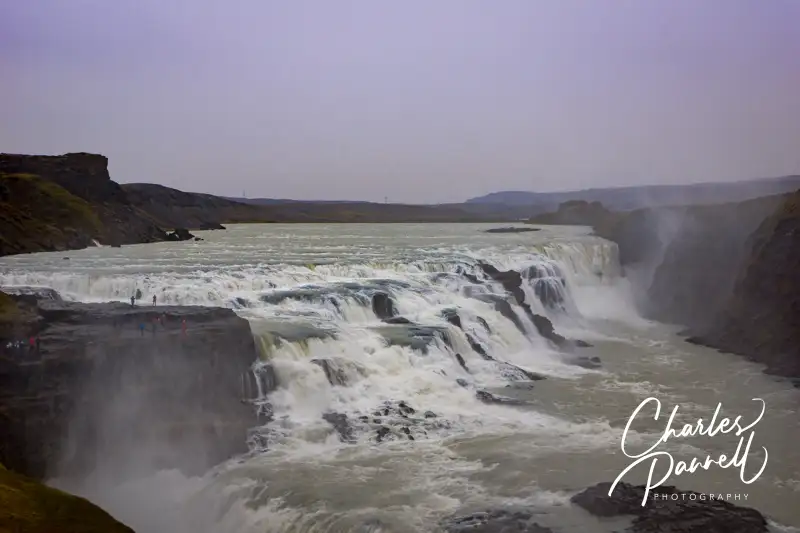
Just down the road from Geysir, you’ll find the crown jewel of the Golden Circle route, Gullfoss. Literally translated Gullfoss means “golden falls”, and on sunny days there’s usually a shimmering rainbow over the falls.
Accessible parking is located near a level boardwalk that leads out to an overlook. Even if you can’t manage the walk to the overlook, you’ll still get an excellent view of the double cascade falls tumbling down the rugged canyon, from just about anywhere along the boardwalk.
There is also stair access to an upper overlook, but the view is actually better from the lower overlook. Either way, the second largest waterfall in Iceland is definitely worth a stop, and it’s the perfect way to top off any Golden Circle drive.
Barrier-Free Travel 101 Accessible Vacations: Travel Ideas for Wheelchair-users and Slow Walkers