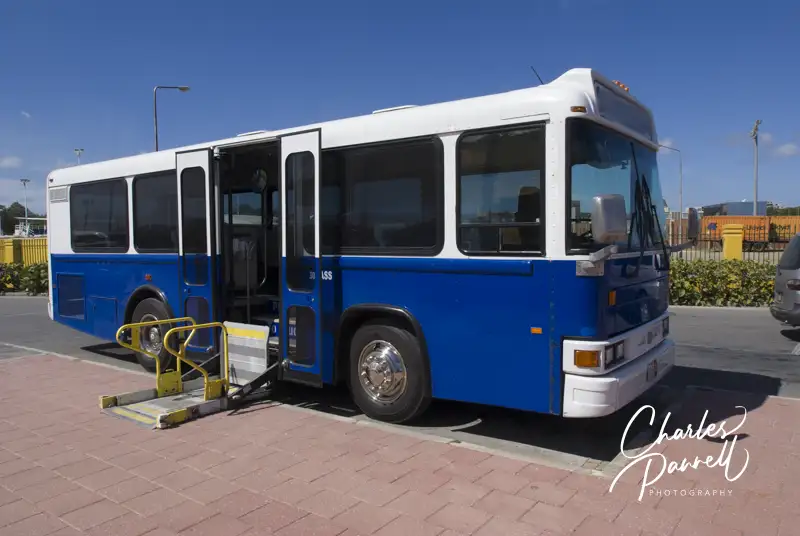
Recently I flew to Los Angeles, and although the hotel I stayed at had a free airport shuttle, it was not wheelchair-accessible. I asked the driver and he said that they didn’t have any wheelchair-accessible airport shuttles, and that I should take a taxi or an Uber. It seemed a bit unfair for me to have to pay for transfers, while others got them for free. Are airport shuttles required to be wheelchair-accessible under the Americans with Disabilities Act (ADA)? If so, what can I do if I encounter one that lacks wheelchair access?
The ADA and Wheelchair-Accessible Airport Shuttles
In a word, yes. If a hotel provides free shuttle service it’s also required to provide an equivalent accessible service under Title III of the ADA (ada.gov/topics/title-iii/). Equivalent is the key word here, so for example if passengers routinely wait 20 minutes for an airport shuttle, then wheelchair-accessible airport shuttles must arrive in the same time frame.
That doesn’t mean that hotels have to own their own shuttles though. They just have to provide the equivalent service. For example, a small hotel can share an accessible shuttle with other properties, but they must offer equivalent service as detailed above. Properties can also opt to send accessible taxis to pick up passengers, instead of purchasing and maintaining wheelchair-accessible airport shuttles. And finally they can alternately opt to reimburse guests for their accessible taxi or Uber fares.
When Things Go Wrong
Although equivalent service means that disabled guests will get the same service as non-disabled guests, a little advance planning can go a long way to making this a reality. First and foremost, don’t wait until you arrive at the airport to inquire about the availability of wheelchair-accessible hotel shuttles. Call the hotel in advance of your trip to confirm that they have the appropriate vehicles — and that they are actually operational.
If the hotel employee you are talking with says that they don’t have any wheelchair-accessible airport shuttles, then ask to speak to the manager. Usually managers know the law, and after you point out that wheelchair-accessible shuttle service is required under the ADA, then they will start to work to find a solution. Of course this solution may be that the hotels provides an accessible taxi or pays for your Uber, but that’s an acceptable solution under the law.
On the other hand if the manager balks at your request, it’s best to find another property. You can’t strong arm someone into adhering to the law, and you don’t want to arrive at the airport only to find out that there’s no way to get to your hotel. Give your money to a property that does follow the law and will be able to accommodate you.
Of course, don’t forget the property that didn’t accommodate you. They broke the law and they deserve to be reported to the Department of Justice (DOJ). It’s easy to do too — just complete this simple online form (civilrights.justice.gov/report) to file an ADA complaint. You won’t receive any compensation as the result of filing an ADA complaint, but it will help effect change. And that helps make everything more accessible in the long run.
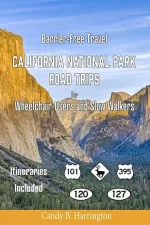
Barrier-Free Travel California National Park Road Trips for Wheelchair-Users and Slow Walkers
Nearly a year ago, on July 26, 2023, the Department of Transportation (DOT) announced a new accessible airline lavatory rule. Unfortunately it will still be many years before single aisle aircraft with more than 125 seat have accessible lavatories, but at least it’s a start. The rulemaking process has been going on for quite some time and the DOT took into consideration comments from consumers, airlines and disability organizations.
So here are the highlights of the final accessible airline lavatory rule, along with a timeline for when you can expect to see some changes.
Lavatory Interiors
Under the new rule, US single aisle aircraft with more than 125 seats must include the following features in their lavatories. These features will be required on new aircraft delivered three years after the effective date (2023) of the rule.
Grab bars
Accessible faucets
Accessible call button
Accessible door lock
Room for onboard wheelchair
Ample toe Clearance
Privacy screen if door is not able to be closed
So basically you can expect to see start seeing these features in 2026.
But there is a catch. The usual life of a commercial commuter aircraft is 25 years, so only 4 percent of the fleet is replaced annually. This figure is from the DOT. If they start replacing aircraft with ones that include accessible lavatories in 2026 (as required), the entire fleet will not be outfitted with them until 2051. And during that interim time, passengers will not know if they have an accessible lavatory until they board the aircraft.
Onboard Wheelchairs
The new accessible airline lavatory rule also includes a provision that the onboard wheelchair must be maneuverable into the lavatory, so that the wheelchair-user will be able to completely close the door. This also applies to single aisle aircraft with over 125 seats.
Again, aircraft are not required to be retrofitted, and the same timeline applies, so this would begin in 2026 and be fully implemented in 2051.
Accessible Lavatory Space
Perhaps the biggest change with the new accessible airline lavatory rule is the requirement for accessible lavatories to have ample space for a person with a disability and an attendant. More specifically the lavatory must have enough room for two males in the 95th percentile of height and weight (6 ft. 2 in., 246 pounds). That’s a pretty large space and it would make airline lavatories truly wheelchair-accessible. And as with the other regulations this applies to single aisle aircraft with more than 125 seats.
But there is a different implementation time frame for this requirement. Specifically, it’s for aircraft ordered 10 years or delivered 12 years from the effective date. That means this would start in 2036 and 2038, and would be fully implemented in 2061 and 2063. And in the interim you won’t know in advance if your aircraft has a lavatory with this extra space.
To be fair, the preliminary rule required implementation in aircraft ordered 18 years from the effective date or placed into service 20 years from the effective date. On that timeline the fleets would be fully outfitted with accessible lavatories in 2069 and 2071.
I addressed the timeline issue in my public comments to the DOT, as did other folks, so at least they listened a bit. But rulemaking is always a process of give and take.
So bottom line, we will start to see some minor accessibility changes in 2026, with full implementation of this rule in 2071. It’s definitely a step forward, but it’s really for future generations. But then again, so was the ADA. Justin Dart was a visionary but he certainly didn’t live to see the strides in accessibility we have made since the first days of his activism.
The American’s with Disabilities Act (ADA) covers a lot of issues in public accommodations; however the ADA doesn’t address bed height. This presents numerous problems for wheelchair-users and slow walkers who need to check into a hotel or motel.
Unfortunately there’s no real agreement on what an “accessible bed” should be. Most wheelchair-users prefer lower beds, while slow walkers with hip or knee issues need higher beds. And then there are wheelchair-users who use portable hoyer lifts who need open-frame beds, as opposed to the standard platforms. And those are just a few of the reasons why the ADA doesn’t address bed height.
So why is there’s no consensus on this matter? Well first and foremost, disabilities are diverse, and you just can’t put one group’s needs over the other. To be honest the same problem was encountered when the toilet height regulations for the ADA were crafted. The lower height was ultimately accepted because there was a cheap and easy fix for folks that needed higher toilets — toilet risers. Unfortunately there’s no cheap and easy fix for beds.
A Little History
The Department of Justice (DOJ) once considered addressing the bed height issue. Back on July 26, 2010 they issued an Advance Notice of Proposed Rulemaking (ANPR), that asked for public input on the accessibility of equipment and removable furniture, such as beds. And boy did they get an earful, as disability organizations and advocates weighed in from across the country. Granted the DOJ never said they were going to move forward and issue regulations, however due to the input received, it was assumed that some preliminary rules would at least be forthcoming.
Sadly that wasn’t the case. In a move that surprised a number of disability advocates, the DOJ instead issued a withdrawal of the ANPR and published that decision in the December 26, 2017 issue of the Federal Register.
So what does this mean? Basically it means that the rulemaking process has ended and the DOJ is not going to consider new rules for equipment and removable furniture. According to the DOJ, they are “reevaluating” whether a regulation like this is necessary. Given that places of public accommodation must ensure access to people with different disabilities, the feeling seems to be that perhaps exact specifications aren’t necessary, because beds of different heights work for different disabilities.
What’s a Traveler to Do?
Since the ADA doesn’t address bed height, travelers need to be more proactive when making lodging reservations. Never assume a bed will be a specific height. Always ask. And don’t call the 800 number for the property — call the direct number and speak to someone on site.
And if the person at the front desk can’t help you, ask to speak to someone in housekeeping. These are the folks that are in and out these rooms every day. If they don’t know the specific height, then ask if they can go and measure the bed.
If the bed is too high for you to use, then ask if it can be lowered by removing the frame. And if that’s not possible, ask if you can have a roll-away bed delivered to the room. Those beds are usually lower.
Unfortunately the trend is for higher beds these days, as many properties feel that this helps cut down on injuries to housekeeping workers. That said, even though the ADA doesn’t address bed height, you can still usually find a bed that will work for you with a little legwork. In the end, the best rule of thumb is to plan ahead to avoid unwanted surprises.
Barrier-Free Travel National Park Lodges for Wheelers and Slow Walkers
When I first started writing about wheelchair-accessible travel some 30 years ago, I was definitely the odd duck in the pond. I remember approaching tourism reps and explaining my niche — travel for wheelchair-users and slow walkers. Usually the response was a polite smile, a nod, a deafening silence or the ever so popular, “we have accessible restrooms in our visitor center” reply.
While I certainly don’t long for those days, it seems that things have come full circle today, and now wheelchair-accessible travel is the cool niche. Diversity is “in”. And although this visibility is a good thing, it’s a double-edged sword. Everyone wants accessible travel content, but the majority of folks don’t want to take the time to appropriately research it, which unfortunately has led to a glut of misinformation. And the internet has made it easy to cobble together articles by cherry picking “facts” from online “resources” that may or may not have been properly researched.
So how do you separate the wheat from the chaff as far as reliable and accurate wheelchair-accessible travel content is concerned? Truth be told there’s not one sure-fire test, but here are a few tips that will help you weed out those poorly researched pieces — ones in which the writers have never actually visited the destinations in question — and direct you to the more useful and accurate access resources.
In this day and age of outsourcing tasks, writing is no different. In fact there are many sites online that offer custom content for as little as $5. And to be honest, who can blame people for going the economical route when getting content for a website? The thing is, you get what you pay for, and in many cases this content is being crafted by folks who speak very little English, and just put their finished work through an on-line translator. And of course, for $5 their research is almost non-existent.
And with the increased usage of Artificial Intelligence to craft articles, credible content is getting harder and harder to find. So, if you start to read an article that makes little sense, keeps repeating the same thing in different ways, or begins to sound like those e-mails that you receive from that Nigerian prince who wants to give you millions, chances are the content is not well researched.
Shower at the Little River Inn, Mendocino County, California
There’s just no way to get around this requirement. That said, all photos are not created equal, as far as website usage is concerned. Be clear, I’m not talking about quality here, but instead photo content. Be wary of wheelchair-accessible travel articles that only show the beautiful glossy tourism photos, and have no specific access photos.
For example, if an article talks about an accessible hotel, but includes a photo of the well manicured gardens under the hotel sign, but fails to feature any photos of the accessible rooms, that’s a huge tip-off that the writer has never been in the accessible room. Chances are they are getting their access information second-hand, which in most cases is incorrect, or at the very least inaccurate. Look for photos that accurately depict access.
Candy enjoys a Moroccotini at the El Morocco in Desert Hot Springs, California
Although the jury is still out on whether you actually have to visit a destination to write a general travel article about it, there is absolutely no way you can pen a wheelchair-accessible travel piece without a site visit. Unfortunately some people are taking shortcuts and gleaning information from online sites and putting it into their accessible travel articles — all without ever leaving their desk. This of course leads to a lot of misinformation, and then that content is subsequently copied by others and repurposed into more inaccurate articles. It’s a vicious cycle.
So how do you tell if a writer has been to a destination? Well some folks just come right out and tell you, while others weave it subtly into their narrative. And then some folks tell it with detailed photos or stories about their trips. Beware of any article that reads like a travel brochure and gives absolutely no indication that the writer ever visited the destination. Also watch out for articles that continually quote websites — “xyz.com says that the Acme Hotel has accessible rooms with roll-in showers” — as that sometimes indicates the writer has not visited the destination to check out the access first-hand.
And then there are the influencers, who are paid to promote specific destinations. Some influencers present honest reviews, while others just praise destinations and post photos of themself frolicking on the beach in a designer outfit with perfectly coiffed hair. Be wary of any article that paints a picture of a “perfect” destination, without at least taking some of the drawbacks or access shortfalls into consideration. There is no one destination that’s perfect for everyone.
Covering wheelchair-accessible travel is not as easy as it looks — trust me on this one. Not only do you have to do site inspections, but you have to know what to look for. There’s no shortage of places that I’ve visited that claimed to be wheelchair-accessible, but instead had one or two steps at the entrances. And let’s not even talk about the B&B that had two two-by-fours as an entrance ramp. Suffice it to say that if an article only says that a place is wheelchair-accessible, but gives no other concrete access details, chances are either the writer has not visited the place, or they have absolutely no idea about the access needs of wheelchair-users and slow walkers. And remember, everyone’s access needs are different.
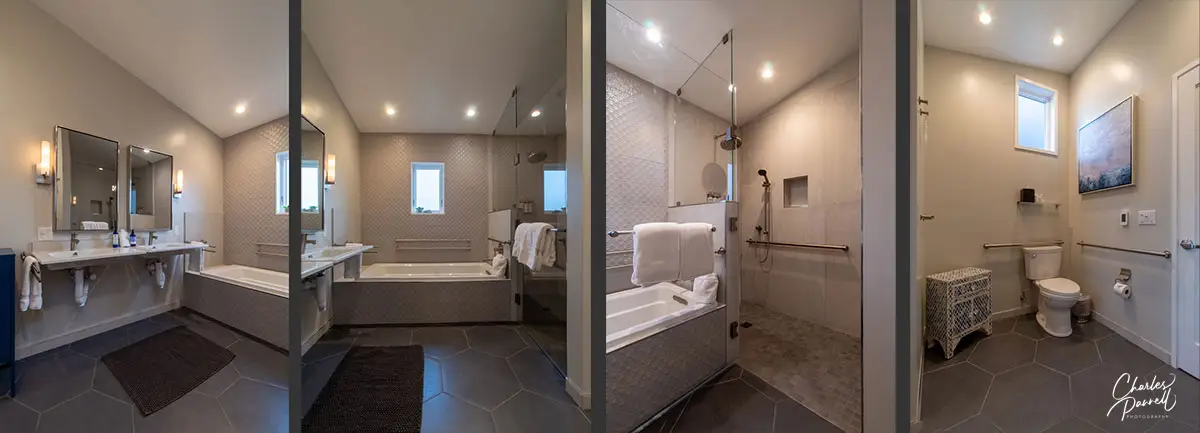
Bathroom at the Olea Hotel in Glen Ellen, California
If an article gives little more than the catch phrase “ADA compliant” as the entire access description for a hotel, chances are the writer didn’t visit the property. Additionally, since the average traveler has no idea of the actual ADAAG regulations (https://www.access-board.gov/ada/), that phrase is pretty meaningless. For example, let’s say you are looking for a hotel with a roll-in shower and you read in an article that a certain hotel is “ADA compliant”. Chances are you’d probably assume that hotel has a roll-in shower — and that assumption might be incorrect. According to the ADAAG, only hotels with over 50 rooms are required to have accessible rooms with roll-in showers; so if the hotel only had 45 rooms that “ADA compliant” property would probably only have accessible rooms with tub/shower combinations. And a detailed access description — instead of a short catch phrase — would have clarified that fact.
Don’t automatically rule out an article that includes archaic — by US standards — terminology, like “handicapped” and “infirmed”. Although it would tend to show a lack of understanding if these words were used by someone in the US, they are the norm in some developing countries. Look beyond the words for a true understanding of access issues.
For example if the article assumes that all wheelchair-users can walk and that one or two steps won’t be a problem, then that person does not understand the realities of life in a wheelchair. Moreover, that lack of understanding will most likely result in an inappropriate evaluation of the access. On the other hand, if you find an article by someone who doesn’t quite get the language right, but still has a good understanding of access needs, it may actually provide some important access information on a less-touristed region of the world.
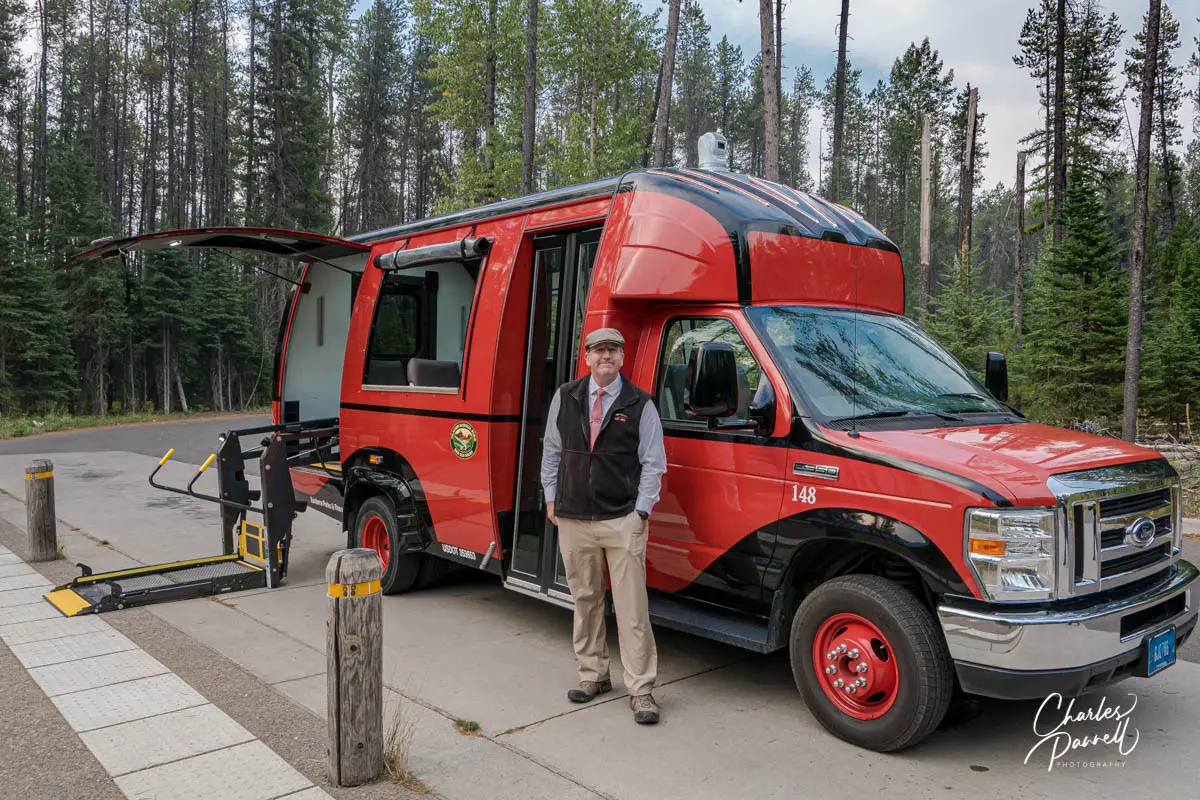
Accessible Red Bus in Glacier National Park, Montana
In order to evaluate access, you need to look at the big picture. Be cautious of destination articles that don’t include access information about ancillary services, such as public transportation. If the author has traveled to the area, they most certainly know about the availability of accessible public transportation, and understand the importance of including this detail in the article.
I’ve seen many an accessible travel article filled with flowery prose, about areas that I know have no accessible public transportation. The authors mention the sandy beaches and gorgeous sunsets, yet fail to acknowledge there is no accessible way to get from the airport to the hotel. Conversely, watch out for articles that claim a destination is accessible because it has an accessible bus system, yet lacks any concrete access details about lodging or attractions.
Finally be wary of roundup articles and listicles. These short pieces are all the rage with editors today, and most have a catchy title like “25 of the Best places to X”. Although they are fun to read, they generally contain very little substantive information; as the writer usually didn’t visit the destinations.
Instead these articles are filled with access information gleaned from the internet and combined with flowery prose from tourist brochures. That said, some legitimate travel writers — myself included — sometimes pen roundup pieces that contain useful access information. In the end, the key is in the access details — look for them. If they are missing or glossed over, that article is probably chock full of misinformation.
If you’re planning a trip to Greece, then check out the comprehensive list of wheelchair-accessible Greece tours and shore excursions and accessible services available from Athens-based Care Under the Sun (www.careundersun.com). Day tour offerings include everything from an Athens food tour and Santorini wine tour, to a Rhodes old town excursion and even a visit to Cape Sounion. These wheelchair-accessible Greece tours include transportation in lift-equipped vans and knowledgeable tour guides; and many can also be done as shore excursions with transportation to and from cruise ships. And if you’d like something a little more active, then try one of their accessible diving and snorkeling day tours.
Care Under the Sun can also arrange for accessible hotels, airport transfers and accessible van rentals. Additionally, they conduct several accessible Greece group tours throughout the year. They can also make arrangements for dialysis treatments and medical equipment rentals. And if you need assistance, they can provide a personal care assistant or nurse. For more information about their accessible Greece tours, contact Care under the Sun at +30 6944319506 or info@careundersun.com.

 Nearly a year ago, on July 26, 2023, the Department of Transportation (DOT) announced a new accessible airline lavatory rule. Unfortunately it will still be many years before single aisle aircraft with more than 125 seat have accessible lavatories, but at least it’s a start. The rulemaking process has been going on for quite some time and the DOT took into consideration comments from consumers, airlines and disability organizations.
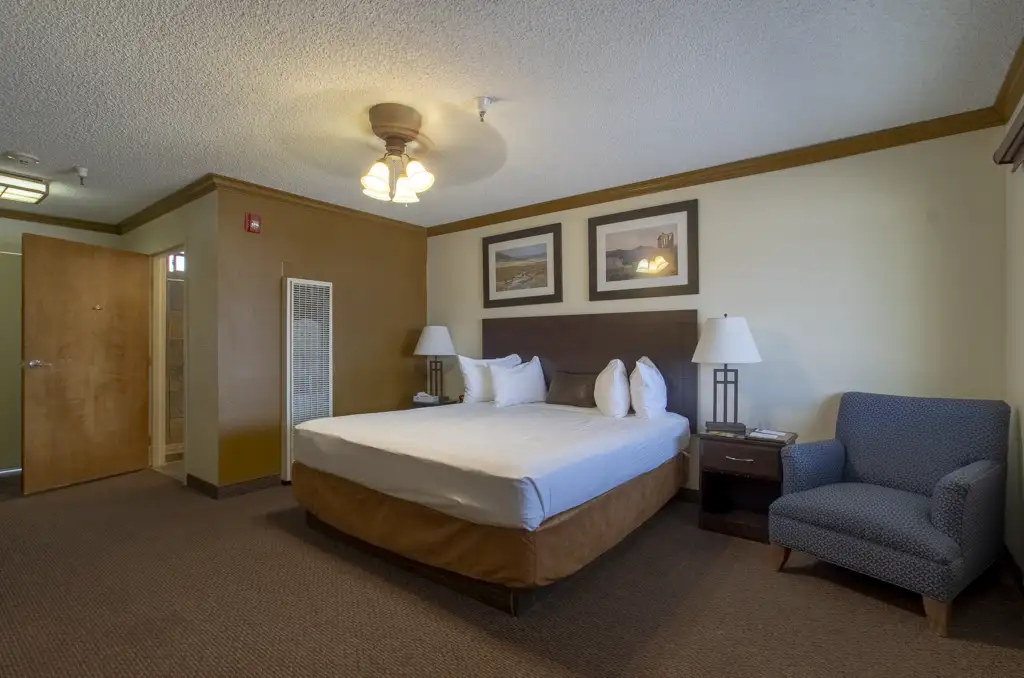 The American’s with Disabilities Act (ADA) covers a lot of issues in public accommodations; however the ADA doesn’t address bed height. This presents numerous problems for wheelchair-users and slow walkers who need to check into a hotel or motel.