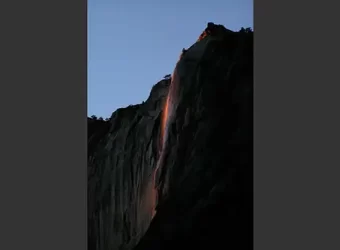
Yosemite Firefall Coming in February

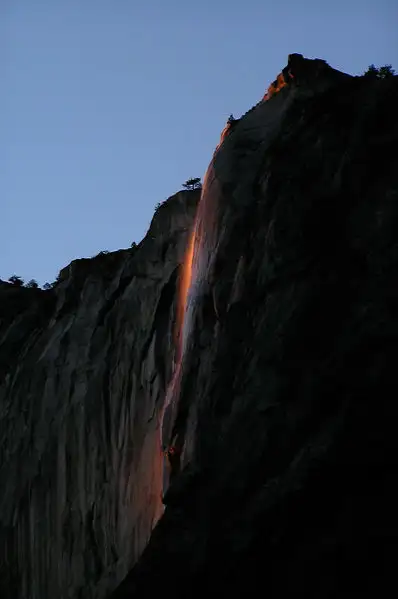
In days of yore, visitors would flock to Yosemite on summer evenings to witness the splendor of the Yosemite Firefall. A naturalist’s nightmare in this day and age, the 1960s firefall was created by park concessionaires tossing a burning rubbish pile off of Glacier Point. And to the delighted crowd gathered below, it appeared as if a fire waterfall was tumbling down over the rock face. For obvious reasons this ritual is no longer performed.
That said, today park visitors can experience a more natural — and just as spectacular — version of a firefall at Horsetail Fall. Every February when this waterfall is backlit near sunset, a vibrant orange glow emanates and mimics the appearance of a waterfall on fire — minus the rubbish pile. And although conditions have to be just right to witness this natural phenomenon, the firefall attracts visitors in droves for the possible opportunity. Of course whenever there are crowds, there are also rules and regulations. So here’s what you need to know — including where to find the accessible viewing areas — to experience the Horsetail Fall lightshow.
Yosemite Firefall Basics
There are several basic requirements for a good Yosemite Firefall. First and foremost you have to have water. A good fall rainfall is helpful for a robust firefall. And Central California has certainly had its share of rain this year!
Second, you need clear skies so the sun can reflect off the granite behind the waterfall. And although this is up to Mother Nature, it also helps to keep an eye on the weather. If it’s overcast, cloudy or foggy, it will probably be a no-go. Of course you have to hit it at the right time of day — sunset — for an optimum firefall experience. The days for the optimum Yosemite Firefall experience in 2026 are February 12 to February 28. And sunset times for those days range from 5:40 PM to 5:47 PM.
Finally, there’s the location. The best place to view Horsetail Fall is near the El Capitan Picnic Area. Best bet is to try and snag a parking spot at Yosemite Falls, and walk 1.5 miles on Northside Drive to the viewing area. If Yosemite Falls parking is full, park in Yosemite Village or Curry Village and take the free shuttle to Yosemite Falls.
Even if you can’t manage the level walk, you can still enjoy this majestic show. Although one lane of Northside Drive will be closed to accommodate the large number of pedestrians, people with an accessible parking placard are allowed to drive to and park in the El Capitan Picnic Area in turnouts on the north side of Northside Drive. That said, it’s important to note that on busy weekends, Northside Drive may close completely for about an hour after the firefall. And if nature calls, remember there’s an accessible vault toilet in the El Capitan Picnic Area.
No Reservations in 2026
Due to the popularity of the Yosemite Firefall, park entrance reservations were required in previous years. This will not be the case in 2026. No reservations will be required to enter the park during the February firefall days.
Southside Drive will be open to vehicles, but parking, stopping, and unloading passengers will be prohibited between the El Capitan Crossover (the road connecting Northside and Southside Drives near El Capitan) and the Swinging Bridge Picnic Area. The area from the Cathedral Beach Picnic Area to the Sentinel Beach Picnic Area, and the area between the road and the Merced River (including the river) will also be closed to all entry.
El Capitan Crossover will “generally” be open, but stopping and parking will be prohibited. And in order to manage congestion, access into Yosemite Valley at the El Capitan Crossover will be controlled. Once the valley is full, vehicles will be diverted out of the valley.
So the best advice for the 2026 Yosemite Firefall is to get there early and bundle up. Visitors are also encouraged to sign up for Yosemite text alerts by texting “Yosemite” to 33311 for real time up dates.
So, plan ahead and have fun at the 2026 Yosemite Firefall.
Barrier-Free Travel
Yosemite, Sequoia and Kings Canyon
National Parks
for Wheelers and Slow Walkers