4203 Loring Park
Converse, Texas
If you need a break from the monotonous drive along Interstate 10 near San Antonio, then take a short detour to check out this interesting — and massive — art installation. Just take exit 585 and head north on FM 1516 for about a half-mile. Make a right on Hays Park Road — the Giant Junk Stag sculpture is just down the road.
This larger-than-life stag is perched on a mound of dirt in the first round-about through the upscale subdivision. There’s parking in a level paved lot near the playground, which is the perfect vantage point to view the piece. Crafted by Mexico City artist, Florentino Narcis, this community centerpiece is comprised of junk, including engine parts, rusted fenders, license plates and even a bicycle seat or two. Check it out and see how many scrap parts you can spot. And if you’d like to get a closer look at the sculpture, there’s curb-cut-access to a short sidewalk from the parking area. There aren’t any public facilities at this stop, but this interesting sculpture is definitely worth a short look on the way through the Lone Star state.
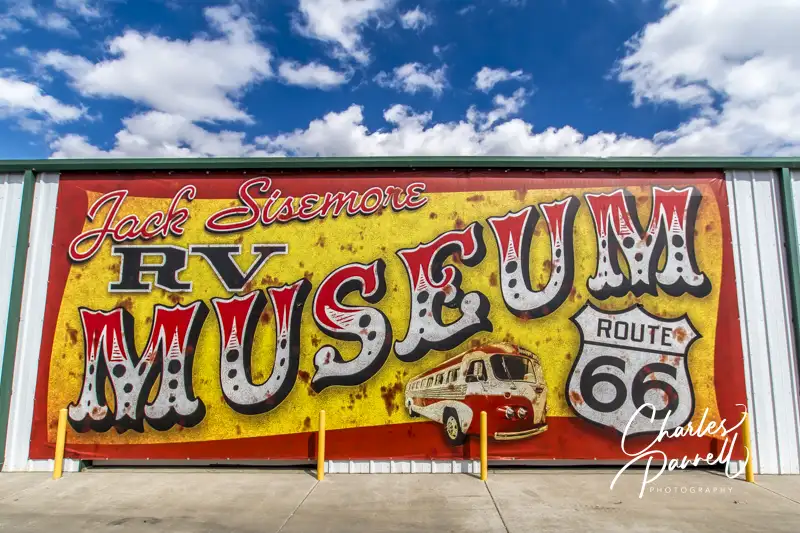
Jack Sisemor RV Museum
14501 Interstate 27
Amarillo, TX www.rvmuseum.net
For a fun trip down Memory Lane, be sure to stop in at The Jack Sisemor RV Museum on your next trip through Amarillo. Even if you’ve never been in a RV in your life, you’ll still love the nostalgic touches to the rigs and the accompanying displays. From that ever-so-familiar 70s shag carpeting, to a collection of vintage cameras, and even some old Coca Cola coolers, there’s bound to be some object that tugs at your heartstrings and evokes fond memories of yesteryear. And chances are high that you’ll also blurt out, “Hey, I had one of those!” at some point during your visit.
Open seasonally, the museum consists of an army of vintage RVs that have been lovingly restored. And that’s something that makes Jack Sisemore incredibly proud. There’s barrier-free access around the exhibits inside the museum. Highlights include a 1921 Ford Lamsteed Kampkar (one of only five made), the 1948 Flxible Bus used in the Robin Williams movie RV, and a 1976 FMC that was owned by Max Factor, Jr. Avid RVers will also love the 1975 Itasca (the first one ever built – serial number 1) and the cute little 1962 Bambi Airstream, which is in pristine condition. And don’t miss the large dirt and street bike collection scattered throughout the museum.
Best of all, there’s no admission charge to the museum. As an added bonus, more pieces are continually added to the collection, so you never know what you’ll find at this offbeat museum.
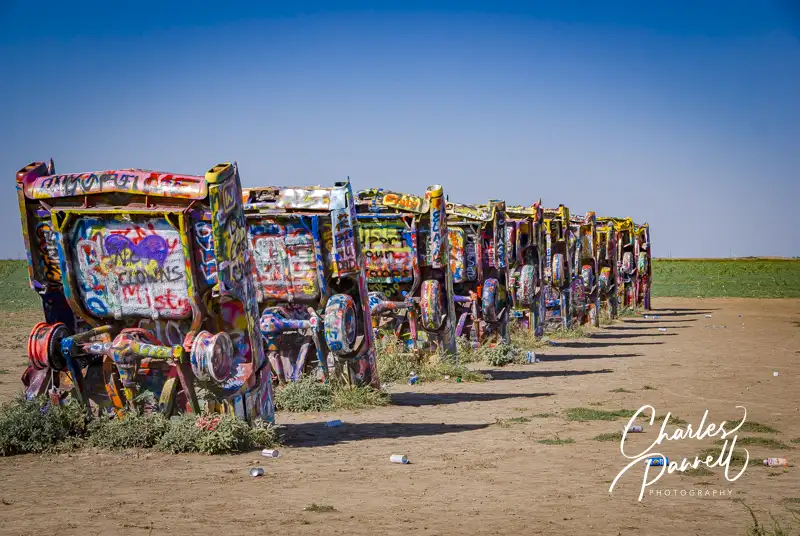
If you’re cruising along Interstate 40 near Amarillo, Cadillac Ranch is a required stop. Located on South Frontage Road between Arnot and Hope Roads, this public art display was created by an artist’s collective called The Ant Farm. It features 10 Cadillacs planted nose first into the ground. Built along the remains of Route 66, they were meant to symbolize the “golden age” of the American automobile. The cars are routinely painted with graffiti and even dressed up on some holidays. And although the creator frowned on this practice at first, it’s now encouraged.
There’s just a wide spot on the road to park in front of Cadillac Ranch, but there’s plenty of room for an accessible van. The entrance gate has a 24-inch clearance, but after that there is a six-foot wide hard-packed dirt path out to the cars. And if you can’t manage the walk, you can still a good view from the road. This roadside attraction is a good appetizer for The RV Museum & Storage (emerginghorizons.com/jack-sisemor-rv-museum/) located up the road on Interstate 27.
El Capitan, the southern-most point of the Guadalupe Mountains
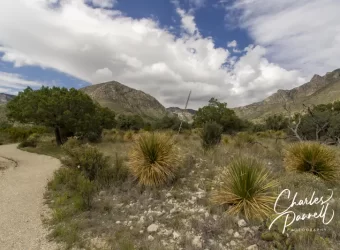
Named for the mountain range that dominates the landscape, Guadalupe Mountains National Park (www.nps.gov/gumo/) contains the four highest peaks in Texas, and boasts an impressive share of backcountry acreage. If all that sounds a little foreboding for wheelchair-users and slow walkers, then think again.
The park also contains a historic stage stop as well as the ruins of an 1800s ranch — both of which are wheelchair-accessible. They can be easily reached from Highway 62/180, which runs from El Paso to Carlsbad and passes through the southwest section of the park. Not only is Guadalupe Mountains National Park a destination by itself, but it also makes a nice add-on to a Carlsbad Caverns visit. Either way, it’s a good choice for wheelchair-users and slow walkers who want to explore a bit of southwest history.
Pinery Stage Station
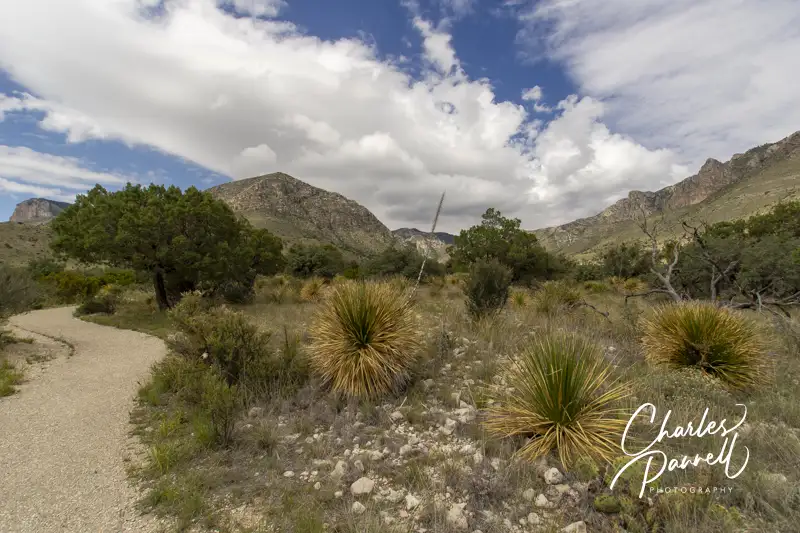
The Pinery Trail in Guadalupe Mountains National Park
The Pinery Visitor Center makes a good first stop in the park. Located just off the highway, there’s accessible parking in front, with barrier-free access to the building. Inside there’s plenty of room to maneuver a wheelchair around the exhibits and ranger information desk, and level access to the accessible restrooms.
But the real attraction — The Pinery Trail — starts just outside the visitor center and leads over to the site of the former Pinery Stage Station. The paved accessible trail is dotted with benches, while interpretive plaques that detail the desert plants line the walkway.
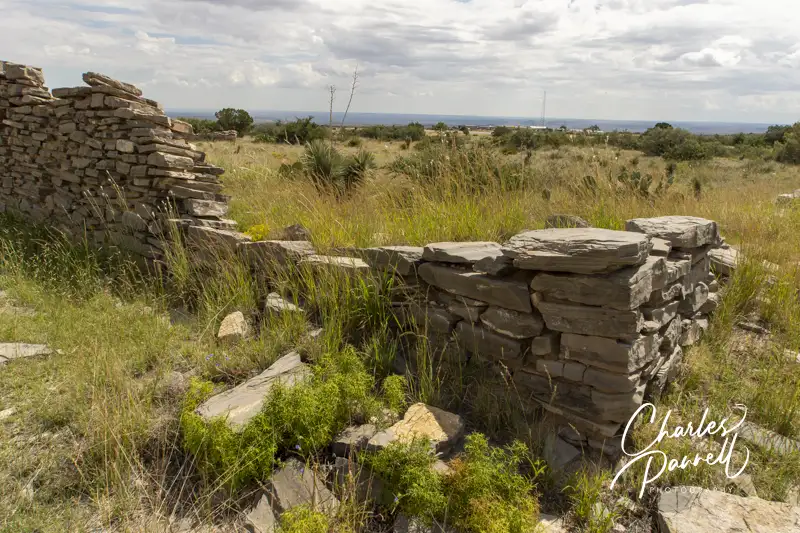
The trail ends at an interpretive plaque that explains the importance of this one-time stage stop. Built in 1858, the stop was named for a nearby stand of pines, and since it had an abundant water source it was one of the most favored stations along the 2,800-mile mail route from St, Louis to San Francisco. It’s about a .7-mile round trip hike from the visitor center, however if you can’t manage the distance, there’s also a pullout along the highway near the stage stop. Although the Butterfield Overland Mail Coach only operated for a little over two years, it should be noted that it never missed a run — even in adverse weather.
Ruins of the Pinery Stage Station
Frijole Ranch History Museum
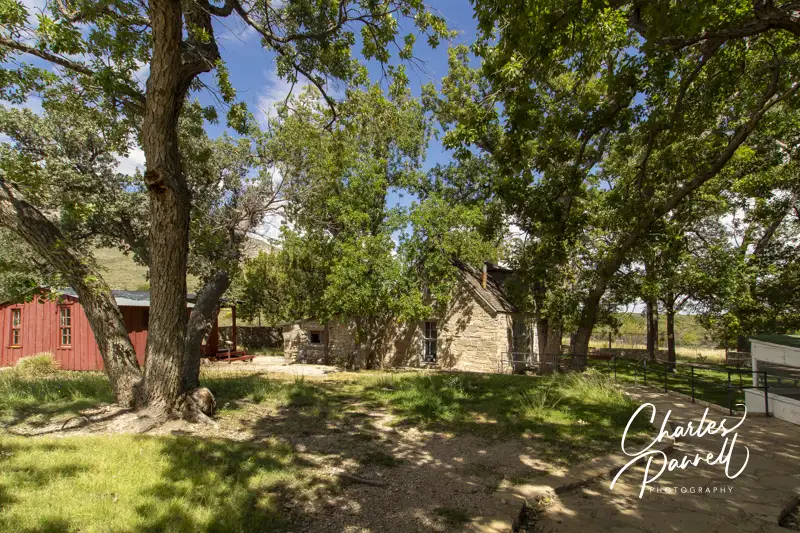
Frijole Ranch History Museum
Another must-see in Guadalupe Mountains National Park is the Frijole Ranch site, which is located just up the highway. Accessible parking is located near the accessible vault toilet. And since there are accessible picnic tables in a nearby covered pavilion, this stop is also a good spot for a lunch break.
The accessible Manzanita Spring Trail begins near the parking area, and leads over to the Frijole Ranch History Museum — an open-air exhibit which focuses on the history of this parcel, which was first settled by the Radar brothers in 1876. It was later acquired by the John Thomas Smith family in 1906. They grew apples, peaches, apricots and other fruits, and transported their harvest by wagon to Van Horn — a two-day ride away. The Smith farmhouse still stands, and it’s furnished as it would have been in the early 1900s. The Smith family operated the orchard until 1942, and it later served as a ranger residence, before it was added to the National Register of Historic Sites.
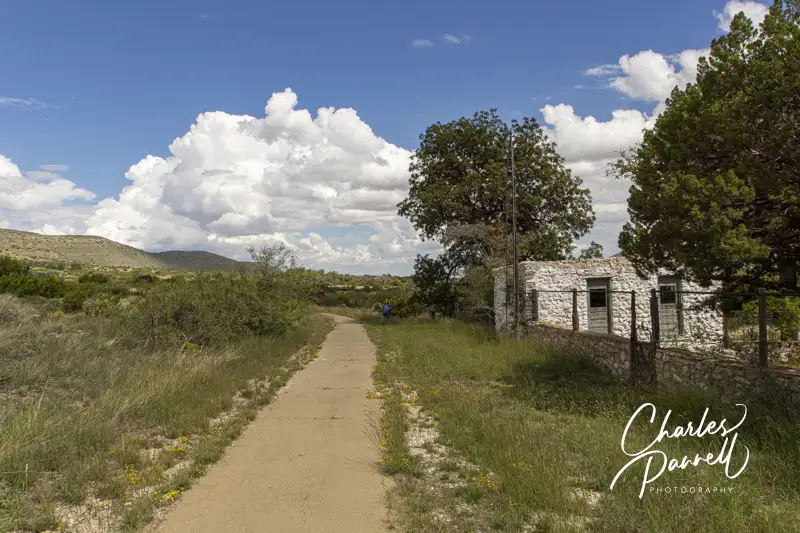
The paved undulating trail continues on past the old farmhouse and ends at Manzanita Spring. It should be noted that there’s a short 15-foot section of the trail that has rocks and dirt along it, from a washout. The good news is, that section is at the beginning of the trail, and if you can make it past that, you won’t have any problems completing the trail. On the other hand, if it’s been repaired, this trail is entirely passable for wheelchair-users and slow walkers. All it all, it’s a one-mile round trip hike that offers an interesting look at the farming history of the area.
Manzanita Spring Trail
Barrier-Free Travel the Grand Canyon for Wheelers and Slow Walkers

 4203 Loring Park
Converse, Texas
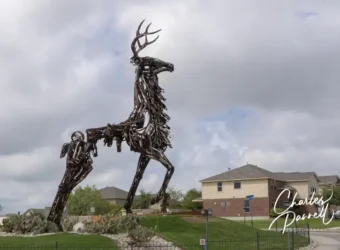
If you need a break from the monotonous drive along Interstate 10 near San Antonio, then take a short detour to check out this interesting — and massive — art installation. Just take exit 585 and head north on FM 1516 for about a half-mile. Make a right on Hays Park Road — the Giant Junk Stag sculpture is just down the road.
This larger-than-life stag is perched on a mound of dirt in the first round-about through the upscale subdivision. There’s parking in a level paved lot near the playground, which is the perfect vantage point to view the piece. Crafted by Mexico City artist, Florentino Narcis, this community centerpiece is comprised of junk, including engine parts, rusted fenders, license plates and even a bicycle seat or two. Check it out and see how many scrap parts you can spot. And if you’d like to get a closer look at the sculpture, there’s curb-cut-access to a short sidewalk from the parking area. There aren’t any public facilities at this stop, but this interesting sculpture is definitely worth a short look on the way through the Lone Star state.
4203 Loring Park
Converse, Texas
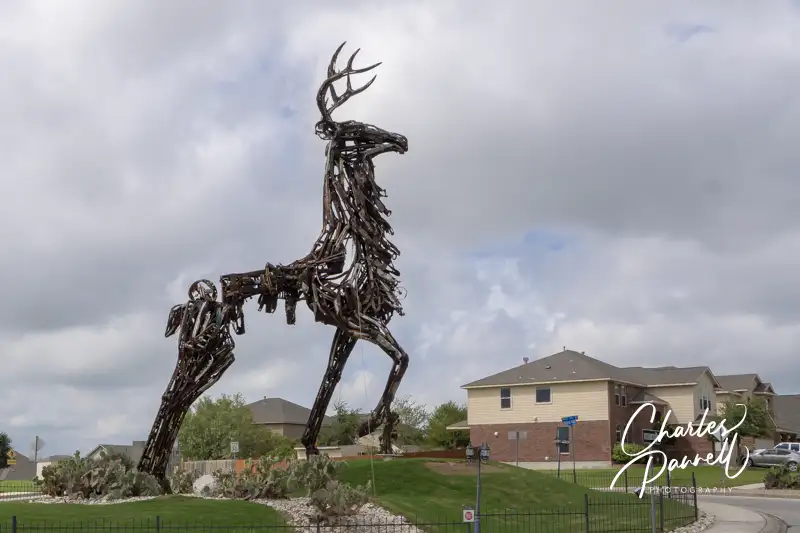
If you need a break from the monotonous drive along Interstate 10 near San Antonio, then take a short detour to check out this interesting — and massive — art installation. Just take exit 585 and head north on FM 1516 for about a half-mile. Make a right on Hays Park Road — the Giant Junk Stag sculpture is just down the road.
This larger-than-life stag is perched on a mound of dirt in the first round-about through the upscale subdivision. There’s parking in a level paved lot near the playground, which is the perfect vantage point to view the piece. Crafted by Mexico City artist, Florentino Narcis, this community centerpiece is comprised of junk, including engine parts, rusted fenders, license plates and even a bicycle seat or two. Check it out and see how many scrap parts you can spot. And if you’d like to get a closer look at the sculpture, there’s curb-cut-access to a short sidewalk from the parking area. There aren’t any public facilities at this stop, but this interesting sculpture is definitely worth a short look on the way through the Lone Star state.