Alamogordo, NM
pistachioland.comLocated at the intersection of Highway 54 and Dog Ranch Road, Tim Mc Ginn’s PistachioLand is home to the world’s largest pistachio. This 30-foot monolith towers over the surrounding desert and attracts visitors from around the world. It was built by Tim McGinn to honor the memory of his father Tom McGinn. The elder McGinn founded the original pistachio and grape farm which grew into PistachioLand. Tim felt a “world’s largest” monument would be fitting, as his dad loved to stop at unique roadside attractions on their many road trips. Erected in 2007, this giant nut is constructed from five yards of concrete and is covered with 35 gallons of paint.
There’s accessible parking near the giant pistachio, and ramp access over to the perfect photo op spot. Next door there’s level access to the Country Store, which has plenty of room to maneuver a wheelchair inside. It stocks everything pistachio — from brittle and nuts, to t-shirts and souvenirs. They even have salt-free and sugar-free products. And if you’d like to sample a little vino, the Arena Blanca tasting room is in back. The World’s Largest Pistachio is fun photo stop, and the country store has plenty of free samples.
Roswell, New Mexico
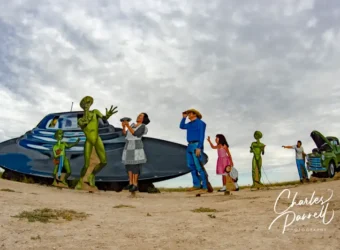
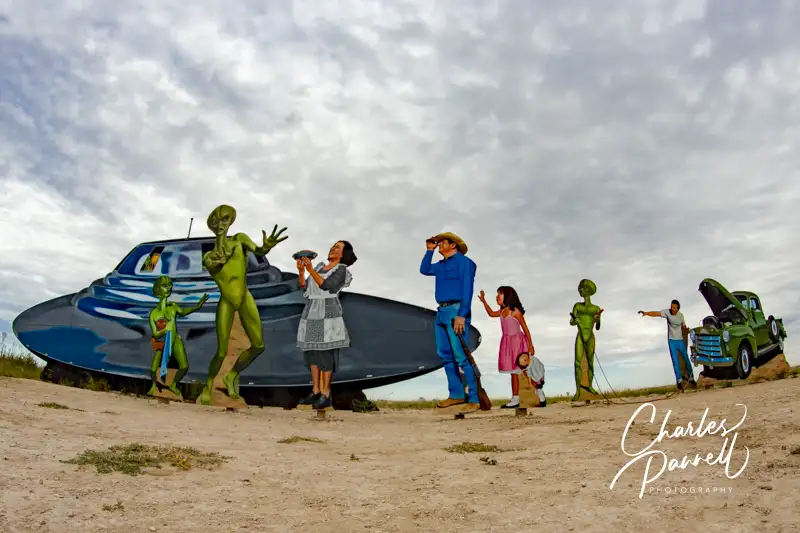
If a trip to the unofficial UFO capital of the world is on your travel itinerary, then be sure and stop at the creative Welcome to Roswell art piece just outside town. You’ll find the masterpiece on the east side of Highway 285, about six miles south of the city. Unveiled in 2013, the John Cerney piece is best described as giant cut-out art. Cerney’s Rockwell-like highway murals are designed to blend into the existing landscape and catch passing motorists off guard. And the Roswell installation does just that.
There’s no official parking lot for the mural, but there’s a wide level dirt area where you can stop and have a good look at the piece. And if you’d like a photo op with it — and who wouldn’t — there’s also a level dirt path over to the mural.
The mural itself depicts an alien spacecraft with a few green beings in front of it, who are being offered a pie by a local woman. The aliens seems put-off by the culinary creation, and one of them appears to be holding ET of movie fame in his arms. Back on the ship, the navigator is reading a map with Roswell prominently marked, which also includes a “photo” of two figures that eerily resemble The X-Files Scully and Mulder. And over on the other side, a rancher is receiving roadside assistance for his broken down California truck from yet another alien. There’s a lot going on in the mural, so take some time and look for the “little things”. And again, it blends into the landscape, so keep an eye out for it as you approach town.
19 Carlsbad Cavern Highway
Whites City, New Mexico
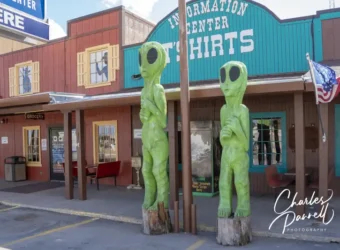
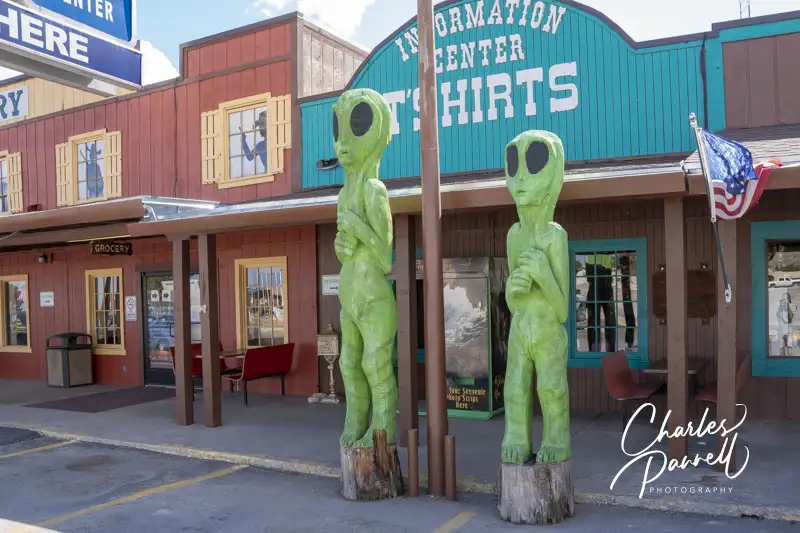
Although they seem a bit out of place, these Green Aliens sit in front of the Whites City Information Center, just off Highway 7 on the way to Carlsbad Caverns. There’s no interpretive plaque at the site; however locals say that the they are a tribute to the old Million Dollar Museum which formerly occupied the space, and had an “alien baby” on display. Today the aliens offer a good photo op on the way to New Mexico’s only national park. Accessible parking is located in front of the post office, with level access over to the aliens next door. It’s a fun stop, especially if you have kids in tow.
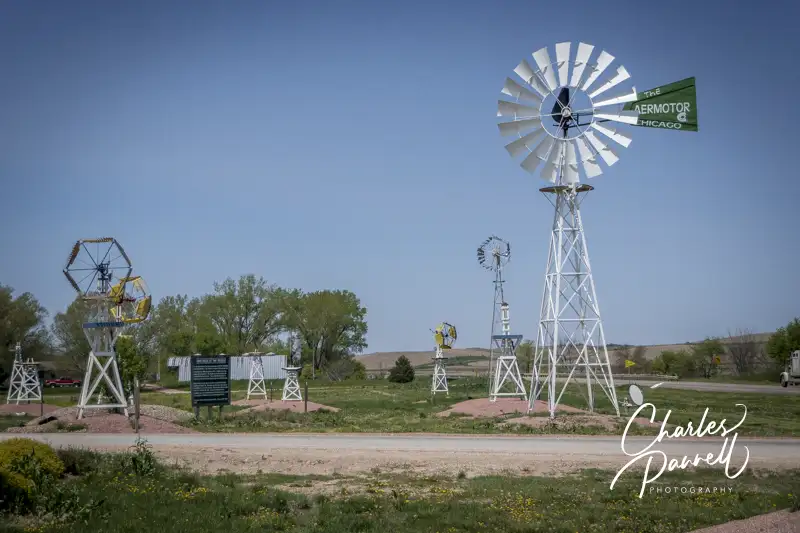
Located near the eastern terminus of the Outlaw Scenic Byway, this collection of vintage windmills is a must-see on any Cornhusker State road trip. The open-air museum features nearly 30 windmills that date back to 1880 – 1930, many of which are in working condition. This quirky roadside attraction was made possible by the local Leonard Gill Family, in an effort to preserve a piece of prairie heritage.
Most of the windmills are from the Howard and Barvetla McLain Collection of Carroll, Nebraska. They were moved to the site and restored by Marvin Baker of Pender, Nebraska. In some cases restoration was an arduous process, as parts had to be fabricated, because they were no longer available commercially. The result is an impressive and very rare exhibition of what’s billed as one of the finest collections of vintage windmills in the world.
The windmills are located on the south side of Highway 20, in front of the LP Gill Landfill. There’s no real parking area, but there is a wide level dirt space where you can pull over to get a better view of the site. In dry weather it’s possible to walk around the grassy area where the windmills are planted, but after a rain it can get pretty muddy. Even if you can’t manage the walk over the grass, it’s still worth a stop to catch a panoramic view of the windmills on the horizon. It’s an impressive sight indeed.
Main Street
Pratt, KS
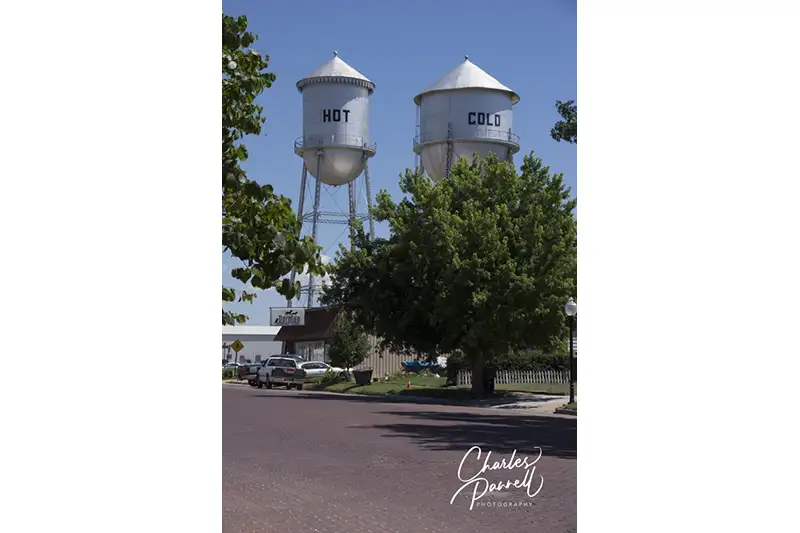
If a road trip takes you along Highway 281 in Southern Kansa, then be sure and stop for a quick photo op in Pratt. Although there’s not much to the town, they do have have a unique set of water towers. The Hot & Cold Water Towers are located at the intersection of Highway 281 (Main Street) and Green Street. You can get a good view of them from the Pratt Community Center parking lot (which has accessible parking), located just across the street. What supposedly began as a high school prank when students graffitied the towers in the 1940s, led to the town formally adopting — and accepting — the designations, and repainting the towers in a more formal and permanent way. Yes, other towns in Kansas also have similar water towers, but the story behind these sends them to the top of the list.
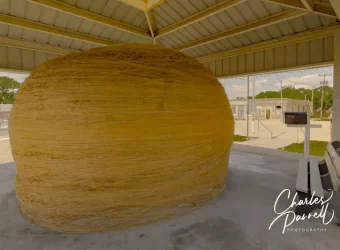
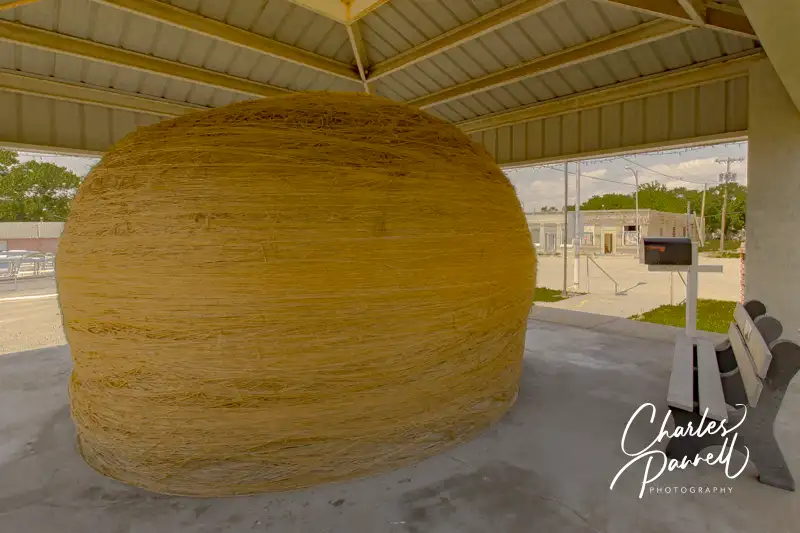
The Cawker City Twine Ball is definitely off the beaten path, but that’s part of the charm of it all. Located about an hour-and-a-half northwest of Salina, you definitely have to go out of your way to visit this Kansas roadside attraction. It was started by Frank Stoeber in 1953 with sisal twine from his hay bales. Frank had been a bit under the weather and he thought twine winding would be a good way to pass the time. After he recovered, he found he had a new hobby, so he decided to keep it up.
Today this massive twine ball sits in an open-air pavilion on Highway 24 between Maple Street and Lake Drive. Accessible street parking is available on the corner of Highway 24 and Lake Street. There are steps up to the twine pavilion from Highway 24, so it’s best to head up Lake Street and cross over the grassy area next to the building with the mural on front, to get to the twine ball. And depending on the upkeep of the grounds, some wheelchair-users may need a bit of assistance bumping up the cement slab where the twine ball sits. Still you can get a good view of it from anywhere on the grass.
And this isn’t a static exhibit — it’s still growing. Every August there’s a twine-a-thon, where visitors are encouraged to add to the twine ball. So if you’re in the area during that time, make plans to become an official twine winder.
28995 Lansing Road
Dyersville, IA
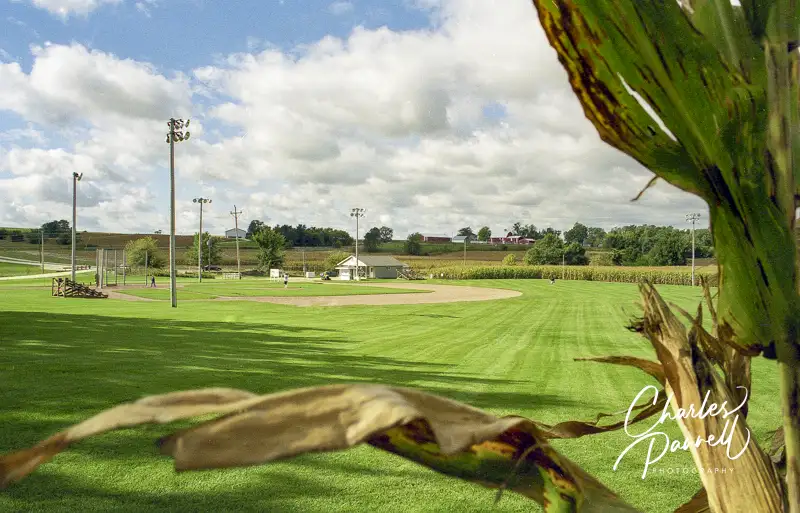
www.fieldofdreamsmoviesite.comIf you’re a Kevin Costner fan, you’ll definitely want to make a stop at the Field of Dreams Filming Site on your next road trip to Chicago. The site is located in rural Iowa, about 25 miles west of Dubuque off of Highway 20. It’s pretty easy to find with GPS, and it’s only five miles off the highway, but if you get lost just follow the signs.
There’s good access to the site, which is located on the Lansing family farm. Accessible parking is available near the entrance with level access over to the large gift shop. There’s also good access over to a vantage point of the field itself, and to the restaurant, concession stand and ice cream stand. Admission is free and for the most part, everything is flat, level and accessible. And although this site has been developed a bit since the filming of the 1989 movie, the nearby cornfield helps put it all into perspective. It’s a good stop for movie buffs or anyone who likes baseball.
130 NW Main Street
Blackfoot, Idaho
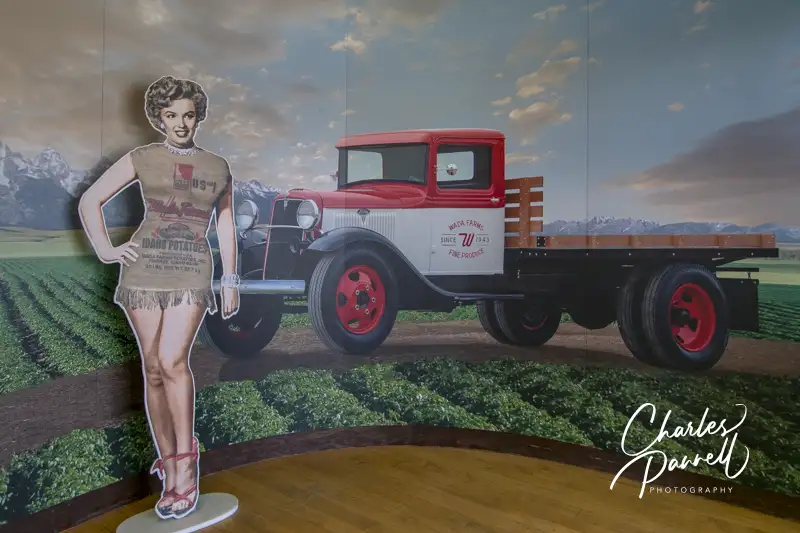
www.idahopotatomuseum.comMost folks know that potatoes are the number one crop in Idaho; however many visitors completely pass up an unusual museum that celebrates the origin and versatility of this ubiquitous cash crop. Located in a 1912 railroad station off Interstate 15, this roadside attraction makes a nice diversion on the route between Pocatello and Idaho Falls. You can’t miss it — it’s the only building on Main Street with a giant potato in the front.
There’s accessible parking near the front door, and level access over to the main entrance of the Idaho Potato Museum. Inside there’s plenty room to maneuver a wheelchair around the exhibits, and ample space for wheelchair seating in the adjacent restaurant.
The exhibits present an excellent history of the spud, tracing its origins back to South America, and illustrating the factors that make Idaho an excellent place to cultivate the crop. Interestingly enough, the timeline also notes that it took western cultures 450 years to realize the advantage of dehydrated potatoes — something that the Incas knew all along. The museum is also filled with display cases that contain collections of potato peelers, potato mashers and even potato sack clothing. And if you’d like a little more education about taters, there’s room for a wheelchair in the small theater where you can view an interesting selection of potato themed videos.
There’s ramped access — although some folks may need a bit of assistance because of the steep pitch — to the second gallery, which includes a collection of machinery, including a potato sorter, a tractor, a potato sack sewing machine and a number of scales. There is also a small children’s hands-on area, but there are five steps up to it. And don’t miss the world’s largest potato crisp, which is 25 inches long and weighs in at 5.4 ounces.
The Idaho Potato Museum also makes a good lunch stop as the cafe serves up a baked potatoes with a variety of toppings, and sandwiches on potato rolls. And if that’s not enough to lure you in, the restored railroad depot is a hidden gem, and certainly worth more than a cursory a drive-by glance.
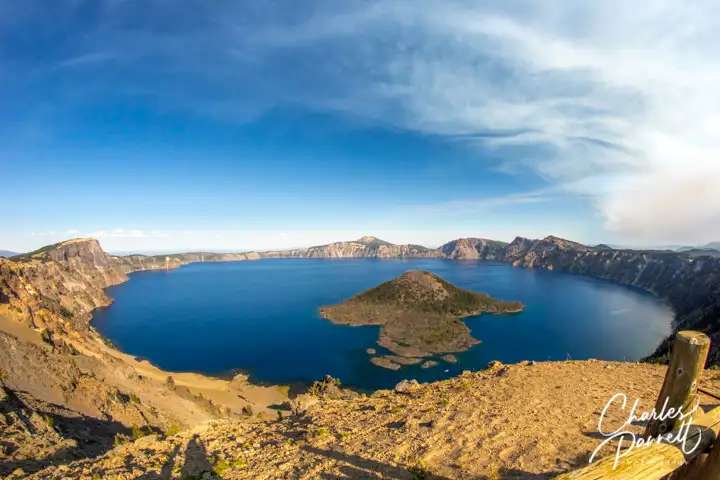
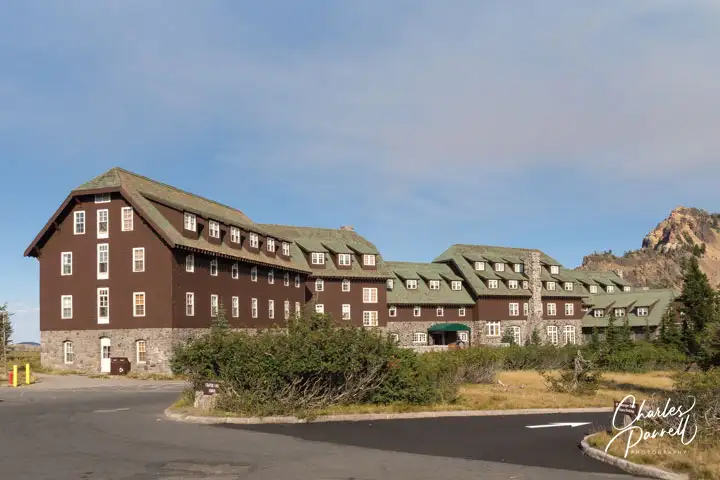
Perched high above the namesake mountain lake, Crater Lake Lodge (explorecraterlake.com) has been welcoming visitors since 1915. And although the historic lodge evokes memories of a kinder and gentler time, this National Register property also boasts modern-day access upgrades. As a result this lakeside retreat is the perfect overnight choice for wheelchair-users and slow walkers who want to extend their stay in this scenic national park. So pack your bags and get ready to explore Crater Lake, with an overnight or two at wheelchair-accessible Crater Lake Lodge.
Wheelchair-Accessible Crater Lake Lodge
Crater Lake Lodge
Although steps grace the front entrance, there’s ramp access on the left side of Crater Lake Lodge. Accessible parking is located around the corner near the side door, which is just steps from the accessible room. And there’s also a drop-off area in front, for folks who can’t manage distances.
Inside, there’s plenty of room to navigate a wheelchair around the cavernous lobby, which is dominated by a massive stone fireplace. There’s also a barrier-free pathway to the front desk, and to the accessible room just down the hall.
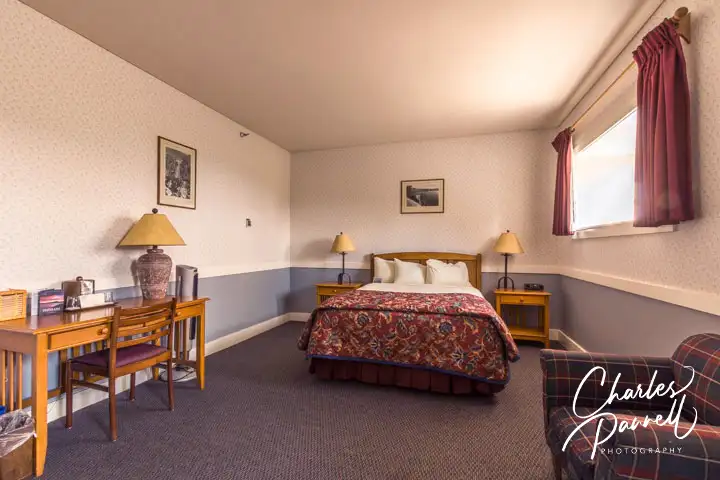
Accessible room 107 features a wide door with a lowered peephole, and plenty of room to navigate a wheelchair or scooter inside. It’s furnished with a 26-inch high queen-sized bed with wheelchair access on both sides, a desk with a chair, and a side chair.
Room 107 at Crater Lake Lodge
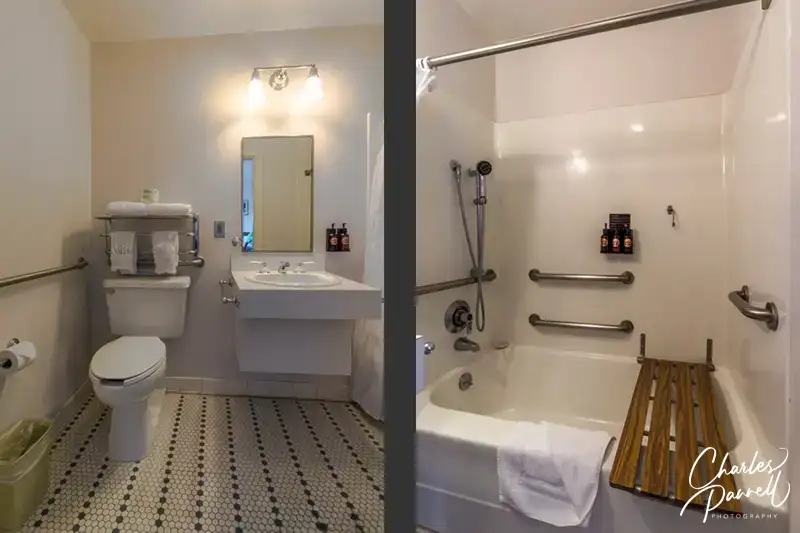
The bathroom is equipped with a tub/shower combination with grab bars, a hand-held showerhead and a fold-down tub bench. The toilet grab bars are located on the back and right walls (as seated), and the bathroom also has a roll-under sink. And like the bedroom, the bathroom is very spacious, with plenty of room for a wheelchair or scooter.
Bathroom in room 107 at Crater Lake Lodge
Additionally, in keeping with the ambiance of days gone by, the guest room is pleasantly devoid of a phone and a television — as are the remaining guest rooms.
Pleasant Public Areas
There’s also good access to the public areas of the lodge, including the great hall, the terrace and the dining room. Guests can enjoy a selection of beverages, appetizers, soups, salads and desserts in the great hall or on the terrace; or indulge in a full menu of Northwest specialties in the dining room.
The terrace offers the best views of the lake, but you’ll also get an eyeful if you snag a window table in the dining room. And for an even better view of the lake, take a stroll on the accessible paved trail behind the lodge. Just take the ramp down from the terrace, and you’re good to go.
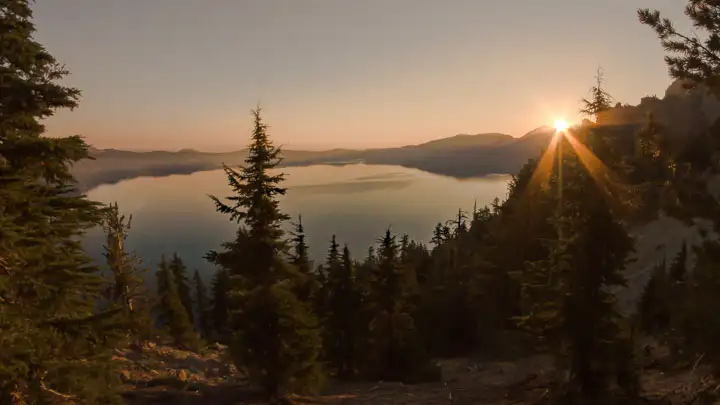
Even if you don’t spend the night, Crater Lake Lodge is definitely worth a stop. Sit back and enjoy a cocktail on the terrace and watch the sunset over the lake. It’s the perfect — and very accessible — way to end a day at this scenic Oregon national park. Keep in mind though that wheelchair-accessible Crater Lake Lodge is only open from May to October, so plan ahead to avoid disappointment.
Sunset view from the terrace at Crater Lake Lodge
Barrier-Free Travel Washington National Parks for Wheelers and Slow Walkers
Although there are many contenders for the World’s Largest Peanut, the true winner resides in Ashburn, GA. You can spy the stately goober from I 75, just south of exit 82 on the west side of the highway. And if you’d fancy a closer look, then take the Washington Drive exit and turn west, then make a left on Sylvia/Whittle, between Zaxby’s and the Pizza Hut. The big nut can be found on a small service road on the left, about a half-mile from the turn. Although it was knocked from its perch in Hurricane Michael in 2018, it was replaced and renovated in 2023. During that interim phase, several other peanuts claimed “largest” status, but after the replacement the Ashburn giant regained the title.
There’s a small paved parking lot, and although it’s not striped it is level and seems adequate for the amount of traffic the peanut gets. There’s level access over to the nut, but if you are expecting a big peanut gift shop filled with tasty treats, coffee cups and t-shirts, you will be sorely disappointed, as the only thing at this stop is a commemorative plaque, and the World’s Largest Peanut. Still it’s a fun stop, and there’s a journalistic twist to the nut too, as it was erected in memory of Nora Lawrence Smith, the former editor and co-publisher of the Wiregrass Farmer, Turner County’s award-winning newspaper. So why a peanut? It is of course Turner County’s most important agricultural product. As an added bonus, if you hit this site after dark, it’s also lighted.

 Alamogordo, NM
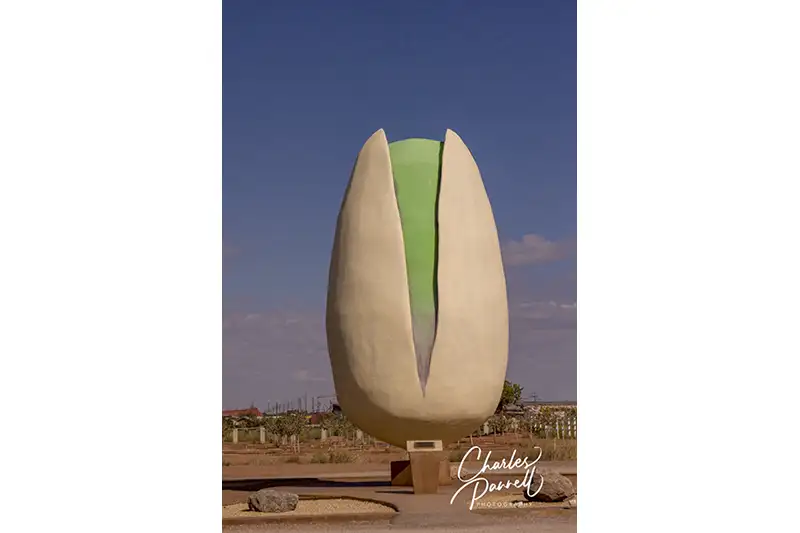
pistachioland.comLocated at the intersection of Highway 54 and Dog Ranch Road, Tim Mc Ginn’s PistachioLand is home to the world’s largest pistachio. This 30-foot monolith towers over the surrounding desert and attracts visitors from around the world. It was built by Tim McGinn to honor the memory of his father Tom McGinn. The elder McGinn founded the original pistachio and grape farm which grew into PistachioLand. Tim felt a “world’s largest” monument would be fitting, as his dad loved to stop at unique roadside attractions on their many road trips. Erected in 2007, this giant nut is constructed from five yards of concrete and is covered with 35 gallons of paint.
There’s accessible parking near the giant pistachio, and ramp access over to the perfect photo op spot. Next door there’s level access to the Country Store, which has plenty of room to maneuver a wheelchair inside. It stocks everything pistachio — from brittle and nuts, to t-shirts and souvenirs. They even have salt-free and sugar-free products. And if you’d like to sample a little vino, the Arena Blanca tasting room is in back. The World’s Largest Pistachio is fun photo stop, and the country store has plenty of free samples.
Alamogordo, NM
pistachioland.comLocated at the intersection of Highway 54 and Dog Ranch Road, Tim Mc Ginn’s PistachioLand is home to the world’s largest pistachio. This 30-foot monolith towers over the surrounding desert and attracts visitors from around the world. It was built by Tim McGinn to honor the memory of his father Tom McGinn. The elder McGinn founded the original pistachio and grape farm which grew into PistachioLand. Tim felt a “world’s largest” monument would be fitting, as his dad loved to stop at unique roadside attractions on their many road trips. Erected in 2007, this giant nut is constructed from five yards of concrete and is covered with 35 gallons of paint.
There’s accessible parking near the giant pistachio, and ramp access over to the perfect photo op spot. Next door there’s level access to the Country Store, which has plenty of room to maneuver a wheelchair inside. It stocks everything pistachio — from brittle and nuts, to t-shirts and souvenirs. They even have salt-free and sugar-free products. And if you’d like to sample a little vino, the Arena Blanca tasting room is in back. The World’s Largest Pistachio is fun photo stop, and the country store has plenty of free samples.