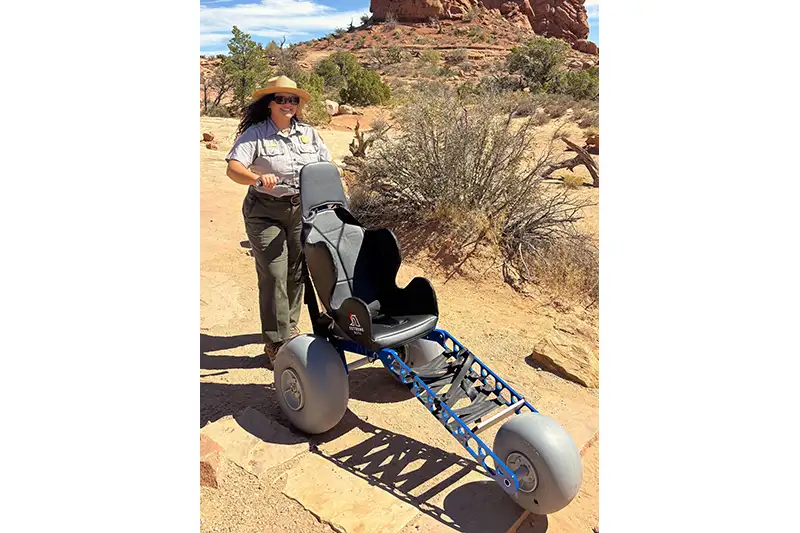
Arches National Park now has an all terrain wheelchair available for loan. This Extreme Motus chair is fitted with three balloon tires, has a long wheelbase, and requires at least one person to push and maneuver the unit. It has a maximum user weight limit of 250 pounds, and a maximum user height limit of 6 feet. The Arches all terrain wheelchair is available for loan at the Arches Visitor Center on a first-come basis. A waiver must be signed prior to checking out the chair, and a ranger will provide a brief training session on how to use the chair. The park cannot store personal wheelchairs, so alternative arrangements must be made while using the Extreme Motus chair.
The Arches All terrain wheelchair can be used on these easy trails, with one assistant.
Landscape Arch Trail
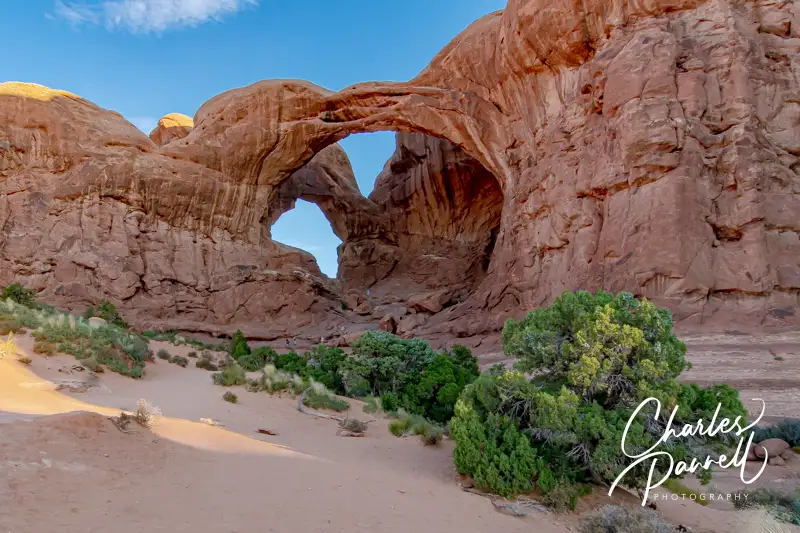
Double Arch Trail
Skyline Arch Trail
Lower Delicate Arch Viewpoint Trail
Double Arch Trail at Arches National Park
Although the Extreme Motus chair is not prohibited on the following trails, sections of them may have steps, uneven terrain and other obstacles that may require the assistance of more than one operator.
Balanced Rock Viewpoint and Trail
Broken Arch Trail
Park Avenue Trail (from Courthouse Towers Viewpoint)
Upper Delicate Arch Viewpoint Trail
Fiery Furnace (Viewpoint Trail only)
Delicate Arch Trail
Tower Arch Trail
Finally, it’s important to note, that the all terrain wheelchair is prohibited on these trails, as they are impassable without causing damage to the natural environment.
Most people don’t really think about wheelchair access, but to be honest it’s in the back of my mind everywhere I go. I’ve seen the good, the bad and the ugly when it comes to accessibility. I’d like to say that bad access doesn’t even faze me any more, but it does. Sometimes I just can’t believe folks can’t get it right in this day and age. And then there are the unexpected good surprises, like Mitchell Point Tunnel.
A Little History
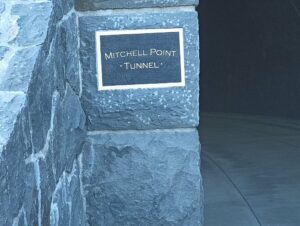
Located down in Northern Oregon, the original Mitchell Point Tunnel dates back to 1915, when John Arthur Elliott built it along the Historic Columbia River Highway. The highway was subsequently re-routed when larger cars wouldn’t fit through the tunnel; and then it was then closed and later demolished when the interstate was constructed in the 1960s. But lo and behold the Oregon Department of Transportation decided to reconstruct a pedestrian version this highway landmark in 2021.
Suffice it to say it was a huge project, and it took many years to complete. Finally in 2025 the new – and improved – Mitchell Point Tunnel was opened, and much to my surprise, it offers excellent wheelchair access. Granted, it’s not that difficult to include access when you are constructing something from the ground up, but it’s amazing how often simple access features are overlooked.
So here are a few access details that they got right at the new Mitchell Point Tunnel.
Parking
Accessible parking is easy, right? Well perhaps it is, but you’d be amazed at how many folks get it wrong. There are only about 16 spaces in the tiny Mitchell Point Tunnel parking lot, but they did manage to include an accessible parking space with adequate room for ramp deployment. And it’s located right next to the trailhead and the picnic area. It’s not rocket science, but I’m thrilled they got it right.
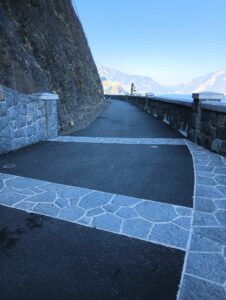
Good pathway access at Mitchell Point Tunnel
Pathway Access
There’s a paved accessible pathway that runs from the accessible parking area, past the picnic tables and over to the tunnel. Once inside the tunnel, the pathway is also paved and wheelchair-accessible. No gaps, no bumps, no access shortfalls. It’s a pleasant half-mile round-trip stroll.
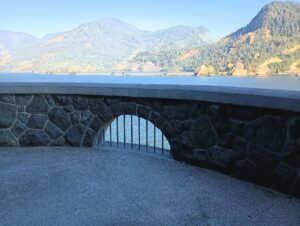
Cutouts so everyone can enjoy the view below
The View From Above
Now here is where this project really shines – in the view department. To say that this short trail offers a scenic view of the Columbia River below is an understatement. That said, I totally understand that the powers-that-be had to “idiot-proof” things and make a wall high enough so that some bozo doesn’t hop up on it for a selfie (trust me it happens). Their solution was to make archway cutouts in the rock wall below, so that you can get a good view from a seated position. Not only does it help keep the idiots in line, but it’s also an attractive and accessible solution.
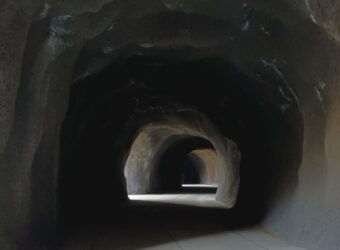
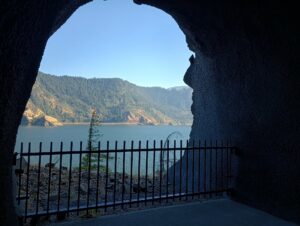
The view from inside Mitchell Point Tunnel
Inside the Tunnel
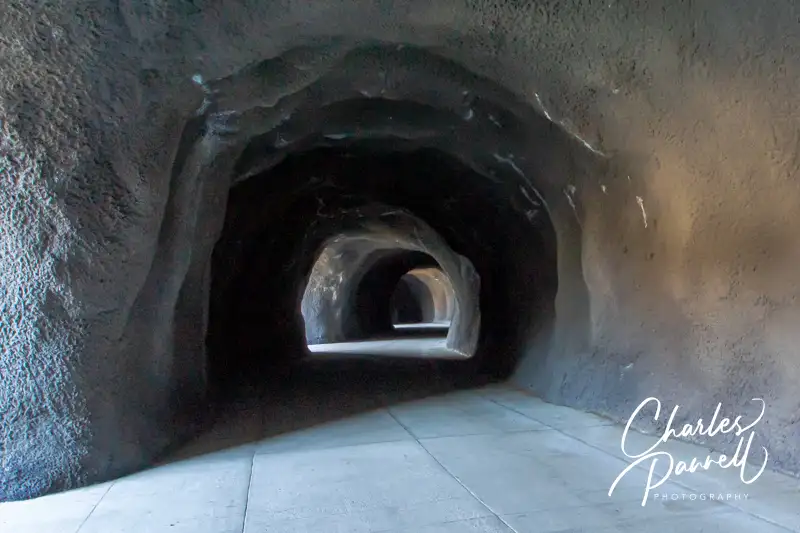
I was equally impressed with the full sized cutout windows that they have inside the tunnel. Granted they had to put up railing because of “stupid people”, but they still look good and are also quite functional. These five openings let natural light in the tunnel so it’s easier for everyone to navigate and see possible tripping hazards. Without these openings it would be pitch black in the tunnel, and people would be grabbing for their phones to safely navigate. I’ve been in tunnels like that before, and this one is so much safer.
Accessible Vault Toilets
Granted, vault toilets are not my favorite amenity; however they are necessary. These models are on a cement slab with good access from the accessible parking space. Many times vault toilets are just placed on the dirt, and over time erosion creates a large step up to them. These are done right. And of course, there’s plenty of room for even the largest wheelchair or scooter inside.
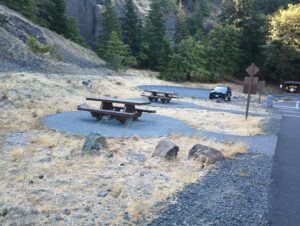
And they didn’t forget truly accessible picnic tables at Mitchell Point Tunnel
Picnic Tables
Last but certainly not least, they remembered the accessible picnic tables. And they are close to the accessible parking space. They are on a nice new level asphalt surface, and they are the true accessible models – with room on the ends for wheelchairs. Add that all up and the Mitchell Point Tunnel makes a great accessible stop to enjoy the view, stretch your legs, use the facilities or have a picnic lunch.
So stop in and check out the Mitchell Point Tunnel for yourself, on your next Oregon road trip, It’s easy to find – just take exit 58 off of Interstate 84 near Hood River, follow the signs, and enjoy!
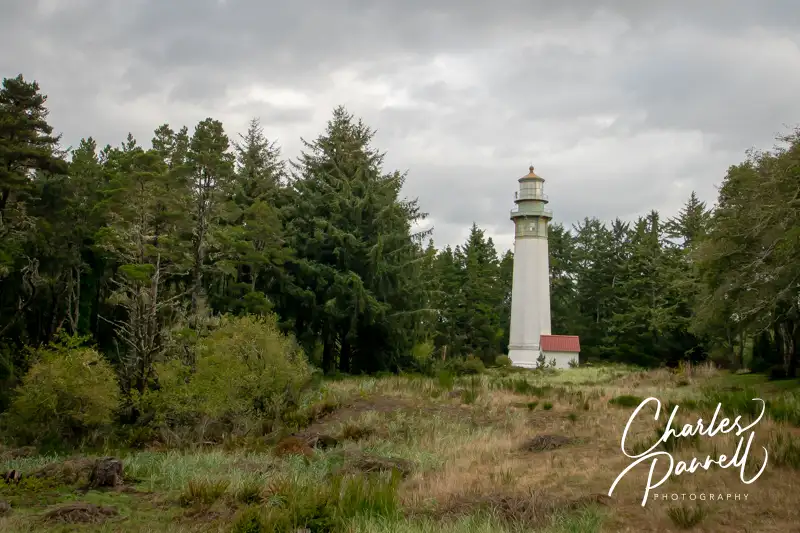
If you’d like to explore the grounds of Grays Harbor Lighthouse in Washington, then make plans to reserve this Westport track chair. It’s available from David’s Chair, and it’s housed in the Westport by the Sea Condos, which are about a .4-mile roll from the lighthouse. There are level sidewalks with curb cuts along the way, but once you get to the lighthouse you’ll need the track chair to traverse the bumpy — and sometimes muddy — dirt trail.
This track chair needs to be reserved at least seven days in advance. Transfer assistance cannot be provided, so if you can’t transfer independently you’ll need to bring along some help. This track chair has a maximum capacity of 350 pounds. For more information, or to request the Westport track chair, visit davidschair.org/request-fixed-location-chair. And for details on some wheelchair-accessible trails and lodging suggestions in the area, visit emerginghorizons.com/westport-a-wheelchair-accessible-pacific-northwest-gem
Barrier-Free Travel
Washington National Parks
for Wheelchair-Users and Slow Walkers
California is home to numerous Giant Sequoia groves. That said, some are more tranquil than others. The good news is, it is possible to spend the night just steps from these stately giants, in a rustic wheelchair-accessible yurt at a peaceful Central California campground. Not only is this remote campground pleasantly bereft of the summertime crowds, but it’s right across the street from a wheelchair-accessible Trail of 100 Giants (www.fs.usda.gov/r05/sequoia/recreation/trail-100-giants-long-meadow-grove). So pack up the car, and get ready to enjoy this wheelchair-accessible Giant Sequoia getaway.
On the Road
Whoever said that getting there is half the fun, most likely took a road trip to the Trail of 100 Giants. The best advice is to turn off your GPS on your wheelchair-accessible Giant Sequoia adventure. It won’t do you any good and will most likely take you in the wrong direction; but more importantly, you’ll miss the scenery along the way if your eyes are glued to a screen.
From Highway 99, take exit 65 A in Earlimart, which is about a half-hour south of Visalia. Continue on through town and head east on Road 56 for about 30 miles, past Ducor, Fountain Springs and California Hot Springs. When the main road makes a sharp turn to the right just past California Hot Springs, turn left on Parker Canyon Road (M 50). If you end up in Pine Flat, turn around — you’ve missed the turn.
Continue along Parker Canyon Road for about 13 miles, but watch for livestock, as it’s open range up there. At the stop sign make a left turn on M 90 and continue along for two miles. You’ll pass the day use parking lot on the right, with access to the Trail of 100 Giants across the street. Just up the road the Redwood Meadow Campground (www.recreation.gov/camping/campgrounds/232825?q=Redwood%20Meadow) is on the right.
A Yurt in the Forest
Yurt 2 in the Redwood Meadows Campground
The Redwood Meadows Campground has just 12 campsites, but the good news is, half of them have wheelchair-accessible yurts. And although the accommodations are pretty basic, you just can’t beat the location. Additionally, you’ll never feel crowded at this small campground.
Yurt 2 is a top wheelchair-accessible choice. It’s close enough to the facilities, yet it has a lot of privacy, and there’s a beautiful picnic area behind the yurt. Parking is available in a level dirt area in front of the yurt; and although the yurt is ramped, there is a one-to-two inch lip at the head of the ramp because of erosion. That’s also the case for the other accessible yurts in this campground. Still, with a little help, it’s doable. On the plus side, the yurt has a wide doorway, a level threshold and plenty of maneuvering room.
Furnishings include a bunk with a 20-inch high double bed on the bottom and a twin bed on the top, as well as a 16-inch high queen-sized bed. There’s also a large chair in the yurt, but other than that there’s no furniture. It’s important to note that there’s no electricity in the yurt, and you’ll also need to bring your own bedding and water. Accessible vault toilets are located nearby, close to the campground entrance, with accessible parking next to them. And although they are cleaned regularly, it’s best to bring your own toilet paper as sometimes it’s in short supply.
It should also be noted that this seasonal campground in closed in the winter. It’s usually open from mid-May through October, so plan ahead to avoid disappointment.
Inside Yurt 2 in the Redwood Meadows Campground
Explore the Giant Sequoias
Trail of 100 Giants
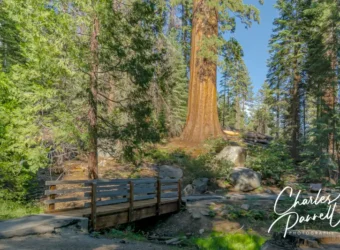
From the Redwood Meadows Campground, cross the street to explore the trails in Long Meadow. This secluded grove features approximately 125 giant sequoias, the largest of which is 220 feet tall and has a diameter of 20 feet.
The trail forks off in two directions shortly after the main trailhead; and the path to the right leads to the Trail of 100 Giants. The half-mile trail is paved and has a six percent maximum grade, but it’s best to take the loop in a clockwise direction to dodge most of the uphill sections. There are interpretive signs along the way, as well as benches to sit and rest and enjoy the forest. And one of the best parts of this trail is that you can get amazingly close to the giant trees.
Once you circle back to the beginning of the loop, follow the signs to the Fallen Giants Loop to the left. At one time there was only one trail through the grove, but on September 30, 2011 two massive trees fell and blocked a portion of the existing trail. Since then an elevated boardwalk has been constructed alongside the fallen trees, which connects back to the original trail. The whole loop is just over a mile long, and it gives visitors an up-close-and-personal look at the downed trees. And although there are few a dips in the paved trail, it’s well maintained, and the bad sections are easy to dodge. It’s a nice meander through the forest, and this trail is also easy to access from the day-use parking area.
Both trails make for a beautiful summertime stroll, and although the grove is a bit hard to find, it’s definitely worth the effort.
Mount Hood is a popular Oregon landmark. To locals, the appearance of this 11,249-foot high giant is a sign of nearing home; and to visitors it’s a sight to behold at first glance. You can drive up to Timberline, ski down the slopes of this active volcano, or even attempt to scale the popular mountain. On the other hand, there are also a number of accessible ways to enjoy this scenic area. So pack your bags and leave the crowds behind, as you explore these wheelchair-accessible nearby Mount Hood stops on your next Western Oregon road trip.
Trillium Lake
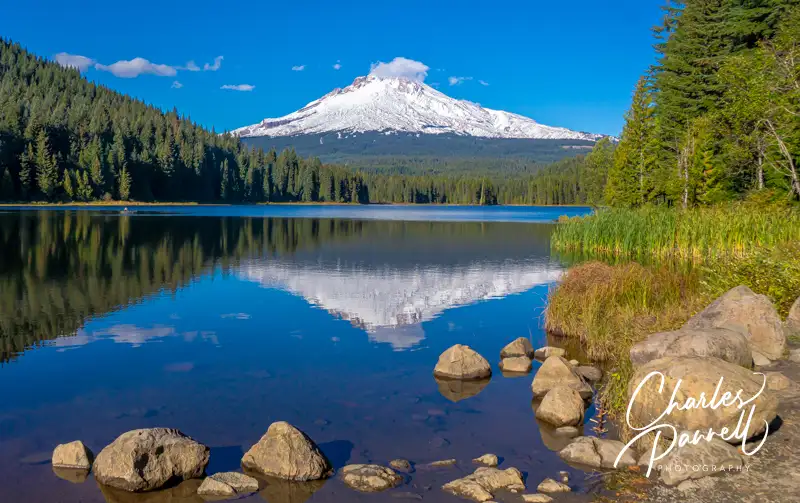
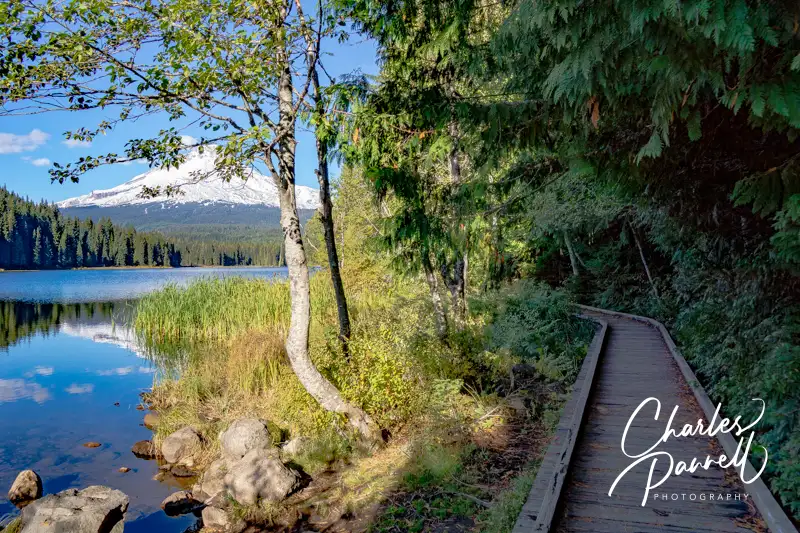
Mount Hood Viewed from the Dam at Trillum Lake
At the top of the list is Trillium Lake, which is a 10 minute drive south of Government Camp off of Highway 26. You’ll need a Northwest Forest Pass (www.fs.usda.gov/r06/passes) to access this site, or you can pay the $10 day-use fee. National parks passes are not accepted.
Before you settle in for a walk on the improved boardwalk system, take some time to drive to the dam for an unforgettable Mount Hood view. There’s accessible parking near the dam, and level access over to a great Mount Hood viewpoint. And although the Trillium Lake Trail lake passes through this area, this section is rocky and bumpy, and not really a good choice for wheelchair-users..
The best place to access the Trillium Lake Trail is from the day-use area. There’s accessible parking near the boat ramp and the picnic area. There’s also an accessible vault toilet near the ramp. The accessible portion of the Trillium Lake Trail trail begins just to the right of the boat ramp, and moves towards the campground. You can also access this trail from the campground; however that area is usually only open to registered campers.
The two-mile lakeside trail begins as a hard-packed dirt trail, with older boardwalk sections here and there. After it passes the campground amphitheater, there’s a sizable new section of boardwalk with plenty of room for even the largest wheelchair. The trail continues over to the east shore of the lake for a great Mount Hood view, but loses its access due to bumps and rocks shortly after that, at about the 1.25-mile point. Still it’s a beautiful out-and back stroll.
And if you’d like to spend the night in Trillium Lake Campground, check out wheelchair-accessible campsite 35, which offers paved access to the Trillium Lake Trail.
Along the Trillium Lake Trail
Little Crater Lake
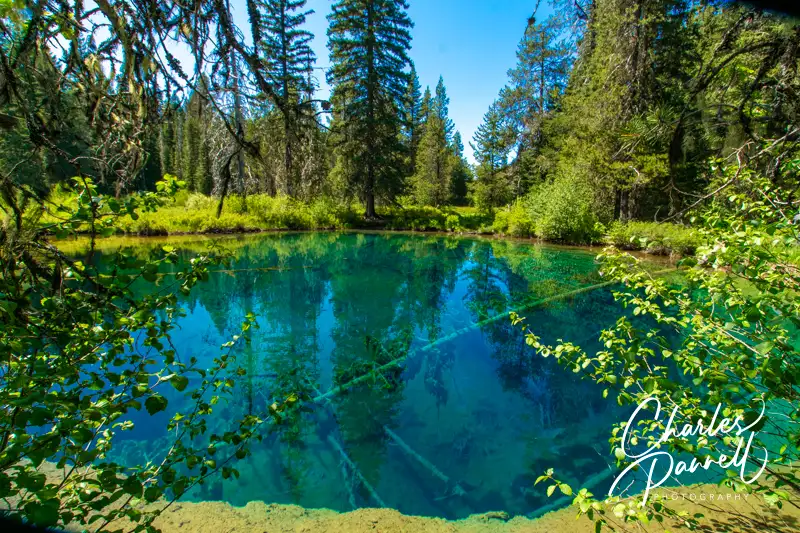
Little Crater Lake
Next up on the list of accessible scenic stops is Little Crater Lake. It’s located about 20 miles south of Trillium Lake. Just take Highway 26 and turn right on Oregon Skyline Road (NF 42). Then make another right on Abbott Road, and follow the signs to Little Crater Lake Campground. This site also only accepts the Northwest Forest Pass.
The lake is located on the far side of the campground — just follow the road around until you see the small parking area. The lot is unstriped, but there’s usually room to parallel park an adapted van. There’s an accessible vault toilet across the road, and level access over to the trailhead to Little Crater Lake.
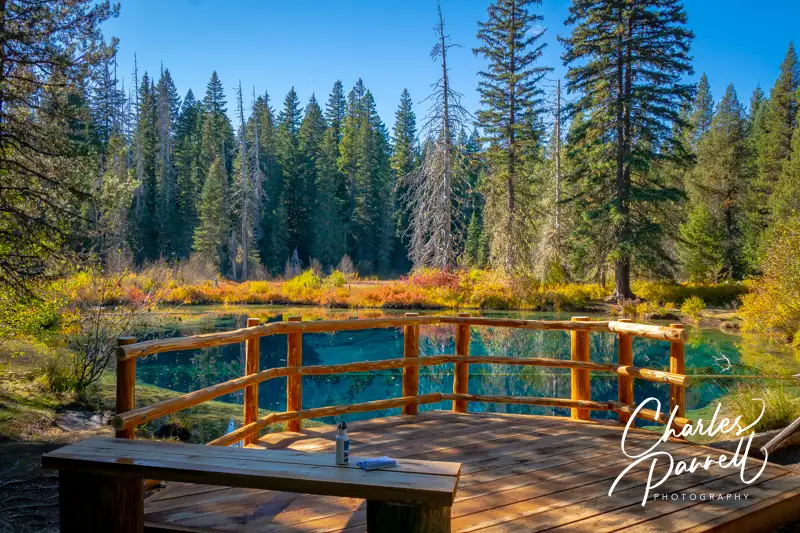
The 250-yard paved level trail leads through the meadow, crosses a bridge, then winds through the forest. There are a few bumps along the way, but it’s definitely passable in a wheelchair. There’s a large viewing deck at the end of the trail that offers a nice view of crystal clear Little Crater Lake. It’s not a busy trail, so the viewing platform is a pleasant spot to just sit and enjoy the space.
And although the trail continues past the lake, it’s not wheelchair-accessible. The path winds through the forest for a quarter-mile, with a few roots to dodge along the way, and a step up to the bridge near the end. It may be doable for some slow walkers, as it’s level; however there are too many obstructions for wheelchair-users to dodge. Still the trek out to the viewing platform is worth the trip. And if you’d like to spend the night, most of the campsites in the adjacent campground are level.
Viewing Platform on Little Crater Lake
Another Lodging Choice
On the other hand, if you’d like to spend the night but you don’t want to pitch a tent, you can still explore the area and then spend the night in comfort at the nearby Best Western Mount Hood Inn. It’s conveniently located in Government Camp, just off Highway 26, about five miles northwest of Trillium Lake.
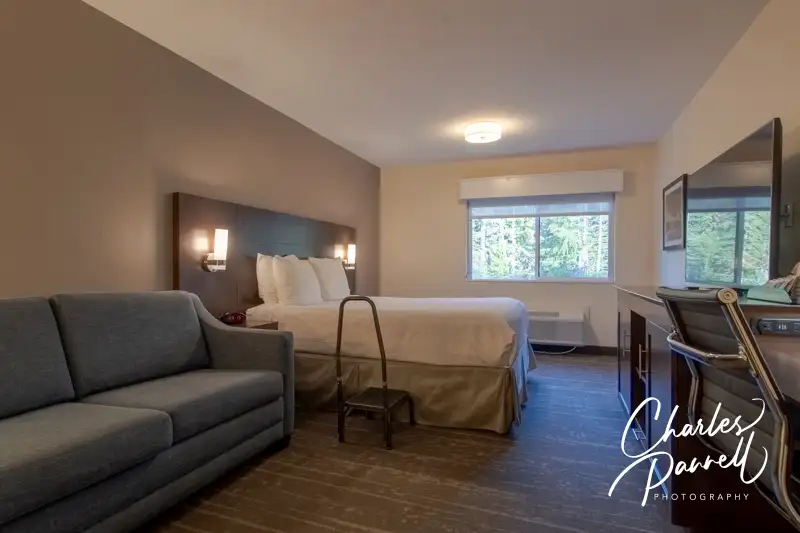
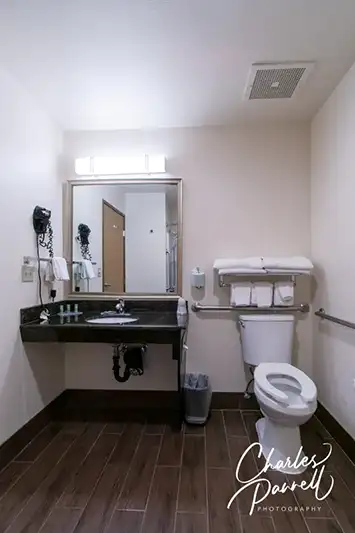
There’s accessible parking in front with level access into the spacious lobby. The property features good pathway access throughout the lobby area, and elevator access to all floors. Accessible room 217 features wide doors, lever handles, good pathway access, a lowered clothing rod, and laminate flooring and low-pile carpet for easy rolling.
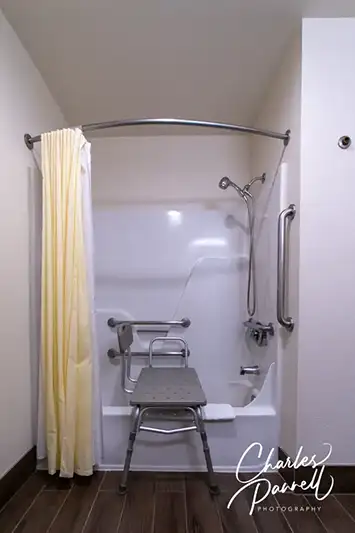
It’s furnished with a 29-inch high open-frame queen-sized bed with wheelchair access on both sides, a desk with a chair, a microwave and a refrigerator. There’s also a 13-inch high sleeper sofa in the room; and if you’d prefer two standard beds, there also an accessible room with two queens. The bathroom includes a tub/shower combination with grab bars, a hand-held showerhead and a portable shower bench . The toilet grab bars are located on the back and left walls (as seated), and there’s also a roll-under sink with a lowered mirror in the bathroom.
A full self-serve buffet breakfast is included each morning; and there’s good access to the breakfast room, which is located near the elevator. The Best Western Mount Hood Inn is a comfortable spot to overnight, after a full day of exploring the accessible outdoor areas near Mount Hood.
Room 217 at the Mount Hood Best Western
Sink and Toilet in Room 217 at the Mount Hood Best Western
Shower in Room 217 at the Mount Hood Best Western
Barrier-Free Travel Glacier, Yellowstone and Grand Teton National Parks for Wheelers and Slow Walkers
Designed by John Arthur Elliott who took his inspiration from a cliffside tunnel above Lake Lucerne, the original Mitchell Point automotive tunnel was built in 1915. Over the years, traffic along the Historic Columbia River Highway was rerouted to accommodate larger vehicles. In the 1950s the original tunnel was blocked with debris, and it was subsequently destroyed in 1966 during construction of the interstate. After decades of closure, in 2021 the Oregon Department of Transportation launched an ambitious project to build a replica pedestrian tunnel in the same location. The project was completed in 2025, and today the new Mitchell Point Tunnel is a must-stop when you’re heading east on Interstate 84, near Hood River. Just take exit 58 and follow the signs.
There’s accessible parking in the small parking lot, with level access over to the paved trail that leads out to the new Mitchell Point Tunnel. The trail parallels the Columbia River below, and thanks to cutouts in the high rock wall lining the path, everyone can enjoy the expansive view. It’s a pleasant walk, with lots of photo ops. The tunnel itself has five arched openings along its length, to let in light and ease navigation. And when you get to the end there’s an equally impressive Columbia River view. It’s about a half-mile round-trip stroll, and there are also accessible picnic tables and vault toilets near the trailhead. It’s a nice stop for a driving break and a picnic lunch.
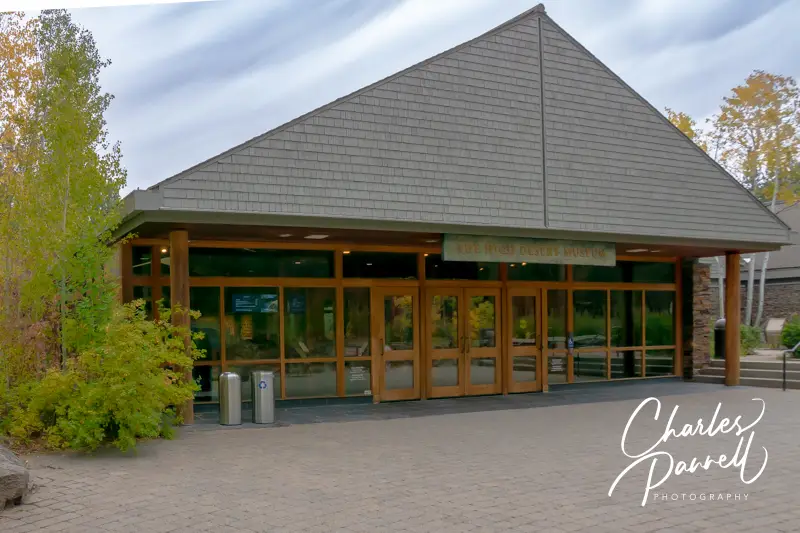
Located along Highway 97 just south of Bend, the High Desert Museum (highdesertmuseum.org/) doesn’t look like much from the lone sign that graces the entrance. That said, as you wind your way up the driveway through the surrounding forest, things begin to come into focus as you spot the main museum building. And by the time you enter the complex, and check out the surrounding enclosures and exhibits, it becomes apparent that this off-the beaten-path find is much more than initially anticipated.
Defined as the highland area on the eastern side of the Cascades, the high desert is the ancestral home to native peoples, as well as a land that supports an abundant wildlife population. The High Desert Museum explores — and even celebrates — the combined history and zoology of the area. This 135-acre campus, which is nicely hidden from the adjacent highway, includes a 100,000-foot indoor museum space, as well as expansive outdoor exhibits. And although the complex was constructed in a rugged natural environment, great thought was given to inclusion, so today wheelchair-users and slow walkers can also enjoy this beautiful space.
A High Desert Primer
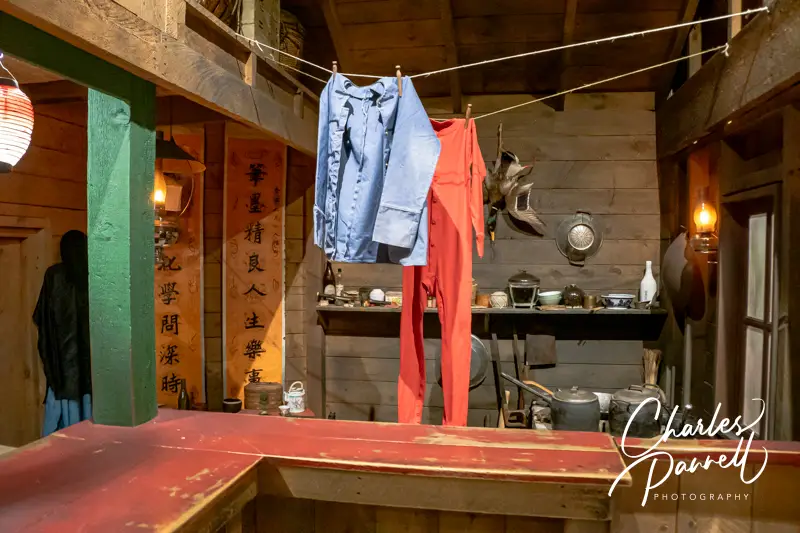
Exhibit in the Main Museum
There’s plenty of accessible parking in the front lot, with level access over to the High Desert Museum entrance. And if you can’t walk far, there’s also a large drop-off area near the door. Inside there’s good pathway access to all the exhibits, accessible restrooms and a good number of benches to sit and take a break. A loaner wheelchair is also available.
The bulk of the inside galleries focus on the resistance and resilience of the native people, and highlight the changes in the area over the past 100 years. And then there’s the Desertarium, which has an impressive collection of reptiles and amphibians that reside in the high desert. And don’t miss Juniper, the porcupine who lives in a natural habitat in the Schnitzer Entrance Hall. She and her brother Tumbleweed were born in captivity and imprinted on humans, and as a result they cannot be released in the wild.
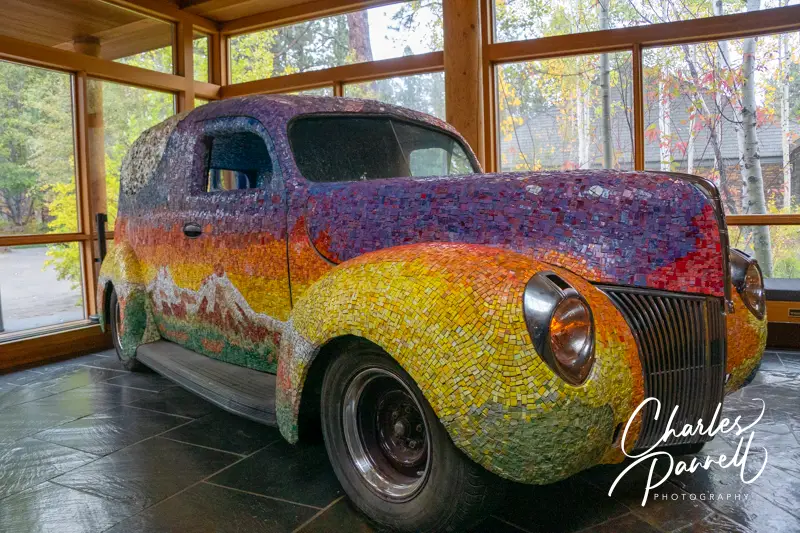
Voyager 1941 Panel Truck with High Desert Mosaic
There are also a number of rotating exhibits in the other galleries, and if you get hungry the Rimrock Cafe has some nice lunch or snack options. And don’t forget to stop in the gift shop to pick up a souvenir of your visit, before you head outside to explore the rest of the campus.
Discover the Forest
Birds of Prey Trail at the High Desert Museum
Outside, a series of trails wind around the exhibits and enclosures; and although not all of the trails are accessible, the museum map clearly highlights the routes that have steep grades. From the main building head over to the popular Donald M Kerr Birds of Prey Center, which features a courtyard with some rehabilitated residents, as well as inside exhibits. Outside, you can get up-close-and-personal with a few owls, hawks and eagles; while the inside exhibits focus on the habitat and behavior of the raptors. And don’t miss the pitch black enclosure with the barred owl.
After you’ve had your fill of raptors, head over to the Forest at Night exhibit, with a quick stop at the pond viewing area along the way. There’s barrier-free access to the Changing Forest pavilion, which includes some interpretive signs and wayside exhibits. Inside there’s equally good access to the Forest at Night interactive installation. This exhibit features the constellations above and highlights the nocturnal forest creatures. And there’s also a touchscreen that allows visitors to learn about the adaptations of the nocturnal forest creatures. It’s a fun and educational exhibit for all ages.
Step Back in Time
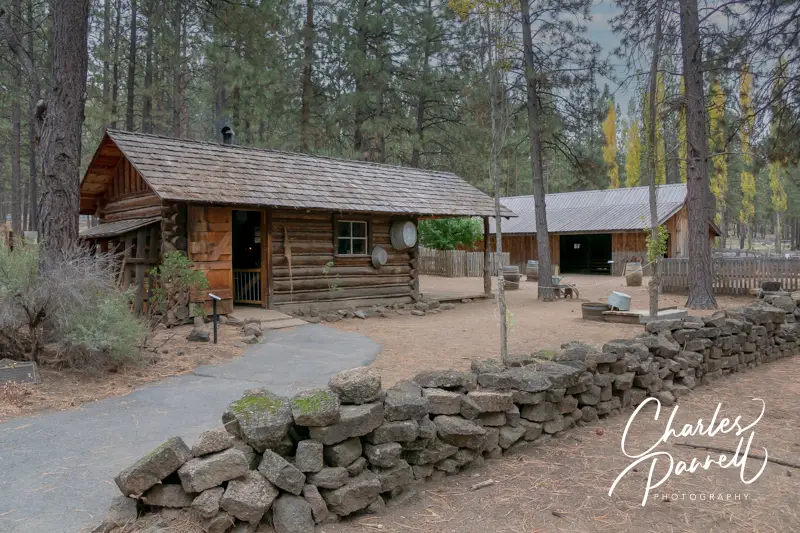
Settlers Cabin at The High Desert Museum
Another outside exhibit with good wheelchair access is the High Desert Ranch and Sawmill. And this area is truly a step back in time, as it tells the story of the early Central Oregon homesteaders. It includes a 1904 vintage cabin and barn (complete with chickens), a corral, bunkhouse, root cellar and old schoolhouse. Docents are on hand to answer questions, and there’s always a demonstration or two in the area. There’s ramped or level access to most of the buildings, as well as the old sawmill. Kids love this area, but it’s also nostalgic step back in time for adults.
After you’ve has a taste of farm life, continue on along the paved trail through the forest to the Autzen Otter Exhibit. There’s level access to the outdoor viewing area, where you can view the antics of the Brook, Pitch and Wesley, the resident otters. And for a good underwater look at them. there are also some wheelchair-height viewing windows as well as an indoor viewing area.
Of course you can always double back to any of the outdoor exhibits, but to conclude your High Desert Museum visit continue along the paved the trail. The pathway passes a playground and a large open meadow before it ends back at the main museum buildings. All in all, it’s just a half-mile trail, with good signage along the way.
And combined with the indoor exhibits this expansive outdoor area gives visitors a comprehensive – and wheelchair-accessible – look at the residents of the high desert.
Near the Entry to The High Desert Museum
Barrier-Free Travel Washington National Parks for Wheelers and Slow Walkers
Rasar State Park (https://parks.wa.gov/find-parks/state-parks/rasar-state-park) offers a peaceful taste of the forest with some great Skagit River views, a few barrier-free hikes, and several wheelchair-accessible deluxe camping cabins. This lush state park is located about 40 miles west of the North Cascades National Park Visitor Center in Newhalem, just off Highway 20. And with a second-growth forest filled with big-leaf maples, Douglas firs and western red cedars, it’s the perfect place to sit back, relax and enjoy all that Mother Nature has to offer.
Stay in Style
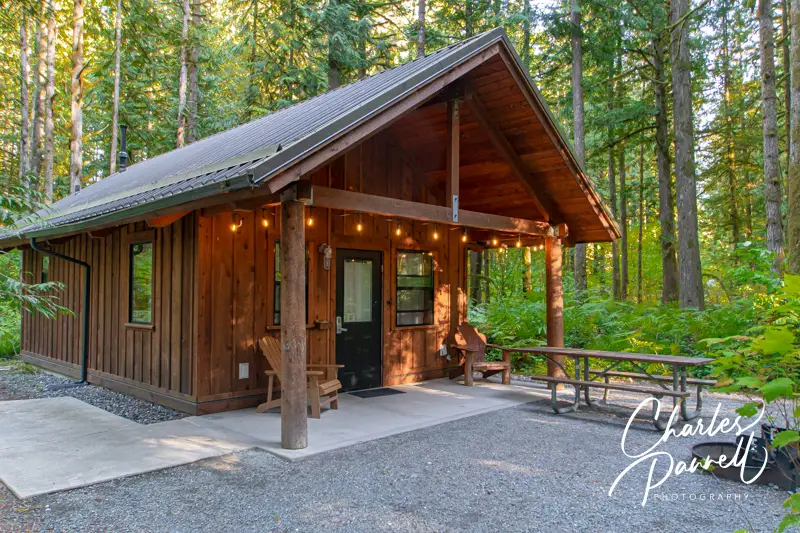
If you’d like to spend the night in Rasar State Park, but don’t want to pitch a tent, then check out one of their three wheelchair-accessible deluxe camping cabins. There’s accessible parking in front of the accessible Chinook Cabin, with paved access over to the front porch. Outside there’s an accessible picnic table and a raised grill, and two oversized Adirondack chairs.
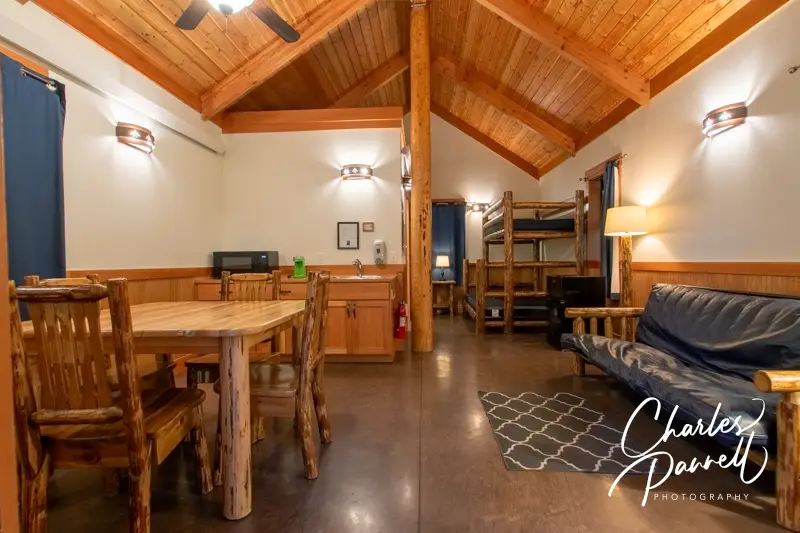
The cabin features a level threshold, wide doorways, lever handles, good pathway access and laminate floors for easy rolling. There’s a small kitchen counter area, with a few cabinets and a sink, with a dinning table and four chairs next to it. The kitchen includes a microwave, a small refrigerator and a K Cup coffee maker (bring your own K Cups).
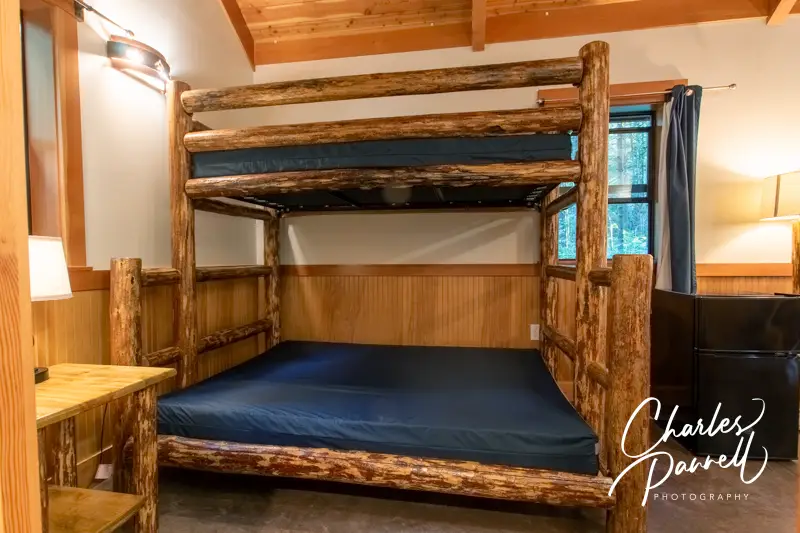
This rustic cabin features exposed beams and natural wood, and includes hand crafted log furniture. For sleeping, there’s a 16-inch high futon in the living area and a bunk bed near the bathroom. The bunk bed includes a 16-inch high double on the bottom and a single on the top. There’s a night table next to the bunk beds, and a floor lamp in the living area. Top it off with a roomy closet, overhead lights, heating and a ceiling fan, and you have a pretty comfortable setup.
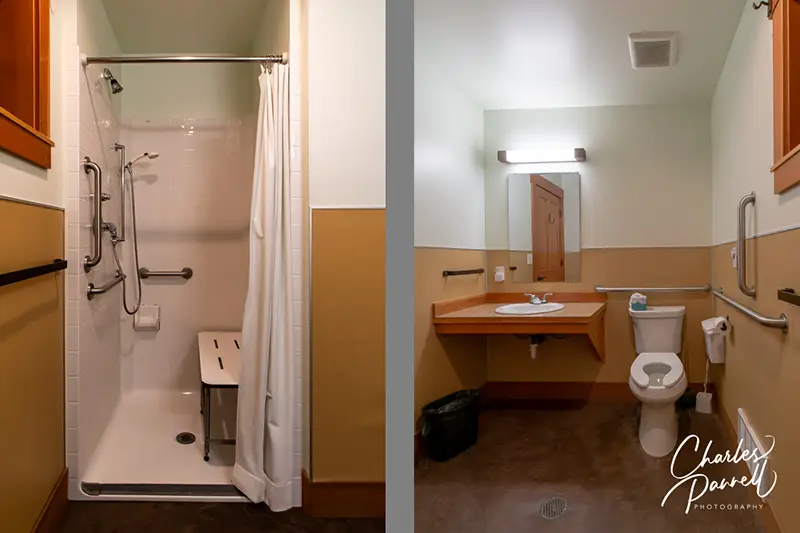
The bathroom features a full five-foot turning radius and includes a 36-inch-square transfer-type shower, with a fold-down shower bench, a hand-held showerhead and grab bars. The toilet grab bars are located on the back and left walls (as seated) and the bathroom also has a roll-under sink.
The Coho Cabin, which is located next door has the same access features, but if you want more privacy, choose the Skagit Cabin across the road. On the plus side, all of the cabins are surrounded by the lush forest.
Living Area in the Chinook Cabin at Rasar State Park
Bathroom in the Chinook Cabin at Rasar State Park
Bedroom in the Chinook Cabin at Rasar State Park
Take a Hike
Even though it’s fairly small, Rasar State Park offers a varied landscape with several accessible trails. Most of the trails are located in the south area of the park, near the Skagit River. There’s accessible parking near the picnic area, and level access over to the trailheads. There are also accessible picnic tables on the grass, if you’d like to stop for a short lunch break.
The paved Skagit River Access begins near the picnic area, and winds through the meadow out to the river. It’s about a .3-mile jaunt down to the river, and although you can walk a little further on the hard-packed sand beach, the wheelchair-access ends at that point. After that you’ll encounter steps, bumps, rocks, and a significant uphill climb. Still, it’s a nice accessible out-and-back trail to the river.
Skagit River Trail at Rasar State Park
The Cedar Trail also starts in the picnic area. This hard-packed dirt trail leads through a canopy of trees, before the access ends at the .25-mile point. Still it’s another nice out-and-back walk, and there are a few shaded picnic tables along the way.
Cedar Trail at Rasar State Park
Another accessible trail option is located on the north side of the park. This hard-packed dirt trail loops through the second-growth forest, past the cabins and group campsites. This 1.5-mile trail begins across the road from the Chinook Cabin and to the right of the Skagit Cabin, and continues past the group camps and the private lands that border the park. And if you’d like a shorter hike, it’s easy to exit the trail at the halfway point.
Finally, if you’d like to hike through some old growth forest nearby, be sure to check out Rockport State Park and Baker Lake for some accessible options. It’s a great way to extend a Rasar State Park Visit.
Barrier-Free Travel Washington National Parks for Wheelers and Slow Walkers
The North Cascades Scenic Byway is much more than a utilitarian route. Sure it connects North Cascades National Park with points east and west, but it also offers a scenic drive with a few old growth forest wheelchair-accessible hikes along the way. So next time you are tooling along Highway 20 west of North Cascades National Park, be sure and stop for these two wheelchair-accessible big trees trails.
Rockport State Park
Along the West Interpretive Loop in Rockport State Park
The West Interpretive Loop is currently closed due to storm damage. Check the park website for updates on the repair and reopening.
First up is the West Interpretive Loop in Rockport State Park (https://parks.wa.gov/find-parks/state-parks/rockport-state-park). It’s located along Highway 20, about 25 miles west of Newhalem. This 1.4-mile round-trip hike offers a beautiful stroll through a wheelchair-accessible slice of an old growth forest.
There’s accessible parking near the picnic area, with level access over to the accessible restroom. From the picnic area, follow the trail west for .2-mile until you get to a junction with a signpost. From there, take a right (away from the Sauk Spring Trail) and continue on the Evergreen Trail for another .2 miles until you get to the West Interpretive Loop.
The .6-mile hard-packed dirt trail is covered in crushed rock, and is wide enough to accommodate even large wheelchairs. It’s not a flat trail, but it’s certainly within the ADA trail standards. The undulating trail leads through the lush forest filled with Douglas firs, western red cedars and western hemlocks. There are interpretive plaques along the way, and this shady forest stroll is the perfect place to cool off a hot afternoon. When you complete the loop, head back to the picnic area on the Evergreen Trail. As an added bonus, it’s not a crowded park, so you will probably have the trail to yourself.
Baker Lake
View from Panorama Point at Baker Lake
After you’ve completed the Western Interpretive Loop, continue west on Highway 20 to Concrete, then head north to the Shadow of the Sentinels at Baker Lake (https://www.fs.usda.gov/r06/mbs/recreation/baker-lake). It’s located about 15 miles off Highway 20, but it’s definitely worth the short detour. The trailhead is located in a small pullout, just before the turnoff to Horseshoe Grove Campground. You can’t miss it, as there’s a cross section of a large old growth tree in the parking lot.
Shadow of the Sentinels Trail
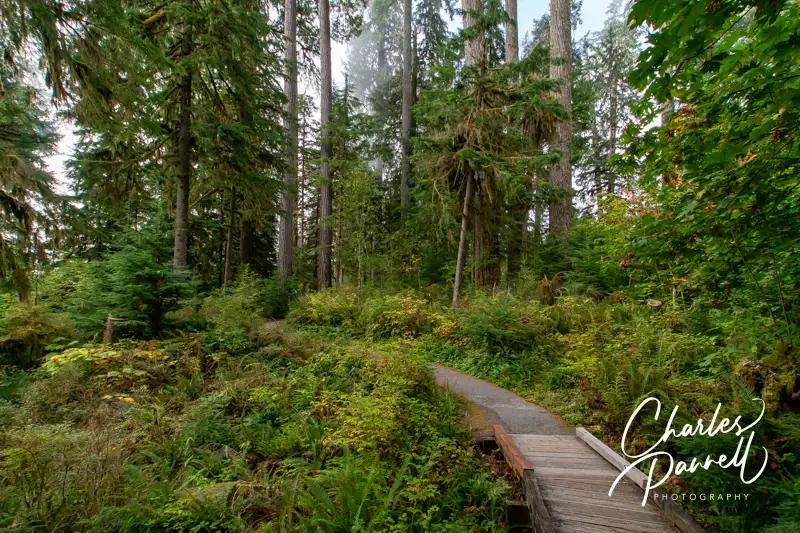
There’s accessible parking near the trailhead, and at the other end of the lot near the accessible vault toilet. This .5-mile loop trail begins as a boardwalk through the old growth forest, and transitions back-and-forth between that and an asphalt trail and a hard-packed dirt trail. There’s a slight elevation gain along the way, but it’s well within the standards. The boardwalk is in excellent repair, and although there are a few frost heaves in the asphalt, they are pretty easy to dodge.
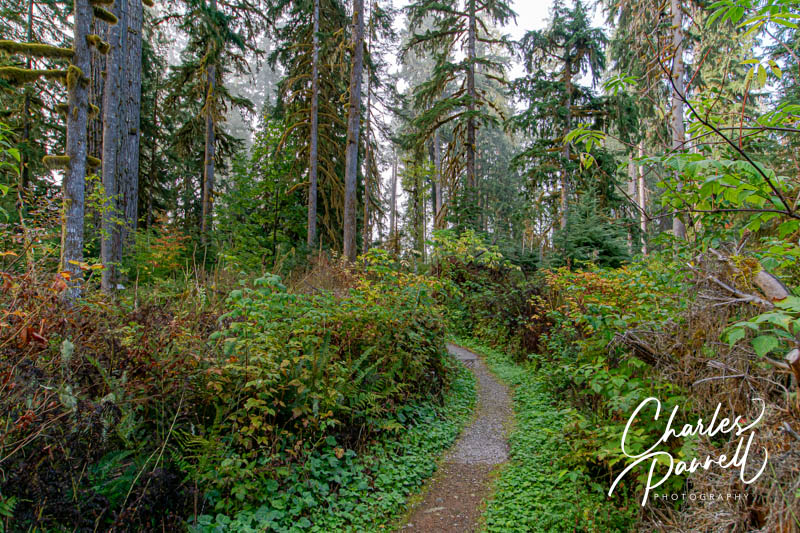
The trail is lined with Douglas firs and western hemlocks, with interpretive plaques along the way. There are a number of downed trees and snags in the adjacent forest, and if you’d like to take a break there are a few benches on the trail. There are also a few side trails to viewpoints in the forest, and one to an extra large Douglas fir tree. It’s estimated that some of the trees in this grove are nearly 700 years old.
Shadow of the Sentinels Trail
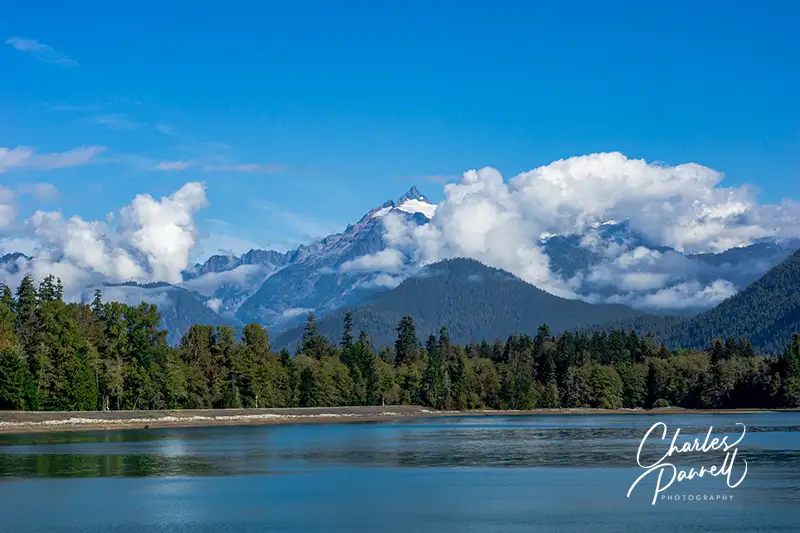
As an added bonus, the drive up to Baker Lake is beautiful. And if you’d like to sneak a peek at at Baker Lake and the Cascades, then head over to the Panorama Point boat launch or drive down to the end of Mount Baker Dam Road. It’s the perfect way to end this North Cascades scenic outing.
Barrier-Free Travel Washington National Parks for Wheelers and Slow Walkers
Named for the giant Rio Grande bend that carves out its southern border, Big Bend National Park is located more than 100 miles from the nearest freeway, hospital or shopping mall. And spring is the ideal time to visit this remote Texas park, as not only is the desert filled with colorful wildflower blooms, but the temperatures are also fairly mild. And despite its seemingly inhospitable environment, Big Bend also boasts wheelchair-accessible trails, overlooks, scenic drives, and even an accessible overnight lodging option. In short, Big Bend is the perfect road trip stop for wheelchair-users and slow walkers, who want to ditch the crowds and enjoy the wide open spaces of the Lone Star State.
Windshield Views Galore!
Sotol Vista Trail
The best way to enjoy this 800,000-acre expanse is to take a drive, and in that respect the Ross Maxwell Scenic Drive tops the list. This 30-mile route leads past the Castolon Historic District and Santa Elena Canyon, and passes through some historic and geologic treasures along the way. The drive takes about 45 minutes one-way, but be sure to allow extra time to stop and admire the scenery.
The drive begins just off the main park road, with a south turn at the Castolon – Santa Elena Junction. There are a number of scenic overlooks along the way, including the Homer Wilson Ranch Overlook and Mule Ears Viewpoint — both of which have accessible parking with barrier-free access out to the viewpoints. The former features views of the old ranch house and surrounding land, while the latter offers the best vantage point for a glance at the iconic Mule Ears rock formation.
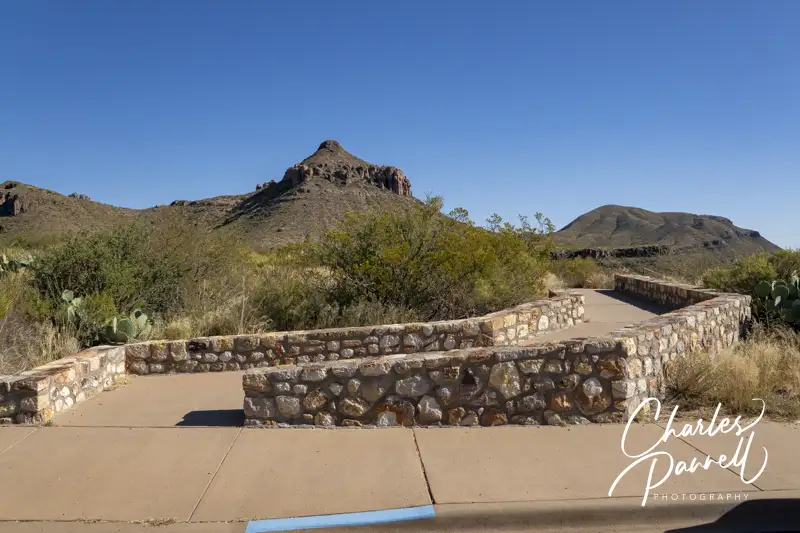
Located between those two overlooks, Goat Mountain Viewpoint, features accessible parking, with ramp access out to the overlook; while nearby Sotol Vista offers a panoramic southern view with accessible parking, an accessible vault toilet, and barrier-free access to the overlook.
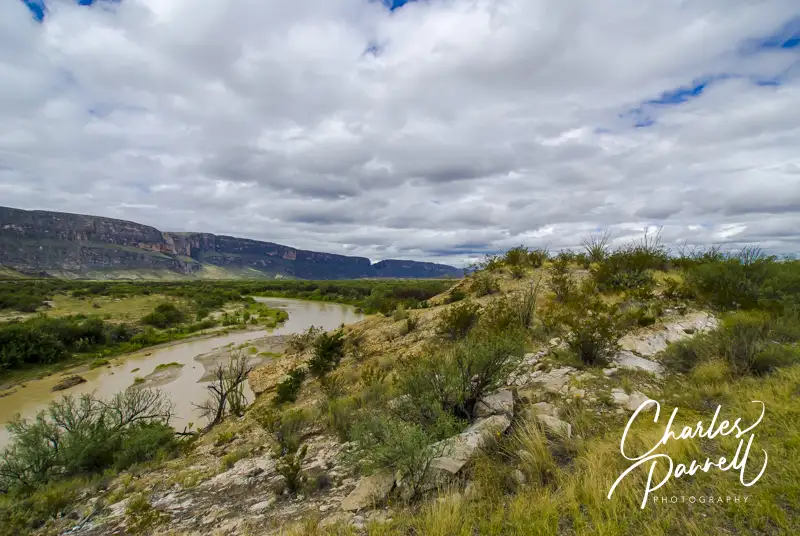
Last but not least, don’t miss the Santa Elena Overlook at the end of the road. From the overlook you can gaze down at the limestone canyon created by the Rio Grande, and look across into neighboring Mexico. Although there’s no curb-cut access from the parking area to the overlook, you can wheel down to where the curb ends and roll out to the overlook. Even though the ground is a bit bumpy in places, it’s still doable for most people, and the spectacular view is well worth the effort.
Scenic Desert Trails
Window View Trail
Although there’s no shortage of great windshield views in the park, there are also a few accessible trails. Panther Path, which is located next to the Panther Visitor Center offers a short – but accessible – introduction to some of the plants found in the park. Accessible parking is located near the visitor center, with level access over to this short 100 yard sidewalk that’s lined with interpretive plaques that identify desert plants.
A portion of the Rio Grande Village Nature Trail is also a good choice for wheelchair-users and slow walkers. It’s located in the southeast area of the park, near Boquillas Canyon. The trailhead is actually located in the campground at Rio Grande Village, across from campsite 18. The trail begins with a short dirt path to the quarter-mile boardwalk over the pond. Some folks may need a bit of assistance over the dirt trail, as it’s a bit bumpy, but the floating boardwalk offers excellent access, and it’s a great spot to enjoy the sunrise or sunset. It’s also an excellent birding location.
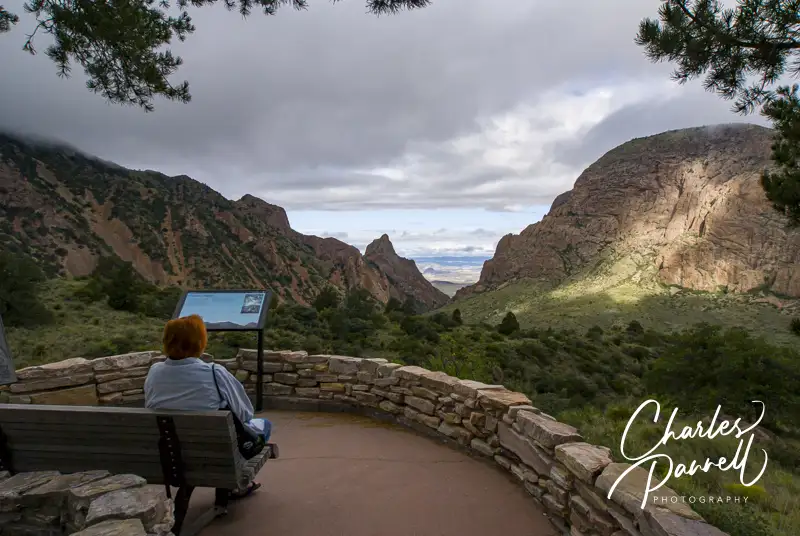
Sunsets are phenomenal in Big Bend National Park, and there’s no better place to enjoy one than from the Window View Trail (not to be confused with the inaccessible Window Trail). The trailhead is located near the Basin Store at Chisos Mountains Lodge. This .3-mile paved trail takes its name from the “window” opening in the canyon that affords a panoramic view of the valley below. It offers a gradual descent to the window viewpoint, which is a pleasant place to linger and enjoy views of the spectacular canyon walls and the Chisos Mountains. And if you need to stop and rest, there are also a few benches along the route.
Comfy Accommodations
Because of its remote location, an overnight stay in Big Bend National Park is a must; and to that end Chisos Mountain Lodge (www.chisosmountainslodge.com) offers some comfortable accessible rooms. There’s accessible parking in front of the office, with level access to the main lobby through automatic doors. Inside there’s plenty of room to maneuver a wheelchair over to the front desk and the gift shop. The accessible rooms are located a short drive away in the Casa Grande section of the property.
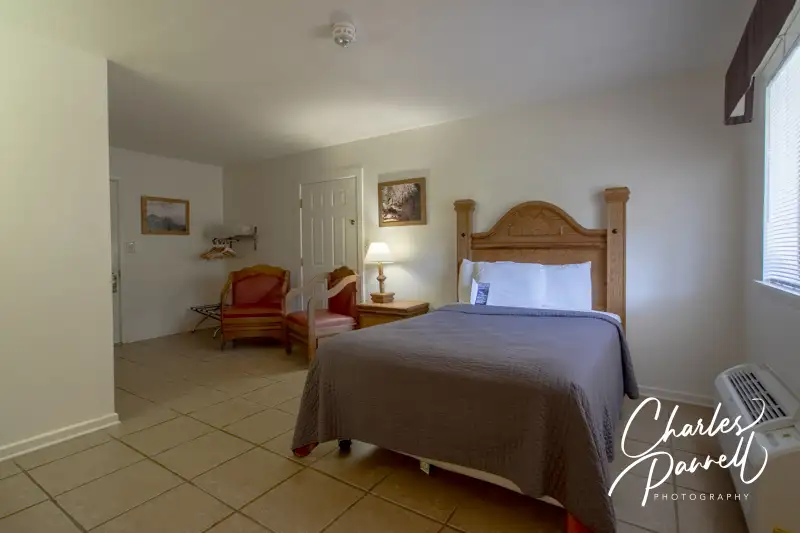
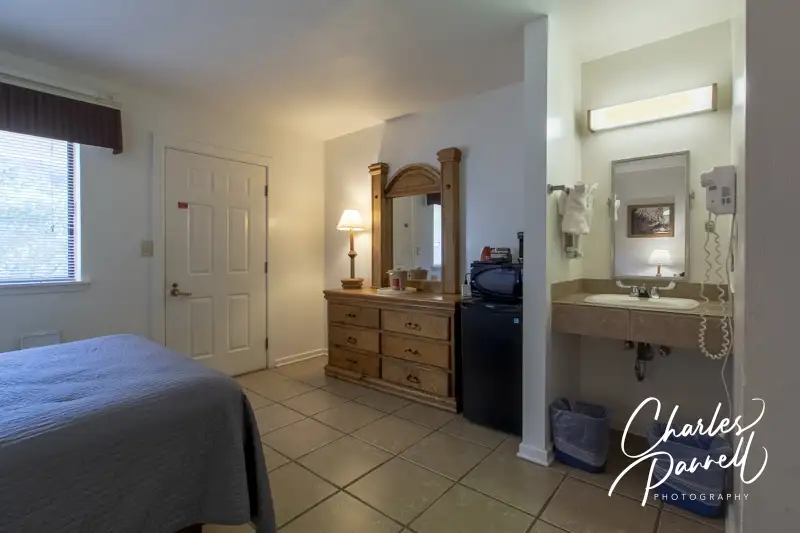
Accessible parking is located in front of room D2 — an accessible ground floor room – with sidewalk access over to the front door. Access features in room D2 include wide doorways, a lowered peephole, lever handles, good pathway access and tile floors for easy rolling. The room is furnished with a 25-inch high open-frame double bed with wheelchair access on the left side (as you face the bed). That said, there’s plenty of room to move the bed if you require wheelchair access on the opposite side. Other furnishings include a night stand, two easy chairs, a dresser, a refrigerator and a microwave.
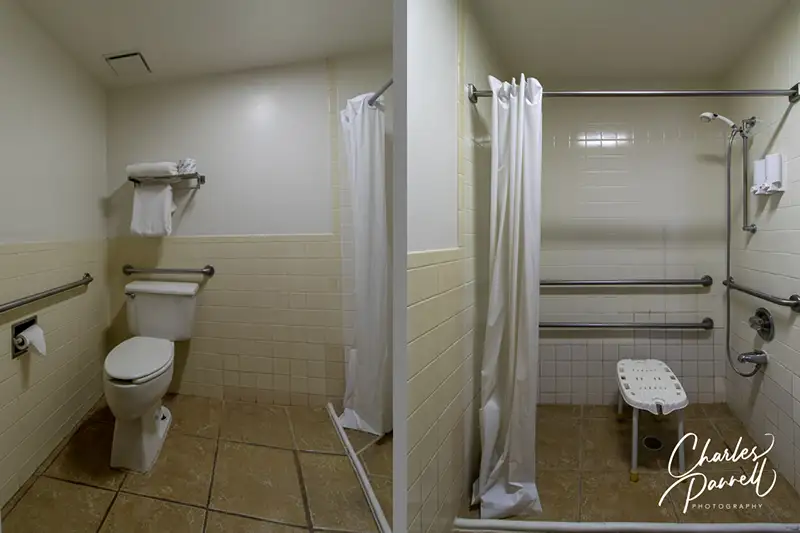
There’s barrier-free access to the bathroom, which features a roll-in shower with grab bars and a hand-held showerhead. The toilet grab bars are located on the back and right walls (as seated), and a portable shower bench is available upon request. A roll-under sink is located in the adjacent sleeping area, in order to free up more room space in the bathroom.
Best of all, this guest room also has level access out to the shared back patio, which is the perfect place to enjoy an sunset, and then take in another one of Big Bend’s natural features – the dark night sky.
(Click image for larger images of Room D2 at the Chisos Mountain Lodge)
Room D2 at the Chisos Mountain Lodge
Room D2 at the Chisos Mountain Lodge (view 2)
Bathroom in Room D2 at the Chisos Mountain Lodge
Barrier-Free Travel Utah National Parks for Wheelchair-users and Slow Walkers