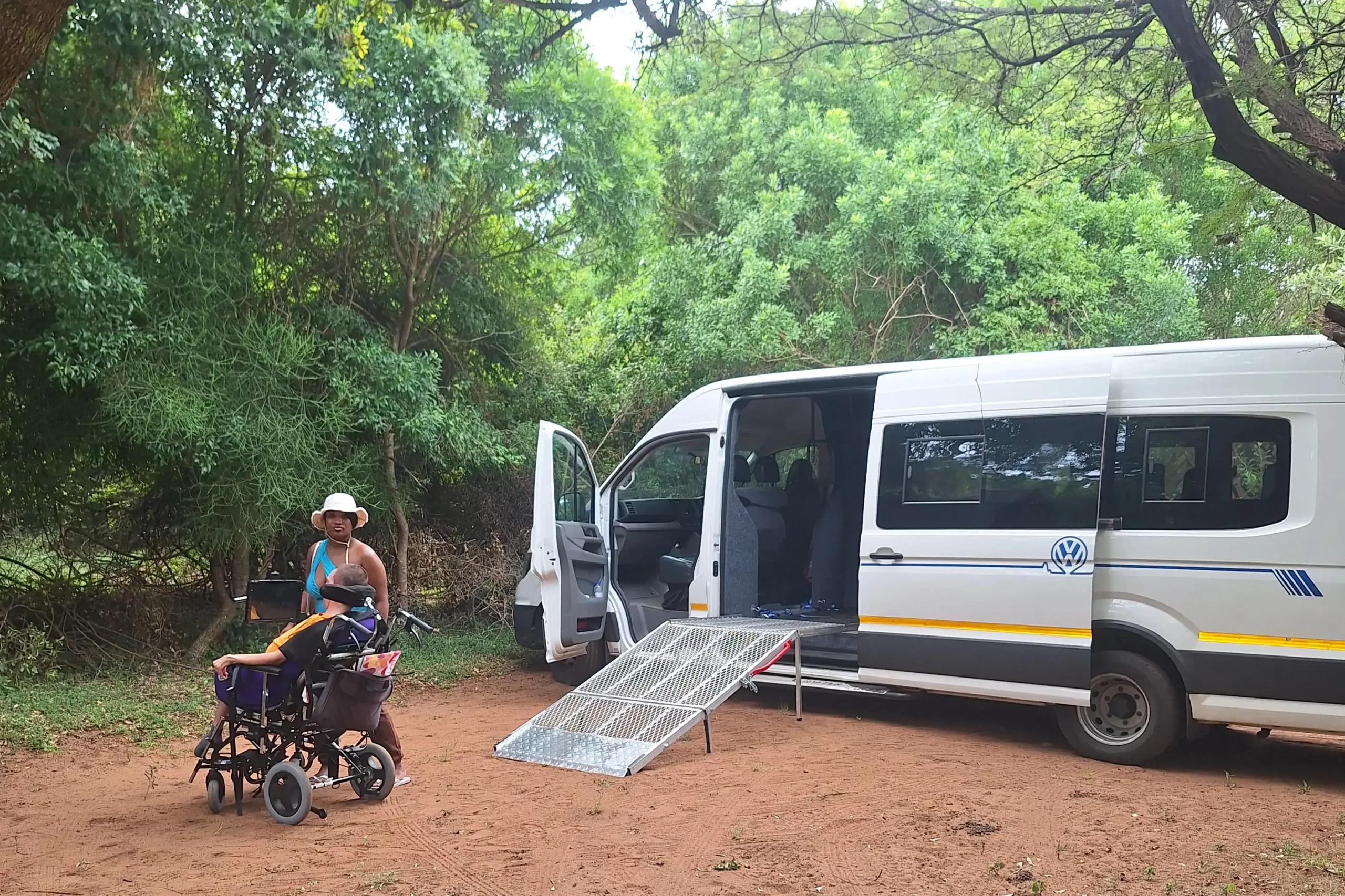
If you’d like to take a wheelchair-accessible Trinidad & Tobago beach excursion, then look no further than T&S Transport & Tours. This local operator offers wheelchair-accessible transportation in lift-equipped or ramped vans to favorite beaches, and includes the use of floating beach wheelchairs while you are there. Choices include Maracas Beach, Las Cuevas Beach, Manzanilla Beach, La Brea Beach and Chaguaramas Beach. And although all these beaches are beautiful, Maracas Beach is reported to be the most accessible choice. T&S Transport & Tours also offers wheelchair-accessible airport transfers, and other local excursions. For more information, visit www.wheelchairtransporttt.com/beaches.
Barrier-Free Travel
101 Accessible Vacations: Travel Ideas for Wheelchair-users and Slow Walkers
Although there’s no shortage of fun diversions in the bustling city of Anchorage, visitors often overlook sights located outside of the city center. Granted, it takes a little planning to take them all in, but it’s well worth the effort. And it’s a great option for a pre- or post-cruise stay. So rent a vehicle, pack your sense of adventure, and get ready to visit these sites on a wheelchair-accessible Anchoarage day trip.
Learn About Indigenous People
Dancers at theAlaska Heritage Cultural Center
Surrounded by the Chugach Mountains, the Alaska Native Heritage Center (www.alaskanative.net/) tops the must-see list. It’s just a short drive north of downtown Anchorage on the Glenn Highway; however this open-air museum seems a world away from the trappings of city life. Situated on 26 acres of prime forest land, this top-notch cultural attraction offers exhibits and programs about Alaska’s indigenous people.
Access is good at the Alaska Native Heritage Center, with plenty of accessible parking in front, a handy drop-off zone near the door, and level access to the front entrance. There’s a wheelchair available for loan at the front desk, and accessible restrooms near the entrance.
From the information desk a ramp leads down to the Gathering Place, where dances, games and stories are shared throughout the day. There’s also level access over to the Hall of Culture, which offers interactive exhibits about the indigenous cultural groups in Alaska. Films are also screened throughout the day in the adjacent theater, which offers level access with wheelchair and companion seating.
Outside, a level paved pathway circles the lake, where villages representing the indigenous people are located. Each village contains at least one structure, with clothing, weapons, tools and other artifacts of that culture on display. Members of the group — usually youth — are on hand to talk about their culture and to answer questions. And although some buildings have a few steps, it’s still possible to get a feel for each culture from the other interpretive exhibits.
Take a Walk on the Wild Side
Grizzly Bear at the Alaska Wildlife Conservation Center
If you’d like to get an up-close-and-personal look at some native wildlife, then be sure and stop in at the Alaska Wildlife Conservation Center (alaskawildlife.org/) on your excursion. Technically this attraction is located in Portage, about 48 miles south of Anchorage; however it’s definitely worth the one-hour drive. The compound is easy to find too, as it’s on the Seward Highway, just north of Portage Road.
The Alaska Wildlife Conservation Center has a mission of education and conservation. It’s not a zoo, and quite a few of the animals are rescues. There’s ramp access up to the main building, and plenty of room to maneuver a wheelchair inside. Outside, the resident animals are kept in large enclosures surrounded by boardwalks or walkways. Visitors can choose to walk the 1.5-mile level route around the enclosures, or drive their own car and park at the bear boardwalk or the Turnagain Arm boardwalk. Along the way you’ll see moose, reindeer, lynx, elk, caribou and even bison.
The bear enclosure is a must-see, as a boardwalk travels above the exhibit which houses both black bears and grizzlies. And although the Turnagain Arm boardwalk is just outside of the park, it’s definitely worth a stop to see the bald eagles swoop down over the snow-covered mountains, and glide over the mud flats in search of some food. Additionally, there are benches at the end of the boardwalk if you’d like to sit and take a break.
Lynx at the Alaska Wildlife Conservation Center
Bring Your Binoculars
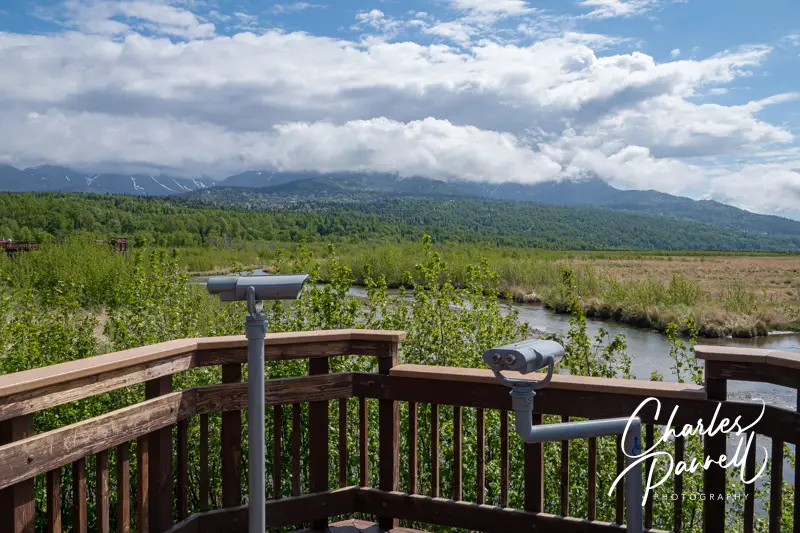
Viewing blind on the Potter Marsh Boardwalk
Last but not least, save some time for a little birdwatching on your Anchorage day trip. And the best place view some avian life is at Potter Marsh (www.adfg.alaska.gov/index.cfm?adfg=viewinglocations.pottermarsh), one of the most accessible bird viewing boardwalks in Alaska. Located about 10 miles south of town on Highway 1 near Milepost 117, this sanctuary is ironically located across the street from the Rabbit Creek Rifle Range.
Accessible parking is located near the boardwalk, with accessible vault toilets nearby. The level boardwalk extends a half-mile out over the wetlands and offers several viewing blinds and overlooks along its length. And it’s all very wheelchair-friendly with lowered viewing slots in the blinds, accessible scopes, and lowered railings at overlooks for unobstructed wheelchair viewing. And if you’d just like to sit down and enjoy the view, there’s no shortage of benches along the way.
Potter Marsh is a year-round birdwatching venue, with geese, ducks and grebes in residence from April to September; and gulls, terns and shorebirds the rest of the year. Bald eagles are also frequently spotted in the cottonwoods near the base of the bluff, so bring your binoculars for a look at these magnificent birds.
Rabbit Creek — which is located about halfway along the boardwalk — is a good spot to catch a glimpse at spawning chinook, coho or humpback salmon, from May to August. And although Potter Marsh is ground zero for avian life, you can also spot moose there in the early mornings in late spring and early summer. Additionally, there’s no admission charge, so it’s also very easy on the wallet. Don’t miss this wheelchair-accessible birding hotspot on your next Anchorage adventure.
Barrier-Free Travel the Grand Canyon for Wheelchair-users and Slow Walkers
If a trip to Cancun is in your future, then look no further than Accessible Cancun (www.cancunaccesible.com/en/) for your day tours, accessible transportation and equipment rental needs.
A variety of wheelchair accessible day tours are available, including shopping excursions as well as trips to Chichen Itza, Playa Del Carmen and the Tulum ruins. And there’s even a dolphin swim excursion. All day tours include transportation in an accessible van and a tour guide, and of course accessibility at the site.
If you’d prefer to set out on your own, accessible van transport is also available from Accessible Cancun. They can provide airport transfers as well as transport to local attractions and nearby towns. Their accessible van is equipped with a ramp and tie-downs. It can accommodate one wheelchair-user and five companions, or two wheelchair-users and three companions. It’s the perfect option for planning a independent family shore excursion.
Last but certainly not least, this Cancun agency also has a wide variety or rental equipment. From scooters and beach wheelchairs, to patient lifts, shower chairs and even hospital beds, they can provide whatever you need to make your stay more comfortable and accessible.
For more information about their offerings, visit the Accessible Cancun website or drop them an e-mail at reserve2@cancunaccesible.com. Start planning your Cancun vacation today!
Barrier-Free Travel
101 Accessible Vacations: Travel Ideas for Wheelchair-users and Slow Walkers
Puerto VallartaSuperior Tours Vallarta offers wheelchair-accessible Puerto Vallarta tours and transportation. Their Ford Transit van has a rear lift and tie-downs, and can accommodate one wheelchair-user as well as six additional passengers. Their services include airport and cruise ship transfers, shore excursions, local transportation and customized tours. They can transport passengers to any hotel or destination in Jalisco and Nayarit, and design a custom tour or shore excursion for your party. For more information about their wheelchair-accessible offerings, visit superiortoursvallarta.com/wheel-chair-accesible-transportation.
Barrier-Free Travel Utah National Parks for Wheelchair-users and Slow Walkers
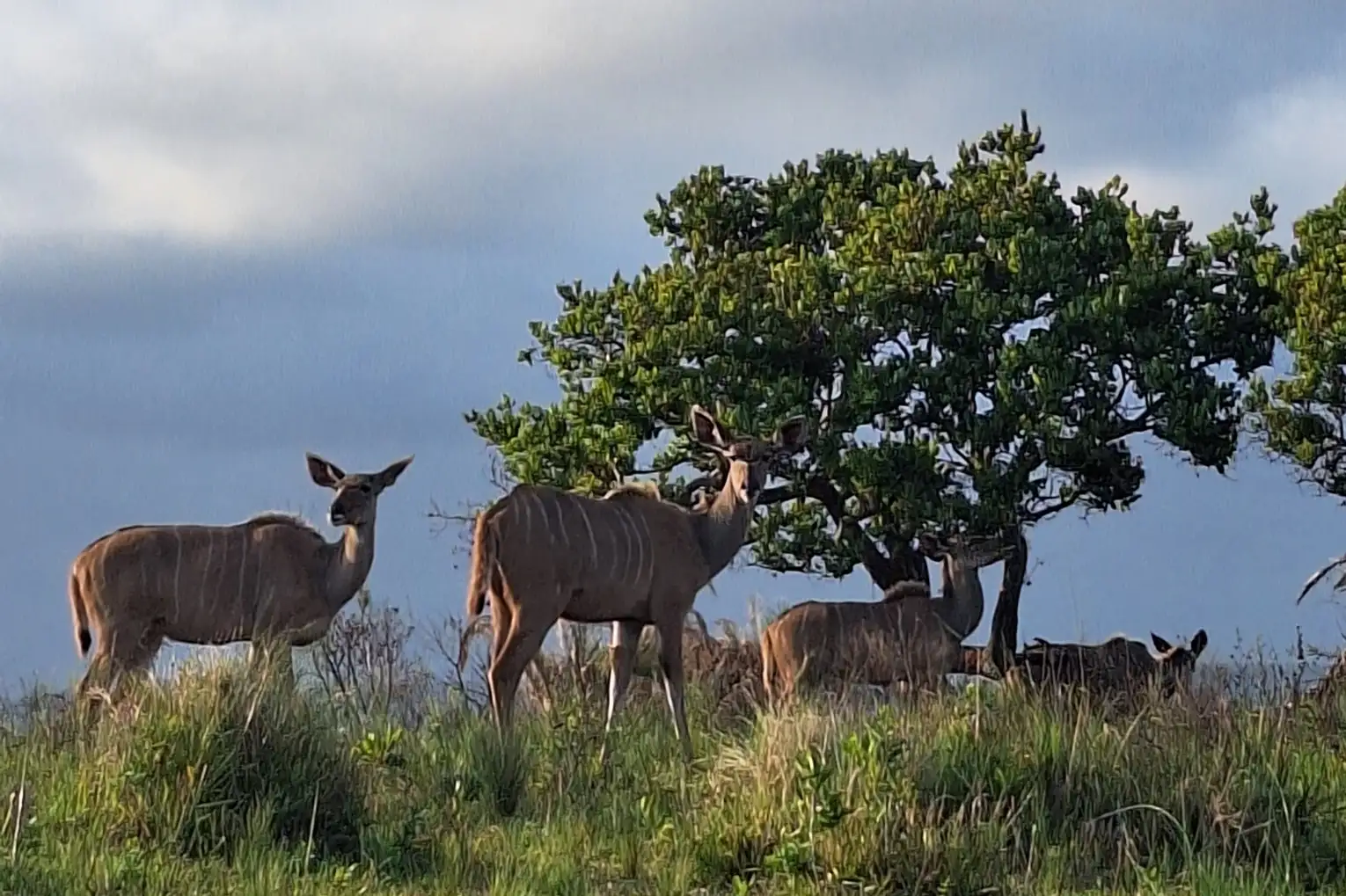
Headquartered in South Africa, Access 2 Africa provides wheelchair-accessible South African safaris and tours. Safari offerings include 7 to 12-day wheelchair-accessible safaris to Kwazulu Natal from Durban, and to Kruger and Swaziland from Johannesburg. All safaris include transportation in accessible vehicles — either a ramped van or a bus with a hydraulic lift — with tie-downs and air conditioning, as well as accessible tours and lodgings. Day tours, which include elephant interactions, hot air ballooning, the cat and cheetah rehabilitation center and whale watching, are also available.
Accessible Van at Access 2 Africa
Additionally they offer a floating beach wheelchair at Cape Vidal, where guests can enjoy the surf, and spot turtles and whales. It’s truly a unique experience to enjoy an accessible game drive, and then hit the beach in a floating beach wheelchair.
Access 2 Africa’s floating beach wheelchair at Cape Vidal
And if you happen to cruise to South Africa, Access 2 Africa can arrange for accessible shore excursions from Richards Bay and Durban to Hluhluwe Umfolozi Game Reserve and the Zulu Cultural Village. For more information about their wheelchair-accessible South African safaris and shore excursions, visit www.access2africasafaris.com.
Barrier-Free Travel California National Park Road Trips for Wheelchair-Users and Slow Walkers
Cruises are an excellent choice for an accessible vacation, as most of the newer cruise ships have good wheelchair access. Additionally, you can visit many ports on a cruise, but you only have to unpack once. And cruises are also a great multigenerational vacation choice. With that in mind, here are a few helpful tips to help you plan a wheelchair-accessible cruise.
Planning Your Wheelchair-Accessible Cruise
Contact the cruise line’s Special Needs Department for detailed access information or special access requests.
Remember to request pier assistance when you book your cruise. Disabled passengers are given priority boarding upon advance request.
Most ships have wheelchairs that can be borrowed for embarkation. If however , you need one full-time or ashore, you need to bring your own or arrange for a rental to be delivered to your cabin. Contact the cruise line for a list of their approved vendors.
Outside vendors can also provide Hoyer lifts and other medical equipment; but make user you order these from an approved vendor.
Some cruise lines can also provide special equipment, such as commode chairs or shower chairs, upon advance request.
Don’t assume all accessible cabins are the same. If you need a specific feature, such as a roll-in shower, ask if it’s available.
The best advice comes from people who have recently cruised, so check out the “Disabled Cruiser” section of the Cruise Critic website (cruisecritic.com). It’s an excellent place to gather information about accessible shore excursions that you can book on your own.
Plan ahead! Accessible cabins are in short supply so try to book at least 6-9 months in advance to get your first choice of sailing dates. Accessible balcony cabins on Alaska cruises go like hotcakes, so book those as soon as they become available.
Things to Remember
Slow walkers who use scooters and don’t have the need for an accessible cabin need to make sure that standard cabin doorways are wide enough to accommodate their equipment. Most cruise lines don’t allow scooters to be parked in hallways.
If you use a power wheelchair or scooter, make sure the electrical supply on the ship is compatible with your battery charger. It’s also a good idea to pack an extension cord and a power strip, as electric outlets are limited. If you do this, make sure to clear it with the special needs department, as these are usually prohibited on board.
If you use a scooter or a wheelchair, request a table near the door in the dining room. There’s very little space between the tables, and the closer to the entrance you are, the easier it will be navigate.
Become familiar with the tendering procedures of your preferred cruise line. Some cruise lines hand-carry wheelchair-users aboard tenders, some use mechanical devices and some do not permit power wheelchair-users to tender at all.
It’s also important to recognize that any port has the potential to become a tender port, due to port traffic and conditions.
Ask a lot of questions about ship sponsored shore excursions. In some cases you have to be able to climb up the steps of a tour bus in order to participate. Do your research and plan your own accessible shore excursions if possible.
It’s also important to plan your shore excursion as far in advance as possible. In some ports they are very limited, and they are usually not available for last minute bookings.
Once Aboard
If you’d like to use the pool, make sure the lift is in working order on the first day. If it’s not, then report it, so the crew will have plenty of time to recharge or repair it.
If you take along a manual wheelchair, mark it clearly with your name or personalize it in some way, so it won’t be mistaken for one of the ship’s wheelchairs.
Take a tour of the ship on the first day and locate the accessible restrooms on each deck. Make note of the locations for future use.
Last but not least, if you use a power wheelchair or scooter, consider bringing along a manual wheelchair for use in port. This is especially helpful in Caribbean ports, where it’s difficult to find lift-equipped transportation.
Barrier-Free Travel California National Park Road Trips for Wheelchair-Users and Slow Walkers