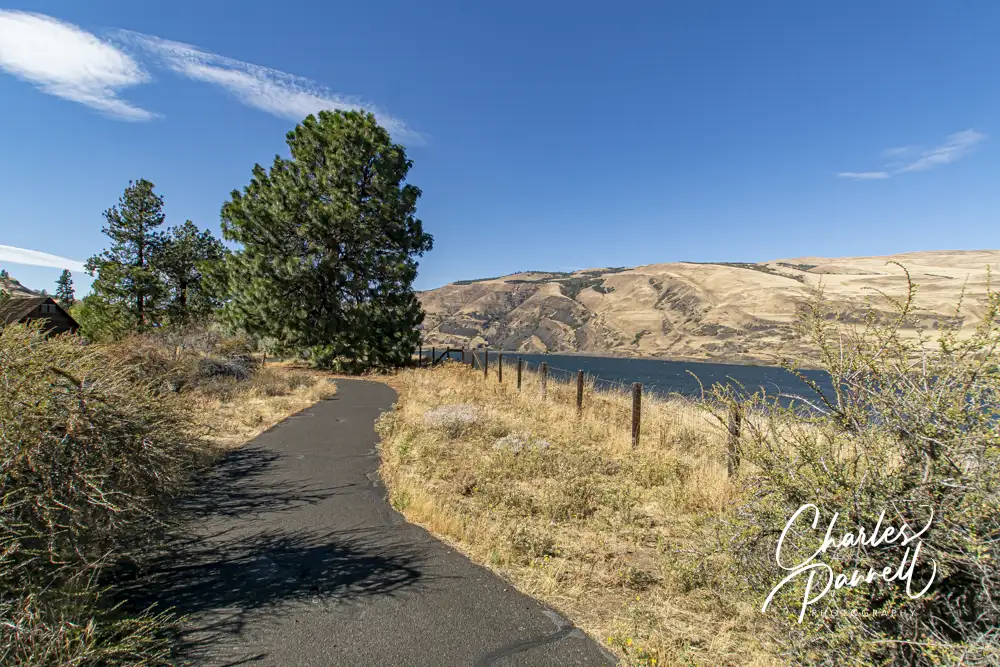
The majestic Columbia River flows through the Pacific Northwest and forms the border between Washington and Oregon. On the Oregon side of the river, Interstate 84 travels through several mid-sized cities as it skirts the waterway. That said, Highway 14 on the north side of the river offers a bucolic view of the Washington landscape. Even better, the northern route boasts several wheelchair-accessible hikes. So take the time to hop off the interstate, cross the river, and enjoy these scenic wheelchair-accessible Columbia River hikes on your next Pacific Northwest road trip.
Sam’s Walker Trail
Sam’s Walker Trail
While traveling on the western part of Interstate 84, the best — and frankly the most scenic — river crossing is at the Bridge of the Gods (www.portofcascadelocks.gov/bridge-of-the-gods), in Cascade Locks. After you cross this two-lane toll bridge, head west on Highway 14 for about 10 miles to get to the first accessible hike on the list — Sam’s Walker Trail. When you hit Skamania Landing Road, turn south and and follow the signs to the trailhead. It should be noted that Skamania Landing Road is a loop, so be sure and take the western turnoff.
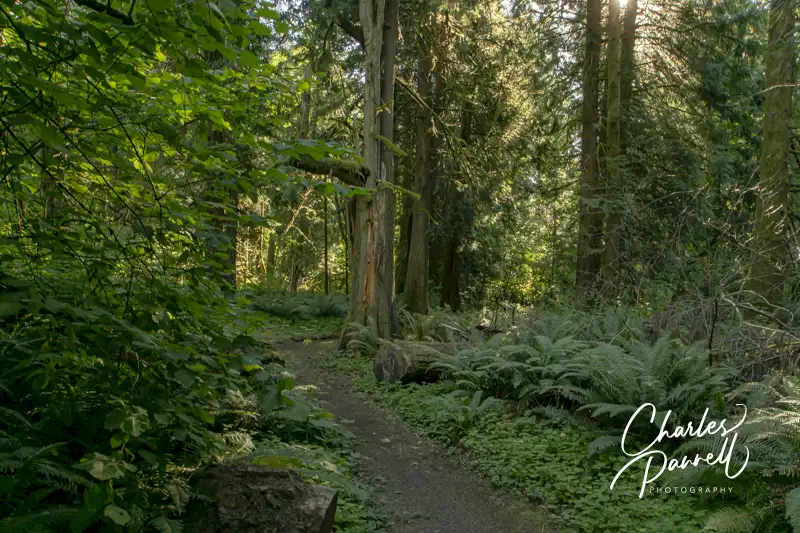
There’s no accessible parking in the gravel lot, but there’s plenty of room to parallel park an adapted van. An accessible vault toilet sits on one side of the parking lot, and an accessible shaded picnic table graces the other side. There’s level access over to the 1.2-mile hard packed dirt trail. It winds through a sweeping meadow, then passes through a shady cedar forest before it loops back to the trailhead,.
Sam’s Walker Trail is pretty well maintained, but there may be some slight vegetation overgrowth depending on the season. It’s mostly a flat trail, although there are some slight elevation changes along the way. Still it’s well within the ADA guidelines for accessible trails; as the steepest grade is only 4%, and that’s just for a few feet. It’s a great spot for a spring wildflower hike, and the meadow is an excellent birding venue. As an added bonus, there’s an accessible picnic table set off the trail under a few trees, about halfway along the hike If the table in the parking lot is occupied, it’s a great spot for a picnic lunch. And even if the parking lot table is available, the trail table offers more privacy. Sam’s Walker Trail makes for a nice accessible hike throughout the year.
Catherine Creek Universal Trail
Catherine Creek Universal Trail
Next up on the list of wheelchair-accessible Columbia River hikes is the Catherine Creek Universal Trail. From Sam’s Walker Trail, head east on Highway 14, then turn north on Old Highway 8, about 40 miles up the road. The Catherine Creek Universal Trail is about 1.5 miles up Old Highway 8.
There’s a small dirt parking area on the north side of the street; and although there are no lined spaces, there’s room enough to parallel park in the level lot. There’s another trailhead near the parking area on the north side of the street, but the Catherine Creek Universal Trail begins across the street, near the accessible porta potty.
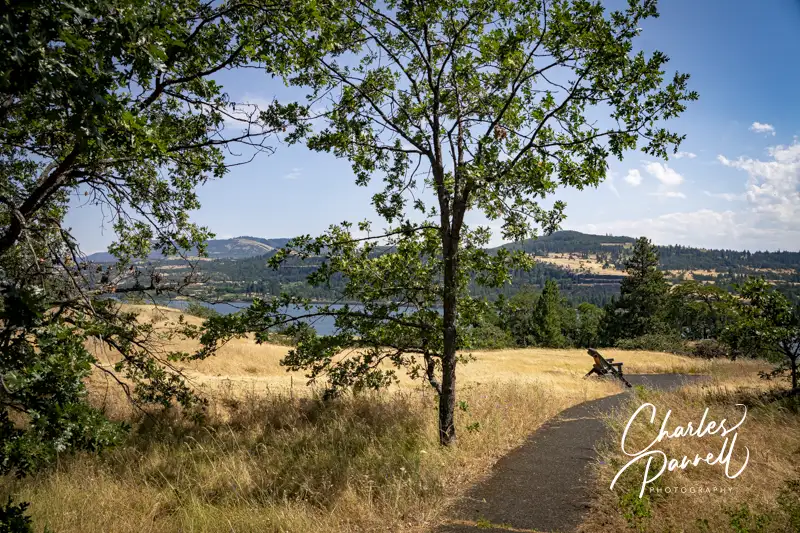
You can take the trail in either direction, but most folks choose to head east (left). The trail winds through a meadow and over to the Catherine Creek Falls viewpoint. It’s just a quarter-mile walk to the falls, and the area is filled with lilies, poppies and balsamroot blooms in the spring. The waterfall decreases to just a trickle in the summer months, but it’s rather impressive earlier in the year . And if you’d like to stay a spell, there’s also a bench in the waterfall viewing area. As an added bonus, there’s also a nice Columbia River view.
The next part of the route crosses a small footbridge and then an accessible boardwalk, before it splits into two trails. The trail to the right is the half-mile shortcut, and it’s a bit steeper than the longer route. The trail to the left winds along the Columbia River and then intersects with the shortcut, before it returns to the starting point for a 1.2-mile stroll. Although neither route is level, they both are accessible. And don’t forget to bring a hat, as there’s not much shade along the way.
Balfour Klickitat Loop
Balfour Klickitat Loop
The final trail on our north shore collection of wheelchair-accessible Columbia River hikes is the Balfour Klickitat Loop. From the Catherine Creek Universal Trail, continue east along Old Highway 8 for about 4.5 miles. The trailhead is on the left, and although it’s marked, it’s east to miss. If you hit Highway 14, turn around and backtrack for about .2 mile.
This land was originally farmed by the Thomas Balfour family in the 1800s, and remnants of the Osage orange trees they planted are still visible along the trail today. There’s accessible parking near the trailhead, with level access over to an accessible vault toilet.
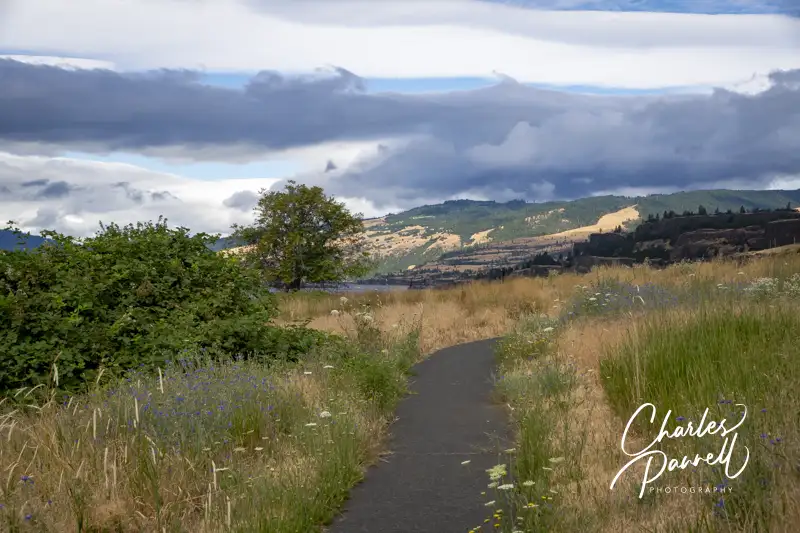
The .75–mile wide paved trail winds through a meadow and offers a panoramic Columbia River view, complete with parasailers. There are turn outs along the way for wheelchair-users, and this is also a great spot for wildflower viewing in the spring. At about the halfway point there’s a single accessible picnic table on a pad, with plenty of room for a wheelchair. It’s a great place for a picnic as it’s tucked off the trail in a private cove, but still offers a nice river view.
The trail then crosses a small bridge and continues along the meadow, with a view of the peaceful Klickitat River. It’s a great birding place, and bald eagles are known to congregate here during the salmon run in January and February. When you reach a fork in the trail, bear left to the return to the parking area. Although there is some elevation gain there, it’s within code, with resting spots every 20 feet. It’s a pleasant trail, that’s definitely worth a stop while road tripping along Highway 14.
Stay a Spell
After you finish exploring the Balfour-Klickitat Loop, head out Highway 14 to continue your trek east. Alternatively, you can extend your stay and explore this less-touristed side of the Columbia River.
Maryhill State Park is located about 20 miles east of the Balfour-Klickitat Loop, and it’s a nice place to stop for a picnic or even spend a night or two. The Maryhill Museum, Maryhill Winery and Maryhill Stonehenge are also all worth a visit while you’re in the area. (emerginghorizons.com/linger-on-in-maryhill-state-park/).
Vista House on the Columbia River Waterfall Corridor
And finally, if you’d prefer to camp out, then check out Beacon Rock State Park. It offers a nicely accessible campsite, as well as a few accessible hikes. Either way these wheelchair-accessible Columbia River hikes only take a few hours, and the scenery is most definitely worth the slight detour.
Barrier-Free Travel Washington National Parks for Wheelers and Slow Walkers
Located near the Intersection of Interstate 84 and Highway 97 in rural Washington, Maryhill State Park makes a great rest stop on any Columbia River road trip. With great views of the majestic river, this 81-acre park offers a nice selection of picnic sites, as well as a variety of overnight camping options. Granted it’s a great choice for a quick hop-off-the-highway lunch break, but because of its proximity to some unique roadside attractions, this Southern Washington gem is also an optimal pick for an overnight stay. So hop off the Interstate on your next Columbia River road trip, and stay a spell at Maryhill State Park (parks.wa.gov/find-parks/state-parks/maryhill-state-park).
Eat and Sleep
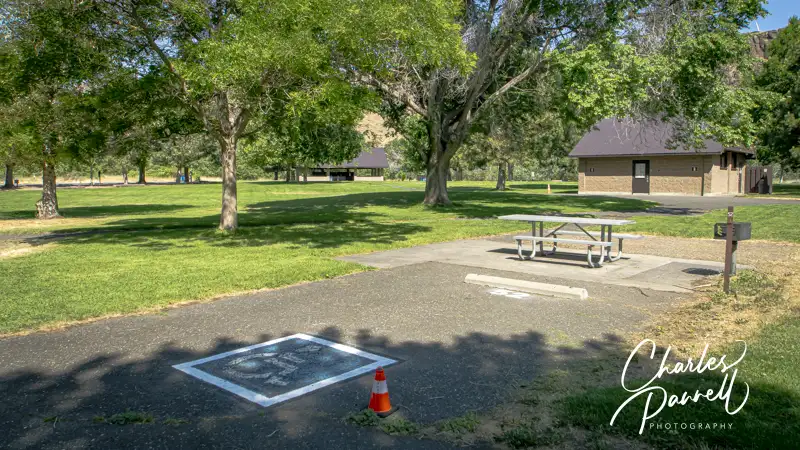
Maryhill State Park has both RV sites and tent sites, with good access in both. Tent Sites 52 and 53 are accessible, and they are located near the accessible restroom and shower house. Both sites have accessible van parking, a level tent site, an accessible picnic table and a raised grill. There’s also a paved path from each site to the restroom, which includes a large accessible stall with grab bars. Each side also has a roomy compartment with a roll-in shower with with grab bars, a lowered showerhead and a fold-down shower seat. Best of all, the showers are free.
Tent Camping Site 53 at Maryhill State Park, Washington
The accessible RV site (51) is located near the day use area. It has a paved driveway, an accessible picnic table, and a standard grill. It’s a short walk away from the accessible restroom, but not as close as the tent sites. This site was an addition to the property and it sits outside of the RV loop, and on the plus side it doesn’t neighbor any other RV sites. All of the accessible sites in the park require proof of disability — such as an accessible parking placard — in order to occupy them. It should also be noted, that there’s some freeway noise and train noise in this park.
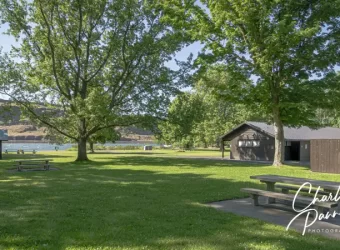
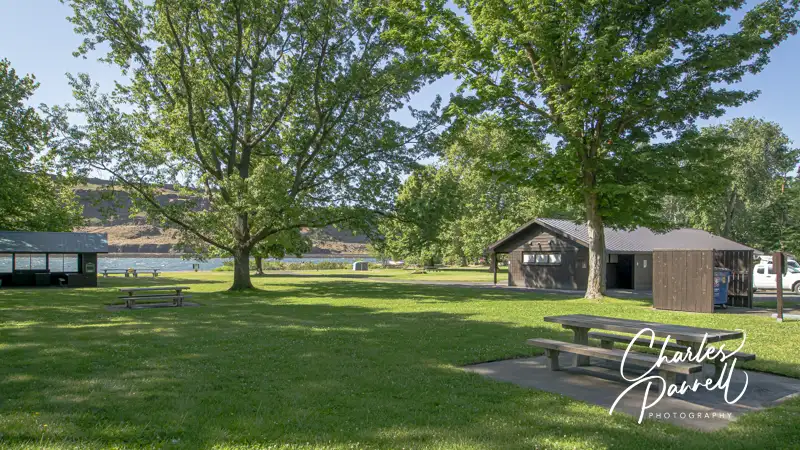
There’s also a nice picnic area in the park, with a Columbia River view. There’s accessible parking near the accessible restrooms. It’s about a 30-foot roll over a level grassy patch out to the closest picnic table. Although it’s a standard table on a cement pad, there’s room for a wheelchair at the end. It’s a pleasant place to stop for lunch on the road.
Art Appreciation 101
The Maryhill Museum of Art
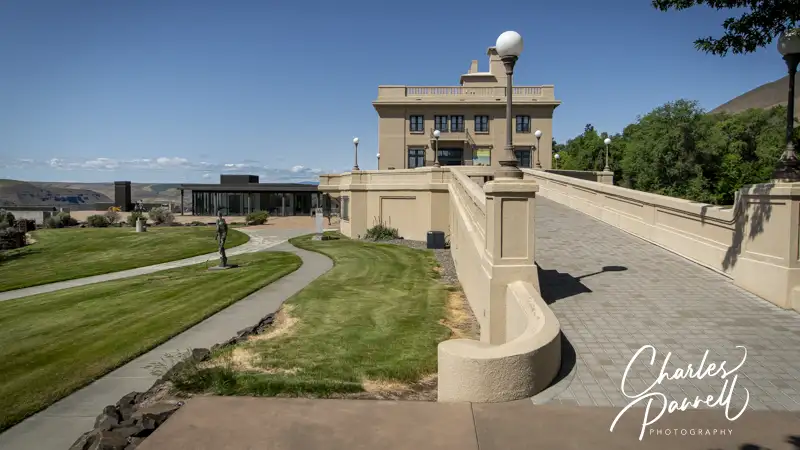
If you’re spending the night at the park, be sure and plan a visit to the Maryhill Museum of Art (www.maryhillmuseum.org), which is just up the road. The museum building was originally the home of Sam Hill. Hill’s goal was to establish a Quaker community — named after his daughter Mary — on his land; however due to a lack of irrigation it never came to fruition. He later donated his home, which subsequently became the Maryhill Museum of Art. It was dedicated by Hill’s friend Queen Marie of Romania in 1926.
There’s accessible parking in front, with a long ramp up to the museum entrance. If the slope and length of the ramp are too much for you, there’s an accessible entrance on the lower level on the left side of the building. Just follow the sidewalk around to the door, and ring the bell. Inside there’s good pathway access throughout the museum, elevator access to all levels and accessible restrooms on the ground level and lower level.
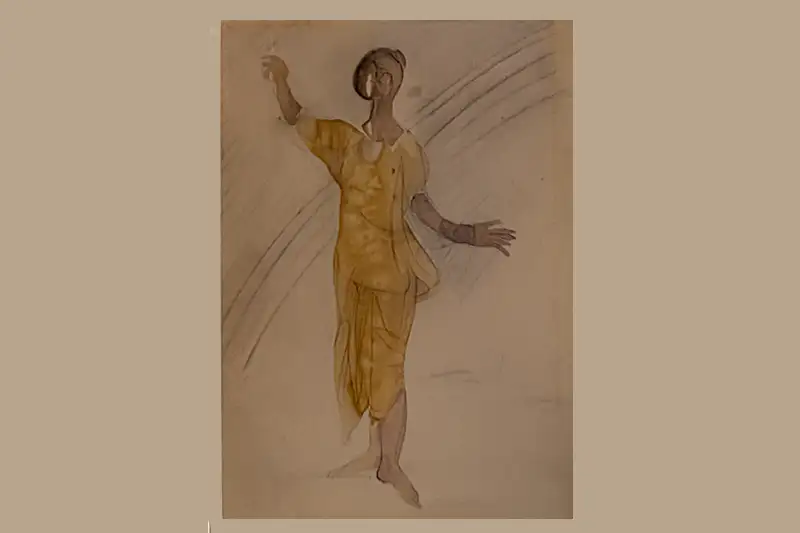
Variety is the key word at this museum, which also offers some interesting visiting exhibitions. Don’t miss the Queen Marie of Romania gallery near the entrance, which includes the gown she wore to the coronation of Nicholas II in 1896. The ground level features a substantial collection of indigenous peoples artifacts, including an extensive basket display. And in contrast, the opposite wing offers and equally diverse Rodin exhibition. Round things out with a display of over 80 chess sets and related works of art, and the contemporary Stevenson Wing that’s lined with windows, for the full Maryhill Museum of Art experience. And don’t forget to take a stroll along the accessible paths outside, to take in some of the garden sculptures and enjoy a Columbia River view.
Rodin Sketch of Cambodian Dancer at the Maryhill Museum
A Little Vino
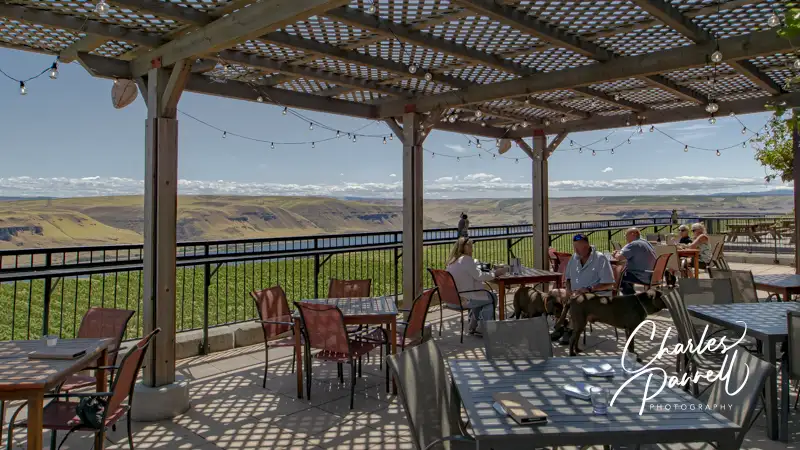
Bistro at the Maryhill Winery
When it’s time for a break, be sure and stop in at the Maryhill Winery (www.maryhillwinery.com), which is just a mile west of the museum. Established in 1999 by Craig and Vicki Leuthold, Maryhill Winery is one of the largest wineries in Washington state. Their first vintage was released in 2001, and since then they’ve garnered over 4,000 awards. They are known for their Washington state varietals, but they also produce some equally impressive blends.
And you just can’t beat their location, high above the Columbia River. Accessible parking is available right next to the entrance. You have two choices here — you can have a bite to eat in the bistro, or you can do a tasting flight in the bistro or the tasting room. Personally I recommend lunch in the bistro, followed by a tasting flight. The menu includes sharable snacks, sandwiches, salads and pizza, and you just can’t beat the Columbia River view.
That said, there’s also level access to the adjacent tasting room, with several lowered tables located near the windows. If Mother Nature isn’t cooperating, it’s another way to snag a great river view while tasting the wines. And with an accessible restroom just around the corner, you have everything you need at Maryhill Winery.
A Historic Museum
The Presby Museum in Goldendale, Washington
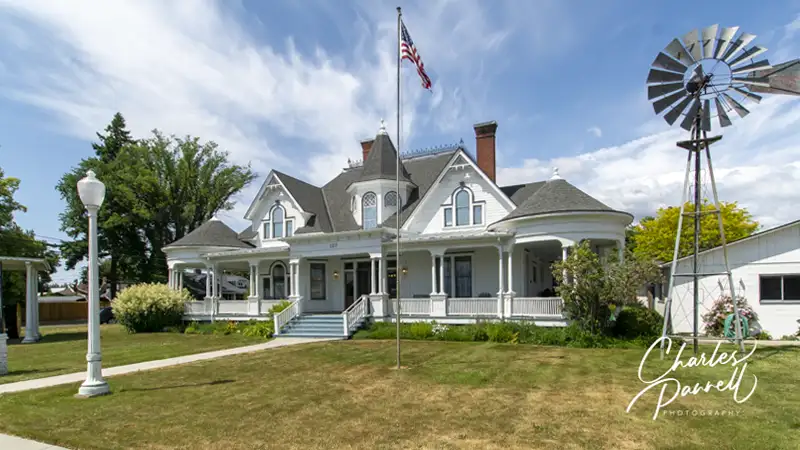
For a different view of the area, head north on Highway 94 and stop in at the historic Presby Museum (www.presbymuseum.com) in Goldendale. Located on the corner of Broadway and Grant, this spacious home was built by Winthrop B. Presby in 1902. He lived there with his second wife Zoe from 1903 to 1915. After that the mansion served as a boarding house for teachers and railway workers, before it was sold to the Klickitat County Historical Society in 1962. Today it’s home to the Presby Museum, where visitors can step back in time and get a taste of yesteryear.
There’s accessible parking to the right of the museum, in the driveway between the museum and the Carriage House. And although steps grace the front facade there’s a wheelchair lift on the side of the house. The first floor of the home is wheelchair-accessible, but the second and third floors can only be accessed by stairs. That said, some of the most interesting pieces are on the first floor.
A larger-than-life pump organ dominates the parlor, which also includes a Victrola and a pianola (a type of player piano). Across the way Mr. Presby’s office includes some interesting artifacts, including a clock from the 1800s and some period law books. The only original piece of furniture — a sideboard hutch — can be found in the dining room. And the kitchen has a gaggle of vintage utensils as well as a wood stove and a washing machine. It’s an interesting peek into the early 1900s.
Finally, the Carriage House and the Annex, have a small one-inch step, and they include everything from a vintage printing press to relics from an old schoolhouse. They’re definitely worth a visit, and if you have questions, just ask the docents.
Don’t Forget Stonehenge
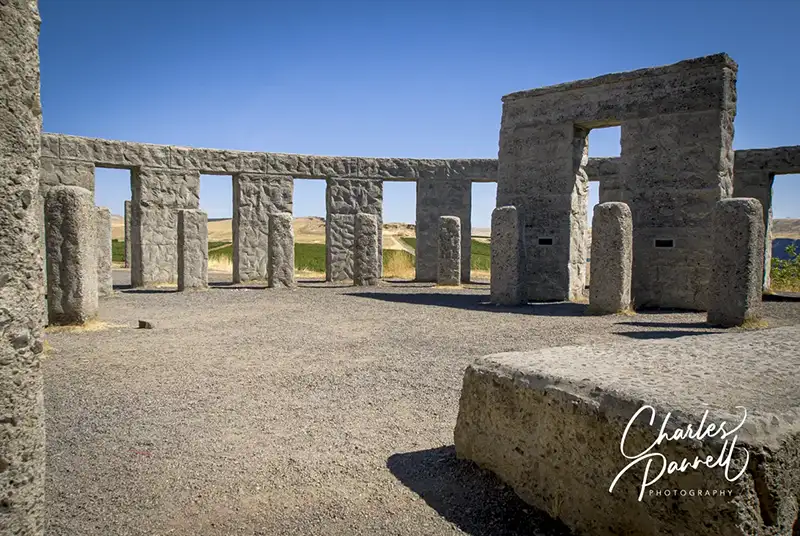
Last but not least, don’t leave the area without a visit to the Maryhill Stonehenge replica (emerginghorizons.com/stonehenge-memorial) down near the Columbia River. At first glance it seems an odd location for this monument, but the reason for the choice was due to misinformation. Sam Hill designed the monument in 1918, as a memorial to local men who perished in the Great War. At that time Hill believed that the original Stonehenge was used as a place for human sacrifices. And he reasoned that the human sacrifices at Stonehenge were not unlike the loss of life in WWI.
And although the replica was designed to look like the original, because of the difference in latitude and different alignment, the Maryhill rendition cannot be used as a astronomical calendar. Still it’s definitely worth a stop, as there’s level access to the entire monument. And like many of the other Maryhill stops, you’ll also get a great Columbia River view from the monument.
Barrier-Free Travel Washington National Parks for Wheelers and Slow Walkers
There’s no shortage of scenic beauty in the Pacific Northwest, but the Mount Hood Infinity Loop in Northwestern Oregon offers more that its fair share of eye candy. The route begins about 20 miles east of Portland as it follows Highway 84 alongside the Columbia River, then heads south through vineyards and farmland to majestic Mount Hood. Finally it circles back north through conifer forests, and offers a picturesque side trip through a waterfall corridor.
The 135-mile loop takes about three hours to drive straight through; however it’s best to spend a few nights in the area, take your time and enjoy the stops along the way. And although the route travels through the mountains and other harsh terrain, there are plenty of wheelchair-accessible stops along the way. So get ready to hit the road and enjoy a wheelchair-accessible slice of the scenic Mount Hood Infinity Loop.
Well Dam!
Bonneville Dam on the Mount Hood Infinity Loop
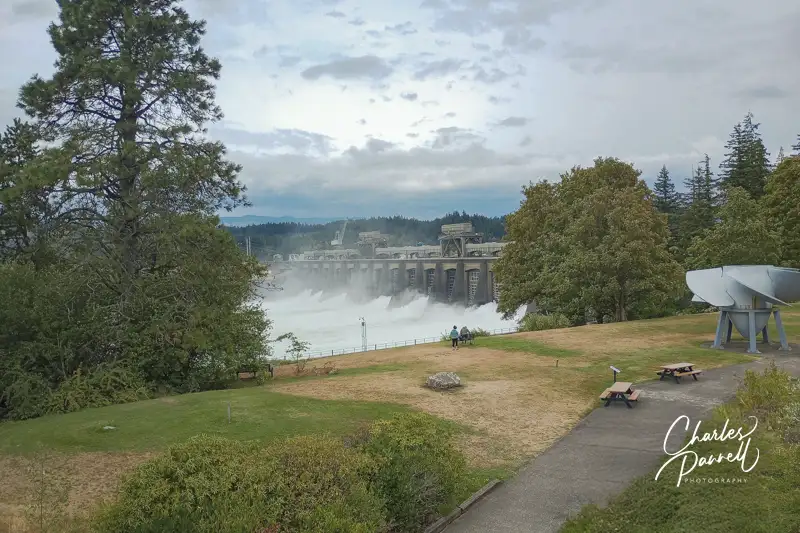
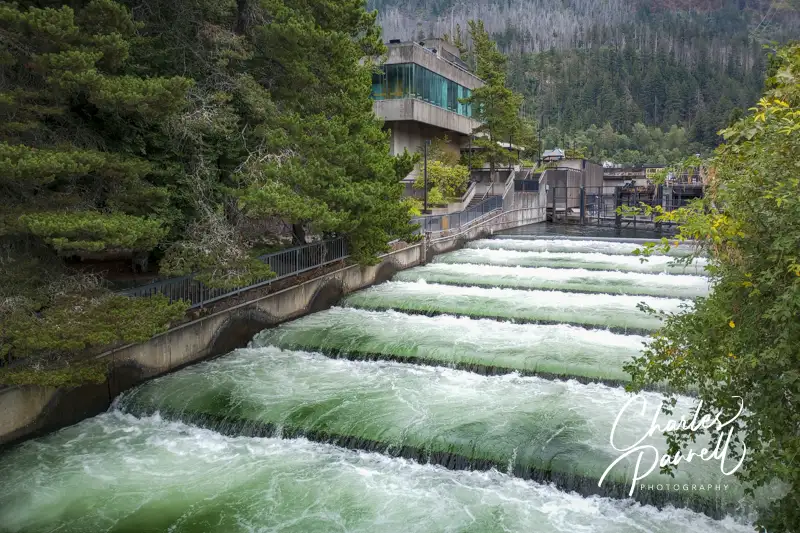
The first stop stop on this accessible Mount Hood Infinity Loop is Bonneville Dam (www.nwp.usace.army.mil/bonneville/). Built in 1938 by the Army Corps of Engineers, the site features the dam, two powerhouses, a spillway, a navigation lock, fish ladders and a fish hatchery. Just take exit 40 from Highway 84 and follow the signs. Bear right at the security gate and head over to the Bradford Island Visitor Center.
There’s accessible parking in the visitor center lot, with level access to the building. Inside, there’s plenty of room to navigate a wheelchair and there are accessible restrooms around the corner. This fourth-floor lobby serves as an information and welcome center. Start your visit with an elevator ride down to the third floor to watch a movie about the dam; then continue on down to the first floor to see some interpretive exhibits and viewing windows on the fish ladders. Complete your visit with a trip to the roof for a birds-eye view of the dam.
The navigation locks are located a short drive away, with accessible parking in front. There’s ramp access up to the viewing platform and lock visitor center. The visitor center has a collection of exhibits that explain the operation of the locks. And if you’re lucky, a ship will pass through and you’ll see them in operation.
Save some time for a stop at the fish hatchery, which includes accessible parking and paved access around the outside display ponds. There’s barrier-free access to the visitor center, which details the operations of the hatchery. There’s also level access to the nearby gift shop. It’s a pleasant and accessible walk through the shaded grounds around the ponds — and don’t forget to feed the trout.
Fish ladder at the Bonneville Dam on the Mount Hood Infinity Loop
The View From Washington
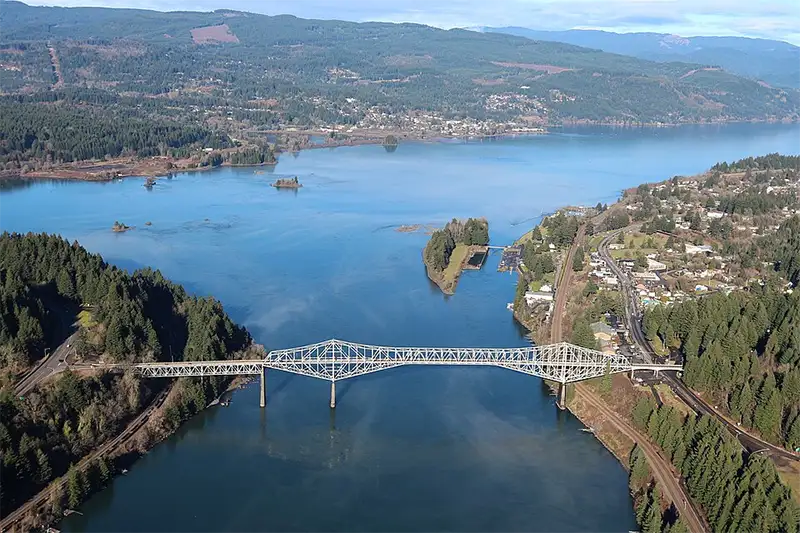
Bridge of the Gods
As you continue east on Highway 84, you can’t miss the Bridge of the Gods (www.portofcascadelocks.gov/bridge-of-the-gods). Originally constructed in 1926, this cantilever bridge had to be raised 44 feet after Bonneville Dam was completed. Subsequently, Charles Lindbergh flew under it in true daredevil fashion in 1927.
Although you’ll get a better view of it from afar, it’s also worth a short detour to cross this historic structure. From Highway 84, take exit 44 and follow the signs. This two-lane toll bridge, which is just 22 feet wide, spans the Columbia River and connects Oregon with Washington.
Of course once you cross over to the Washington side, you’ll have good view of the bridge, the Columbia River, and the Oregon side of things. A pleasant place to enjoy that view is Skamania Lodge (www.skamania.com), more specifically the Cascade Dining Room at Skamania Lodge. It’s a nice spot for a leisurely brunch, as it overlooks the Columbia River with views of the lush pine forests on the Oregon side. Menu offerings range from brioche bread French toast and a crab eggs Benedict to steelhead tacos, a pacific crab roll and a delicious seafood salad. The choices are tasty and the view is exceptional.
Stay a Spell
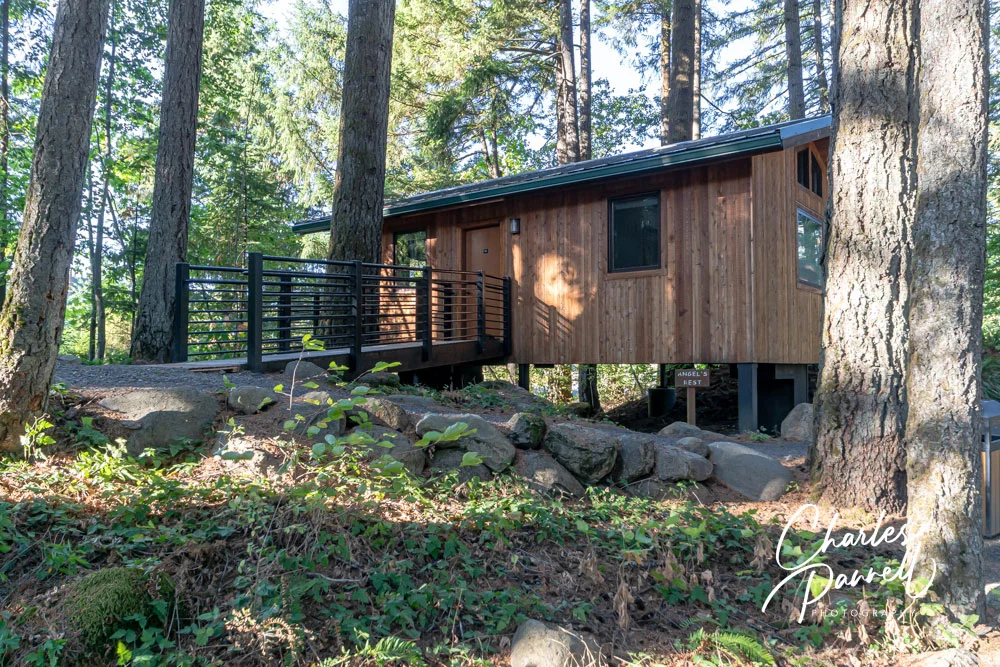
Angels Rest Accessible Treehouse Suite at Skamania Lodge, Oregon
Skamania Lodge also makes an ideal home base for a multi-day Mount Hood Infinity Loop excursion. Access is excellent throughout the property, which offers accessible lodge rooms with either a roll-in shower or a tub/shower combination. And if you’d like something a little different, spend the night in the treetops in a wheelchair-accessible treehouse (emerginghorizons.com/sleep-in-a-wheelchair-accessible-treehouse-at-skamania-lodge/).
The newest addition to the accessible lodging inventory at Skamania Lodge is a luxurious wheelchair-accessible cabin. https://emerginghorizons.com/relax-in-a-skamania-lodge-wheelchair-accessible-cabin/. Nestled away in the treehouse section of the property, this spacious cabin includes a large bathroom with a roll-in shower, a compact kitchen, a separate bedroom, a cozy fireplace and a spacious deck with a firepit — and it’s all wheelchair-accessible.
Vintage Autos & Aircraft Galore
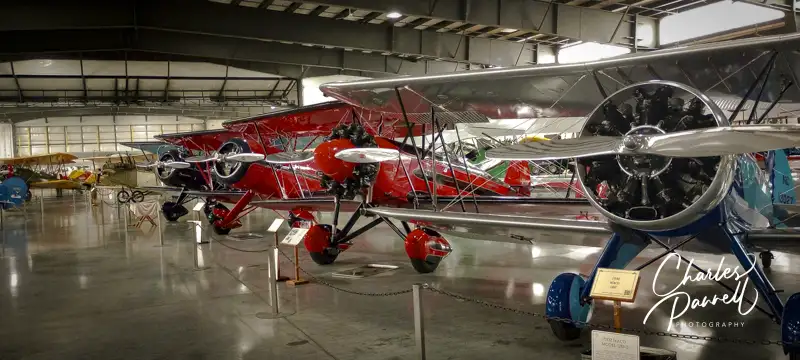
Planes at The Western Antique Aeroplane and Automobile Museum
After a Skamania Lodge visit — or overnight stay — cross back over the Bridge of the Gods and continue east on Highway 84. Take exit 62 about 20 miles down the road, then follow Country Club Drive and Barrett Road to the Western Antique Aeroplane and Automobile Museum www.waaamuseum.org. It’s a pleasant 25 mile drive, as the scenery transitions from the Columbia River landscape to the farming and agricultural region around Mount Hood.
There’s accessible parking near the museum entrance, with level access over to the building. The large collection is housed in three adjacent hangers, which have cement floors and plenty of room to maneuver a wheelchair. There’s also an accessible restroom on site, barrier-free access to the gift shop, and a power wheelchair available to rent.
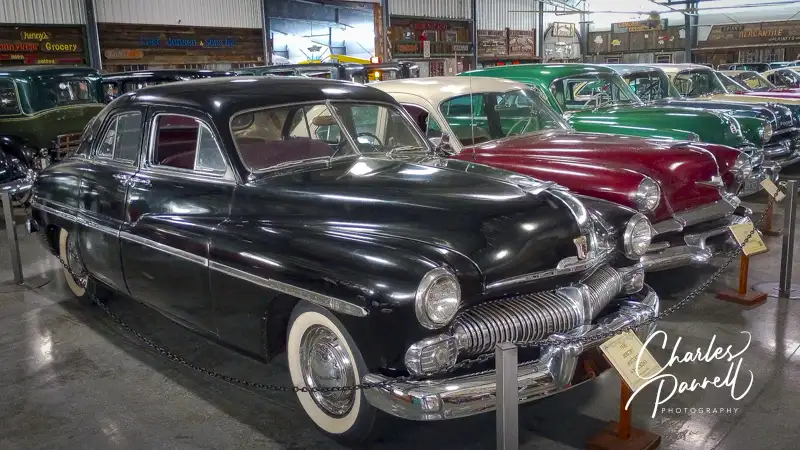
The thing that makes this massive auto, aircraft and motorcycle museum unique, is that most of the collection is flyable or drivable. And besides the aircraft and autos, you’ll find vintage furniture, appliances, toys and decorations woven between them. This museum houses much more than airplanes — it includes everything that flies, from balloons to gliders — and it also features a substantial Wright Brothers exhibit. And don’t miss the oldest Boeing aircraft, a 1928 40C mail plane — and yes it still flies.
A second hangar is devoted to military planes and includes a large collection of military equipment, from radios and MREs to bicycles, scooters and even a jeep. The final hangar is filled with over 130 cars, including a 1914 electric car, a Studebaker and a Locomobile. And if you get tired, there are plenty of spots to sit and take a break along the way. It’s an excellent and often overlooked museum.
Autos at the Western Antique Aeroplane and Automobile Museum
At the Summit
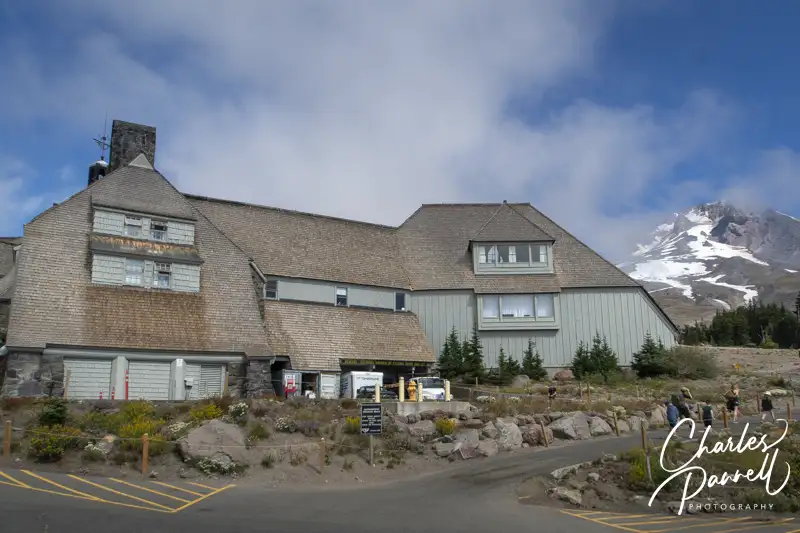
Timberline Lodge at Mount Hood, Oregon
One of the highlights of the Mount Hood Infinity Loop, is a visit to Timberline Lodge (www.timberlinelodge.com) at the summit. From the Western Antique Aeroplane and Automobile Museum follow Odelle and Davis Drive to Highway 35 south, then take Highway 26 east to the Timberline Highway. From there it’s just a six mile drive; however the road has up to a 10% grade with numerous switchbacks along the way. Timberline Lodge is located at 6,000 feet, and it’s not unusual to see snow there, even in the summer.
Known as the showplace of Works Projects Administration projects, Timberline Lodge was dedicated in 1935 by President Roosevelt. The consulting architect, Gilbert Stanley Underwood, who designed national park lodges in Yosemite and Bryce Canyon, was known for using natural materials to help his buildings blend in with their surroundings. The Underwood style caught director Stanley Kubrick’s eye, and he ultimately used aerial shots of the property in the opening scenes of The Shining.
And although the drive is certainly scenic, the best plan of action is to enjoy a little time on top, look around the lodge and have lunch. There are two different parking areas on top. The lot close to the lodge is reserved for overnight guests, while the one further away is for day visitors. And the walk to the lodge is uphill from the day-use parking. Still if you stop at the guard shack and tell them you have a disabled passenger they will let you drive in and drop them off. Although there are steps up to the front entrance, there’s plenty of accessible parking near an elevator that takes you up to the lobby level. It’s a pleasant place for a midday break.
Mount Hood History
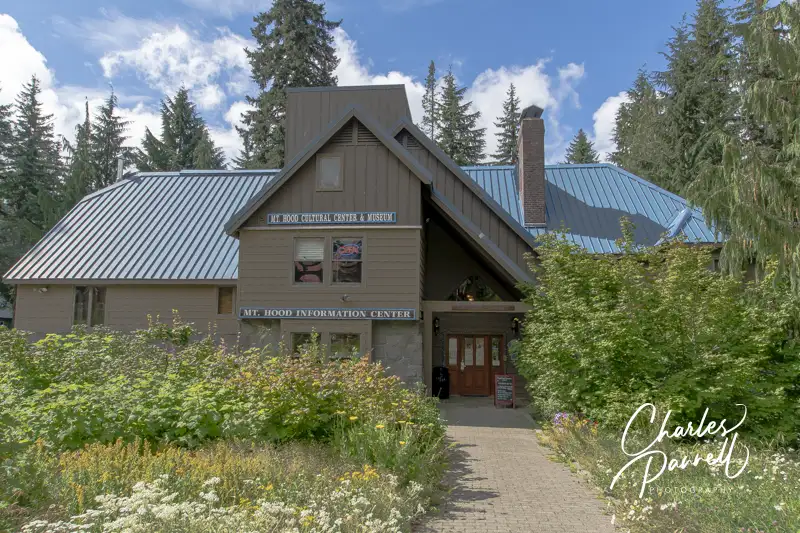
Mount Hood Cultural Center & Museum
After you get descend from the mountaintop, take a little time to learn about some local history at the Mt. Hood Cultural Center & Museum mthoodmuseum.org. To get there, continue east on Highway 26, then make a right on Government Camp Loop, about a quarter-mile down the road. The Mt. Hood Cultural Center & Museum is on the left, with street parking in front.
Accessible parking is located near the museum, with level access over to the building. And although the museum occupies several floors, there’s elevator access between them.
Downstairs, there’s an information center and a gallery that focuses on the history of the ski area and the local ski and recreation clubs. Upstairs there’s a gallery that showcases the works of Mount Hood area artists, and another one that boasts a large collection of skis and details the history of skiing. There’s also a gallery that focuses on the early exploration of the area and one that includes exhibits about the natural history and the regional flora and fauna. All in all this small museum offers a good primer of the area, with volunteers on hand to help you plan your visit, and loads of free brochures available to map out your travels.
Take a Hike
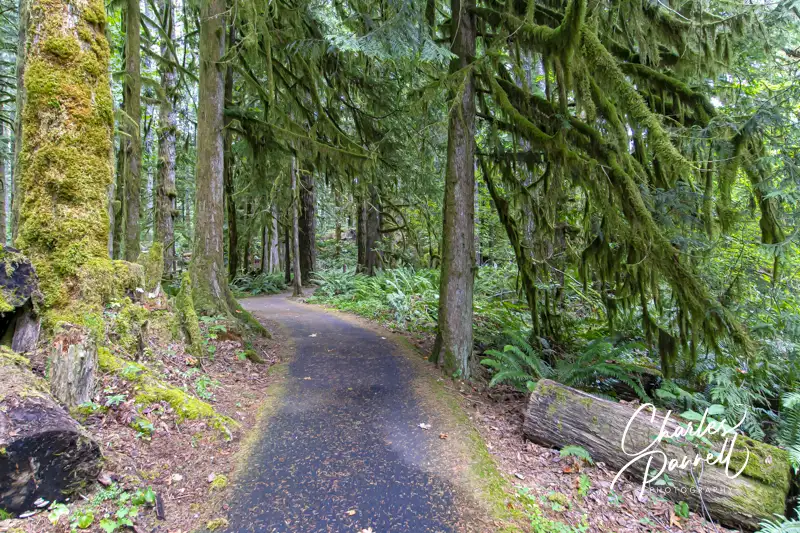
Cascade Streamwatch Trail in the Recreation Area
If you’d like to get out and enjoy a hike or two, head on over to the Wildwood Recreation Site www.blm.gov/visit/wildwood-recreation-site, which is on Highway 26 about 13 miles east of the Mt. Hood Cultural Center & Museum. This site has two accessible trails and a nice picnic area. And although there is a day-use fee at this area, the America the Beautiful Access Pass (emerginghorizons.com/how-to-get-a-lifetime-national-park-pass/) is also good there.
The Cascade Streamwatch Loop is located all the way at the end of the the main park road. There’s accessible parking near the accessible restrooms, and level access over to the trail. Make a right just past the amphitheater and follow this .75-mile paved loop through the alder and conifer forest. Be sure and take a slight detour near the beginning of the trail to the underwater viewing window, where you can see the hidden side of the river ecosystem. After you rejoin the main trail, continue alongside the Salmon River and loop back to the beginning. There are benches to rest along the way, and the picnic area near the pavilion includes an accessible table on level ground. It’s shaded by the trees, and a very pleasant place to take a break.
The equally accessible Wetlands Loop can be accessed from the next parking lot. Although there is a connector trail from the Cascade Streamwatch Loop, it’s steep and not accessible. Accessible parking and restrooms are located near the trailhead, with level access over the .75-mile trail. It begins as a paved trail, crosses the river and continues as a boardwalk through the cattail marsh, before it reconnects to the paved trail and loops back to the parking area.
Million Dollar View
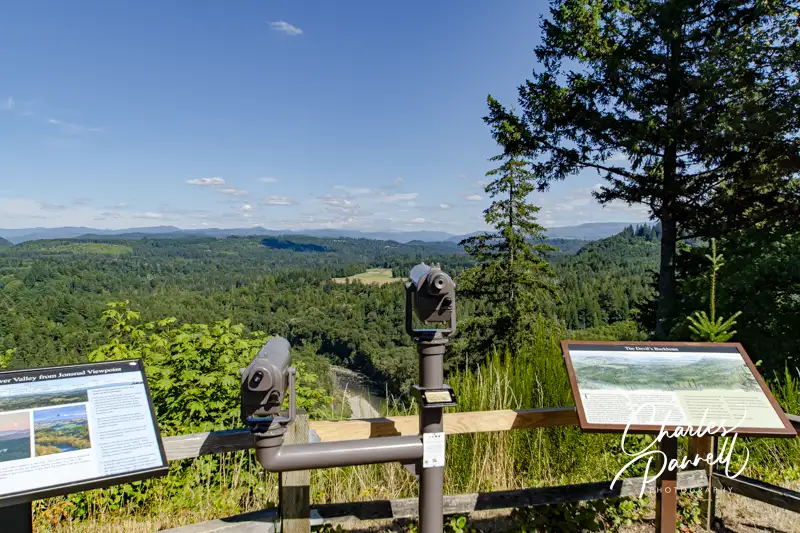
Jonsrud Viewpoint on Highway 36
You’ll catch fleeting glimpses of Mount Hood from Highway 26, but for a great photo op continue east along the thoroughfare to an often overlooked viewpoint. It’s located about four miles down the road in Sandy. Turn north at the Walmart on Bluff Road, then continue on for about a mile to the Jonsrud Viewpoint, on the right.
There’s accessible parking near the viewpoint, with curb-cut access to a brick path to the overlook. From there you’ll get what’s billed as “one of the best views of Mount Hood in Oregon.” There’s also a wheelchair-height viewing scope, which allows folks who are color blind to view the vivid scenery of the Sandy River Valley. This neighborhood overlook is also the perfect spot to wait out the clouds and for an unobstructed view of Mount Hood. It’s a great little detour.
Tracking Sasquatch
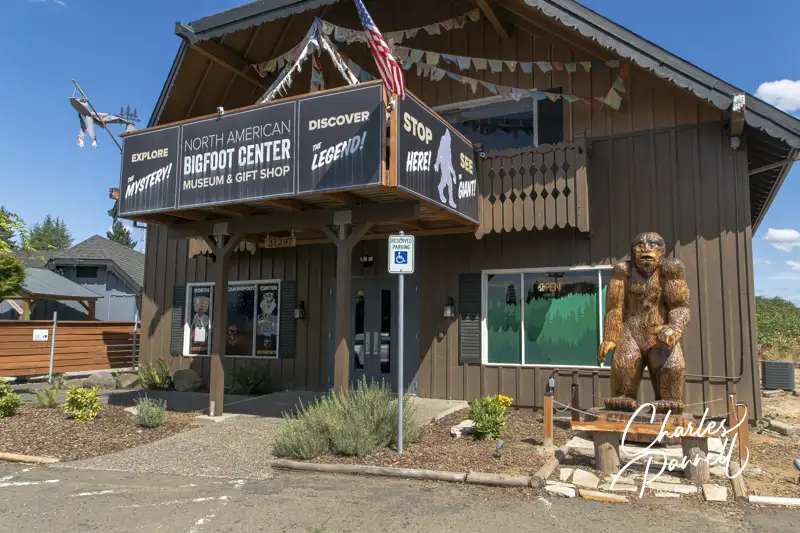
North American Bigfoot Center
Once you’re back on Highway 26, continue east for five miles to Boring, and make a stop at the North American Bigfoot Center northamericanbigfootcenter.com. Located just off the highway it’s easy to find — turn in at the Chevron, then wind past Chester’s Pub to the back of the parking lot. You can’t miss this eclectic attraction, as the entrance is marked with a giant Bigfoot statue.
There’s accessible parking and a level entrance to the museum, which houses Bigfoot evidence and artifacts from around the world. There’s plenty of room to navigate a wheelchair throughout the galleries, and to roll up to a life-sized Sasquatch (named Murphy) for a photo.
The galleries are filled with photos, films and descriptions of first-person sightings of Bigfoot from around the world. From Vietnam and Australia, to Western Sumatra, California and of course the Pacific Northwest, there are Bigfoot stories from nearly every corner of the world. There’s also a robust collection of Bigfoot artifacts, including, footprints, handprints, fingerprints and even hair (in a Nutella jar). And if you’d like some first-hand information on Bigfoot, the museum is staffed with experienced field researchers who are happy to share their stories. Don’t miss the gift shop, which has a solid collection of Bigfoot books, clothing and assorted trinkets. Even if you don’t buy anything, it’s quite entertaining to browse through the assorted offerings.
A Waterfall Detour & More
Bridal Veil Falls
After you’ve had your Sasquatch fix, continue east on Highway 26 to Troutdale and make a quick stop at Barn Hall (www.facebook.com/THSkingofroads/). Although this small museum has limited hours (check the website), it includes some interesting exhibits about the history of the area. The barn itself was constructed in 1988 by the Troutdale Historical Society, and 10 years later they opened their doors. The exhibits change up a bit every few years, but they always focus on the history of the Columbia River Gorge.
There’s no striped parking in the gravel lot, but depending on the crowds, it’s usually possible to parallel park an adapted van, with room to deploy the ramp. There’s barrier-free access to the museum, and plenty of room to maneuver a wheelchair inside. Although it’s a small museum, it’s definitely worth a stop if you can catch it open when you’re in the area.
To complete the Mount Hood Infinity Loop, hop on Highway 84 and continue east. There is, however, a highly recommended short scenic waterfall detour along the way (emerginghorizons.com/explore-the-historic-columbia-river-highway-waterfall-corridor/). From Highway 84 take exit 22 at Corbet, then follow Corbet Hill Road south on this short section of the Columbia River Highway. The two-lane road meanders past five waterfalls, and it’s especially scenic during the spring runoff. You can drive straight through or stop and linger along the way. Either way, it’s a worthy side trip. And when you’re through, hop back on Highway 84 and continue on your way. It’s the perfect ending to any Mount Hood Infinity Loop scenic drive.
Barrier-Free Travel Washington National Parks for Wheelers and Slow Walkers
Located in Northern Oregon, the Historic Columbia River Highway parallels Interstate 84 and runs from Troutdale to The Dalles. This scenic two-lane road, which is also known as Highway 30, snakes through the Columbia River Gorge and offers some spectacular windshield views. And although Interstate 84 is the quicker way to traverse the gorge, Highway 30 is definitely the more picturesque choice.
Granted, there’s no shortage of bold scenery along the entire length of the 75-mile route; however the 10-mile segment between Vista House and Horsetail Falls is a don’t-miss side trip for wheelchair-users and slow walkers. Known as the waterfall corridor, this segment includes a number of wheelchair-accessible viewpoints, trails and historic stops, and offers a closer look at some of the beautiful cascades along the way.
Vista House
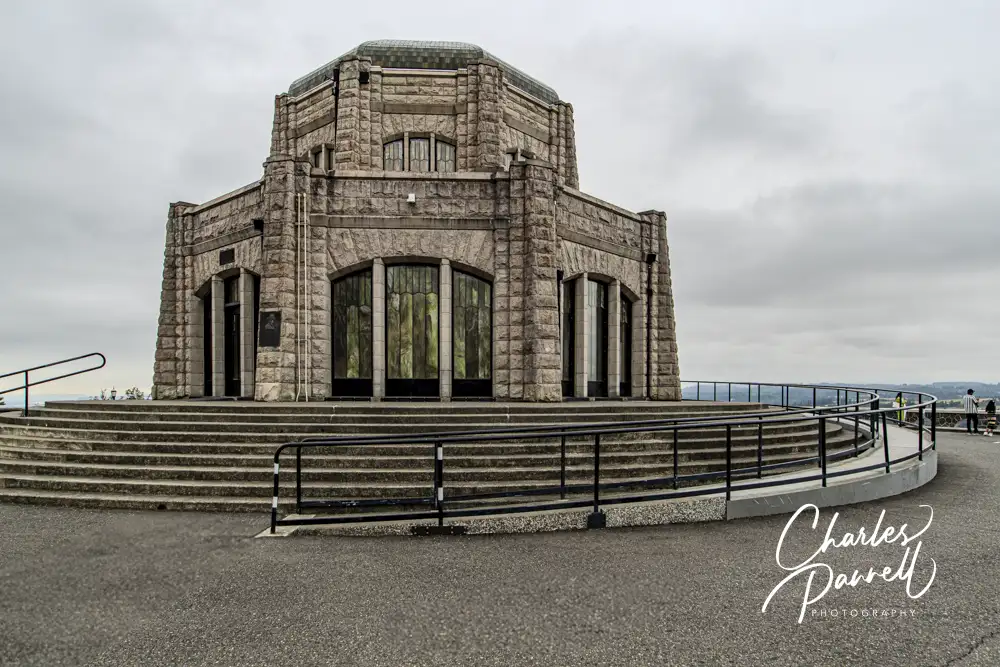
The Vista House on the Columbia River Highway Waterfall Corridor
Finding the waterfall corridor is easy. Head east from Portland on Interstate 84, then take exit 22 at Corbett and turn right. From there just follow the signs, and make a left on the Historic Columbia River Highway. This portion of the road winds through the forest for about three miles, before it heads uphill to Vista House at Crown Point (www.vistahouse.com).
Built in 1916 as a rest stop and observation tower, Vista House is a fitting starting point for the drive, as it was also the site of the 1916 dedication of the highway. There’s accessible parking near the front, with ramp access around to the back entrance. There’s level access through the automatic doors and plenty of room to maneuver around the main floor of this architectural treasure. Perched some 600 feet above the Columbia River, Vista House is lined with marble floors and filled with stained glass windows.
Listed on the National Register of Historic Places, this historic building also includes a cleverly hidden wheelchair lift. Designed to blend in with the architecture, the lift allows wheelchair-users and slow walkers access to the restrooms, exhibits, gift shop and cafe that are housed in the lower level. The building is usually open from Friday to Monday, but it depends on available staffing. And even if the building isn’t open you can still peer inside. There’s also a great river view near the back entrance.
Latourell Falls
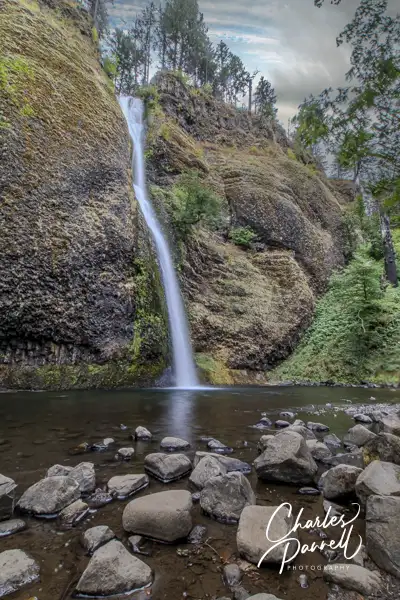
Latourell Falls is located 2.5 miles up the road, in the verdant Guy W. Talbolt State Park. There’s accessible parking with level access over to a viewing area, where you can get a gander at the majestic falls, as it tumbles 224 feet down over columnar basalt pillars. There’s a trail to an upper viewing area, but it’s steep and not wheelchair-accessible. Still you can get a great view from below.
There’s also an accessible vault toilet at this stop. And if you’d like to enjoy lunch alfresco, there’s an accessible picnic table located near the parking lot.
Bridal Veil Falls
Bridal Veil Falls, which is located two miles up the road, is also worth a stop. Although the trail to the the falls is steep and has steps, there’s another accessible trail that offers a good river view. There’s accessible parking in the large lot, with level access over to the trailhead. The trail to the right goes up to the falls, while the accessible Overlook Trail on the left leads over to the river. There’s also an accessible vault toilet near the trailhead.
The half-mile Overlook Trail has a few bumps along the way, but it’s still doable for most wheelchair-users and slow walkers. It winds through the woods, passes a picnic table and then skirts the river. There are a few places where you can get good view of the Columbia River, before the trail winds back through the woods to the beginning. It’s a pleasant stroll, and definitely worth a stop.
Wahkeena Falls
As you continue along Highway 30, Wahkeena Falls is located three miles up the road. Accessible parking is available on the left, above the picnic area. There’s also an old restroom with an accessible stall in the picnic area; however it’s best to drive down if you need to use it, as the road is pretty steep.
The accessible trail to the falls viewpoint is located across the street. The 200-foot paved trail is fairly level and winds over to the perfect vantage point. You can’t see these falls from the road, but there’s a great view of them at the end of the accessible trail.
Multnomah Falls
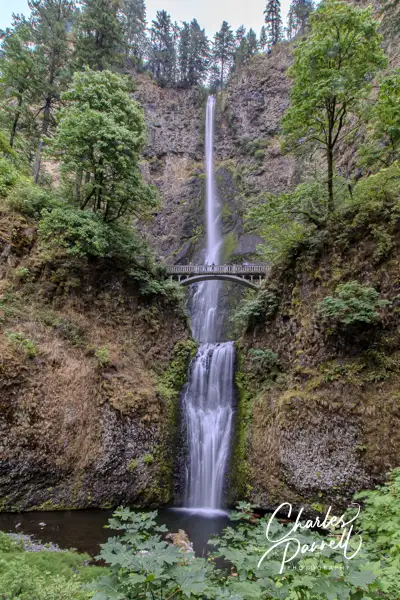
By far the most popular waterfall along the route is Multnomah Falls, which is located a half-mile from Wahkeena Falls. There’s accessible parking in the small lot across from Multnomah Falls Lodge, with level access over to the lower viewing area. Across the street, there’s a paved walkway that leads about 200 yards to the upper viewing area. Although this is a good option for power wheelchair-users, it’s a bit steep for manual wheelchair-users and slow walkers. Still you can get a nice view from the lower vantage point.
There’s also level access to the lodge, which houses a visitor center and a gift shop on the lower level; and offers elevator access up to the restaurant on the second floor. Accessible restrooms are also located on the lower level. And if you drive by slowly, you can get a nice view of the falls from Highway 30.
There’s also another parking area off of Interstate 84 for this popular stop. Just take exit 31 and follow the signs. There’s plenty of accessible parking in the lot; however the path over to the Highway 30 parking area is steep — especially near the bridge — so it’s not a viable option for most folks. The best bet is to park in the Highway 30 parking area. It should also be noted that there is no vehicular access from the Interstate 84 parking area to the Highway 30 parking area; so if you use the Interstate 84 parking area you won’t be able to drive to the Historic Columbia River Highway from there.
Multnomah Falls Timed Use Permit
During the peak summer season, a Multnomah Falls Timed Use Permit is required in order to park in the parking lot off of Interstate 84. The permit is required from late May to early September from 9 AM to 6PM. One permit per car is required, and the permits are checked on the path from the parking lot to the falls.
The permits are available for $2 at www.recreation.gov. They are valid for entry during a one-hour time frame, and if not used they will expire at the end of the issued time. For example, if you buy a permit for 1:00 PM and have not used it by 2:00 PM it will expire at that time. That said, you can spend as much time at the falls as you want, as long as you enter within the specified time frame.
The bulk of the permits are available 14 days in advance; while a smaller batch is released two days prior to the arrival date. Permits are not sold on site, so make sure to get one ahead of time. Additionally, just because you have a permit, does not mean you are guaranteed a parking space.
Horsetail Falls
Last but certainly not least on this Historic Columbia River Highway drive is Horsetail Falls, which is located 2.5 miles from Multnomah Falls. There’s accessible parking in the lot across the street from the falls. From there a short paved level trail leads 150 feet over to a nice viewpoint. There are also a few picnic tables near the viewpoint, and although there are no services at this stop there’s a bench to sit and enjoy the falls. As an added bonus, you can also get an excellent view of Horsetail Falls from Highway 30 or even from the adjacent parking lot.
After you’d had time to enjoy the falls, continue east on Highway 30 to Dodson, and hop on Interstate 84. From there you can either circle back to Portland, or continue east to explore more of Oregon. Either way, this scenic drive is well worth the short detour.
Latourell Falls
Bridal Veil Falls
Multnomath Falls
Horsetail Falls
Historic Columbia River Highway Travel Tips
Although the scenic waterfall corridor is a must-do on any Oregon road trip, there are a few things you can do to make your visit go smoother.
First and foremost, try and arrive early in the day. The route gets extremely crowded in the afternoon, and parking places — even accessible spots — are hard to come by.
The early bird rule applies double for the Multnomah Falls area. Even if you don’t plan to stop, that section of the route routinely backs up after 11 AM, as people sit in the road and wait for available parking spots.
It’s also a good idea to travel from west to east along the route. Most of the e-bike rentals begin at Cascade Locks and head west along Highway 30; and since there aren’t any alternative trails they have to ride in the road along the waterfall corridor. This tends to slow down the traffic that’s going in the westerly direction, and even backs it up at some spots.
There aren’t many services along the waterfall corridor, so pack along water and snacks. There are however a lot of pleasant picnic spots to enjoy a quiet breakfast or lunch.
Summer is the most crowded season along the Columbia River Gorge, so try to visit in the off season. The peak flow seasons for the waterfalls are winter and spring, which are usually less crowded.
Fall is also becoming a busy time along the route, as the fall foliage show is spectacular. It’s especially crowded on the weekends, so try to visit mid-week if possible.
Finally, take your time and stay a while to enjoy the Columbia River Gorge. For a fun getaway, spend the night in an accessible treehouse at nearby Skamania Lodge.
Barrier-Free Travel Washington National Parks for Wheelers and Slow Walkers
Angels Rest Wheelchair-Accessible Treehouse Suite at Skamania Lodge, Oregon
Although Skamania Lodge (https://www.skamania.com/) is just a 45-minute drive from Portland, it’s a world away from the trappings of urban life. Surrounded by towering evergreens, the 175-acre property offers upscale amenities in the scenic Columbia River Gorge. Of course the standard lodge rooms and suites at Skamania Lodge are beyond comfortable; however if you want to raise the meter on the exclusivity index, then check-in to their new wheelchair-accessible treehouse suite. Located in an private corner of the property, this luxurious tree-level suite offers comfortable furnishings, first-rate-amenities and more than a few little extras. And even though most treehouses aren’t doable for people with mobility issues, this wheelchair-accessible treehouse suite at Skamania Lodge is an excellent lodging choice for wheelchair-users and slow walkers.
A Wheelchair-Accessible Treehouse
Inside the Angels Rest wheelchair-accessible treehouse suiteThere are Lots of Windows in the Angels Rest wheelchair-accessible treehouse suite
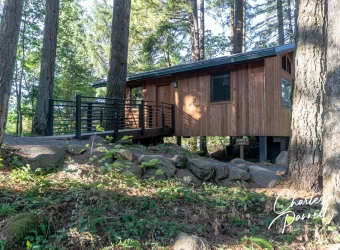
The new treehouse suites are located in a quiet corner of the lodge property that’s reserved for treehouse guests. There’s plenty of room to deploy a ramp in the parking space reserved for the Angels Rest (701) wheelchair-accessible treehouse suite. From there a 300-foot paved pathway leads up to the treehouse. There’s a slight incline to the path near the end, but it’s doable for most power wheelchair and scooter-users. Golf cart assistance is available to anyone who needs it — just inquire at check in. And if you encounter any problems, just call the front desk.
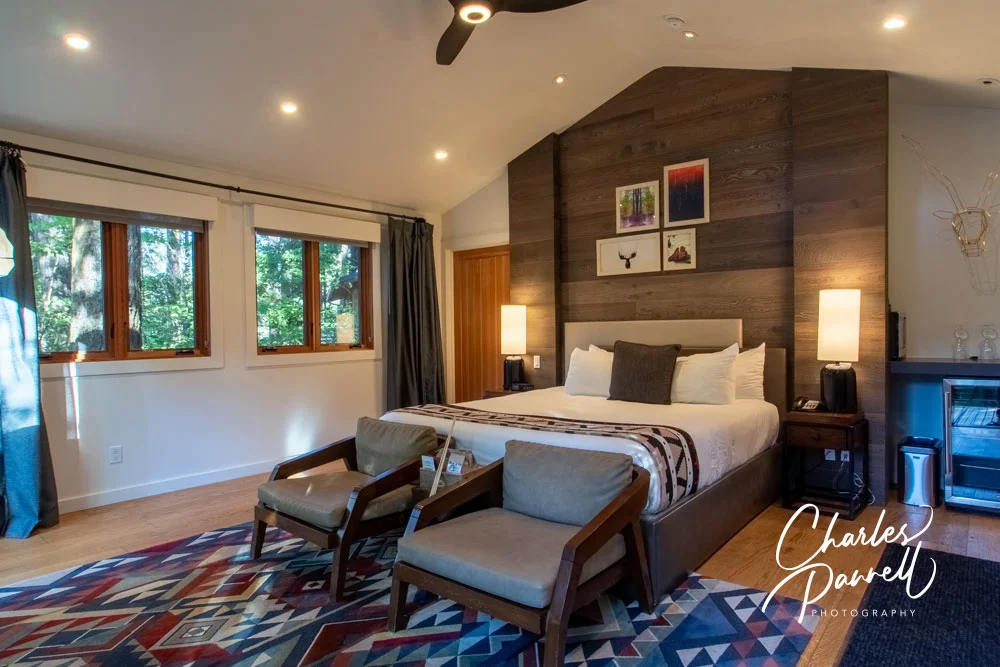
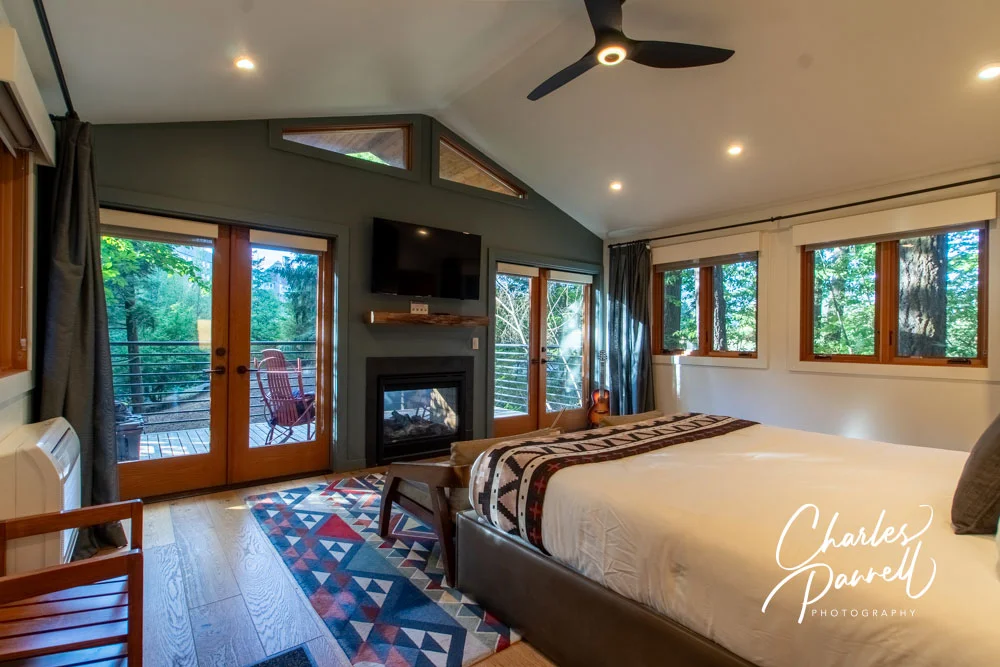
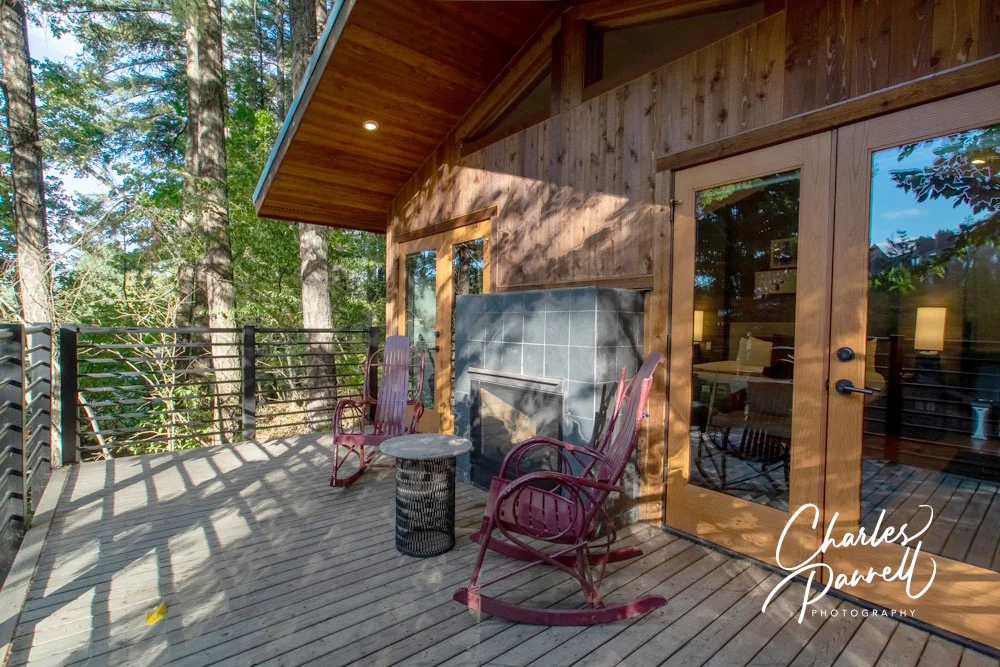
Access features in Angels Rest include wide doorways, lever handles and plenty of room to maneuver a wheelchair or scooter. The main room is lined with windows that bring the outside in — you really feel like you are in a tree. It’s furnished with a 26-inch high king-sized bed with wheelchair access on both sides, two night tables, a refrigerator and a microwave. And there are two comfy chairs in front of the indoor-outdoor gas fireplace, and a vintage guitar tucked away in the corner. There’s also level access to the spacious deck through two double doors.
Deck outside the Angels Rest wheelchair-accessible treehouse suite
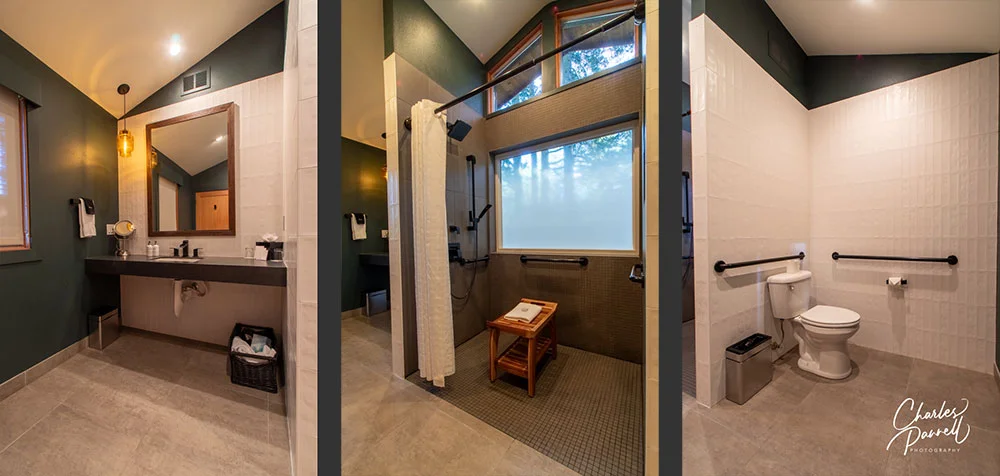
The bathroom is cavernous, and includes a full five-foot turning radius. It’s outfitted with a large roll-in shower with grab bars, a hand-held showerhead and a wooden shower bench. The toilet, which is located in an alcove around the corner, has grab bars on the back and left walls (as seated). Top it off with a large roll-under sink and a lowered mirror and you have a nicely outfitted and accessible suite.
Bathroom in the Angels Rest wheelchair-accessible treehouse suite
Those Little Extras
And then there are those little extras that are included in this luxurious wheelchair-accessible treehouse. For starters, there’s not just a coffee maker, but a Nespresso machine. Just pop in a pod for a perfectly brewed cup of expresso. Of course if you prefer tea or cocoa, they have that too.
And let’s talk about the robes. Many hotels provide guests with robes and slippers, but the treehouse robe was the softest and plushest one I’ve ever worn. Seriously, I didn’t want to take it off.
There were also some nice extras outside. Not only are there comfy chairs and a table on the deck, but there’s also a Yeti ice chest. And it’s filled with ice, so bring your favorite beverage and enjoy. And although the whole treehouse suite simply oozes romance, the deck is a particularly romantic retreat. There’s also a nice open meadow below the deck, where the deer like to hang out near the end of the day.
Last but certainly not least, there’s the gas firepit that’s located close to the treehouse. There’s level access to the firepit, which is reserved for treehouse guests. And you don’t have to worry about actually starting a fire — just push a button and you’re good to go. Of course you can just sit around the fire and enjoy the evening, or you can whip up some tasty s’mores. And in keeping with the “little extras included” theme, s’more kits are also included in the treehouse suites. Truly they thought of everything.
But Wait, There’s More
Of course the wheelchair-accessible treehouse is just the tip of the iceberg at Skaminia Lodge. Let’s not forget the public spaces. There’s plenty of accessible parking near the main lodge building with a barrier-free path over to the spacious lobby. On the far side of the registration desk there’s a large fireplace, with plenty of spots to sit and enjoy the warmth, and take in the view of the surrounding forest.
The Cascade Dining Room, which is located just down the hall, also offers good wheelchair access. Guests can enjoy eggs benedict for brunch and feast on a rack of lamb at dinner. Lighter fare and gluten-free selections are also available. But one of the best features of the dining room is the expansive view of the forest, with the Columbia River in the background.
If you’d prefer some lighter fare, there’s also barrier-free access to the River Rock Lounge, which is located just down the hall.
And if you’d like to go for a swim, then just take the elevator to the basement and check out the indoor swimming pool. Not only is there good access around the pool, but there’s also a wheelchair lift to get into it. And since it’s protected from the elements, you can enjoy the water year-round.
In the end, not only does Skamania Lodge have all the bells and whistles, but it’s also just a short drive from the Historic Columbia River Highway, where you’ll find scenic vistas, jaw-dropping views and cascading waterfalls. It’s the perfect spot for a romantic retreat. After all a segment of The Bachelorette was filmed there!
Barrier-Free Travel Washington National Parks for Wheelers and Slow Walkers
Located along the Historic Columbia River Highway in Dalles, the Columbia River Gorge Discovery Center (gorgediscovery.org) is a must-stop on any Northern Oregon road trip. If you’re already on the historic highway, just follow Taylor Franz Road and Discover Drive to the museum; and if you’re on Interstate 84, then take exit 82 and follow the signs. Either way it’s easy to find.
The Columbia Gorge Discovery Center, which is located in an award-winning 48,200 square-foot building, serves to create appreciation for the Columbia River Gorge through the interpretation of cultural and natural resources. To that end it presents a comprehensive history of the area, offers daily raptor shows and has a wheelchair-accessible trail that’s filled with native plants and exhibits. And it’s also the starting point of the accessible Riverside Trail. It’s a great primer for any Columbia River Gorge trip, and a must do on a Historic Columbia River Highway excursion.
Discover the Gorge
Access is good at the Columbia River Gorge Discovery Center, with plenty of accessible parking, level access to the front door; and ample room to maneuver a wheelchair inside. There’s elevator access to the second floor, and accessible restrooms are located near the boardroom. And if you’d like to bring along lunch, there’s a picnic area with accessible tables in back.
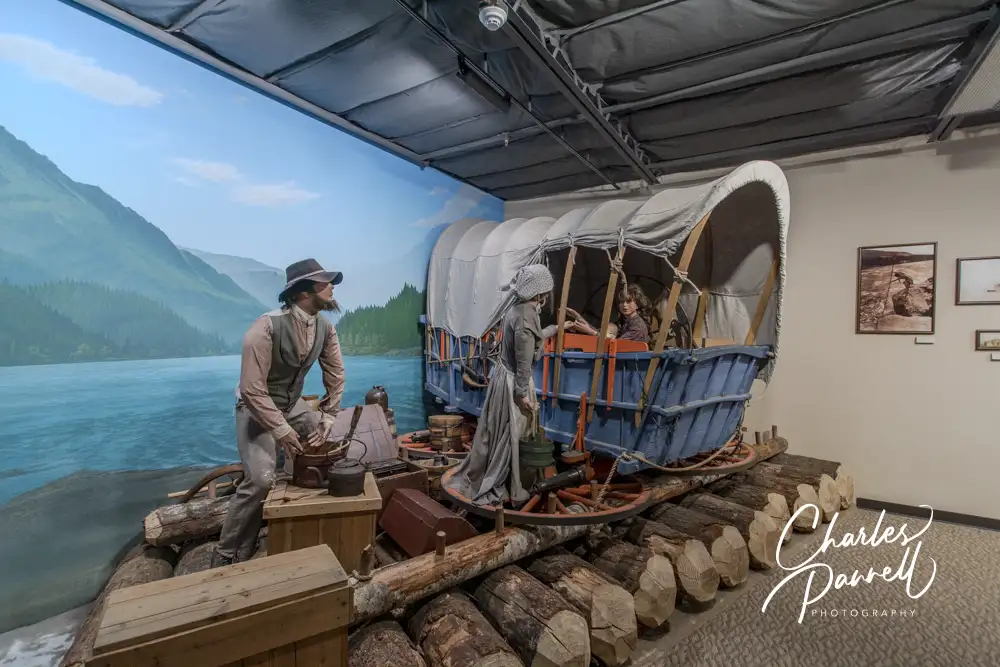
There’s good pathway access throughout the Discovery Center, which focuses on the history of the the gorge from the ice age to present day. Exhibits include displays about the geology of the gorge, Lewis & Clark, gorge ecology, the Oregon Trail and transportation. There are a number of interactive and tactile exhibits, and the whole museum offers a comprehensive look at the Columbia River Gorge.
And don’t miss the live raptor presentations that are held in the theater. These educational seminars are included with admission and in addition to having a raptor — or two — present, they also offer a good overview of raptor habits, behavior and habitat. And there’s barrier-free access to the theater, with plenty of room for wheelchairs in the front and on the sides. Check the theater schedule when you arrive so you don’t miss this educational and entertaining presentation.
A Little History
Display inside the Columbia River Gorge Discovery Center
The Wasco County Historical Museum, which is located in the east wing, also has excellent wheelchair access. Established in 1854, Wasco County is home to portions of the Lewis & Clark Trail and the Oregon Trail; while Native Americans, missionaries, pioneers and folks looking to strike it rich in the gold rush also inhabited the area over the years. And the museum offers a wide variety of displays on the diverse history of the area.
There’s plenty of room for a wheelchair to maneuver around the exhibits about the early inhabitants, shipwrecks on the Columbia River, the former cannery, a rail depot and the old Umatilla House hotel. And there’s even a turn-of the-century street scene of Dalles. Round it out with a agriculture exhibit and a gallery filled with George Lawrence Company saddles, and you get a pretty good picture of the early settlers of Wasco County.
Take a Hike
Along the Native Plant Walk outside the Columbia River Gorge Discovery Center
Finally, save some time to explore the outdoor areas of the museum. There’s level access out the back door to the paved Native Plant Walk. Make a left as you exit the museum and head all the way to the end of the trail to the Columbia River scenic overlook, where’ you’ll get a good view of the river with the Klickitat Hills in the background.
Next head back to the museum — past some evidence of beaver activity — to the Native American petroglyph rock art near the back door. The remainder of the trail winds past Olney’s cabin, Crate’s Cabin and a tepee, and includes over 40 identified plants. Pick up a guide at the front desk and see how many you can find. The whole trail is paved and wheelchair-accessible.
And near the end of the Native Plant Walk, you’ll find the beginning on the Riverfront Trail. This wide paved trail winds along the southern bank of the Columbia River, from the Columbia River Gorge Discovery Center to the Dalles Dam Visitor Center. The trail is an excellent option for wheelchair-users and slow walkers; and the great part is, you can do as little or as much of it as you want. That said, even if time is short, try to fit in a short stint along this scenic thoroughfare. It’s the perfect way to top off a visit to the Columbia River Gorge Discovery Center.
Barrier-Free Travel Washington National Parks for Wheelers and Slow Walkers