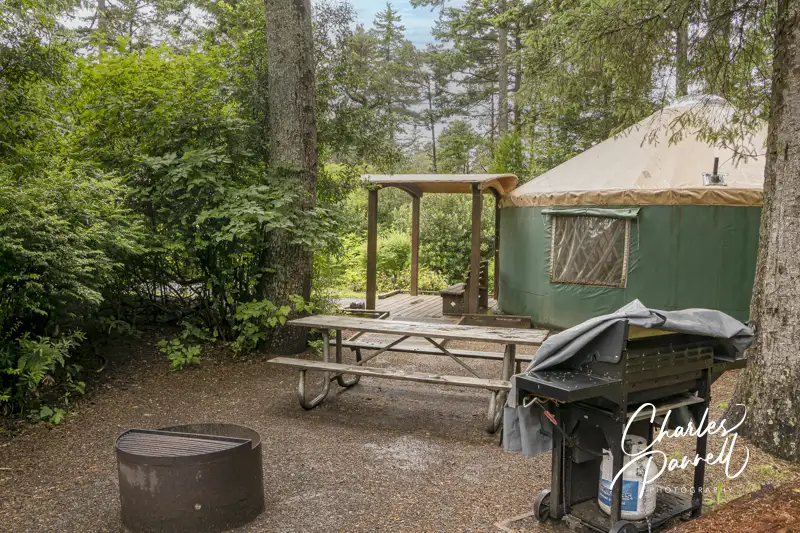
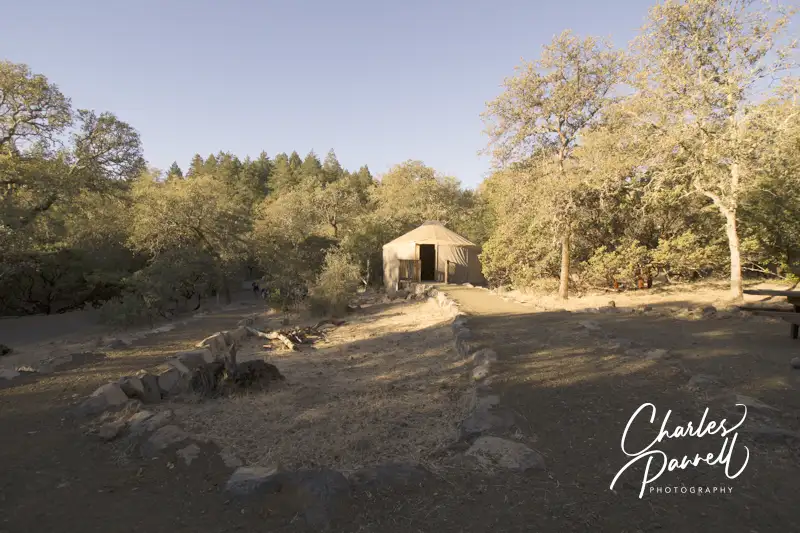
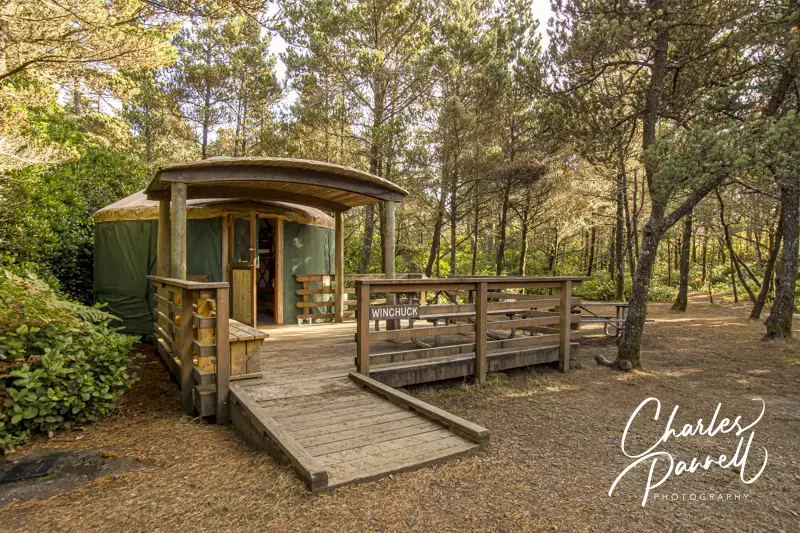
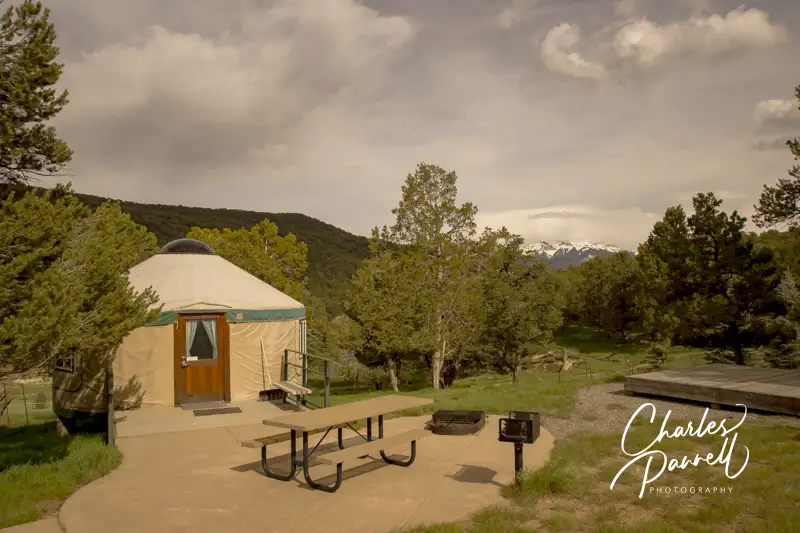
Yurts are all the rage these days. An alternative to pitching a tent, they come in all shapes and sizes. Some are pretty basic, while others offer all the comforts of home. They are all set in stunning locations, and since you just have to take along bedding and towels, it’s easy to pack for a yurting vacation. And the good news is, wheelchair-accessible yurts are popping up at campgrounds across America.
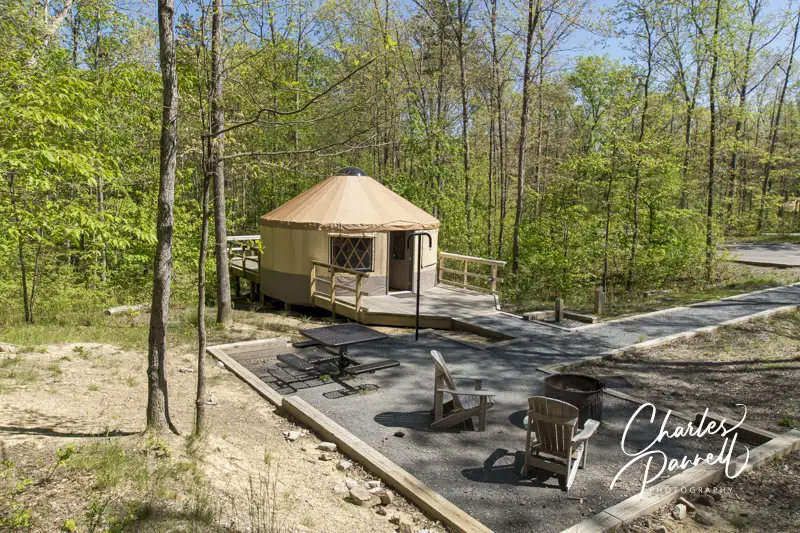
This accessible yurt is located in a popular state park in Northwestern Georgia. Spend a night or two and enjoy some of the views from the accessible Overlook Trail.
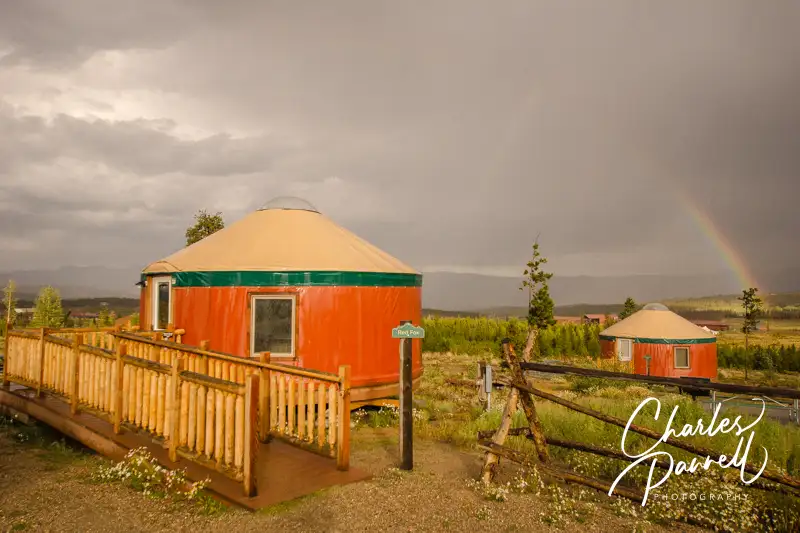
These two wheelchair-accessible yurts are surrounded by Colorado’s scenic beauty. One is located in Golden Gate Canyon, while the other is near Rocky Mountain National Park.
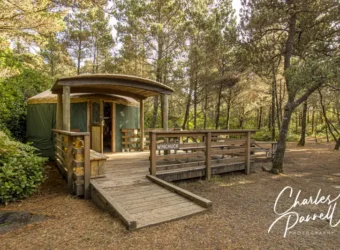
Located south of highly visited Sequoia National Park, this secluded yurt is in a campground with only 11 other sites. And it’s just a stones throw away from a wheelchair-accessible trail through the Sequoias.
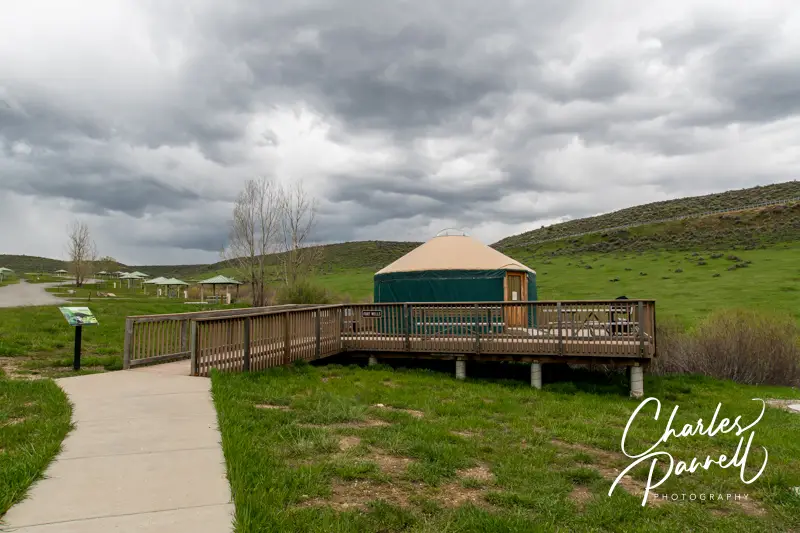
This simple yurt is perched on a hillside overlooking a scenic Utah lake. Add in a spacious deck with a gas BBQ and you have a perfectly accessible retreat.
If you want to dodge the tourist crowds in popular Napa Valley, then head over to Boothe Napa State Park and spend the night in this wheelchair-accessible yurt. And then enjoy some of the wheelchair-accessible trails in the park.
South Beach State Park, which is located on the Oregon coast, features 23 wheelchair-accessible yurts. Add in some accessible trails and you have the perfect spot to stay for a few days.
Last but certainly not least, this wheelchair-accessible yurt is located in Ridgeway State Park, nestled at the base of the San Juan Mountains in Southwestern Colorado. And it’s just a short drive from Black Canyon of the Gunnison National Park.
Barrier-Free Travel
California National Park Road Trips
for Wheelchair-Users and Slow Walkers
Most people don’t really think about wheelchair access, but to be honest it’s in the back of my mind everywhere I go. I’ve seen the good, the bad and the ugly when it comes to accessibility. I’d like to say that bad access doesn’t even faze me any more, but it does. Sometimes I just can’t believe folks can’t get it right in this day and age. And then there are the unexpected good surprises, like Mitchell Point Tunnel.
A Little History
Located down in Northern Oregon, the original Mitchell Point Tunnel dates back to 1915, when John Arthur Elliott built it along the Historic Columbia River Highway. The highway was subsequently re-routed when larger cars wouldn’t fit through the tunnel; and then it was then closed and later demolished when the interstate was constructed in the 1960s. But lo and behold the Oregon Department of Transportation decided to reconstruct a pedestrian version this highway landmark in 2021.
Suffice it to say it was a huge project, and it took many years to complete. Finally in 2025 the new – and improved – Mitchell Point Tunnel was opened, and much to my surprise, it offers excellent wheelchair access. Granted, it’s not that difficult to include access when you are constructing something from the ground up, but it’s amazing how often simple access features are overlooked.
So here are a few access details that they got right at the new Mitchell Point Tunnel.
Parking
Accessible parking is easy, right? Well perhaps it is, but you’d be amazed at how many folks get it wrong. There are only about 16 spaces in the tiny Mitchell Point Tunnel parking lot, but they did manage to include an accessible parking space with adequate room for ramp deployment. And it’s located right next to the trailhead and the picnic area. It’s not rocket science, but I’m thrilled they got it right.
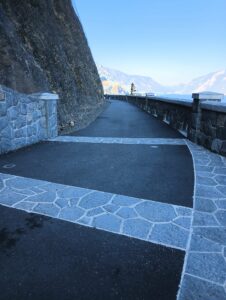
Good pathway access at Mitchell Point Tunnel
Pathway Access
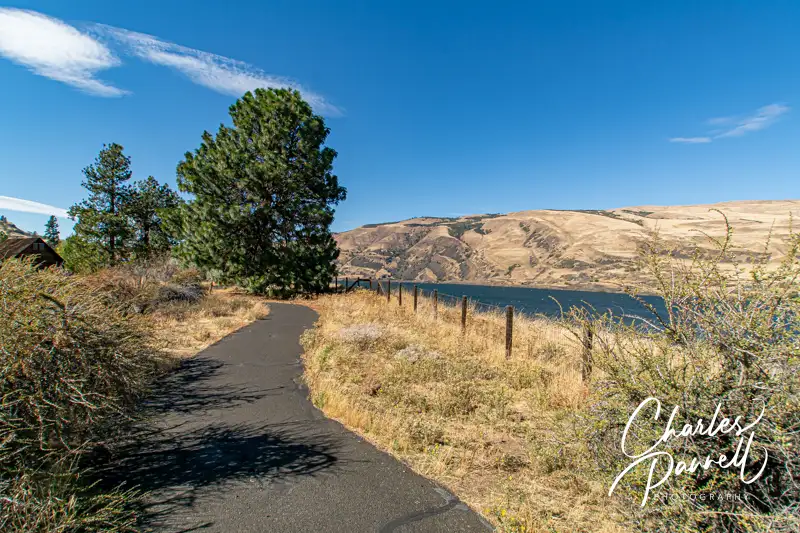
There’s a paved accessible pathway that runs from the accessible parking area, past the picnic tables and over to the tunnel. Once inside the tunnel, the pathway is also paved and wheelchair-accessible. No gaps, no bumps, no access shortfalls. It’s a pleasant half-mile round-trip stroll.
Cutouts so everyone can enjoy the view below
The View From Above
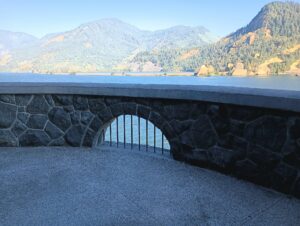
Now here is where this project really shines – in the view department. To say that this short trail offers a scenic view of the Columbia River below is an understatement. That said, I totally understand that the powers-that-be had to “idiot-proof” things and make a wall high enough so that some bozo doesn’t hop up on it for a selfie (trust me it happens). Their solution was to make archway cutouts in the rock wall below, so that you can get a good view from a seated position. Not only does it help keep the idiots in line, but it’s also an attractive and accessible solution.
The view from inside Mitchell Point Tunnel
Inside the Tunnel
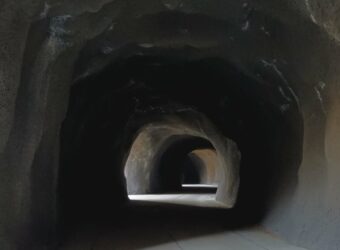
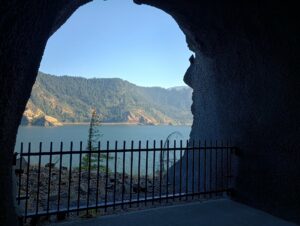
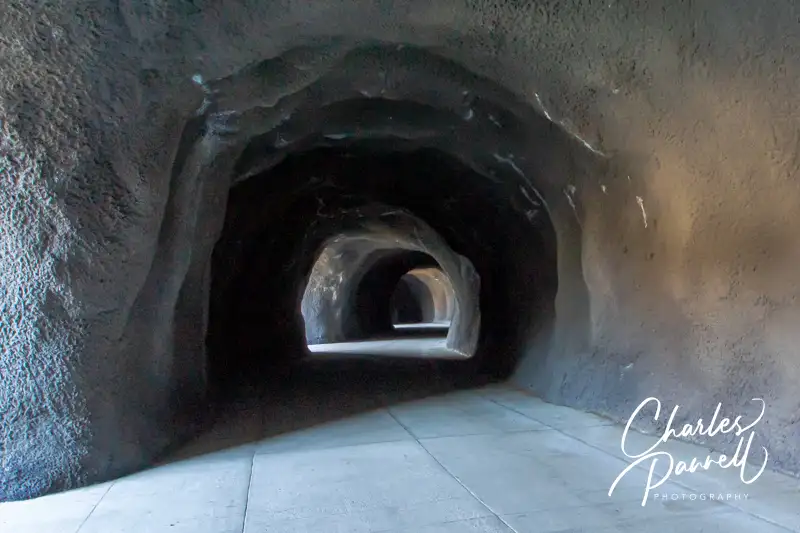
I was equally impressed with the full sized cutout windows that they have inside the tunnel. Granted they had to put up railing because of “stupid people”, but they still look good and are also quite functional. These five openings let natural light in the tunnel so it’s easier for everyone to navigate and see possible tripping hazards. Without these openings it would be pitch black in the tunnel, and people would be grabbing for their phones to safely navigate. I’ve been in tunnels like that before, and this one is so much safer.
Accessible Vault Toilets
Granted, vault toilets are not my favorite amenity; however they are necessary. These models are on a cement slab with good access from the accessible parking space. Many times vault toilets are just placed on the dirt, and over time erosion creates a large step up to them. These are done right. And of course, there’s plenty of room for even the largest wheelchair or scooter inside.
And they didn’t forget truly accessible picnic tables at Mitchell Point Tunnel
Picnic Tables
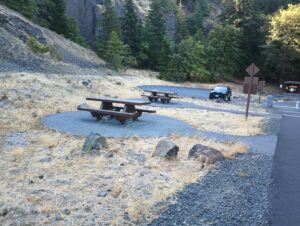
Last but certainly not least, they remembered the accessible picnic tables. And they are close to the accessible parking space. They are on a nice new level asphalt surface, and they are the true accessible models – with room on the ends for wheelchairs. Add that all up and the Mitchell Point Tunnel makes a great accessible stop to enjoy the view, stretch your legs, use the facilities or have a picnic lunch.
So stop in and check out the Mitchell Point Tunnel for yourself, on your next Oregon road trip, It’s easy to find – just take exit 58 off of Interstate 84 near Hood River, follow the signs, and enjoy!
Located along scenic Highway 97, just north of Bend, Lava Lands Visitor Center (www.fs.usda.gov/r06/deschutes/recreation/lava-lands-visitor-center) is worth a stop on any Crater Lake road trip. Unfortunately many visitors zip right on by this volcanic site on the way to the more popular national park. Beside the visitor center, this site offers several trails that wind through the eerie remnants of an ancient eruption. And despite its foreboding name, this remote Oregon stop is actually a good choice for wheelchair-users and slow walkers.
Lava Lands Visitor Center
There’s accessible parking near the Lava Lands Visitor Center, with curb-cut access to a paved pathway that leads to the front door. Inside there’s plenty of room to maneuver a wheelchair through the galleries. The visitor center serves as the interpretive hub for the Newberry National Volcanic Monument, which includes over 54,000 acres of lava flows. Exhibits focus on the geology and cultural history of the area, and rangers are available to field questions. There’s also a bookstore, a theater and accessible restrooms inside the visitor center.
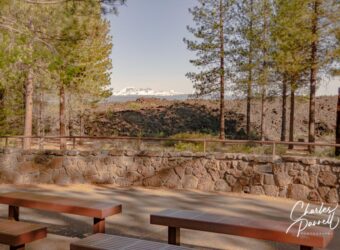
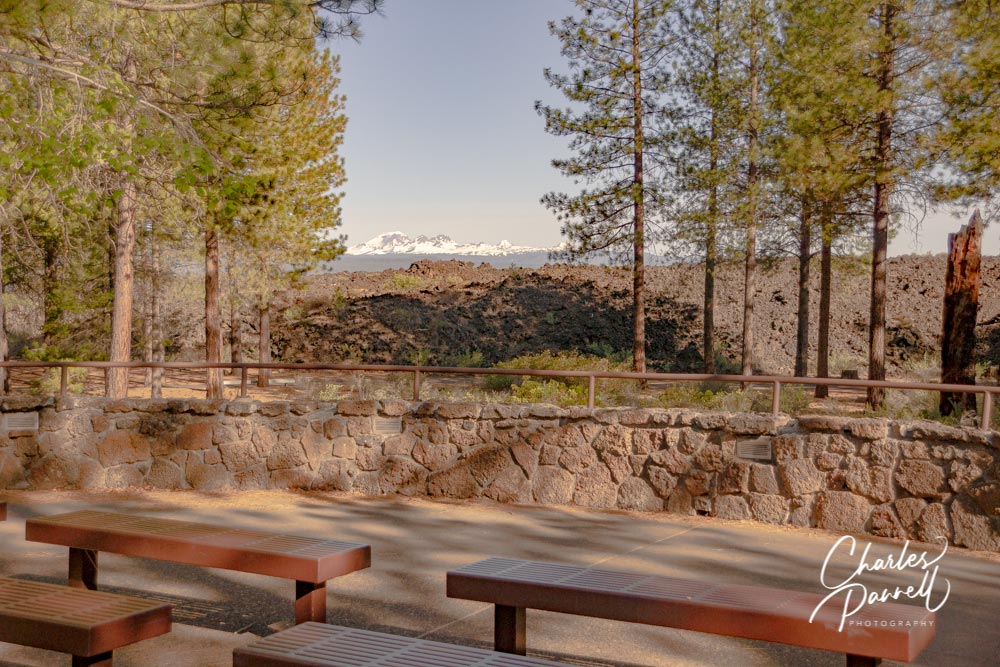
Outside on the back patio there are several benches to sit and enjoy the mountain views. It’s also the site for ranger programs and presentations. It should be noted that the visitor center is only open seasonally, usually from late May until winter.
Explore the Lava Flow
Trail of Molten Land
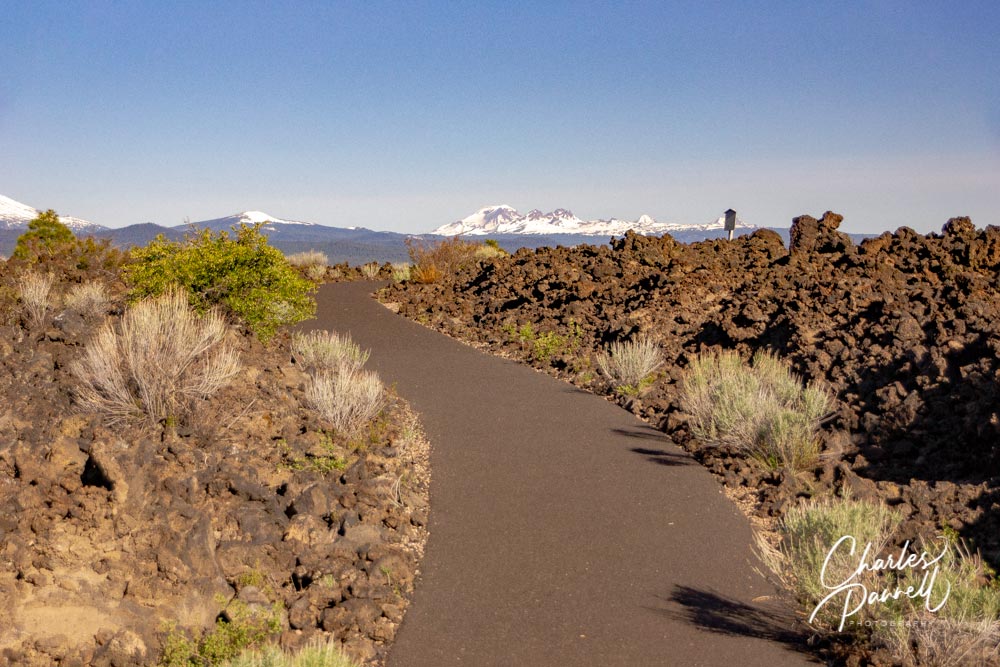
Save some time to explore the unusual landscape near the visitor center, on one or more of the accessible trails. At the top of the list is the Trail of Molten Land, which begins just to the right of the visitor center patio. The first part of the trail is shaded by pines, but once you turn the corner the stark reality of the eruption that happened some 7,000 years ago really hits home. The Lava Butte cinder cone is clearly visible in the background, as the trail winds around the basalt lava flow. To say it’s stark is an understatement.
The paved trail has a slight elevation gain in the beginning, but there are level spots to stop and rest. At about the .3-mile mark there’s a nice viewpoint which offers a stunning Cascade panorama. Unfortunately the wheelchair-access ends at this point, as the trail continues on with a steep uphill climb. Still it’s a nice .6-mile round-trip stroll.
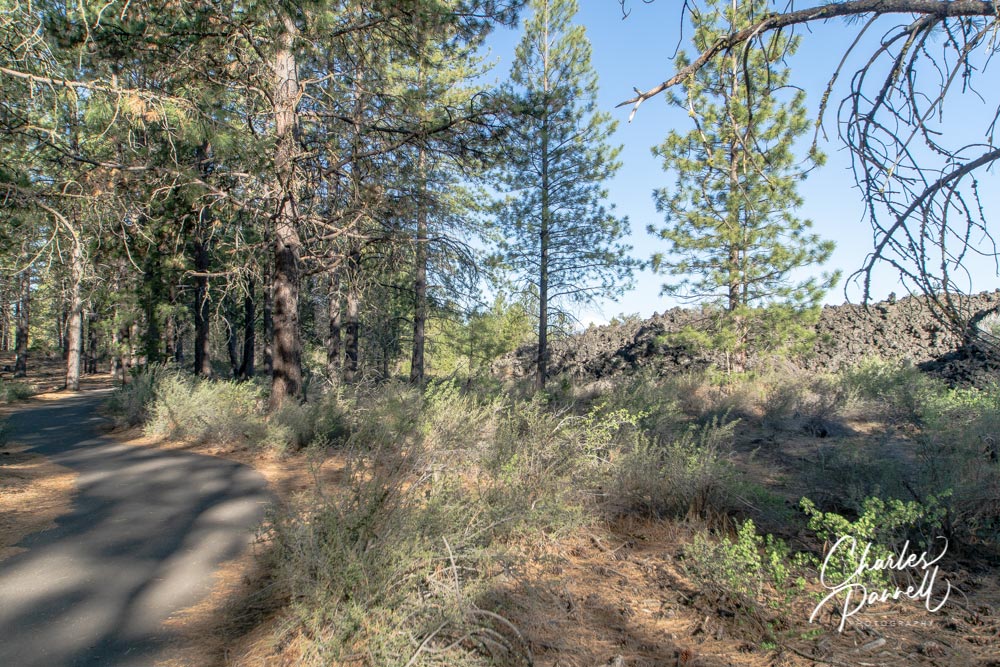
In contrast, the nearby Trail of the Whispering Pines offers a pleasant walk through a pine forest, on the edge of the lava flow. The trailhead is located to the left of the visitor center patio. This quarter-mile trail is paved and includes a nice shaded bench to rest and take in the the snow-capped mountain view. The trail winds around the Ponderosa Pines and skirts the parking lot, before it circles back to the visitor center.
Enjoy a Longer Stroll
Sun-Lava Paved Path
Finally, if you’d fancy a longer hike, the Sun-Lava Paved Path begins at the far side of the parking lot, near the accessible porta-potty. This wide paved trail runs through the forest, gradually descends to the Deschutes River, then continues on to Sunriver Resort. Although the grade never exceeds 5%, and there are level places to rest along the way, remember it’s an uphill trek on the return trip, so plan accordingly. It’s a beautiful trail, and you can do as little or as much of it as you like.
Once you’ve concluded your hikes, you can hop back on Highway 97 and continue on to Crater Lake. All in all, it’s a pleasant detour, and there are also a few accessible picnic tables near the parking lot if you happen to visit around lunch time.
Barrier-Free Travel
Washington National Parks
for Wheelchair-Users and Slow Walkers
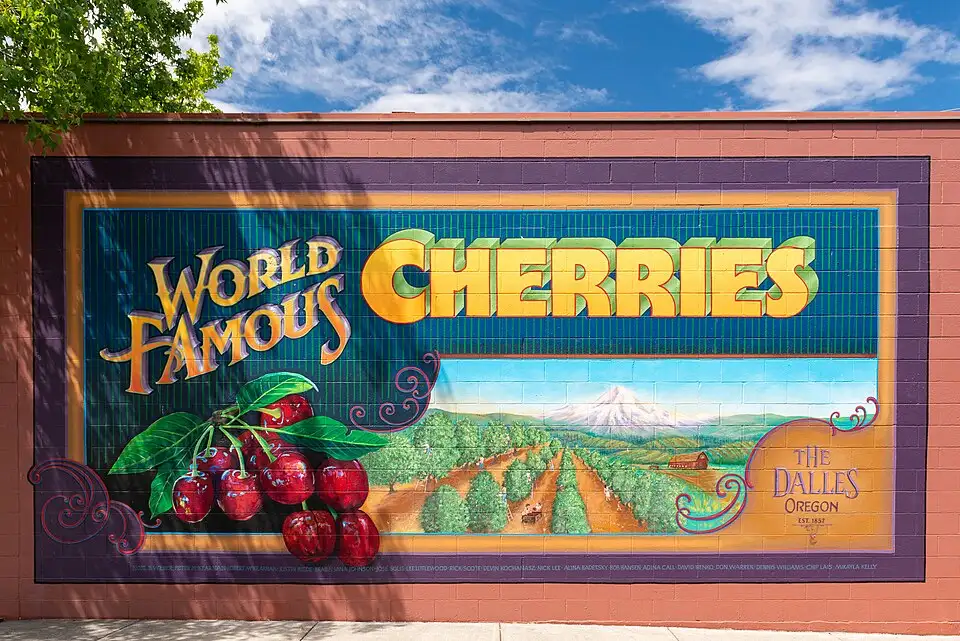
Named by French Canadian fur traders for the stone islands in the middle of the treacherous rapids in the Columbia River, The Dalles is steeped in history. That said, although the town name comes from the French word for flagstone, there’s far more to see than a few river stones in this Northwestern Oregon city. From the history of early explorers to the impressive dam and even a vibrant if not eclectic downtown area, there’s plenty to see and do in this thriving Columbia River community. And the good news is, much of it is wheelchair-accessible.
A Downtown Stroll
One of the best ways to acquaint yourself with the history and character of The Dalles is to explore some of the 30-plus murals in the downtown area (explorethedalles.com/murals/). A project of the Dalles Mural Society these pieces depict the people and places that shaped the area. And along the mural walk, there are also a few must-see historic stops.
At the top of the list is The Dalles City Hall, which is located at 313 Court Street. Accessible street parking is located on Court Street; and although the outside of City Hall offers is nice photo op, there’s also a noteworthy display inside. The Dalles Fire Museum is located on the ground floor and is open during City Hall business hours. It offers a historic look at the local fire companies and honors the lifesaving actions of local firefighters. It’s a fun look at some vintage equipment. Best of all, there’s barrier-free access to this historic display/
And for more ideas of things to do in the downtown area, visit explorethedalles.com.
A Slice of History
Fort Dalles Museum
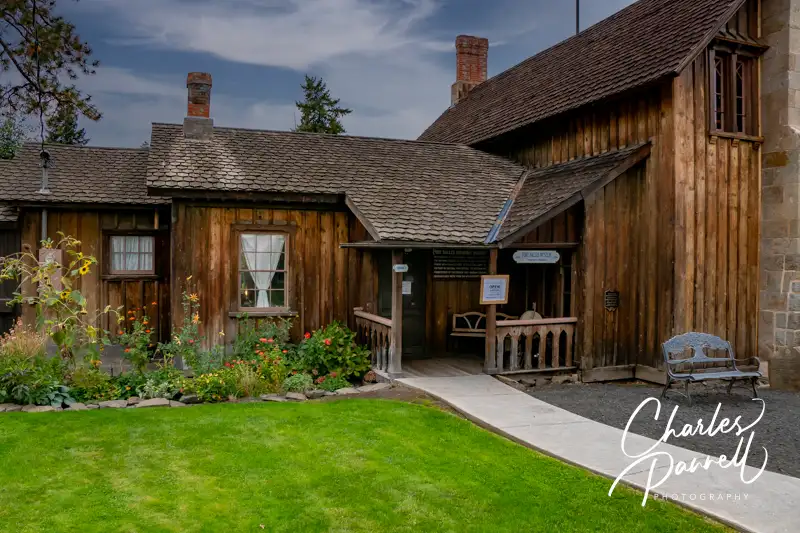
For a dive into the history of the area, make sure and stop at the Fort Dalles Museum (www.fortdallesmuseum.org). Despite the age of this historic structure, wheelchair-access was worked into the master plan, so today most folks can easily navigate the grounds.
One of Oregon’s oldest museum buildings, the main house dates back to 1856, when it served as the surgeon’s quarters at the original fort. There’s parallel parking on the street in front of the fort, and a nice accessible pathway to the front door. Inside, there’s good access on their first floor, which has a large living area, a kitchen and dining room and a music room. There’s also a narrow stairway to the two small upstairs bedrooms. Still the first floor houses the bulk of the exhibits, which include old photos, furniture, rifles, dishes, surgeon’s tools, and a nice collection of Native American artifacts. And if you have any questions, just ask the helpful docent.
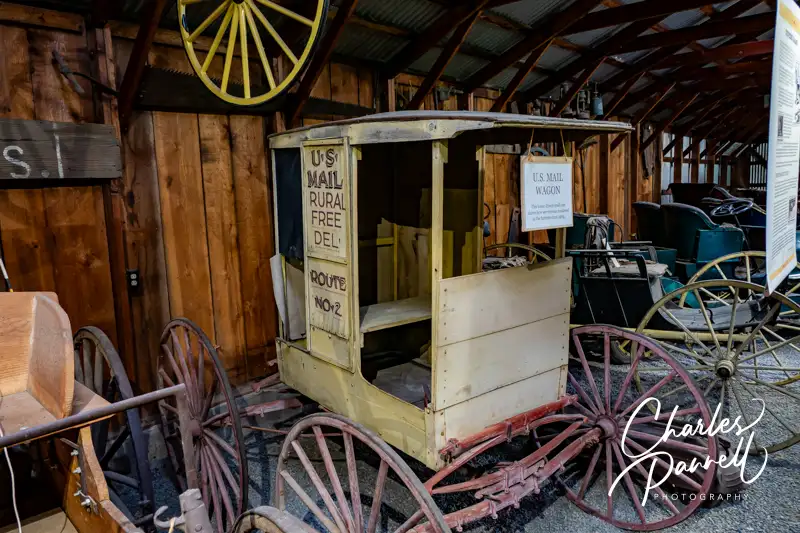
Out back there’s a gravel pathway down to the the antique vehicle building which houses a gaggle of historic cars. They are in various states or restoration and include a 1908 Knox touring car, a 1925 Ford roadster, an 1884 Hansom cab, a milk wagon and a few vintage hearses. Next door there’s an outside display of carriages, and although there’s a wide pathway, some folks may need assistance with the slight uphill slope.
Antique Vehicle Building at the Fort Dalles Museum
There are also a few picnic tables in a level area near the back of the house, with accessible restrooms just around the corner. And you can get a nice view of the historic Anderson House from the back of the property, so pack along a picnic lunch, take a break and enjoy the view.
Riverside trail at the Columbia Gorge Discovery Center
And for a deeper dig into the history of the area, a stop at the Columbia Gorge Discovery Center (emerginghorizons.com/columbia-river-gorge-discovery-center/) is certainly warranted. This excellent museum celebrates the cultural and natural resources of the Columbia Gorge; and as an added bonus it also offers a nice accessible riverside trail.
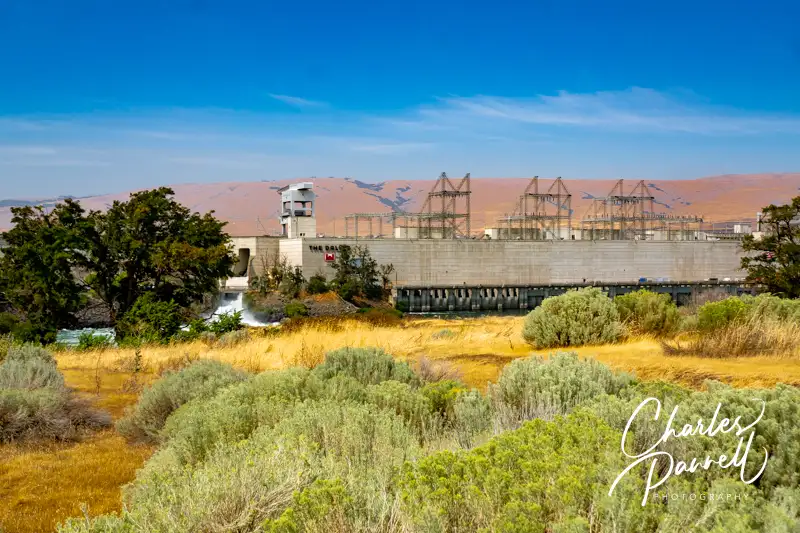
Dalles Dam viewed from the Dalles Lock & Dam Visitor Center
Don’t forget to stop at the Dalles Lock & Dam Visitor Center while you are in the area, as it offers a nice view of the dam. Just take exit 87 from Interstate 84 and follow the signs. There’s level access to the visitor center, but the hours are usually limited to summer and fall weekends. You can still get a good view of the dam from the accessible scope in the parking lot, and there are some covered accessible picnic tables next to the visitor center if you’d like to have lunch there.
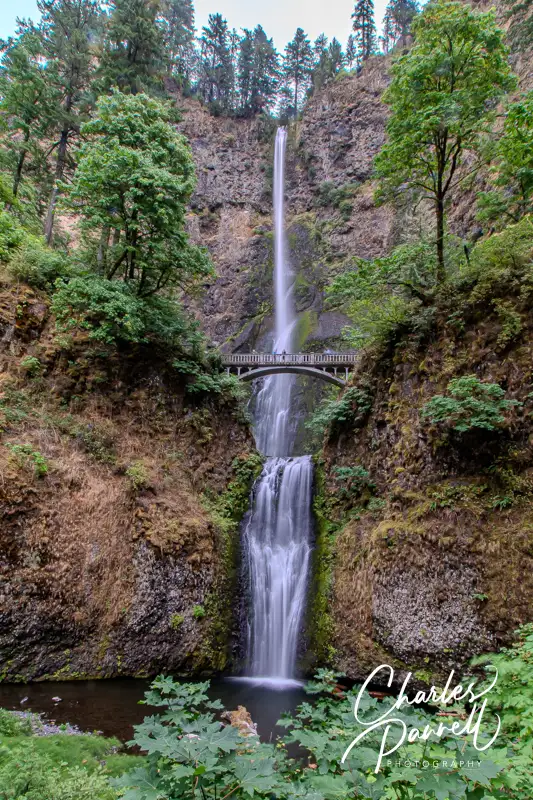
Multnomah Falls on the Columbia River Highway Waterfall Corridor
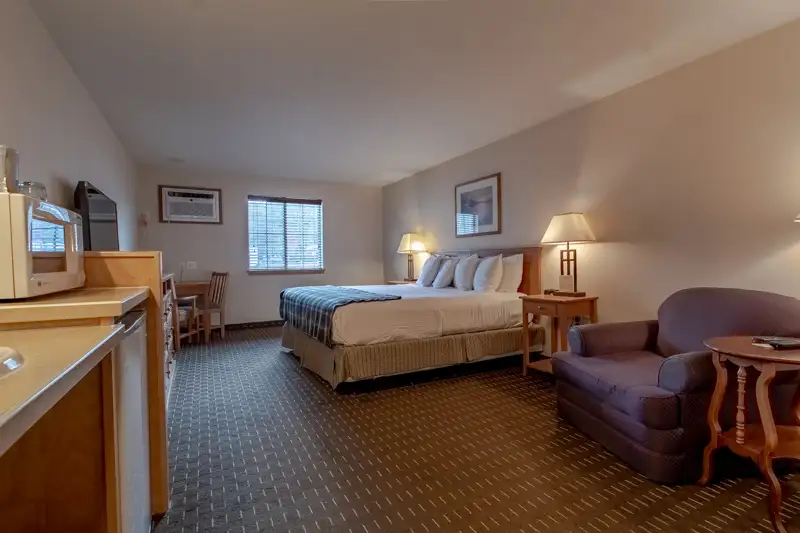
Of course, with all the things to see and do in the area, it’s best to spend a night or two. And in that respect, Cousins’ Country Inn (cousinscountryinn.com) is a comfortable and accessible choice.
There’s an accessible drop-off area in front of the office, with level access to the front desk, and the adjacent restaurant. From there, it’s just a short drive to accessible room 149. There’s accessible parking in front, with level access over to the front door.
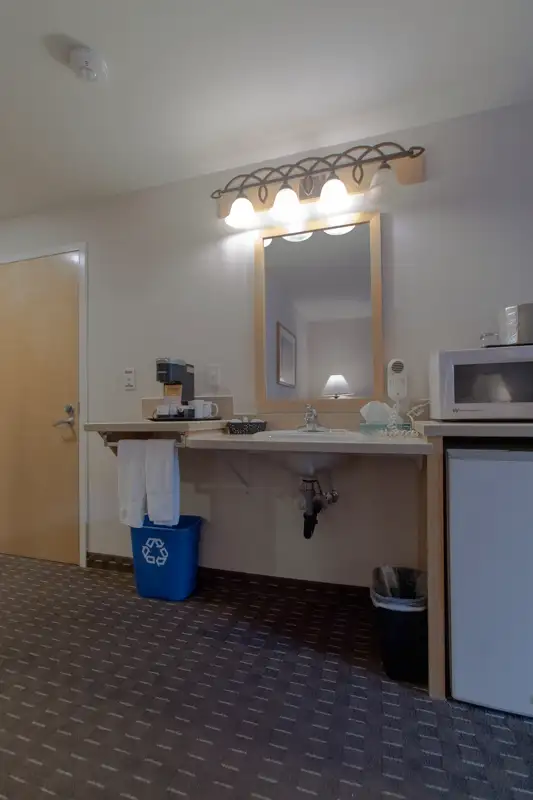
Access features in the room include wide doorways, lever handles, a lowered closet rod and low-pile carpet for easy rolling. It’s furnished with a 27-inch high king-sized platform bed with wheelchair access on both sides, two nightstands, a chest of drawers, an easy chair and a dining table with two chairs. And even with all that furniture, there’s still plenty of room to maneuver a wheelchair. The room also has a refrigerator and a microwave, and there’s a roll-under sink in the main room, next to the bathroom.
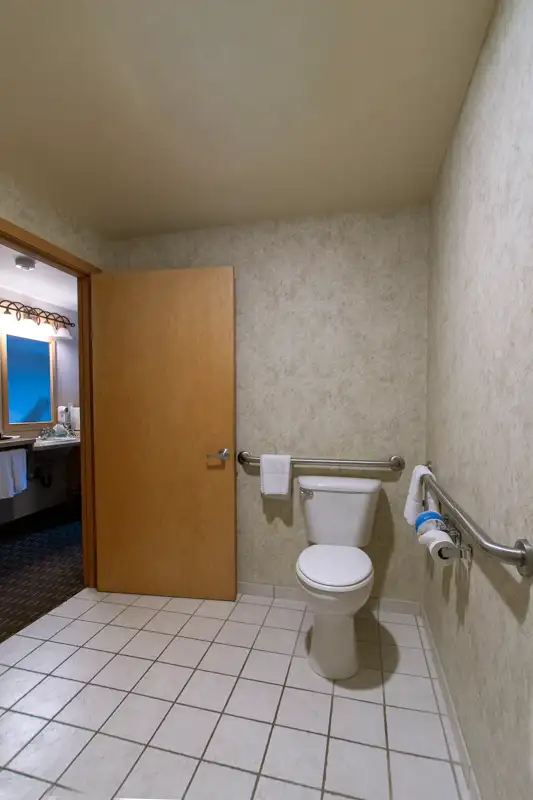
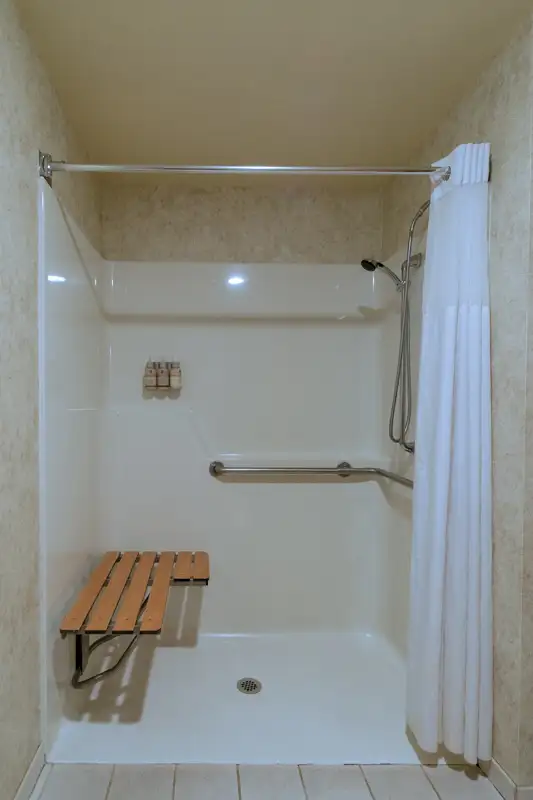
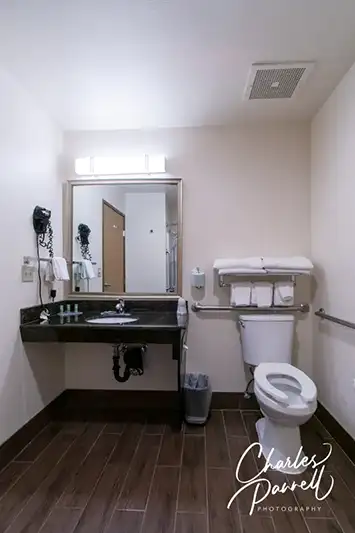
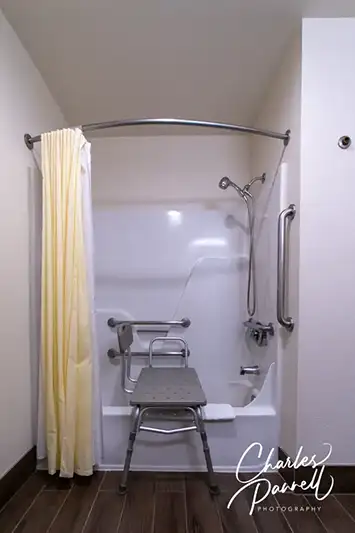
The bathroom has a full five-foot turning radius and is equipped with a roll-in shower with grab bars, a hand-held showerhead and a fold-down shower bench. Top it off with a toilet with grab bars on the back and left walls (as seated) and you have a very functional and accessible bathroom.
Overnight guests also get a discount on breakfast at Cousins’ Restaurant, which is located off the lobby. All in all, Cousins’ Country Inn is an affordable and accessible lodging choice.
(click for larger image)
Room 149
Toilet in Room 149
Shower in Room 149
Vanity in Room 149
Barrier-Free Travel California National Parks Road Trips Travel Ideas for Wheelchair-users and Slow Walkers
Mount Hood is a popular Oregon landmark. To locals, the appearance of this 11,249-foot high giant is a sign of nearing home; and to visitors it’s a sight to behold at first glance. You can drive up to Timberline, ski down the slopes of this active volcano, or even attempt to scale the popular mountain. On the other hand, there are also a number of accessible ways to enjoy this scenic area. So pack your bags and leave the crowds behind, as you explore these wheelchair-accessible nearby Mount Hood stops on your next Western Oregon road trip.
Trillium Lake
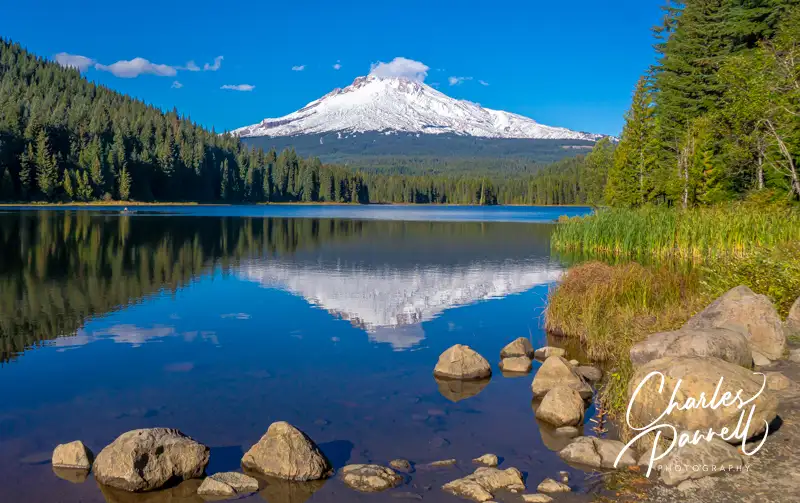
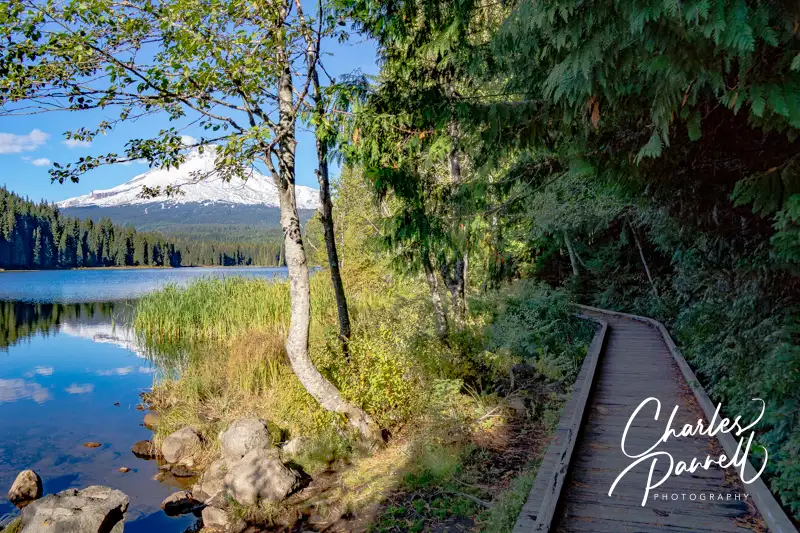
Mount Hood Viewed from the Dam at Trillum Lake
At the top of the list is Trillium Lake, which is a 10 minute drive south of Government Camp off of Highway 26. You’ll need a Northwest Forest Pass (www.fs.usda.gov/r06/passes) to access this site, or you can pay the $10 day-use fee. National parks passes are not accepted.
Before you settle in for a walk on the improved boardwalk system, take some time to drive to the dam for an unforgettable Mount Hood view. There’s accessible parking near the dam, and level access over to a great Mount Hood viewpoint. And although the Trillium Lake Trail lake passes through this area, this section is rocky and bumpy, and not really a good choice for wheelchair-users..
The best place to access the Trillium Lake Trail is from the day-use area. There’s accessible parking near the boat ramp and the picnic area. There’s also an accessible vault toilet near the ramp. The accessible portion of the Trillium Lake Trail trail begins just to the right of the boat ramp, and moves towards the campground. You can also access this trail from the campground; however that area is usually only open to registered campers.
The two-mile lakeside trail begins as a hard-packed dirt trail, with older boardwalk sections here and there. After it passes the campground amphitheater, there’s a sizable new section of boardwalk with plenty of room for even the largest wheelchair. The trail continues over to the east shore of the lake for a great Mount Hood view, but loses its access due to bumps and rocks shortly after that, at about the 1.25-mile point. Still it’s a beautiful out-and back stroll.
And if you’d like to spend the night in Trillium Lake Campground, check out wheelchair-accessible campsite 35, which offers paved access to the Trillium Lake Trail.
Along the Trillium Lake Trail
Little Crater Lake
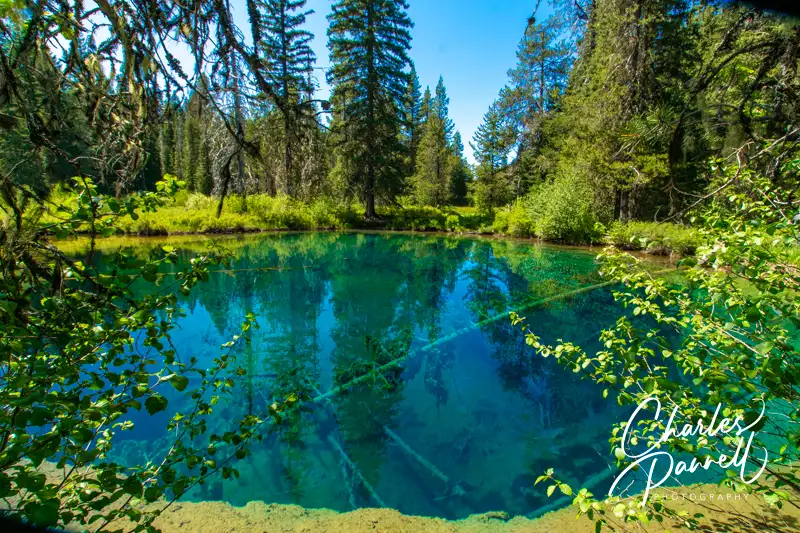
Little Crater Lake
Next up on the list of accessible scenic stops is Little Crater Lake. It’s located about 20 miles south of Trillium Lake. Just take Highway 26 and turn right on Oregon Skyline Road (NF 42). Then make another right on Abbott Road, and follow the signs to Little Crater Lake Campground. This site also only accepts the Northwest Forest Pass.
The lake is located on the far side of the campground — just follow the road around until you see the small parking area. The lot is unstriped, but there’s usually room to parallel park an adapted van. There’s an accessible vault toilet across the road, and level access over to the trailhead to Little Crater Lake.
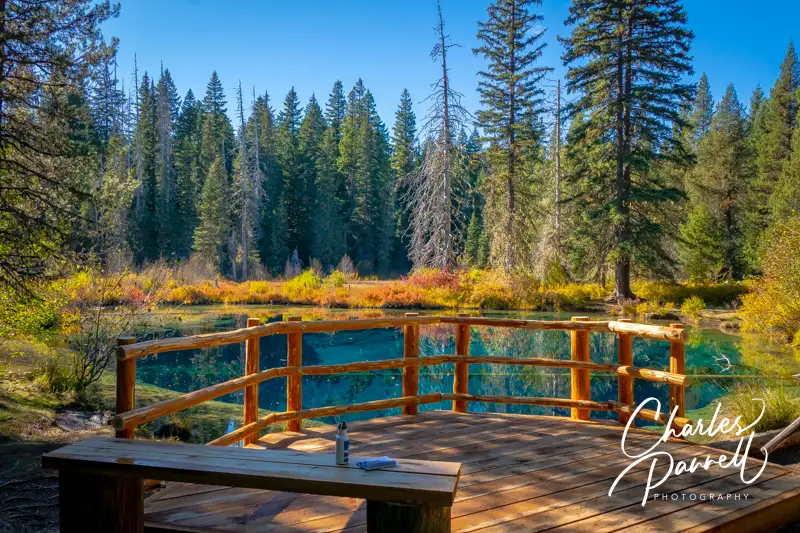
The 250-yard paved level trail leads through the meadow, crosses a bridge, then winds through the forest. There are a few bumps along the way, but it’s definitely passable in a wheelchair. There’s a large viewing deck at the end of the trail that offers a nice view of crystal clear Little Crater Lake. It’s not a busy trail, so the viewing platform is a pleasant spot to just sit and enjoy the space.
And although the trail continues past the lake, it’s not wheelchair-accessible. The path winds through the forest for a quarter-mile, with a few roots to dodge along the way, and a step up to the bridge near the end. It may be doable for some slow walkers, as it’s level; however there are too many obstructions for wheelchair-users to dodge. Still the trek out to the viewing platform is worth the trip. And if you’d like to spend the night, most of the campsites in the adjacent campground are level.
Viewing Platform on Little Crater Lake
Another Lodging Choice
On the other hand, if you’d like to spend the night but you don’t want to pitch a tent, you can still explore the area and then spend the night in comfort at the nearby Best Western Mount Hood Inn. It’s conveniently located in Government Camp, just off Highway 26, about five miles northwest of Trillium Lake.
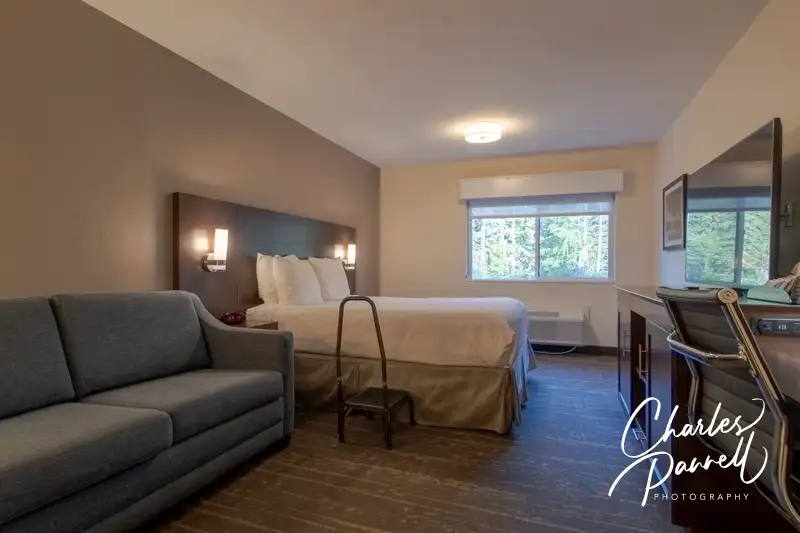
There’s accessible parking in front with level access into the spacious lobby. The property features good pathway access throughout the lobby area, and elevator access to all floors. Accessible room 217 features wide doors, lever handles, good pathway access, a lowered clothing rod, and laminate flooring and low-pile carpet for easy rolling.
It’s furnished with a 29-inch high open-frame queen-sized bed with wheelchair access on both sides, a desk with a chair, a microwave and a refrigerator. There’s also a 13-inch high sleeper sofa in the room; and if you’d prefer two standard beds, there also an accessible room with two queens. The bathroom includes a tub/shower combination with grab bars, a hand-held showerhead and a portable shower bench . The toilet grab bars are located on the back and left walls (as seated), and there’s also a roll-under sink with a lowered mirror in the bathroom.
A full self-serve buffet breakfast is included each morning; and there’s good access to the breakfast room, which is located near the elevator. The Best Western Mount Hood Inn is a comfortable spot to overnight, after a full day of exploring the accessible outdoor areas near Mount Hood.
Room 217 at the Mount Hood Best Western
Sink and Toilet in Room 217 at the Mount Hood Best Western
Shower in Room 217 at the Mount Hood Best Western
Barrier-Free Travel Glacier, Yellowstone and Grand Teton National Parks for Wheelers and Slow Walkers
If you love the great outdoors, but literally cringe at the thought of pitching a tent, then head over to Fort Stevens State Park (oregonstateparks.org/index.cfm?do=parkPage.dsp_parkPage&parkId=129) and spend a night or two in a wheelchair-accessible cabin. Located at the mouth of the Columbia River, about 10 miles west of Astoria, this popular park was the site of the namesake fort that once guarded the river in Civil War times. A few remnants of the fort have survived over the years; but today the park’s biggest draw is the scenic Oregon coastline.
A Cabin in the Woods
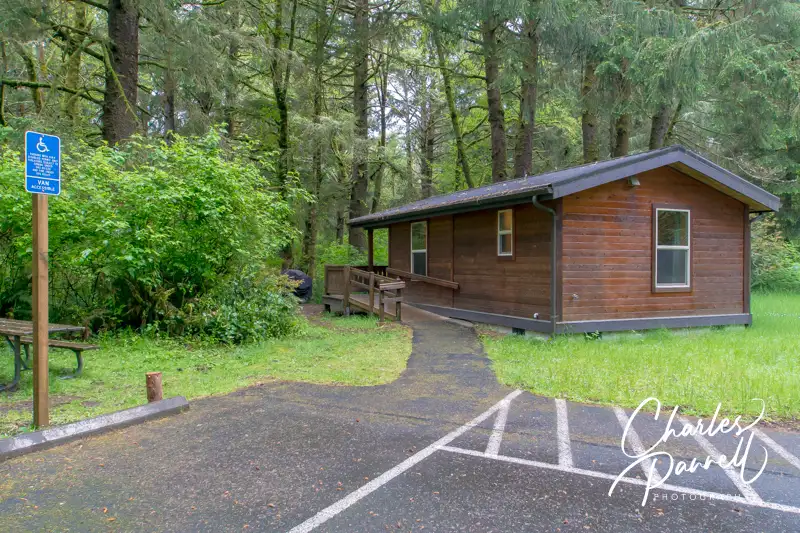
And there’s not just one accessible cabin in Fort Stevens State Park. People who need accessible accommodations have choices, as the park offers 11 cabins, including eight which are wheelchair-accessible. Cabin K15 is a favorite though, as it not only gets top marks for accessibility, but it also borders the woods.
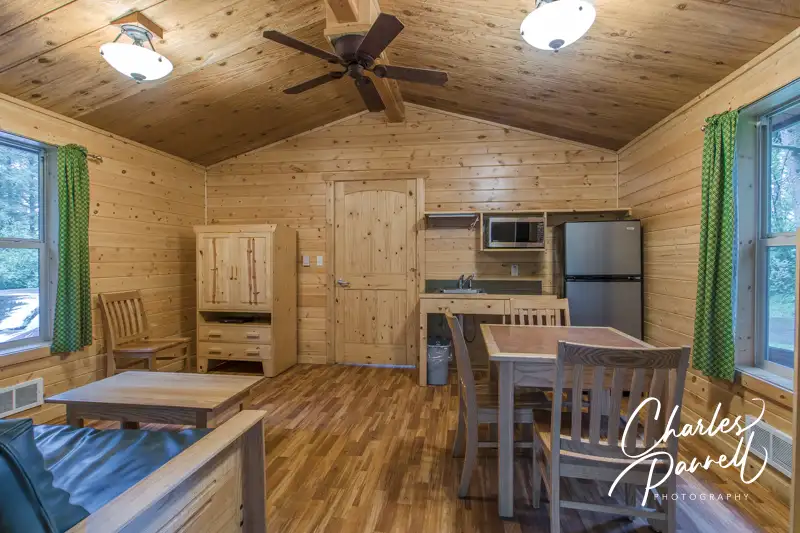
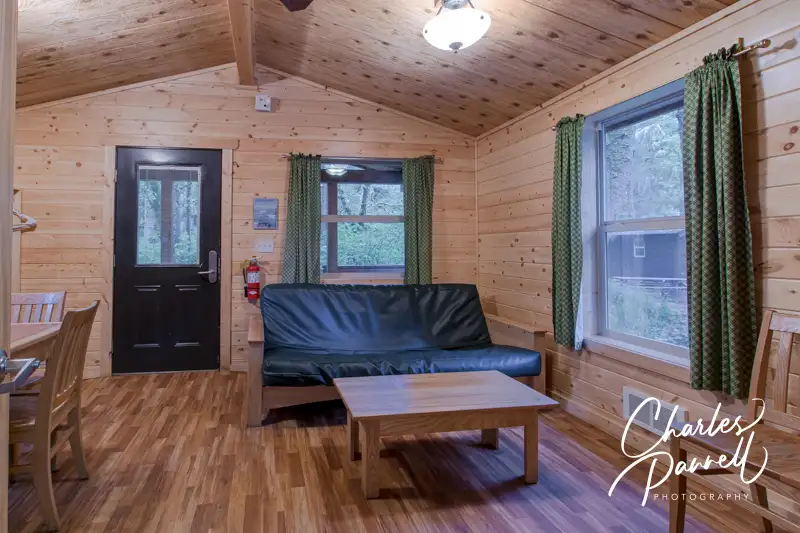
Accessible parking is located next to the cabin, with ramp access over to the back door. Access features include a level threshold, wide doorways, wood floors and good pathway access. The spacious great room is furnished with a 19-inch high futon, an armoire with drawers, a table with four chairs, and a kitchenette with a roll-under sink, microwave and refrigerator.
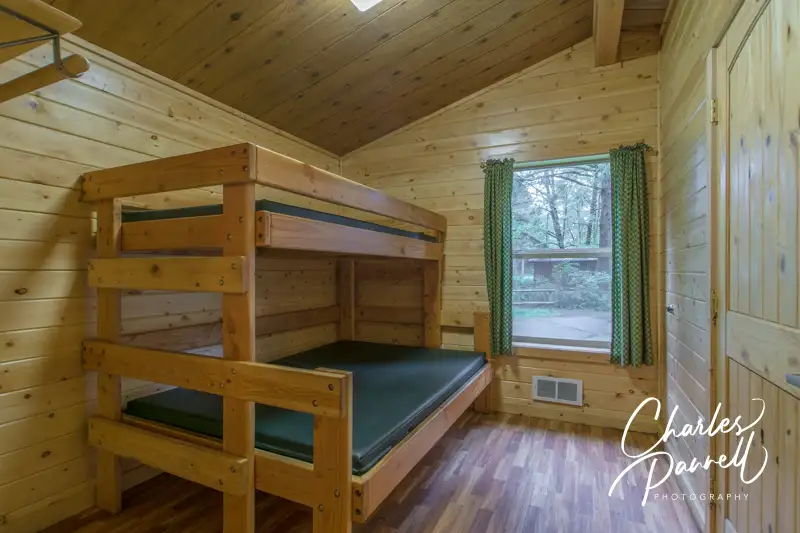
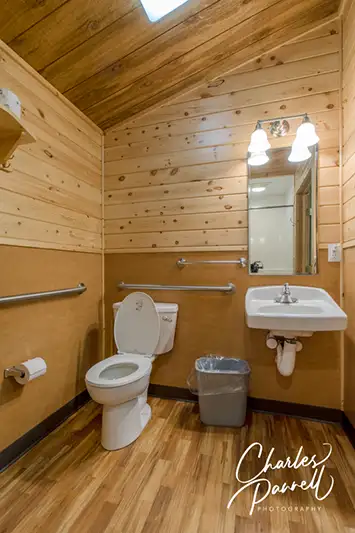
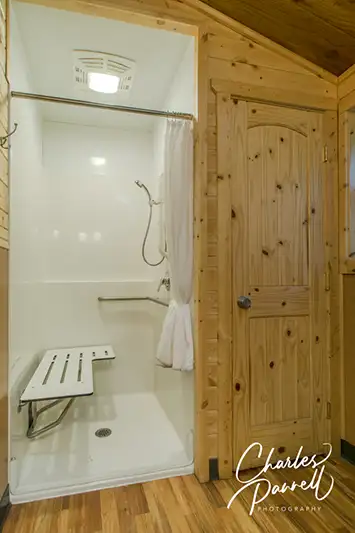
The bedroom includes a bunk bed with a 21-inch high double below and a single on top. The bathroom is equipped with a 36-inch-square transfer-type shower with grab bars, a hand-held showerhead and a fold-down shower seat. It also includes a flexible rubber dam that helps control the drainage, yet still allows access. Other access features include a toilet with grab bars on the back and right walls (as seated), and a roll-under sink.
And outside, the wheelchair-accessible cabin offers plenty of room to roll around on the back deck. There’s also a gas barbeque, an accessible picnic table and a fire ring located in a level area near the deck. The best part is, that the deck backs up on the forest, so you really get that genuine outdoor experience.
There are no dishes or utensils in the cabin, so pack along your camping box. Guests must also supply their own bedding and towels. Reservations for the wheelchair-accessible cabin can be made at oregonstateparks.reserveamerica.com or by calling (800) 452-5687.
Inside Cabin K15 (view 1)
Inside Cabin K15 (view 2)
Bedroom In Cabin K15
Toilet and Sink In Cabin K15
Shower In Cabin K15
Enjoy the View
View From the Bunker
There are a number of paved level multiuse trails throughout the park, but one of the most poplar things to do is to drive to lands end on the park road. It’s a gorgeous journey, with the Pacific Ocean on one side and the Colombia River on the other. In addition to the magnificent windshield views enroute, there are several spots to stop and admire the rugged landscape along the way.
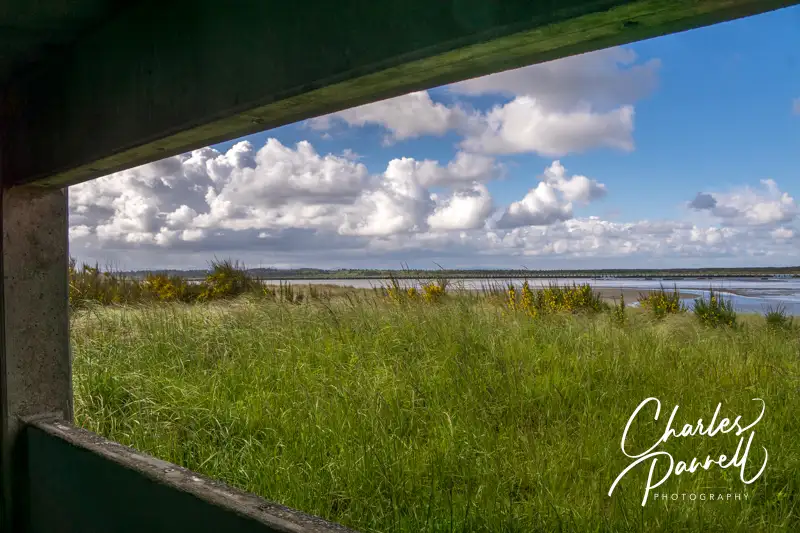
At the end of the line, there’s a large paved parking area, with an accessible vault toilet, and an accessible boardwalk trail over to a wildlife viewing bunker. There’s level access to this roomy bunker, which affords a good view of the adjacent marshland. It’s an excellent place to spot waterfowl, especially near dusk and dawn.
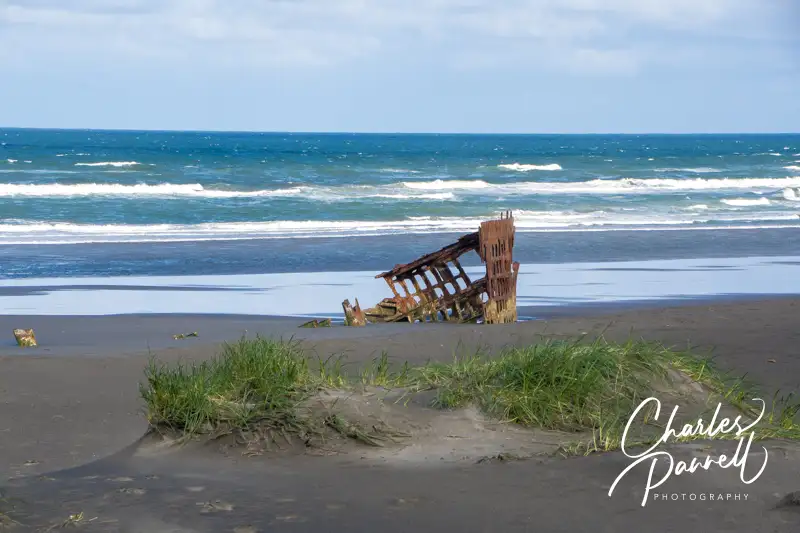
Finally, don’t miss the remains of the Peter Iredale on your way out of the park. It’s located near the North Lake day use area, with parking available near the Sunset Trail. This four-masted vessel ran aground on Clatsop Beach one foggy morning in 1906. Miraculously the crew escaped unharmed, and what’s left of the steel hull can be seen from the parking lot. It’s a must-see on any visit, and one of the most poplar sights in the park.
Remains of the Peter Iredale
Barrier-Free Travel Washington National Parks for Wheelers and Slow Walkers
Designed by John Arthur Elliott who took his inspiration from a cliffside tunnel above Lake Lucerne, the original Mitchell Point automotive tunnel was built in 1915. Over the years, traffic along the Historic Columbia River Highway was rerouted to accommodate larger vehicles. In the 1950s the original tunnel was blocked with debris, and it was subsequently destroyed in 1966 during construction of the interstate. After decades of closure, in 2021 the Oregon Department of Transportation launched an ambitious project to build a replica pedestrian tunnel in the same location. The project was completed in 2025, and today the new Mitchell Point Tunnel is a must-stop when you’re heading east on Interstate 84, near Hood River. Just take exit 58 and follow the signs.
There’s accessible parking in the small parking lot, with level access over to the paved trail that leads out to the new Mitchell Point Tunnel. The trail parallels the Columbia River below, and thanks to cutouts in the high rock wall lining the path, everyone can enjoy the expansive view. It’s a pleasant walk, with lots of photo ops. The tunnel itself has five arched openings along its length, to let in light and ease navigation. And when you get to the end there’s an equally impressive Columbia River view. It’s about a half-mile round-trip stroll, and there are also accessible picnic tables and vault toilets near the trailhead. It’s a nice stop for a driving break and a picnic lunch.
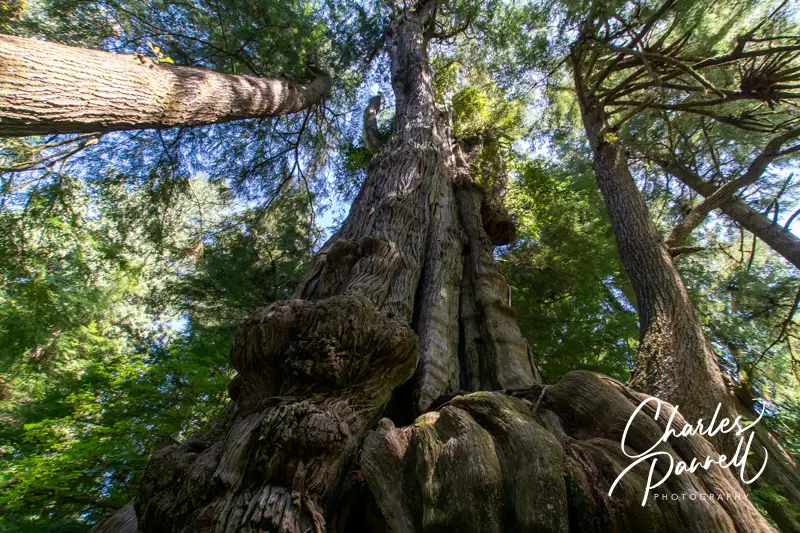
There are lots of self-named “big trees” in the world, but if you happen to be in Northwestern Oregon, be sure and stop in Rockaway Beach, for a gander at Oregon’s largest cedar tree. Lovingly nicknamed the Rockaway Cedar by the locals, this giant stands over 150-feet high, and is surrounded by an equally impressive forest. And believe it or not, it’s in a preserve in the middle of town. The best part is, the half-mile boardwalk that leads out to this local landmark is wheelchair-accessible. So slow down on your next trek down Highway 101, and stop in Rockaway Beach to enjoy a short walk through the forest to admire this stately giant.
A Wheelchair-Accessible Boardwalk
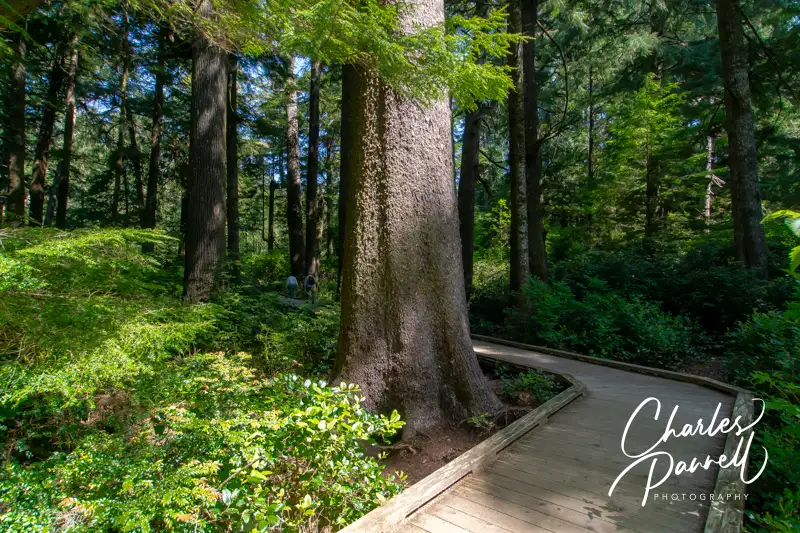
Rockaway Beach Old Growth Cedar Preserve Boardwalk to the Rockaway Cedar
It’s easy to zip by the small parking lot for the Rockaway Beach Old Growth Cedar Preserve. If you’re heading south, slow down when you see the giant hot dog on your left, and look for the parking lot just past Washington Street, on the left. There’s only six standard spaces in the lot, and two accessible slots, but the accessible ones are usually available.
From the parking area, the level boardwalk winds through the 45-acre old growth forest filled with skunk cabbage, salmonberry and coast sedge. About midway along there’s also a level boardwalk over to a viewing platform with a picnic table and benches. It’s a nice secluded spot for a lunch break.
And Oregon’s largest cedar tree – a 154-foot giant — sits at the end of the .6-mile trail. There are a few benches to sit and admire the giant, as well as another picnic table there. There’s also a short stretch of boardwalk that leads over to a more secluded bench if you’d like a little privacy. All in all, it’s a beautiful stroll through the forest, and a must-stop on any Pacific Northwest road trip. And while you’re in the area, be sure to plan a stop at the equally wheelchair-accessible Kilchis Point Reserve, which is just down the road in Bay City emerginghorizons.com/kilchis-point-reserve-a-wheelchair-accessible-tillamook-county-gem/.
Barrier-Free Travel Yosemite, Sequoia and Kings Canyon National Parks for Wheelchair-users and Slow Walkers
I’m often asked what I think is the most important element of an accessible travel destination or facility. That’s a tough call for sure, because I truly believe all access elements are important, no matter how small or inexpensive. That said, there’s one critical building block that’s consistently overlooked, when it comes to accessibility – signage.
Accessible signage seems simple enough when it’s in place, but it can lead to a lot of confusion, and maybe even injury when it’s overlooked. Here are some examples of where a little signage could of gone a long way to improve the accessibility and overall visitor experience.
Where’s the Entrance?
Accessible entrances are one of the basic building blocks for inclusion; however even in this day and age, not all businesses have them. I’ll skip the debate of why so many things are not “readily achievable” and get to the meat of the matter here – signage at inaccessible entrances.
Sure, I’ve gone to plenty of places with wheelchair-users, only to find a step or two at the entrance. For me, it’s not problem, as I can just go in and ask about the location of the accessible entrance for my friends. Sometimes they pull out a portable ramp, while other times I’m directed to an alternate entrance, usually in back. It’s time consuming, but it works. Everybody gets in the door.
But what if you’re not there with someone that can navigate the inaccessible entrance and go inside to inquire about things? That’s where accessible signage comes in. I’ve seen way too many inaccessible buildings that lack any signage as to where the accessible entrance may be. Oh, and if you’re going to put a phone number on your sign, make sure it goes to a phone that you actually answer. Don’t even get me started on that one.
You’ve Got to Be Kidding!
And then there was this shopping center in Philadelphia that had stairs up to the front entrance. Two flights of stairs, mind you. So I walked around the large building several times, but I just couldn’t see any type of accessible entrance. It was puzzling for sure, as this seemed like an establishment that had enough money to make things accessible.
So I tromped up those two flights of stairs to the entrance. And what do I find at the entrance? A sign with a phone number that says to call for information about the accessible entrance. OK, folks, this isn’t rocket science – if a person needs an accessible entrance then they are most likely not going to be able to read the sign at the top of two flights of stairs that gives them the magic phone number. Put the sign on the ground level where a person who uses a wheelchair can actually find it.
And yes, I did call the phone number. It went to voice mail and I never received a return call. Again, put a phone number that you routinely answer on all access signs, because the person that’s calling probably needs immediate assistance.
Scratching My Head
Signage is good, but to be honest, sometimes it makes me scratch my head. I’ve visited more than one place that just has blue wheelchair signs intermittently scattered around the grounds. Not at entrances, or facilities, but just haphazardly scattered. It’s like they purchased a set amount signs and they were determined to use them all. I guess it really didn’t harm anything, except it made me scratch my head. It also made me wonder if they were suppose to be used somewhere else, like an accessible entrance or a path of travel.
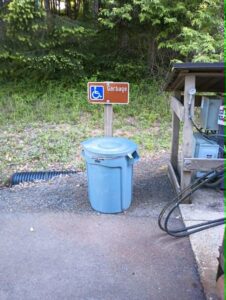
And then there was the garbage can. We were camping in Oregon and on our way out of the campground we stopped to throw out our trash. Some public garbage cans can be very complicated. At this location there was one can for plastic, one for paper, one for refuse, and the list went on. To be honest it was confusing because there was also a list of things you couldn’t put in each can. And then at the very end there was a trash can standing alone, and it had the blue wheelchair sign on it. I guess it was accessible, but so were the other 20 cans that I just passed. And to be honest, a quad would have a really difficult time getting the lid off – it was hard for me. So, I couldn’t really figure out what it was for, but since I didn’t understand the other cans either, I just put all our trash in that one.
And then there are signs, that make absolutely no sense, but have nothing to do with access. We were driving down the highway on a road trip a few weeks ago and we saw a sign that read, “Intermittent Road Work for the Next 52 Miles”. Really? Talk about being non-committal.
Don’t Forget Printed Material
And although accessible signage is important out in the real world, it’s also equally important in printed material. You want to let folks know about access to your place of business in all your printed material. Otherwise, if accessibility isn’t listed, many folks will assume your business is not accessible. And you will lose out on business; and it won’t be just wheelchair-users, but also their friends and family who want to go to an inclusive place.
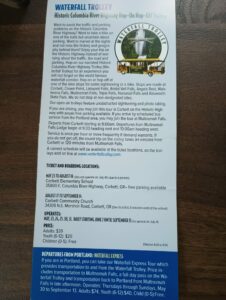
Case and point is a brochure I picked up the other day about a new shuttle service to some Oregon waterfalls. It’s a great service, as it can be difficult to find parking at some of the scenic waterfalls on the route; however there wasn’t one word about accessibility mentioned in the brochure.
They took the time – and space — to describe the routes, make notes of all the stops, and include information about bus connections to neighboring cities, but there wasn’t one word about wheelchair access. So I went to their website and it did state that they were wheelchair-accessible, and told folks to be sure and note their needs when they made reservations so appropriate vehicles could be dispatched. How hard would that be to include in the brochure? Just saying.
Where Am I?
One of the most frustrating things about accessible signage, or lack thereof, is that it can turn a nice outing into a frustrating challenge. I’ve looked at hundreds of accessible trails, because it’s something that interests my readers. My goal is to give folks solid and accurate information so that they can easily access and enjoy accessible trails. But sometimes that’s a challenge for me.
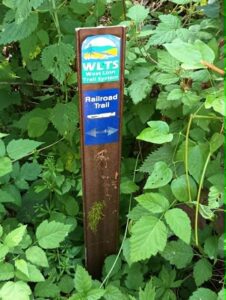
Charles and I were out exploring some accessible possibilities one day, and after a nice picnic lunch we set out to find this accessible trail. It was mentioned on the park website, but the directions to the trailhead were unclear. When we got to the park we followed several signs to nowhere, and then one to a trail that branched off in three different directions, with no signage whatsoever. We then found a sign for the trail on the other side of the park, and figured if we followed it, it would lead back to the start. Wrong, it led to a a trail that wasn’t even on the map. In the end I gave up, and so will most other people.
The same is true, when we set out to find this new accessible boardwalk on a lake. Some people said it went around the lake, but we couldn’t find it. Turns out the trail goes around the lake, but the accessible boardwalk is only a portion of that trail. And with zero signage it was just by luck we found it. Now at least we can tell others where to look, as it’s a pretty cool trail. But a little signage would of helped.
The reserve is owned and maintained by the Tillamook County Pioneer Museum, and it’s funded through donations, grants and membership dues. And even with this limited funding, their signage is excellent. Additionally, all of their trails of wheelchair-accessible.
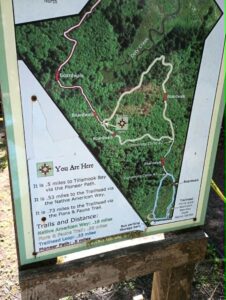
They way I look at things, if this small reserve can provide such excellent signage on a limited budget, then anyone can do it. It’s a beautiful preserve and you always know exactly where you are, and what trail leads where. At the trailheads there’s a large map, showing your location, and listing the length of all the trails. And every time you cross another trail, it’s clearly marked. You have absolutely no doubt where you are at any point in Kilchis Point Reserve. It’s really a great place to visit.
Finally, I’d be remiss if I didn’t also give a shoutout to the National Park Service for their excellent trail signage. They not only list the location of the trails, but also include the length, width, slope and cross-slope. So not only can you determine the accessibility of a trail, but again, you always know exactly where you are.
So see, it is possible to get the signage right. I’d really like to see more of that in the future.
Summer is a great time to hit the road. The days are long, the weather is good and the roads are clear. Add in some gorgeous windshield views along the way, and a scenic drive is the perfect summertime activity. With that in mind, here are some favorite scenic summer drives to add to your vacation list.
Pikes Peak Highway
Pikes Peak Highway
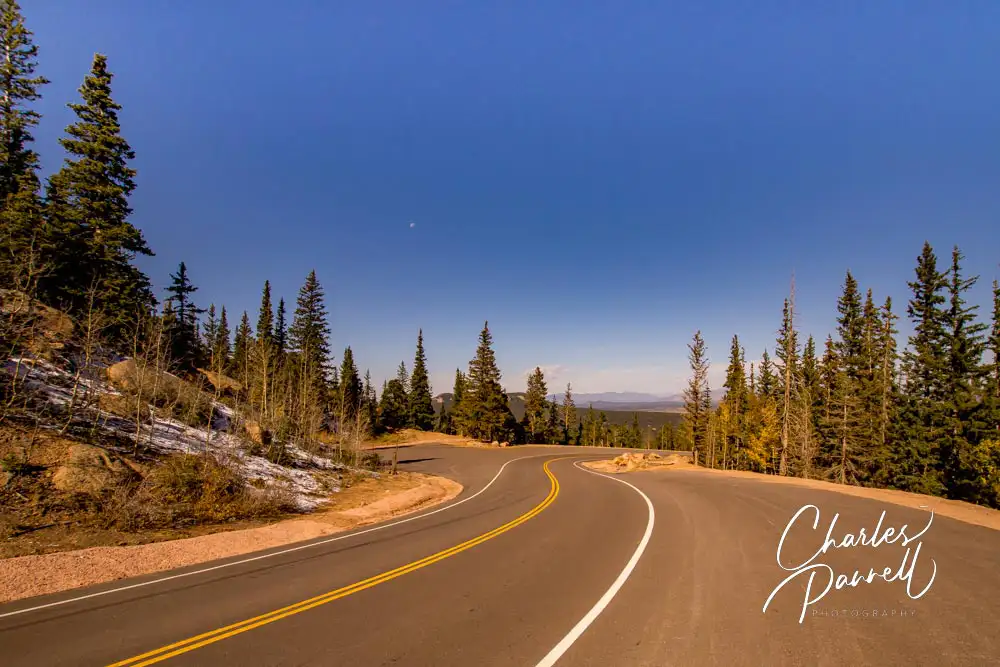
Located just west of Colorado Springs, Pikes Peak Highway (emerginghorizons.com/drive-the-pikes-peak-highway/) tops the list of scenic summer drives. The tollgate is located just off Highway 24 in Cascade; but be forewarned that advance reservations are required to drive this scenic route. The 20-mile drive winds up to the 14,115-foot summit, with some drop-dead gorgeous views along the way. Some good wheelchair-accessible stops include Crystal Reservoir, Halfway Picnic Area and Glen Cove. Up at the top there’s another impressive view, along with a cafeteria, gift shop and some interpretive exhibits. A must-see on any Colorado trip.
North Cascades Scenic Highway
Happy Creek Forest Walk
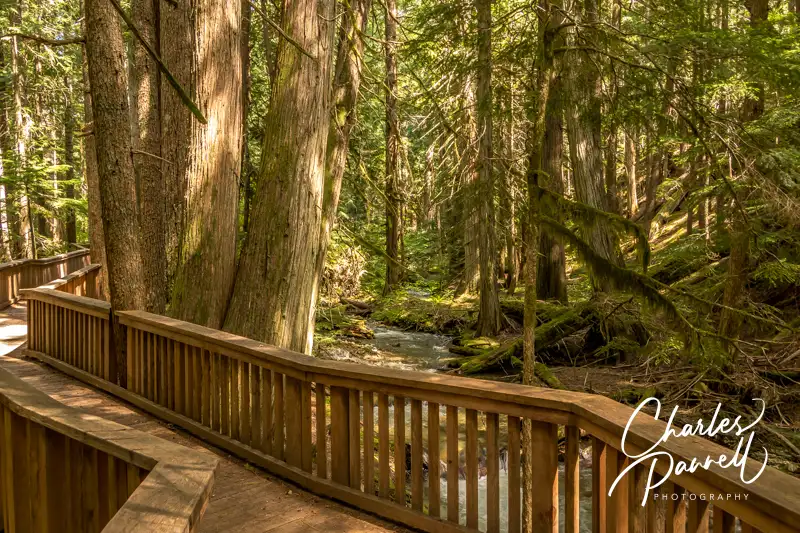
This scenic drive traverses part of North Cascades National Park (emerginghorizons.com/barrier-free-travel-washington-national-parks-for-wheelers-and-slow-walkers/) in Northern Washington. Closed during the winter, the route runs from Winthrop to Rockport, crosses Washington Pass and continues past glacier-fed lakes and old growth forests. There’s no shortage of great windshield views along the way, but suggested wheelchair-accessible stops include the the Happy Creek Forest Walk, Sterling Munro Boardwalk and the Trail of the Cedars. And don’t forget to stop at the Skagit General Store in Newhalem for some delicious homemade Skagit fudge.
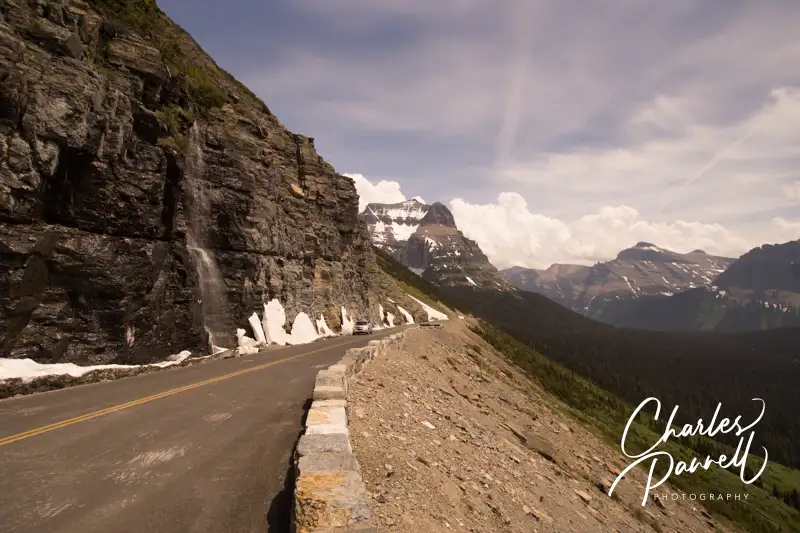
acier-yellowstone-and-grand-teton-national-parks-for-wheelchair-users-and-slow-walkers/), scenic Going-to-the-Sun Road is not for the faint of heart. It climbs up a winding mountain route to scenic Logan Pass, with beautiful views along the way. That said, this two-lane road is filled with hair-pin turns, dramatic drop-offs and expansive views of the glacier carved valley. Wheelchair-accessible stops along the way include the Trail of the Cedars, Lake Mc Donald and Logan Pass. And there’s no shortage of scenic pullouts to stop and enjoy the views.
Chinook Scenic Byway
Whispering Hemlocks Loop Trail in Federation Forest State Park
Another mountain route, the Chinook Scenic Byway (emerginghorizons.com/drive-the-chinook-scenic-byway/) traverses the Mt. Baker-Snoqualmie National Forest and crosses Chinook pass. This route also winds in to the eastern portion of Mount Rainier National Park and offers some spectacular ridgetop views. Notable wheelchair-accessible highlights along the way include Federation Forest State Park, Sunrise Point and Tipsoo Lake. And don’t miss a stop at Whistlin’ Jack’s Outpost and the Naches Trading Post on the east side.
The International Selkirk Loop
Chickadee Trail in the Kootenai Wildlife Refuge
A classic drive, the International Selkirk Loop (emerginghorizons.com/the-international-selkirk-loop-for-wheelchair-users-and-slow-walkers/) winds through two states and two countries. It begins in Northeastern Washington, and heads through Northern Idaho, then up to British Columbia, before it returns to Washington. This 280-mile loop is definitely a multi-day trip, with many scenic stops along the way. Highlights of the route include Kootenai Wildlife Refuge, Creston Wildlife Management Area, the Mill Pond Historic Site and Sweet Creek Falls. And don’t forget the Kalispel Tribe’s buffalo herd. Enjoy this scenic jaunt through the Selkirk Range.
Mount Hood Infinity Loop
Bridge of the Gods on the Hood River
As its name implies, the Mount Hood Infinity Loop (emerginghorizons.com/drive-the-scenic-mount-hood-infinity-loop/), snakes around the namesake mountain. This Northern Oregon drive runs along the Columbia River and travels south through the Dalles orchards, before it climbs up Mount Hood and circles back up north. Along the way there’s a Bigfoot exhibit, a few wheelchair-accessible hikes, some beautiful Mount Hood views and several fun museums. And if you’d like to take your time, you can even overnight in a wheelchair-accessible treehouse.
Columbia River Waterfall Corridor
Latourell Falls
Bridal Veil Falls
Multnomath Falls
Horsetail Falls
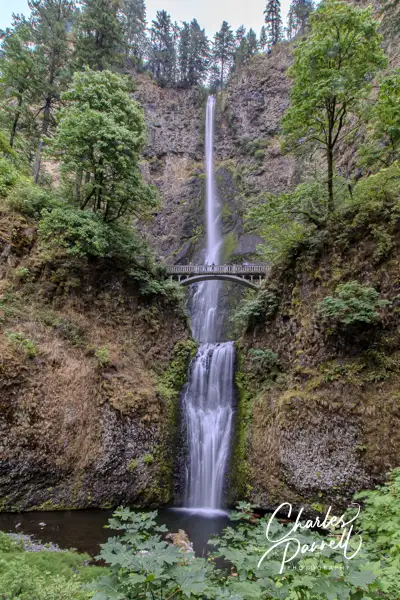
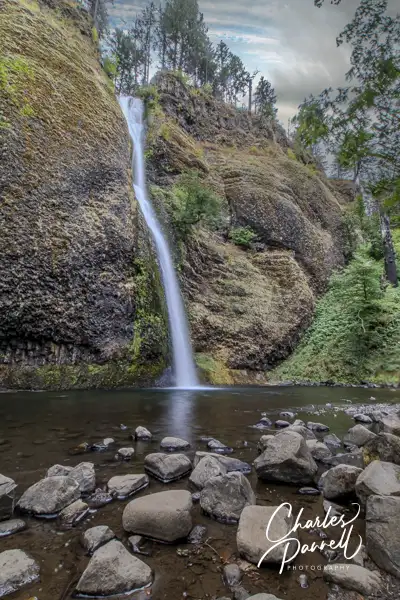
A classic drive, the Columbia River Waterfall Corridor (emerginghorizons.com/explore-the-historic-columbia-river-highway-waterfall-corridor/) winds along a two-lane road in Northern Oregon and passes a number of scenic waterfalls. It can be easily completed in one day and it’s also a favorite for bicyclists. Although the scenery is great along the route, several wheelchair-accessible waterfalls are worth a stop. These include Latourell Falls, Bridal Veil Falls, Wahkeena Falls, Multnomah Falls and Horsetail Falls. Pack a picnic lunch and enjoy your meal alfresco at one of the picnic areas along the way.
Barrier-Free Travel Glacier, Yellowstone and Grand Teton National Parks for Wheelers and Slow Walkers