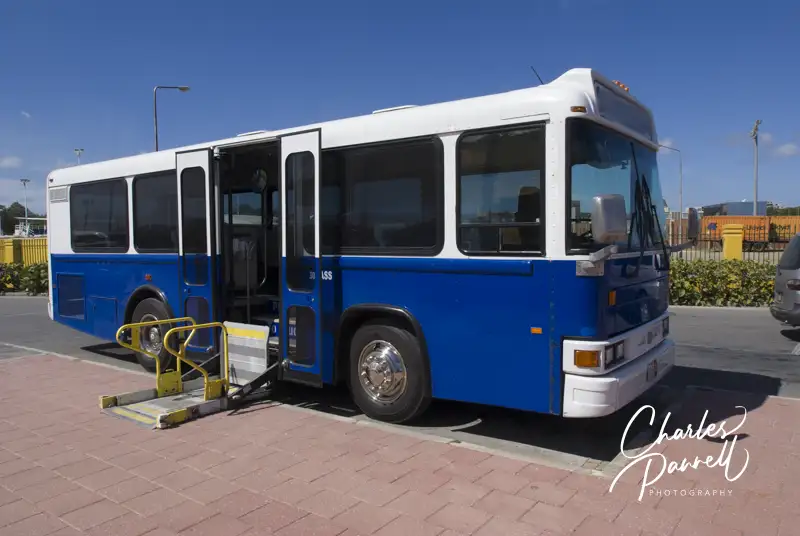
Have you ever had an access-related problem while traveling on Greyhound or FlixBus? If so, the Department of Justice (DOJ) wants to hear from you. After receiving a number of complaints on these carriers, the DOJ is in full investigation mode. But they can’t proceed without your help. They want to hear from you if you’ve ever had your Americans with Disabilities Act (ADA) rights violated. This includes:
Failure to maintain bus lifts.
Refusal to assist disabled passengers.
Refusal to allow service animals aboard.
Abandoned disabled passengers in the middle of their journey.
Failure to assist disabled passengers off the bus at rest stops.
Ever wonder why some people end up with upgrades and refunds whenever they make a wheelchair-access travel complaint, while others walk away with zero compensation? Truth be told, it’s all in the details. Knowing when to complain, how to complain and who to complain to are the keys to not only resolving the issue at hand, but also to receiving adequate compensation for your inconvenience. So the next time you encounter an access-related problem on the road, follow this roadmap for prompt resolution and adequate compensation.
Save Your Trip
The first and foremost rule about making a wheelchair-access travel complaint is to address the problem at hand. If your wheelchair arrives damaged, request a suitable loaner from the airline. If that supposedly accessible bus arrives but has two steps, request an appropriate replacement. If you arrive at a hotel to find that they gave your accessible room away, have them find you one at another property. Try and remedy the access shortfall, so you can salvage your vacation and enjoy the rest of your trip.
Additionally, you should try to prevent further damage. In other words, don’t throw the baby out with the bathwater. For example, if you miss a connection because the airline didn’t have a wheelchair waiting at the gate for you, don’t just throw in the towel. Work with the airline to get on the next available flight, so you can at least enjoy part of your vacation.
Don’t be afraid to address your loss while you are trying to mitigate damages, but don’t put a dollar price tag on it. For example, in the case of the missed connection, if the next available flight isn’t until late at night, don’t be afraid to point out that you are missing a whole day of vacation because of their error. And then ask if perhaps an upgrade is available. Keep in mind, this doesn’t wipe the slate clean, but it will make your travels more comfortable.
It’s also a good idea to jot down a few notes about the incident while it’s fresh in your mind. Write down times, dates and names if you have them. Then, put the notebook away, and don’t dwell on the incident. Enjoy what’s left of your vacation, then address the matter when you return home.
When You Return Home
The time to file an official wheelchair-access travel complaint with a service provider is after you return from your trip. And although every situation is different, here are some tips to help you approach the official complaint process.
Although it’s easy to pick up the phone, your complaint will receive more attention if you put it in writing.
Address the appropriate person. Don’t start with the President or CEO, but instead begin at the bottom and work your way up. You want to be able to show that you followed the company’s complaint procedure in an effort to resolve your accessibility issue.
Keep your complaint letter short and to the point. It should be no longer than one page. Avoid superfluous details and get to the point quickly.
Keep it polite, professional and G-rated. Abstain from vulgarities and name-calling.
Have someone who isn’t emotionally invested in the incident proofread your letter for clarity.
Never threaten to sue or to file an Americans with Disabilities Act (ADA) complaint in your initial complaint. This just creates an adversarial situation and makes the matter harder to resolve.
If you are going to quote the law, make sure you know the law.
Make sure and enclose all documentation, including receipts and photos.
Most important, ask for some type of resolution. Don’t be afraid to ask for specific compensation, but be realistic. If you’re reasonable with your request, most companies will be generous in their response.
Make it Official
You should also file an official ADA or Air Carrier Access Act (ACAA) complaint when you return home. This can be done in addition to your complaint with the provider, and even if you received compensation from them. This type of a complaint won’t get you anything personally, but it may help effect change.
The Department of Justice (DOJ) and the Department of Transportation (DOT) look for patterns, and the number of complaints against individual companies. If they see a lot of a certain type of complaint, they can issue fines and directives to help avoid future access-related failures. And that in turn may lead to better compliance in the future.
Plus it’s pretty easy to file an official wheelchair-access travel complaint.
If your issue involves physical access at a hotel, attraction, restaurant, outdoor area or venue in the United States, then you can file an ADA complaint. Information about an ADA complaint can be found at www.ada.gov/file-a-complaint. And the online form is located at civilrights.justice.gov/report.
Filing an official complaint is the final step in the process. And again, although it won’t benefit you personally, it can help to make the world a more accessible place.
Barrier-Free Travel 22 Accessible Road Trips for Wheelers and Slow Walkers
Recently I flew to Los Angeles, and although the hotel I stayed at had a free airport shuttle, it was not wheelchair-accessible. I asked the driver and he said that they didn’t have any wheelchair-accessible airport shuttles, and that I should take a taxi or an Uber. It seemed a bit unfair for me to have to pay for transfers, while others got them for free. Are airport shuttles required to be wheelchair-accessible under the Americans with Disabilities Act (ADA)? If so, what can I do if I encounter one that lacks wheelchair access?
The ADA and Wheelchair-Accessible Airport Shuttles
In a word, yes. If a hotel provides free shuttle service it’s also required to provide an equivalent accessible service under Title III of the ADA (ada.gov/topics/title-iii/). Equivalent is the key word here, so for example if passengers routinely wait 20 minutes for an airport shuttle, then wheelchair-accessible airport shuttles must arrive in the same time frame.
That doesn’t mean that hotels have to own their own shuttles though. They just have to provide the equivalent service. For example, a small hotel can share an accessible shuttle with other properties, but they must offer equivalent service as detailed above. Properties can also opt to send accessible taxis to pick up passengers, instead of purchasing and maintaining wheelchair-accessible airport shuttles. And finally they can alternately opt to reimburse guests for their accessible taxi or Uber fares.
When Things Go Wrong
Although equivalent service means that disabled guests will get the same service as non-disabled guests, a little advance planning can go a long way to making this a reality. First and foremost, don’t wait until you arrive at the airport to inquire about the availability of wheelchair-accessible hotel shuttles. Call the hotel in advance of your trip to confirm that they have the appropriate vehicles — and that they are actually operational.
If the hotel employee you are talking with says that they don’t have any wheelchair-accessible airport shuttles, then ask to speak to the manager. Usually managers know the law, and after you point out that wheelchair-accessible shuttle service is required under the ADA, then they will start to work to find a solution. Of course this solution may be that the hotels provides an accessible taxi or pays for your Uber, but that’s an acceptable solution under the law.
On the other hand if the manager balks at your request, it’s best to find another property. You can’t strong arm someone into adhering to the law, and you don’t want to arrive at the airport only to find out that there’s no way to get to your hotel. Give your money to a property that does follow the law and will be able to accommodate you.
Of course, don’t forget the property that didn’t accommodate you. They broke the law and they deserve to be reported to the Department of Justice (DOJ). It’s easy to do too — just complete this simple online form (civilrights.justice.gov/report) to file an ADA complaint. You won’t receive any compensation as the result of filing an ADA complaint, but it will help effect change. And that helps make everything more accessible in the long run.
Barrier-Free Travel California National Park Road Trips for Wheelchair-Users and Slow Walkers
If you’re a member of any online group that focuses on access or disability, chances are you’ve read about more than a few “Americans with Disabilities Act (ADA) access shortfalls”. Granted, in this day and age this shouldn’t happen, but it does. Why? Well the short answer is because there’s no “ADA Police Force” that goes around and looks for access violations. For the most part, the Department of Justice (DOJ) relies on user-input to decide when and where to issue fines or take remedial action. And where does that user-input come from? In a few words, from you and the rest of the general public.
And the good news is, it’s easy to file and ADA complaint. Unfortunately most people just brush off the access shortfalls they encounter, and skip reporting them to the DOJ. It’s true that the DOJ does not move forward and take action on every single complaint; however if they don’t receive any complaints, it virtually guarantees that access shortfalls will remain unchanged. And that’s why we still encounter ADAAG code violations, over 30 years after the ADA was signed by President George Bush.
The ADA Complaint Process
It’s easy to file an ADA complaint. Just go to https://civilrights.justice.gov/report/ and complete the form. Keep it short and sweet and get right to the violation. And try to leave your emotions out of it. A well written concise complaint will get more attention than a wordy unorganized one.
After the DOT receives a complaint, they review it. If there are any questions they will contact you. At the very least they will confirm that they received your complaint.
Next they check to see if the item addressed is covered under the ADA. For example, if someone complains about the height of a hotel bed, no action is taken because bed height is not regulated by the ADA (https://emerginghorizons.com/why-the-ada-doesnt-address-bed-height/). They also make sure that the complaint is in the right department. So if they get a complaint about an air travel issue, they will not address it because air travel is covered under the Air Carrier Access Act, not the ADA.
If the DOJ does decide to move forward with an ADA complaint, there are a few ways things can go. The most popular choice is mediation. This is when they assign an impartial mediator and have the parties sit down in a neutral location and hammer out a workable solution. It’s a little time intensive, but the results are usually worth it.
Of course, the best outcome is when fines are issued or a lawsuit is initiated and remedial action is required. This tends to make companies stand up and take notice. On the other hand, some cases are not pursued. This could be because the DOJ is targeting certain violations, geographic areas or even providers. And the DOJ does look for patterns — like an increase in specific violations — so reporting ADA issues is always good.
Mediation Works!
Just for the record, I do practice what I preach, as I have filed several ADA complaints. All of them were addressed in one way or another, but one of my most successful efforts actually went to mediation.
About 15 years ago I was summoned to jury duty in a small town; and I was totally gob smacked when I discovered that there was not a single accessible restroom in the entire courthouse. I brought this to the attention of a few supervisors and the prevailing attitude seemed to be that anyone with a disability could get excused so they didn’t really need those accessible facilities. But what if they wanted to do their civic duty and serve on a jury? That option was pretty much taken away from them due to the lack of accessible restrooms.
So I filed an ADA complaint. Shortly thereafter I got a phone call saying my complaint was referred to mediation, and that I would be getting a call from the mediator. The mediator called and explained the process and set up a meeting time that worked for all parties. I was expecting something adversarial, but it was all very businesslike. I explained the problem, and of course the city folks claimed “budget issues” but in the end they realized they were obligated to provide accessible facilities at the courthouse.
And it all had a happy ending. Although it didn’t happen overnight, they redid the restrooms in the courthouse and put in a large accessible unit. In my opinion it was a win-win for everyone, and it really took very little effort on my part.
Sometimes Fines are Imposed
The DOJ can also start legal proceedings as the result of an ADA complaint. Such was the result of an ADA complaint filed by one couple against a Columbus, Ohio Holiday Inn Express (https://archive.ada.gov/badrivishal_sa.pdf).
The complaint was filed by the wife of a man who has multiple sclerosis, and requires a roll-in shower to bathe. She reserved an accessible room with a roll-in shower at the property, but when they arrived they discovered that neither of the two accessible rooms had a roll-in shower. Since her husband was unable to use the tub/shower combination in the accessible room, they were forced to relocate to another hotel during the busy Thanksgiving weekend.
The hotel claimed that they were up to code in regards to their accessible facilities; however a subsequent access audit found that there were many ADA violations. Under the DOJ agreement, the hotel was required to remove access barriers in the parking lot, building entrance, public restrooms, front desk, and the routes of travel within the hotel. They were also required to fix the access shortfalls in their accessible rooms, and add one more accessible room to the inventory.
The agreement also required additional training for the hotel staff on how to accommodate guests with a disability. And as part of the settlement, the hotel paid the couple that filed the complaint $20,000. Granted, nobody should have to endure access shortfalls like these in this day and age, but thanks to this complaint, one more property is now truly accessible to wheelchair-users.
Excuses, Excuses!
I’ve been preaching this “file an ADA complaint” mantra for several decades. Many folks are receptive to it, however few follow through with any action. I’ve gotten many excuses for this reluctance. Here are some of my favorites, along with my arguments against them.
“I addressed the issue with the manager who seemed eager to correct things.”
A good manager always makes you feel that your complaint is valid and will be addressed. It’s what happens after you leave that really matters. Many managers won’t take the time to follow up on access related issues. And even if the manager tries to pursue things, if the higher ups nix the idea it’s a no-go. Which is why it’s a good idea to file an ADA complaint, even if you also personally addressed the issue with on-site staff — to make sure that things get fixed.
“It takes too long to file a complaint.”
Everything takes time, but truly it takes less time to file and ADA complaint than to tell your story on numerous Facebook groups. It’s all about using time wisely.
“I’m not the ADA police.”
Well actually, you are. We don’t have inspectors or officials that go around looking for ADA violations, so the only way they get reported is if average citizens complain. And that means everyone!
“Nothing ever happens with these complaints. It’s just a waste of time.”
The DOJ doesn’t have the staff to address all of the complaints; however a good number are referred to mediation, and some are even pursued legally. You can’t really predict what will happen to any complaint, but you can be sure that the issue won’t be addressed if you don’t submit a complaint.
The American’s with Disabilities Act (ADA) covers a lot of issues in public accommodations; however the ADA doesn’t address bed height. This presents numerous problems for wheelchair-users and slow walkers who need to check into a hotel or motel.
Unfortunately there’s no real agreement on what an “accessible bed” should be. Most wheelchair-users prefer lower beds, while slow walkers with hip or knee issues need higher beds. And then there are wheelchair-users who use portable hoyer lifts who need open-frame beds, as opposed to the standard platforms. And those are just a few of the reasons why the ADA doesn’t address bed height.
So why is there’s no consensus on this matter? Well first and foremost, disabilities are diverse, and you just can’t put one group’s needs over the other. To be honest the same problem was encountered when the toilet height regulations for the ADA were crafted. The lower height was ultimately accepted because there was a cheap and easy fix for folks that needed higher toilets — toilet risers. Unfortunately there’s no cheap and easy fix for beds.
A Little History
The Department of Justice (DOJ) once considered addressing the bed height issue. Back on July 26, 2010 they issued an Advance Notice of Proposed Rulemaking (ANPR), that asked for public input on the accessibility of equipment and removable furniture, such as beds. And boy did they get an earful, as disability organizations and advocates weighed in from across the country. Granted the DOJ never said they were going to move forward and issue regulations, however due to the input received, it was assumed that some preliminary rules would at least be forthcoming.
Sadly that wasn’t the case. In a move that surprised a number of disability advocates, the DOJ instead issued a withdrawal of the ANPR and published that decision in the December 26, 2017 issue of the Federal Register.
So what does this mean? Basically it means that the rulemaking process has ended and the DOJ is not going to consider new rules for equipment and removable furniture. According to the DOJ, they are “reevaluating” whether a regulation like this is necessary. Given that places of public accommodation must ensure access to people with different disabilities, the feeling seems to be that perhaps exact specifications aren’t necessary, because beds of different heights work for different disabilities.
What’s a Traveler to Do?
Since the ADA doesn’t address bed height, travelers need to be more proactive when making lodging reservations. Never assume a bed will be a specific height. Always ask. And don’t call the 800 number for the property — call the direct number and speak to someone on site.
And if the person at the front desk can’t help you, ask to speak to someone in housekeeping. These are the folks that are in and out these rooms every day. If they don’t know the specific height, then ask if they can go and measure the bed.
If the bed is too high for you to use, then ask if it can be lowered by removing the frame. And if that’s not possible, ask if you can have a roll-away bed delivered to the room. Those beds are usually lower.
Unfortunately the trend is for higher beds these days, as many properties feel that this helps cut down on injuries to housekeeping workers. That said, even though the ADA doesn’t address bed height, you can still usually find a bed that will work for you with a little legwork. In the end, the best rule of thumb is to plan ahead to avoid unwanted surprises.
Barrier-Free Travel National Park Lodges for Wheelers and Slow Walkers



 Ever wonder why some people end up with upgrades and refunds whenever they make a wheelchair-access travel complaint, while others walk away with zero compensation? Truth be told, it’s all in the details. Knowing when to complain, how to complain and who to complain to are the keys to not only resolving the issue at hand, but also to receiving adequate compensation for your inconvenience. So the next time you encounter an access-related problem on the road, follow this roadmap for prompt resolution and adequate compensation.





 The American’s with Disabilities Act (ADA) covers a lot of issues in public accommodations; however the ADA doesn’t address bed height. This presents numerous problems for wheelchair-users and slow walkers who need to check into a hotel or motel.