Most people don’t really think about wheelchair access, but to be honest it’s in the back of my mind everywhere I go. I’ve seen the good, the bad and the ugly when it comes to accessibility. I’d like to say that bad access doesn’t even faze me any more, but it does. Sometimes I just can’t believe folks can’t get it right in this day and age. And then there are the unexpected good surprises, like Mitchell Point Tunnel.
A Little History
Located down in Northern Oregon, the original Mitchell Point Tunnel dates back to 1915, when John Arthur Elliott built it along the Historic Columbia River Highway. The highway was subsequently re-routed when larger cars wouldn’t fit through the tunnel; and then it was then closed and later demolished when the interstate was constructed in the 1960s. But lo and behold the Oregon Department of Transportation decided to reconstruct a pedestrian version this highway landmark in 2021.
Suffice it to say it was a huge project, and it took many years to complete. Finally in 2025 the new – and improved – Mitchell Point Tunnel was opened, and much to my surprise, it offers excellent wheelchair access. Granted, it’s not that difficult to include access when you are constructing something from the ground up, but it’s amazing how often simple access features are overlooked.
So here are a few access details that they got right at the new Mitchell Point Tunnel.
Parking
Accessible parking is easy, right? Well perhaps it is, but you’d be amazed at how many folks get it wrong. There are only about 16 spaces in the tiny Mitchell Point Tunnel parking lot, but they did manage to include an accessible parking space with adequate room for ramp deployment. And it’s located right next to the trailhead and the picnic area. It’s not rocket science, but I’m thrilled they got it right.
Good pathway access at Mitchell Point Tunnel
Pathway Access
There’s a paved accessible pathway that runs from the accessible parking area, past the picnic tables and over to the tunnel. Once inside the tunnel, the pathway is also paved and wheelchair-accessible. No gaps, no bumps, no access shortfalls. It’s a pleasant half-mile round-trip stroll.
Cutouts so everyone can enjoy the view below
The View From Above
Now here is where this project really shines – in the view department. To say that this short trail offers a scenic view of the Columbia River below is an understatement. That said, I totally understand that the powers-that-be had to “idiot-proof” things and make a wall high enough so that some bozo doesn’t hop up on it for a selfie (trust me it happens). Their solution was to make archway cutouts in the rock wall below, so that you can get a good view from a seated position. Not only does it help keep the idiots in line, but it’s also an attractive and accessible solution.
The view from inside Mitchell Point Tunnel
Inside the Tunnel
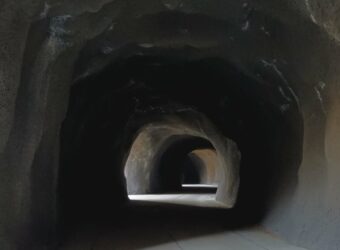
I was equally impressed with the full sized cutout windows that they have inside the tunnel. Granted they had to put up railing because of “stupid people”, but they still look good and are also quite functional. These five openings let natural light in the tunnel so it’s easier for everyone to navigate and see possible tripping hazards. Without these openings it would be pitch black in the tunnel, and people would be grabbing for their phones to safely navigate. I’ve been in tunnels like that before, and this one is so much safer.
Accessible Vault Toilets
Granted, vault toilets are not my favorite amenity; however they are necessary. These models are on a cement slab with good access from the accessible parking space. Many times vault toilets are just placed on the dirt, and over time erosion creates a large step up to them. These are done right. And of course, there’s plenty of room for even the largest wheelchair or scooter inside.
And they didn’t forget truly accessible picnic tables at Mitchell Point Tunnel
Picnic Tables
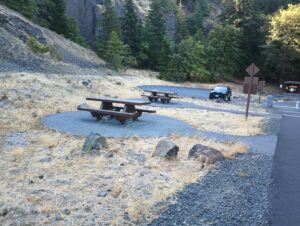
Last but certainly not least, they remembered the accessible picnic tables. And they are close to the accessible parking space. They are on a nice new level asphalt surface, and they are the true accessible models – with room on the ends for wheelchairs. Add that all up and the Mitchell Point Tunnel makes a great accessible stop to enjoy the view, stretch your legs, use the facilities or have a picnic lunch.
So stop in and check out the Mitchell Point Tunnel for yourself, on your next Oregon road trip, It’s easy to find – just take exit 58 off of Interstate 84 near Hood River, follow the signs, and enjoy!
There’s been a lot of misinformation on the internet lately about the US Department of Transportation (DOT) rolling back or not enforcing wheelchair-access rules under the Air Carrier Access Act (ACAA). First and foremost, this is not true, and all protections that are in place under the ACAA will continue to be recognized by US air carriers and foreign air carriers on flights to and from the US. The misunderstanding stems from a misinterpretation of the process of updating the current ACAA.
The ACAA Update Process
The ACAA dates back to 1986, and over the years as technology and travel have evolved so have the regulations. But because they are government regulations it’s not like they can be easily updated. It’s a process. And it usually takes years.
It begins when the need for a change is recognized by the DOT. Then there are usually a series of public meetings to gather feedback on the proposed changes, and to determine the exact needs of the public. Then the proposed regulations are crafted by a committee, which usually takes years. Sometimes it takes longer, as there is a lot of input from the disabled community, airlines and other businesses.
After the proposed changes are finally agreed upon, they are published in the Federal Register. Then there is a public comment period, which can take six months or more. Then the Access Board reconvenes and considers the public comments from both consumers and the airlines. And then they may make changes if appropriate. But we’re not done yet!
The final rule is then published in the Federal Register, along with an implementation date. Depending on the complexity of the regulation that implementation date may be six months or six years in the the future.
The “Current” Proposed Changes
Which brings us to our current situation, and the most recent changes to the ACAA. They have been “in the works” for many years and they were finally released in 2024.
Most of these changes were originally scheduled to go into effect in 2025, but were subsequently delayed until December 31, 2026. The DOT recently further delayed that implementation date on four of those changes until April 30, 2027. The delayed changes are those that pertain to:
Mishandled wheelchairs
Refresher training frequency
Pre-departure notifications
Fare difference reimbursements
Additionally the DOT also extended implementation of the refreshed training frequency in the Accessible Lavatories on Single Aisle Aircraft Rule, to April 30, 2027.
But remember this delay only applies to the training. That rule will still take decades to be fully implemented.
So why did the DOT delay the implementation of the changes? Well basically some of the airlines initiated legal proceedings against the changes and that prompted the DOT to give things a closer look.
And to be honest, just about anything can happen between now and April 30, 2027, the new scheduled implementation date. The rules may go into effect as written, they may be updated, or there could be another delay. Only time will tell. After all, it is a government process.
The important thing to remember is that the current ACAA remains in full effect. Nothing has changed. These new regulations have not even been implemented yet, and only a portion of them will be delayed. And when you consider the protections that the ACAA already offers, those changes are minor.
Bottom line – slow walkers and wheelchair-users are still fully protected under the ACAA.
Know Your Rights
Of course it’s still important to know your rights under the ACAA. Here are the basics.
And remember, the DOT is NOT rolling back wheelchair access rules on airplanes, as reported by some media. It’s merely going through the routine process of updating those rules. In other words – business as usual.
Despite all the complaints and irritations about accessible air travel these days, there’s some good news on the horizon, at least as far as Air Canada is concerned. Not only does this carrier make it a point to abide by Canada’s Accessible Transportation for Person with Disabilities Regulations, but they are also becoming more proactive about providing adequate services to passengers with disabilities. And to that end, they recently released their Air Canada Accessibility Plan for 2026 to 2029.
Plans are great, but I was impressed that they based this plan on the “nothing about us, without us” battle cry of the independent living movement. This impressive – 49 page – document addresses all disabilities and includes a lot more than just making sure there’s an aisle chair available when the plane lands. Along with training and access improvements this comprehensive plan also includes customer sensitivity issues, studies, feedback, consultations, committees, advisors, employment and sponsorships. And in the end it presents a forward view of addressing accessible air travel shortfalls.
Here are a few highlights.
Accessibility Progress
This section includes some of their access successes. They include:
The implementation of mobility aid tracking, with with real time updates and alerts on the Air Canada app
The inclusion of more detailed information about airport accessibility on the Air Canada website and app.
The availability of more support for passengers who need to use medical oxygen during flights, and the addition of discounted oxygen options.
The elimination of inconsistencies relating to equipment limits, and the reduction of physical barriers to aircraft and airports.
And what I feel is a huge improvement – the availability of transfer slings at Canadian airports, and the ability to secure many mobility aids in the cabin.
Access Barriers
Of course there are still some access issues that could use some improvement. Those are also included in the report.
Some aircraft have physical barriers, including cargo door dimensions and cabin layouts that limit the ability to accommodate some wheelchairs.
On-board lavatories need accessibility improvements.
Wheelchair damage and delays need to be eliminated.
Boarding and deplaning in uncomfortable aisle chairs needs to be improved.
Accessibility shortfalls during service interruptions need to be addressed.
Airport Accessibility
The report also addressed how they can address access airport accessibility in the long term. Here are some of the issues they plan to tackle.
Expand the availability of passenger lifts and transfer equipment to smaller airports throughout Canada.
Incorporate the use of transfer slings with third-party providers in the US.
Evaluate improved aisle chair designs which allow for greater passenger independence and comfort.
Improve boarding and deplaning options in Latin America for customers with mobility disabilities.
Improve independent wayfinding and movement through airports.
Improve the availability of ambulifts at airports, for customers who are unable to walk or navigate steps.
Upgrade the regular inspection and maintenance program for accessibility equipment.
Lobby with airport authorities for a dedicated accessibility lane at Canadian hubs.
Work with airport partners to provide more consistency on gate passes for non traveling support persons.
Mobility Aid Handling
And finally, one of the most important sections of the report addressed how to improve the reliability of mobility aid handling. Here are their plans.
Develop a system that prevents flights from departing when mobility aids are missing from the cargo hold.
Expand mobility aid tracking notifications.
Enhance hand held digital devices used in ramp operations to improve the handing of mobility devices.
Introduce automation that helps prevent the loss of mobility aids.
Enhance communication between ground handling and flight services regarding the handing of mobility aids.
Consider creating an Air Canada branded pouch for wheelchair tools and loose components that will clip to the mobility aid.
Continue to engage with mobility aid manufacturers, so they can create power mobility aids that can fit through all air cargo doors.
Include cargo do size as a factor when selecting flight partners.
Continue to refine the notification tool for mishandled mobility aids.
Continue to improve the recovery infrastructure for faster response when a mobility aid is damaged or lost.
My Take
First and foremost I’m glad that they addressed access, and in fact had an entire report that focused on the issue. My hope is that is goes further than the printed word, and that many of their goals come to fruition.
What do I think is most important? That’s a tough call, as equipment damage is one of the top complaints from wheelchair-users; however a little more comfort during the trip goes a long way to making the journey more enjoyable.
Personally. I hope they put a priority on improving the aisle chair for greater passenger comfort and independence. I get a lot of complaints about those uncomfortable aisle chairs. I know that they have to fit down the aisles, but I would think that there’s a way to make them a little more comfortable – maybe add some extra padding or something?
Of course everyone wants their wheelchair to arrive on time and unharmed, so that goes right up there with comfort in the air. I don’t really have a solution for that one, except more training for employees (I expect there is a high turnover) and just take a little more care when it comes to assistive devices. Luggage can be easily replace, but mobility aids are another issues entirely. I mean I can go out and buy some more underwear if my luggage is delayed or lost, but it’s not that easy if your wheelchair is lost or damaged.
Anyway, this is a first step. At least Air Canada has some plans and goals, so that’s good. Now I’d like to see those goals accomplished.
I’m often asked what I think is the most important element of an accessible travel destination or facility. That’s a tough call for sure, because I truly believe all access elements are important, no matter how small or inexpensive. That said, there’s one critical building block that’s consistently overlooked, when it comes to accessibility – signage.
Accessible signage seems simple enough when it’s in place, but it can lead to a lot of confusion, and maybe even injury when it’s overlooked. Here are some examples of where a little signage could of gone a long way to improve the accessibility and overall visitor experience.
Where’s the Entrance?
Accessible entrances are one of the basic building blocks for inclusion; however even in this day and age, not all businesses have them. I’ll skip the debate of why so many things are not “readily achievable” and get to the meat of the matter here – signage at inaccessible entrances.
Sure, I’ve gone to plenty of places with wheelchair-users, only to find a step or two at the entrance. For me, it’s not problem, as I can just go in and ask about the location of the accessible entrance for my friends. Sometimes they pull out a portable ramp, while other times I’m directed to an alternate entrance, usually in back. It’s time consuming, but it works. Everybody gets in the door.
But what if you’re not there with someone that can navigate the inaccessible entrance and go inside to inquire about things? That’s where accessible signage comes in. I’ve seen way too many inaccessible buildings that lack any signage as to where the accessible entrance may be. Oh, and if you’re going to put a phone number on your sign, make sure it goes to a phone that you actually answer. Don’t even get me started on that one.
You’ve Got to Be Kidding!
And then there was this shopping center in Philadelphia that had stairs up to the front entrance. Two flights of stairs, mind you. So I walked around the large building several times, but I just couldn’t see any type of accessible entrance. It was puzzling for sure, as this seemed like an establishment that had enough money to make things accessible.
So I tromped up those two flights of stairs to the entrance. And what do I find at the entrance? A sign with a phone number that says to call for information about the accessible entrance. OK, folks, this isn’t rocket science – if a person needs an accessible entrance then they are most likely not going to be able to read the sign at the top of two flights of stairs that gives them the magic phone number. Put the sign on the ground level where a person who uses a wheelchair can actually find it.
And yes, I did call the phone number. It went to voice mail and I never received a return call. Again, put a phone number that you routinely answer on all access signs, because the person that’s calling probably needs immediate assistance.
Scratching My Head
Signage is good, but to be honest, sometimes it makes me scratch my head. I’ve visited more than one place that just has blue wheelchair signs intermittently scattered around the grounds. Not at entrances, or facilities, but just haphazardly scattered. It’s like they purchased a set amount signs and they were determined to use them all. I guess it really didn’t harm anything, except it made me scratch my head. It also made me wonder if they were suppose to be used somewhere else, like an accessible entrance or a path of travel.
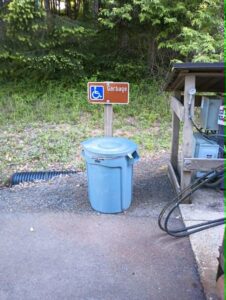
And then there was the garbage can. We were camping in Oregon and on our way out of the campground we stopped to throw out our trash. Some public garbage cans can be very complicated. At this location there was one can for plastic, one for paper, one for refuse, and the list went on. To be honest it was confusing because there was also a list of things you couldn’t put in each can. And then at the very end there was a trash can standing alone, and it had the blue wheelchair sign on it. I guess it was accessible, but so were the other 20 cans that I just passed. And to be honest, a quad would have a really difficult time getting the lid off – it was hard for me. So, I couldn’t really figure out what it was for, but since I didn’t understand the other cans either, I just put all our trash in that one.
And then there are signs, that make absolutely no sense, but have nothing to do with access. We were driving down the highway on a road trip a few weeks ago and we saw a sign that read, “Intermittent Road Work for the Next 52 Miles”. Really? Talk about being non-committal.
Don’t Forget Printed Material
And although accessible signage is important out in the real world, it’s also equally important in printed material. You want to let folks know about access to your place of business in all your printed material. Otherwise, if accessibility isn’t listed, many folks will assume your business is not accessible. And you will lose out on business; and it won’t be just wheelchair-users, but also their friends and family who want to go to an inclusive place.
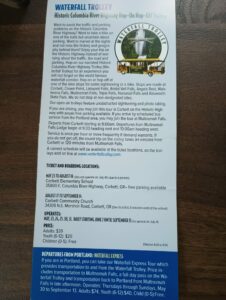
Case and point is a brochure I picked up the other day about a new shuttle service to some Oregon waterfalls. It’s a great service, as it can be difficult to find parking at some of the scenic waterfalls on the route; however there wasn’t one word about accessibility mentioned in the brochure.
They took the time – and space — to describe the routes, make notes of all the stops, and include information about bus connections to neighboring cities, but there wasn’t one word about wheelchair access. So I went to their website and it did state that they were wheelchair-accessible, and told folks to be sure and note their needs when they made reservations so appropriate vehicles could be dispatched. How hard would that be to include in the brochure? Just saying.
Where Am I?
One of the most frustrating things about accessible signage, or lack thereof, is that it can turn a nice outing into a frustrating challenge. I’ve looked at hundreds of accessible trails, because it’s something that interests my readers. My goal is to give folks solid and accurate information so that they can easily access and enjoy accessible trails. But sometimes that’s a challenge for me.
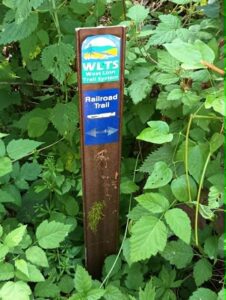
Charles and I were out exploring some accessible possibilities one day, and after a nice picnic lunch we set out to find this accessible trail. It was mentioned on the park website, but the directions to the trailhead were unclear. When we got to the park we followed several signs to nowhere, and then one to a trail that branched off in three different directions, with no signage whatsoever. We then found a sign for the trail on the other side of the park, and figured if we followed it, it would lead back to the start. Wrong, it led to a a trail that wasn’t even on the map. In the end I gave up, and so will most other people.
The same is true, when we set out to find this new accessible boardwalk on a lake. Some people said it went around the lake, but we couldn’t find it. Turns out the trail goes around the lake, but the accessible boardwalk is only a portion of that trail. And with zero signage it was just by luck we found it. Now at least we can tell others where to look, as it’s a pretty cool trail. But a little signage would of helped.
The reserve is owned and maintained by the Tillamook County Pioneer Museum, and it’s funded through donations, grants and membership dues. And even with this limited funding, their signage is excellent. Additionally, all of their trails of wheelchair-accessible.
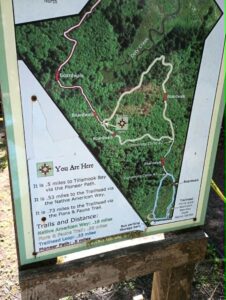
They way I look at things, if this small reserve can provide such excellent signage on a limited budget, then anyone can do it. It’s a beautiful preserve and you always know exactly where you are, and what trail leads where. At the trailheads there’s a large map, showing your location, and listing the length of all the trails. And every time you cross another trail, it’s clearly marked. You have absolutely no doubt where you are at any point in Kilchis Point Reserve. It’s really a great place to visit.
Finally, I’d be remiss if I didn’t also give a shoutout to the National Park Service for their excellent trail signage. They not only list the location of the trails, but also include the length, width, slope and cross-slope. So not only can you determine the accessibility of a trail, but again, you always know exactly where you are.
So see, it is possible to get the signage right. I’d really like to see more of that in the future.
OI get a lot of questions about flying with lithium-ion wheelchair batteries. There is a lot of misinformation and confusion out there, and many folks are concerned about their first flight with their wheelchair or other assistive device that has lithium ion batteries. So let me try and clear things up for you.
Lithium-Ion Battery Rules for Assistive Devices
So who sets the rules for lithium-ion batteries? Well in the US, these safety rules are set by the Federal Aviation Administration (FAA). That agency sets minimum guidelines for the safe transport of lithium-ion batteries on US aircraft; however individual airlines may set stricter standards or even disallow them altogether.
The magic number for lithium-ion batteries in mobility devices for air travel in 300 watt hours (Wh). If you have a wheelchair or assistive device with a lithium-ion battery of 300 Wh or less that does not have a protective housing, then it must be removed and carried on the plane with you. On the other hand, if the lithium-ion battery (still 300 Wh or less) is installed on an assistive device and it does have a protective housing, then it will need to be carried as checked luggage. If this is the case, you need to notify the airline, as additional protective measures and an inspection may be required.
As for spare batteries, the magic number is also 300 Wh. One spare battery of up to 300 Wh or two spares of 160 Wh each are allowed. The spare batteries must be carried on the aircraft, as they cannot be carried in the cargo hold. Spare batteries should be carried in protective pouches or covered with non-conductive tape to prevent short circuits. Airline personnel will likely inspect all batteries before boarding.
Additional Information
It’s also a good idea to bring a copy of the battery’s Material Safety Data Sheet with you in case there are any questions from the flight crew. You also need to check with the airline in advance (at least 48 hours prior to departure) to see what the specific requirements are, as they do vary from airline to airline. Again, the airlines may have stricter requirements than the FAA minimum guidelines.
Additionally, foreign airlines (non US-airlines) may have different safety regulations and requirements, so it’s best to check with them well in advance of your flight. Most airlines have detailed information listed on their websites. It’s important that you check the airline website before booking because some airlines may not allow them at all,
Additionally, lithium metal (nonrechargeable lithium) batteries are forbidden with assistive devices. That means the airlines will not take them.
And here are a few good resources about traveling with lithium-ion wheelchair batteries, .
Southwest Airlines has long been a favorite airline for many manual wheelchair-users, because they can bypass the aisle chair and use their personal wheelchairs to board the aircraft. This is largely due to the configuration of Southwest Airlines 737 aircraft, as the wide entrance aisle allows many folks to roll right up to the first row of aircraft seats, and skip the aisle chair. Unfortunately, new security additions mandated by the Federal Aviation Administration will change the configuration of the aircraft; and many wheelchair-users who previously used their personal wheelchairs to board Southwest aircraft will now have to use an aisle chair.
New Secondary Cockpit Barriers
So what are these new security additions to Southwest aircraft? Well, after the September 11 attacks, the FAA began to consider implementing higher security measures for US aircraft; however the regulations were not put into place until 2023. These regulations include the installation of secondary cockpit barriers for new aircraft placed into service after that date.
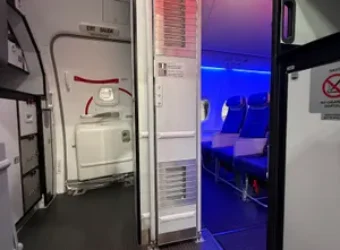
The secondary cockpit barrier is a fold-away door that is attached to the cabin side of the forward galley. This security device is deployed when the cockpit door is opened and closed while in flight. So when someone in the cockpit wishes to exit the cockpit to use the lavatory, the cockpit barrier will be closed by a flight attendant until the crew member returns to the cockpit. Previously, flight attendants used beverage carts to block the aisle, and they stood there until the crew member returned to the cockpit. The new cockpit barrier is a safer and more secure option for the flight crew.
Unfortunately the installation of the secondary cockpit barrier takes a few inches off the already narrow passageway; and as a result many wheelchair-users will no longer be able to access that first row of seats in their own wheelchairs.
Aisle Chair Required
As the new secondary cockpit barriers began to appear on Southwest Airlines 737s in mid-2026, many wheelchair-users reported that their wheelchairs no longer fit past these new security barriers.
It appears that that the addition of the new secondary cockpit barriers have taken off approximately three inches of aisle space. From reports we’ve received, anyone with a wheelchair narrower than 23 inches should still be able to navigate the aisle and transfer into an airplane seat from their own wheelchair. Wheelchair-users with wheelchairs that are wider than 23 inches will now have to use the aisle chair.
Some people ask if this is legal? In a word, yes. The Air Carrier Access Act is the regulation that covers wheelchair-access on commercial airlines in the US. These regulations do not require aircraft aisles to be wide enough to accommodate personal wheelchairs. They do have to be wide enough to accommodate an aisle chair, and this new design allows for that.
So how do you tell if you are going to be on a new 737 with the secondary cockpit barriers installed? Well, unfortunately there’s no 100% way to tell, as equipment changes occur often. Right now only a few of the planes are outfitted with the new devices; however as time passes more and more of the new planes will have them.
Future Flight Preparation
The bottom line is, that if you can’t walk to your seat, you will most likely have to use an aisle chair on Southwest Airlines when the secondary cockpit barriers are installed. And I know that’s a difficult adjustment. Many folks fly Southwest specifically because they don’t have to use an aisle chair to board the aircraft. And that will no longer be an option for many folks in the future.
The good news is that aisle chairs are readily available at the gates, and if you need one, it’s easy to get one. It’s also a good idea to always request one when you book your Southwest flight, even if you could previously roll to your seat. If you happen to find out later that you can roll down the aisle, you can always decline the aisle chair. It’s also wise to be mentally prepared for the possibility that you will need an aisle chair on your future Southwest flights. Be aware of the possibility, so you won’t be disappointed. And don’t let these new secondary cockpit barriers ruin your trip!
Times are a changing and technology is making things possible today that we never thought could happen. But will people ever be able to board an airline in their own wheelchair and stay in it for the entire flight? Well things are moving forward, and that’s good, but it’s not going nearly as quickly as some people have hoped. So here’s an update on where we stand on flying in your own wheelchair.
The Regulations
When I last covered flying in your own wheelchair, the Federal Aviation Administration (FAA) was set to review their regulations by 2025 (https://emerginghorizons.com/flying-in-your-wheelchair-when-will-it-really-happen/). This is really the most crucial first step, as if the FAA won’t allow it, then it’s a no-go from the start.
The majority of airplanes have a boarding door large enough to accommodate most personal wheelchairs.
Boeing 737 and Airbus 320 models would only require modest interior modifications to create a wheelchair securement area at the front of the cabin.
Many personal wheelchairs comply with the crash performance standards (WC19) established by the Rehabilitation Engineering and Assistive Technology Society of North America (RESNA).
The report recommended that the U.S. Department of Transportation and the FAA establish a research program in collaboration with RESNA to test and evaluate a selection of WC19-compliant wheelchairs in accordance with applicable FAA crashworthiness and safety performance criteria. It also recommended that the Access Board sponsor further studies to assess the demand for this service. There is no timeline for these recommendations.
So, in other words, more studies, and no definitive implementation date.
So, unfortunately we are quite a ways away from the reality of anyone flying in their own wheelchair.
Airbus Progress – A Concept Design
Even though the regulations at this point are up in the air (no pun intended) one company is moving forward with a workable design to accommodate personal wheelchairs aboard their commercial aircraft – Airbus.
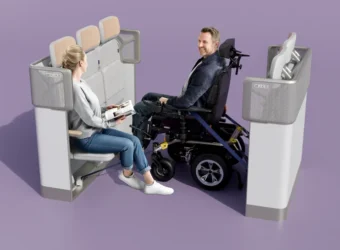
Airbus has created a new concept design — The Airspace U Suite — which would not only accommodate passengers in their own wheelchairs, but also serve as a premium space for other passengers. This universal design concept will most likely appeal to airlines who don’t want to designate valuable space for wheelchair-users, only for it to sit empty when not in use. And not only will it not sit empty, but the airlines will be able to charge a premium for this spacious seating compartment.
The Airbus U Suite will not only accommodate a person in their own wheelchair, but it’s being billed as space for.
Travelers who want to lay down and take a nap
A family space
A business space for an in-flight meeting
In short, it’s universal design in the air.
The Airbus team has taken their first test flight with a wheelchair-user, and they hope to have the concept ready to produce by 2032. And their Airspace U Suite was on prominent display at the Aircraft Interiors Expo in Hamburg last month.
So the design end of things is falling together nicely; but again, that’s only one piece of of an incredibly complex puzzle. Even if they are able to produce the design as expected, it won’t be available to wheelchair-users until the FAA – and worldwide regulatory agencies – approve it. And perhaps that’s why Airbus has included the universal design concept, so it can be used for other travelers in the meantime.
The Reality
The Airspace U Suite looks like a great design, but the question is, what will it cost passengers? Will it be a premium space like first class, or will it be an affordable space for wheelchair-users? That of course remains to be seen, but it does look like it will be a premium ($$) space, located in the front of the aircraft. Still there are plenty of folks with the means to pay for this space. And maybe this is just a first step to create more affordable accessible spaces on aircraft.
And accessibility – when and if it begins – will only be for larger aircraft at first. But that’s good because it’s those longer flights can be the most problematic for wheelchair-users. Even if you use your own wheelchair cushion on the flight, it’s still not the same, and skin issues can develop.
And finally, let’s remember that there’s nothing in the Air Carrier Access Act (ACAA) that requires seating in your own wheelchair on airplanes. That would take a lot of additional work and new regulations. Most likely if anything, the Access Board would allow but not require it. Just like the fact that airlines are allowed to, but not required to, provide on-board medical oxygen.
But still, it’s a start. As the folks at Airbus said, “So we started the process” to develop more accessible solutions and “we are in the middle of it.”
But I’m happy to see research and development moving forward for flying in your own wheelchair. And to put things in perspective, in my lifetime, prior to the ACAA, airlines made wheelchair-users sit on towels because they were afraid they would soil the seats. And they made a big deal about it. So, honestly, I’m really happy with any progress. But again, it will be a while, and unfortunately, probably not in my lifetime.
Yosemite has always been a popular destination, and in order to manage the crowds in previous years advance vehicle reservations were necessary. These were cheap and easy to get at www.recreation.gov. And once you got to the park at your appointed time, there wasn’t a wait, because the required vehicle reservations metered the traffic.
Fast forward to 2026, and vehicle reservations are no longer required (https://emerginghorizons.com/yosemite-entrance-reservations-not-required-in-2026-but-plan-ahead/). Why? Well it depends who ask, but there was a huge outcry from locals who opposed the reservations, and then apparently the park statistics showed they weren’t needed. In any case, no vehicle reservations are required in 2026, and that’s led to major traffic jams. Because traffic is no longer metered, there’s a huge back-up at the gates. Just last week there were reports of 90-minute waiting times at the gates – and it’s not even peak season.
Once you get in the park, finding parking is another issue, and of course finding accessible parking is always harder. To be honest, I’d really advise against a visit this year. And it’s not that I’m anti-Yosemite, but I’m just being pragmatic. I grew up in the mountains near Yosemite and for most of my life it was my “home national park”. And I love it. I just feel that with it’s over popularity, and non-metered traffic, it’s just really hard to enjoy this gem. Perhaps things will change next year.
That said, if you absolutely must visit Yosemite in 2026, here are a few tips for wheelchair-users, to help minimize your wait times, and more fully enjoy the park.
Spend the Night
Spending the night in the park is best way to maximize your sleep, and still get that much-needed early start in the morning. That said, lodging in Yosemite Valley can be extremely hard to get during peak season. Hard, but not impossible.
The cancellation period for Yosemite Valley hotels and lodges in seven days. That means that people can cancel their reservations with no penalty up to seven days before their visit. So, if you’re looking for Yosemite lodging in the peak months, and can do a spur-of -the-moment trip, then try searching for available properties early in the day, seven days ahead of time. It’s not guaranteed to work, but it’s the best shot at a vacancy. And yes, sometimes wheelchair-accessible rooms get cancellations too.
And my favorite wheelchair-accessible room in the park is room 421 at the Ahwahnee. It has a king bed, a roomy bathroom with a roll-in shower and an impressive view of Half Dome.
Yosemite Shuttle
Park and Walk (or Roll)
If you can’t spend the night inside the park, then you need to get an alpine start for a hassle-free wheelchair-accessible Yosemite visit in 2026. It depends on where you spend the night, but try to get to the park no later than 6 AM. Yes, you read that correctly, 6 AM.
Years ago, you could have the park to yourself at that time; but with the crowded entrance stations today, it only cuts down on the crowds. Still, that’s a good thing. Your goal after getting to Yosemite Valley is to find an accessible parking spot in the Yosemite Village parking lot. And then leave your car there for the day.
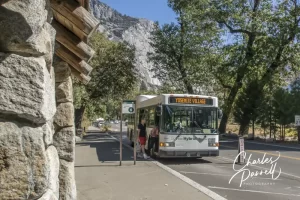
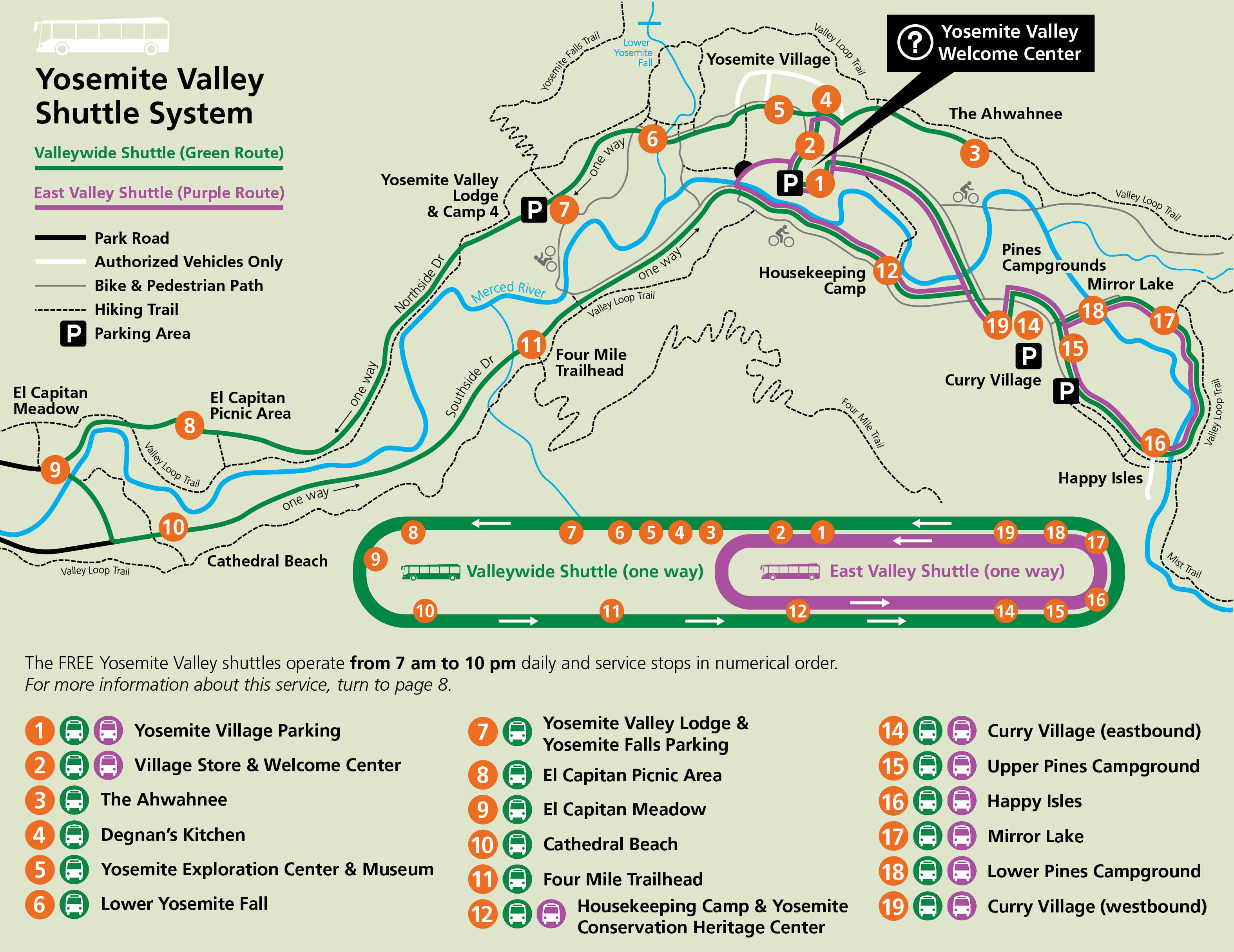
The good news is, there are a lot of sites, viewpoints, concessions and attractions in Yosemite Valley; and they are all connected on the wheelchair-accessible Yosemite Valley shuttle (https://www.nps.gov/yose/planyourvisit/images/valleyshuttle2.jpg). And there’s a shuttle stop near the parking area and in front of the Visitor Center.
The shuttles from 7 AM to 10 PM daily, and there’s usually about a 15-minute wait for a bus. There are two routes in Yosemite Valley – The Valley Shuttle, which covers the whole area, and the East Side Shuttle which stops at Yosemite Village, Curry Village and the campgrounds and trailheads on the east side of the valley
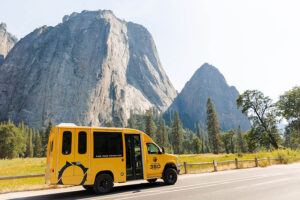
All of the shuttle buses are wheelchair-accessible, and they come equipped with wheelchair-lifts and tie-downs. They can accommodate wheelchairs up to 24 inches wide by 46 inches long, with a weight of up to 750 pounds.
Alternatively it you’d like to get a little exercise, rental handcycles are available at the Curry Village Bike Stand (209-372-8323) and the Yosemite Valley Lodge Bike Stand (209-372-1208). It’s best to reserve those in advance though, as supplies are limited and they go quickly.
YARTS bus in Yosemite Valley
Ride YARTS!
Another way to to get the most our of your wheelchair-accessible Yosemite visit is to take public transportation to the park – more specifically YARTS (https://www.yarts.com/). Based in nearby Merced, YARTS stands for Yosemite Area Regional Transportation System, and it has four routes that lead to the park. So you can overnight in a nearby community, ride YARTS to the park, and not worry about any delays at the entrance (public transport takes an express lane) or finding an accessible parking space.
The routes run from Merced, Fresno, Sonora, and Mammoth Lakes to Yosemite Valley, and stop at mountain communities along the way. So you could overnight in a variety of places including, Mariposa, Groveland, El Portal, Oakhurst and June Lake. All YARTS buses are equipped with wheelchair lifts; however you either need to contact them 48 hours in advance, or indicate on your online reservation that you require wheelchair seating. And attendants traveling with a wheelchair-user get a 50 percent discount. So not only is riding YARTS accessible it’s also affordable.
Although the general public has to hike in to Mirror Lake, if you have an accessible parking placard or license plate, you can drive along the this road. Although you won’t have the lake to yourself, the hike in – even though it’s easy – eliminates a lot of folks. Even better – go early in the day to dodge the bulk of the visitors.
The road up to mirror lake is about a mile long, and motorists will be sharing the road with pedestrians and cyclists. You must travel with your hazard light on, and the speed limit is 15 mph along this road. And of course you need to watch out for pedestrians – especially kids – along the way.
About half way up, the roads gets steeper, and bicycles are prohibited beyond this point. Once you get to the top there’s accessible parking near the lake. There are some accessible vault toilets nearby and some picnic tables on level ground that may be doable for wheelchair-users. That said, Mirror Lake is seasonal and it usually dries up by late summer; however the granite views are spectacular from there. It’s well worth the drive.
Although they have some great wheelchair-accessible cabins (called havens) at adjacent Waybound Yosemite (operated by Tenaya Lodge) you don’t have to be a lodge guest in order to book one of their tours. The accessible tour bus has a lift and tie downs, so you can stay in your own wheelchair or transfer to a seat.
The day-long accessible tours feature stops at all the popular attractions, a picnic lunch, and time to explore Yosemite Valley on your own on the free wheelchair-accessible shuttle. Plus you don’t have to worry about parking, waiting in the entrance line or driving. Book early though, as this popular tour sells out quickly.
Walk-through Tree at Mariposa Grove in Yosemite National Park
Visit Mariposa Grove
Last but certainly not least, one of the best ways to enjoy a quieter slice of Yosemite is to get out of the valley and visit Mariposa Grove (https://emerginghorizons.com/escape-to-the-wheelchair-accessible-mariposa-grove/). You can access the grove on the Yosemite Shuttle Bus, but if you have a accessible parking placard, you can drive along the road that is reserved for shuttles, hiker and cyclists.
With an accessible parking placard, you can drive to the Mariposa Grove Arrival Center and check out the accessible Big Trees Loop. From there you can drive to the Grizzly Giant Trailhead and take part of the trail to the Grizzly Giant and the California Tunnel Tree. Not only are these massive trees, a must-see on any Yosemite itinerary, but you can dodge some of the crowds by driving there.
And as with any Yosemite itinerary, get an alpine start to beat some of the crowds. This is especially important in 2026, when there are no vehicle restrictions at the entrance stations. So plan ahead for a trouble-free wheelchair-accessible Yosemite visit this year.
Established long before the Americans with Disabilities Act, the Air Carrier Access Act (ACAA) covers accessible air travel on all US airlines, as well as flights on all airlines to and from the US. But does it cover all types of airplanes, including those small planes which board from stairs on the tarmac? The short answer is no, and that issue was recently brought to light when actress Marissa Bode was recently denied boarding on a Southern Airways (https://www.iflysouthern.com/) commuter flight.
What the ACAA Says
According to the ACAA, lift or ramped boarding must be provided on all covered aircraft. And while most commercial aircraft are covered under the law, there are some exclusions. In fact § 382.97 of the ACAA specifically lists those exclusions. They include:
Float Planes
Aircraft with fewer than 19 seats
Fairchild Metro
Jetstream 31 and 32
Beech 1900 (C and D models)
Embraer EMB-120
It also excludes any other aircraft model determined by the Department of Transportation (DOT) to be unsuitable for boarding and deplaning assistance by lift, ramp, or other suitable device. And the DOT makes that determination if no existing boarding and deplaning assistance device on the market will accommodate the aircraft without a significant risk of serious damage to the aircraft or injury to passengers or employees; or if there are internal barriers that would prevent passengers in an aisle chair from reaching a non-exit row seat.
Southern Airlines is a small commuter airlines which flies the Cessna Grand Caravan 208, which typically seats between 8 and 14 passengers and one pilot. Standard commuter configurations generally hold 10 to 12 passengers, but tighter seat configurations can accommodate up to 14 passengers. In short, it’s less than the 19 passenger requirement under the ACAA, so yes this aircraft is exempt from the ACAA, and not required to carry wheelchair passengers.
What Happened to Marissa Bode?
According to news accounts Marissa Bode discovered this when she was booked on a Southern Airlines flight to attend a speaking engagement in Pennsylvania. Although Bode had some problems locating her virtual ticket at the airport, the real problem arose when she got to the gate and was questioned about her physical abilities. When she replied that she couldn’t stand up and walk, the staff informed he that she couldn’t fly because she needed to climb up a flight of stairs to board the small plane.
In the end, the actress drove three hours to her speaking engagement.
So is Southern Airlines at fault for this denied boarding? Although they followed the letter of the law as to whether or not wheelchairs are allowed on this small commuter plane, there is an issue about the information that was provided to Bode’s “team”.
According to Bode, her people spoke to the airline in advance of the flight and the customer service personnel “fully assured” her manager that they would be able to accommodate Bode and her wheelchair. That’s where the airline dropped the ball, because under the ACAA airlines are also required to provide accurate information to passengers regarding the carriage and stowage of all assistive devices. And according to the actress’ accounts, Southern Airlines failed in that respect. If the airline would have communicated accurate information, the Southern Airlines flight would not have been booked, and Bode would never have been denied boarding.
So yes, Southern Airlines did drop the ball, but not for not carrying wheelchairs on their commuter aircraft. They violated the ACAA for not communicating the correct information to a potential passenger. So no, you can’t fly this airline in a wheelchair, but they do need to improve their employee training and customer service.
Peer-to-peer vehicle rentals are an up-and-coming concept. Some call it car sharing, while others refer to it as the Airbnb of car rentals. The big question is, will it work for wheelchair-users who need adapted vehicles?
The premise is pretty simple. A company contracts with individual owners to rent out their vehicles, offers them to the public, and then gives the owners the lion’s share of the profits. The customers get a reliable rental at a bargain price, and the owners get some cash in their pockets. It’s a win-win for everyone. But is it a realistic option for wheelchair-users?
Turo
Let’s start by looking at one of the leading providers of peer-to-peer vehicle rentals in the US – Turo (https://turo.com). I’ve never used them, but a friend made some extra money by renting her adapted van through them. The rental vehicle requirements are pretty simple.
All Turo Vehicles must:
Be less than 12 years old
Have less than 130,000 miles
Be fully insured
Owners get about 70% of the rental rates, which are about a third of the going rates for accessible vehicles in the US. And of course location is king. My friend lived near the Miami airport, so she did pretty well.
But what about renting an adapted van? Well they do have a filter to find adapted vehicles, but you have to do a city search first. The filter is to the far left, under “all filters”. If you search a major city, you will probably find at least one adapted vehicle, but they are not as available as standard vehicles in smaller cities and towns.
The good news is, there are lots of photos of the adapted vehicles, so you will have a good idea of what features they have. In short, it’s a good economical alternative for major airports in the US. But once you get out of the big cities, the availability of adapted vehicles drops to almost zero. And hey, if you have an adapted vehicle that you don’t use every day, you might consider offering it to Turo as a rental.
The French Approach
The French have an entirely different approach to adapted vehicles as far as peer-to-peer vehicle rentals are concerned. They have a whole company that is entirely dedicated to peer-to-peer adaptive vehicle rentals. It’s called Wheeliz (https://www.wheeliz.com/), and it’s headquartered in Paris. And according to their website they are the first peer-to-peer car rental program for wheelchair-users.
Their concept is pretty simple, and much like Turo. People register their cars on the Wheeliz website, where users search for rentals. When a match is made, the user picks up the vehicle at an appointed place and payment is made through the Wheeliz website. The owner is later paid a percentage of the rental rate.
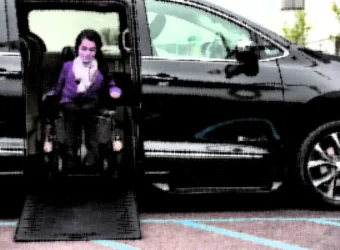
You can choose from a ramped van or a vehicle with adaptive driving features. And there are plenty of photos, and lots of information about each vehicle, so you really know what you are renting.
The great thing about Wheeliz is that it really seems to be catching on. Of course there’s no shortage of rentals in Paris, but I searched in several rural locations, and many small cities, and still found a good selection of vehicles. And they were all at bargain prices – about 65 Euros for an adapted van.
So hopefully the Wheeliz model will catch on over in the states, but if you’re traveling to France I would most definitely check them out. Not only is it a more economical alternative, but it also benefits someone with a disability. It’s a great idea!