Trails Without Limits in Westchester County, New York allows slow walkers and wheelchair-users to explore the county parks on guided track chair hikes. The program runs from March to November and the venue changes each month. Volunteers lead participants on a one to two-mile guided hike through one of the scenic county parks. The track chair allows users to easily wheel over rough terrain and other obstacles that would be impassable in a standard wheelchair.
There’s no charge for the hikes, but participants must complete a registration form online at www.thewpf.org/trailswithoutlimits. Family and friends are also invited to attend. It’s important to note that the staff and volunteers who lead the hikes are not allowed to help with transfers; so if you cannot transfer to the track chair independently, you must provide your own assistance. And if you’d prefer to cycle though the parks, Trails Without Limits also offers bicycle rides with handcycles. Either option is a great way to get out and enjoy the Westchester County Parks.
Barrier-Free Travel National Park Lodges for Wheelchair-users and Slow Walkers
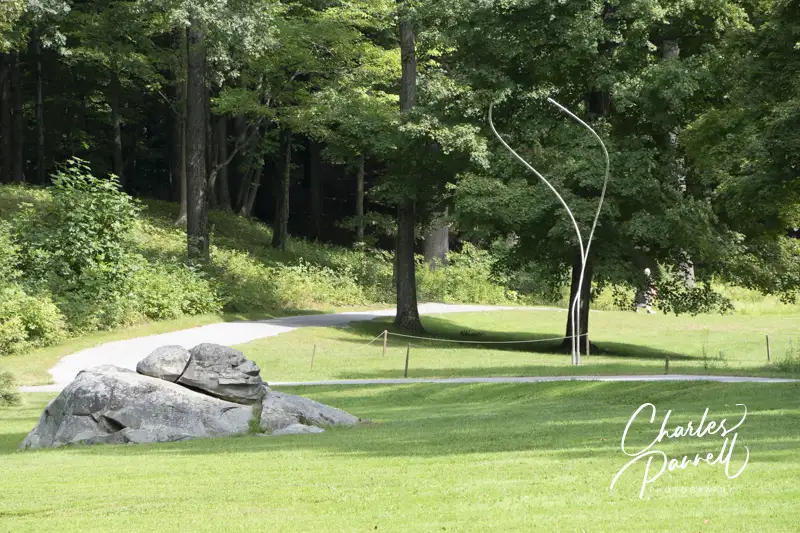
Located in the Hudson Valley three miles from Cornwall, Storm King Art Center (stormking.org) isn’t your average art installation. For starters it’s located on a 500-acre parcel dotted with meadows, ponds, hills and forests, that offer a taste of the natural beauty and diversity of the area. Add in over 100 small-scale and larger-than-life sculptures in a variety of mediums, and you have one of the region’s largest — and most diverse — outdoor sculpture parks. And although there are a few hills and rocky patches in certain parts of the landscape, Storm King Art Center is still an excellent choice for wheelchair-users and slow walkers.
Access with a Capital A
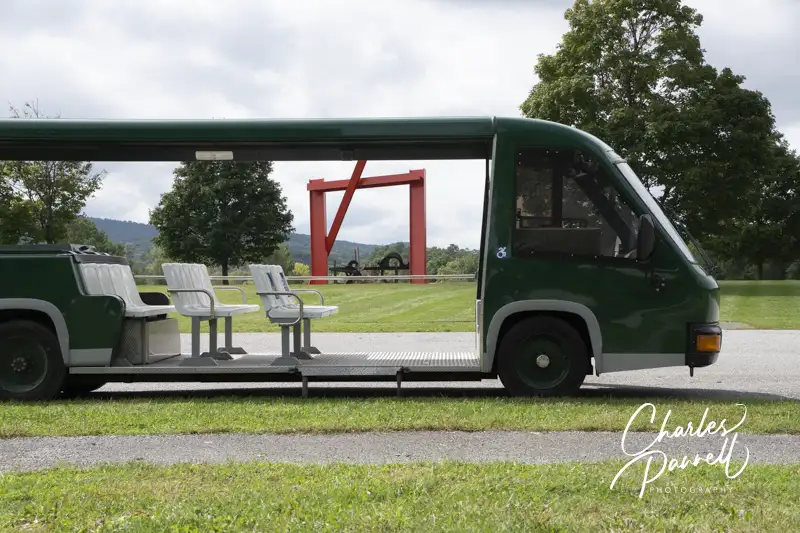
Storm King Art Center Tram
Wheelchair access is first-rate at the Storm King Art Center, starting with their large parking area. There’s accessible parking with level access over to the outdoor lobby, which features accessible restrooms, visitor information and ticketing windows. From there, you have several choices.
The easiest way to explore the park is to hop on the wheelchair-accessible tram. There’s ramp access to the tram, and you can stay in your own wheelchair or transfer to a bench seat. The tram stops at all the major areas of the park, and it’ a great option for slow walkers too.
Alternatively, you can walk over to Museum Hill, the focal point of the park. It’s a .4-mile level walk through the South Fields to the elevator which goes up to Museum Hill. As an added bonus, you can check out some of the sculptures on your stroll through the South Fields.
Although the bulk of the park is flat and easy to navigate in a wheelchair, there are some steep and rocky areas. The free visitor map is an excellent resource, as it points out all the paved pathways, as well as the steep areas, uneven paths and stairs. The park also operates an accessible cart service to help visitors navigate over areas with inaccessible terrain. For more information or to reserve a ride, call (845) 534-3115.
Explore the Grounds
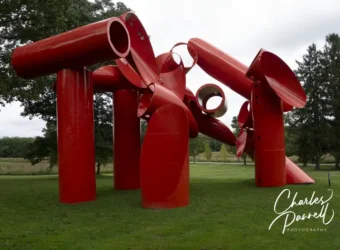
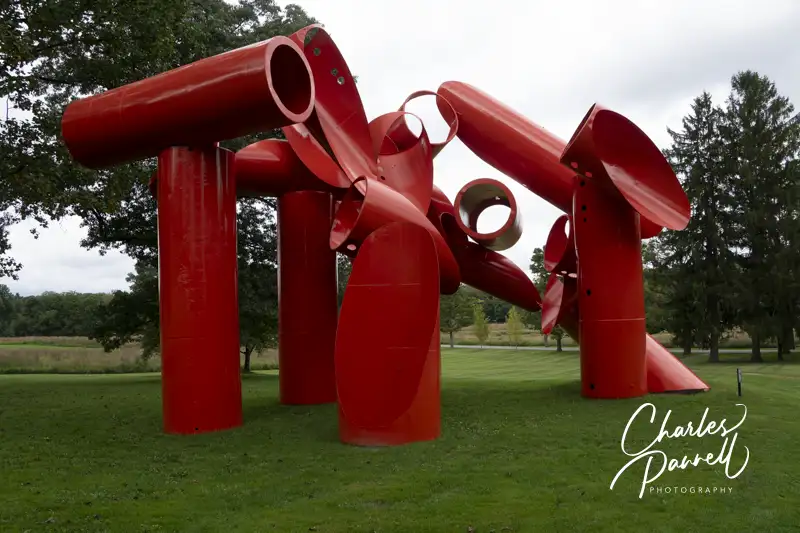
Iliad by Alexander Liberman
The grounds are filled with varied landscapes, and although there are hills here and there, you can also use the accessible tram to bypass them. The best bet is to start with Museum Hill. There’s ramp access to the Museum and ample room to maneuver a wheelchair through the galleries, which offer rotating exhibits. There is a step down to one of the galleries, but it’s also accessible from outside. And if you’re a slow walker, you might want to pick up one of the loaner wheelchairs at the Museum Store.
Museum Hill is fairly level, and it’s dotted with abstract cubes, tubes, triangles and a variety of other shapes. Two favorite pieces are also located on Museum Hill — City on the High Mountain, by Louise Nelson and Dwellings by Charles Simonds. Both of these pieces are located near the Museum, so they’re relatively easy to find.
The North Woods, which is located near Museum Hill, is one of the least accessible areas in the park. Although there are some fairly level paths through the lower part, the upper areas are rocky and steep. Still there’s plenty to see in the lower areas, which are located near the tram stop.
New pieces are continually added to the collection at Storm King Art Center, and sometimes there are also special exhibitions. And don’t miss the four Alexander Calder sculptures! Take some time to explore all the areas of the park, and if you get tired, catch the accessible tram and head back to your car. Alternatively you can use the tram as a tour vehicle to see the whole park, as it offers a good look at many of the sculptures along the route.
Grab a Bite to Eat
If you’d like to take a break and grab a bite to eat, stop in at the Storm King Café, which is located near the parking lot in the North Woods. The tram stops near the café, and there’s level access over to the entrance, and plenty of room to maneuver a wheelchair inside. Offerings include a selection of sandwiches, salads, cookies, snacks and soft drinks.
If you’d prefer to pack along your own lunch, there are plenty of places to picnic on the grounds. Management welcomes guests to bring in their own food, but no cooking is allowed in the park. Accessible picnic tables are available near the parking area, or you can bring a blanket and and enjoy your lunch anywhere on the grounds, except for Museum Hill. Pick a spot with a view, and enjoy the sculptures during your lunch break.
It’s also important to note that peak times at the Storm King Art Center are on weekends in September and October. If you don’t like crowds, it’s best to avoid those times. And no matter when you visit, it’s a still good idea to arrive early. That way you’ll have a more serene and crowd-free experience in this beautiful outdoor space.
Barrier-Free Travel the Grand Canyon for Wheelers and Slow Walkers
I use a power wheelchair and I don’t drive or own a vehicle at home. I live in a big city and pretty much rely on public transportation. When I do take a taxi, I must remain in my wheelchair, as I cannot transfer to a standard seat.
I’m planning on taking several trips in the US and although I know that accessible cabs and van hires are available in some places, their service seems spotty and expensive. With the advent of ride sharing services I’m wondering how reasonable it is for me to rely on them for my future travels. Are Uber and Lyft wheelchair-accessible? I’ve heard they have accessible vehicles in some areas, but that’s about it. Can you give me more information on what wheelchair-accessible ride share services are available in the US, and how I can go about reserving them for my future travels.
The short answer to that question is that both Uber and Lyft have limited accessibility for power wheelchair-users; however they do have other services that will work for folks who use manual wheelchairs, or just need a little extra assistance.
Technically these ride sharing services are not required to have wheelchair-accessible vehicles in all of their locations, as they are considered a service that subcontracts out transportation rather than a transportation company. In short, they operate a network, while the individual contactors maintain their own vehicles and provide rides to customers. That said, under a 2022 settlement agreement, they are prohibited from charging waiting fees if disabled patrons happen to take longer to board their vehicles.
So although there’s not across the board accessibility in all locations, both Uber and Lyft can offer some wheelchair-accessible services in select US cities. Here’s how to secure an accessible ride on them.
Uber
Uber provides two type of accessible vehicle options — Uber Assist and Uber WAV. Uber Assist is for people who can transfer from their wheelchair or just need a little extra help getting into the vehicle; while Uber WAV is for wheelchair-users who cannot transfer to a standard seat.
Uber Assist drivers are trained to give assistance to slow walkers and wheelchair-users. Drivers can assist with transfers, and they have room to accommodate folding wheelchairs, collapsible scooters and walkers in their vehicles. These vehicles are not adapted, and they do not have ramps or lifts. Still, if you just need a bit of assistance, then Uber Assist is for you. To see if it’s available, log into the app, select your pick up point and destination, and scroll down to see if Uber Assist is one of the choice. It’s now available in over 40 cities on Uber X rides.
Uber WAV, on the other hand, provides transportation in a wheelchair-accessible vehicle. These vehicles have ramp of lift access so riders do not need to transfer to a seat. You order it the same way you order any Uber vehicle — just open the Uber App and enter your location and destination. If Uber WAV is available in your area it will appear in the choices. It should be noted that because of limited availability, wait times for Uber WAV scan be longer than for standard vehicles.
Uber WAVs are available in these US cities.
Boston
Chicago
Los Angeles
New York
Philadelphia
San Francisco
Washington DC
Lyft
Lyft also provides wheelchair-accessible vehicles (WAV). These WAV rides can fit a fixed frame wheelchair, and have ramp or lift access. You can reserve one much in the same way you reserve an Uber WAV. Once you download the Lyft app, go to the settings tab and check “wheelchair-access”. After you do this you will see a ride type called “wheelchair” when you request a ride. Just click on that, and you are good to go.
As with Uber, Lyft only has wheelchair-accessible vehicles in select markets. If you request a ride in an area that doesn’t have wheelchair-accessible vehicles, Lyft will send you a list of local resources that can provide wheelchair-accessible transportation.
Lyft drivers will assist with boarding wheelchair passengers. Additionally, you don’t need to request an accessible vehicle if you can transfer to the vehicle and stow your assistive device in the trunk. Drivers will also assist with the storage of mobility equipment.
Lyft WAVs are available in these US cities.
Boston
Chicago
Dallas
Los Angeles
New York City
Philadelphia
Phoenix
Portland
San Francisco
Ask a Local
Of course, true wheelchair access with ride share companies is still limited. Additionally, because of driver turnover it’s not always consistent. For the most accurate updated information, it’s best to talk to someone local who uses these services on a regular basis. They will be able to tell you about the local availability of Uber and Lyft wheelchair-accessible vehicles. Alternatively, you can also ask someone who has visited the area recently.
Local Facebook groups are a good resource for this information. Search for them in or around your destination. Additionally, some Facebook accessible travel groups may have folks who have recently visited your destination and are willing to share updated local transportation information.
Finally, be sure to plan ahead and give yourself plenty of extra time, as the waiting times for WAVs may be longer than for standard vehicles. Hopefully as technology and the need expands, we will start to see reliable ride share options in even more cities.
Barrier-Free Travel Yosemite, Sequoia and Kings Canyon National Parks for Wheelers and Slow Walkers
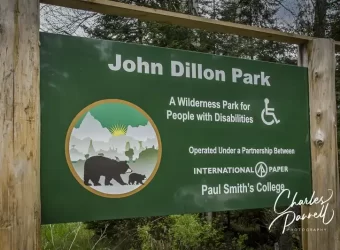
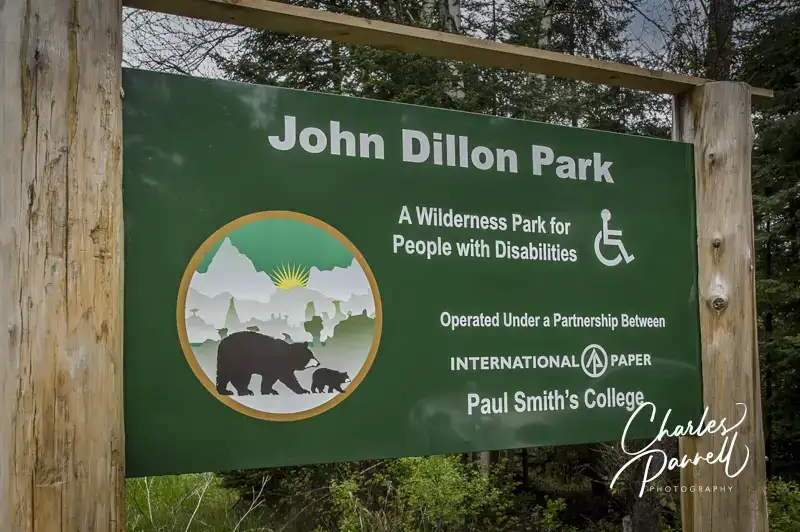
Located 15 miles from Tupper Lake in upstate New York, John Dillon Park (www.paulsmiths.edu/john-dillon-park) is a wheelchair-accessible Adirondack wilderness facility. This purpose-built camp, which is the result of a partnership between International Paper and Paul Smith’s College, was designed from the ground up to be accessible. The vision of International Paper’s former CEO John Dillion, this namesake park is the first facility of its kind. And the goal of its creators is simple – to make the natural landscape of the Adirondacks accessible to wheelchair-users and slow walkers. And, they did an excellent job.
Camping Adirondack Style
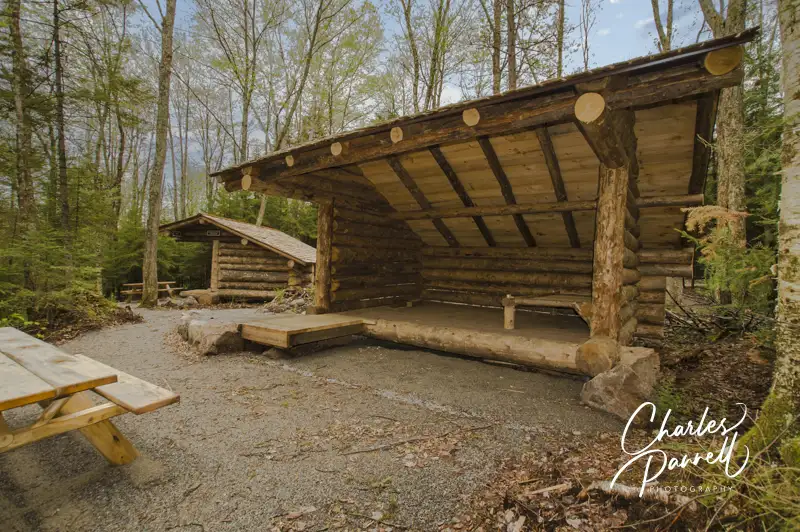
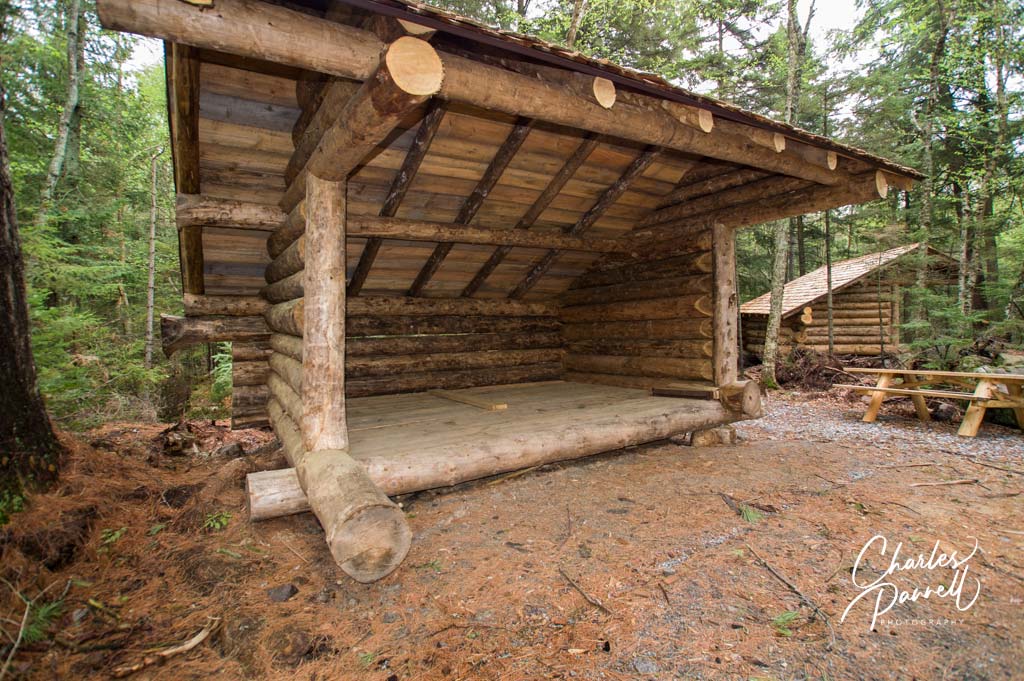
Lean-to at John Dillon Park – A Ramp Has Been Added
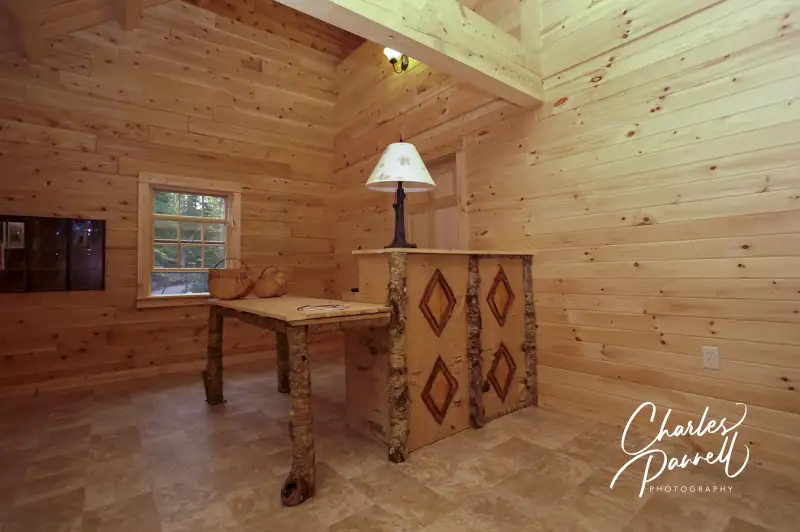
Located about two miles off the main road, John Dillon Park offers campers a chance to get away from the crowds and camp in a wheelchair-accessible Adirondack lean-to or tent. Accessible parking is located near the Welcome Center, which features barrier-free access and plenty of room to maneuver a wheelchair or scooter inside. There’s also an accessible flush toilet (the only one in camp), and a refrigerator for medication storage. After campers register, they set-off to one of the accessible lean-tos or to the tent site on the property.
The only lean-to you can drive to — Bear Cub — is located near the Welcome Center. The others are built in pairs along an accessible trail; with the farthest ones being about 2.5 miles from the Welcome Center. A golf cart is available to help folks transport their gear, so assistance is available if needed.
The lean-tos are open on one side, and they have ramped access. They are equipped with a fold-down bed, a fire ring, an accessible picnic table and a food locker. Accessible composting toilets and potable water are also located at each lean-to site. Additionally, there’s one large accessible tent site, which is located about .04 mile from the Welcome Center. This level site has an accessible fire pit, picnic table and outhouse. And if you happen to have a power wheelchair that needs a charge, a solar powered battery charger can be wheeled to your site upon request.
And there’s lot of things to do once you set up camp. With over three miles of accessible trails at John Dillon Park, there’s no shortage of places to explore. Add in an accessible fishing and kayak dock, and an accessible pontoon boat, and you have all the ingredients for a full fledged wheelchair-accessible Adirondack adventure.
Boardwalk Trail at John Dillon Park
Image 1 of 3
Reserve Your Spot
There is no charge to use John Dillon Park, but it’s only open to people with disabilities and their companions. Dogs are permitted, but they must be leashed and they can never left unattended. A valid rabies certificate is required for all dogs. This wheelchair-accessible Adirondack retreat is a quiet place, and no partying, loud music or firearms are permitted. Anyone who does not comply with the rules will be asked to leave.
The maximum stay at John Dillon Park is five nights. Reservations are recommended, although walk-ins can sometimes be accommodated on a space available basis. The park is open from late May through early September. For more information call (518) 806-9774 (summer season only) or e-mail dillonpark@paulsmiths.edu. Reservations can be made online at ipjohndillonpark.checkfront.com/reserve/. So gather your camping gear and get ready to enjoy the accessible Adirondacks this summer.
Welcome Center at John Dillon Park
Barrier-Free Travel the Grand Canyon for Wheelers and Slow Walkers
Lea-to at John Dillon Park – a Ramp Has Been Added
Population 3,328
Located in upstate New York, Tupper Lake is a nice stop for nature lovers. The anchor attraction is the Wild Center, which is designed to inspire visitors to explore the great outdoors ( emerginghorizons.com/a-wheelchair-accessible-adirondack-adventure) . Access is excellent throughout the museum, which features a number of outdoor habitats and interactive exhibits that introduce visitors to Adirondack ecosystems. Outside, an accessible half-mile trail winds around Greenleaf Pond, with interpretive panels along its length. And if you want to get serious about the outdoors, then spend the night in an accessible lean-to in nearby John Dillon Park (www.paulsmiths.edu/john-dillon-park). Designed from the get-go to be barrier free, the park features trails, a fishing and kayak dock and a pontoon boat — all of which are wheelchair-accessible. Although there’s no charge to spend the night at John Dillon Park, usage is limited to disabled campers. Day-use visitors don’t need to make advance arrangements, however reservations are required for overnight stays.
Have you ever become frustrated at not being able to find wheelchair-accessible taxis in New York City? Well, your not alone. And this problem goes back decades. In 2011 a group of disabled advocates finally got together and decided to do something about it. At that time only 2% of active taxi medallions were assigned to accessible vehicles in New York City. So a class action lawsuit was filed against the New York City Taxi and Limousine Commission (TLC) for their failure to adequately provide wheelchair-accessible taxis in New York City.
Wheelchair-Accessible Taxis in New York City Ruling
And the result of this litigation was a groundbreaking settlement agreement on May 30, 2014. The settlement agreement required the TLC to make at least 50% of its fleet wheelchair-accessible by 2020. And 2020 seemed like a long way away in 2014. Six years later when the deadline rolled around, guess what? Only 42% of New York City cabs were wheelchair accessible.
So off to court they went again. This time the plaintiffs (Taxis for All, Dr. Simi Linton, United Spinal Association and the 504 Democratic Club) filed a motion to enforce the original agreement, while the TLC filed a motion to be relieved of it’s obligations under the agreement.
And the result was a decision that was released on August 29, 2024. The TLC was ordered to make 100% of all new taxis wheelchair-accessible, until that original 50% requirement is met. The plaintiffs also asked for a “Special Master” to be appointed to “determine what additional steps defendants can and should take to accelerate the accessibility of yellow taxis.” This was denied; however the judge stated that they may renew this request if the TLC fails to meet the Active Medallion Requirement by March 31, 2025.
So although access to taxis in New York City has greatly improved since 2011, it still has a ways to go. Thanks to all the advocates and their counsel (Disability Rights Advocates and the law firm of Sheppard, Mullin, Richter and Hampton) for pushing forward for this much needed access.
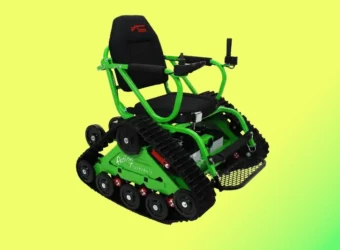

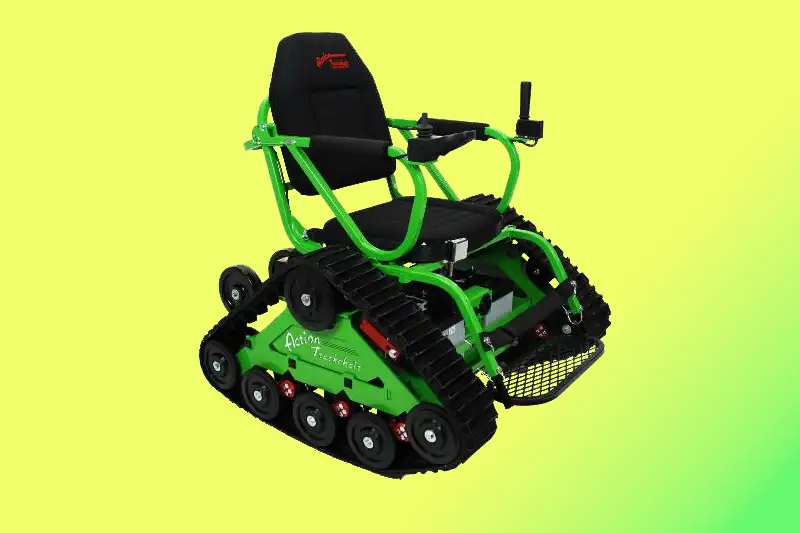 Trails Without Limits in Westchester County, New York allows slow walkers and wheelchair-users to explore the county parks on guided track chair hikes. The program runs from March to November and the venue changes each month. Volunteers lead participants on a one to two-mile guided hike through one of the scenic county parks. The track chair allows users to easily wheel over rough terrain and other obstacles that would be impassable in a standard wheelchair.