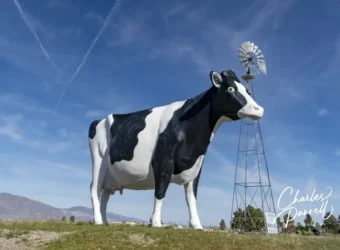
You just can’t miss Alphie — also known as the Big Bovine of the Desert — when you cruise down Highway 373 near the California-Nevada border. This 14-foot tall fiberglass bovine is located right next door to the Longstreet Inn and Casino. And although she’s a local favorite, she’s really a Las Vegas transplant. Considered a part of Nevada history, Alphie originally stood under a brightly colored rainbow clad in her Blues Brothers sunglasses, on the roof of the Holy Cow Casino and Brewery. The Holy Cow closed in 2002, and Jim Marsh, the owner of the Longstreet Inn and Casino, snapped Alphie up for a cool $2,220. And the rest, as they say, is history. There’s plenty of parking in a level asphalt lot next to Alphie, and you can roll right over to her for the photo op. The Big Bovine of the Desert is definitely worth the short side trip from Death Valley (emerginghorizons.com/barrier-free-travel-death-valley-for-wheelers-and-slow-walkers/#itin-1).
Alamogordo, NM
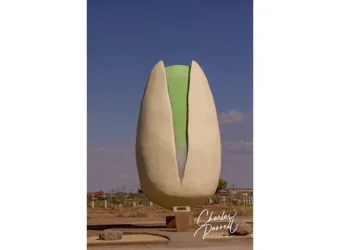
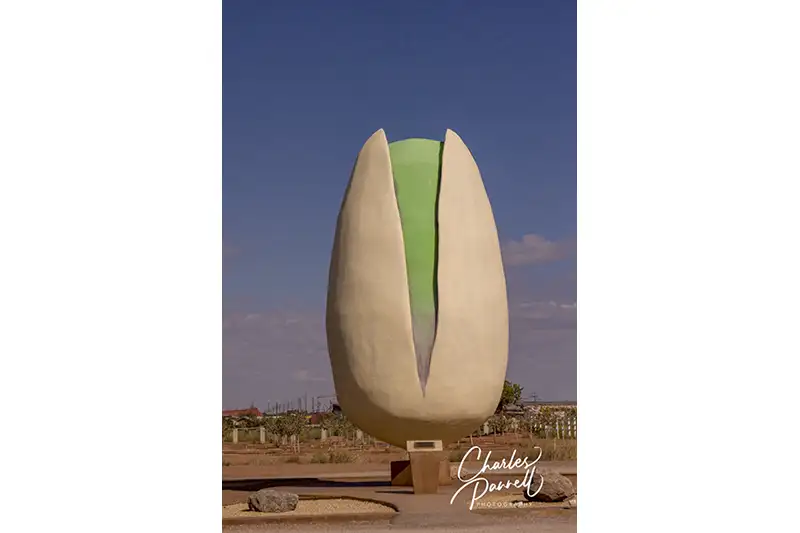
pistachioland.comLocated at the intersection of Highway 54 and Dog Ranch Road, Tim Mc Ginn’s PistachioLand is home to the world’s largest pistachio. This 30-foot monolith towers over the surrounding desert and attracts visitors from around the world. It was built by Tim McGinn to honor the memory of his father Tom McGinn. The elder McGinn founded the original pistachio and grape farm which grew into PistachioLand. Tim felt a “world’s largest” monument would be fitting, as his dad loved to stop at unique roadside attractions on their many road trips. Erected in 2007, this giant nut is constructed from five yards of concrete and is covered with 35 gallons of paint.
There’s accessible parking near the giant pistachio, and ramp access over to the perfect photo op spot. Next door there’s level access to the Country Store, which has plenty of room to maneuver a wheelchair inside. It stocks everything pistachio — from brittle and nuts, to t-shirts and souvenirs. They even have salt-free and sugar-free products. And if you’d like to sample a little vino, the Arena Blanca tasting room is in back. The World’s Largest Pistachio is fun photo stop, and the country store has plenty of free samples.
118 Smokey Bear Boulevard
Capitan, NM
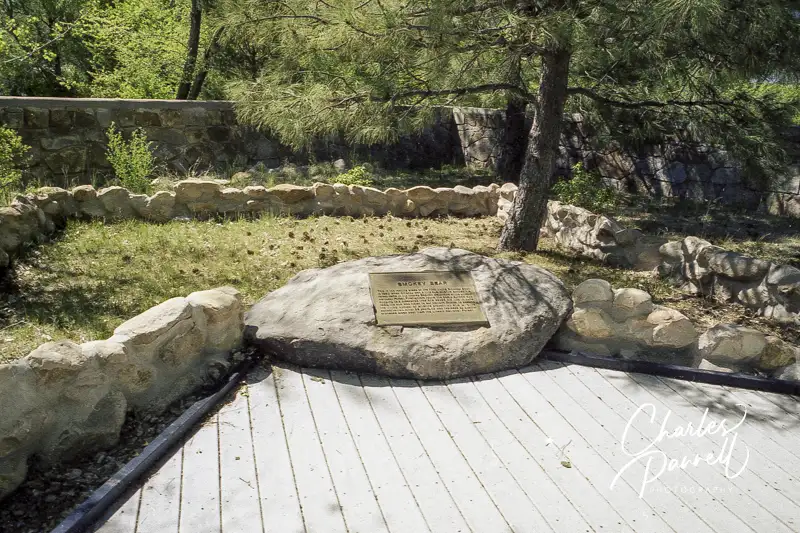
Located along Billy the Kid National Scenic Byway (nsbfoundation.com/nb/billy-the-kid-national-scenic-byway/) in Southwestern New Mexico, Smokey Bear Historical Park pays tribute to the popular fire prevention icon. Smokey was found in the nearby Capitan Mountains with burned paws, after a 17,000-acre wildfire destroyed his home in 1950. He quickly became a national poster child for the US Forest Service, and touted the catch phrase, “Only You Can Prevent Forest fires.” This park and museum was completed in 1979, and it’s conveniently located along the Capitan stretch of Highway 380 — also known as Smokey Bear Boulevard.
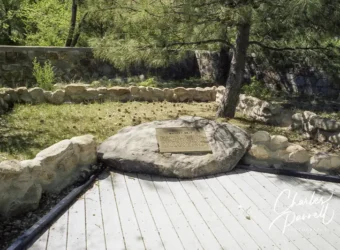
There’s good wheelchair access to the Visitors Center, which features exhibits about the history of Smokey Bear, fire prevention, ecology and forest health. Out back there’s level access to a nature trail that winds through native vegetation from six different climate zones. And of course, Smokey’s grave is prominently located along the trail. It’s a fun stop, especially if you have kids in tow.
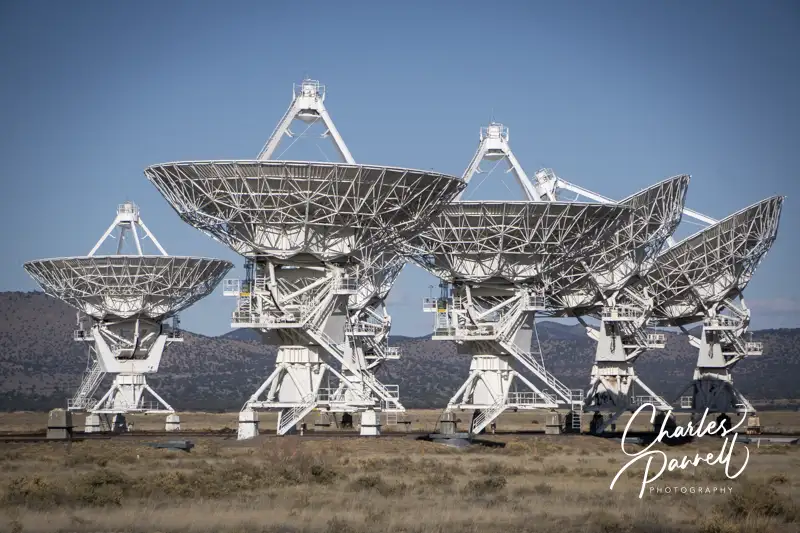
Located in the middle of nowhere, it takes a bit of effort to get to the National Radio Astronomy Observatory Very Large Array (VLA). Spread over more than 100 square-miles of New Mexico desert, the massive antennae that make up the VLA are located about an hour-drive west of Socorro. Take exit 150 from Interstate 25, then head west on Highway 60 for about 45 miles. After you pass Magdalena, go south on Highway 52 for about 3 miles. The VLA is on the right – you can’t miss it.
There’s accessible parking in front of the visitor center, with barrier-free access to the building. Inside there’s a small gift shop and a few exhibits about the VLA. There’s also level access to the theater, with plenty of room for a wheelchair next to the seats. Take some time to watch the excellent movie – narrated by Jodie Foster – that explains how the array works and what exactly it’s able to do.
The VLA is comprised of 27 dish shaped antennae arranged in a Y configuration across the desert. Visitors can also get an up-close-and-personal look at the antennae, as well as a few other outside exhibits, from a short level trail that winds around the complex.
The first stop on the walking tour is the Bracewell Radio Sundial, which is located near the back entrance to the visitor center. Named after Roy Bracewell, who created one of the world’s first radio telescopes, this sundial consists of a sphere mounted on a pole, and seven others mounted on cement pedestals. From the sundial, continue along the path past the Whisper Dish Gallery, and head over to the Radio Dish Gallery, which is located in the gazebo near the antennae. After that, make a left and head out to the base of the closest antenna, where there’s another interpretive plaque that describes its workings. From there you can circle past the control building and return to the visitor Center.
The VLA makes a fun New Mexico road trip stop even if you aren’t an astronomy buff, as the silhouette of the array against the vast desert backdrop is worth the short detour alone. And amateur astronomers will absolutely love the site.
Roswell, New Mexico
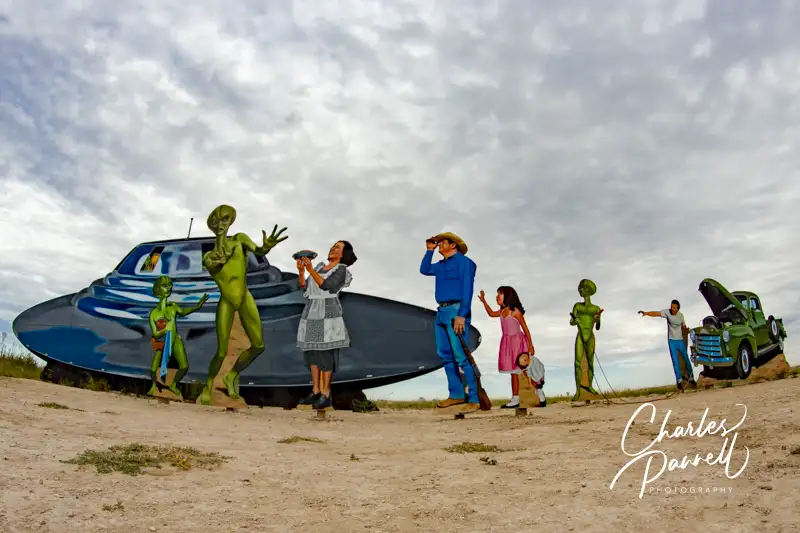
If a trip to the unofficial UFO capital of the world is on your travel itinerary, then be sure and stop at the creative Welcome to Roswell art piece just outside town. You’ll find the masterpiece on the east side of Highway 285, about six miles south of the city. Unveiled in 2013, the John Cerney piece is best described as giant cut-out art. Cerney’s Rockwell-like highway murals are designed to blend into the existing landscape and catch passing motorists off guard. And the Roswell installation does just that.
There’s no official parking lot for the mural, but there’s a wide level dirt area where you can stop and have a good look at the piece. And if you’d like a photo op with it — and who wouldn’t — there’s also a level dirt path over to the mural.
The mural itself depicts an alien spacecraft with a few green beings in front of it, who are being offered a pie by a local woman. The aliens seems put-off by the culinary creation, and one of them appears to be holding ET of movie fame in his arms. Back on the ship, the navigator is reading a map with Roswell prominently marked, which also includes a “photo” of two figures that eerily resemble The X-Files Scully and Mulder. And over on the other side, a rancher is receiving roadside assistance for his broken down California truck from yet another alien. There’s a lot going on in the mural, so take some time and look for the “little things”. And again, it blends into the landscape, so keep an eye out for it as you approach town.
19 Carlsbad Cavern Highway
Whites City, New Mexico
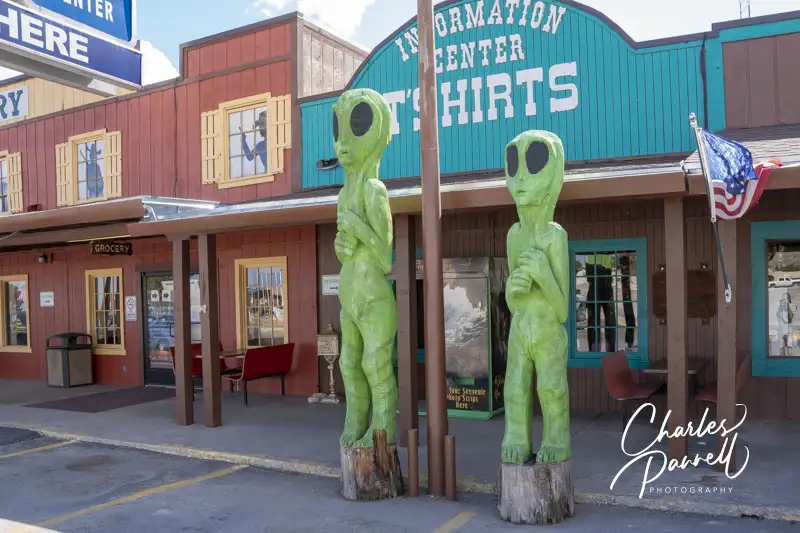
Although they seem a bit out of place, these Green Aliens sit in front of the Whites City Information Center, just off Highway 7 on the way to Carlsbad Caverns. There’s no interpretive plaque at the site; however locals say that the they are a tribute to the old Million Dollar Museum which formerly occupied the space, and had an “alien baby” on display. Today the aliens offer a good photo op on the way to New Mexico’s only national park. Accessible parking is located in front of the post office, with level access over to the aliens next door. It’s a fun stop, especially if you have kids in tow.
Located just outside Omaha, Boys Town was the dream-come-true of Father Flanagan. He began his home for orphaned and neglected boys with just $90 of borrowed capital in 1917. Today the Omaha campus is just one of many across America.
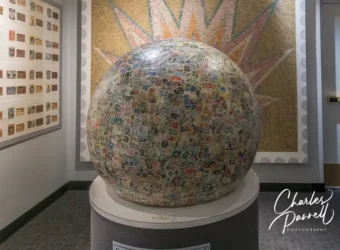
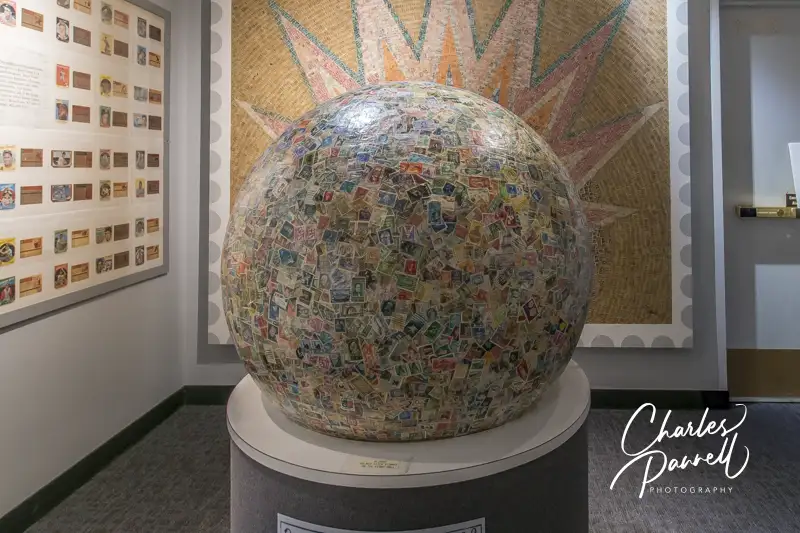
The campus itself is open for self-guided tours, but the real roadside attraction draw at this stop is located in the Visitor Center. That’s where you’ll find the World’s Largest Ball of Stamps in the Leon Myers Stamp Center.
There’s accessible parking in the Visitor Center lot, with ramp access up to the building. Inside, there’s barrier-free access to the information desk, and the sizable gift shop. The small stamp museum is located inside the gift shop, but if you can’t find it, just ask, as the employees are very helpful.
The stamp museum contains a number of themed displays that highlight stamps depicting children from around the world; but the piece de resistance is located in a small alcove in the back of the museum. The 600-pound stamp ball, which was crafted by students, is composed of over 4 million stamps and is recognized by Guinnessas the World’s Largest Stamp Ball. The stamp collage in the background is an impressive piece on its own, but the stamp ball definitely takes center stage.
As an added bonus, if you are collector you can pick up foreign and domestic stamps for just a penny a piece at a small table near the stamp ball. Of course there is one caveat – “Please don’t add stamps to the stamp ball.”
Located near the eastern terminus of the Outlaw Scenic Byway, this collection of vintage windmills is a must-see on any Cornhusker State road trip. The open-air museum features nearly 30 windmills that date back to 1880 – 1930, many of which are in working condition. This quirky roadside attraction was made possible by the local Leonard Gill Family, in an effort to preserve a piece of prairie heritage.
Most of the windmills are from the Howard and Barvetla McLain Collection of Carroll, Nebraska. They were moved to the site and restored by Marvin Baker of Pender, Nebraska. In some cases restoration was an arduous process, as parts had to be fabricated, because they were no longer available commercially. The result is an impressive and very rare exhibition of what’s billed as one of the finest collections of vintage windmills in the world.
The windmills are located on the south side of Highway 20, in front of the LP Gill Landfill. There’s no real parking area, but there is a wide level dirt space where you can pull over to get a better view of the site. In dry weather it’s possible to walk around the grassy area where the windmills are planted, but after a rain it can get pretty muddy. Even if you can’t manage the walk over the grass, it’s still worth a stop to catch a panoramic view of the windmills on the horizon. It’s an impressive sight indeed.
Located in Lincoln, Nebraska, Lee’s Restaurant first opened in 1945 as a twelve-seat beer joint. Apparently one of the regulars got a hankering for fried chicken, so Alice Lee went out back, slaughtered one and fried it up. And although they’ve added burgers, sandwiches and even lobster to the menu over the years, people still come for miles for their yummy fried chicken. No matter when you go, you’ll find the place filled with locals — a sure sign you’ve made the right dining choice. To add to the quaint atmosphere, there’s even a piano player who takes requests. There’s accessible parking in the lot, with level access to the building. Just take exit 397 off Highway 77, drive two miles west and look for the big chicken. You can’t miss it!
No trip through the Cornhusker State is complete without a stop at Carhenge, located about three miles north of Alliance on County Road 59. Not to be confused with Cadillac Ranch (emerginghorizons.com/cadillac-ranch/), this structure was built to replicate Stonehenge in England. It was erected at a 1987 family reunion, as a memorial to Jim Reinders’ father, and was appropriately dedicated during the summer solstice later that year.
The cars that comprise the sculpture are largely from the 50s and 60s and they are all American made. Previously there were three foreign models included, but they have since been removed and buried at the site. The circle of implanted cars replicates the placement of 38 of the major stones at Stonehenge. Originally Carhenge was unpainted, but it was subsequently painted flat gray to more closely resemble the British structure. In contrast, the Car Art Preserve, which is also located at the site, features a variety of colorful sculptures made from old cars and car parts.
There’s no striped parking at the site, but the lot is level, and is made of hard-packed dirt with bits of large gravel on top. The best place to park is over near the concrete pad at the Pit Stop, as it’s easier to access the level dirt trails around Carhenge from there. The pathways that lead through the Carhenge site are made of hard-packed dirt, and they are mostly doable in dry weather. There’s also level access to the Pit Stop, which sells souvenirs during the summer months. It’s a fun road trip stop.