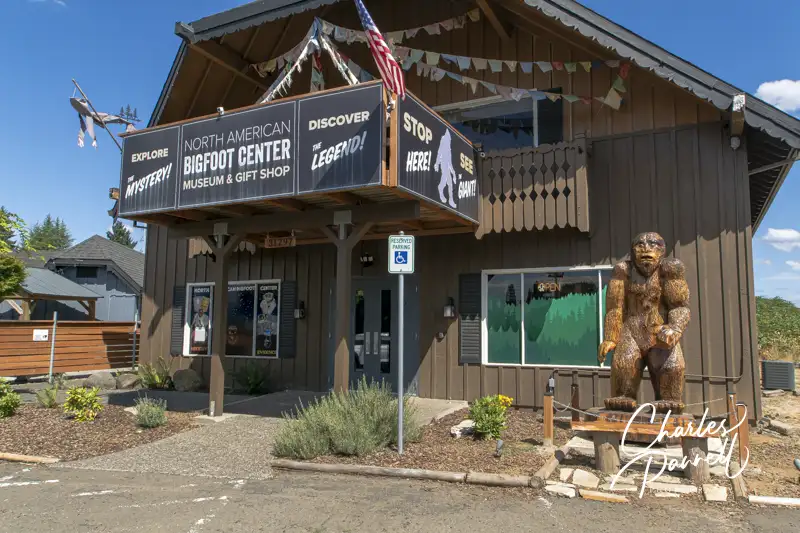
A must stop along the Mount Hood Infinity Loop (emerginghorizons.com/drive-the-scenic-mount-hood-infinity-loop/), The North American Bigfoot Center includes an impressive collection of artifacts about the “mythical” forest creature. There’s accessible parking outside, with level access to this unusual museum. Along with a life-sized Sasquatch statue for a photo-op, the galleries are filled with photos, videos and other documentation that prove — or disprove — the existence of Bigfoot. Add in some real-life Bigfoot researchers that man the front desk, and you’ve got all the makings for an very entertaining stop. And don’t miss the gift shop.
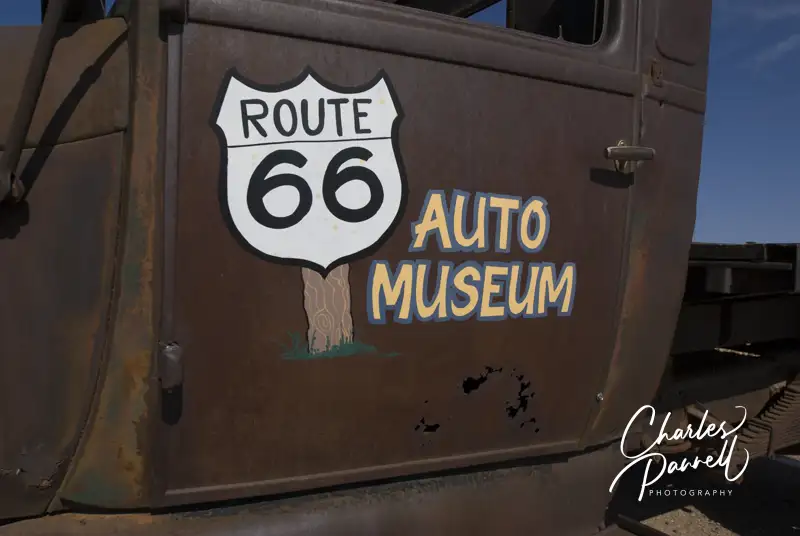
Located along the post-1937 incarnation of Route 66, Santa Rosa, the Route 66 Auto Museum is a must-stop for car buffs on any Interstate 40 road trip. This brainchild of Bozo and Anna Cordova — who also own Bozo’s Garage & Wrecker Service — is the result of Bozo’s lifelong love affair with automobiles. He built his first car when he was just 12, and subsequently Bozo and his crew have custom built over 150 different vehicles. These restorations, many of which required some “out of the box thinking” have been subsequently displayed in the museum.
There’s accessible parking in front, with level access to the museum, and plenty of room for even the largest wheelchair to navigate around the displays. The cars range from 1920 to 2005, and there’s also a good collection of old signs, Route 66 memorabilia, photos and vintage vending machines on display. It’s a great blast from the past.
.
Barrier-Free Travel the Grand Canyon for Wheelers and Slow Walkers
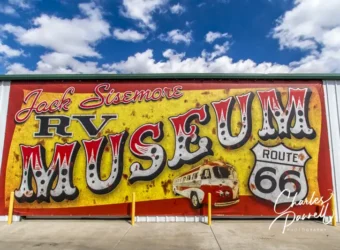
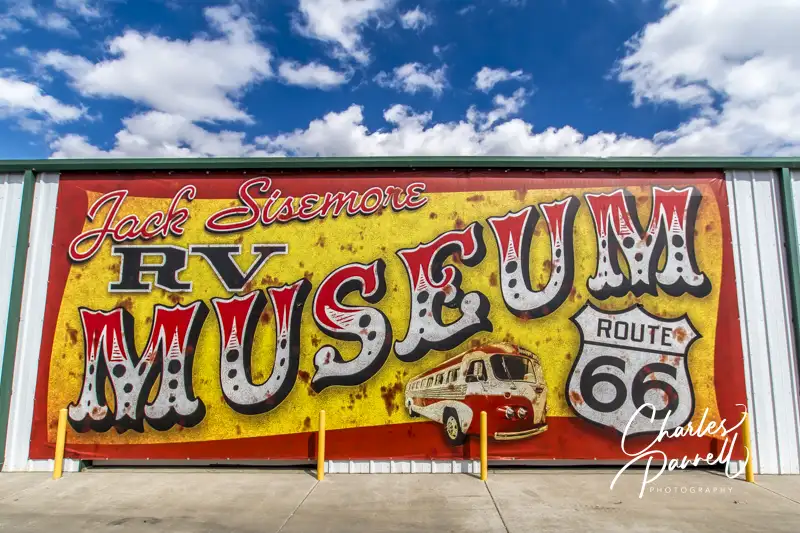
Jack Sisemor RV Museum
14501 Interstate 27
Amarillo, TX www.rvmuseum.net
For a fun trip down Memory Lane, be sure to stop in at The Jack Sisemor RV Museum on your next trip through Amarillo. Even if you’ve never been in a RV in your life, you’ll still love the nostalgic touches to the rigs and the accompanying displays. From that ever-so-familiar 70s shag carpeting, to a collection of vintage cameras, and even some old Coca Cola coolers, there’s bound to be some object that tugs at your heartstrings and evokes fond memories of yesteryear. And chances are high that you’ll also blurt out, “Hey, I had one of those!” at some point during your visit.
Open seasonally, the museum consists of an army of vintage RVs that have been lovingly restored. And that’s something that makes Jack Sisemore incredibly proud. There’s barrier-free access around the exhibits inside the museum. Highlights include a 1921 Ford Lamsteed Kampkar (one of only five made), the 1948 Flxible Bus used in the Robin Williams movie RV, and a 1976 FMC that was owned by Max Factor, Jr. Avid RVers will also love the 1975 Itasca (the first one ever built – serial number 1) and the cute little 1962 Bambi Airstream, which is in pristine condition. And don’t miss the large dirt and street bike collection scattered throughout the museum.
Best of all, there’s no admission charge to the museum. As an added bonus, more pieces are continually added to the collection, so you never know what you’ll find at this offbeat museum.
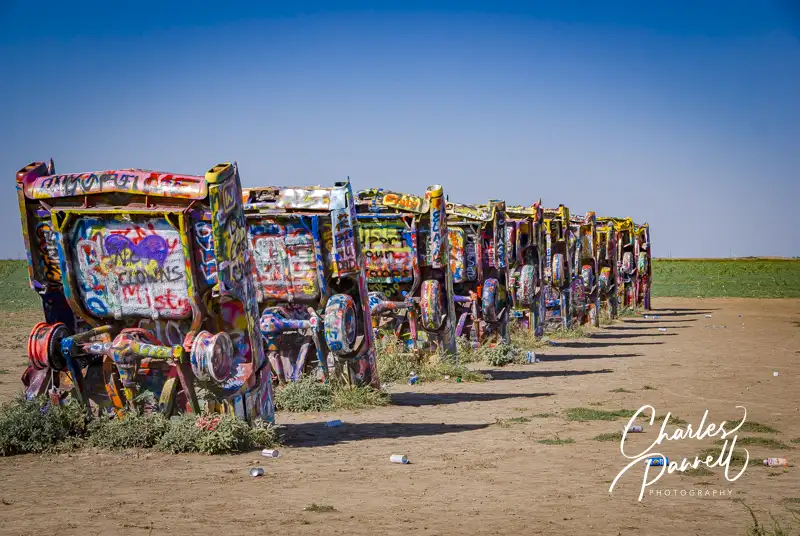
If you’re cruising along Interstate 40 near Amarillo, Cadillac Ranch is a required stop. Located on South Frontage Road between Arnot and Hope Roads, this public art display was created by an artist’s collective called The Ant Farm. It features 10 Cadillacs planted nose first into the ground. Built along the remains of Route 66, they were meant to symbolize the “golden age” of the American automobile. The cars are routinely painted with graffiti and even dressed up on some holidays. And although the creator frowned on this practice at first, it’s now encouraged.
There’s just a wide spot on the road to park in front of Cadillac Ranch, but there’s plenty of room for an accessible van. The entrance gate has a 24-inch clearance, but after that there is a six-foot wide hard-packed dirt path out to the cars. And if you can’t manage the walk, you can still a good view from the road. This roadside attraction is a good appetizer for The RV Museum & Storage (emerginghorizons.com/jack-sisemor-rv-museum/) located up the road on Interstate 27.
404 17th Street SE
Jamestown, North Dakota
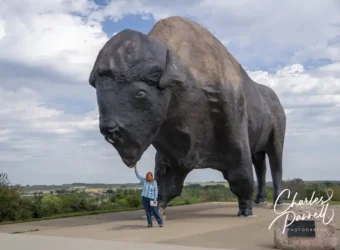
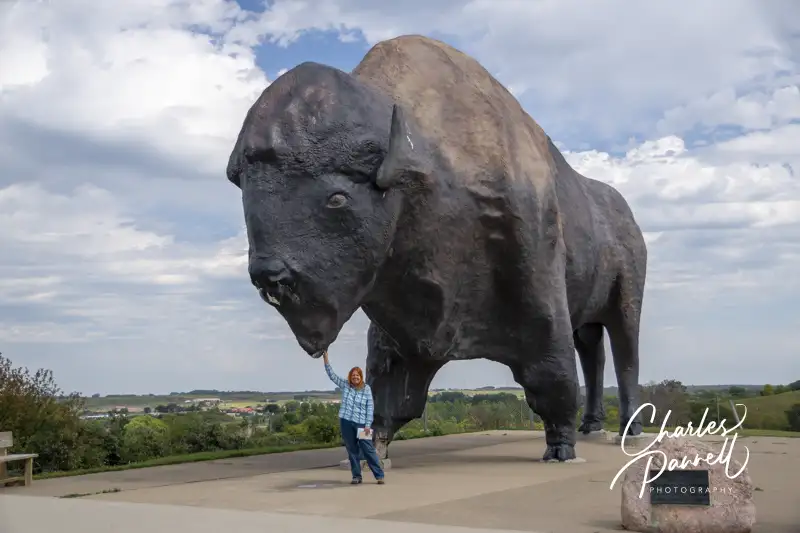
Although it’s not visible from the highway, this “world’s largest” entry is worth a short detour on any trek along North Dakota’s Interstate 94. Just take exit 258, then head north for about two miles and make a right on 17th Street. The road will pass the turnoff to the National Buffalo Museum, and travel through Frontier Village, before it dead-ends in a small unstriped parking lot. From there it’s a 150-foot walk down a paved sidewalk to the massive monument. And although there’s a slight incline at the beginning of the sidewalk, if you can make it past the first fifteen feet, you’re good to go. That said, manual wheelchair-users may need a bit of assistance
Erected in 1959 to draw tourists off the newly constructed interstate, the big buffalo lacked a name for 50 years, after which it was christened Dakota Thunder. It’s fabricated from steel beams, wire, and three-inch thick gunite; and it stands and impressive 26-feet tall and tips the scales at a portly 60 tons. The original sculpture — which was repainted in 2016 — cost the town $8,500, which was nearly double the original estimate. It’s a fun photo stop, and if you’d like to also check out the stores in Frontier Village, there’s ramp access up to the boardwalk sidewalks and level access to most businesses. And if your lucky you may be able to spot the National Buffalo Museum’s bison herd from a vantage point near the statue.
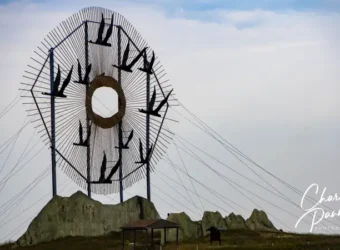
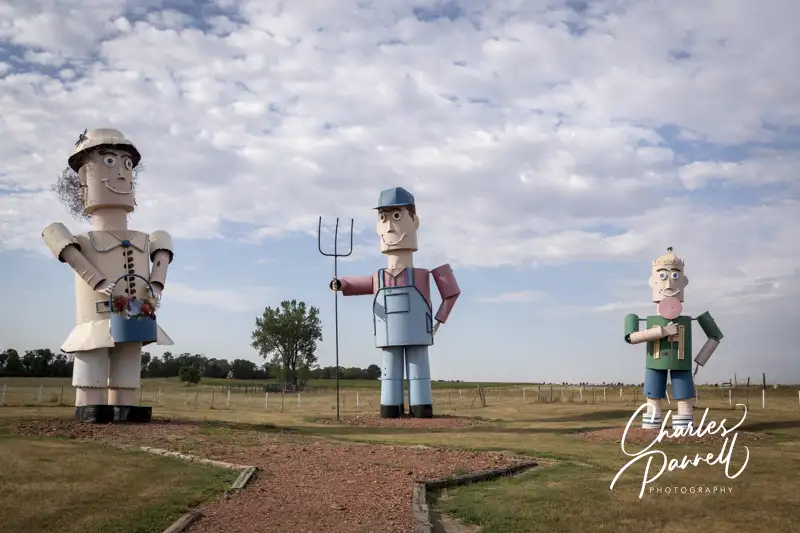
If you happen to be road tripping through North Dakota, a short detour on the Enchanted Highway is definitely a must-do. The brainchild of local resident Gary Greff, these larger-than-life sculptures dot the highway between Gladstone and Regent. Just take exit 72 off Interstate 94 and enjoy the ride. You can stop and picnic at most of the installations, or just pop in for a quick photo op. Either way, it’s definitely worth a short detour while motoring through the Peace Garden State.
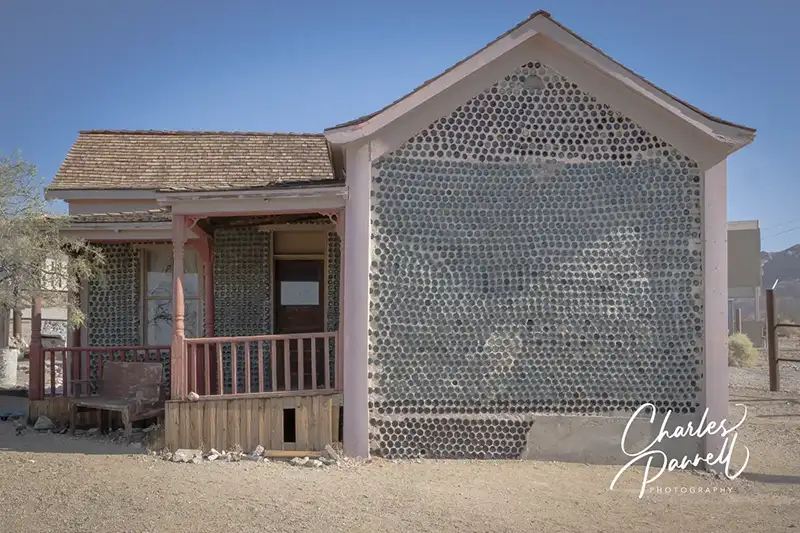
Located off Highway 374 just west of Beatty in the ghost town of Rhyolite, Tom Kelly’s Bottle House is worth a stop on the way to Death Valley. Constructed in 1906 during the gold rush, Kelly built his masterpiece from 51,000 beer bottles, adobe and mud. And since there were some 50 bars in town, there was never a shortage of building materials. As for Kelly’s motivation and reasoning for his chosen medium, he was often known to say that it was easier to build a home from beer bottles than it was to mill lumber from the native Joshua trees. Kelly’s creation is easy to find too — just follow the signs to it from Rhyolite Road. And the good news is, there’s an accessible parking pad and a level sidewalk over to the house. The bottle house sits behind a fence to protect it from vandals, but it’s sometimes opened for private tours. Still you can get an excellent gander at the house from the sidewalk near the entrance.
Located along a barren stretch of Interstate 80 in Northwestern Nevada, Thunder Mountain offers motorists a much needed — and somewhat entertaining — break between Reno and Winnemucca. It’s easy to find too — just take exit 145, turn east, and then make a left turn on the frontage road. Soon the asphalt is replaced by dirt, and then gravel, before the first remnants of Frank Van Zant’s paradise lost comes into view on the left.
As the story goes, an old Creek medicine woman told Frank that in the final days there shall rise up a place called Thunder Mountain, and only those that lived there would survive the apocalypse. So he set out to build this mythical place of refuge after his car broke down along the interstate. Shortly thereafter he changed his name to Chief Rolling Mountain Thunder as he set to work to craft his mansion patterned after Tom Kelly’s Bottle House in Rhyolite (emerginghorizons.com/tom-kellys-bottle-house/). It all began with his travel trailer, which he parked in the sagebrush and covered in concrete. That was in 1968. Sadly Chief Rolling Mountain Thunder committed suicide in 1989, and although the elements — and sadly some vandals — have taken their toll on this creation over the years, it’s still worth a visit.
As far as access goes, it’s doable for many folks. There’s no striped parking, but there’s plenty of room to park an adapted van in the large dirt parking area next to the entrance. From there; it’s a level roll to the front gate which is 35 inches wide. Inside the compound, the pathways around the sculptures, homes and exhibits are flat, and although there’s a bit or gravel here and there, it’s easy to dodge.
Located on the way to Rhyolite — and Tom Kelley’s Bottle House (www.emerginghorizons.com/tom-kellys-bottle-house) — this unique open-air sculpture installation is definitely worth a stop. From Beatty, head west on Highway 374 for about four miles, then turn right on Rhyolite Road. Take the first left on the road – look for a miner with a penguin – and you’ve found the museum. It’s really pretty hard to miss. There’s parking in a level dirt area, and usually there’s plenty of room for an adapted van. A small information center that’s ramped in the back is located nearby. The information center is open periodically, but even if it’s closed you can still pick up a brochure about the artwork.
The sculptures are dotted throughout the desert, with mostly level paths covered in gravel leading out and around them. That said, you can get a good look at the bulk of them from the information center, so it’s worth a stop even if you can’t negotiate the paths. The sculptures range from a ghostly interpretation of the Last Supper, to the more traditional Tribute to Shorty Harris, a legendary Rhyolite prospector. And there are even a few pieces that visitors can sit or lean on, and snap a selfie or two.
This lone sculpture sits on the side of the road just off Interstate 80 in Fernley. At one time the Bottle Cap Gazebo stood nearby, but it was permanently removed in 2024. To be fair, that piece was originally designed as a temporary structure for Burning Man in 2014; so it’s impressive that it braved the elements for as long as it did. Still the tortoise is worth a quick stop. To find it, take exit 48 off of interstate 80 and follow the signs to Fernley. Keep right on Main Street, and look for the tortoise on the right, across the street from the 76 gas station.
Although the parking lot is composed of gravel, there’s also an accessible parking spot on a cement pad, with a level sidewalk over the Desert Tortoise. This permanent installation was created by artist Pan Pantoja, with assistance from Fernley Elementary School’s fourth-graders.
This 25-foot long and 17-foot tall sculpture was crafted from boulders from a local quarry and decorated with hand painted ceramic tiles that reflect the culture of Fernley and the surrounding area. Although the vision and execution came from Pantoja, the fourth-graders supplied the artist with the creative tiles. There’s level access around the sculpture which weighs in at an impressive 70 tons, and there’s also a smaller slab covered with leftover tiles located next to the tortoise.
It’s a good place to stretch your legs, and a fun photo op, while tooling along Interstate 80 through the desert.