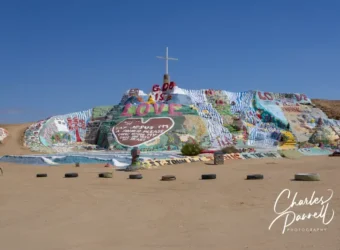
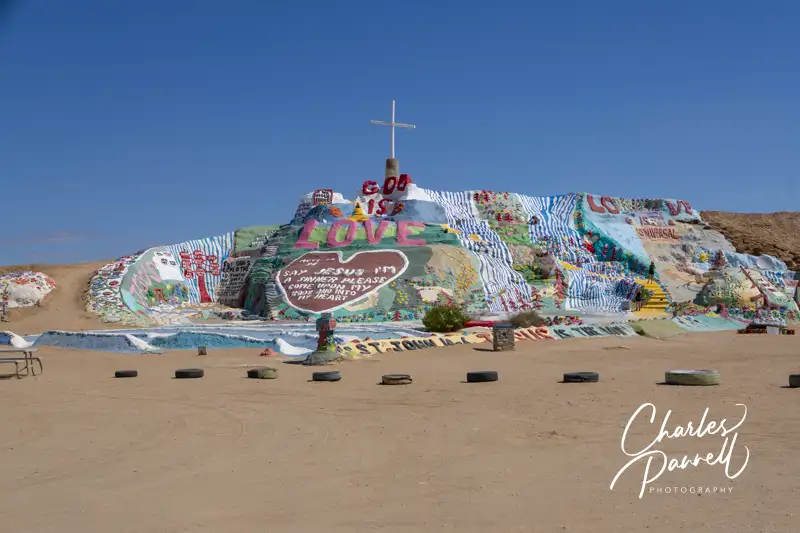
Although this Southern California artistic creation is located about 35 miles off Interstate 8, it’s definitely worth the detour. Just take exit 118 B, east of El Centro, and follow Highway 111 north. When you hit Niland, make a right on Main Street, which soon turns into Beal Road. Once out in the desert, you’ll pass the city dump and the makeshift community of Slab City, before you spot Salvation Mountain on the right.
This colorful masterpiece was crafted by Leonard Knight, who sadly passed away in 2014. His vision was to create a piece that reflected God’s love; and the 100-foot wide concrete mountain colorfully announces that belief to all who visit. And although age has taken it toll on this desert masterpiece, it’s still worth a visit. There’s no striped parking at the site, but there’s plenty of room to parallel park an adapted vehicle in the dirt parking lot. Although there are steps up to the top of the mountain, you can get an excellent view of the entire piece from below.
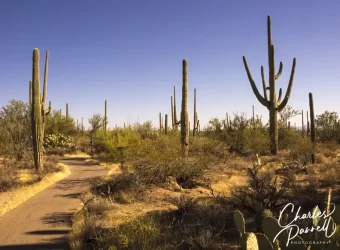
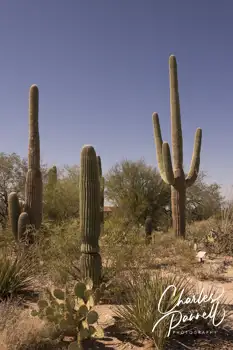
Known as the symbol of the American West, the giant saguaro cactus can only be found in the Sonoran Desert in the Southwestern US and Mexico. These large columnar cacti are covered in spines and develop branches (arms) as they age. There’s nothing like seeing a forest of saguaros framed by a colorful desert sunset. And the best place to do that is at Saguaro National Park (nps.gov/sagu), near Tucson, Arizona. Divided in two sections — with the city of Tucson in between — this scenic desert area offers several accessible trails for wheelchair-users and slow walkers.
Saguaro East
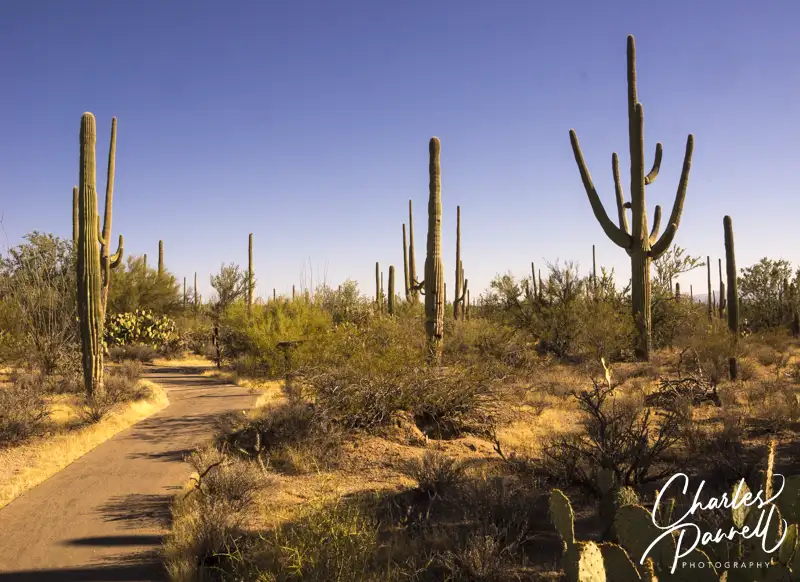
Ecology Trail in Saguaro East
Located in the Rincon Mountain District, Saguaro East is about 10 miles off Interstate 10. Just take exit 27 and follow the signs to the Rincon Mountain Visitor Center in Saguaro National Park. Accessible parking is located near the visitor center, which offers level access and houses a collection of interpretive exhibits. There’s also plenty of room for a wheelchair in the theater, which shows an introductory film throughout the day. And outside there’s level access around the small native garden, and over to a covered shelter with benches.
The eight-mile Cactus Forest Drive scenic loop begins just east of the visitor center. This one-way drive travels through the heart of a saguaro forest, and boasts fabulous windshield views of the gigantic cacti. There are a number of pullouts along the way, all of which have accessible parking. And if you visit in May, you’ll be treated to an eyeful of showy white booms on the giant cacti.
The first accessible trail is located midway along the drive. There’s accessible parking at the Mica View Picnic Area, with level access over to accessible tables and an accessible vault toilet. Although the entire length of the Mica View trail is not not accessible, the first .7 mile is fairly level and is covered in stabilized granite. The Desert Ecology Trail, which is located just up the road, is also worth a stop. This quarter-mile trail features a paved pathway with benches to sit and rest along the way.
When you reach the end of the scenic loop drive, turn left at the stop sign and head through the Javalina Picnic Area. After you leave the picnic area, look to the right as the road curves, for a view of a tall saguaro with a magnificent crown.
Javalina Picnic area in Saguaro National Park East
Saguaro West
Desert Discovery Trail in Saguaro National Park West
Saguaro West is located in the Tucson Mountain District, which is on the west side of the city, just up the road from the Arizona Sonora Desert Museum. From interstate 10, head west on Gates Pass Road, then make a right on Kinney Road. The Red Hills Visitor Center will be on the right, just past the park entrance.
There’s accessible parking in front with level access to the building. Inside there are a number of interpretive exhibits as well as accessible restrooms. Outside there’s a short accessible paved trail that focuses on the ecology of the Sonoran Desert.
The highlight of this section of the park is the Desert Discovery Trail, which is located just a mile past the visitor center, on the left side of the road. This half-mile paved trail features interpretive plaques along the way that describe the plants and animals of the Sonoran Desert. There are benches to rest along the trail, and it’s a favorite spot to catch a spectacular sunset view amidst the cactus forest.
This section of the park also boasts a scenic drive. The 5-mile Bajada Loop Drive winds through the saguaro forest, with plenty of pullouts along the way. Although the road is not paved, it’s still doable in a low clearance vehicle. And if you’d like to pack along a snack, there are two picnic areas along the loop.
Last but not least, don’t forget to ask about the free ranger programs at either visitor center. Offered in the peak winter season, many of the programs are held at accessible areas or trails in or near the visitor centers. These interpretive programs, which focus on the Sonoran Desert and the Saguaro Cactus, greatly enhance any visit to Saguaro National Park.
Barrier-Free Travel the Grand Canyon for Wheelers and Slow Walkers
Named for the prolific yucca plant that’s found within its borders, Joshua Tree National Park features two distinct desert ecosystems within its 800,000-acre expanse. From cholla and ocotillo cactus, to unusual rock formations sculpted by the harsh desert winds and torrential rains, this Southern California national park is filled to the brim with unique plants and animals. And although the landscape may appear a bit foreboding, rest assured there are a number of wheelchair-accessible trails and attractions in this desert wonderland. Add in a nice collection of scenic drives that offer some some jaw-dropping windshield views, and you have an excellent choice for wheelchair-users and slow walkers.
Insider Tips
The Oasis of Mara, which is located near the North Entrance, offers an accessible half-mile loop trail. Honey mesquite trees dot the desert landscape, which is bordered by mountains in the distance, while a ring of California Fan Palms mark the presence of water — the oasis. Be sure to take a close look in the underbrush near the palms for some Gambel’s Quail, as it’s one of their favorite haunts.
Located on Pinto Basin Road, just a few miles south of the Park Boulevard intersection, the Cholla Cactus Garden boasts a quarter-mile trail through a mature cholla forest. There are a few ruts here and there, but for the most part, they are pretty easy to dodge. There’s also a one-inch lip up to the boardwalk sections of the trail, but most folks can manage it with a little assistance. Even if you can’t do the whole trail, you’ll be surrounded by chollas just by walking 10 feet into the forest.
The Bajada Nature Trail, which is located in the south area of the park, is the oldest accessible trail in the park. This quarter-mile trail passes through the bajada — a broad slope of alluvia material at the base of a mountain — and offers a wonderful view of the surrounding desert. There are interpretive plaques along the way, and although there are a few sandy patches here and there, all-in-all this 1998 “all access trail” has held up fairly well.

 Beal Road