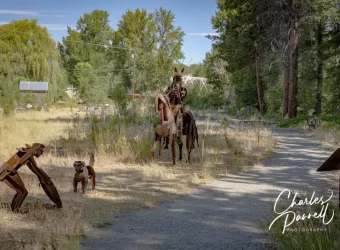
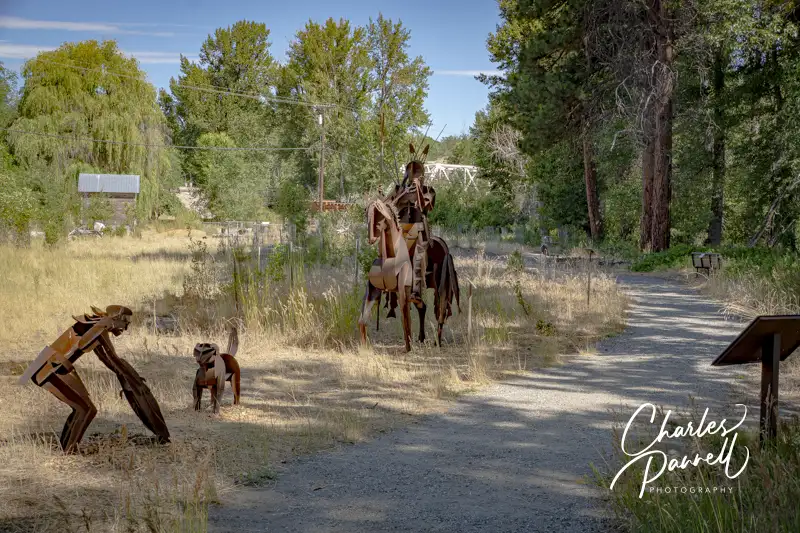
Located 11 miles west of the Nisqually Entrance to Mount Rainier National Park, Recycled Spirits of Iron Sculpture Park features the works of Daniel Klennert. And as the name implies, his creations are crafted from recycled and discarded objects. The front installations are dwarfed by a giant train near the entrance, and they include everything from a broomstick horse, and a wagon wheel, to a seahorse crafted from horseshoes, a collection of birds, and a number of themed motorcycles. Around back the installations continue with another train, more motorcycles, a collection of outhouses and an X-rated Mona Lisa. And although it’s a little bumpy in the back, the front garden and the inside gallery and gift shop are wheelchair-accessible.
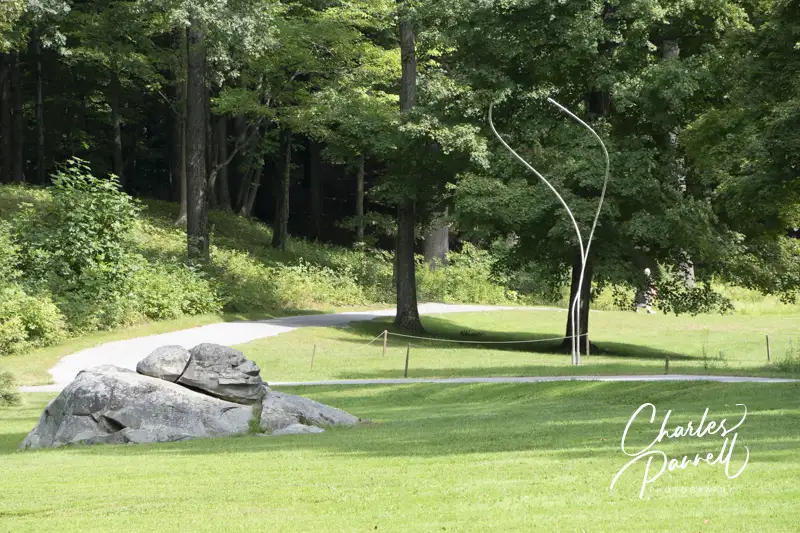
Located in the Hudson Valley three miles from Cornwall, Storm King Art Center (stormking.org) isn’t your average art installation. For starters it’s located on a 500-acre parcel dotted with meadows, ponds, hills and forests, that offer a taste of the natural beauty and diversity of the area. Add in over 100 small-scale and larger-than-life sculptures in a variety of mediums, and you have one of the region’s largest — and most diverse — outdoor sculpture parks. And although there are a few hills and rocky patches in certain parts of the landscape, Storm King Art Center is still an excellent choice for wheelchair-users and slow walkers.
Access with a Capital A
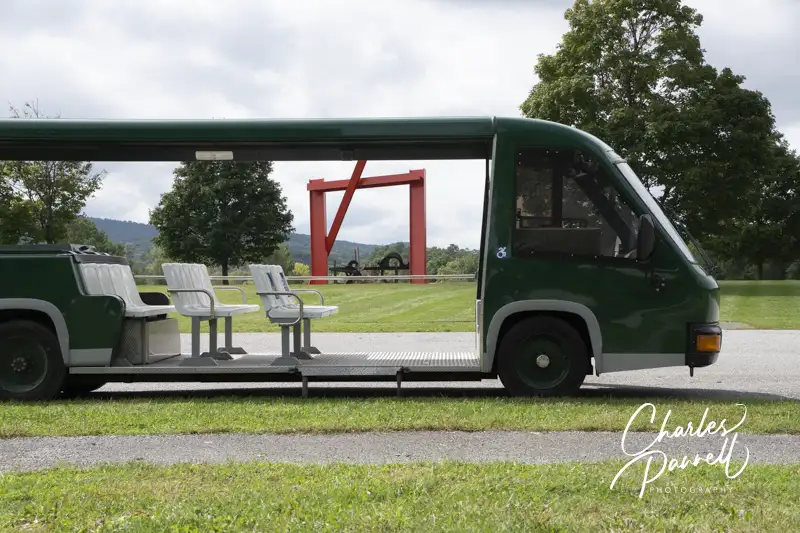
Storm King Art Center Tram
Wheelchair access is first-rate at the Storm King Art Center, starting with their large parking area. There’s accessible parking with level access over to the outdoor lobby, which features accessible restrooms, visitor information and ticketing windows. From there, you have several choices.
The easiest way to explore the park is to hop on the wheelchair-accessible tram. There’s ramp access to the tram, and you can stay in your own wheelchair or transfer to a bench seat. The tram stops at all the major areas of the park, and it’ a great option for slow walkers too.
Alternatively, you can walk over to Museum Hill, the focal point of the park. It’s a .4-mile level walk through the South Fields to the elevator which goes up to Museum Hill. As an added bonus, you can check out some of the sculptures on your stroll through the South Fields.
Although the bulk of the park is flat and easy to navigate in a wheelchair, there are some steep and rocky areas. The free visitor map is an excellent resource, as it points out all the paved pathways, as well as the steep areas, uneven paths and stairs. The park also operates an accessible cart service to help visitors navigate over areas with inaccessible terrain. For more information or to reserve a ride, call (845) 534-3115.
Explore the Grounds
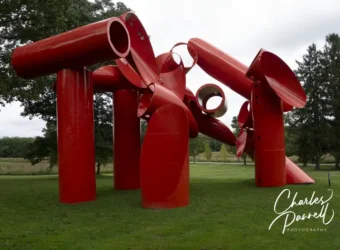
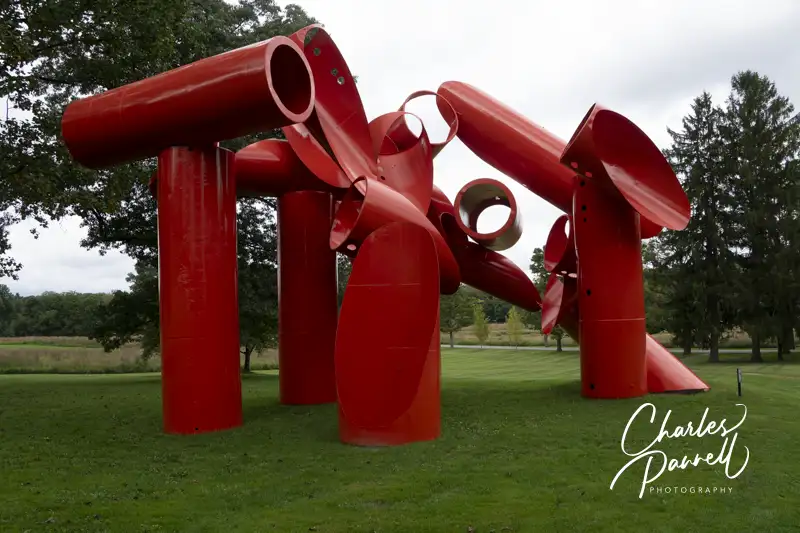
Iliad by Alexander Liberman
The grounds are filled with varied landscapes, and although there are hills here and there, you can also use the accessible tram to bypass them. The best bet is to start with Museum Hill. There’s ramp access to the Museum and ample room to maneuver a wheelchair through the galleries, which offer rotating exhibits. There is a step down to one of the galleries, but it’s also accessible from outside. And if you’re a slow walker, you might want to pick up one of the loaner wheelchairs at the Museum Store.
Museum Hill is fairly level, and it’s dotted with abstract cubes, tubes, triangles and a variety of other shapes. Two favorite pieces are also located on Museum Hill — City on the High Mountain, by Louise Nelson and Dwellings by Charles Simonds. Both of these pieces are located near the Museum, so they’re relatively easy to find.
The North Woods, which is located near Museum Hill, is one of the least accessible areas in the park. Although there are some fairly level paths through the lower part, the upper areas are rocky and steep. Still there’s plenty to see in the lower areas, which are located near the tram stop.
New pieces are continually added to the collection at Storm King Art Center, and sometimes there are also special exhibitions. And don’t miss the four Alexander Calder sculptures! Take some time to explore all the areas of the park, and if you get tired, catch the accessible tram and head back to your car. Alternatively you can use the tram as a tour vehicle to see the whole park, as it offers a good look at many of the sculptures along the route.
Grab a Bite to Eat
If you’d like to take a break and grab a bite to eat, stop in at the Storm King Café, which is located near the parking lot in the North Woods. The tram stops near the café, and there’s level access over to the entrance, and plenty of room to maneuver a wheelchair inside. Offerings include a selection of sandwiches, salads, cookies, snacks and soft drinks.
If you’d prefer to pack along your own lunch, there are plenty of places to picnic on the grounds. Management welcomes guests to bring in their own food, but no cooking is allowed in the park. Accessible picnic tables are available near the parking area, or you can bring a blanket and and enjoy your lunch anywhere on the grounds, except for Museum Hill. Pick a spot with a view, and enjoy the sculptures during your lunch break.
It’s also important to note that peak times at the Storm King Art Center are on weekends in September and October. If you don’t like crowds, it’s best to avoid those times. And no matter when you visit, it’s a still good idea to arrive early. That way you’ll have a more serene and crowd-free experience in this beautiful outdoor space.
Barrier-Free Travel the Grand Canyon for Wheelers and Slow Walkers
Mount Rushmore is a bucket list item for many folks. It’s also makes a great stop on any Black Hills road trip. And although the stately presidential carvings are indeed a sight to see, there’s also a scenic drive with lots of wildlife viewing opportunities nearby. And the the good news is that Mount Rushmore — like the majority of US National Parks and monuments — includes some upgraded access features. So don’t forget to make a stop at wheelchair-accessible Mount Rushmore on your next trip through South Dakota.
Mount Rushmore for Wheelchair-Users
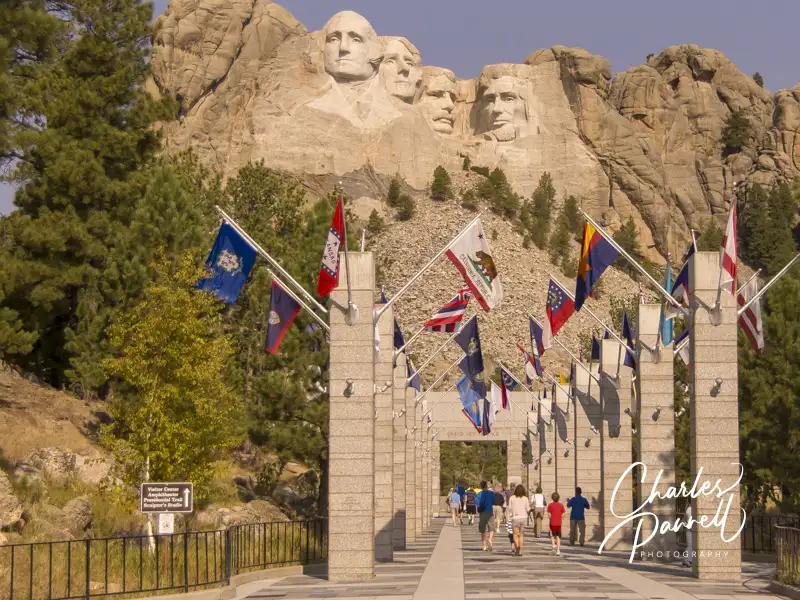
Avenue of the Flags at Mount Rushmore National Memorial, South Dakota
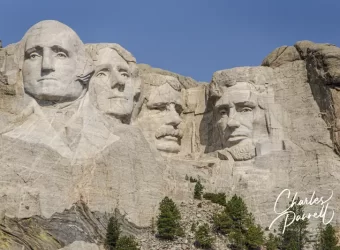
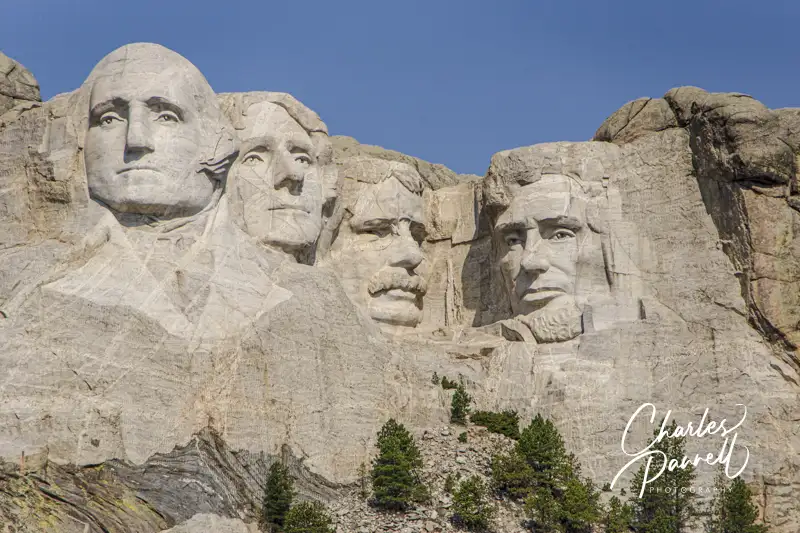
Located just 35 minutes from Rapid City, Mount Rushmore (www.nps.gov/moru/) was sculpted by the father-son team of Gutzom and Lincoln Borglum. It took them 14 years to complete the intricate carvings of the four presidents — Washington, Jefferson, Roosevelt and Lincoln. And as a result of their hard work, the sculptures have stood the test of time.
Although there’s no entrance fee to Mount Rushmore, there is a fee to park in the garage. Accessible parking is available in the garage, with ramp and elevator access up to the main level. Additionally, there’s a drop-off area right in front of the main entrance. Loaner wheelchairs are available at the Information Center, which is located near the main entrance, just across from the restrooms (which are also accessible).
There is barrier-free access down the Avenue of the Flags to Grand View Terrace, where you’ll catch your first glimpse of the four presidents. From there, take the left entrance to the Presidential Trail, which travels past the Lakota Indian Heritage Village to four alcoves with optimal views of each president. The trail is paved and level, and the accessible portion ends at the Upper Terrace, where you’ll get another good view of the mountain. From there you’ll have to double back, as the trail continues downhill with lots of steps along the way. Still, the quarter-mile accessible stretch offers the best views of the presidential carvings.
There’s also elevator access to the amphitheater and the Lincoln Borglum Visitors Center, on both sides of Grand View Terrace. And if you’ve worked up an appetite, the Carver’s Cafe along the Avenue of the Flags is wheelchair-accessible.
A Scenic Drive and More
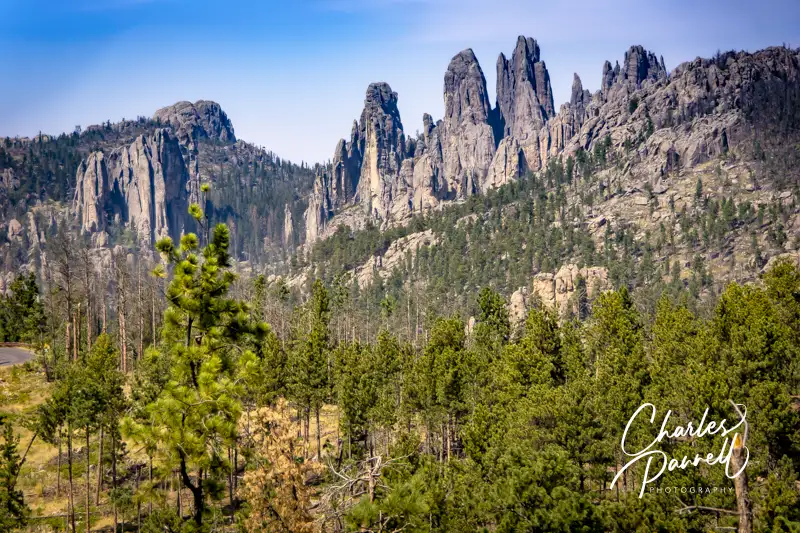
Little Devil’s Tower and Cathedral Spires on the Needles Highway Scenic Drive in Custer State Park, South Dakota
After your wheelchair-accessible Mount Rushmore visit, save some time to enjoy one of the most scenic drives in the state. From Mount Rushmore, follow the signs back to Highway 16A, then head towards Custer State Park. Along the way you’ll pass through three one-lane tunnels, and get some absolutely gorgeous windshield views of the scenic Black Hills. Have your camera ready as you exit the second tunnel, as it’s a great vantage point for the iconic shot of Mount Rushmore.
After your visit, be sure to take a cruise along the Needles Highway Scenic Drive. At the end of Wildlife Loop Road, take a right on Highway 87 and follow the signs. Named for the needle-like formations and cathedral spires that dot the landscape, the route traverses a Ponderosa Pine forest and passes through three narrow tunnels.
There are lots of spots to stop and enjoy the view, but make sure and use the pullout right before tunnel five, for a great view of Little Devil’s Tower and Cathedral Spires. After that, you’ll get up-close-and-personal with the spire-like formations, as the road cuts right through them. It’s a once-in-a-lifetime drive, and a great way to end a wheelchair-accessible Mount Rushmore visit.
Barrier-Free Travel Glacier, Yellowstone and Grand Teton National Parks for Wheelchair-Users and Slow Walkers
Dedicated to the rivers and fish of the Methow Valley, Homestream Park is a spot to pause, reflect and observe. And since it’s just off Highway 20, it makes for a good stop. That said, unless you have an accessible parking placard, there’s no vehicle parking in this urban oasis. There’s level access from the accessible parking area over to a covered and uncovered picnic area. And the good news is, both areas have accessible tables.
A short .2-mile trail runs along the river and loops back to the picnic area. And along the way it’s dotted with works by sculptor Smoker Marchand. These sculptures focus on the salmon and the original inhabitants of the Methow Valley. About half of the level hard-packed dirt trail is accessible, and there are several benches to sit down and take a break along the way. After the halfway point there are nine boulders along the trail, which represent the nine dams that the salmon encounter on their journey to the Pacific Ocean. Some slow walkers may be able to get around the boulders, but most spaces are too tight for wheelchair-users, so you’ll have to double back. Still it’s a nice spot to stop, enjoy a picnic, and peruse the sculptures.
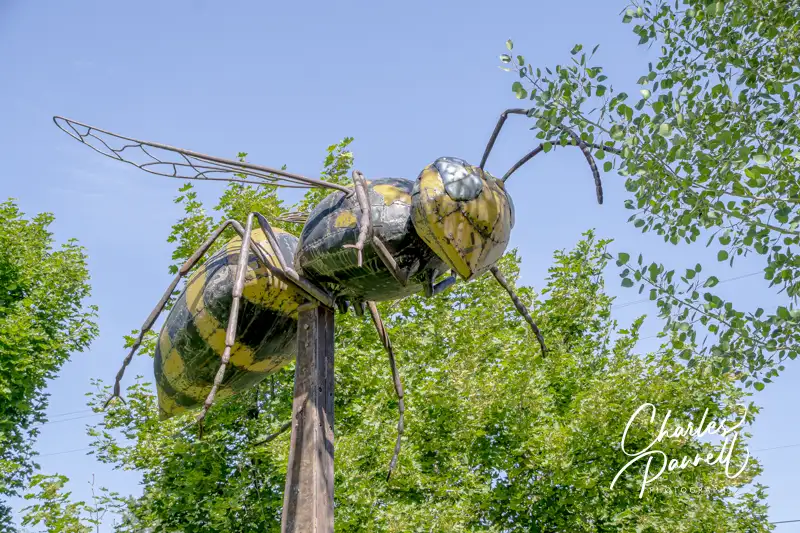
Created by local artist Barry Stromberger, this giant metal yellowjacket sculpture sits on a 15 foot pole in Twisp Commons Park. What makes it unique is that it was crafted from a 1951 Plymouth Cranbrook that was pulled from the Methow River, in an effort to improve the salmon habitat. Why a yellowjacket? It’s widely believed that the name of the town (Twisp) comes from the Okanagan word txʷəc’p, which supposedly translates to yellowjacket or wasp. And in keeping with the theme, the local high school also has a yellowjacket as a mascot.
There’s accessible parking in front of the Methow Valley Community Center across the parking lot from the sculpture. And if you need local visitor information, there’s ramped access to the building which has a nice selection of Methow Valley brochures and maps in the lobby. It makes a nice quick stop off of Highway 20.
Although the Enchanted Highway sounds like a scene straight from the pages of a Lewis Carroll tome, in reality it’s a sculpture-dotted scenic byway located smack dab in the middle of rural North Dakota. And it’s definitely worth a short detour on any trek through the Peace Garden State.
The brainchild of local resident, Gary Greff, this project began on one of Greff’s treks through South Dakota. He spotted a crude sculpture of a farmer with a makeshift hay bale alongside the road, and noticed that people stopped to photograph the creation. That was Greff’s “Eureka moment”. He figured that if he created a whole highway full of sculptures, then tourists would visit his hometown of Regent. And he figured the best way to do that was to make the sculptures larger then life. To that end he enlisted the help of local farmers who were masters at welding, and he set out to create the giant metal sculptures that dot the Gladstone-Regent Highway, off Interstate 94, just east of Dickinson.
The route can be taken as a side trip off the interstate, or used as a one-way north or south route as an alternative to Highway 85. It’s just 32 miles long, but allow for time to stop and enjoy Greff’s colorful creations that all depict some aspect of prairie life. And the good news is, you don’t even have to get our of your vehicle to enjoy the sculptures. That said, all of the sites (except Whirly Gigs) have level parking in dirt lots, and standard picnic tables in level areas. So pack along a picnic lunch, and prepare to linger on and enjoy the artistic creations along the Enchanted Highway.
Geese in Flight – Mile 0
Geese in Flight on the Enchanted Highway, North Dakota
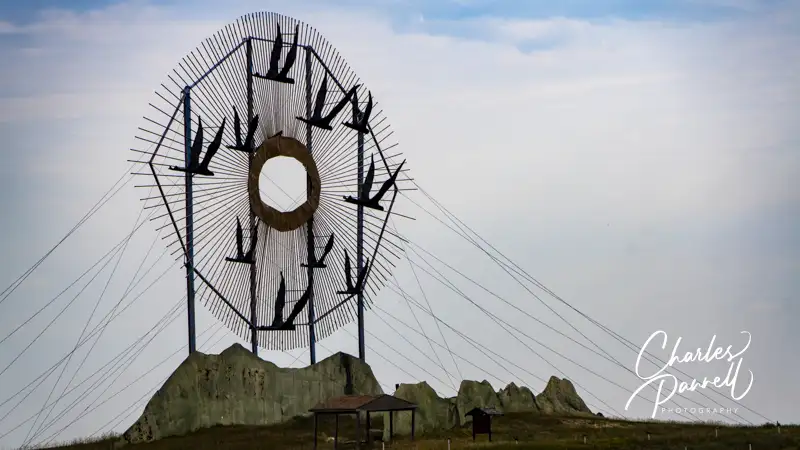
The first sculpture you’ll come across is Geese in Flight; in fact this piece marks the northern entrance to the Enchanted Highway at exit 72 off of Interstate 94. To be honest this piece is best seen from afar, so head south at the exit, and then pull over on the dirt road on the west side of the road. From there you’ll spot the sculpture, which depicts a flock geese flying around what appears to be a setting sun.
Deer Crossing – Mile 3
Deer Crossing on the Enchanted Highway, North Dakota
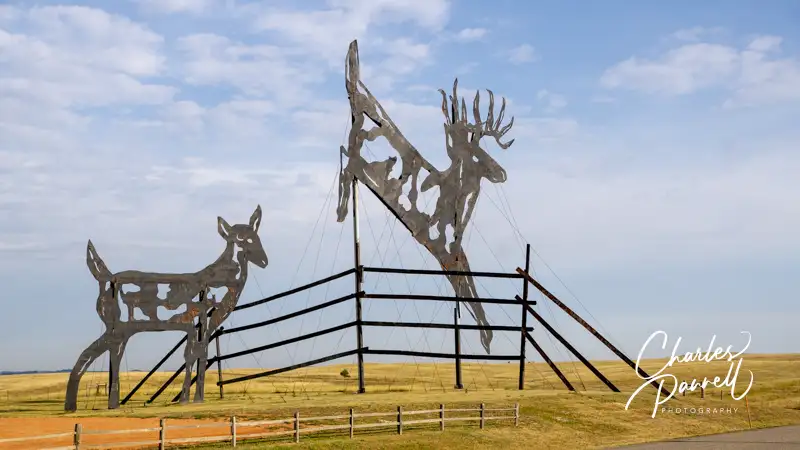
Next up is Deer Crossing, which is located just past Gladstone on the west side of the road. This massive piece depicts a pair of deer jumping over a fence, and measures in at a whopping 50 feet in height. As an added bonus, a small Maze of Enchantment is located near the sculpture. There’s level access to this easy maze, which features pathways that are wide and level for wheelchair-users and slow walkers. There’s fun for the whole family at this stop!
Grasshopper in the Field – Mile 15
Grasshopper in the Field on the Enchanted Highway, North Dakota
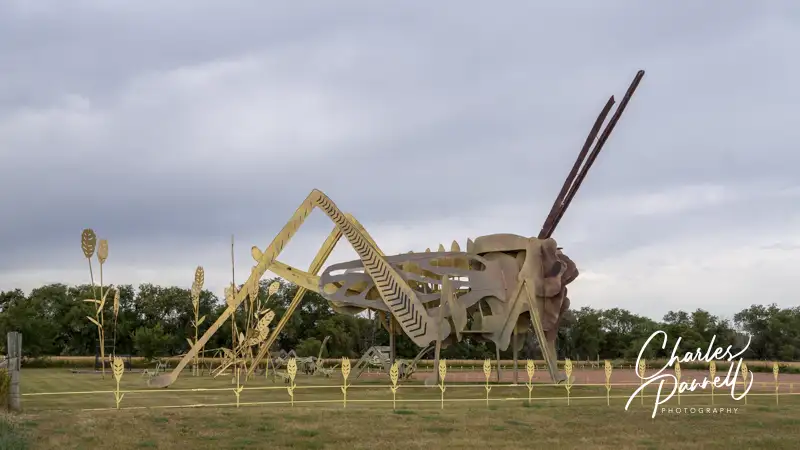
What collection of prairie-themed sculptures would be complete without a few grasshoppers? To that end Grasshopper in the Field — which is located 12 miles south of Deer Crossing — certainly solidifies the theme. This piece features one large grasshopper with several juveniles in a wheat field. Better yet, they are all surrounded by a cute little wheat picket fence. Greff got creative in the design phase of this piece, as he collected grasshoppers one summer and froze them for models. He wanted to make sure he got the colors just right, and he did a great job. A jungle gym and a few whimsical grasshopper bouncy toys round out this creative installation.
Fisherman’s Dream – Mile 19
Fisherman’s Dream on the Enchanted Highway, North Dakota
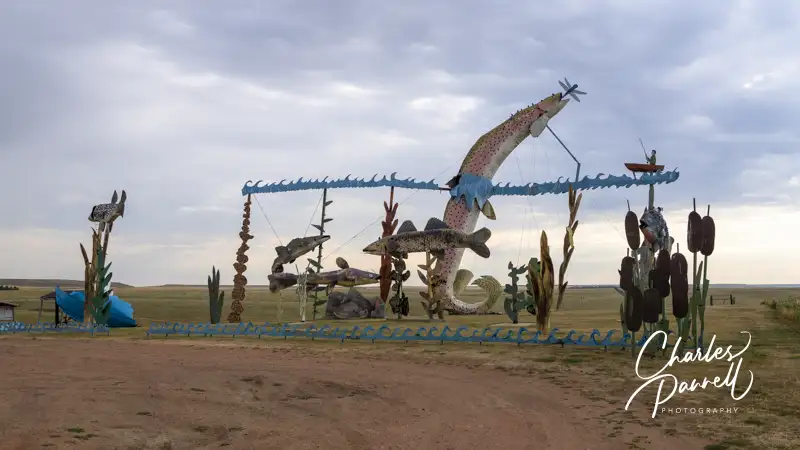
Fisherman’s Dream, which is located four miles down the road, depicts a scene only an avid fisherman can really appreciate. The sculpture includes a pond complete with cat tails and a large underwater fish population, with a fisherman trolling in a small boat on the surface. A larger-than-life rainbow trout is literally jumping out of the water in pursuit of a circling dragonfly, just off the bow of the boat. And an empty-handed fisherman just stands there awestruck. The giant trout is so large that its tail curls around the other fish and rests the bottom of the pond. Considering the epic proportions of the fish, this piece is definitely well named.
Pheasants on the Prairie – Mile 24
Pheasants on the Prairie on the Enchanted Highway, North Dakota
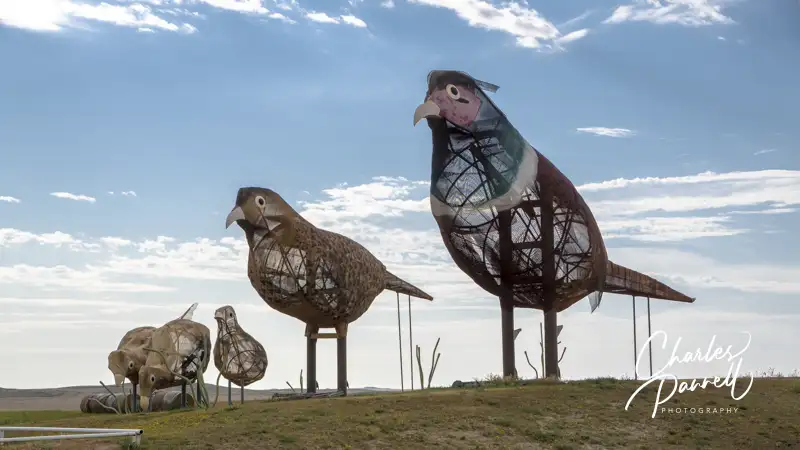
Just five miles down the road, you can’t miss Pheasants on the Prairie. which features mom, dad and three juvenile birds. They’re doing what pheasants do best — sit in the field. The birds are more than just one-dimensional stick figures though, as they’re fashioned out of a metal frame, covered with screen, and painted in realistic pheasant colors. It’s a striking scene.
Teddy Rides Again – Mile 26
Teddy rides Again on the Enchanted Highway, North Dakota
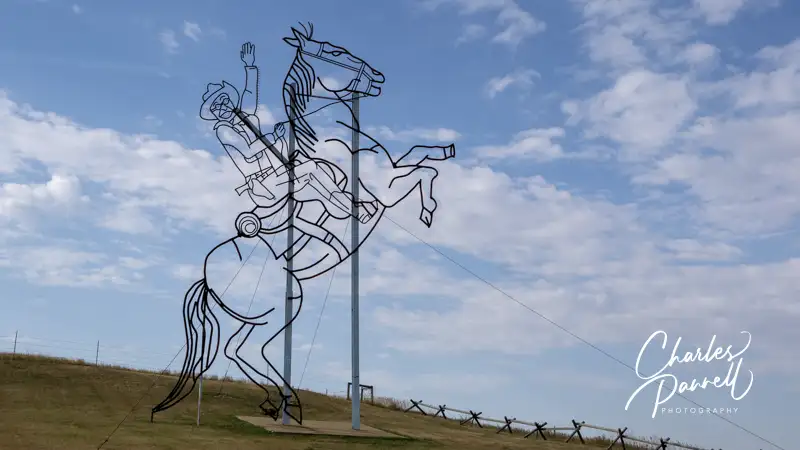
In true North Dakota fashion, Teddy Roosevelt is featured in the next piece, which is located just two miles south of the pheasant family. The sculpture, which depicts the profile of the former president on a bucking horse, was chosen by the Enchanted Highway Committee and designed by the North Dakota University Art Department. There’s also a small stagecoach on a level area in front of the sculpture, for kids — or adults — to climb in and explore.
Tin Family – Mile 30
The Tin Family on the Enchanted Highway, North Dakota
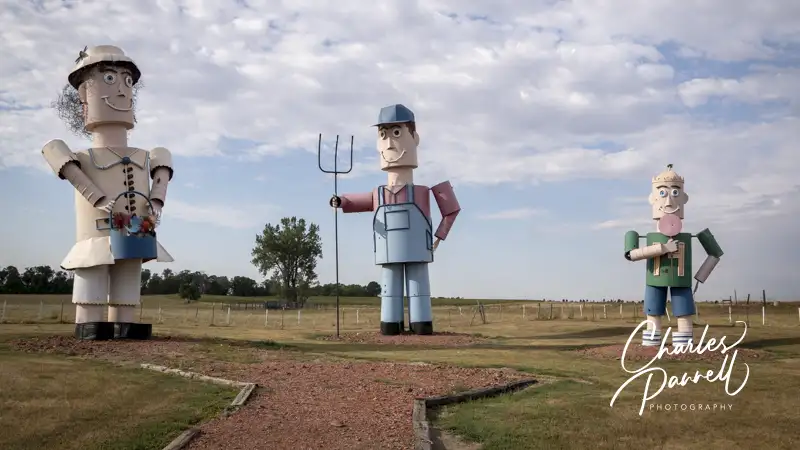
The Tin Family, which depicts a typical prairie farm family, is located four miles south of Teddy and his mount. Local farmers donated the tanks from which the family was crafted, and supplied the manpower to weld them all together. Mom is outfitted in her dress and carrying a basket of flowers, dad is clad in his overalls with pitchfork in hand, and junior is dressed in jeans and a jersey with a firm grip on his lollipop. And in true prairie style, they are bordered by a quaint white picket fence. Not only is this the first sculpture that was constructed along the route, but it’s also a local favorite.
Whirly Gigs – Mile 32
Whirly Gigs on the Enchanted Highway, North Dakota
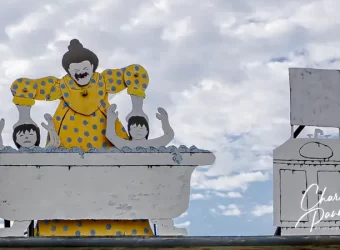
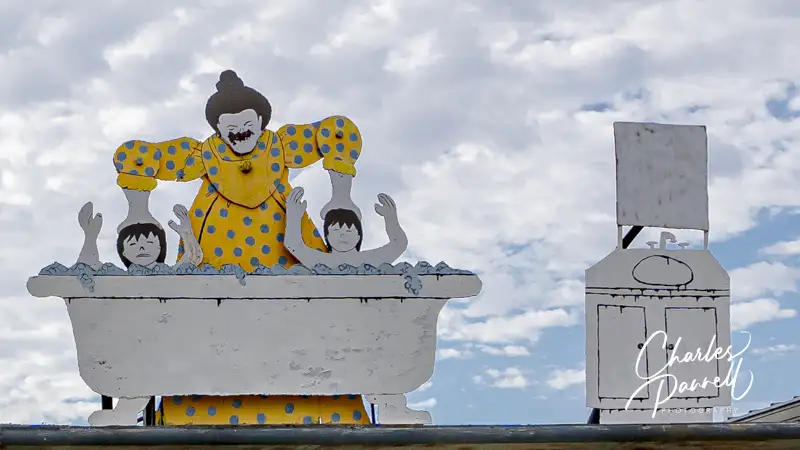
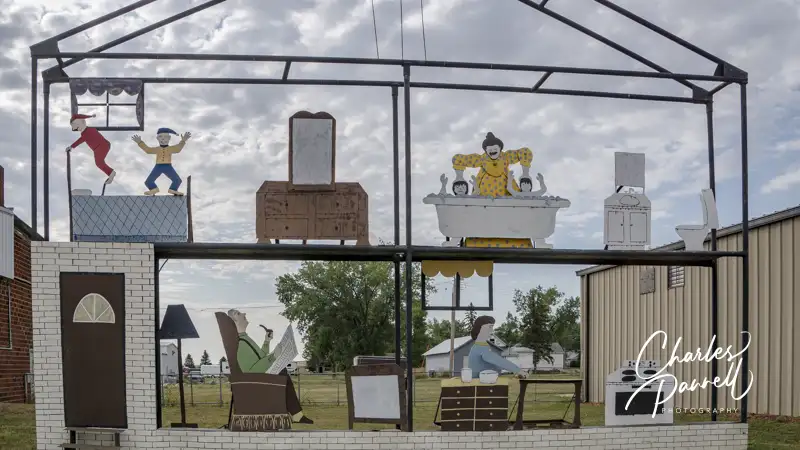
The Enchanted Highway ends two miles south on the main drag in Regent, with the only kinetic sculpture in the collection — Whirly Gigs. At first glance the frame house looks like a static piece; but once you press the green button it all comes to life. The kids jump on the second-floor bed, while another pair of youngsters splash in the upstairs tub, and mom rolls out some dough in the kitchen downstairs while dad reclines in his favorite chair. The sculpture is located next door to the Enchanted Highway Gift Shop, which has several stairs up to the entrance. There’s level street parking on the road nearby and a steep curb-cut up to the sculpture. Still, you can appreciate this — or any piece along the Enchanted Highway — from afar; so don’t hesitate to enjoy this artistic detour on your next road trip
Barrier-Free Travel Glacier, Yellowstone and Grand Teton National Parks for Wheelchair-Users and Slow Walkers
Located just west of Spokane, Way Out West Statue Farm is worth a stop on any Interstate 90 road trip. Owned by two brothers who relocated from downtown Spokane, this rural property allows them plenty of room for expansion. You get your first glance of the property on the north frontage road while driving east on Interstate 90. Fortunately it’s not hard to backtrack. Just take the next exit (272), cross the freeway, then head west on the frontage road. The parking lot is not paved and it has gravel to fill in the low spots, so it’s not that great for most wheelchairs. That said, the whole area where the metallic works of art are displayed is level. The pathways are narrow and not paved, but it’s still a great choice for slow walkers. But if you have a little help it may also work for some wheelchairs.
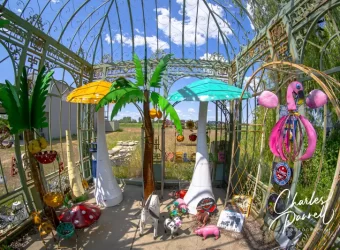
The selection of yard art is second-to-none at the Way out West Statue Farm. You’ll find a little bit of everything, from signs and metal sculptures to small decorations and larger works of art. A chicken here, an alligator there, flamingos planted in the flowerbeds and a cactus or two are just a few examples of the offerings; but trust me, there’s much more. Everything is for sale, but browsers are also welcome. There are no pushy salespeople there; in fact if you want to buy something you’ll have to flag down one of the owners who are usually roaming the grounds in golf carts. If you can’t find them, then just ask — the other tenants are usually out and about and they will go and fetch them for your. As one friendly guy told me “It’s part of our job”. Either way it’s a fun stop, and I came home with a cool “welcome rooster”. And had a wonderful conversation with the owner, who wanted to make sure the rooster was going to a good home. This fun roadside attraction is also worth a revisit, as the selection constantly changes, but the owners are always friendly. And don’t miss their trademark alien spaceship.
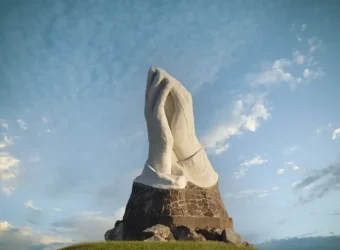
Located on a grassy knoll on Dawson Drive near Main Street in Webb City, this 32-foot high Giant Hands in Prayer sculpture is hard to miss. Constructed by local artist J.E. “Jack” Dawson in 1974, this massive concrete and steel piece weighs in at an impressive 220,000 pounds. Dawson crafted this work of art in his backyard, and then hauled it on a flatbed truck to where it sits today. According to the artist, the sculpture is a response to events in the 1960s, which was “a bad time for our country”.
There’s a small slab of asphalt with three standard parking spaces, just past the Giant Hands in Prayer. From there a short paved path leads over to a memorial wall, which was added to the site. This panel depicts how the hands were created. You can get a good view of this icon from that viewpoint, but if you want to get closer you have to climb up the grassy 40-foot high mound (not accessible). There’s also a small picnic shelter near the parking area which has an accessible picnic table, so this iconic site makes a good lunch stop on a Route 66 Missouri road trip.
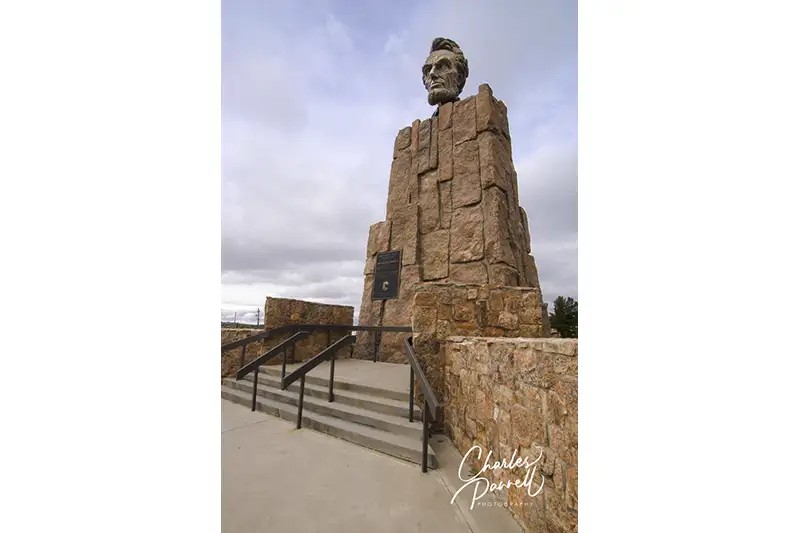
Although it may seem a bit unusual to see a Giant Lincoln Head sculpture in the middle of Wyoming, it makes more sense once you realize that it’s located along the Lincoln Highway. More specifically, it’s on Sherman Summit on Interstate 80, just east of Laramie. And although it’s called a highway, it’s actually a collection of roads that run from San Francisco to New York City. And this stretch of Interstate 80 just happens to be part of that historic route, with Sherman Summit marking the highest place along the way.
The larger-than-life Lincoln head was first sculpted by Robert Russin from 70 tons of clay, and then cast in bronze in Mexico City. The Giant Lincoln Head stands 12.5 feet high, but it rests on smaller shoulders, giving it a somewhat caricature-like appearance. Still it’s an impressive work, with the former president looking down on his audience. And it was fittingly dedicated in 1959, 150 years after the former presidents was born.
Although you can see the massive head from Interstate 80, it’s worth a stop to get a closer look. There’s accessible parking with a cement walkway over to sculpture, and although there are four steps up, you can still get an adequate look at Mr. Lincoln from ground level.
East Dickinson Boulevard & North Main Street Fort Stockton, Texas
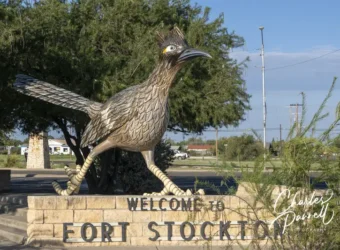
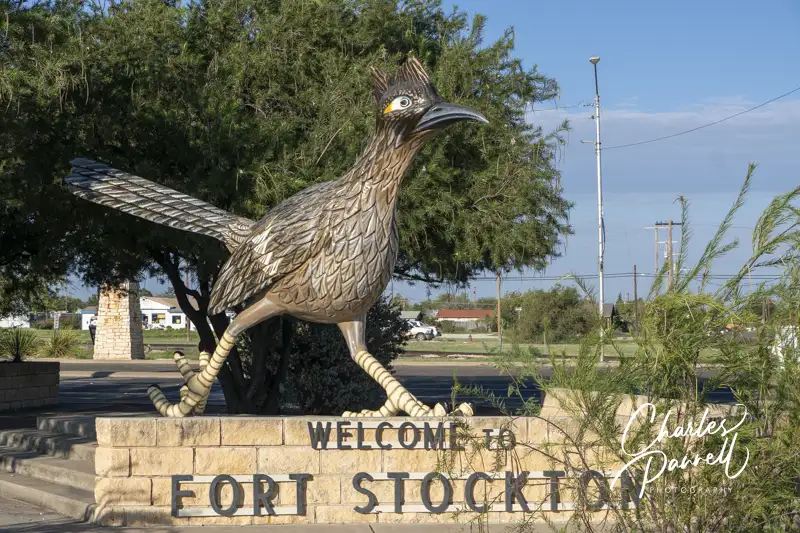
Although he’s no longer the-record-holding “largest roadrunner”, Paisano Pete is still dearly loved by the locals in this gateway town to Texas Hill Country. Built in 1979, old Pete measures in at an impressive 22 feet long and 11 feet tall. He’s located on the corner of Main Street and Dickinson, and unlike many other large statues, he’s kept up by the locals. The even dress him up for Christmas. There’s no official parking area, but there’s a large level dirt lot next to Pete that serves the purpose. And if you’d like to get a closer look at the bird, there’s curb-cut access up to the nice mini-park that surrounds him.

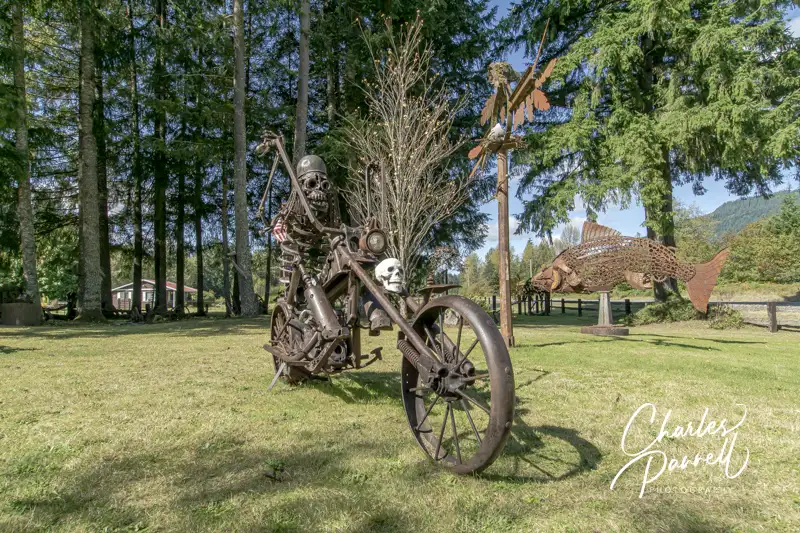 Located 11 miles west of the Nisqually Entrance to Mount Rainier National Park, Recycled Spirits of Iron Sculpture Park features the works of Daniel Klennert. And as the name implies, his creations are crafted from recycled and discarded objects. The front installations are dwarfed by a giant train near the entrance, and they include everything from a broomstick horse, and a wagon wheel, to a seahorse crafted from horseshoes, a collection of birds, and a number of themed motorcycles. Around back the installations continue with another train, more motorcycles, a collection of outhouses and an X-rated Mona Lisa. And although it’s a little bumpy in the back, the front garden and the inside gallery and gift shop are wheelchair-accessible.