If you’re planning on a trip to Italy and use are a wheelchair-user or slow walker, here are a few resources to help you in the trip planning process.
Rome and Italy Tourist Services
Rome and Italy Tourist Services (www.romeanditaly.com) is able to organize customized accessible tours and excursions throughout Italy. The tours are conducted by English speaking guides in lift-equipped vans, and feature accommodations at accessible properties. Tours are available to Rome, Sicily, Tuscany, Pisa, Naples, Florence and more.
Day tours of Rome are also available, and a special adaptive device – a Wheely Trekky – is used for inaccessible archeological sites such as the Colosseum. Additionally, arrangements for the rental of adaptive equipment, including shower chairs, hoists, scooters and manual and power wheelchairs can be made. Accessible transfers to and from all the major Italian airports are also available. For more information e-mail info@romeanditaly.it. And if you arrive in Italy by ship, accessible shore excursions are also available.
ADR Assistance
If a flight to the Eternal City is in your future, then make sure and check out the ADR website for information about accessible transfers to and from the airport. Helpful information about accessible taxi, bus and train transfers at Fiumicino and Ciampino airports are listed on this website. Also included is some general access information and some helpful tips. https://www.adr.it/web/aeroporti-di-roma-en/adrassistance
Italy Accessible
Italy Accessible offers accessible tours of Rome, Florence, Venice, Tuscany and and the surrounding areas for wheelchair-users and slow walkers. This local tour operator arranges customized excursions in ramped minivans, with stops at accessible attractions and restaurants. Accessible lodging in hotels that have been inspected for access is also included. Day tours, as well as week-long adventures are offered. And if you’d like a customized tour, they can put that together too. For more information, visit www.accessibletourism.it.
Barrier-Free Travel 101 Accessible Vacations Travel Ideas for Wheelers and Slow Walkers
Beginning on September 25, 2025 Southwest Airlines will implement new regulations for passengers traveling with lithium-powered mobility devices. The new regulation requires customers to remove all lithium batteries from their wheelchairs or scooters before boarding the aircraft. The batteries will need to be carried aboard by passengers, but will not count towards their checked baggage allowance or personal items.
The majestic Columbia River flows through the Pacific Northwest and forms the border between Washington and Oregon. On the Oregon side of the river, Interstate 84 travels through several mid-sized cities as it skirts the waterway. That said, Highway 14 on the north side of the river offers a bucolic view of the Washington landscape. Even better, the northern route boasts several wheelchair-accessible hikes. So take the time to hop off the interstate, cross the river, and enjoy these scenic wheelchair-accessible Columbia River hikes on your next Pacific Northwest road trip.
Sam’s Walker Trail
Sam’s Walker Trail
While traveling on the western part of Interstate 84, the best — and frankly the most scenic — river crossing is at the Bridge of the Gods (www.portofcascadelocks.gov/bridge-of-the-gods), in Cascade Locks. After you cross this two-lane toll bridge, head west on Highway 14 for about 10 miles to get to the first accessible hike on the list — Sam’s Walker Trail. When you hit Skamania Landing Road, turn south and and follow the signs to the trailhead. It should be noted that Skamania Landing Road is a loop, so be sure and take the western turnoff.
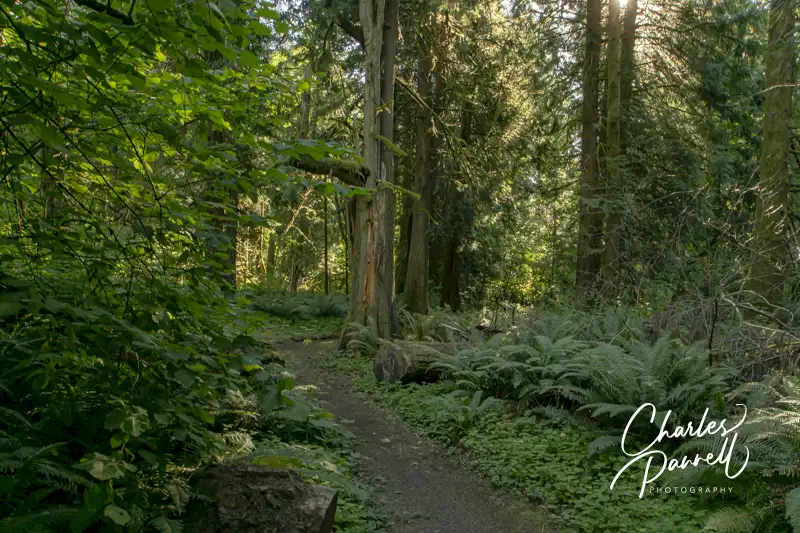
There’s no accessible parking in the gravel lot, but there’s plenty of room to parallel park an adapted van. An accessible vault toilet sits on one side of the parking lot, and an accessible shaded picnic table graces the other side. There’s level access over to the 1.2-mile hard packed dirt trail. It winds through a sweeping meadow, then passes through a shady cedar forest before it loops back to the trailhead,.
Sam’s Walker Trail is pretty well maintained, but there may be some slight vegetation overgrowth depending on the season. It’s mostly a flat trail, although there are some slight elevation changes along the way. Still it’s well within the ADA guidelines for accessible trails; as the steepest grade is only 4%, and that’s just for a few feet. It’s a great spot for a spring wildflower hike, and the meadow is an excellent birding venue. As an added bonus, there’s an accessible picnic table set off the trail under a few trees, about halfway along the hike If the table in the parking lot is occupied, it’s a great spot for a picnic lunch. And even if the parking lot table is available, the trail table offers more privacy. Sam’s Walker Trail makes for a nice accessible hike throughout the year.
Catherine Creek Universal Trail
Catherine Creek Universal Trail
Next up on the list of wheelchair-accessible Columbia River hikes is the Catherine Creek Universal Trail. From Sam’s Walker Trail, head east on Highway 14, then turn north on Old Highway 8, about 40 miles up the road. The Catherine Creek Universal Trail is about 1.5 miles up Old Highway 8.
There’s a small dirt parking area on the north side of the street; and although there are no lined spaces, there’s room enough to parallel park in the level lot. There’s another trailhead near the parking area on the north side of the street, but the Catherine Creek Universal Trail begins across the street, near the accessible porta potty.
You can take the trail in either direction, but most folks choose to head east (left). The trail winds through a meadow and over to the Catherine Creek Falls viewpoint. It’s just a quarter-mile walk to the falls, and the area is filled with lilies, poppies and balsamroot blooms in the spring. The waterfall decreases to just a trickle in the summer months, but it’s rather impressive earlier in the year . And if you’d like to stay a spell, there’s also a bench in the waterfall viewing area. As an added bonus, there’s also a nice Columbia River view.
The next part of the route crosses a small footbridge and then an accessible boardwalk, before it splits into two trails. The trail to the right is the half-mile shortcut, and it’s a bit steeper than the longer route. The trail to the left winds along the Columbia River and then intersects with the shortcut, before it returns to the starting point for a 1.2-mile stroll. Although neither route is level, they both are accessible. And don’t forget to bring a hat, as there’s not much shade along the way.
Balfour Klickitat Loop
Balfour Klickitat Loop
The final trail on our north shore collection of wheelchair-accessible Columbia River hikes is the Balfour Klickitat Loop. From the Catherine Creek Universal Trail, continue east along Old Highway 8 for about 4.5 miles. The trailhead is on the left, and although it’s marked, it’s east to miss. If you hit Highway 14, turn around and backtrack for about .2 mile.
This land was originally farmed by the Thomas Balfour family in the 1800s, and remnants of the Osage orange trees they planted are still visible along the trail today. There’s accessible parking near the trailhead, with level access over to an accessible vault toilet.
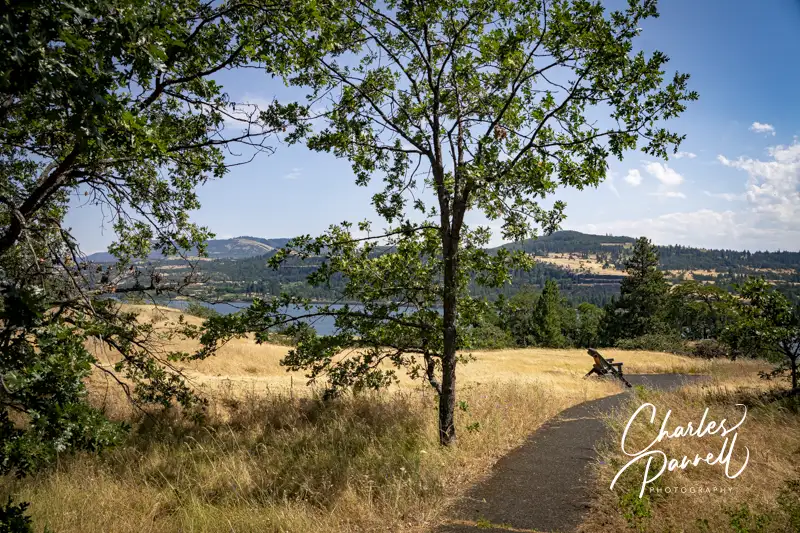
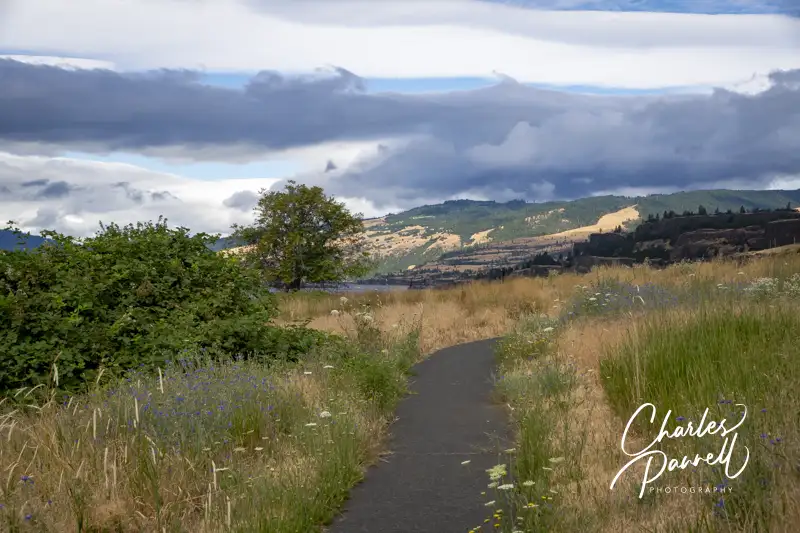
The .75–mile wide paved trail winds through a meadow and offers a panoramic Columbia River view, complete with parasailers. There are turn outs along the way for wheelchair-users, and this is also a great spot for wildflower viewing in the spring. At about the halfway point there’s a single accessible picnic table on a pad, with plenty of room for a wheelchair. It’s a great place for a picnic as it’s tucked off the trail in a private cove, but still offers a nice river view.
The trail then crosses a small bridge and continues along the meadow, with a view of the peaceful Klickitat River. It’s a great birding place, and bald eagles are known to congregate here during the salmon run in January and February. When you reach a fork in the trail, bear left to the return to the parking area. Although there is some elevation gain there, it’s within code, with resting spots every 20 feet. It’s a pleasant trail, that’s definitely worth a stop while road tripping along Highway 14.
Stay a Spell
After you finish exploring the Balfour-Klickitat Loop, head out Highway 14 to continue your trek east. Alternatively, you can extend your stay and explore this less-touristed side of the Columbia River.
Maryhill State Park is located about 20 miles east of the Balfour-Klickitat Loop, and it’s a nice place to stop for a picnic or even spend a night or two. The Maryhill Museum, Maryhill Winery and Maryhill Stonehenge are also all worth a visit while you’re in the area. (emerginghorizons.com/linger-on-in-maryhill-state-park/).
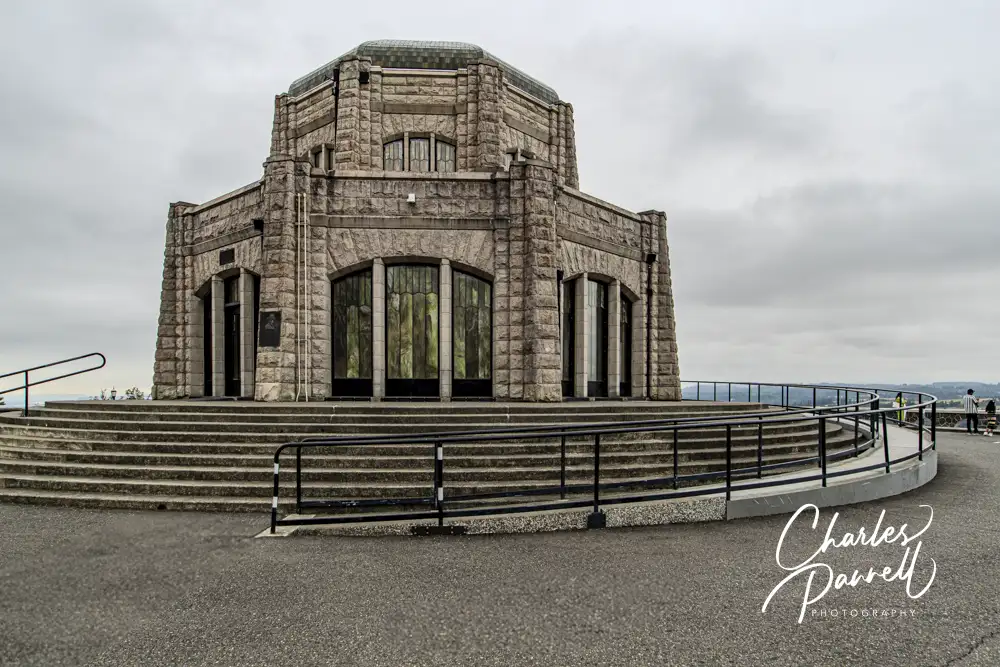
Vista House on the Columbia River Waterfall Corridor
And finally, if you’d prefer to camp out, then check out Beacon Rock State Park. It offers a nicely accessible campsite, as well as a few accessible hikes. Either way these wheelchair-accessible Columbia River hikes only take a few hours, and the scenery is most definitely worth the slight detour.
Barrier-Free Travel Washington National Parks for Wheelers and Slow Walkers
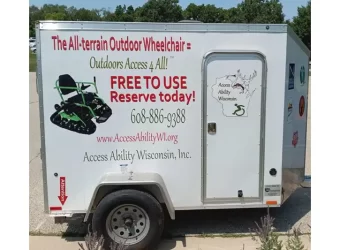
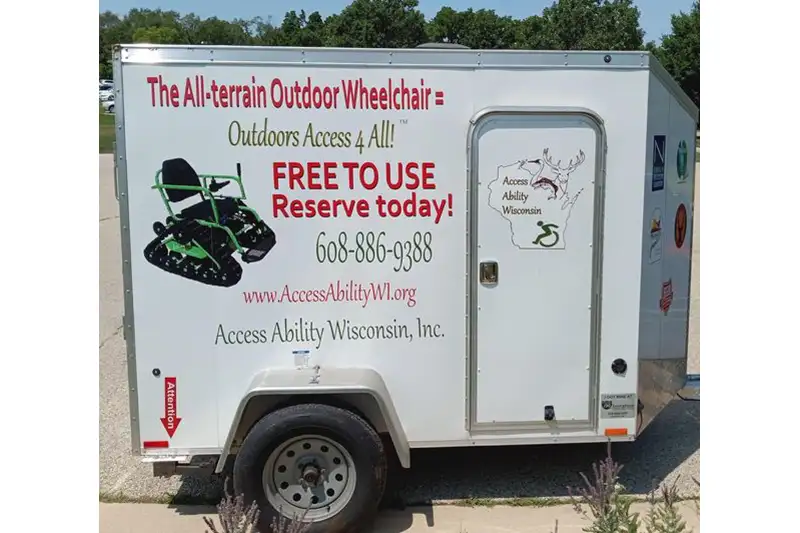
Based in Southern Wisconsin, Access Ability Wisconsin (www.accessabilitywi.org/) offers free loaner track chairs throughout the state. These track chairs have tank tracks instead of tires and unlike most wheelchairs, they can travel over rough terrain.
On-site track chairs, as well as track chairs that can be towed to the location of your choice are available for loan. The towable track chairs come with a trailer and everything that’s needed to tow it. The track chair weighs 350 pounds and the trailer weighs 800 pounds, so you need a vehicle with a towing capacity of at least 1,150 pounds in order to tow the trailer. The hitch uses a two-inch ball, and for safety reasons at least 8 inches of ground clearance is required. A mid-sized SUV, van or truck is suggested, in order to meet these safety requirements.
Reservations for the track chairs can be made at https://www.accessabilitywi.org/reserves-types. A $50 refundable deposit is required at the time of the reservation, and a $2.75 non-refundable processing fee will be charged for each chair. The processing fee will be deducted from the deposit when the equipment is returned.
If the track chair will be towed, a copy of your drivers license and proof of insurance are also required. A Waiver of Liability and User Agreement must also be signed in order to borrow the track chair.
The goal of Access Ability Wisconsin is to have at least one track chair for loan in every county. Their available inventory is continually growing, so check back often. For more information about these Wisconsin track chairs for loan, visit the Access Ability Wisconsin website or call (608) 886-9388.
Barrier-Free Travel National Park Lodges for Wheelers and Slow Walkers
Can you sue an airline because they damaged your wheelchair, delayed your deplaning, or otherwise infringed on your rights as a wheelchair-user? That’s a question I often get. And rightly so, because litigation is a logical solution to bad customer service.
To be honest, you can sue anyone for anything; however the bigger question in this case is, will you prevail in court?
An unfortunately in cases regarding the Air Carrier Access Act (ACAA) — the law that mandates wheelchair access on US airlines — the answer is no.
The Air Carrier Access Act
The ACAA, which was implemented in 1986, covers access issues on US airlines and on flights to and from the US. It’s the law of the land as far as accessible air travel goes, and it even predates the Americans with Disabilities Act.
Unfortunately the ACAA does not allow for private lawsuits. On the other hand it doesn’t specifically prohibit them either. So, it was basically up to the courts to decide if you can sue an airline for for a disability-related issue. And although the ACAA has been mentioned in numerous other cases, the final decision on this matter came in 2017 in Stokes v. Southwest Airlines
Stokes v. Southwest Airlines
In Stokes v. Southwest Airlines, Kelli Stokes claimed that her autistic son suffered physical, emotional and mental injuries, because of a denied boarding due to his disruptive behavior and disability. The lower court dismissed the case, on the grounds that the ACAA did not specifically provide for private lawsuits.
And the Fifth District Court of Appeals upheld that decision. The final ruling held that no private right of action exists to enforce the ACAA. So, yes, you can always try to sue, but because of this precedent, then it will most likely be dismissed. And with that in mind, you’ll be hard pressed to find an attorney to take a ACAA case on contingency. So, can you sue an airline for mishandling your wheelchair? No, you can’t.
That said, even though you can’t prevail in a lawsuit if an airline violates the ACAA, there’s still something you can — and should — do instead. File an ACAA complaint. I know, I can hear the eyes rolling as I type this, but this is really the only way to effect change.
So, What Happens Next?
Will filing an ACAA complaint compensate you for your damages? No. If your personal property has been damaged or you have been injured by the airline, you need to take that issue up directly with them. Keep your receipts, bills and quotes and file a claim with the airline for your damages. You should always do this, however you can also file an ACAA complaint at the same time.
Granted the Department of Transportation (DOT) may do nothing more than log your complaint; however it’s essential to have it on file. That way if an airline continues to violate the ACAA, then the DOT has a paper trail of the complaints. And once an airline starts to accrue complaints, the DOT usually takes action.
What do they do? Well they can issue hefty fines, require remedial training regarding access issues, and even order the airline to implement new policies. But again, nothing will happen if you don’t file an ACAA complaint.
So next time your rights are ignored when you fly the friendly skies, don’t just look the other way. File an official complaint so some remedial action will be taken. It’s really the best way to make air travel more accessible, and to make sure that the ACAA is followed.
With 63 parks in the US National Park System, it’s really hard to choose a favorite. That said, wheelchair-access plays a big part in my top choices. But there has to be more than just access to a visitor center or a few overlooks to make my list. Diversity also plays into my choices, but so does the quality of the visit. Accessible overnight lodging has to be in that mix too.
And let’s not forget about the price of popularity. Sadly, with so many visitors flocking to some of these national treasures, sometimes it feels like you are lined up for a popular ride at an iconic theme park at some national parks. That definitely takes away from the natural experience. So taking that all these factors into consideration, here are my five favorite wheelchair-accessible national parks .
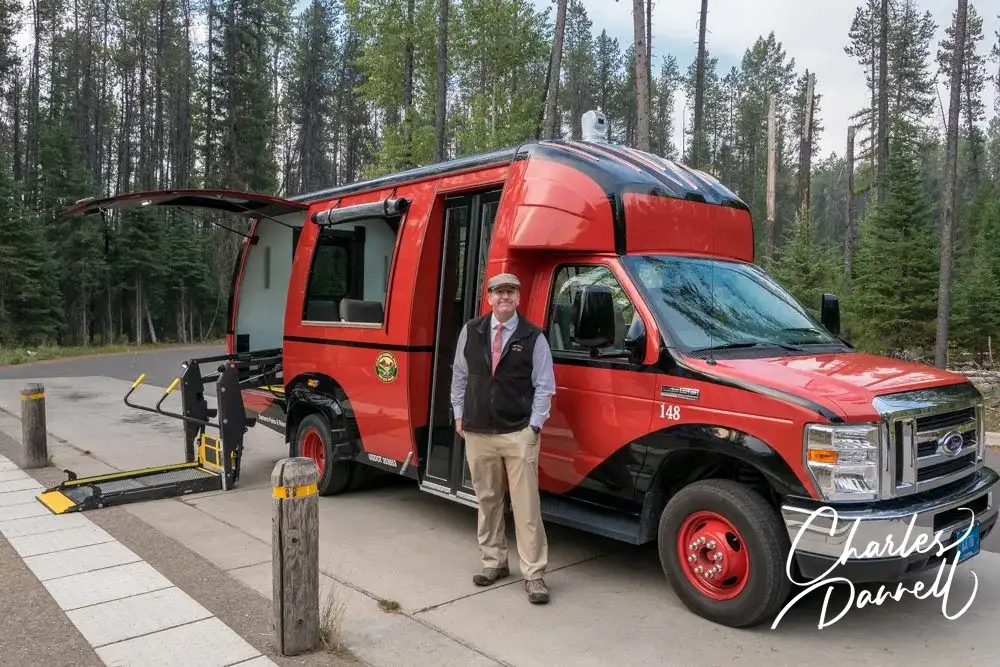
Glacier National Park (emerginghorizons.com/barrier-free-travel-glacier-yellowstone-and-grand-teton-national-parks-for-wheelchair-users-and-slow-walkers/#itin-1) tops my list of wheelchair-accessible national parks, not only for the beautiful scenery and variety of accessible lodging choices, but for its ease of access without a vehicle. That’s right, you can take the Amtrak Empire Builder to this iconic national park, and then hop on the visitor shuttle to your in-park lodge and then book a Red Bus tour to see the park. And the good news is, that all of these transportation options are wheelchair-accessible. Plus, you don’t have to worry about getting an entrance reservation (emerginghorizons.com/national-park-entrance-reservations-required-in-2024/) if you stay in the park. So ditch your car and visit this Montana gem this summer!
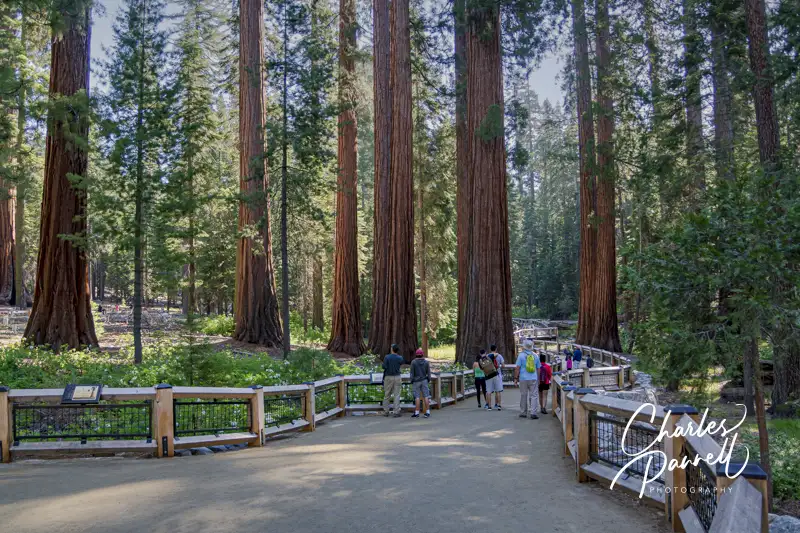
Big Trees Loop at Mariposa Grove in Yosemite National Park
Yosemite (emerginghorizons.com/barrier-free-travelyosemite-sequoia-and-kings-canyon-national-parksfor-wheelers-and-slow-walkers/#itins holds a special place in my heart, as I grew up near there and spent a good chunk of my adult life in the area. Nothing beats the grandeur of Yosemite Falls or Half Dome; however Yosemite Valley can get extremely crowded, even in the off season. One way to dodge some of the crowds is to plan an excursion to a non-valley site. And my top pick for that is Mariposa Grove. Located near the South Entrance of the park, Mariposa Grove is home to over 500 mature giant sequoias. And thanks to upgrades over the years, there are two wheelchair-accessible trails through this often overlooked corner of the park.
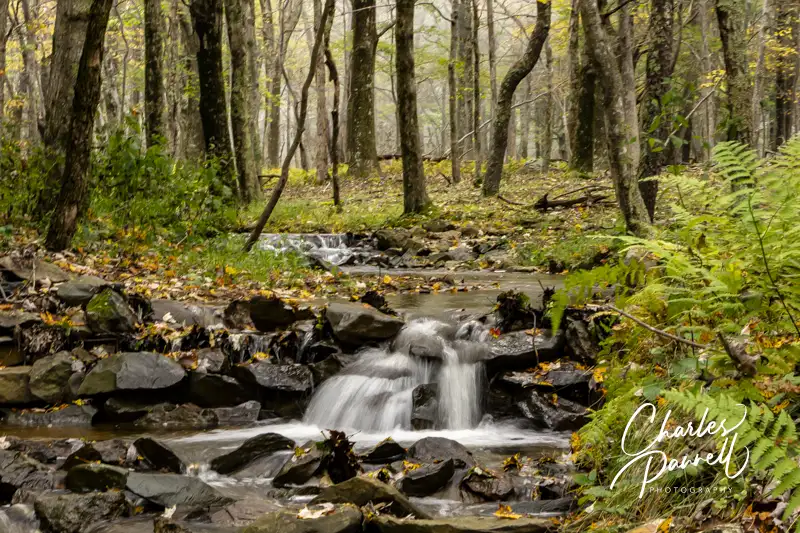
Next up on my list of favorite wheelchair-accessible national parks is Shenandoah National Park. This Northwestern Virginia national park is chocked full of beautiful views, and the wildflower blooms in the summer are absolutely gorgeous. There’s also a beautiful 1.3-mile accessible trail that runs through a wooded area and over a boardwalk. And the trail is close to Skyland, an excellent choice for wheelchair-accessible lodging. The property boasts a spacious accessible room with a roll-in shower and the restaurant offers more great views. It’s the perfect spot to unwind and spend a night or two.
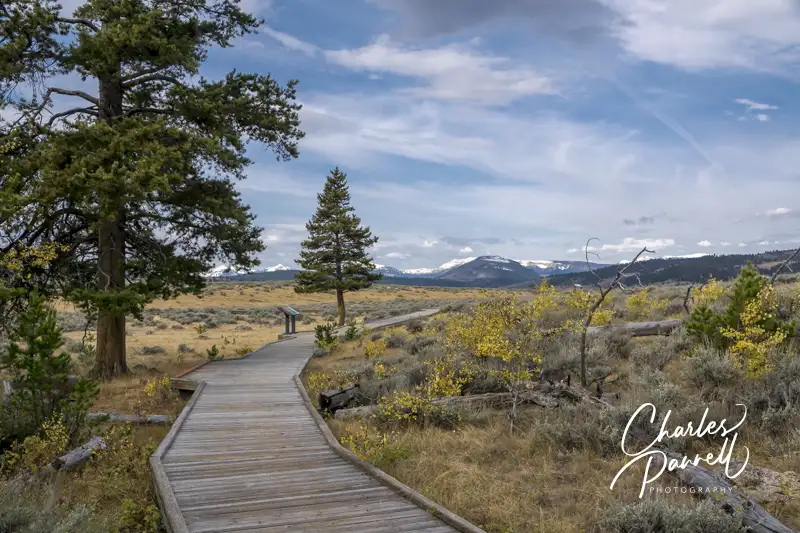
Forces of the Northern Range Boardwalk in Yellowstone National Park
I love Yellowstone National Park (emerginghorizons.com/barrier-free-travel-glacier-yellowstone-and-grand-teton-national-parks-for-wheelchair-users-and-slow-walkers/#itin-1), and I’m not alone with that opinion. It’s an incredibly busy national park. That said, if you get there early you can enjoy a somewhat uncrowded experience at Old Faithful, one of the park’s biggest draws. But there’s much more to see beyond the iconic geyser, and even a few places that are a little off-the-beaten-path. Some of my wheelchair-accessible favorites are West Thumb Geyser Basin, Frying Pan Spring and the Forces of the Northern Range Boardwalk. And one of my friends even had an accessible hunting adventure there (emerginghorizons.com/a-disabled-hunting-adventure-stalking-big-game-out-west/). Truly, they sky’s the limit as far as accessible things to do in the nation’s first national park.
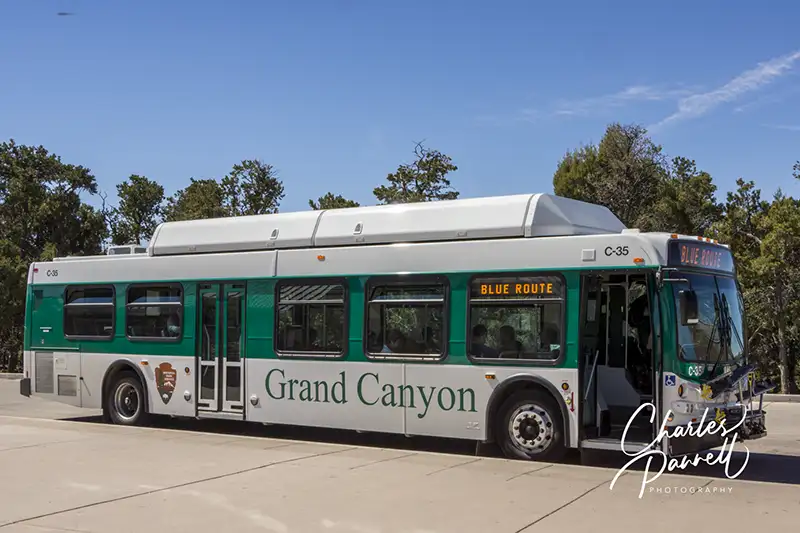
Rounding out my list of favorite wheelchair-accessible national parks is and oldie but goodie — Grand Canyon National Park (emerginghorizons.com/the-grand-canyon-for-wheelers-and-slow-walkers/#itin-1). More specifically, the South Rim of this iconic national park. I love it not only because of the accessible canyon views and lodging options, but also because it’s another national park that you can see without a car. You can take Amtrak’s Southwest Chief to Flagstaff and connect with an accessible shuttle to the park. Alternately, you can take an Amtrak thruway bus to Williams and hop on the equally accessible Grand Canyon Railway and ride it to the park. Add in an overnight at the Grand Canyon Railway Hotel, and you have a truly accessible car-free Grand Canyon package. And once you’re in the park, there’s an accessible shuttle that stops at the most popular South Rim sites. Enjoy the scenery and leave the driving to someone else in this beautiful national park.
Barrier-Free Travel National Park Lodges for Wheelers and Slow Walkers
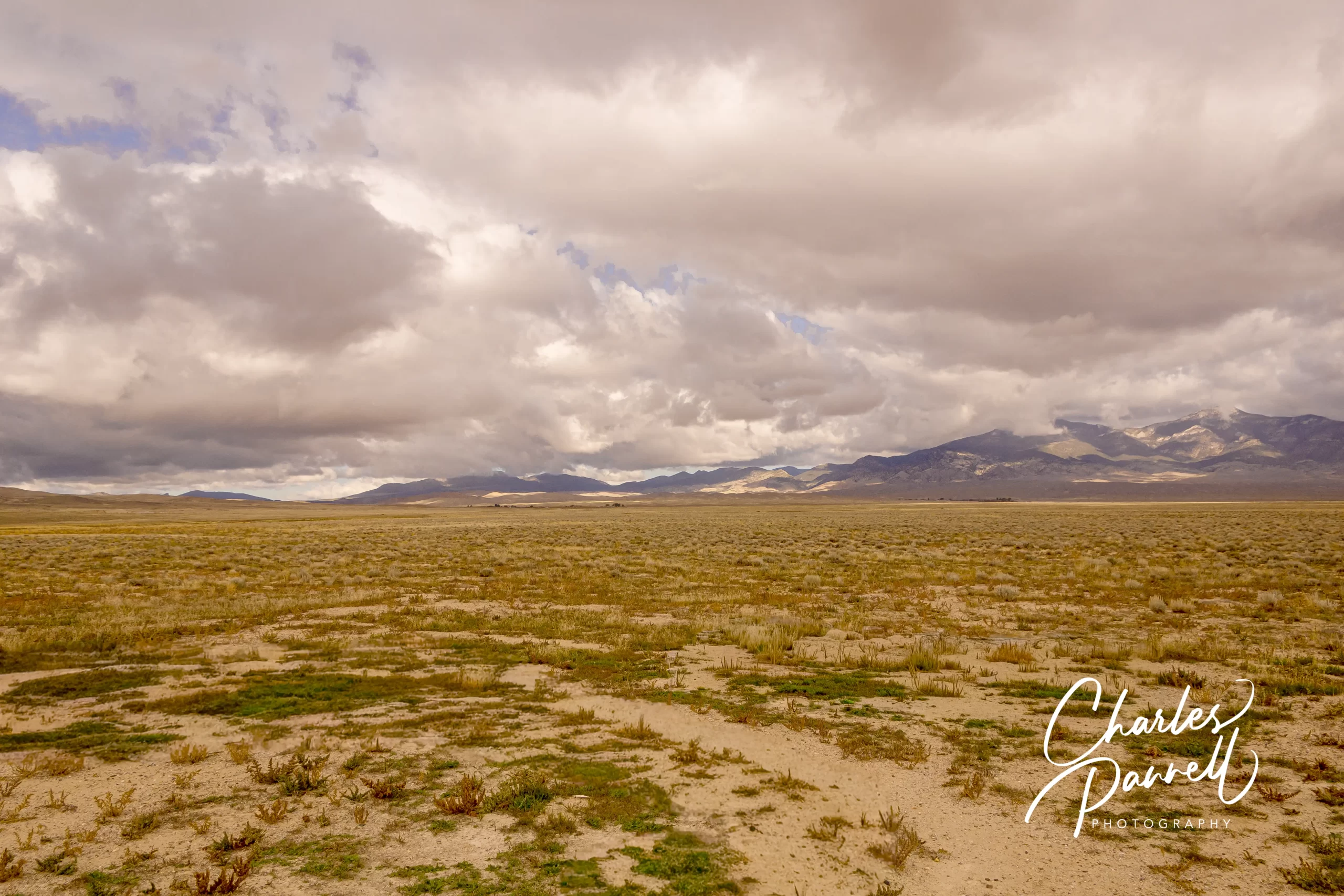
Located just off what’s often been called “the loneliest road in America”, Great Basin National Park (nps.gov/grba/) is the epitome of remote. Named for the dry and mountainous basin between the Sierra Nevada and Wasatch mountain ranges, this Eastern Nevada national park offers a diverse landscape, from subterranean caverns to high alpine peaks. And as one of America’s least visited national parks, it’s the perfect place to take a welcome break from hectic city life. The good news is, even though parts of this park are quite rugged, it still offers plenty of places for wheelchair-users and slow walkers to admire Mother Nature’s handiwork.
Get Your Bearings
Wheeler Peak Viewpoint
One of the most accessible ways to enjoy Great Basin National Park is to take the 12-mile scenic drive up to Wheeler Peak. The best place to begin your adventure is at the Great Basin Visitor Center, located on Highway 487 in Baker. There’s accessible parking in front, with level access to the visitor center. Inside there’s plenty of room to navigate a wheelchair around the interpretive exhibits. This is a good place to get your bearings, pick up a park map and get first-hand information from the rangers on duty.
From the visitor center, continue along Highway 488 until you reach the park. Just past the park entrance, make a right turn on Wheeler Peak Scenic Drive. This winding road hugs the mountain as it passes through several ecosystems on the way to the summit. The landscape is dotted with sagebrush, before it gives way to a pinion juniper woodland, and then transforms into a conifer forest. There’s no shortage of great windshield views along the way, and there are several scenic viewpoints where you can admire the sweeping vistas. And although the road is paved, the average grade is eight percent, and vehicles and trailers longer than 24 feet are prohibited. On the plus side, that means you won’t see any tour buses at the top.
Enjoy the View
Sky Island Forest Trail
There are several scenic viewpoints along Wheeler Peak Scenic Drive, that are definitely worth a stop. First up on the drive is the Osceola Ditch trailhead, which is located just past Lehman Creek campgrounds. There’s plenty of room to parallel park in the asphalt pullout, with level access over to the interpretive panel about the Osceola Ditch. This 18-mile flume dates back to 1890, when it was built to carry water to the nearby gold mining operation. Although the mines saw some success in the beginning, they shut down in 1905, but some remnants of the Osceola Ditch still stand.
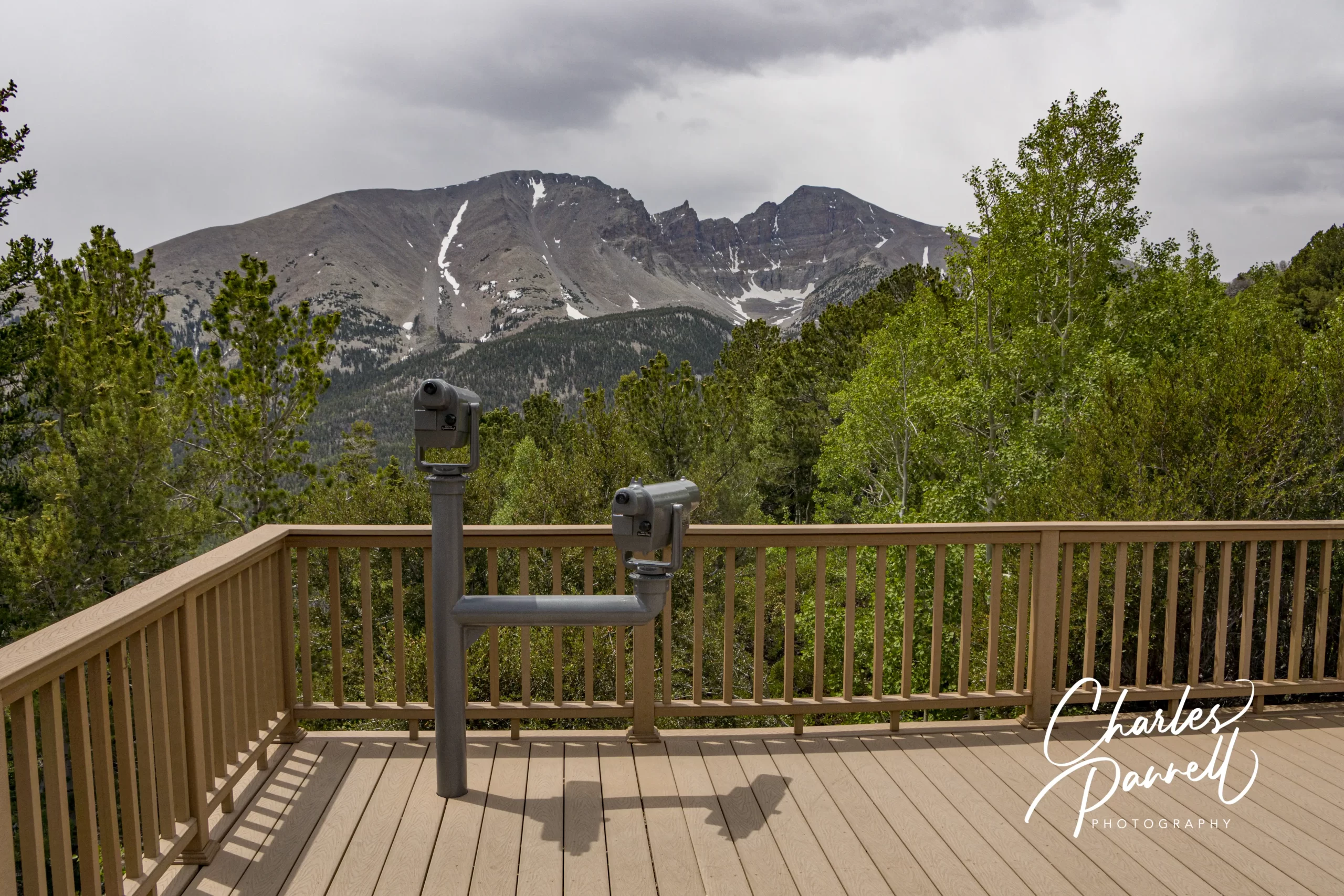
Just up the road you’ll find two viewpoints which offer great views of the vast Great Basin. Mather Overlook is just a short drive off the main road, and it features level access to the viewing deck, which has a wheelchair-height scope. There is also an accessible vault toilet and a picnic table on a cement pad at this overlook. Wheeler Peak Overlook also offers level access to a viewing deck with a wheelchair-height scope, where you’ll get an excellent view of the Wheeler Peak Glacier.
Up at the top there is accessible parking in the Bristlecone Parking Lot, with level access to the Sky Island Forest Trail. This .4-mile loop is very nicely done, with rubber mats and boardwalk sections to make it accessible in all weather. The maximum grade along the 32-inch wide trail is eight percent, and there are benches along the way to stop and rest. Interpretive plaques dot the trail, which winds through a fir and pine forest. Located at 10,000 feet, this trail offers a unique opportunity for wheelchair-users and slow walkers to explore the sub-alpine forest.
The Wonder Down Under
The Gothic Room at Lehman Caves in Big Basin National Park
There’s another side to Great Basin National Park – a subterranean side. After you finish the scenic drive, head down to Lehman Caves for an entirely different view of the park. Located at the end of Highway 488, the Lehman Caves Visitor Center offers accessible parking, with a ramp up to the back entrance. Inside, there’s barrier-free access to the visitor center and gift shop.
Although there are 76 steps on the regular cave tour, a special “mobility tour” is also available. Although not 100 percent accessible it may work for some wheelchair-users and slow walkers. The tour is actually a shorter version of the regular tour, and people who can’t manage the steps and grade just go to the first room — the Gothic Room — and then return to the visitor center.
There’s level access on a paved pathway to the cave entrance, but there’s a five-to-eight-percent grade to the Gothic Room. Wheelchair-users must be accompanied by a companion who can push them in and out of the cave. And although it may sound a bit restrictive, it’s a good opportunity for some wheelchair-users and slow walkers to get a look at the fabulous stalactite and stalagmite formations inside the cave.
The availability of the mobility tour is dependent on the staffing, as there has to be an extra ranger to take wheelchair-users and slow walkers back early. For more information on the mobility tour or to find out about availability, call (775) 234-7517. Tickets for this tour are not available online, but it’s definitely worth the extra effort to make arrangements for the mobility tour in advance.
Located in Southwestern South Dakota, Badlands National Park (www.nps.gov/badl) features a rugged landscape dotted with an almost otherworldly collection of geological formations. The windshield views of the convoluted rock formations are spectacular, so you don’t even need to get out of your vehicle to enjoy it all. On the other hand, if you’d like to linger a bit, there are plenty of wheelchair-accessible Badlands options; including numerous trails and overlooks along the way. And there’s even an accessible lodge to spend the night.
Take a Hike
Fossil Exhibit Trail in Badlands National Park
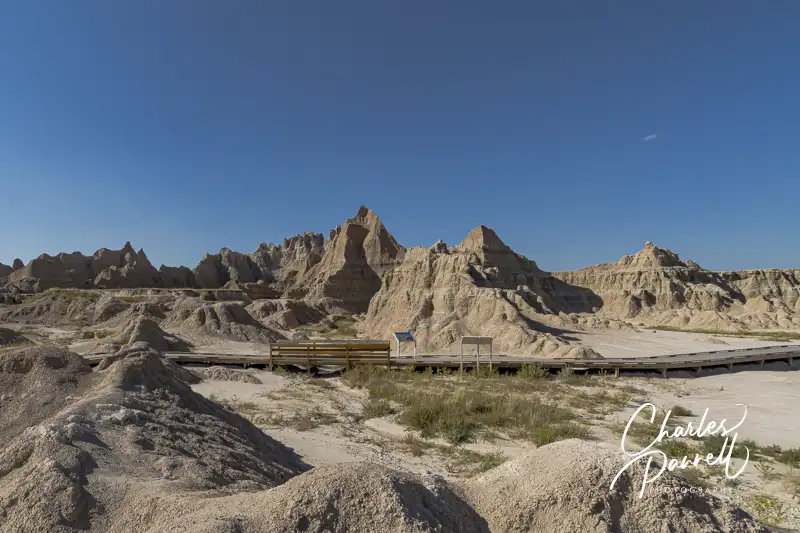
Although the landscape looks foreboding, it’s easy to plan a wheelchair-accessible Badlands trip. To get a good overview, take a drive along Badlands Loop Road, where you’ll find a number of wheelchair-accessible viewpoints and pullouts that aren’t even marked on the park map.
There are also several accessible trails along Badlands Loop Road, including the Window Trail and the Door Trail, which are just a short drive from the visitor center. Both trails can be accessed from the same parking lot, which includes accessible parking and an accessible vault toilet.
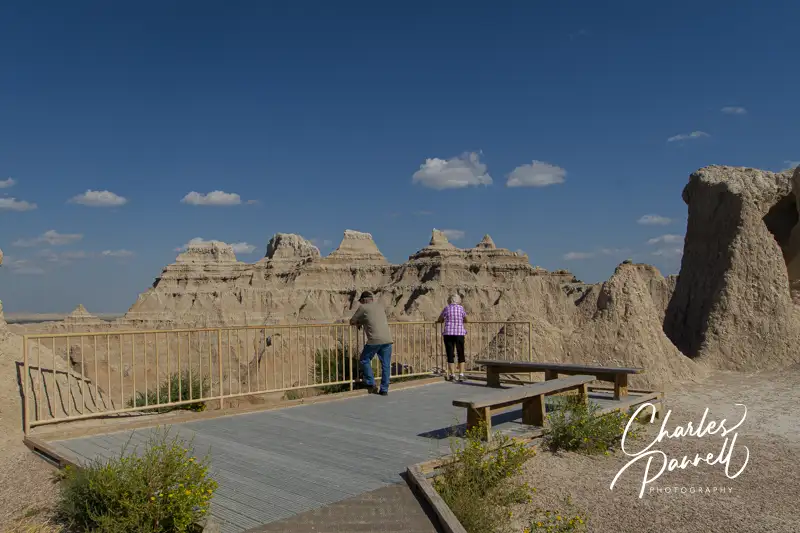
The Window Trail is located on the south side of the parking lot. The level boardwalk leads out to a natural window that looks out on eerie hoodoo-like formations off in the distance. It’s a pleasant quarter-mile out-and-back stroll.
Viewing Platform at the End of the Windows Trail in Badlands National Park
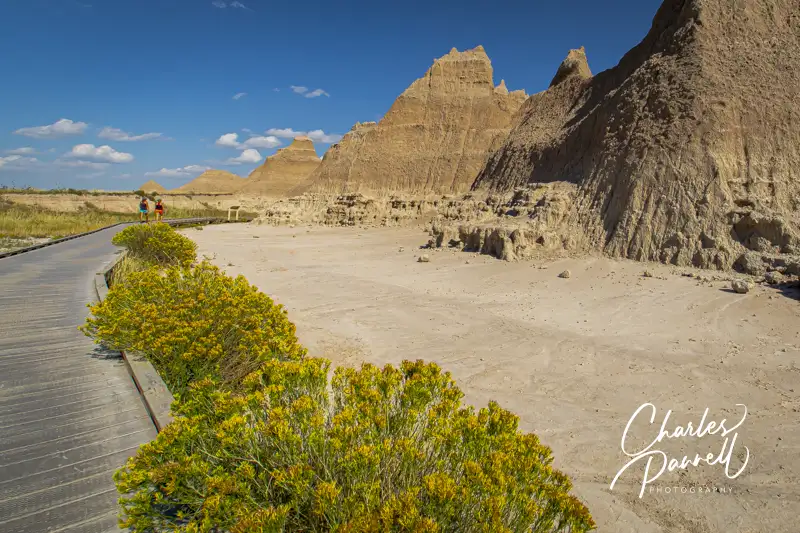
The Door Trail is located at the other end of the parking lot, near the much needed shade structure. The level boardwalk snakes between a break in the Badlands Wall — called The Door — and opens up to a sweeping sandstone canon view at the end. It’s a .75-mile round-trip hike.
Start of the Door Trail in Badlands National Park
And don’t miss the Fossil Exhibit Trail, which is located near White River Valley Overlook. Accessible parking and an accessible vault toilet are located near the trailhead. This quarter-mile boardwalk features low bumpers for unobstructed views, and includes interpretive panels that describe the extinct creatures that once roamed the area. Examples of fossils are also located along this nicely accessible loop trail.
Each trail offers a different look at the varied landscape, but don’t forget the sunscreen, as shade is in short supply in this neck of the woods
Stay a Spell
To ramp up your wheelchair-accessible Badlands experience, plan to spend at least one night at Cedar Pass Lodge (www.cedarpasslodge.com). Not only is it one of the newer properties in the national park system, but it’s also conveniently located right next door to the Ben Reifel Visitor Center.
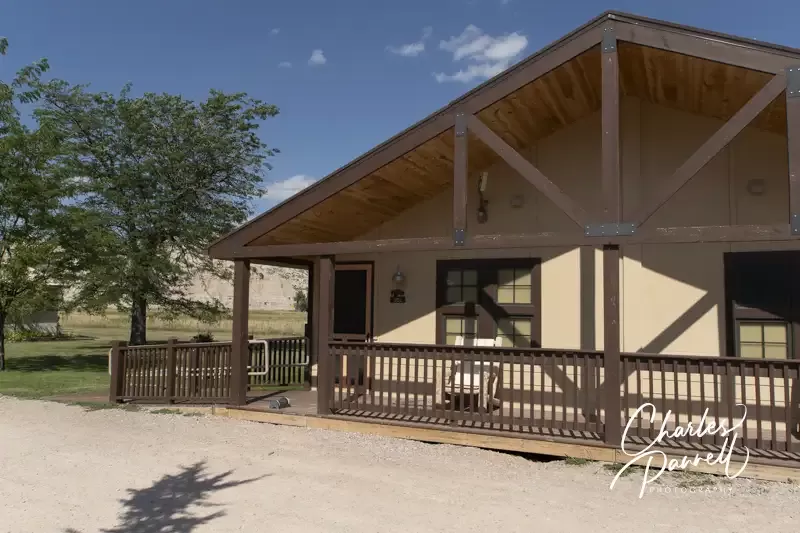
Designed to resemble the rustic 1928 Cedar Pass cabins, this modern incarnation includes all the creature comforts that travelers expect today. It has several accessible cabins, including cabin 101, a duplex model.
Access features include ramp access to the front porch, wide doorways, excellent pathway access, a lowered clothing rod, and wood floors for easy rolling. The interior is equally striking and includes walls paneled with beetle-kill pine from the Black Hills, and furnishings that are hand-crafted from Lodgepole pines.
Furnishings include a 23-inch high bed with wheelchair access on both sides, a table, two chairs, a refrigerator and a microwave. There’s also level access out to the spacious back deck, which is a great place to enjoy the sunset.
The bathroom is furnished with a roll-in shower with grab bars, a hand-held showerhead and a padded shower bench. The toilet grab bars are located on the back and right walls (as seated), and the bathroom also includes a roll-under sink and a lowered mirror. And like the rest of the cabin, there’s plenty of room to maneuver even the largest wheelchair or scooter around the bathroom.
Cabin 101 at Cedar Pass Lodge in Badlands National Park
Image 1 of 4
There’s also good access to the public areas of the property, including the gift shop, registration area and the restaurant. The only in-park lodging option in Badlands National Park, Cedar Pass Lodge makes a great home-base for any wheelchair-accessible Badlands visit. And you just can’t beat the scenery!
If you’d like to hit the beach while visiting the Bay State, then check out these informative websites about accessible beaches in Massachusetts.
This site (www.mass.gov/info-details/accessible-beaches) contains helpful information about the location of all the Massachusetts beaches that have beach mats. These hard rubber mats are rolled out on beaches, and make it possible to traverse them in a standard wheelchair. They are usually rolled out to the high tide line.
This site (www.mass.gov/info-details/beach-wheelchairs) includes information about beach wheelchairs available at Massachusetts beaches. They have two types of beach wheelchairs available for loan on a first-come basis.
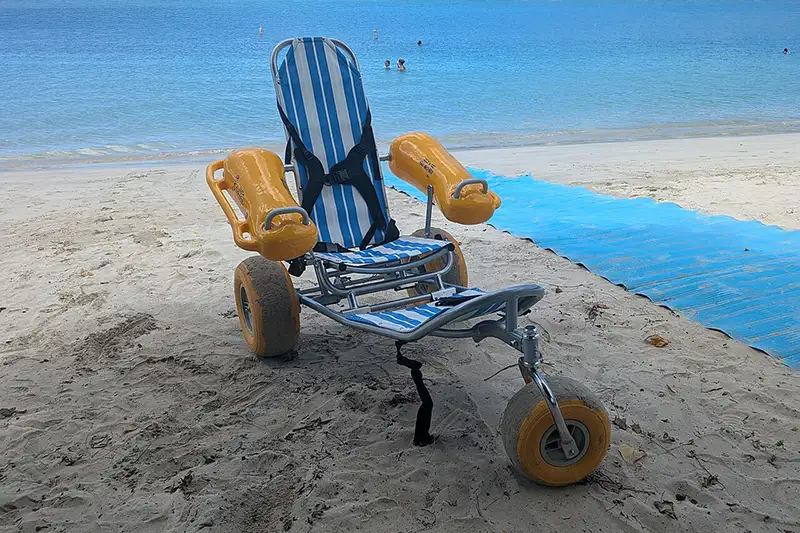
The standard sand beach wheelchairs are made of PVC pipe and have four balloon-like tires. They must be pushed by a companion, and they are not allowed to be taken into the water. They have a weight limit of 275 pounds.
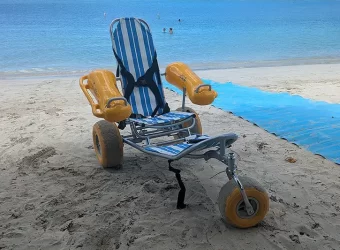
Floating beach wheelchairs, on the other hand, are a great option if you want to get in the water. They have three wheels that are supported by an aluminum frame. These chairs are not self propelling, but they can be pushed from the back or pulled from the front. They have a 330 pound weight limit, and they are great fun in the surf.
This website has a handy table which lists the availability of each type of beach wheelchair, and a direct link to the beach website for more information.
Combined, these two resources offer a comprehensive look at what you can expect to find accessible beaches in Massachusetts.
Barrier-Free Travel Yosemite, Sequoia and Kings Canyon National Parks for Wheelers and Slow Walkers
Located at the foot of Zafarraya Gorge, just an hour from the Malaga Airport, Villa Zafarraya is an excellent lodging choice for wheelchair-users and slow walkers. But it wasn’t always that way. Previously, the three-bedroom two-bathroom unit was not wheelchair-accessible; so prior to an extensive renovation the owners sought input from wheelchair-users to determine how to improve access in their villa. Today, after lots of hard work, the results are apparent, and Villa Zafarraya (www.villazafarraya.com) is now truly a wheelchair-accessible Malaga villa.
The Property
Although wheelchair-access was the ultimate goal of the renovation, the owners also wanted to make Villa Zafarraya a relaxing and inviting lodging option, free from any hospital or institutional trappings. And in that respect they greatly exceeded all expectations.
There’s level access from the parking area to this boutique villa, which can sleep two to six people. Inside there’s barrier-free access, with wide doorways and tile floors for easy rolling. Large windows dot the unit, and there are gorgeous views of the swimming pool and gardens from just about everywhere. The large kitchen features a wheelchair-accessible workspace, as well as appliances that are easy to operate from a wheelchair.
Outside, level cement pathways wind through the gardens and around the swimming pool. There’s ramp access to the pool, and you can roll right into it in the provided water wheelchair. And there’s even barrier-free access over to the quiet little nook under the pergola with a table underneath. No matter where you look, you get that true Mediterranean vibe at this wheelchair-accessible Malaga villa. .
A Wheelchair-Accessible Suite
Great care was also paid to the renovation of the wheelchair-accessible suite. There’s good pathway access throughout the bedroom, which is furnished with a double hospital bed. Rest assured, it doesn’t look like a hospital bed though, as the bedding and interior design bring out a true Mediterranean flavor.
There’s a sliding barn door to the adjacent bathroom, which has plenty of room to maneuver even the largest wheelchair. It includes a Continental (no-hub) shower with a hand-held showerhead, a grab bar and a fold-down shower seat. The shower seat can easily be folded up out of the way if you’d prefer to use the included shower/pool wheelchair. Round out this accessible unit with fold-down grab bars on both sides of the toilet, and a roll-under sink, and you have just about everything you need in this wheelchair-accessible Malaga villa.
The Extras
This beautiful rental comes with a lot of extras, as well as some referrals to sometimes hard-to-find accessible services. First off, as noted earlier, it includes a shower wheelchair that can also be used to access the pool via the ramp. A mobile electric hoist is also included in the rental. And if you want to get out and see some of the sights, a lightweight wheelchair that can be easily folded up and put in the back of a car, comes along with the rental. Additionally, if you need additional medical equipment, the owners can recommend a local equipment rental firm.
Finally, if you need an adapted rental car or caregivers while you are in the area, the owners can refer you to the appropriate folks. It’s a full service rental package. Best of all, you won’t pay extra for any of these access features or services, as this wheelchair-accessible Malaga villa is competitively priced. All in all, it’s a great vacation pick.
Barrier-Free Travel 101 Accessible Vacations Travel Ideas for Wheelers and Slow Walkers


 If you’re planning on a trip to Italy and use are a wheelchair-user or slow walker, here are a few resources to help you in the trip planning process.