As a travel writer since 1977, Candy Harrington has been writing about accessible travel exclusively since 1996. She’s the founding editor of Emerging Horizons, and the author of the popular Barrier-Free Travel national park series. With thousands of bylines to her credit, Candy hits the road often, in search of new accessible travel finds. Candy and her travel photographer husband Charles Pannell reside in NE Washington, where they tend to their chicken flock and enjoy a rural lifestyle.
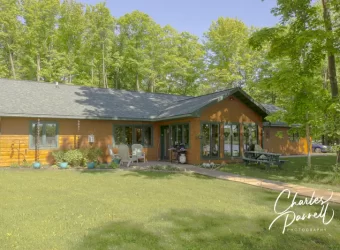
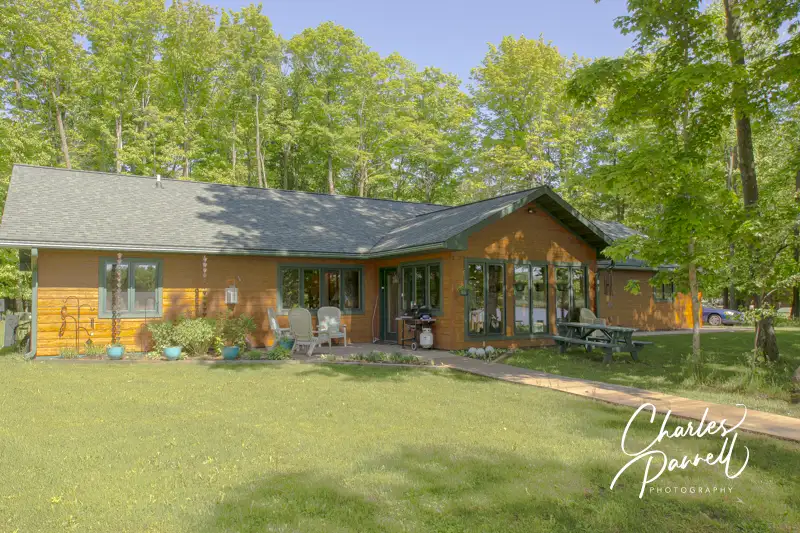
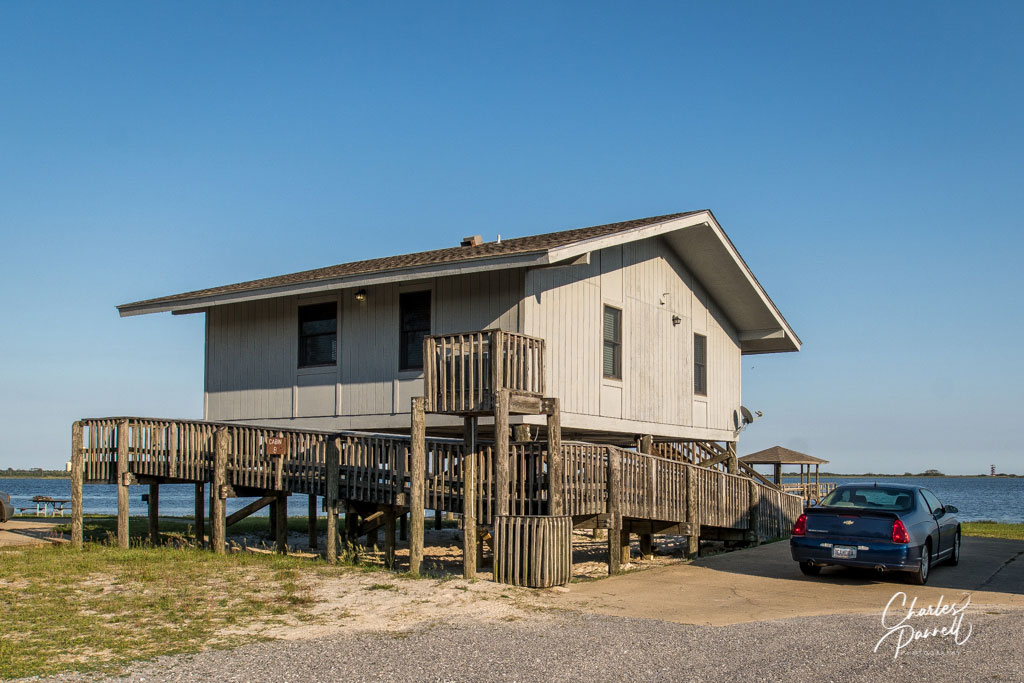
The Overson’s wheelchair-accessible Lake Namakagon cabin
Located in Northern Wisconsin, this wheelchair-accessible Lake Namakagon cabin (vrbo.com/1146321) is the perfect choice for avid fishermen, folks who enjoy water sports, or anyone who just wants to soak in the scenic beauty of the area. As an added bonus, this comfortable home is owned by two people who intimately understand access issues – Susan and Mark Overson. Mark, who uses a manual wheelchair, enjoys the great outdoors, and enthusiastically encourages other wheelers to do the same. Of course the Oversons absolutely love their lakeside retreat, but they are equally excited about being able to offer it to others who have mobility issues.
A Cabin on the Lake
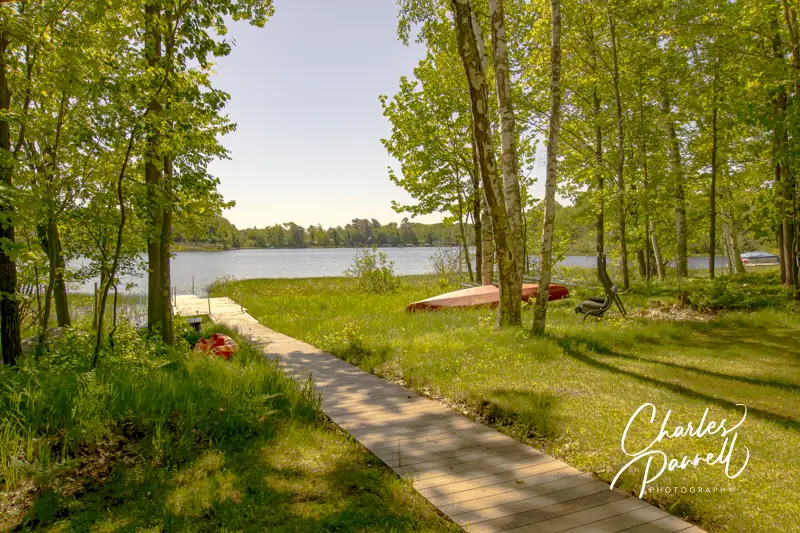
Pathway to Lake Namakagon
As a result of their extensive experience, the Oversons did an excellent job equipping their wheelchair-accessible Lake Namakagon cabin. There’s level access up to the front door, with wide doorways and barrier-free access throughout the home. The open floor plan includes a living room with a fireplace, a gourmet kitchen, a master suite with a bath, two additional bedrooms, another bathroom and a sun porch that doubles as a bedroom.
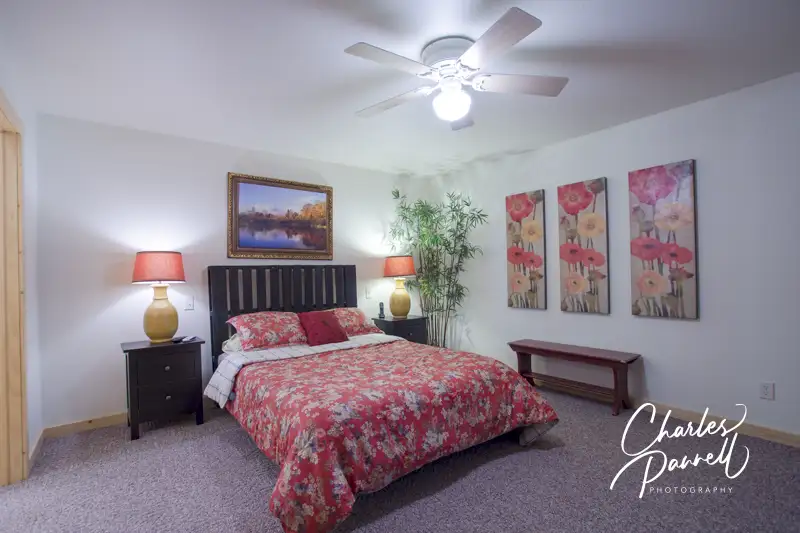
Master Bedroom at the Overson’s Lake Namakagon Cabin
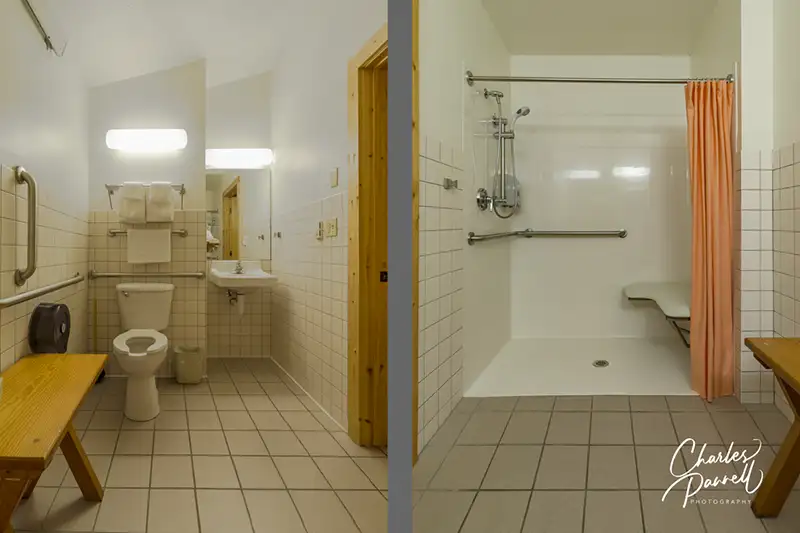
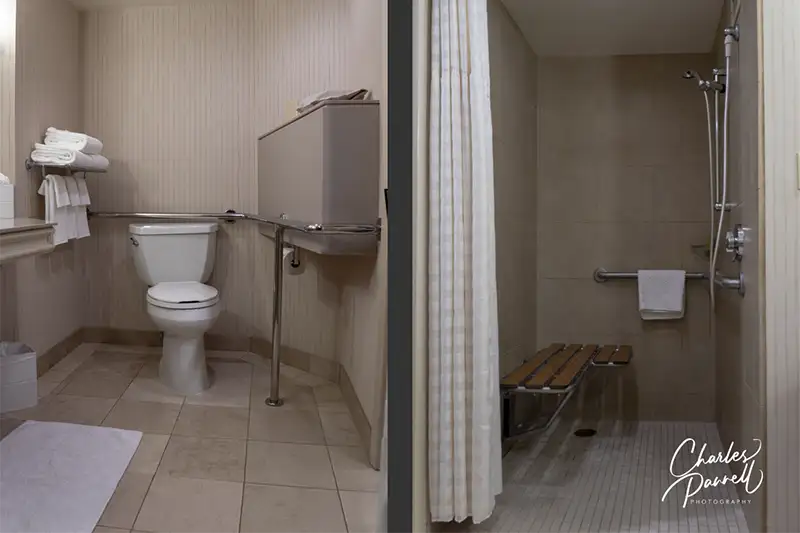
The master bedroom is furnished with an adjustable 20-inch high king-sized bed with wheelchair access on both sides. There’s barrier-free access to the adjacent master bathroom, which is equipped with a roll-in shower with grab bars and a hand-held showerhead. The toilet has grab bars on the back and right walls (as seated), and the spacious bathroom can accommodate even the largest wheelchair or scooter.
Master Bathroom at the Overson’s Lake Namakagon Cabin
The other two bedrooms are furnished with a 22-inch high full-sized bed, and a 20-inch high trundle bunk bed. Additionally, the sun room has an adjustable queen bed.
There’s level access out to the laundry room, which is equipped with a washer and a dryer. A large garage is also attached to the cabin, and as an added bonus it has a heated floor, which is a great feature for a year-round retreat in this area.
Outside, the patio is furnished with some Adirondack chairs and a gas grill. And then there’s the lake, which is located down an accessible path from the back door. There is also an accessible fire pit along the way to the dock, and a picnic table near the cabin. It’s a very comfortable and accessible cabin, with a location that you just can’t beat.
The Little Extras
Susan definitely provides her guests with important details about things to do in the area, including a binder filled with access information. And what’s not to love about a place that has an accessible travel book in the library? And of course Susan knows the local area, so if you need any additional information, feel free to ask.
If you’d like to do a little paddling while you’re staying at this wheelchair-accessible Lake Namakagon cabin, there’s also a selection of kayaks and life vests in the garage. Mark chose ocean kayaks for their stability, and he has a tandem one that will work for people with limited upper body strength.
The Oversons also have a standard pontoon boat available for rent. You can just roll on to it from the dock, then take it out and drop anchor and wait for the fish to bite. There are two fishing chairs in the front, or you can fish from your wheelchair.
And if you visit during the winter, then give Mark’s accessible ice fishing house a try. It features a back wall that folds down and acts as a ramp, three fishing holes and a propane heater. After you are safe and secure inside, the back ramp can be folded back up so you can fish in heated comfort. Best of all, they have folks who will tow it out on the lake and set it up, supply the bait and the fishing gear, and even clean your catch. It’s the easy — and accessible — way to enjoy ice fishing.
Road trips are an excellent vacation choice for wheelchair-users and slow walkers. Not only can you take things at your own pace on a road trip, but you can also map out a custom itinerary that includes accessible attractions, rest stops and lodging choices. Plus you can pack along all of your equipment, and you don’t have to worry about wheelchair damage by airline baggage handlers.
Additionally, a wheelchair-accessible road trip is are a great way to explore small towns that are often overlooked on large group tours. And although some small towns may lack accessible facilities, that’s not the case across the board. With that in mind, here are 36 towns across America that have wheelchair accessible lodgings, attractions and even trails. Some are along less traveled byways, some are near national parks, and some are located on popular road trip routes; however they’re all worthy of consideration on your next road trip adventure. So add them to your itinerary on your next wheelchair-accessible road trip.
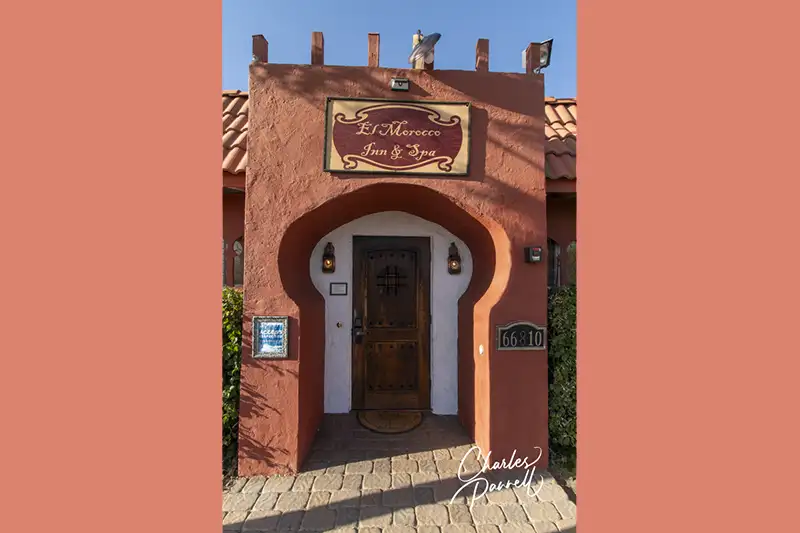
As you walk under the entry arch and peel back the heavy brocade curtains at the El Morocco Inn & Spa (www.elmoroccoinn.com), you’re instantly transported to another world – one that’s filled with the sights, sounds and even the smells of Morocco. From the bright blue doors and the massive ceramic pots throughout the courtyard, to the smell of incense wafting on the desert breeze, and strains of Moroccan music in the background, you definitely get that “I’m not in Kansas any more” feeling as you enter this sanctuary.
And that’s exactly the reaction that Bruce Abney wants all of his guests to have – he wants everyone to have an amazing experience at his little piece of Morocco in the middle of Desert Hot Springs. And the good news is, Bruce’s desert oasis is also accessible for wheelchair-users and slow walkers.
A Man with a Vision
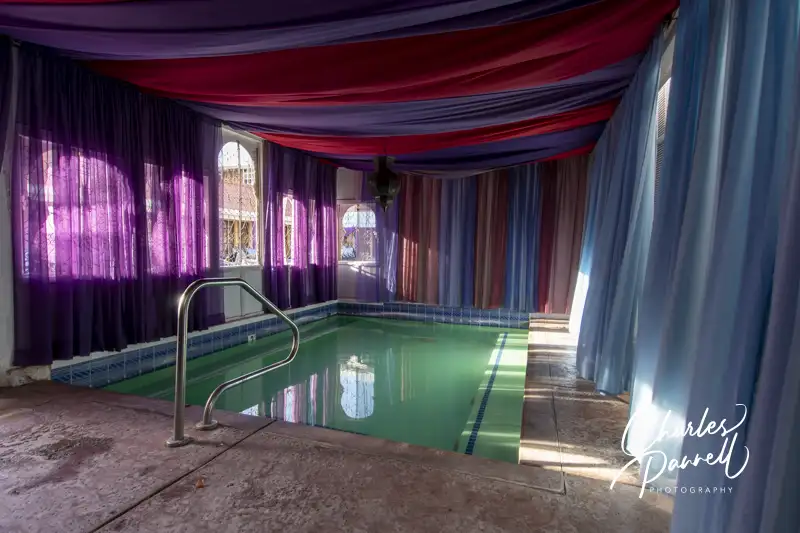
Hot Spring Soaking Pool
Built in the late 1950s the El Morocco Inn was originally known as the Caravan Spa-tel. The property thrived in the 50s and 60s, when Desert Hot Springs was known as “California’s Spa City”. Visitors traveled for miles to soak in the healing waters. Unfortunately, many of the resorts closed over the years — including the Caravan Spa-tel — because of the high cost of maintaining the hot springs. Bruce stepped into the picture in 2001, when he purchased the property and proceeded to transform it into a Moroccan paradise.
As a child, Bruce was intrigued by the El Morocco Hotel in Las Vegas, so when the Caravan Spa-tel renovations began, that Las Vegas property became his inspiration. He also immensely enjoyed his own journey to Morocco, and he wanted to create that feeling of “being a million miles away from home” for his guests. And he wanted something authentic, so he purchased handwoven fabrics from Moroccan co-ops, and filled the property with goatskin wrapped lights and hanging lamps that cast mesmerizing geometric shadows. “Even the tent in the Spa Garden is the real deal, as are the little touches like the succulent dates available in the Kasbah Lounge,” says Bruce.
As for his inclusive attitude and his decision to add top-drawer access features to this 13-room property, Bruce chalks it all up to “good hospitality”. “I had to ask myself ‘Did I want to share this experience with as many folks as possible who might enjoy it?,’” says Bruce. “The answer back to myself was a heartfelt yes, so I decided to go all out,” he adds. So although the inn itself has the look and feel of a Marrakech riad, it also has first-rate access features for wheelchair-users and slow walkers.
An Accessible Oasis
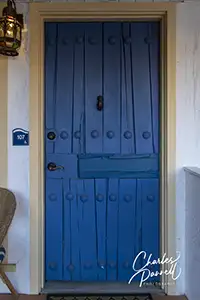
Door to room 107
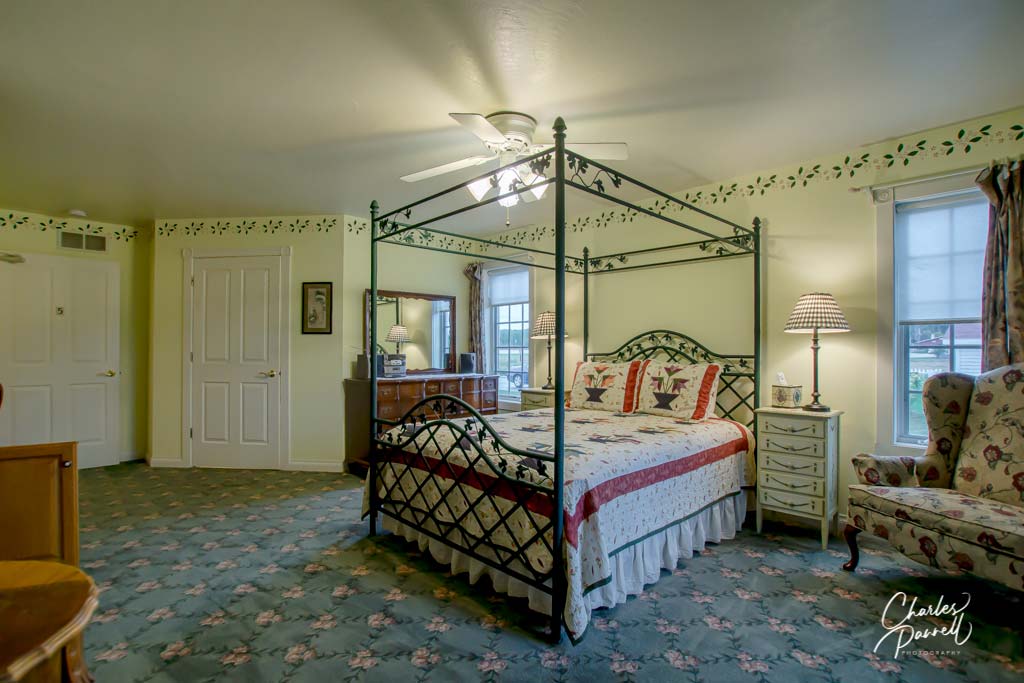
El Morocco’s access begins in the parking lot, with accessible parking and level access to the front door. Inside there’s barrier-free access to the front desk, and ramp access into the courtyard. Accessible room 107 is located on the opposite side of the courtyard. And In keeping with the Moroccan theme, the room is a patchwork of vivid colors, with a sheer canopy with tassel accents hanging above the bed.
Access features include ramp access, wide doorways, lever handles and good pathway access. It’s furnished with a 27-inch high open-frame king-sized bed with wheelchair access on the right side (as you face it), but there’s plenty of room for it to be moved over if you require wheelchair access on the left side. Other furnishings include two night tables, a chair, a wardrobe, a chest of drawers, a mini-fridge and a microwave.
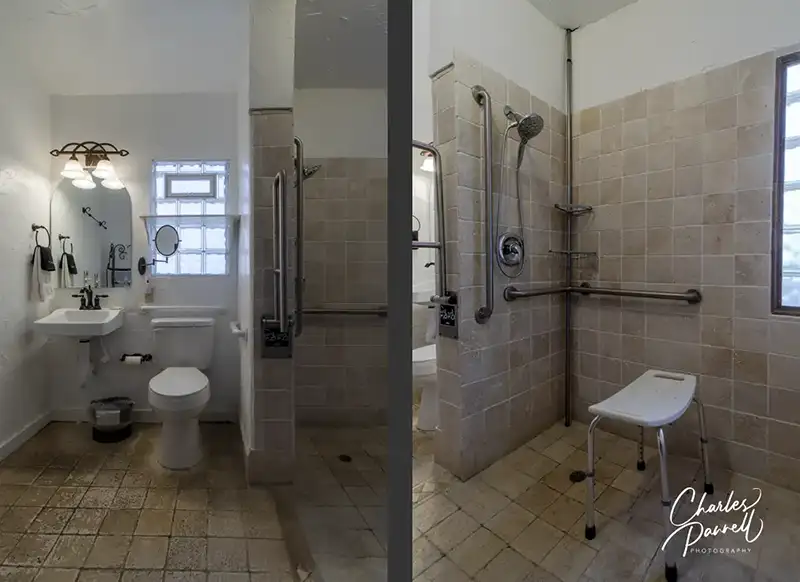
Room 107 at the El Morocco InnBathroom in Room 107 at the El Morocco Inn
A wide sliding barn door leads into the spacious bathroom, which has a full five-foot turning radius and is equipped with a custom-built roll-in shower with grab bars, a hand-held showerhead and a portable shower bench. There’s also a set of fold-down grab bars for easier transfers. The toilet grab bars are located on the back and left walls (as seated), and the bathroom also has a roll-under sink, a lowered mirror and a lowered towel bar. And even with all those access features, the bathroom still retains the Moroccan ambiance with colorful accent pieces.
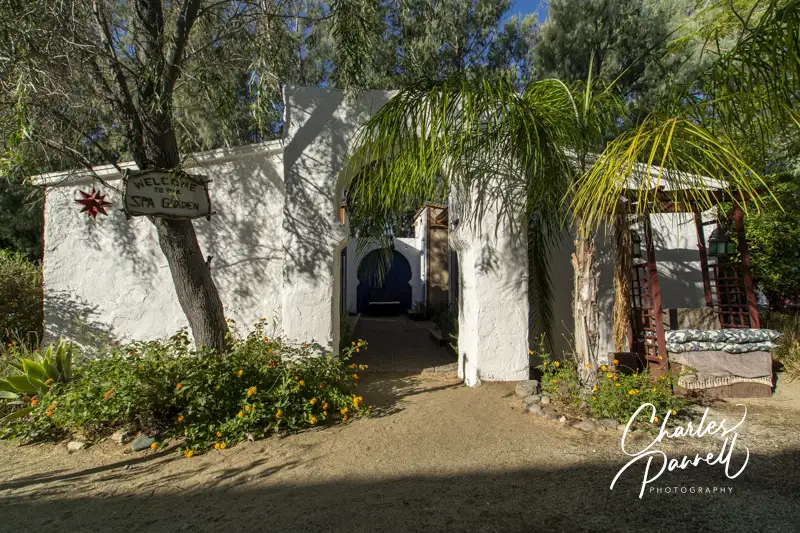
There’s wheelchair-access to the public spaces as well, including the Kasbah Lounge, the Spa Garden, the outdoor showers and the public restroom. There’s also plenty of room for even the largest wheelchair or scooter to maneuver around the lift-equipped mineral pool, and over to the fire pit.
But Wait – There’s More
Spa Garden at the El Morocco Inn
In the end, it’s the little extras that make for a memorable getaway, and the El Morocco Inn has no shortage of those. At the top of the list is breakfast. Although it’s called a Continental breakfast, I’d actually describe it as a Continental-plus affair. Each morning the Kasbah Lounge is filled with fresh fruit, juices, freshly baked goodies, hard-boiled eggs and all the accompaniments to put together a luscious — and filling — meal. And the pièce de résistance? French press coffee. Guests can either choose to enjoy their repast at one of the courtyard tables, or in their own rooms.
Even the spa treatments have a taste of Morocco – minus the overzealous exfoliation treatments found in the hammams. Guests can choose from a variety of massages and body treatments including a Moroccan clay body mask, which uses Moroccan Rhassoul clay. Known for its ability to stimulate cell renewal, this treatment revitalizes and softens the skin.
And last but not least, there’s the library – a little nook located next to the Kasbah Lounge. Filled with books and DVDs to borrow, it’s a cozy spot to retreat and relax. Alternatively, you can watch that Bogart classic, Casablanca, which plays on a continuous loop throughout the day. A subtle nod to El Morocco’s roots, the film also creates the perfect ambiance for this wheelchair-accessible oasis in the California desert.
Barrier-Free Travel the Grand Canyon for Wheelers and Slow Walkers
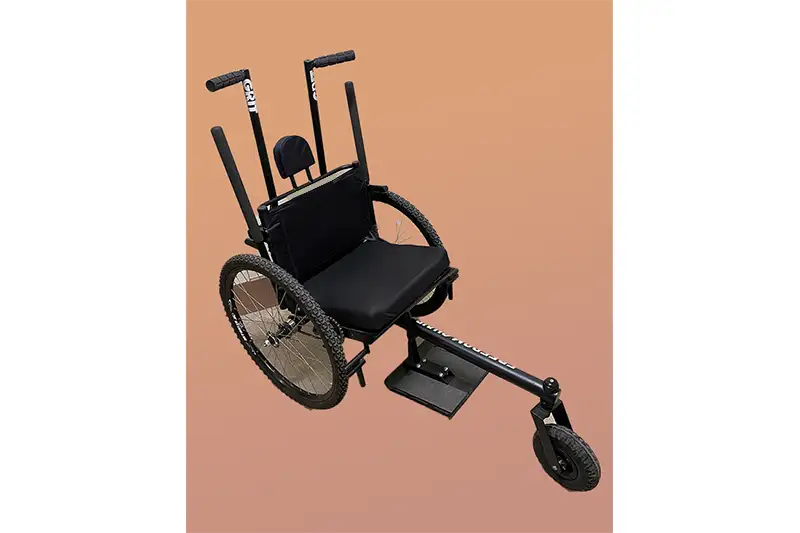
In order to make their natural areas more accessible to wheelchair-users and slow walkers, a number of Texas state parks offer GRIT Freedom Chairs. The GRIT Freedom Chair is a cross between a manual wheelchair and a mountain bike, and it allows wheelchair-users and slow walkers to access rugged terrain or sandy beaches.
Built with mountain bike parts, the GRIT Freedom Chair has three wheels – two standard wheelchair wheels on the sides of the seat, and a smaller wheel in front of the chair. It’s easier to self-propel than a standard wheelchair, thanks to the lever handles installed on each side of the seat; however there are also push handles on the back of the chair for folks who need more assistance. Add in some all terrain tires, and you have a rugged wheelchair, built to tackle rougher terrain. And although GRIT Freedom Chairs are easy to transport, these Texas State Parks offer loaner models on site.
And the good news is, thanks to the popularity of these GRIT Freedom chairs, more and more Texas state parks are adding them to their inventory. So check out this updated list to see if any additional Texas State Parks offer these adaptive wheelchairs tpwd.texas.gov/state-parks/park-information/accessibility/assistive-chairs.
Barrier-Free Travel
Utah National Parks for Wheelchair-users and Slow Walkers
Calaveras County played an integral part in the California Gold Rush, as folks flocked to the area in hopes of striking it rich. Today the 49ers are long gone; however there’s another rush in this famous county — a wine rush, of sorts. The mining equipment of yesteryear has been replaced with vineyards and tasting rooms, as over two dozen wineries now dot the county.
And there’s no better place to enjoy the fruits of the harvest then in the tiny hamlet of Murphys. Located two hours southeast of Sacramento, this quaint town is a wine lovers paradise, as it boasts a gaggle of tasting rooms along the main drag. And even if you can’t walk or roll very far, there are still some excellent choices along this wheelchair-accessible Murphys wine tasting route.
Getting Around Downtown
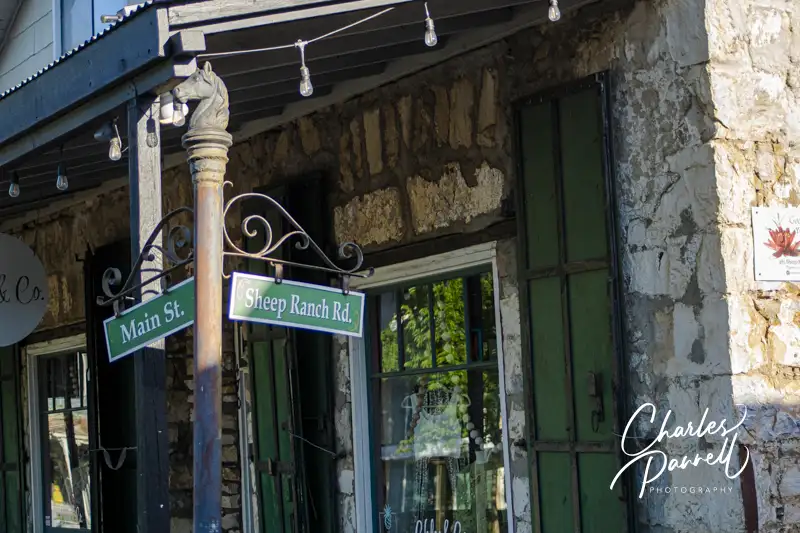
Street Signs and Historic Building in Downtown Murpyys
Although Murphys is a historic town, access upgrades have been added over the years. Accessible parking can be difficult to locate, but the Murphys Creek Theater lot on Algiers Street has the largest number of accessible parking spots. The lot is located about 150 yards off of Main Street, but manual wheelchair-users may require some assistance getting up the steeper section of Algiers Street to access the main drag.
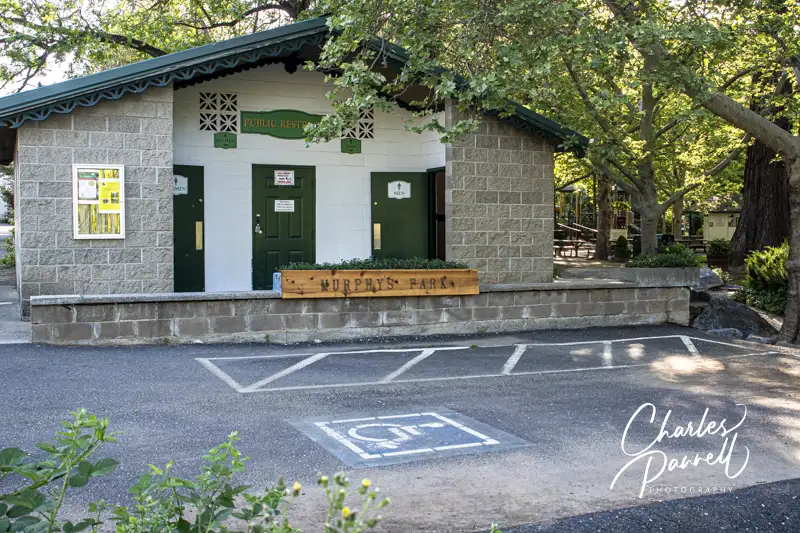
There is also one accessible parking spot next to the City Park restrooms, just down the street from the theater. Additional accessible parking is available in the public lot on Church Street and in the lot behind the Victoria Inn, both of which offer level access to Main Street. And if you can’t walk far, there are two tasting rooms close to accessible parking in Country Square on Main Street.
Most of the sidewalks in town are relatively free of obstructions, and once you get on Main Street, everything is pretty level. Although there are a few steps here and there, it’s still possible to navigate downtown in a wheelchair. Granted, some shops are housed in historic buildings with one or two steps, but all of the tasting rooms mentioned below have barrier-free access.
City Park restrooms in Murphys, California
Take a Wine Stroll
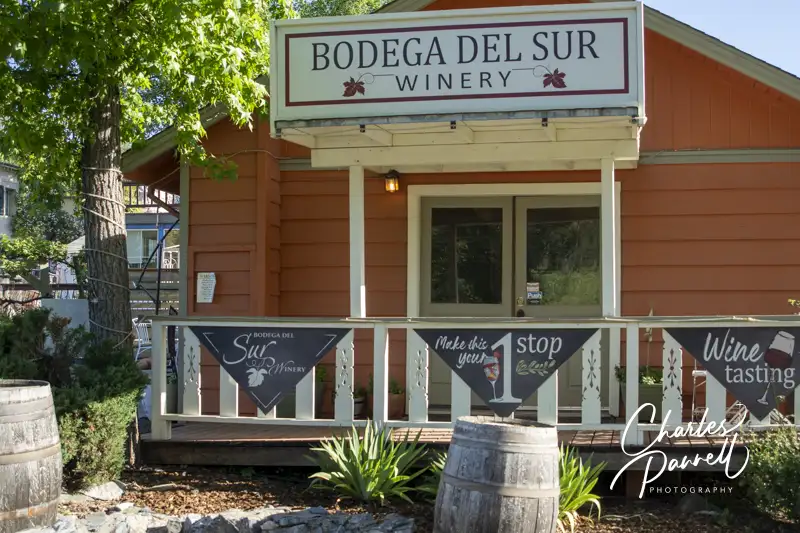
Bodega del Sur in Murphys, California
The Bodega del Sur (bodegadelsur.com) tasting room, which is located on Algiers Street just shy of Main Street, makes a good first stop on any wheelchair-accessible Murphys wine tasting stroll. There’s level access to the tasting room with plenty of room for wheelchairs and scooters inside. This boutique winery features wines made from locally grown grapes, with a decidedly Latin influence.
The Tanner Winery (tannervineyards.com) tasting room is a short walk away on the corner of Algiers and Main Streets. There is level access to the tasting room, where samples of Cabernet Sauvignon, Carignane, Barbera, Mourvèdre and several blends can be had.
Wrap up your Murphys wine tasting stroll at Newsome Harlow (nhvino.com), which is located on Main Street, near Church Street. The tasting room offers level access through the courtyard, with plenty of room to roll around inside. A Murphys favorite, this winery is heavy on the reds and it produces some excellent Zinfandels.
Stay Put and Sip
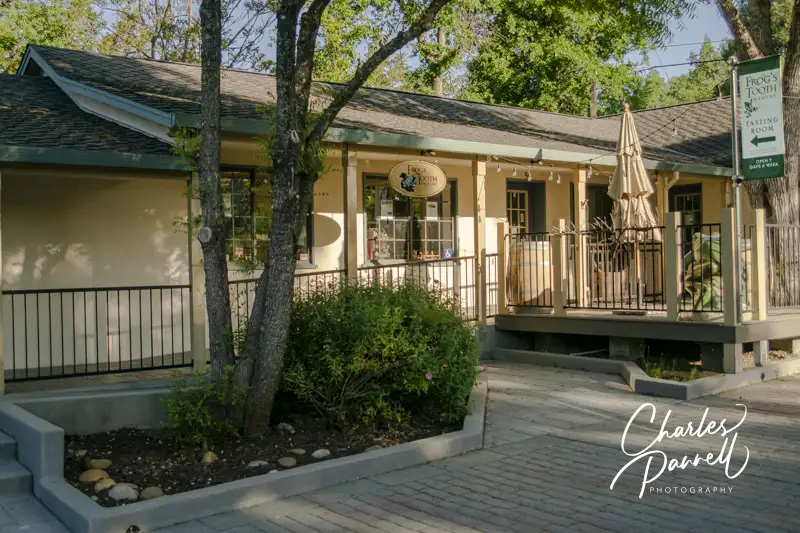
If all that strolling is a bit too much for you, you can also opt to park close to a few tasting rooms in Country Square. Accessible parking is located off of Main Street, but it can only be accessed by vehicle from the back entrance. From Main Street, turn north on Church Street, then make a left at the stop sign. Country Square is the third driveway on the left, past Murphys Pourhouse and Murphys Professional Center. And as luck would have it, the accessible parking space is right across from the Frog’s Tooth
There’s ramp access up to the Frog’s Tooth tasting room and the adjacent deck. Inside you’ll find wood floors, plenty of room to maneuver a wheelchair and a lowered bar. Frog’s Tooth is known for their small batch locally produced wines. Favorites include Tempranillo, Syrah, a variety of red blends, Viognier, Sauvignon Blanc and Rose.
And if you’d like to try another winery, Jazz Cellars (jazzcellars.com/) is located just across the courtyard from Frog’s Tooth. There’s barrier-free access to this tasting room, which features wide doorways and level access. Have a taste of their award-winning Barbera, Viognier, Sauvignon Blanc, Zinfandel or Syrah. And in keeping with their name, you can also often find live music at Jazz Cellars. It’s a great way to top off any wheelchair-accessible Murphys wine tasting stroll.
Barrier-Free Travel Yosemite, Sequoia and Kings Canyon National Parks for Wheelers and Slow Walkers
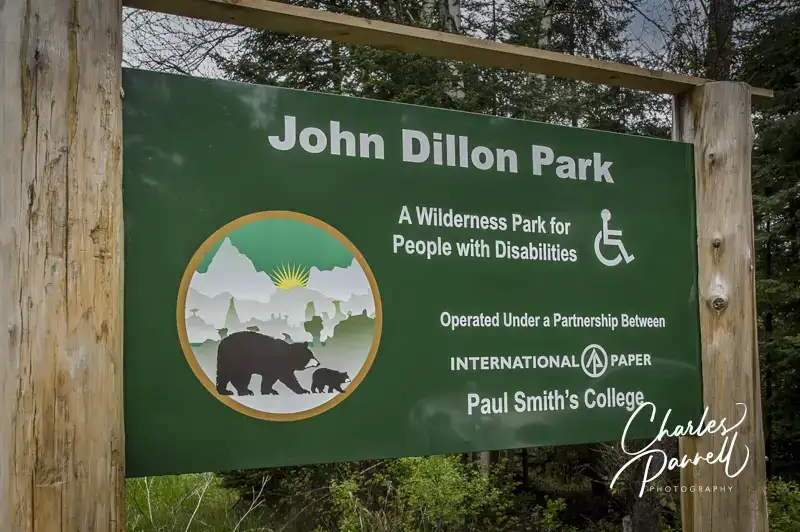
Located 15 miles from Tupper Lake in upstate New York, John Dillon Park (www.paulsmiths.edu/john-dillon-park) is a wheelchair-accessible Adirondack wilderness facility. This purpose-built camp, which is the result of a partnership between International Paper and Paul Smith’s College, was designed from the ground up to be accessible. The vision of International Paper’s former CEO John Dillion, this namesake park is the first facility of its kind. And the goal of its creators is simple – to make the natural landscape of the Adirondacks accessible to wheelchair-users and slow walkers. And, they did an excellent job.
Camping Adirondack Style
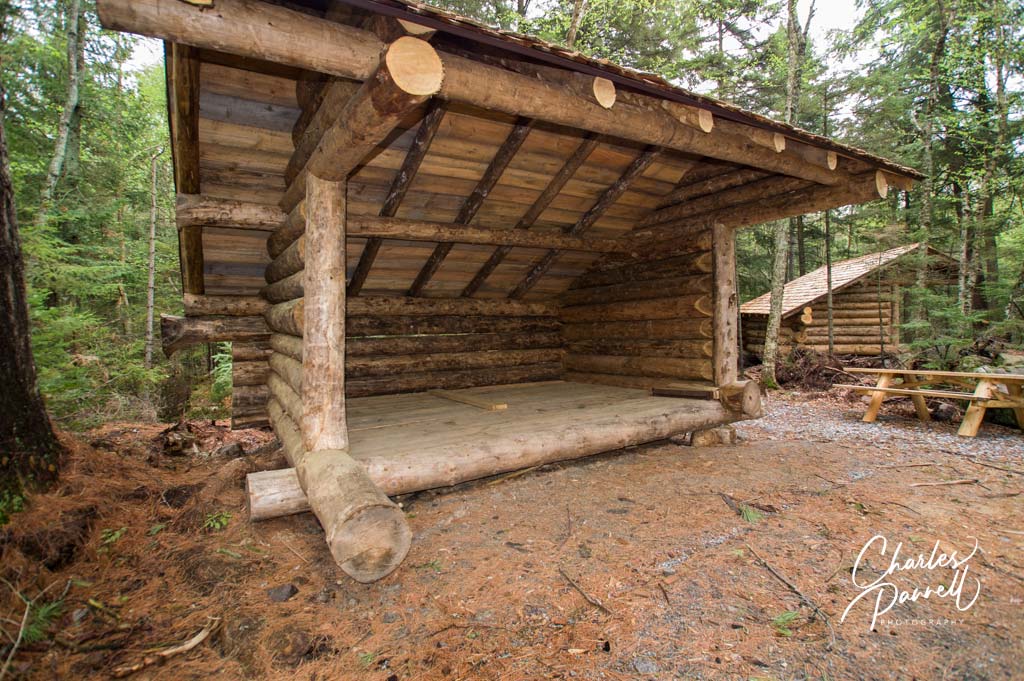
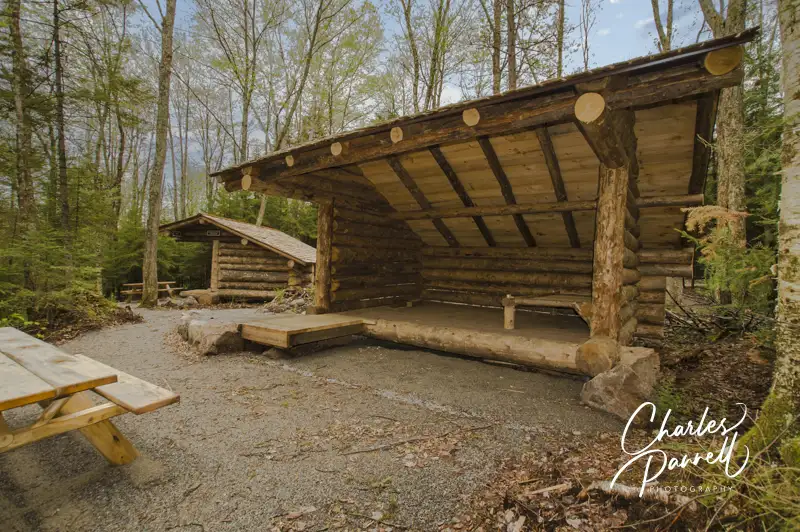
Lean-to at John Dillon Park – A Ramp Has Been Added
Located about two miles off the main road, John Dillon Park offers campers a chance to get away from the crowds and camp in a wheelchair-accessible Adirondack lean-to or tent. Accessible parking is located near the Welcome Center, which features barrier-free access and plenty of room to maneuver a wheelchair or scooter inside. There’s also an accessible flush toilet (the only one in camp), and a refrigerator for medication storage. After campers register, they set-off to one of the accessible lean-tos or to the tent site on the property.
The only lean-to you can drive to — Bear Cub — is located near the Welcome Center. The others are built in pairs along an accessible trail; with the farthest ones being about 2.5 miles from the Welcome Center. A golf cart is available to help folks transport their gear, so assistance is available if needed.
The lean-tos are open on one side, and they have ramped access. They are equipped with a fold-down bed, a fire ring, an accessible picnic table and a food locker. Accessible composting toilets and potable water are also located at each lean-to site. Additionally, there’s one large accessible tent site, which is located about .04 mile from the Welcome Center. This level site has an accessible fire pit, picnic table and outhouse. And if you happen to have a power wheelchair that needs a charge, a solar powered battery charger can be wheeled to your site upon request.
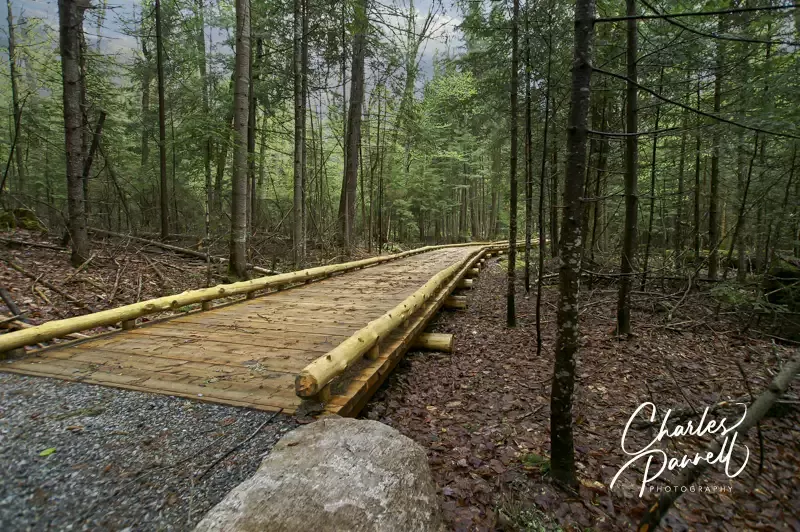
And there’s lot of things to do once you set up camp. With over three miles of accessible trails at John Dillon Park, there’s no shortage of places to explore. Add in an accessible fishing and kayak dock, and an accessible pontoon boat, and you have all the ingredients for a full fledged wheelchair-accessible Adirondack adventure.
Boardwalk Trail at John Dillon Park
Image 1 of 3
Reserve Your Spot
There is no charge to use John Dillon Park, but it’s only open to people with disabilities and their companions. Dogs are permitted, but they must be leashed and they can never left unattended. A valid rabies certificate is required for all dogs. This wheelchair-accessible Adirondack retreat is a quiet place, and no partying, loud music or firearms are permitted. Anyone who does not comply with the rules will be asked to leave.
The maximum stay at John Dillon Park is five nights. Reservations are recommended, although walk-ins can sometimes be accommodated on a space available basis. The park is open from late May through early September. For more information call (518) 806-9774 (summer season only) or e-mail dillonpark@paulsmiths.edu. Reservations can be made online at ipjohndillonpark.checkfront.com/reserve/. So gather your camping gear and get ready to enjoy the accessible Adirondacks this summer.
Welcome Center at John Dillon Park
Barrier-Free Travel the Grand Canyon for Wheelers and Slow Walkers
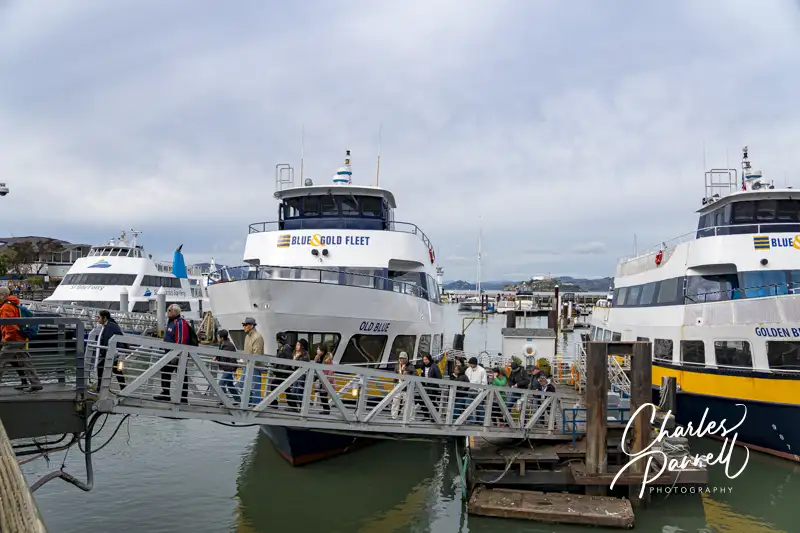
Blue and Gold Fleet cruise boat entering San Francisco Bay
At first glimpse San Francisco seems a challenge for anybody with mobility issues. After all, hills aren’t very wheelchair friendly. And although there’s certainly no shortage of steep streets in the City by the Bay, there are also some level and accessible areas. Take the Embarcadero and Fisherman’s Wharf area, for example. Not only is this popular tourist haunt level and accessible by public transportation, but there’s also a wide variety of attractions to choose from in the area. So here’s the low down on how to explore San Francisco in a wheelchair.
Getting There
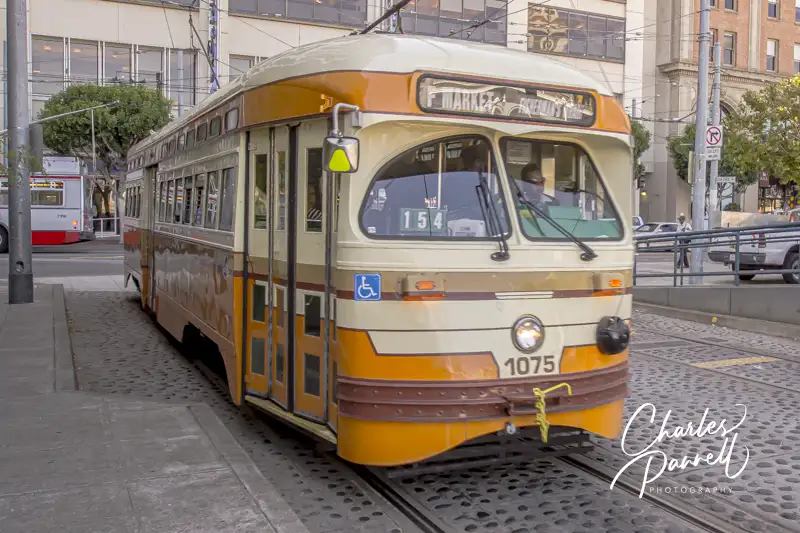
Vintage F-Line Streetcar
There’s no doubt about it, public transportation is the easiest way to explore San Francisco in a wheelchair; and in that respect BART (www.BART.gov) — the local regional rail service — tops the list. All BART trains feature roll-on access, with wheelchair spaces located near the doors. Additionally, all BART stations feature elevator access.
The Embarcadero BART station is conveniently located near the F-Line Streetcar (www.streetcar.org/rider-information-map-2/) stop at Main and Drumm, so it’s easy to get to Fisherman’s Wharf in two accessible legs. Riding the F-line is fun too, as these vintage streetcars have been lovingly restored to their previous glory. And unlike the iconic cable cars, the F-Line Streetcars feature wheelchair access via raised boarding platforms along the route. In short, it’s a very nostalgic way to get to Fisherman’s Wharf.
Cruising!
Blue and Gold Fleet on San Francisco Bay
After you take in the views at Fisherman’s Wharf, follow the accessible sidewalk up to Pier 39 for breakfast at the Eagle Cafe (eaglecafe.com). The eatery is located on the second floor, and the elevators are tucked away under the bridge on the right. This landmark cafe has been serving hungry diners since 1928, and it’s know for its generous portions, so it’s the perfect place to fuel up for the day.
Next door you’ll find level access to the kiosk for the Blue and Gold Fleet (www.blueandgoldfleet.com), which offers an informative and accessible cruise around the bay. There’s level access to the boat and wheelchair access on the main deck, where the accessible restrooms and the snack bar are located. This 60-minue narrated cruise heads out under the Golden Gate Bridge, then cruises around Alcatraz before it returns to the dock. And along the way it offers a good introduction to the history and the culture of the City by the Bay.
Under the Bay
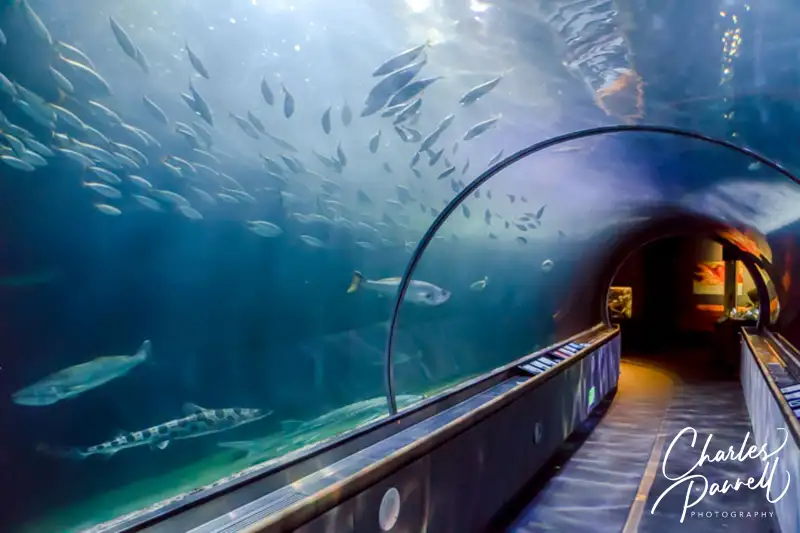
Aquarium of the Bay on Pier 39 in San Francisco
After you’ve seen the bay from above, save some time to explore its deeper reaches at the Aquarium of the Bay (www.aquariumofthebay.org) on Pier 39. There’s a flight of stairs up to the main entrance, but there’s also an elevator to the left of the stairs. Inside, there’s barrier-free access around the exhibits. The top floor includes a nice sampling of fish found in the bay, while the lower level includes 300 feet of crystal clear tunnels under the bay.
There’s barrier-free access to the lower level with wide pathways through the acrylic tunnels. The Nearshore Tunnel features fish of the bay, while the Shark Tunnel offers a collection of sharks, rays and sturgeons. Try and schedule your visit at feeding time, as the fish are most active then.
Top off your visit with a stop at the touch pools and ecological exhibits on the second floor. All in all this mid-sized aquarium presents a comprehensive overview of the marine inhabitants and ecosystems of the region.
Not Just for Kids
Inside the Exploratorium on Pier 15 In San Francisco
After you’ve had your fill of underwater fun, hop on a F-Line Streetcar across the street from Pier 39, at Beach and Stockton Streets. Next stop — Pier 15, home of the Exploratorium (https://www.exploratorium.edu/). This interactive museum presents educational exhibits on science, art and human perception, that truly challenge your mind. And although there’s no shortage of kids at this playground for you mind, it’s also lots of fun for adults — even those without kids in tow.
There’s level access to the front entrance and barrier-free access throughout the galleries. Most of the exhibits are constructed at wheelchair-height, so it’s really quite inclusive. Accessible restrooms are located in the lobby, and a family restroom is located near the first gallery in the atrium.
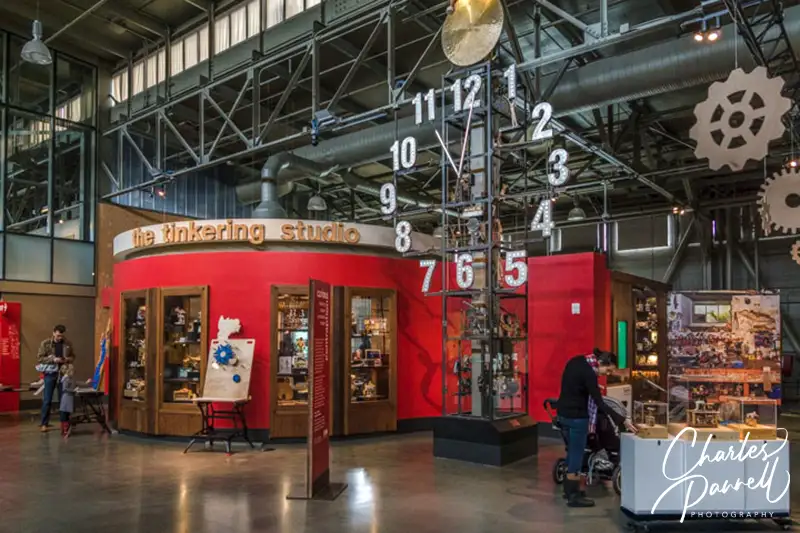
Exhibits range from those on the science of sharing and tinkering, to some that focus on the mechanics of vision, sound and hearing, with a little bit of everything else in between. And don’t miss the Bay Observatory Terrace — which features elevator access — for a splendid view of San Francisco Bay.
Additionally, the Sea Glass Restaurant, located at the east end of the museum, makes a nice lunch stop. It’s not frequented by the school groups, so it provides a quiet respite from the museum hubbub. It offers a lovely ocean view, has good pathway access, and the menu includes a nice selection of sushi, salads, hot dishes and sandwiches.
Stroll to the Ferry Building
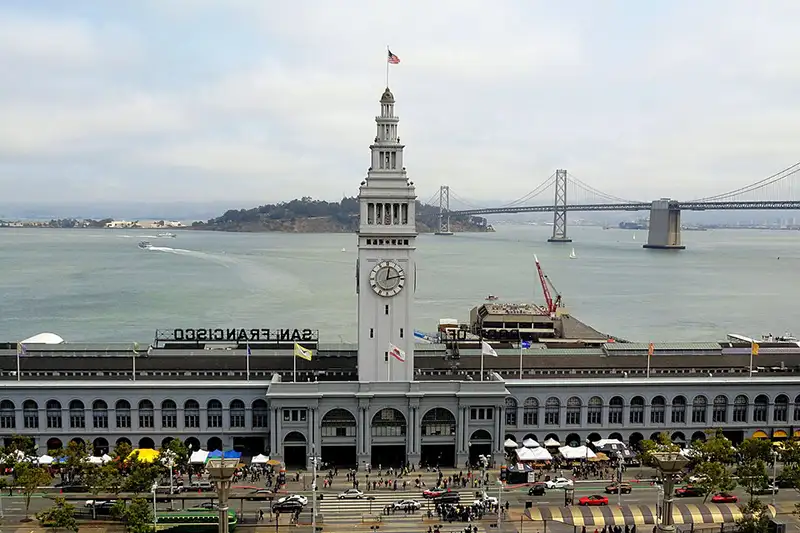
Ferry Building on the Embarcadero in San Francisco
Last but certainly not least on this San Francisco in a wheelchair itinerary is the Ferry Building, which is a short stroll from the Exploratorium. But first, a short detour is in order — just follow the Public Shore signs at Pier 17 next to the Exploratorium. This accessible path leads around the back of the Exploratorium to the bay, and features a number of interactive Exploratorium exhibits along the way. It’s just a short half-mile walk on a level sidewalk, but the bay view is definitely worth the detour.
Once you return to the Embarcadero, you can either turn left and follow the sidewalk along the street, or look for the Public Shore signs and opt for the scenic route along the bay. Either way is accessible, and soon you’ll find yourself at the historic Ferry Building (www.ferrybuildingmarketplace.com).
Opened in 1898, the Ferry Building was once a transportation hub for passengers arriving in San Francisco by train and ferry. Sadly with the development of local roadways and bridges, the popularity of the Ferry Building fell off in the 1950s. It was subsequently gutted and converted to office space. The building was later renovated to its prior glory some 50 years down the road, and it reopened in 2003 as The Ferry Building Marketplace. Today it houses a mouth-watering collection of tenants who offer everything from coffee, biscuits and cheese, to mushrooms, chocolate and even wine. Add in some locally sourced restaurants and a few specialty shops, and you have a complete gastronomic marketplace.
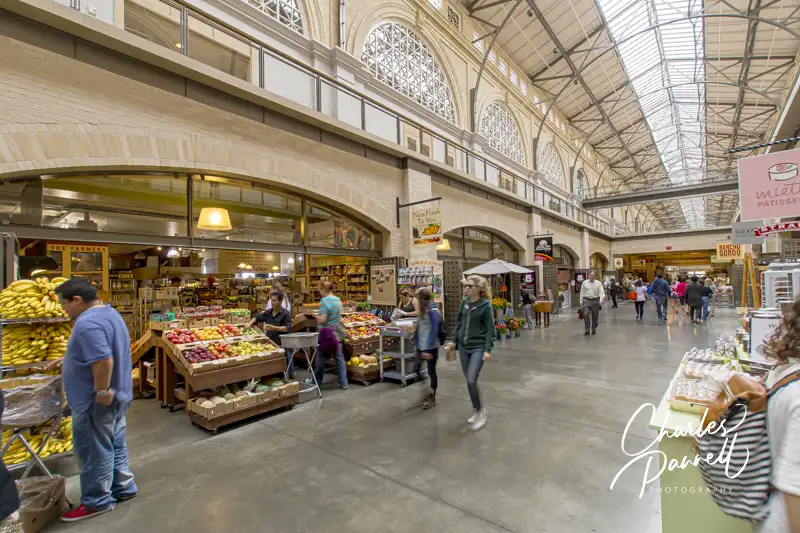
Access inside this historic building is good too, with barrier-free access to all the vendors, and spacious accessible restrooms on site. Take your time and wander through the building — sample some cheese, have a cup of coffee and admire the beautifully restored interior.
Inside the Ferry Building on the Embarcadero in San Francisco
Spend the Night
And when you’re ready to call it a day, the Embarcadero BART station is just a short level walk across the street from the Ferry Building. Alternatively, if you’d like to spend the night, the Parc 55 (https://www.hilton.com/en/hotels/sfosfhh-parc-55-san-francisco) is an excellent lodging choice. Located near the Powell Street BART Station, this 1024-room property has all the required business and conference amenities, but the overall layout and design conjures up a decidedly boutique hotel ambiance.
The accessible entrance to the property is located near the valet station, with elevator access up to the second-floor lobby. There’s good pathway access around the lobby and plenty of room to maneuver a wheelchair in the open floorplan. The hotel is also equipped with smart elevators, which eliminate congestion. Guests simply enter their destination floor on the keypad outside the elevator, and they are directed to the appropriate car. And no congestion means other guests don’t crowd in front of wheelchair-users.
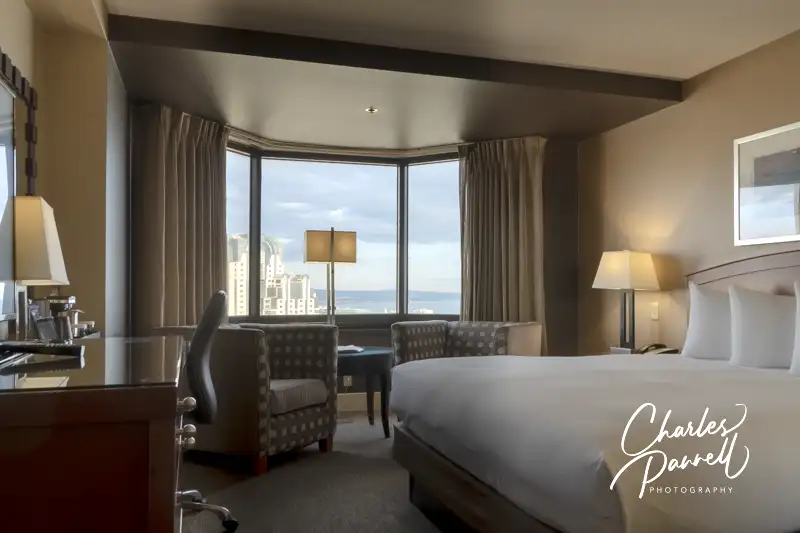
Room 2911 is one of 28 accessible rooms at the Parc 55. Access features include wide doors, lever handles, good pathway access, a lowered closet rod and low-pile carpet for easy rolling. It’s furnished with a 26-inch high king-sized bed, a desk with a chair, a chest of drawers, and a refrigerator. It also includes two easy chairs tucked away in an atrium-like alcove, that offers an impressive city view.
Room 2911 at the Parc 55 Hotel in San Francisco
There’s a wide pocket door that leads into the bathroom, which is equipped with a roll-in shower with grab bars, a hand-held showerhead and a fold-down shower bench. Other access features include a roll-under sink, and a toilet with grab bars on the back and left walls (as seated).
Bathroom in room 2911 at the Parc 55 Hotel in San Francisco
It’s a pleasant — and very accessible — place to spend the night, and a fitting inclusion on any San Francisco in a wheelchair itinerary.
Barrier-Free Travel California National Park Road Trips for Wheelchair-Users and Slow Walkers
Population 243
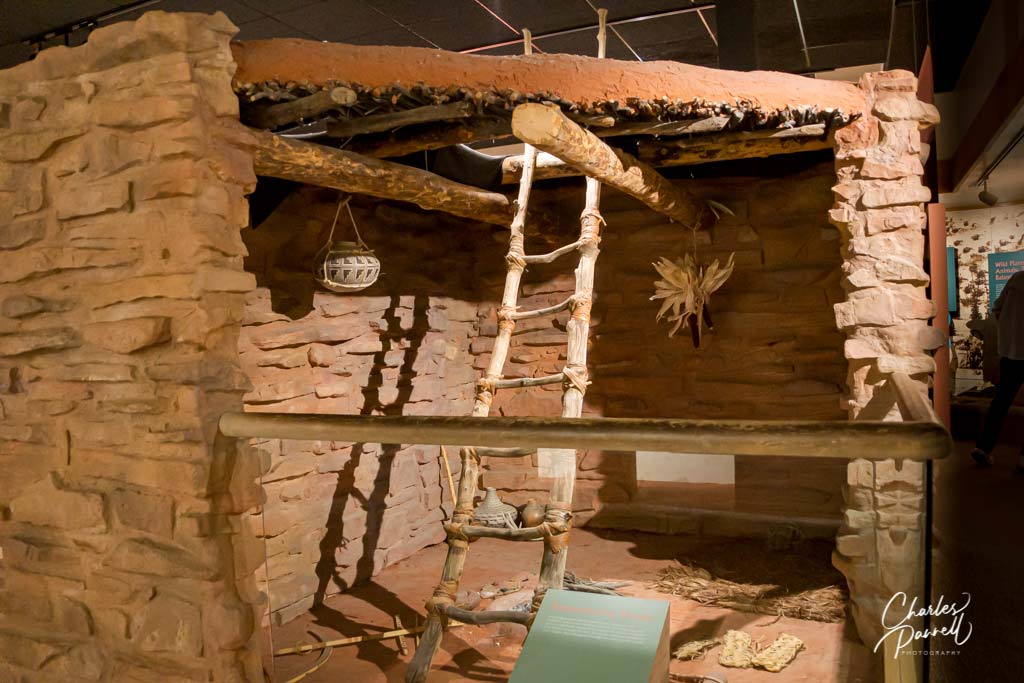
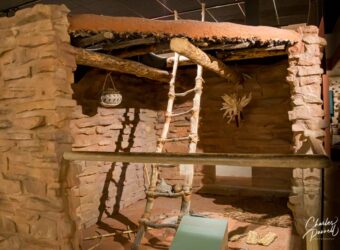
This Southern Utah town, which is located along Scenic Byway 12, connects Capitol Reef National Park and Bryce Canyon National Park. It’s home to the Anasazi State Park Museum (www.stateparks.utah/parks/anasazi) , which offers an intimate look at the Anasazi people who once inhabited the area. The highlight of the museum is the Coombs excavation site out back — where 97 rooms, 10 pit structures and hundreds of thousands of artifacts were unearthed. There’s a level walkway through the excavation site, with interpretive panels about the former residents along the way. While you’re in town, stop in and have a bite at the Burr Trail Grill — which features level access — and don’t forget to save room for a piece of their mouth-watering home made pie. Last but not least, save some time for a scenic drive on the Burr Trail, which begins next to the Burr Trail Grill and winds through Grand Staircase-Escalante National Monument.
Population 2,697
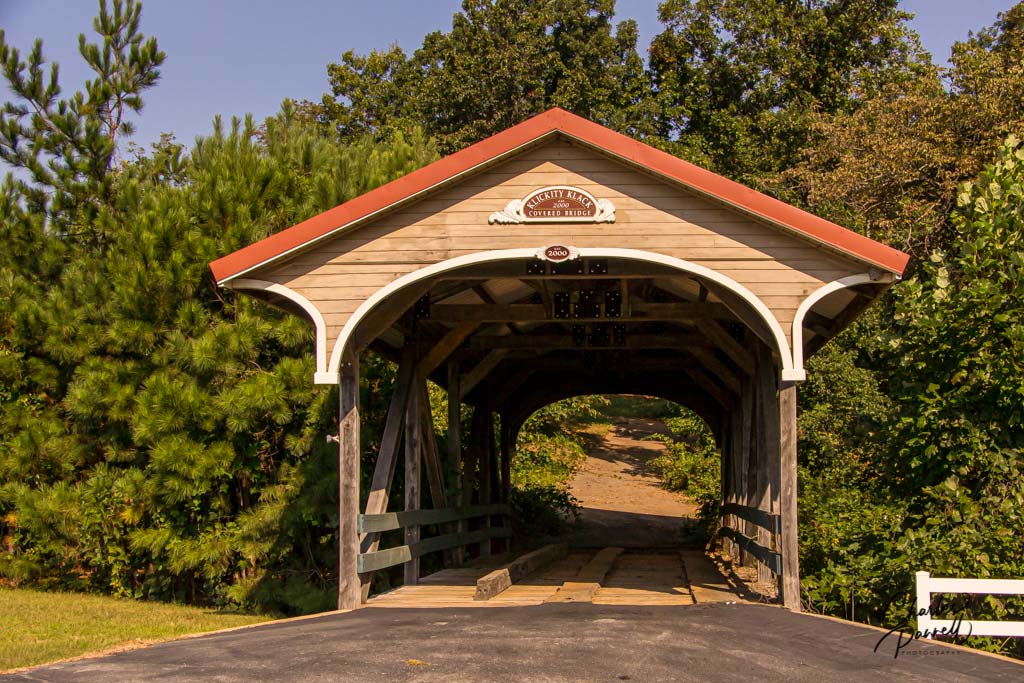
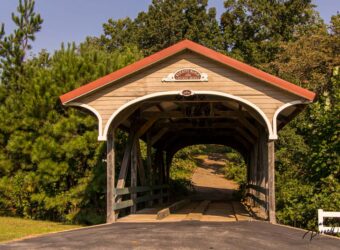
Located smack dab in the middle of covered bridge country, Landrum is a nice place to settle in for a few days, while you take in some of the local sights. And the Red Horse Inn (www.theredhorseinn.com) includes an accessible room that has a bathroom with an accessible whirlpool tub and a built-in shower bench. Additionally, since the property is located just off the Cherokee Foothills Scenic Byway, it’s a great road trip choice. Nearby covered bridges include Campbell’s Bridge, Klickety-Klack Bridge and Pointsett’s Bridge. And if you’re not sure how to get to them, just ask the innkeeper and she’ll be happy to point them out on the map. Be sure and stop in at Victoria Valley Vineyards (www.victoriavalleyvineyards.com) for lunch too. Styled after a French Chateau, the tasting room features barrier-free access, and the café offers a nice sampling of sandwiches and salads. And then there’s the wine.
Population 10,337
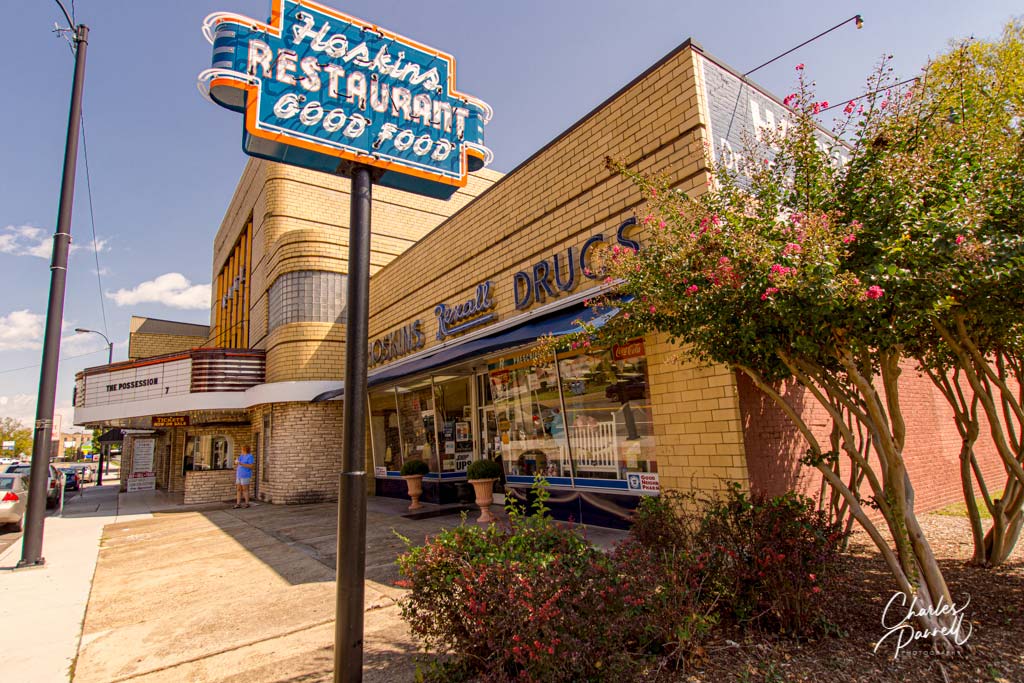
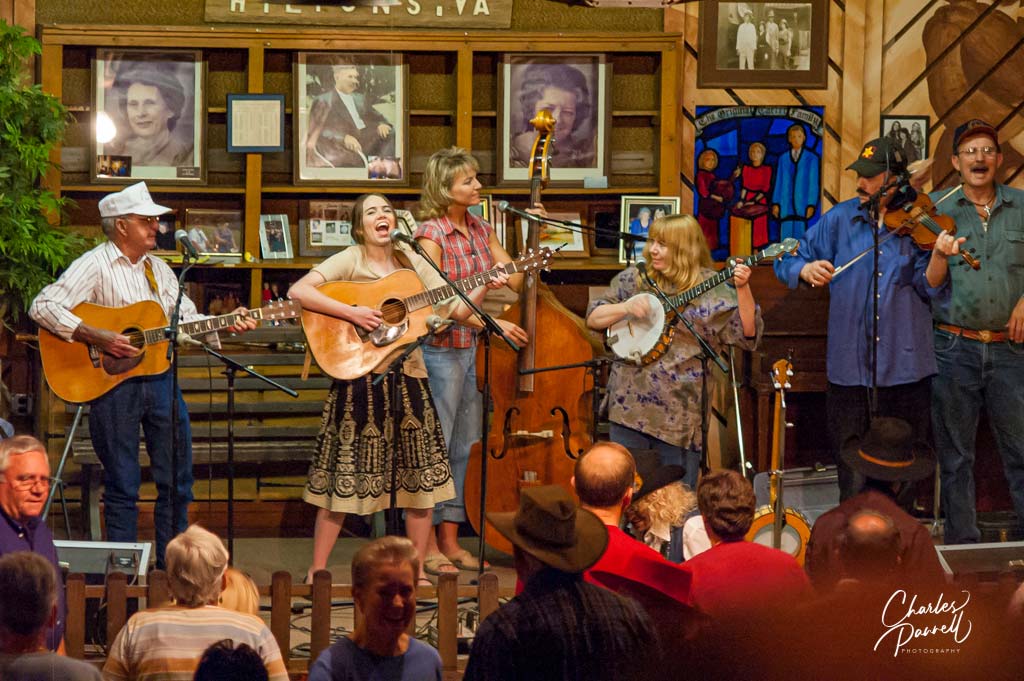
This rural Tennessee town is a tasty place to stop for a treat along the White Lightening Trail. The route — formerly called Thunder Road — received its colorful moniker from bootleggers who once roared along it in their hot rods to deliver prohibition era moonshine. Today this 200-mile drive features historic towns, a slice or two of Appalachian history, and some absolutely gorgeous scenery. And for a step back in time, stop in at Hoskins Drug Store (www.hoskinsdrugstoreandsodafountain.com) in downtown Clinton. Established in 1930 the store retains much of its old time charm, and includes a small lunch counter and a soda fountain. There’s accessible parking on Main Street, with level access to the store, and the soda fountain has booths with room at the end for wheelchairs. And although you can certainly order a burger and fries, the real reason to stop at this soda fountain is for the milkshakes — they’re absolutely delicious.