As a travel writer since 1977, Candy Harrington has been writing about accessible travel exclusively since 1996. She’s the founding editor of Emerging Horizons, and the author of the popular Barrier-Free Travel national park series. With thousands of bylines to her credit, Candy hits the road often, in search of new accessible travel finds. Candy and her travel photographer husband Charles Pannell reside in NE Washington, where they tend to their chicken flock and enjoy a rural lifestyle.
If you’d like to hit the beach while visiting the Bay State, then check out these informative websites about accessible beaches in Massachusetts.
This site (www.mass.gov/info-details/accessible-beaches) contains helpful information about the location of all the Massachusetts beaches that have beach mats. These hard rubber mats are rolled out on beaches, and make it possible to traverse them in a standard wheelchair. They are usually rolled out to the high tide line.
This site (www.mass.gov/info-details/beach-wheelchairs) includes information about beach wheelchairs available at Massachusetts beaches. They have two types of beach wheelchairs available for loan on a first-come basis.
The standard sand beach wheelchairs are made of PVC pipe and have four balloon-like tires. They must be pushed by a companion, and they are not allowed to be taken into the water. They have a weight limit of 275 pounds.
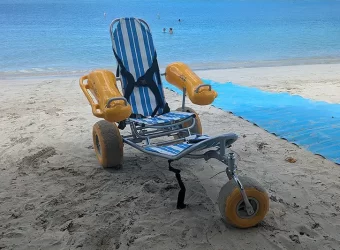
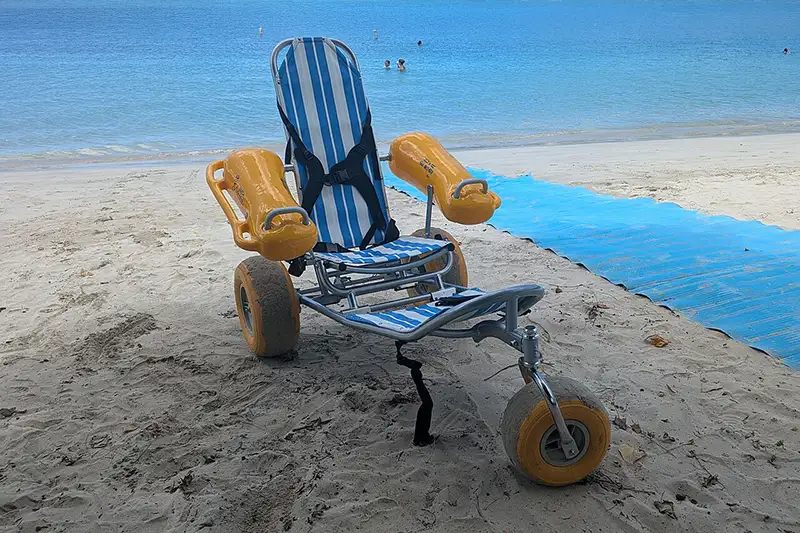
Floating beach wheelchairs, on the other hand, are a great option if you want to get in the water. They have three wheels that are supported by an aluminum frame. These chairs are not self propelling, but they can be pushed from the back or pulled from the front. They have a 330 pound weight limit, and they are great fun in the surf.
This website has a handy table which lists the availability of each type of beach wheelchair, and a direct link to the beach website for more information.
Combined, these two resources offer a comprehensive look at what you can expect to find accessible beaches in Massachusetts.
Barrier-Free Travel Yosemite, Sequoia and Kings Canyon National Parks for Wheelers and Slow Walkers
Located in Northwest Washington, Mount Rainier towers 14,410 feet over the surrounding alpine meadows. And when the “mountain is out” it’s visible from as far away as Seattle, Portland and even Vancouver. That said, there’s nothing like a close look at this active volcano, which can be had from Mount Rainier National Park , as well as aboard a local rail excursion. Although it’s only possible to access these sites in the summer season, due to snow and road closures; they are definitely worth a visit. So take some time to to check out these wheelchair-accessible Mount Rainier views on your next Washington national park road trip.
Kautz Creek Boardwalk
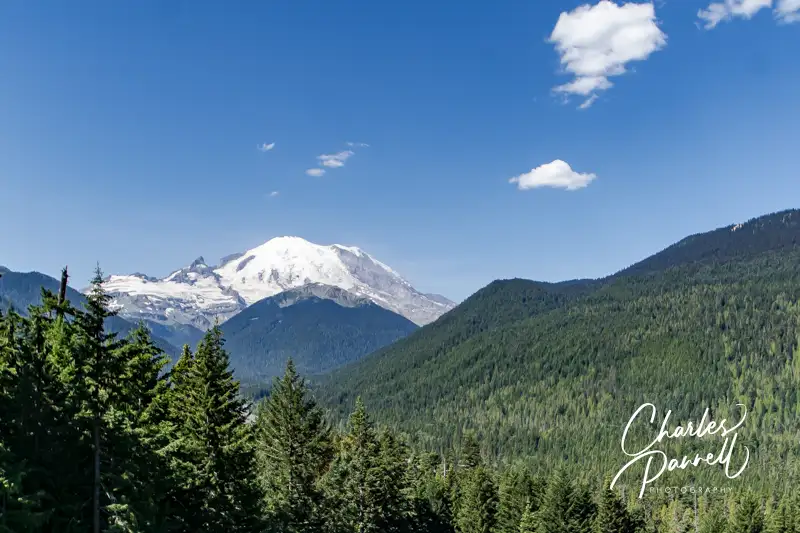
Located about three miles east of the Nisqually Entrance to Mount Rainier National Park, the Kautz Creek Boardwalk is one of the newest accessible trails in the park. There’s accessible parking near the picnic area, with level access to the .1-mile boardwalk across the street. The boardwalk leads through a section of forest that’s still recovering from a 1947 glacier generated debris flow, and it ends in a crushed granite viewing area with a few benches. And on a clear day, you just can’t beat the Mount Rainier view from there.
Henry M. Jackson Visitor Center
Henry M. Jackson Visitor Center
Next up on our list of wheelchair-accessible Mount Rainier views is the Henry M. Jackson Visitor Center, which is located about 14 miles up the road in Paradise. This area of the park was named by an early settler who reportedly exclaimed “Oh, what a paradise!” when she first saw it. And it’s a fitting description. There’s accessible parking in front of the building, with barrier-free access to all areas of the visitor center. The visitor center offers a 360-degree panoramic view of the area, but you’ll also get a great Mount Rainier view if you just step out the back door. And if you hit this stop at the right time in the summer, you’ll also be treated to a nice view of the wildflower-filled meadows.
Reflection Lake Pullout
The next stop is about 3.5 miles up the road at the Reflection Lake Pullout. Although the lake is on the left side, the most accessible viewpoint is located on the right. The small parking area includes an accessible parking place with curb-cut access out to the viewpoint. And you just can’t beat the stunning reflection of Mount Rainer in the water. This is also a great stop for folks who have trouble walking, as you can get a nice windshield view from the pullout.
Sunrise Visitor Center
Mount Rainier viewed from Sunrise Visitor Center
The highest point in Mount Rainier National Park which can be reached by vehicle is located in Sunrise, about 60 miles northeast of the Nisqually Entrance. And it just makes sense that you’ll get a good mountain view from this 6,400 foot vantage point. Although the front entrance to the Sunrise Visitor Center has steps, there’s an accessible side entrance. There are a number of interpretive exhibits inside, but the main attraction is the view. You’ll get an absolutely jaw-dropping glimpse of the mountain from the spotting scope on the far side of the room. It’s definitely worth the drive! Plan ahead though, as the visitor center is generally only open from July through mid-September, as the road closes after the first substantial snowfall.
White Pass Scenic Byway
Mount Rainier viewed from White Pass Scenic Byway at Milepost 147.6
This scenic route, which is also known as Highway 12, is located south of Mount Rainier National Park. It runs from Naches in the east to Interstate 5 in the west. The shady lane is relatively uncrowded and there are several places to stop along the way for views of the forest and river. That said, there’s a killer Mount Rainier view at the pullout near mile marker 147.6. This is an undeveloped viewpoint with no striped parking and a gravel parking lot; however you can still get an excellent view of the mountain from your car. Additionally, if there’s room you can always parallel park next to the viewpoint and lower your ramp on the sidewalk. There are a few interpretive plaques there, but the real star of the show is Mount Rainier. And if you want to connect to the park, just take Highway 123, which goes up to the Ohanapecosh.
Highway 410
This viewpoint is nestled away on Highway 410 south of Snoquera, shortly after you enter Mount Rainier National Park. It can easily sneak up on you, so be on the lookout for it as you see fewer and fewer trees on the west side of the road. The small turnout is located between mileage markers 63 and 64. There’s no paved parking, but you can park parallel in the wide turnout near the viewpoint. The parking area is mostly gravel, but you can still get a good view from inside your vehicle. If you don’t stop, then at least slow down to admire the impressive mountain view. And if you miss it, no worries, as there’s no shortage of Mount Rainier views as your continue south. Just keep your eyes open.
Mt. Rainier Scenic Railroad
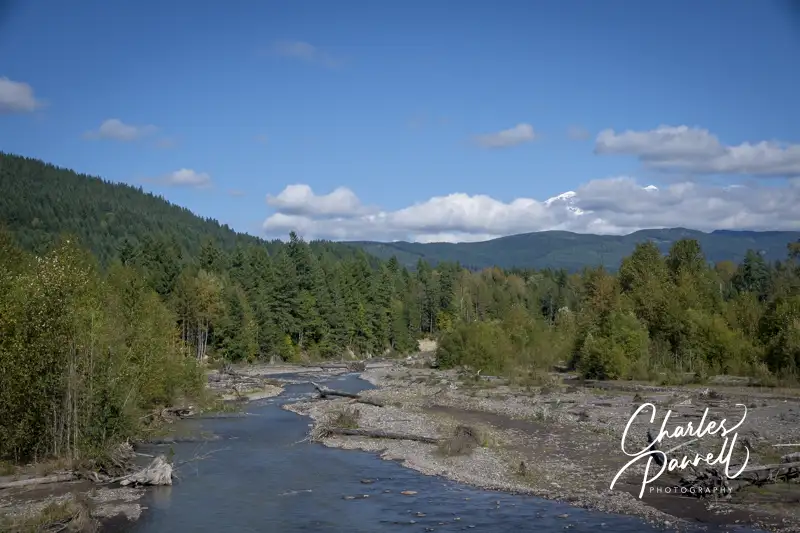
The Nisqually River Viewed from Mount Rainier Railroad
Last but not least on our list of wheelchair-accessible Mount Rainier views, is the impressive vista that can be seen aboard the Mt. Rainier Scenic Railroad (mtrainierrailroad.com). This seasonal train excursion departs from the Elbe depot, which is just 15 minutes from the Nisqually Entrance. There’s accessible parking near the depot, with barrier-free access to the building. Accessible restrooms are located next door, and there are plenty of accessible pathways around the outside depot area, and lift access to the train. This scenic excursion travels along the Nisqually River and offers no shortage of photo worthy views. And there’s an announcement right before you round the corner for that iconic Mount Rainier view. It’s a great excursion to add to any Mount Rainier visit.
Barrier-Free Travel Washington National Parks for Wheelers and Slow Walkers
Created by Jane Orleman and Dick Elliott, this downtown Ellensburg home is decorated in a conglomeration of reflectors and other common items. And it’s more than just a work of art, as Jane still lives there. Sadly Dick passed away in 2008, but his artistic creation lives on in this house that the couple purchased in 1978.
The home is surrounded by a fence with posts adorned with everything from nails and keys, to bottle caps, insulators and even a few cooking implements here and there. A “Life is But a Dream” mural graces one side of the fence, and a nook with a guest book sits near the end. Add in a few insulators on the side, a racy mannequin with reflectors for boobs (Big Red), and a man with a camera for a face and you have everything but the kitchen sink — all artistically done of course. And don’t miss the gigantic hand that adorns the front, near the doorway. Dick and Jane’s Spot is truly a work of art, and everywhere you look, you find something different — and sometimes it’s pretty subtle. Other times, it’s hard to miss.
Access is good around the house, with sidewalks lining the venue, and curb-cuts at the corner. And there’s a little side alley that gives folks access to another aspect of the decorated home. There’s a parking lot that’s adjacent to the house, but there are no accessible parking spaces. Best bet is to park in the accessible street parking spots in front of the police station across the street. If you need accessible parking, set your GPS to 100 N. Pearl Street, as otherwise you’ll be routed through a few parking lots to the side of the house. Worth a quick stop for sure — an excellent photo-op.
In the spring of 2025 a wildfire destroyed a wooden trestle in a non-operational section of the Mt. Rainier Scenic Railroad (mtrainierrailroad.com). Even though this trestle was not along the scenic rail route, it still was an operational setback for the railway, as crews had to clean up the damage and evaluate the safety of the tracks. The good news is, after a brief shut-down all is well and this iconic railway is up and running. Not only is this classic rail excursion a great addition to any Mount Rainier visit, but it’s also a good choice for wheelchair-users and slow walkers. And as the folks at the railway say, “The fire destroyed a bridge. It didn’t stop the railroad.”
All Aboard!
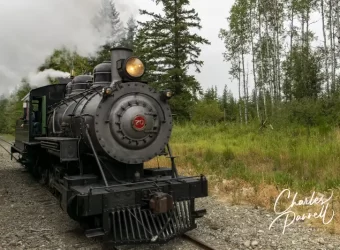
The Mt. Rainier Scenic Railroad station is located in Elbe, which is just a 15-minute drive from the Nisqually Entrance to Mount Rainier National Park. The historic Little White Church of Elbe sits near the back of the parking area, and adds to the nostalgic atmosphere of the experience. Accessible parking is located near the entrance of the parking lot, with level access over to the ticket office. And on the way, there’s a good photo op of a vintage locomotive in front of the station.
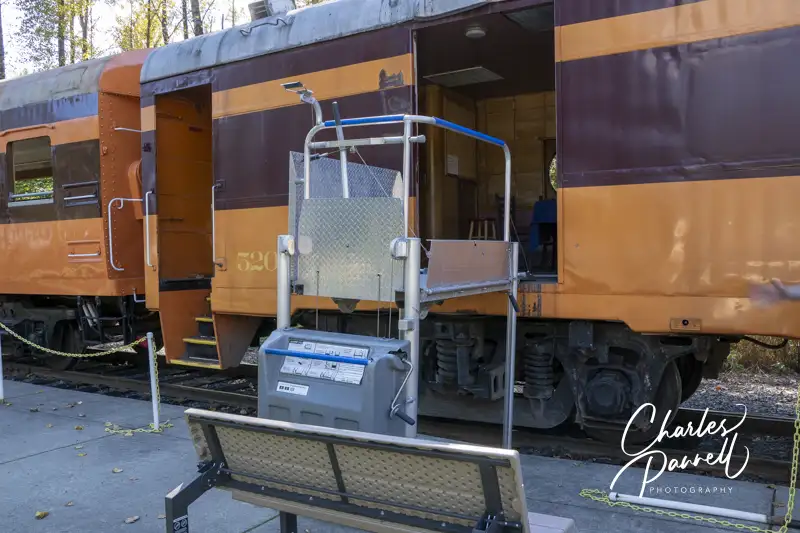
There’s level access to the station, with plenty of room to maneuver a wheelchair around the ticket office and through the adjacent gift shop. The ADA waiting area is located just outside the station, near the manual wheelchair lift. When it’s time to board, the manual lift is usually positioned next to a standard coach car, and the wheelchair- is lifted up to the car. From there, it’s just a short roll from the vestibule to the wheelchair-seating space at the front of the car. Slow walkers or anyone who has difficulty with stairs can also use the wheelchair lift.
According to the conductor, most wheelchair-users can be accommodated in the coach car; however some larger power wheelchairs may need to use the lift to board the baggage car. There’s no seating in the baggage car, which also contains the snack bar. There is however, an open doorway with a safety fence in the baggage car, so you can still get a good view of the passing scenery. The baggage car also has an accessible restroom. That said, the doorways on the connecting cars are narrow and the thresholds are uneven, so it’s best to use the facilities in the station if you are seated in coach.
Ride the Rails
View along the Mount Rainier Scenic Railway Excursion
Part of the ambiance of a Mt. Rainier Scenic Railroad excursion is the vintage rolling stock. The historic train cars are pulled by a Polson Logging No. 70 steam locomotive. This engine was built by the Baldwin Locomotive Works in 1922 for the Polson Logging Company. And today it still chugs along on these scenic excursions.
Passengers can choose from two excursions. The classic ride to Mineral is now joined by a new route to New Reliance. The routes alternate throughout the day, but both travel through the forest and offer scenic views of the countryside. And if the weather is cooperative, you’ll also get a good Mount Rainier view along the route. Once the train reaches its destination, the engine rolls back down a side track and hooks up to the other end of the train. And then it chugs back to the station.
Service is top-drawer too on the railway, with helpful attendants that point out the local attractions and weave in a little bit of history about the area along the way. All in all it’s a great ride, and a perfect Mount Rainier National Park side trip. Additionally, if you have any questions about access for your particular mobility device, just give them a call, as their customer service is excellent. And if you’ve worked up an appetite during your excursion, then stop by the Hobo Pizza Car after your ride. It’s located next door to the railway, and the converted railcar that serves as a dining room has ramp access. It’s a great finale to a Mt. Rainier Scenic Railroad visit.
Barrier-Free Travel Washington National Parks for Wheelers and Slow Walkers
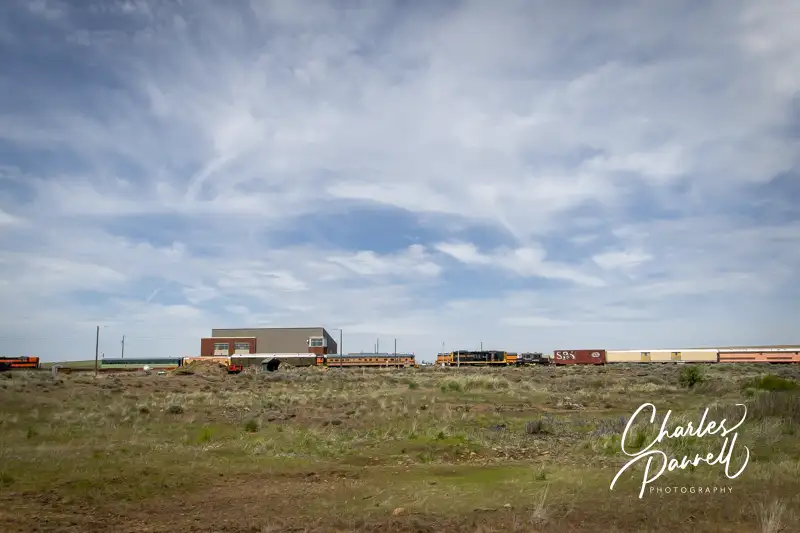
Located off Highway 2, about 25 miles west of Spokane in Reardon, the Inland Northwest Rail Museum (inlandnwrailmuseum.com) is a bit off the beaten path. That said, if you happen to be traveling from Spokane to North Cascades National Park (emerginghorizons.com/north-cascades-national-park/), it makes a nice road trip stop. Make sure and check the website for their operating hours though, as as this largely volunteer-operated museum is open on limited days — usually weekends. Still it’s worth a stop on any North Cascades road trip
A Bit of PNW Railroad History
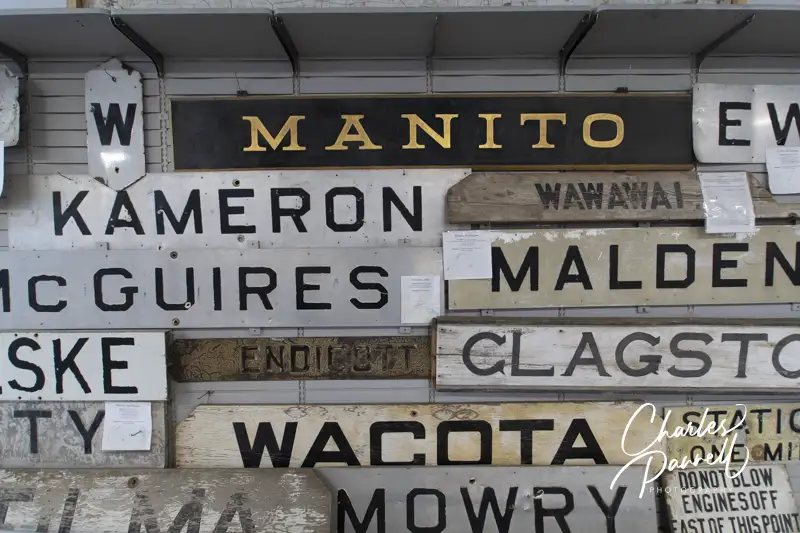
Railroad Signs At The Inland Northwest Rail Museum
The Inland Northwest Rail Museum’s collection focuses on railroad history in the Pacific Northwest (PNW). There’s accessible parking in front, with level access to the front door. And although the folks at the museum have done a good job providing access throughout the facility, there are still some limitations due to the nature of the exhibits.
There’s level access around most of the inside exhibits, elevator access to the second floor, and accessible restrooms on the ground floor. That said, most of the rolling stock — which comprises at least half of their exhibits — can only be accessed by climbing a few steps. Still it’s a great — and very nostalgic stop — for slow walkers.
The centerpiece downstairs exhibit is the 1906 Spokane United Railways Streetcar. After streetcar use was discontinued in Spokane, this car served as a restaurant in Chewelah, and was later donated to the museum. There are several steps up to the streetcar, and it’s kind of fun to walk through, sit down and imagine the public transportation system of yesteryear.
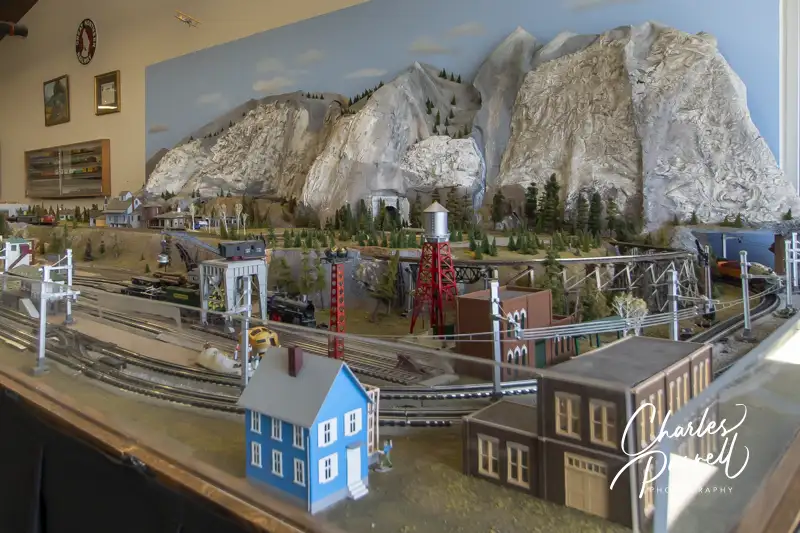
The inside exhibits also include a large collection of railroad equipment, signs, signals, photos, horns, uniforms and lots of interesting tidbits. Don’t miss the model trains and the photo collection of PNW train wrecks upstairs. And while you’re upstairs, stroll down to the end of the building and get a birds eye view of the rolling stock out in the yard.
Model Train Layout at The Inland Northwest Rail Museum
All Aboard!!
The great thing about the rolling stock in the yard is that you can explore as little or as much of it as you want, depending on your energy level. There’s level access to the yard, and the 1941 American Scene Sleeper Car sits rights outside the back door of the museum. Although there’s level access to it — no steps required — the hallways of yesteryear are too narrow for a wheelchair.
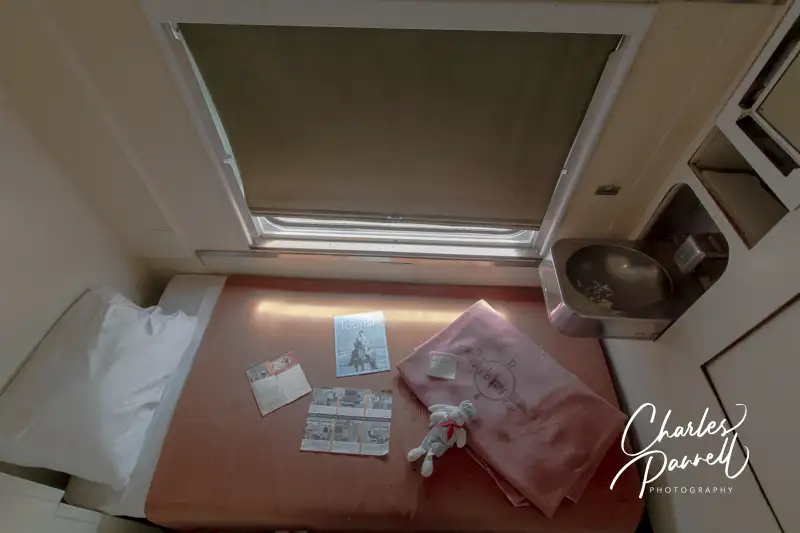
Inside the sleeper car, many of the compartments are set up as they would have been in the 1940s. And there are other exhibits about railroad life peppered in throughout the car. The sleeping car is attached to a dining car which has more exhibits that highlight life on board. From dishes and photos, to a uniform and even a telegraph display, there’s something for everyone.
Berth in Sleeper Car at The Inland Northwest Rail Museum
And don’t miss the Spokane, Portland & Seattle Railway’s St. Helens Sleeper Buffet Lounge Car. It’s located a short walk away, and although the ground is covered with gravel it’s fairly level. There are several steps up to this beauty, which was built by the Pullman Standard Company in 1950. Inside the compartments are roomier than the 1940s model, and they each include a toilet that pulls out from the sink cabinet. Although it’s a far cry from modern day trains, it was luxurious back in the day.
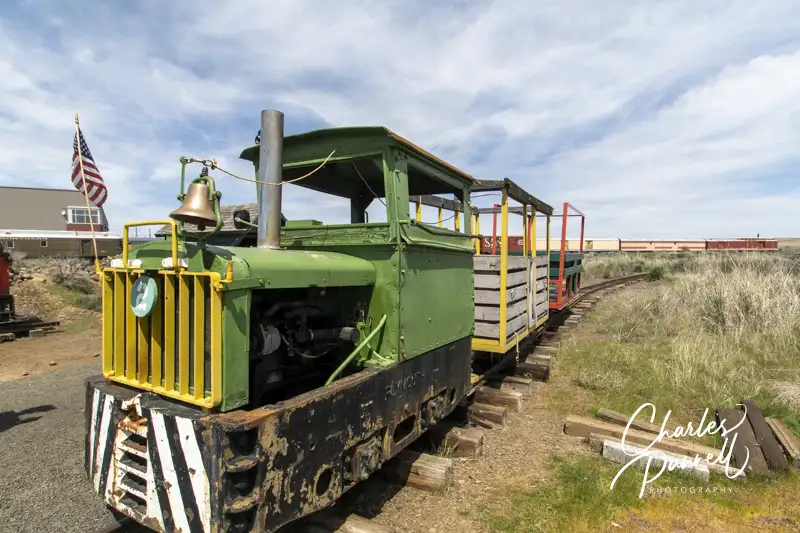
Last but not least, don’t miss a ride on the Rearden Rocket — a two-foot gauge railroad that runs through the museum grounds. You have to be able to step up into the open-air car for this two-mile ride that circles the campus, but it’s a fun finale. The engines are operated by enthusiastic volunteers, and hearing their stories is part of the fun. It’s the perfect finale to any Inland Northwest Rail Museum visit.
The Reardon Rocket at The Inland Northwest Rail Museum
Barrier-Free Travel Washington National Parks for Wheelers and Slow Walkers
Located at the foot of Zafarraya Gorge, just an hour from the Malaga Airport, Villa Zafarraya is an excellent lodging choice for wheelchair-users and slow walkers. But it wasn’t always that way. Previously, the three-bedroom two-bathroom unit was not wheelchair-accessible; so prior to an extensive renovation the owners sought input from wheelchair-users to determine how to improve access in their villa. Today, after lots of hard work, the results are apparent, and Villa Zafarraya (www.villazafarraya.com) is now truly a wheelchair-accessible Malaga villa.
The Property
Although wheelchair-access was the ultimate goal of the renovation, the owners also wanted to make Villa Zafarraya a relaxing and inviting lodging option, free from any hospital or institutional trappings. And in that respect they greatly exceeded all expectations.
There’s level access from the parking area to this boutique villa, which can sleep two to six people. Inside there’s barrier-free access, with wide doorways and tile floors for easy rolling. Large windows dot the unit, and there are gorgeous views of the swimming pool and gardens from just about everywhere. The large kitchen features a wheelchair-accessible workspace, as well as appliances that are easy to operate from a wheelchair.
Outside, level cement pathways wind through the gardens and around the swimming pool. There’s ramp access to the pool, and you can roll right into it in the provided water wheelchair. And there’s even barrier-free access over to the quiet little nook under the pergola with a table underneath. No matter where you look, you get that true Mediterranean vibe at this wheelchair-accessible Malaga villa. .
A Wheelchair-Accessible Suite
Great care was also paid to the renovation of the wheelchair-accessible suite. There’s good pathway access throughout the bedroom, which is furnished with a double hospital bed. Rest assured, it doesn’t look like a hospital bed though, as the bedding and interior design bring out a true Mediterranean flavor.
There’s a sliding barn door to the adjacent bathroom, which has plenty of room to maneuver even the largest wheelchair. It includes a Continental (no-hub) shower with a hand-held showerhead, a grab bar and a fold-down shower seat. The shower seat can easily be folded up out of the way if you’d prefer to use the included shower/pool wheelchair. Round out this accessible unit with fold-down grab bars on both sides of the toilet, and a roll-under sink, and you have just about everything you need in this wheelchair-accessible Malaga villa.
The Extras
This beautiful rental comes with a lot of extras, as well as some referrals to sometimes hard-to-find accessible services. First off, as noted earlier, it includes a shower wheelchair that can also be used to access the pool via the ramp. A mobile electric hoist is also included in the rental. And if you want to get out and see some of the sights, a lightweight wheelchair that can be easily folded up and put in the back of a car, comes along with the rental. Additionally, if you need additional medical equipment, the owners can recommend a local equipment rental firm.
Finally, if you need an adapted rental car or caregivers while you are in the area, the owners can refer you to the appropriate folks. It’s a full service rental package. Best of all, you won’t pay extra for any of these access features or services, as this wheelchair-accessible Malaga villa is competitively priced. All in all, it’s a great vacation pick.
Barrier-Free Travel 101 Accessible Vacations Travel Ideas for Wheelers and Slow Walkers
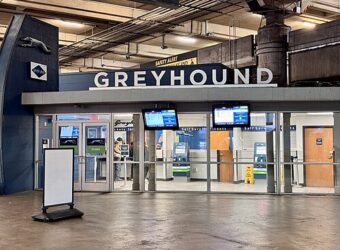
Have you ever had an access-related problem while traveling on Greyhound or FlixBus? If so, the Department of Justice (DOJ) wants to hear from you. After receiving a number of complaints on these carriers, the DOJ is in full investigation mode. But they can’t proceed without your help. They want to hear from you if you’ve ever had your Americans with Disabilities Act (ADA) rights violated. This includes:
Failure to maintain bus lifts.
Refusal to assist disabled passengers.
Refusal to allow service animals aboard.
Abandoned disabled passengers in the middle of their journey.
Failure to assist disabled passengers off the bus at rest stops.
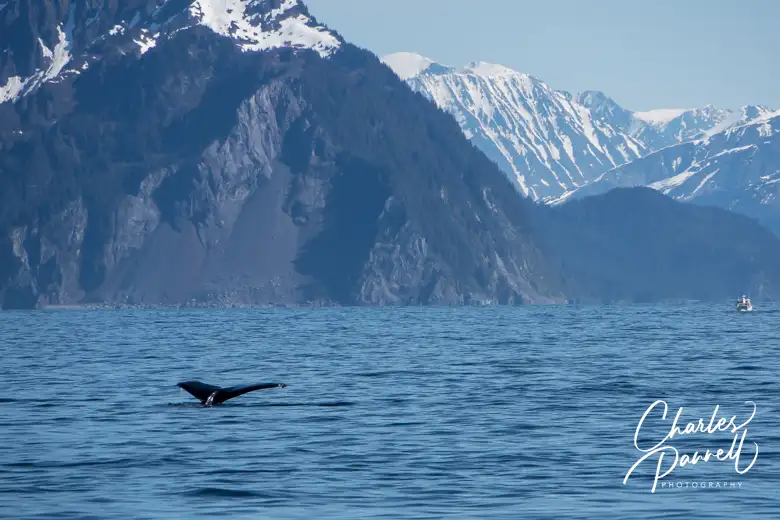
Whale Tail Breaching at Kenai Fjords National Park
Located at the head of Resurrection Bay, Seward is a popular port for many cruise ships, including Celebrity, Viking, Royal Caribbean and Silversea vessels. It’s also the gateway to rugged Kenai Fjords National Park, and the southern terminus of the Seward Highway. The good news is, it is possible to explore Seward in a wheelchair. In fact, this port city offers visitors a number of wheelchair-accessible tours and attractions. And that’s reason enough to spend at least one day in this Kenai Peninsula community on your next Alaskan cruise or road trip.
Explore Kenai Fjords
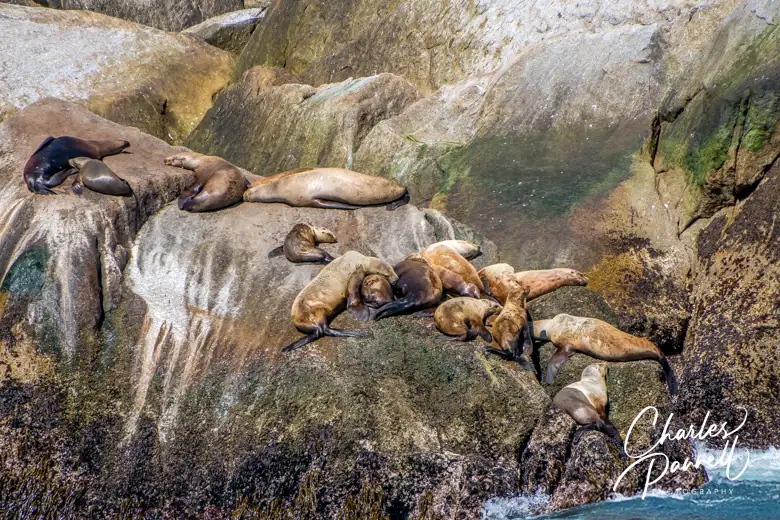
Seals viewed on the Kenai Fjords Tours
Although the lion’s share of Kenai Fjords National Park (www.nps.gov/kefj/) is comprised of backcountry trails and inaccessible glaciers, visitors can get a peek at the diverse wildlife and stunning scenery of the park on a day cruise.
Conducted by Kenai Fjords Tours (www.alaskacollection.com/day-tours/kenai-fjords-tours/), the Classic Kenai Fjords Park Tour tour departs twice daily from the Seward harbor. There’s level access to the ticket office , with a large drop-off area in front. Accessible parking is available in front of the Kenai Fjords Tours office, and in the remote parking lot, which is a few blocks away. There’s also accessible shuttle service from the remote parking lot to and from the harbor.
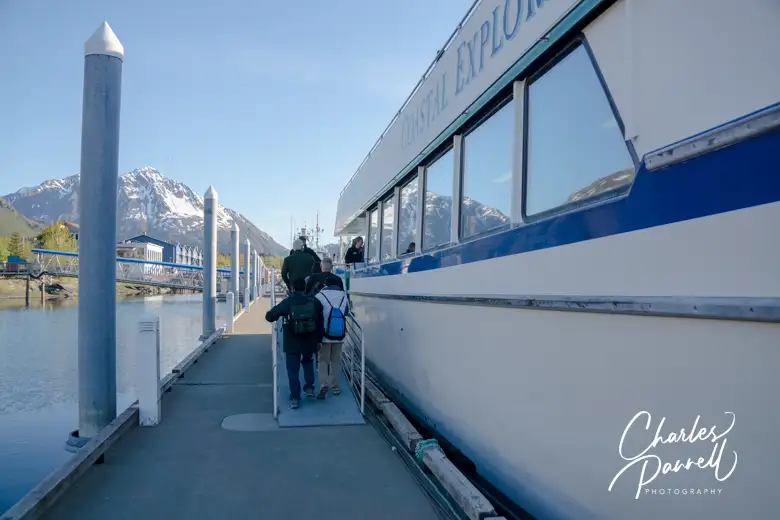
There’s level access out to the tour boat, and employees will provide boarding assistance with advance notice. Unfortunately the vessels cannot accommodate scooters. The main deck features good pathway access; and wheelchair users can transfer to a reserved accessible table or stay in their own wheelchair. If you opt for the latter, there’s also a handy fold-down table next to the accessible space. Additionally, there’s a large accessible marine head — reserved for disabled passengers — on the main deck.
Enjoy the Cruise
Boarding the Kenai Fjords Tour Boat
Although there’s only stairway access to the top deck, the main deck has large picture windows, so the view is equally good in both spaces. And the captain provides an excellent interpretation of the wildlife found in the water and along the shore. Sightings include whales, seals and puffins and maybe even bear or moose.
About midway along, the captain stops and turns off the engine so passengers can see and hear the glaciers calve off into the water below. Afterwards the crew retrieves a piece of an iceberg, so everybody can get a closer look. In short, it’s a very scenic, informative and entertaining cruise. Add in a tasty lunch served at your table, and a very accommodating crew, and you have the perfect way to enjoy Seward in a wheelchair.
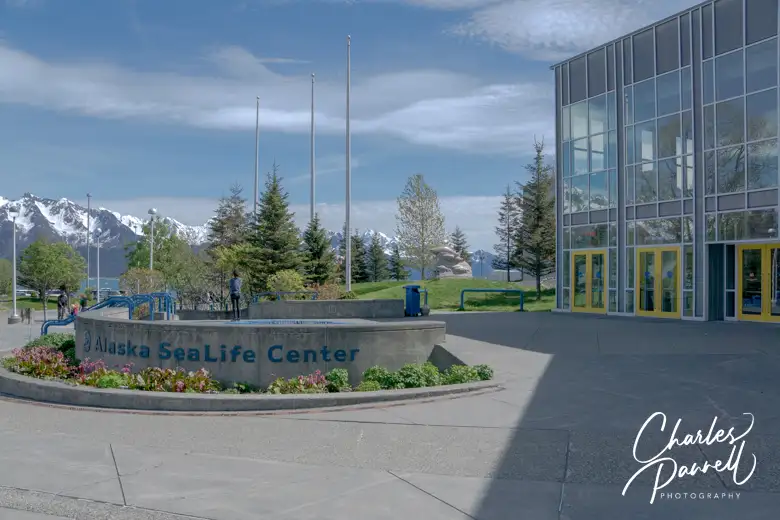
Alaska Sealife Center
Alaska Sealife Center
A visit to the Alaska Sealife Center (www.alaskasealife.org/) is the ideal companion to a Kenai Fjords Cruise, as it offers a closer look at some of the local marine life. This unique facility, which is a cross between an aquarium and a research center, was partially funded by Exxon after the Valdez oil spill in 1989. Prior to that disaster, researchers had very little knowledge about the delicate ecosystem of Prince William Sound.
The tourism component of the facility allows visitors the chance to get up-close-and-personal with a variety of marine mammals, birds and fish found in the area. Accessible parking is available in the adjacent lot, and there’s level access to the center. There’s barrier-free access throughout the building, elevator access to all floors and a loaner wheelchair at the information desk. Best of all, the wheelchair-height aquariums offer unobstructed views of the marine life.
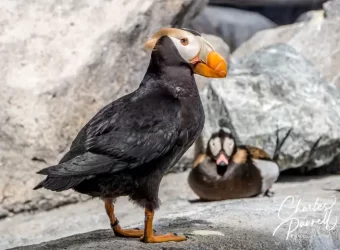
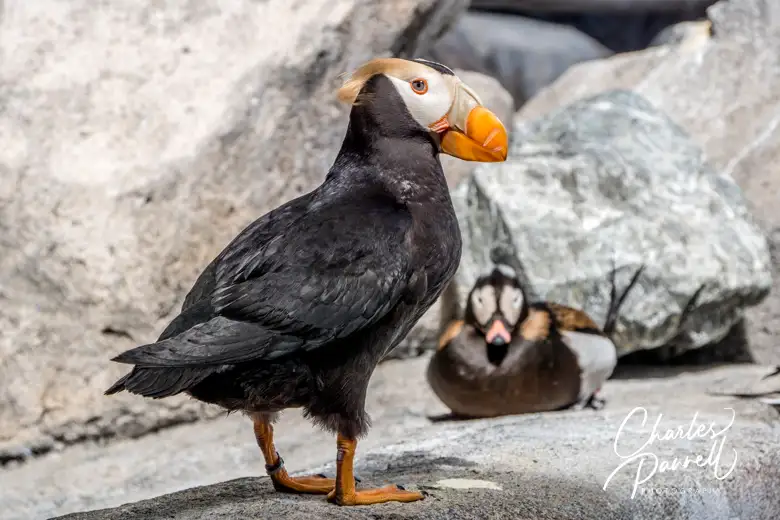
The first-floor exhibits include interpretive panels about fishing sustainably and wild Alaskan seafood, while the second floor has a nice collection of interactive exhibits. There’s also level access to the seabird aviary on the second floor, where visitors can get a close look at the resident puffins, cormorants and murres. And don’t miss the equally enjoyable antics of the stellar sea lions, harbor seals and ringed seals in the enclosure across the hall. And if you’d like a backstage look at the animal enclosures, a level overlook offers an accessible glimpse of that too. All in all, the Alaska Sealife Center is a fun and educational stop, and a must-see on any Seward itinerary.
Puffin at the Alaska Sealife Center
Visit Exit Glacier
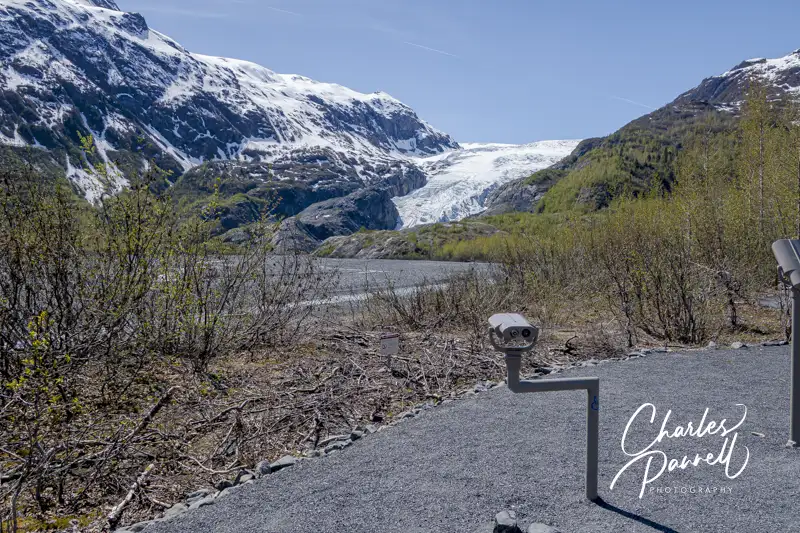
Exit Glacier in Kenai Fjords National Park
Finally, a drive out to Kenai Fjords National Park to see Exit Glacier is a must-do on any Seward visit. Not only is it one of Alaska’s walk-up glaciers, but Exit Glacier is the only part of Kenai Fjords National Park that is accessible by road. It’s located three miles north of Seward, just off the Seward Highway. Keep a lookout for Herman Leirer Road and follow it for about eight miles, until it dead-ends in the parking lot.
There’s accessible parking near the Exit Glacier Nature Center, with level access over to the small building. Inside there are a few exhibits as well as a staffed ranger desk. There are also a few accessible picnic tables outside, near the accessible restrooms.
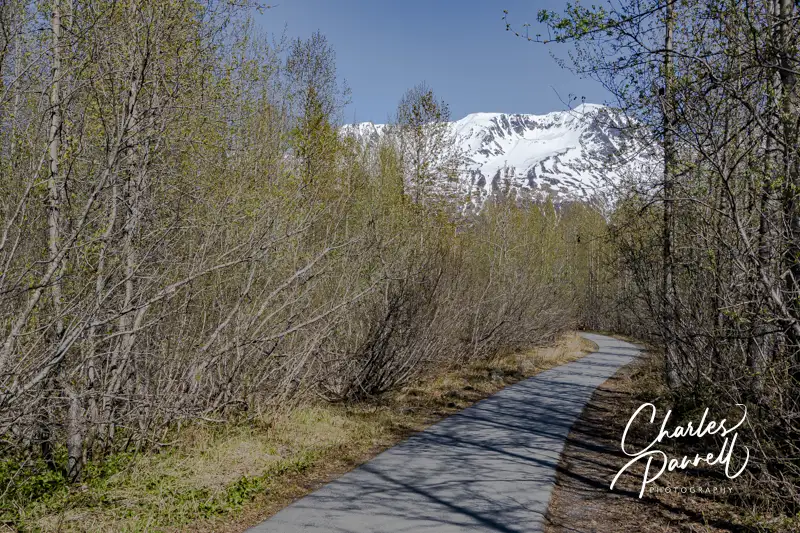
The wheelchair-accessible one-mile Glacier View Loop Trail begins on the other side of the nature center. The paved trail leads through a cottonwood forest and transitions into a hard-packed dirt trail topped with stabilized granite. About halfway along the trail there’s a level viewing spot, where you can get an excellent view of Exit Glacier, as it spills down the mountain from the Harding icefield. And if you didn’t bring along binoculars, there’s also a wheelchair-height viewing scope in the viewing area.
And although the view is spectacular, the walk is equally pleasant, as there are interpretive plaques and benches to sit and enjoy the forest along the way. And if you are visiting Seward on a cruise, Exit Glacier makes a great shore excursion. No matter how you get there, Exit Glacier is a must-see for anyone who visits Seward in a wheelchair.
Trail to the Exit Glacier in Kenai Fjords National Park
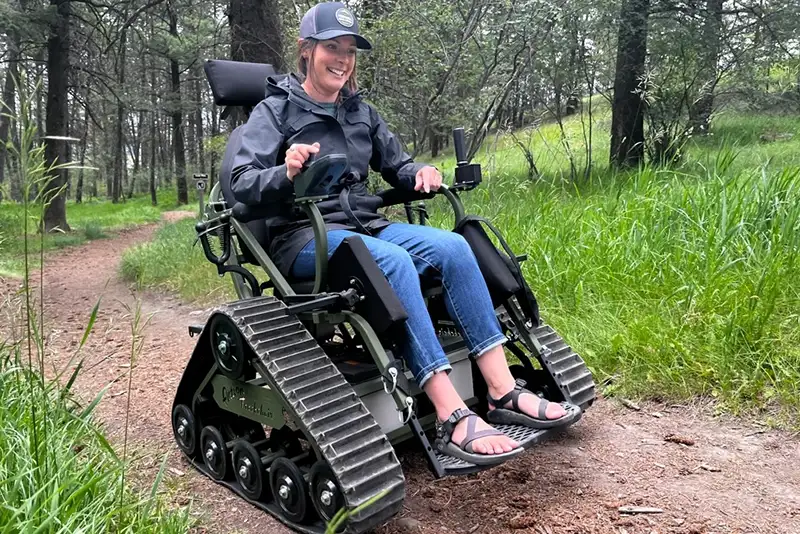
Thanks to a partnership between the Aimee Copeland Foundation (aimeecopelandfoundation.org/) and the Georgia Department of Natural Resources (gastateparks.org/), many Georgia State Parks offer track chairs to disabled visitors. These all terrain wheelchairs are fitted with tank tracks instead of wheels, and can maneuver through mud and over trails that might otherwise be inaccessible in standard wheelchairs. They can be used for hiking, hunting, fishing and other recreational activities. There’s no charge to borrow the track chairs, but a safety certification and a 48-hour advance reservation are required.
Georgia State Park Track Chair Locations
The following Georgia State Parks offer track chairs:
Georgia State Park Track Chair Reservation Process
Advance reservations are required to borrow a Georgia State Park track chair. A valid accessible parking placard is needed in order to make a reservation. A doctor’s statement describing your disability and your need for a track chair is also acceptable. If you do not have either of these, but believe you still qualify, call (770) 866-2815.
All track chair-users must also be accompanied by a companion 18 years of age or older, who is able to navigate the park terrain alongside the track chair. This is important, because the terrain on some of the trails can get pretty rough. The user and the companion must submit a copy of their photo IDs. All documents must be e-mailed to info@allterraingeorgia.org.
Once all the documents are received, the user will be sent a link to a safety/operational tutorial. The user and the companion must view the tutorial and pass an online test. After this is completed, the user will be sent a link and a password to access the online reservation system. They can then make their track chair reservation online
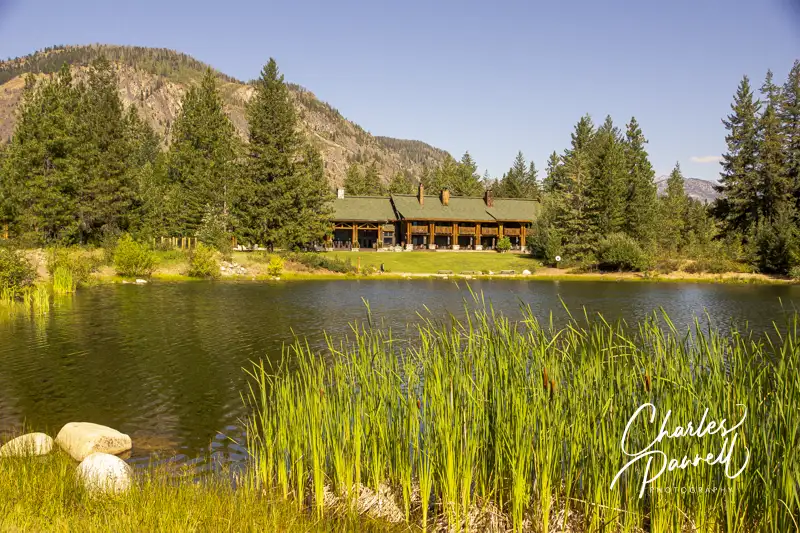
The Freestone Inn, Mazama, Washington (near Eastern edge of North Cascades National Park)
Located about 40 miles from the eastern edge of North Cascades National Park, the Freestone Inn is a true wheelchair-accessible North Cascades retreat. This secluded Mazama property borders a placid private pond, and it’s the ideal spot to kick back, relax and rejuvenate. The property also makes a good home base for exploring the eastern side of the national park. And although the Freestone Inn only has 12 rooms and five suites, the powers-that-be have gone above and beyond as far as access for slow walkers and wheelchair-users is concerned.
An Accessible Room With a View
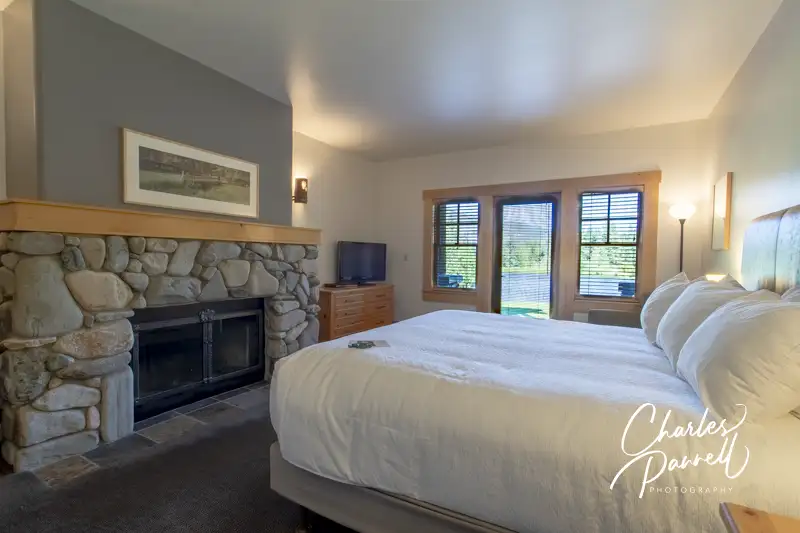
Room 1 at The Freestone Inn, Mazama, Washington (near Eastern edge of North Cascades National Park)
The good access at the Freestone Inn begins the moment you pull up to this lodge-style property. There’s accessible parking in front, ramp access up to the front porch, and barrier-free access over to the lowered key box, where you can complete your no-contact check-in. From there, a barrier-free path leads through the wide front door to accessible room 1, which is located just off the lobby.
Access features in the room include, wide doorways, lever handles, low-pile carpet for easy rolling and excellent pathway access. It’s furnished with a 27-inch high open-frame king-sized bed with wheelchair access on both sides. Other furnishings include a desk with a chair, a nightstand, a dresser, an easy chair and a refrigerator. And for those chilly nights, there’s a large electric fireplace in front of the bed.
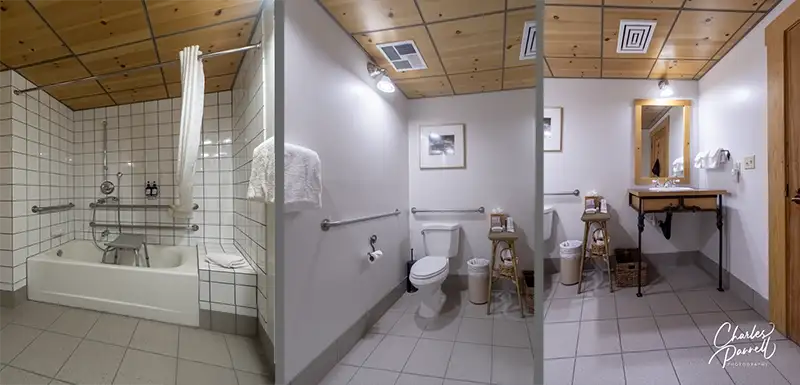
The bathroom includes a full five-foot turning radius, and is outfitted with a tub/shower combination, with grab bars and a hand-held showerhead. There’s a built-in shower bench at the end of the tub, and if that won’t work for you, there’s also a portable shower seat in the oversized bathroom. The toilet grab bars are located on the back and right walls (as seated), and a decorative – but functional — roll-under sink rounds out the bathroom access features.
Bathroom in room 1 at the Freestone Inn, Mazama, Washington (near Eastern edge of North Cascades National Park)
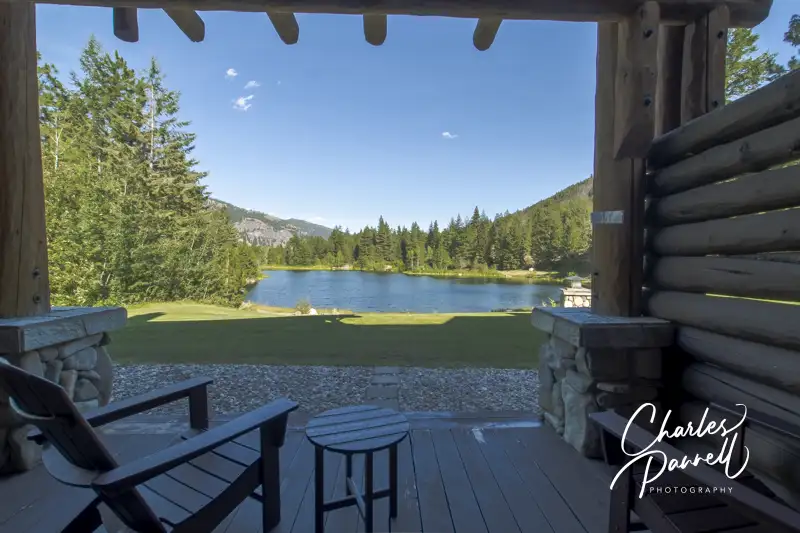
There’s also a wide back door that leads out to one of the nicest features of this room – a wheelchair accessible porch with a sweeping water view. It’s furnished with a pair of Adirondack chairs, but there’s still plenty of room for even a large wheelchair. And if you’d like the chairs removed, just ask the staff, as they are happy to accommodate most any request.
Porch view at the Freestone Inn, Mazama, Washington (near Eastern edge of North Cascades National Park)
The Little Extras
The Freestone Inn is far from a chain hotel, in ambiance, amenities and service. First off it’s a quiet and relaxed property. Because of the low number of guest rooms and the expansive public space, you’ll never feel crowded there. And at times it feels like it’s your own private lakeside retreat.
One of the best features of the property is the pond that sits in the back of the inn. Even if you can’t manage the trail, it’s still a relaxing and refreshing feature to view from your private porch. There is a .4-mile path that circles the pond that some slow walkers may be able to navigate. It’s mostly hard-packed dirt, but there are a few short rocky spots along the way. It’s not a good choice for most wheelchair-users, but again, you can still enjoy it from your private porch.
There is Wi-Fi at the property, although to be honest it’s not really reliable. But you’re on vacation, so ditch the phone and enjoy Mother Nature. There are TVs in the rooms, but there’s no cable; however there’s a large selection of DVDs available to borrow.
And although the accessible room doesn’t have a microwave, there’s a shared kitchen down at the end of the hall. It has a microwave, sink, and a good supply of paper plates and utensils.
If you’d like to leave the cooking to someone else, then stop by Jack’s Hut, which is located across the parking lot from the inn. There’s good wheelchair access to this restaurant, which offers breakfast sandwiches in the morning, and pizza, beer and snacks in the afternoon. The food is yummy, the service is a great, and it’s the perfect way to top off any wheelchair-accessible North Cascades adventure.
Barrier-Free Travel Washington National Parks for Wheelers and Slow Walkers


 If you’d like to hit the beach while visiting the Bay State, then check out these informative websites about accessible beaches in Massachusetts.




 101 N. Pearl Street