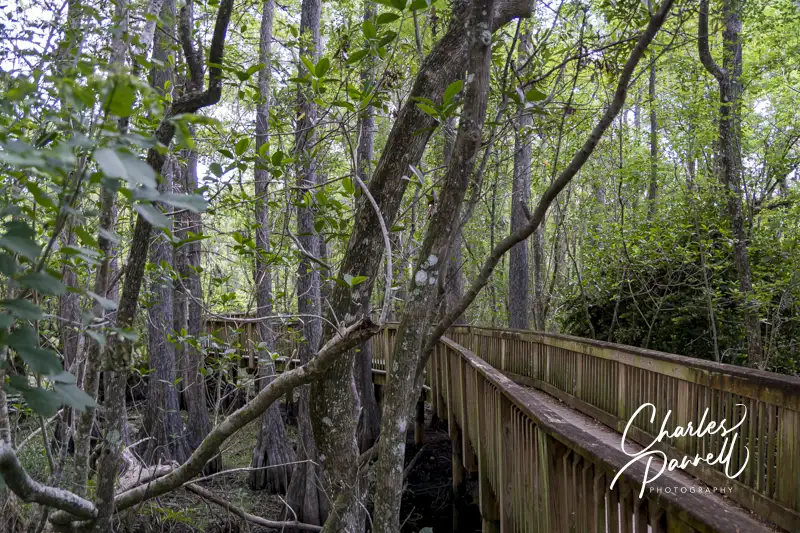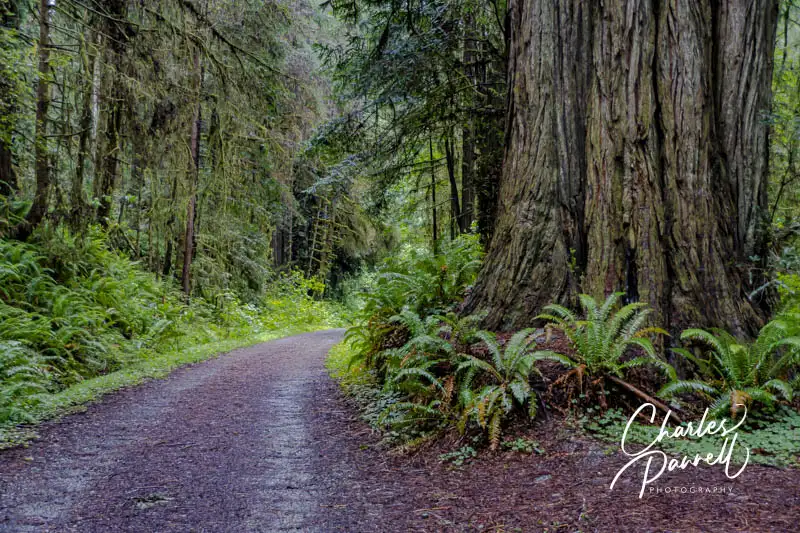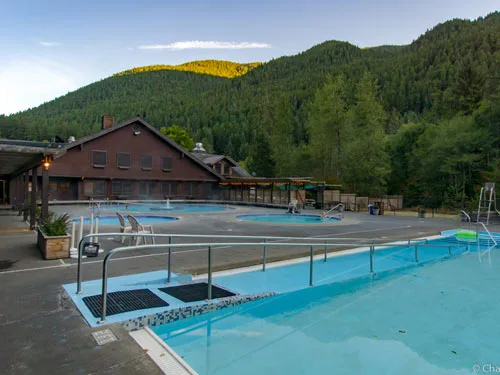
Located in Southwestern South Dakota, Badlands National Park (www.nps.gov/badl) features a rugged landscape dotted with an almost otherworldly collection of geological formations. The windshield views of the convoluted rock formations are spectacular, so you don’t even need to get out of your vehicle to enjoy it all. On the other hand, if you’d like to linger a bit, there are plenty of wheelchair-accessible Badlands options; including numerous trails and overlooks along the way. And there’s even an accessible lodge to spend the night.
Take a Hike
Fossil Exhibit Trail in Badlands National Park
Although the landscape looks foreboding, it’s easy to plan a wheelchair-accessible Badlands trip. To get a good overview, take a drive along Badlands Loop Road, where you’ll find a number of wheelchair-accessible viewpoints and pullouts that aren’t even marked on the park map.
There are also several accessible trails along Badlands Loop Road, including the Window Trail and the Door Trail, which are just a short drive from the visitor center. Both trails can be accessed from the same parking lot, which includes accessible parking and an accessible vault toilet.
The Window Trail is located on the south side of the parking lot. The level boardwalk leads out to a natural window that looks out on eerie hoodoo-like formations off in the distance. It’s a pleasant quarter-mile out-and-back stroll.
Viewing Platform at the End of the Windows Trail in Badlands National Park
The Door Trail is located at the other end of the parking lot, near the much needed shade structure. The level boardwalk snakes between a break in the Badlands Wall — called The Door — and opens up to a sweeping sandstone canon view at the end. It’s a .75-mile round-trip hike.
Start of the Door Trail in Badlands National Park
And don’t miss the Fossil Exhibit Trail, which is located near White River Valley Overlook. Accessible parking and an accessible vault toilet are located near the trailhead. This quarter-mile boardwalk features low bumpers for unobstructed views, and includes interpretive panels that describe the extinct creatures that once roamed the area. Examples of fossils are also located along this nicely accessible loop trail.
Each trail offers a different look at the varied landscape, but don’t forget the sunscreen, as shade is in short supply in this neck of the woods
Stay a Spell
To ramp up your wheelchair-accessible Badlands experience, plan to spend at least one night at Cedar Pass Lodge (www.cedarpasslodge.com). Not only is it one of the newer properties in the national park system, but it’s also conveniently located right next door to the Ben Reifel Visitor Center.
Designed to resemble the rustic 1928 Cedar Pass cabins, this modern incarnation includes all the creature comforts that travelers expect today. It has several accessible cabins, including cabin 101, a duplex model.
Access features include ramp access to the front porch, wide doorways, excellent pathway access, a lowered clothing rod, and wood floors for easy rolling. The interior is equally striking and includes walls paneled with beetle-kill pine from the Black Hills, and furnishings that are hand-crafted from Lodgepole pines.
Furnishings include a 23-inch high bed with wheelchair access on both sides, a table, two chairs, a refrigerator and a microwave. There’s also level access out to the spacious back deck, which is a great place to enjoy the sunset.
The bathroom is furnished with a roll-in shower with grab bars, a hand-held showerhead and a padded shower bench. The toilet grab bars are located on the back and right walls (as seated), and the bathroom also includes a roll-under sink and a lowered mirror. And like the rest of the cabin, there’s plenty of room to maneuver even the largest wheelchair or scooter around the bathroom.
Cabin 101 at Cedar Pass Lodge in Badlands National Park
Image 1 of 4
There’s also good access to the public areas of the property, including the gift shop, registration area and the restaurant. The only in-park lodging option in Badlands National Park, Cedar Pass Lodge makes a great home-base for any wheelchair-accessible Badlands visit. And you just can’t beat the scenery!
Walk-through Tree at Mariposa Grove in Yosemite National Park
Located near the South Entrance to Yosemite National Park, Mariposa Grove is a must-see on any Yosemite visit. The bulk of the Yosemite crowds tend to gravitate to Yosemite Valley, and this large stand of sequoias remains overlooked by many visitors. That said, if you want a little one-on-one time with Mother Nature, then Mariposa Grove is just the place for you. Granted, it takes a bit of extra planning to get there, but this stately grove is definitely worth a visit. So head south, bypass the crowds and enjoy a visit to wheelchair-accessible Mariposa Grove on you next Yosemite adventure.
A Few Logistics
Getting to Mariposa Grove isn’t difficult, but you need to be aware of a few things. This secluded grove of over 500 mature giant sequoias previously housed a number of commercial operations including a tram tour and a gift shop. These facilities — along with the asphalt pathways around the trees — were removed in a massive renovation project designed to preserve the ecological integrity of the grove. Today there are natural trails and boardwalks through the grove — with nearly a mile of accessible routes — but aside from a few restrooms, there are no developed facilities in the area.
The Welcome Plaza, which is located near the South Entrance, is the starting point for most Mariposa Grove visits. In order to lessen visitor impact on the trees, vehicle traffic is not permitted in the grove. Instead, wheelchair-accessible shuttles take visitors from the Welcome Plaza to the Mariposa Grove Arrival Center, where the accessible Big Trees Trail begins. If however you’d like to drive, and you have an accessible parking placard, you can bypass the shuttle and take your personal vehicle aIl the way to the Mariposa Grove Arrival Center. That said, it’s important to note that the road to the grove is closed to all vehicle during the winter months, as it’s not plowed.
Additionally, if you are planning a visit during the peak summer season, you’ll also need an entrance reservation to see the Mariposa Grove. This entrance reservation is in addition to any national park pass that you may have. For more information about entrance reservations, visit this helpful site. Plan ahead to avoid disappointment, as entrance reservations are not available at the park.
Hike the Big Trees Loop
Big Trees Loop at Mariposa Grove in Yosemite National Park
The Mariposa Grove Arrival Center marks the beginning of the wheelchair-accessible Big Trees Loop. Accessible parking, restrooms and a water bottle filling station are located near the trailhead; and there’s barrier-free access from the shuttle bus stop and accessible parking area over to the .3-mile Big Trees Loop.
The wide, hard-surfaced trail has excellent wheelchair access, and also includes level boardwalk sections over the wetlands areas. There are plenty of benches to sit and rest along the way, and a number of interpretive panels provide information about the grove. Although the trail loops back around to the parking lot, there is a short accessible jag out to the Fallen Monarch — a sequoia that came down more than 300 years ago. Even if you can’t do the whole loop, take some time to enjoy the sequoia forest on the boardwalk near the beginning of the trail.
Enjoy the Grizzly Giant
Grizzly Giant at Mariposa Grove in Yosemite National Park
Visitors with an accessible parking placard can also drive over to the trailhead for the accessible portion of the Grizzly Giant Loop. This trail can also be accessed from the Mariposa Grove Arrival Center; however that portion of the trail is not wheelchair-accessible, so it’s best to drive to the accessible trailhead..
From the accessible parking area it’s a level .1-mile walk through the forest to the Grizzly Giant Loop, and another 425-foot stroll on a wide level trail out to the Grizzly Giant. The California Tunnel Tree, which was carved out as a novelty for stagecoaches in 1895, is another 425 feet down the trail. It’s a nice photo op and you can still walk or roll through this giant today.
After the California Tunnel Tree, the trail continues back through the forest to the Mariposa Grove Arrival Center; however it loses its access in another 425 feet, due to rocks and a steep grade. Still it’s a lovely 2/3-mile out-and-back stroll, and it offers visitors a very accessible overview of the lower grove.
Although the accessible part of the Grizzly Giant Loop is a bit longer than the Big Trees Loop Trail, it’s worth the short trek. And no matter how far you hike, the wheelchair-accessible Mariposa Grove is definitely worth a stop on any Yosemite itinerary.
Barrier-Free Travel California National Park Road Trips for Wheelchair-Users and Slow Walkers
College campuses include much more than just classrooms and dorms today. Many also boast museums, architectural gems and even historic sites. And the good news is, admission isn’t just limited to students — many college attractions are also open to the general public. Even better, most are wheelchair-accessible. So take some time to scout out the local college attractions on your next road trip. Here are a few favorites to add to your itinerary.
Mississippi Art Museum
First up on our roundup of college attractions is the University of Mississippi Museum (museum.olemiss.edu/). Located in Oxford, this campus is known for its impressive collection of Greek and Roman antiquities. The museum offers accessible parking nearby, a barrier-free entrance and plenty of room to wheel through the galleries.
The David M. Robinson Collection of Greek and Roman Antiquities covers the period from 1500 BC to 300 AD and includes a nice mix of pottery, arrowheads, coins and architectural fragments. And don’t miss the marble satyr sculpture. This depiction of a male nature spirit dates back to 200 BC and is particularly striking.
Other permanent collections include the Seymour Lawrence Collection of American Art and the Millington-Barnard Collection of Scientific Instruments. The former includes works by Georgia O’Keefe, Kurt Vonnegut and Richard Brautigan; while the latter showcases an eclectic collection of scientific instruments. And then of course, there are rotating exhibitions, so there’s always something new to enjoy. Best of all — as with many college campus attractions — admission is always free.
Texas Ghost Town
Gladys City Boomtown Museum
Not all college campus attractions are located in the middle of campus. For example the Spindletop – Gladys City Boomtown Museum (www.lamar.edu/spindletop-gladys-city/), is located at the remote intersection of University Drive and U.S. Highway 69 on the Lamar University campus in Beaumont, Texas.
This re-created oil rush town focuses on the history of the Texas oil boom and includes a saloon, a post office, a dry goods store, a barber shop and of course a livery stable. The museum is staffed by knowledgeable docents and each building features artifacts from the boom days. For example, the barber shop, (which also served as the dentist’s office) includes an old barber chair and an assortment of antique dental tools; while the dry goods store features goods typically offered for sale at the beginning of the twentieth century.
Access is excellent throughout the complex, with ramped or level access to the buildings, a level boardwalk around the town and an accessible restroom near the post office.
Western Landscapes Galore
Southern Utah Museum of Art
Located on the campus of Southern Utah University in Cedar City, the Southern Utah Museum of Art (www.suu.edu/suma/) is filled to the brim with landscapes of the surrounding Colorado Plateau. There’s level access to the building, accessible restrooms near the entrance, and room to maneuver even the largest wheelchair around the spacious galleries.
This museum grew out of a legacy donation by artist Jimmie Jones, and today that 15-painting bequest is part of the museum’s permanent collection. The museum also features rotating exhibitions, most of which focus on western landscapes or include the work of the school’s faculty or students. Additionally, the Stillman Sculpture Court, which is located just east of the museum, features works by Jane DeDecker and Marvin Nelson.
The museum building is a work of art itself. In keeping with the outdoor theme, it’s an interpretation of a Southern Utah slot canyon. The canyon-lined roof and the 5,000 square-foot canopy over the main entrance are designed to blur the boundaries of the indoor and outdoor spaces. Take some time to step back and admire the structure from afar. And come back as often as you want — there’s no admission charge.
Reach for the Stars
Steward Observatory at University of Arizona
Up next on the list of college attractions is University of Arizona in Tucson. A lot of colleges have an evening lecture series, but Tucson puts a different spin on things, as it conducts its lectures in the Steward Observatory (astro.arizona.edu/outreach/public-evening-lecture-series). The lectures conclude with the opportunity to check out the night sky on a 21-inch telescope. And as with most campuses, wheelchair-access is excellent.
The lectures are held during the school year, and they cover a variety of topics. From “Hunting for Imaginary Aliens” to “How we Built the Biggest Telescope in Space” and even “Dusty Debris Disks, Galaxies and Black Holes”, there’s something for just about everyone. And yes, they are all free, and open to the general public.
A Great Missouri Combo
University of Missouri
The next stop on this tour of US college attractions is Columbia Missouri. Once housed in two separate buildings, the Museum of Art and Archaeology (maa.missouri.edu/) and the Museum of Anthropology (anthromuseum.missouri.edu) now occupy the east wing of the Ellis Library at the University of Missouri. The collections are located on the ground floor, across from the Memorial Union. Accessible parking is available in the Hitt Street lot, which is near the accessible entrance. Please note that the Lowry Mall entrance to the library is not wheelchair-accessible.
The Museum of Art and Archaeology features an impressive Old Masters collection. and offers an overview of artistic trends and influences through the 19th century. The museum also includes an antiquities collection of over 8,000 objects, including Greek, Roman, Egyptian and Near Eastern pieces. Add in some rotating special exhibitions and you’ll always find something new and interesting.
The Museum of Anthropology is one of only a few in the Midwest; and it boasts a large collection of Native American artifacts. It includes over 35,000 artifacts, which date back 2.6 million years. It’s also home to the Sutton Collection of African Weaponry and the Grayson Archery Collection — one of the largest archery equipment collections in the world. Additionally, this museum offers many free events, including lectures, workshops and collaborations. This fascinating facility offers a comprehensive collection, and like most of the other college museums, it’s easy on the wallet, as there’s no admission charge.
The Ultimate Architecture Tour
Annie Pfeiffer Chapel at Florida Southern College
Last but not least on our list of college campus attractions is Florida Southern College (www.flsouthern.edu/frank-lloyd-wright-home), which is well known for its collection of Frank Lloyd Wright buildings. In fact, it’s a National Historic Landmark, as it boasts the largest single site collection of Frank Lloyd Wright architecture in the world.
The best place to begin your self-guided Frank Lloyd Wright architecture tour is at the Sharp Family Tourism and Education Center. Located on the corner of Frank Lloyd Wright Way and Johnson Avenue, there’s accessible parking in front of the education center, with level access to the building. Inside there’s plenty of room to maneuver a wheelchair around the display of Frank Lloyd Wright photographs, furniture and drawings. And don’t forget to pick up a walking tour map.
The walking tour begins across the street on the west section of the campus. There’s good pathway access throughout the campus, with wide sidewalks, curb-cuts and ramped or level entrances to the buildings. Wander over to the Frank Lloyd Wright administration buildings, past the Water Dome and over to the Thad Bucker Building. Then continue over to the Annie Pfeiffer Chapel (known affectionately as the bicycle rack in the sky), the William Danforth Chapel (which has some beautiful cypress woodwork) and the Polk Science Building.
Conclude your visit with a stroll up the 1.5-mile esplanade which lines the west campus. The tour offers some great photo ops and you can take it at your own pace. It’s a wonderful way to immerse yourself in some beautiful Frank Lloyd Wright architecture.
Barrier-Free Travel 22 Accessible Road Trips for Wheelers and Slow Walkers
Located in Northwest Washington, Mount Rainier towers 14,410 feet over the surrounding alpine meadows. And when the “mountain is out” it’s visible from as far away as Seattle, Portland and even Vancouver. That said, there’s nothing like a close look at this active volcano, which can be had from Mount Rainier National Park , as well as aboard a local rail excursion. Although it’s only possible to access these sites in the summer season, due to snow and road closures; they are definitely worth a visit. So take some time to to check out these wheelchair-accessible Mount Rainier views on your next Washington national park road trip.
Kautz Creek Boardwalk
Located about three miles east of the Nisqually Entrance to Mount Rainier National Park, the Kautz Creek Boardwalk is one of the newest accessible trails in the park. There’s accessible parking near the picnic area, with level access to the .1-mile boardwalk across the street. The boardwalk leads through a section of forest that’s still recovering from a 1947 glacier generated debris flow, and it ends in a crushed granite viewing area with a few benches. And on a clear day, you just can’t beat the Mount Rainier view from there.
Henry M. Jackson Visitor Center
Next up on our list of wheelchair-accessible Mount Rainier views is the Henry M. Jackson Visitor Center, which is located about 14 miles up the road in Paradise. This area of the park was named by an early settler who reportedly exclaimed “Oh, what a paradise!” when she first saw it. And it’s a fitting description. There’s accessible parking in front of the building, with barrier-free access to all areas of the visitor center. The visitor center offers a 360-degree panoramic view of the area, but you’ll also get a great Mount Rainier view if you just step out the back door. And if you hit this stop at the right time in the summer, you’ll also be treated to a nice view of the wildflower-filled meadows.
Reflection Lake Pullout
The next stop is about 3.5 miles up the road at the Reflection Lake Pullout. Although the lake is on the left side, the most accessible viewpoint is located on the right. The small parking area includes an accessible parking place with curb-cut access out to the viewpoint. And you just can’t beat the stunning reflection of Mount Rainer in the water. This is also a great stop for folks who have trouble walking, as you can get a nice windshield view from the pullout.
Sunrise Visitor Center
Mount Rainier viewed from Sunrise Visitor Center
The highest point in Mount Rainier National Park which can be reached by vehicle is located in Sunrise, about 60 miles northeast of the Nisqually Entrance. And it just makes sense that you’ll get a good mountain view from this 6,400 foot vantage point. Although the front entrance to the Sunrise Visitor Center has steps, there’s an accessible side entrance. There are a number of interpretive exhibits inside, but the main attraction is the view. You’ll get an absolutely jaw-dropping glimpse of the mountain from the spotting scope on the far side of the room. It’s definitely worth the drive! Plan ahead though, as the visitor center is generally only open from July through mid-September, as the road closes after the first substantial snowfall.
White Pass Scenic Byway
Mount Rainier viewed from White Pass Scenic Byway at Milepost 147.6
This scenic route, which is also known as Highway 12, is located south of Mount Rainier National Park. It runs from Naches in the east to Interstate 5 in the west. The shady lane is relatively uncrowded and there are several places to stop along the way for views of the forest and river. That said, there’s a killer Mount Rainier view at the pullout near mile marker 147.6. This is an undeveloped viewpoint with no striped parking and a gravel parking lot; however you can still get an excellent view of the mountain from your car. Additionally, if there’s room you can always parallel park next to the viewpoint and lower your ramp on the sidewalk. There are a few interpretive plaques there, but the real star of the show is Mount Rainier. And if you want to connect to the park, just take Highway 123, which goes up to the Ohanapecosh.
Highway 410
This viewpoint is nestled away on Highway 410 south of Snoquera, shortly after you enter Mount Rainier National Park. It can easily sneak up on you, so be on the lookout for it as you see fewer and fewer trees on the west side of the road. The small turnout is located between mileage markers 63 and 64. There’s no paved parking, but you can park parallel in the wide turnout near the viewpoint. The parking area is mostly gravel, but you can still get a good view from inside your vehicle. If you don’t stop, then at least slow down to admire the impressive mountain view. And if you miss it, no worries, as there’s no shortage of Mount Rainier views as your continue south. Just keep your eyes open.
Mt. Rainier Scenic Railroad
The Nisqually River Viewed from Mount Rainier Railroad
Last but not least on our list of wheelchair-accessible Mount Rainier views, is the impressive vista that can be seen aboard the Mt. Rainier Scenic Railroad (mtrainierrailroad.com). This seasonal train excursion departs from the Elbe depot, which is just 15 minutes from the Nisqually Entrance. There’s accessible parking near the depot, with barrier-free access to the building. Accessible restrooms are located next door, and there are plenty of accessible pathways around the outside depot area, and lift access to the train. This scenic excursion travels along the Nisqually River and offers no shortage of photo worthy views. And there’s an announcement right before you round the corner for that iconic Mount Rainier view. It’s a great excursion to add to any Mount Rainier visit.
Barrier-Free Travel Washington National Parks for Wheelers and Slow Walkers
In the spring of 2025 a wildfire destroyed a wooden trestle in a non-operational section of the Mt. Rainier Scenic Railroad (mtrainierrailroad.com). Even though this trestle was not along the scenic rail route, it still was an operational setback for the railway, as crews had to clean up the damage and evaluate the safety of the tracks. The good news is, after a brief shut-down all is well and this iconic railway is up and running. Not only is this classic rail excursion a great addition to any Mount Rainier visit, but it’s also a good choice for wheelchair-users and slow walkers. And as the folks at the railway say, “The fire destroyed a bridge. It didn’t stop the railroad.”
All Aboard!
The Mt. Rainier Scenic Railroad station is located in Elbe, which is just a 15-minute drive from the Nisqually Entrance to Mount Rainier National Park. The historic Little White Church of Elbe sits near the back of the parking area, and adds to the nostalgic atmosphere of the experience. Accessible parking is located near the entrance of the parking lot, with level access over to the ticket office. And on the way, there’s a good photo op of a vintage locomotive in front of the station.
There’s level access to the station, with plenty of room to maneuver a wheelchair around the ticket office and through the adjacent gift shop. The ADA waiting area is located just outside the station, near the manual wheelchair lift. When it’s time to board, the manual lift is usually positioned next to a standard coach car, and the wheelchair- is lifted up to the car. From there, it’s just a short roll from the vestibule to the wheelchair-seating space at the front of the car. Slow walkers or anyone who has difficulty with stairs can also use the wheelchair lift.
According to the conductor, most wheelchair-users can be accommodated in the coach car; however some larger power wheelchairs may need to use the lift to board the baggage car. There’s no seating in the baggage car, which also contains the snack bar. There is however, an open doorway with a safety fence in the baggage car, so you can still get a good view of the passing scenery. The baggage car also has an accessible restroom. That said, the doorways on the connecting cars are narrow and the thresholds are uneven, so it’s best to use the facilities in the station if you are seated in coach.
Ride the Rails
View along the Mount Rainier Scenic Railway Excursion
Part of the ambiance of a Mt. Rainier Scenic Railroad excursion is the vintage rolling stock. The historic train cars are pulled by a Polson Logging No. 70 steam locomotive. This engine was built by the Baldwin Locomotive Works in 1922 for the Polson Logging Company. And today it still chugs along on these scenic excursions.
Passengers can choose from two excursions. The classic ride to Mineral is now joined by a new route to New Reliance. The routes alternate throughout the day, but both travel through the forest and offer scenic views of the countryside. And if the weather is cooperative, you’ll also get a good Mount Rainier view along the route. Once the train reaches its destination, the engine rolls back down a side track and hooks up to the other end of the train. And then it chugs back to the station.
Service is top-drawer too on the railway, with helpful attendants that point out the local attractions and weave in a little bit of history about the area along the way. All in all it’s a great ride, and a perfect Mount Rainier National Park side trip. Additionally, if you have any questions about access for your particular mobility device, just give them a call, as their customer service is excellent. And if you’ve worked up an appetite during your excursion, then stop by the Hobo Pizza Car after your ride. It’s located next door to the railway, and the converted railcar that serves as a dining room has ramp access. It’s a great finale to a Mt. Rainier Scenic Railroad visit.
Barrier-Free Travel Washington National Parks for Wheelers and Slow Walkers
Located off Highway 2, about 25 miles west of Spokane in Reardon, the Inland Northwest Rail Museum (inlandnwrailmuseum.com) is a bit off the beaten path. That said, if you happen to be traveling from Spokane to North Cascades National Park (emerginghorizons.com/north-cascades-national-park/), it makes a nice road trip stop. Make sure and check the website for their operating hours though, as as this largely volunteer-operated museum is open on limited days — usually weekends. Still it’s worth a stop on any North Cascades road trip
A Bit of PNW Railroad History
Railroad Signs At The Inland Northwest Rail Museum
The Inland Northwest Rail Museum’s collection focuses on railroad history in the Pacific Northwest (PNW). There’s accessible parking in front, with level access to the front door. And although the folks at the museum have done a good job providing access throughout the facility, there are still some limitations due to the nature of the exhibits.
There’s level access around most of the inside exhibits, elevator access to the second floor, and accessible restrooms on the ground floor. That said, most of the rolling stock — which comprises at least half of their exhibits — can only be accessed by climbing a few steps. Still it’s a great — and very nostalgic stop — for slow walkers.
The centerpiece downstairs exhibit is the 1906 Spokane United Railways Streetcar. After streetcar use was discontinued in Spokane, this car served as a restaurant in Chewelah, and was later donated to the museum. There are several steps up to the streetcar, and it’s kind of fun to walk through, sit down and imagine the public transportation system of yesteryear.
The inside exhibits also include a large collection of railroad equipment, signs, signals, photos, horns, uniforms and lots of interesting tidbits. Don’t miss the model trains and the photo collection of PNW train wrecks upstairs. And while you’re upstairs, stroll down to the end of the building and get a birds eye view of the rolling stock out in the yard.
Model Train Layout at The Inland Northwest Rail Museum
All Aboard!!
The great thing about the rolling stock in the yard is that you can explore as little or as much of it as you want, depending on your energy level. There’s level access to the yard, and the 1941 American Scene Sleeper Car sits rights outside the back door of the museum. Although there’s level access to it — no steps required — the hallways of yesteryear are too narrow for a wheelchair.
Inside the sleeper car, many of the compartments are set up as they would have been in the 1940s. And there are other exhibits about railroad life peppered in throughout the car. The sleeping car is attached to a dining car which has more exhibits that highlight life on board. From dishes and photos, to a uniform and even a telegraph display, there’s something for everyone.
Berth in Sleeper Car at The Inland Northwest Rail Museum
And don’t miss the Spokane, Portland & Seattle Railway’s St. Helens Sleeper Buffet Lounge Car. It’s located a short walk away, and although the ground is covered with gravel it’s fairly level. There are several steps up to this beauty, which was built by the Pullman Standard Company in 1950. Inside the compartments are roomier than the 1940s model, and they each include a toilet that pulls out from the sink cabinet. Although it’s a far cry from modern day trains, it was luxurious back in the day.
Last but not least, don’t miss a ride on the Rearden Rocket — a two-foot gauge railroad that runs through the museum grounds. You have to be able to step up into the open-air car for this two-mile ride that circles the campus, but it’s a fun finale. The engines are operated by enthusiastic volunteers, and hearing their stories is part of the fun. It’s the perfect finale to any Inland Northwest Rail Museum visit.
The Reardon Rocket at The Inland Northwest Rail Museum
Barrier-Free Travel Washington National Parks for Wheelers and Slow Walkers
Whale Tail Breaching at Kenai Fjords National Park
Located at the head of Resurrection Bay, Seward is a popular port for many cruise ships, including Celebrity, Viking, Royal Caribbean and Silversea vessels. It’s also the gateway to rugged Kenai Fjords National Park, and the southern terminus of the Seward Highway. The good news is, it is possible to explore Seward in a wheelchair. In fact, this port city offers visitors a number of wheelchair-accessible tours and attractions. And that’s reason enough to spend at least one day in this Kenai Peninsula community on your next Alaskan cruise or road trip.
Explore Kenai Fjords
Seals viewed on the Kenai Fjords Tours
Although the lion’s share of Kenai Fjords National Park (www.nps.gov/kefj/) is comprised of backcountry trails and inaccessible glaciers, visitors can get a peek at the diverse wildlife and stunning scenery of the park on a day cruise.
Conducted by Kenai Fjords Tours (www.alaskacollection.com/day-tours/kenai-fjords-tours/), the Classic Kenai Fjords Park Tour tour departs twice daily from the Seward harbor. There’s level access to the ticket office , with a large drop-off area in front. Accessible parking is available in front of the Kenai Fjords Tours office, and in the remote parking lot, which is a few blocks away. There’s also accessible shuttle service from the remote parking lot to and from the harbor.
There’s level access out to the tour boat, and employees will provide boarding assistance with advance notice. Unfortunately the vessels cannot accommodate scooters. The main deck features good pathway access; and wheelchair users can transfer to a reserved accessible table or stay in their own wheelchair. If you opt for the latter, there’s also a handy fold-down table next to the accessible space. Additionally, there’s a large accessible marine head — reserved for disabled passengers — on the main deck.
Enjoy the Cruise
Boarding the Kenai Fjords Tour Boat
Although there’s only stairway access to the top deck, the main deck has large picture windows, so the view is equally good in both spaces. And the captain provides an excellent interpretation of the wildlife found in the water and along the shore. Sightings include whales, seals and puffins and maybe even bear or moose.
About midway along, the captain stops and turns off the engine so passengers can see and hear the glaciers calve off into the water below. Afterwards the crew retrieves a piece of an iceberg, so everybody can get a closer look. In short, it’s a very scenic, informative and entertaining cruise. Add in a tasty lunch served at your table, and a very accommodating crew, and you have the perfect way to enjoy Seward in a wheelchair.
Alaska Sealife Center
A visit to the Alaska Sealife Center (www.alaskasealife.org/) is the ideal companion to a Kenai Fjords Cruise, as it offers a closer look at some of the local marine life. This unique facility, which is a cross between an aquarium and a research center, was partially funded by Exxon after the Valdez oil spill in 1989. Prior to that disaster, researchers had very little knowledge about the delicate ecosystem of Prince William Sound.
The tourism component of the facility allows visitors the chance to get up-close-and-personal with a variety of marine mammals, birds and fish found in the area. Accessible parking is available in the adjacent lot, and there’s level access to the center. There’s barrier-free access throughout the building, elevator access to all floors and a loaner wheelchair at the information desk. Best of all, the wheelchair-height aquariums offer unobstructed views of the marine life.
The first-floor exhibits include interpretive panels about fishing sustainably and wild Alaskan seafood, while the second floor has a nice collection of interactive exhibits. There’s also level access to the seabird aviary on the second floor, where visitors can get a close look at the resident puffins, cormorants and murres. And don’t miss the equally enjoyable antics of the stellar sea lions, harbor seals and ringed seals in the enclosure across the hall. And if you’d like a backstage look at the animal enclosures, a level overlook offers an accessible glimpse of that too. All in all, the Alaska Sealife Center is a fun and educational stop, and a must-see on any Seward itinerary.
Puffin at the Alaska Sealife Center
Visit Exit Glacier
Exit Glacier in Kenai Fjords National Park
Finally, a drive out to Kenai Fjords National Park to see Exit Glacier is a must-do on any Seward visit. Not only is it one of Alaska’s walk-up glaciers, but Exit Glacier is the only part of Kenai Fjords National Park that is accessible by road. It’s located three miles north of Seward, just off the Seward Highway. Keep a lookout for Herman Leirer Road and follow it for about eight miles, until it dead-ends in the parking lot.
There’s accessible parking near the Exit Glacier Nature Center, with level access over to the small building. Inside there are a few exhibits as well as a staffed ranger desk. There are also a few accessible picnic tables outside, near the accessible restrooms.
The wheelchair-accessible one-mile Glacier View Loop Trail begins on the other side of the nature center. The paved trail leads through a cottonwood forest and transitions into a hard-packed dirt trail topped with stabilized granite. About halfway along the trail there’s a level viewing spot, where you can get an excellent view of Exit Glacier, as it spills down the mountain from the Harding icefield. And if you didn’t bring along binoculars, there’s also a wheelchair-height viewing scope in the viewing area.
And although the view is spectacular, the walk is equally pleasant, as there are interpretive plaques and benches to sit and enjoy the forest along the way. And if you are visiting Seward on a cruise, Exit Glacier makes a great shore excursion. No matter how you get there, Exit Glacier is a must-see for anyone who visits Seward in a wheelchair.
Trail to the Exit Glacier in Kenai Fjords National Park
Located on the western edge of Lookout Mountain in far Northwestern Georgia, Cloudland Canyon State Park (gastateparks.org/CloudlandCanyon) boasts some of the best views in the state. Visitors marvel at the deep gorge cut by Daniel Creek, and enjoy sandstone cliffs, dense woodlands and abundant wildlife in this remote natural area. But remote doesn’t necessarily mean inaccessible, as slow walkers and wheelchair-users can also enjoy the scenery and then bed down in an accessible yurt at this off-the-beaten-path scenic find.
Enjoy the Canyon View
Overlook Trail in Cloudland Canyon State Park, Georgia
Although a good chunk of Cloudland Canyon State Park is composed of rugged backcountry and some challenging trails, the most spectacular canyon views can be found on the accessible Overlook Trail. Accessible parking is available in the picnic area parking lot, with level access over to the trailhead. There are also accessible picnic tables and restrooms near the parking area.
Make a right at the trailhead to take the Overlook Trail, as a left turn will put you on the inaccessible West Rim Loop Trail, which descends into the canyon. The Overlook Trail is wide and paved and mostly level, and is marked by light blue blazes on the trees. This half-mile trail winds along the canyon and offers some nice views along the way.
The most accessible overlook is located directly behind the interpretive center. Some manual wheelchair-users may require assistance with the slight grade, but it’s quite doable for most power wheelchair-users. There are also two more overlooks along the trail, but due to some aging Civilian Conservation Corps stone steps, they are not accessible.
After the second overlook the trail winds through the forest past a picnic table before it loses its access. Still it’s a pleasant one-mile round trip hike, with benches to sit and enjoy the forest along the way. And if you can’t manage the distance, at least stop for the beautiful canyon view behind the interpretive center.
Camp Out in an Accessible Yurt
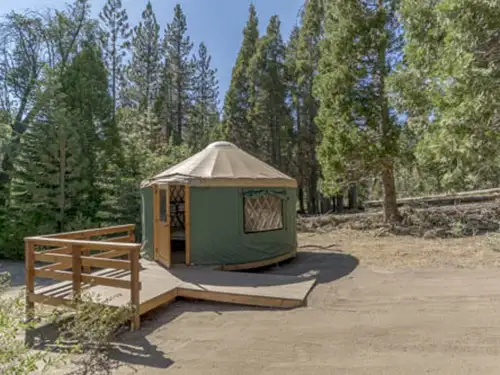
Yurt 10 in Cloudland Canyon State Park, Georgia
If you’d like to spend the night at Cloudland Canyon State Park, then reserve a comfortable yurt. Yurt 10 is wheelchair accessible and can sleep up to six people. Accessible parking is available near the yurt, with a drop-off space directly in front of the level walkway to the front porch.
The yurt features wide doorways and wood floors and is outfitted with a 13-inch high bunk bed (bottom bunk) and a 19-inch high double futon. Other furnishings include four bar stools, a tall table, a shorter wheelchair-height table and some shelves. The yurt is also equipped with electric outlets, a ceiling fan and a heater. Linens are not provided, so make sure to pack along your sleeping bag.
There’s level access out to the private back porch that’s surrounded by the forest, and furnished with two Adirondack chairs and a small table. Out front there’s an accessible picnic table on a pad, a grill, a deer dressing stand and a water spigot. It’s a comfortable set up, and with only 10 yurts in the village, it’s not as crowded as the campgrounds.
The comfort station is located a short walk down a paved road; however there’s also an accessible parking space in front if you’d prefer to drive. The standard comfort station is not accessible, but there are two large accessible family restrooms next door. They each feature a toilet with grab bars, a roll-under sink and a full five-foot turning radius. The shower area includes a roll-in shower with grab bars, a fold-down shower bench and a hand-held shower head. And since these two units are mirror images, there’s a choice in regards to toilet grab bar placement.
Located in Lake Superior, just off the Bayfield Peninsula, Apostle Islands National Lakeshore (www.nps.gov/apis/) is composed of 21 islands. Early settlers only found 12 of the islands though, so they named the site for the 12 apostles. The only way to explore the lakeshore is by boat – your own or a tour boat – and although there are a number of choices, Apostle Islands Cruises (www.apostleisland.com) is the best wheelchair-accessible Apostle Islands cruise option.
Anchors Aweigh
Based in Bayfield, Wisconsin, Apostle Islands Cruises offers several tours, including the comprehensive Grand Tour. This 55 mile scenic cruise departs from the Bayfield City Dock, aboard the accessible catamaran, Archipelago.
Accessible parking is available on Front Street near Rittenhouse, in front of the Keeper of the Light Gift Shop. There’s ramp access to the Apostle Islands Cruises ticket office, which is located on the corner of Front and Rittenhouse. From there it’s a short level walk out to the dock; however a loaner wheelchair is available for folks who can’t manage the distance.
There is level access to the Archipelago, and wheelchair-users and slow walkers are preboarded upon request (just ask at the ticket office). There’s plenty of room to maneuver a wheelchair around the spacious main deck, which is lined with large windows for panoramic views. There’s also a head on the the main deck that may work for some slow walkers. It has a two-inch coaming and a 28-inch wide doorway, and it’s equipped with one grab bar. On the plus side, the cruise is only 2.5 hours long so it’s easy to plan ahead if this setup won’t work for you.
Best bet is to buy your tickets online, as this is a popular summer tour. That said, feel free to call Apostle Islands Cruises if you have any access related questions or concerns (800-323-7619), as the staff is quite helpful.
The Wheelchair-Accessible Apostle Islands Cruise
The wheelchair-accessible Apostle Islands Grand Tour features a good overview of the history and natural features of the area, and includes an on-board guide. From the harbor the cruise heads past Basswood Island, which is know for it’s “sea stack” rock formation on the north shore. After that the cruise continues north past the sandstone carved formations on Hermit Island and then passes the tallest of the Apostle Islands — Oak Island.
Raspberry Island in Apostle Islands National Lakeshore
Next the captain pulls in to give passengers a close look at the Raspberry Island Lighthouse. Built in 1862 this duplex building features the light tower in the middle with living quarters on both sides. The lighthouse keeper lived in one side, while the assistant lighthouse keeper lived in the other.
Devil’s Island in Apostle Islands National Lakeshore
After that the cruise continues north past Bear Island before it circles Devils Island for a look at another lighthouse and the rocky southern shore. Native Americans believed the island was haunted — hence the name — because the waves that crashed against the rocks sounded like a woman screaming. Today the shore is a popular spot for sea kayakers. The highlight of the island — Devils Island Light Tower — dates back to 1898, and it’s still in service today.
Finally, the cruise heads south past the fish camp on Manitou Island, then skirts Stockton Island, before it returns to the Bayfield City Dock. It’s a pleasant and educational cruise, and a nice accessible way for wheelchair-users and slow walkers to explore this remote national lakeshore.
Fish Camp on Manitou Island in Apostle Islands National Lakeshore
Billed as the largest freshwater lake west of the Mississippi, Flathead Lake takes up a fair amount of real estate. Measuring 30 miles long and 16 miles wide, it covers 197 square miles. And although there are a number of campgrounds around the lake, the one at the Big Arm Unit (montanastateparks.reserveamerica.com/camping/big-arm-unit–flathead-lake-state-park/r/campgroundDetails.do?contractCode=MT&parkId=630110) is particularly attractive. This section, which was name for the large bay that resembles a “big arm,” has just 40 campsites; most of which are located under a mature stand of ponderosa pines.
And then there are the yurts, which are perched on a hillside overlooking the lake. There are three of them, including one that’s ideal for wheelchair-users and slow walkers. So pack the car and hit the road to Western Montana, and spend the night in this wheelchair-accessible Flathead Lake yurt.
Wheelchair-Accessible Flathead Lake Yurt
Interior of Yurt at Flathead Lake, Montana
The organization of the campground at the Big Arm Unit allows for maximum privacy for folks in the yurts. Most of the campsites are located along the main park road near the shoreline, while only the yurts and the host sites are located on a small road above the lake. Finding it may be a bit tricky the first time though, because the sign pointing to the yurts is located right after the turn. No problem, just continue down to the general campground, turn around by the restrooms, then hit the turn on your way back. The wheelchair-accessible Swan yurt is the last one on the right.
There’s parking in a level area, with room to deploy a ramp near the yurt, and a level pathway over to the deck. The deck winds around to the front of the yurt, where there’s level access through a wide door. Inside, there’s plenty of room to roll around the yurt, which is furnished with two shelving units, a table with two benches, a bunk bed (the lower bunk is 21 inches high) and a futon. The 19-inch high futon folds down and can accommodate two people, with wheelchair access on one side.
The yurt also includes several electrical outlets, lights, a heater and a fan. And the unit is partially surrounded by trees for privacy, but there’s still a nice view of the lake from the front deck. Add in an accessible vault toilet next door, and you have just about everything you need.
There’s More!
Accessible Yurt at Flathead Lake, Montana
There’s certainly enough room on the deck for a camp chair or two, but there’s also an accessible picnic table right next to the yurt. There’s a raised grill and a fire ring next to it, so bring some s’more makings and you’re good to go.
There’s also a tent pad next to the picnic table. The short pathway to the tent pad has a steep slope, which would be a challenge for many wheelchair-users. That said, it might be a good option for friends or family who don’t need any accessible accommodations.
And of course, you just can’t beat this location, as Flathead Lake is beautiful. You can get a closer look at it from the day-use area, which is near the park entrance. Make a right, just after you pass the entrance kiosk. This road goes all the way to the boat launch, but there’s a nice picnic and viewing area on the right, before you hit the launch.
There’s accessible parking in this lakeshore lot, and a sidewalk that leads over to an accessible vault toilet. There are two accessible picnic table under the pines near the lake, with level access out to them. There’s also a large ramada in this area, and although it does have level access and an accessible picnic table, it’s reserved for groups. And if you happen to be launching a boat, there’s an accessible trailer parking spot right behind the vault toilet. All in all, the Big Arm Unit of Flathead Lake is a pleasant place for a picnic, or a nice place to take a break, spend the night and and enjoy the view.
Barrier-Free Travel Glacier, Yellowstone and Grand Teton National Parks for Wheelchair-Users and Slow Walkers