As a travel writer since 1977, Candy Harrington has been writing about accessible travel exclusively since 1996. She’s the founding editor of Emerging Horizons, and the author of the popular Barrier-Free Travel national park series. With thousands of bylines to her credit, Candy hits the road often, in search of new accessible travel finds. Candy and her travel photographer husband Charles Pannell reside in NE Washington, where they tend to their chicken flock and enjoy a rural lifestyle.
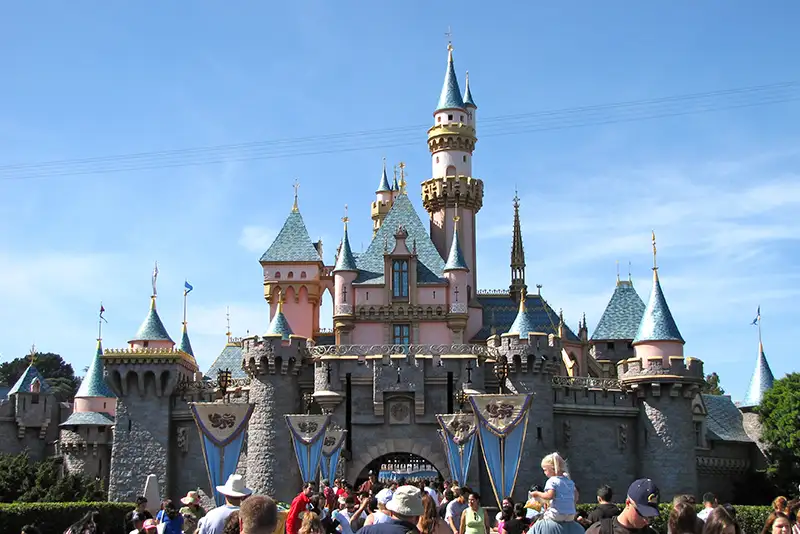
Changes are coming to the Disney Disability Access System (DAS) hat may affect some wheelchair-users and slow walkers. These changes will go into effect on May 20, 2024 at Walt Disney World, and on June 18, 2024 at Disneyland.
The DAS pass allows guests who cannot wait in long lines to go to the ride and schedule a return time. The biggest change in this system is the criteria for qualification. Previously, all “guests who have difficulty tolerating extended waits in a conventional queue environment due to a disability” qualified for the DAS pass. Under the new system, the qualifications have been narrowed to “guests who, due to a developmental disability such as autism or similar, are unable to wait in a conventional queue for a long period of time.” And although some guests who qualify under the new criteria may also have a physical disability, they must also have a developmental disability that renders them unable to wait in long lines.
How the Program Works
Under the old program, guests could meet with a Cast Member at the Disney parks, have a short interview and then get their DAS. Under the new program, all DAS interviews will be done virtually, and they can be done two to 30 days in advance. In-person registration will no longer be an option. Additionally, professionals from Health Alliance will assist Cast Members to determine a guest’s eligibility for a DAS pass.
After you get your DAS pass, you can reserve a return time on rides through the My Disney Experience Mobile app. Guests can only reserve one wait time; and although they won’t have to stand in line, the return time will be comparable to the current waiting time for that ride or attraction. The DAS pass is good for the length of your ticket or 120 days, whichever is shorter. And it’s only good for a total of four people, unless they are immediate family.
The DAS may not be used for guests with a service animal, unless they meet the eligibility criteria for a developmental disability. Instead, guests with a service animal can use the Rider Switch Program. This program allows guests to split their party, and have half of their party board the ride, then have the rest of the party take the ride when they are done. This program is available to guests who have a service animal that cannot board the attraction or who do not want to use the provided kennel.
Why Did the Disney Disability Access System Criteria Change?
So why the big changes to the Disney Disability Access System? There are basically two reasons for this. Improved access and abuse of the previous system.
Years ago wheelchair-users got front-of-line privileges, usually because the entrances were not accessible. They had to go in the exit or an alternate entrance, and since there wasn’t a line at the exit, well they skipped the queue. Today many theme parks have worked hard to make their rides accessible to as many people as possible, so a separate entrance is not necessary.
And that leads to the second reason. Abuse. There’s no shortage of stories about folks who “faked” a disability in order to get a DAS pass. Basically if you rolled into guest services in a wheelchair — your own or not — you got one. Of course that ruined things for folks who really needed the access.
Once such “incident” involved some Manhattan moms who booked an accessible VIP Disney tour through a Florida tour company, even though nobody in the party was disabled. And they saw absolutely nothing wrong with booking an accessible tour to get what they considered concierge access to the front of the line. As one mom told the New York Post, “This is how the 1% does Disney.”
And after that went public, Disney cut their front-of-line policy for wheelchair-users and went to a more stringent evaluation for the DAS. But the latest change to their plan is just an attempt to fine tune it, and to meet the needs of guests with developmental disabilities who just cannot physically wait in long lines.
And with the entrances to most modern rides now being accessible, it makes for a more inclusive environment at Disney parks. So plan ahead for your next Disney visit so you know what to expect.
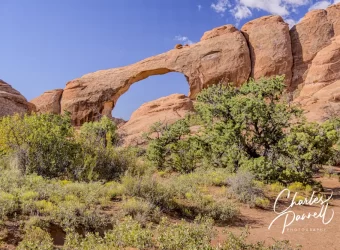
Skyline Arch viewed from the Devil’s Garden campground in Arches National Park
Arches National Park is filled to the brim with red rocks, arches and scenic beauty. So it comes as no surprise that it’s a top pick as a Hollywood filming location. The results are some stunning backdrops and jaw-dropping views added to the big screen. And the good news is, many of these sites are pretty easy to find. So take some time to scout out these Hollywood filming locations in Arches National Park on your next visit.
A Little Primer
Moab Museum of Film and Western Heritage
Before you visit the park, plan a stop at the Moab Museum of Film and Western Heritage (moabmfwh.com), which is just a short scenic drive down Highway 128 at Red Cliffs Lodge. Not only will it help you appreciate the complexities of filming on location, but it will also give you some fun inside stories on the productions filmed in the area.
There’s accessible parking in front of the lodge, and although the museum is located down a flight of stairs, there’s an alternate accessible entrance. From the accessible parking space, follow the sidewalk on the left, down around the building to the level back entrance. Inside you’ll find a hallway lined with movie posters, with the museum at the end of the hall on the right. There’s level access to the museum, with good pathway access to all the exhibits.
Take some time to watch the introductory video that details the history of filming in the area and includes some fun facts, stories and recollections about the flicks. The museum is jam packed with memorabilia from the over 120 movies shot in the area, including City Slickers II, Back to the Future III, Thelma and Louise and Indiana Jones and the Last Crusade. Don’t miss the Geena Davis stunt dummy that survived the final crash in Thelma and Louise, or the license plate from the Shaguar in Austin Powers Goldmember. Add in a large collection of photographs, movie posters and memorabilia and you have a complete picture of the filming history in the area. And the best part is – there’s no admission charge to this fun and funky museum.
Filming Locations in Arches
Park Avenue Viewpoint
Park Avenue Viewpoint in Arches National Park
Located about two miles from the park entrance, Park Avenue Viewpoint is the first stop on this filming locations in Arches scenic drive. The opening scenes of Indiana Jones and the Last Crusade were filmed here. Just picture a group of boy scouts — including a youthful Indy –riding their horses through the desert against this magnificent backdrop. There’s accessible parking near the paved 200-foot trail out to the upper viewpoint, where you’ll get a good view of the towering formations that resemble the skyscrapers of Manhattan.
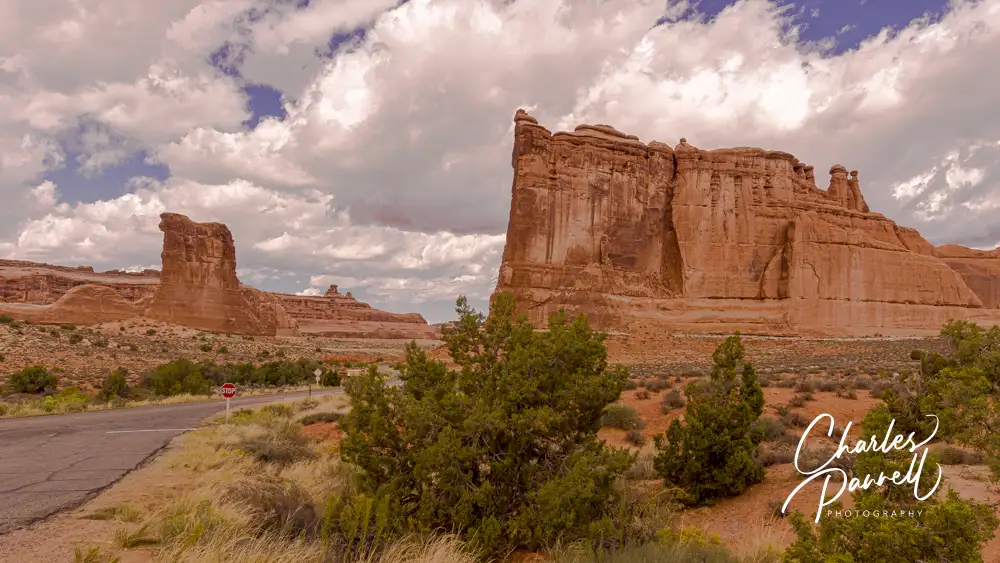
Courthouse Towers
Courthouse Towers in Arches National Park
Just down the road you’ll find Courthouse Towers, the next stop on this Arches filming locations tour. A memorable scene from Thelma & Louse was filmed nearby. It begins as the pair is stopped by a police officer in the middle of nowhere, and concludes when the gals get the officer’s gun and later lock him in the trunk of his car. Just look down the road and try to imagine it all unfolding. There’s accessible parking in the small lot with level access to viewpoints on both sides, so you’ll have a variety of vantage points for a good view.
Balanced Rock
Balanced Rock in Arches National Park
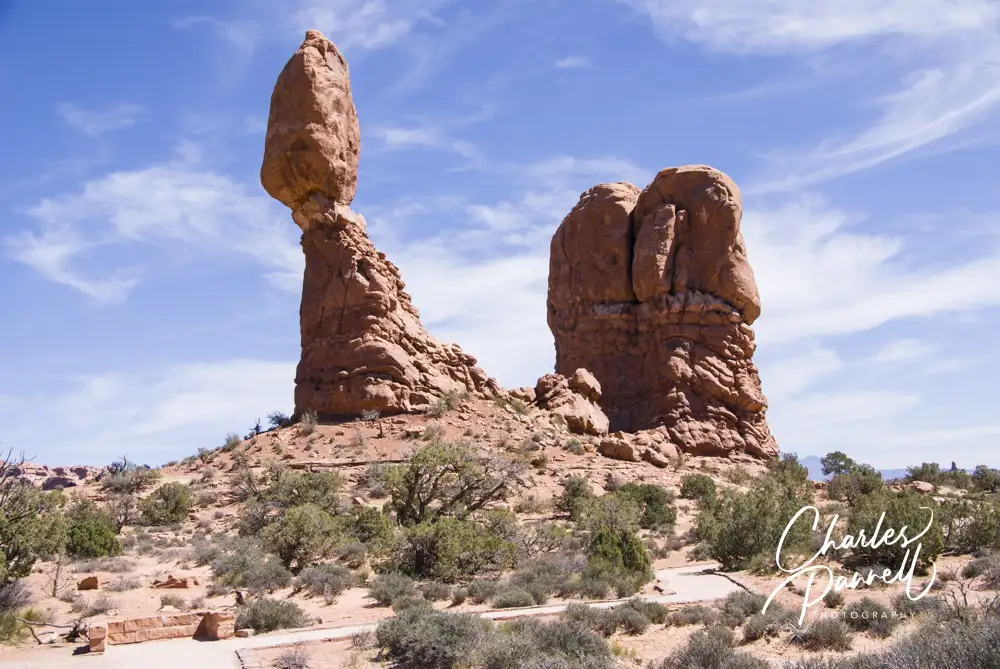
Balanced Rock, which is located just south of the intersection of Arches National Park Road and The Windows Road, is one of the most popular stops in the park. It was also a filming site for Rio Conchos starring Stuart Whitman and Richard Boone in 1964. The infamous rock can be seen in the background in several scenes, but is most prominent in the camping scene. There’s accessible parking in the small lot near Balanced Rock, with curb-cut access up to the interpretive plaque. From there you’ll get an excellent view of this Arches favorite.
Double Arch
Double Arch in Arches National Park
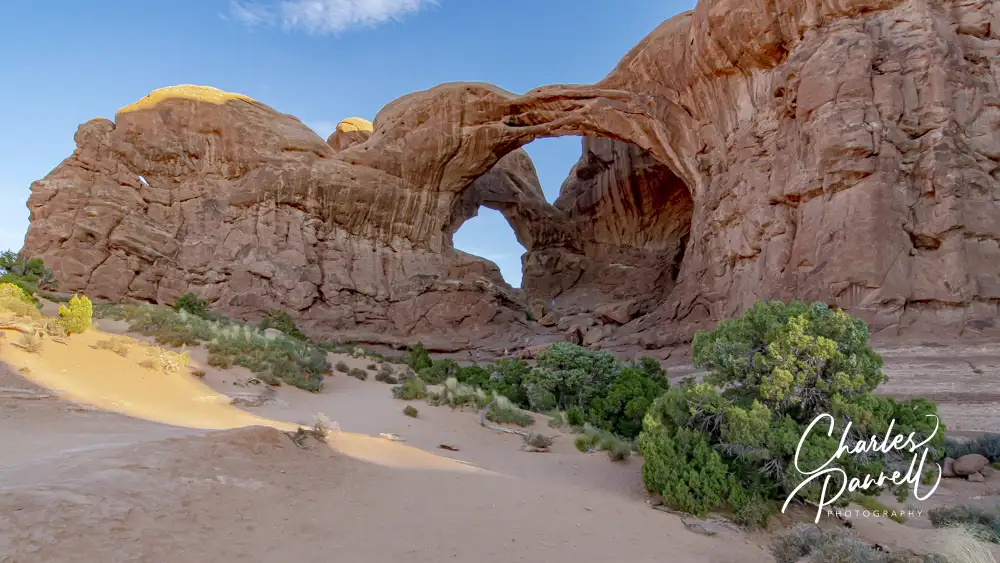
Located in the Windows Section of the park, Double Arch was another filming site for Indiana Jones and the Last Crusade. Again in the beginning of the movie, River Phoenix runs down the hill in front of the arch, after encountering some grave robbers. There’s accessible parking near the trailhead, and the .3-mile trail leads out to this unique arch. It may be doable for some slow walkers and power wheelchair-users, but manual wheelchair-users may require assistance with the first steep grade. And even if you can’t do the trail, you’ll still get a good view of Double Arch from the trailhead.
Devils Garden Trail
Devil’s Garden Trail in Arches National Park
Last but no least on our list of filming locations in Arches is the Devils Garden Trail, which is located at the end of the Arches National Park Road. Although the entire length of this tail is not accessible, the first 100 yards offers some dramatic views for wheelchair-users and slow walkers. It was also the filming site for Taza Son of Cochise. More specifically the scene where the US Calvary was ambushed by the Indians was shot here. Just imagine the troops advancing through the fin, only to be cut down in the attack. The first part of this trail is a must-see, as you don’t often find wheelchair-accessible canyon walks.
Insider Tip
In an effort to better manage the crowds at Arches National Park, entrance reservations are required during the peak visitation season. These reservations are not available for purchase at the park entrance. They must be purchased in advance at www.recreation.gov. And even if you have a national park pass you still need an entrance reservation to enter the park between 7AM and 4PM.
That said, the park is absolutely gorgeous in the early morning hours; so if you don’t happen to score an entrance reservation get there before 7AM. As an added bonus, you’re find fewer people there at that hour, and you won’t have to search in vain for parking at the popular stops. For more information about the required entrance reservations, visit emerginghorizons.com/national-park-entrance-reservations-required-in-2024/.
Barrier-Free Travel
Utah National Parks for Wheelchair-users and Slow Walkers
If you’ve always dreamed of enjoying some fun and sun on the beach, but thought it was impossible because you use a wheelchair, then think again. Thanks to an enterprising man on the Gulf Coast, power beach wheelchairs on Alabama beaches are a reality for wheelchair-users and slow walkers..
A Man With a Plan
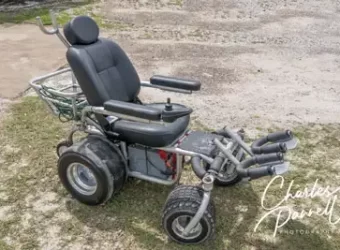
After retiring to the Gulf Coast, Jerry Nasello was diagnosed with ALS. A diehard beachgoer, Nasello was devastated, but he was also determined to find a way to navigate over the sand without walking. He remembered a power beach wheelchair that he once saw in California, and his analytical mind went to work and he created his own version. And over the years he improved it, so he and other wheelchair users could hit the beach.
His first model used PVC pipe, but subsequent models incorporated lightweight metal frames and non-corrosive alloys into the design. He then added an upholstered seat and a joystick for steering for the perfect beach access solution for wheelchair-users and slow walkers. And shortly thereafter he started a company and began renting his fleet of power beach wheelchair to others.
New Owners Continue The Dream
Sadly Jerry is no longer with us, however his power beach wheelchairs on Alabama beaches are still a reality. Today Beach Power Rentals (www.BeachPowerRentals.com) offers rental power beach wheelchair in Gulf Shores. You can rent them by the day, week or month, and delivery is available for an extra charge. It’s the perfect solution for folks who have level or ramped access to a beach near their accommodations. And if you also need a beach umbrella, manual beach wheelchair, a scooter or a shower chair, they can deliver those too.
Additionally, they can make adjustments to the power beach wheelchairs based on individual needs. They can mount the joystick on either side, or take it off to allow a companion to steer it. They can also adjust the length, height, width and rotation of the footrests. And if there are other adjustments that you need, just let the folks at Beach Power Rentals know, and they will do their best to make it happen.
So get ready to hit the beach in a power wheelchair on your next Gulf Shores visit.
Barrier-Free Travel Favorite Florida Parks for Wheelers and Slow Walkers
Located on the Monterey Peninsula, Asilomar Conference Center (visitasilomar.com) dates back to 1913, when it opened its doors as a YWCA leadership camp. Over the years the 107-acre beachfront campus morphed into a full service conference facility. That said, remnants from the past remain, as 11 of the original Julia Morgan buildings dot this refuge by the sea. And although the venue is an excellent choice for a conference, reunion or retreat, Asilomar is also a good pick for a leisurely seaside getaway. As an added bonus, since Asilomar Conference Center is located on a state beach (www.parks.ca.gov/?page_id=566), a good deal of attention has been paid to access, so it’s also a great option for wheelchair-users and slow walkers.
Spend the Night
The “Stuck-Up” Inn at Asilomar Conference Center
Built in 1913, the Phoebe Apperson Hearst Social Hall originally housed a classroom, the library and a gift shop. Today this Julia Morgan building serves as a lobby, front desk and information center for this favorite Monterey Peninsula lodging choice.
There’s accessible parking in the adjacent lot with barrier-free access to the building. Inside there’s plenty of room to roll around the thick redwood floor to the front desk. Although the building serves a utilitarian purpose, take some time to admire the architecture; from the massive stone fireplace to the exposed redwood beams.
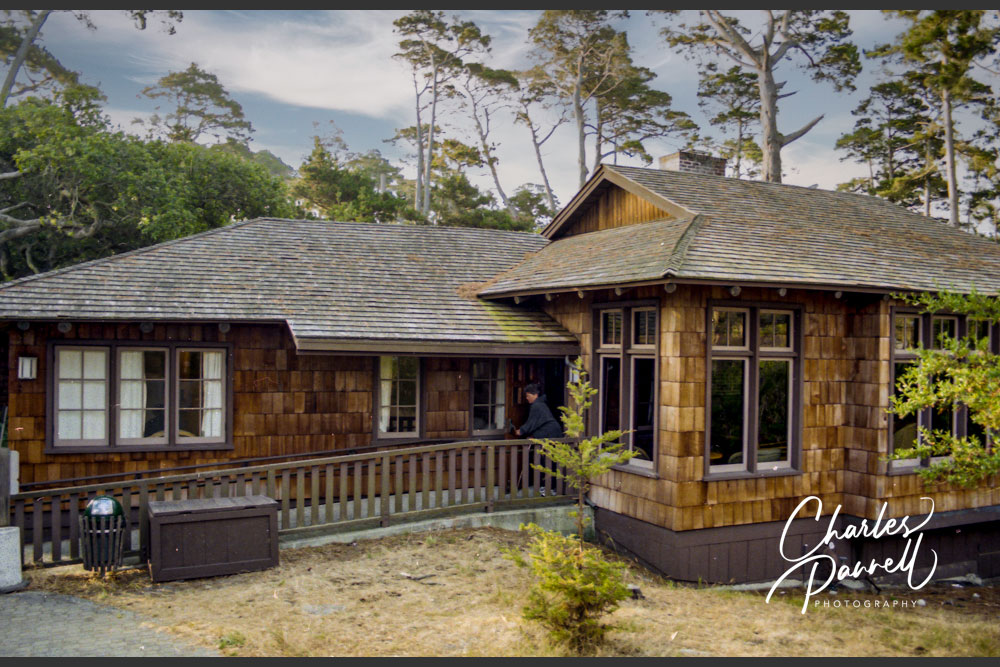
Although Asilomar has added some modern rooms over the years, two of the accessible rooms are located in a historic building, close to the social hall. Nicknamed the Stuck-Up Inn, this building was once home to a group of college women who thought the menial work they were hired to do was beneath them. Accessible parking is located near the front entrance and there is ramped access up to the front door. The large common area features plenty of room to wheel around, and it has an accessible public restroom.
Accessible rooms 401 and 413 both feature good pathway access, and hardwood floors for easy rolling. One room is furnished with a full bed, while the other offers two twin beds. And both bathrooms are nicely equipped with a roll-in shower with a hand-held showerhead, grab bars and a fold-down shower bench. Other access features include plenty of room to maneuver a wheelchair, and toilet grab bars. A plastic shower bench, and a toilet seat riser with attached grab bars can also be added to these — or any other — rooms upon request.
Inside the Stuck-Up Inn
Explore the Area
Asilomar is definitely the place to reflect and commune with nature; in fact it’s not unusual to look out your window and see deer grazing in the surrounding woodlands. That said, take some time to get out and discover what the conference center itself has to offer.
Although the property is hilly in places, an accessible shuttle service is available. This ramp-equipped van is available 24 hours a day to transport guests and their luggage anywhere on the property. Just Dial 0 on any house phone or call the front desk (831-372-8016) from your cell phone.
Merrill Hall at Asilomar Conference Center
Several of the historic Julia Morgan buildings now boast modern access features. These include Merrill Hall, the Crocker Dining Complex and the Chapel. And if you work up an appetite while exploring the grounds, Phoebe’s Cafe in the social hall offers a selection of sandwiches, salads, beverages and sweet treats. There’s also an accessible picnic and campfire area, as well as a lift-equipped pool on the grounds.
Dune boardwalk at Asilomar Conference Center
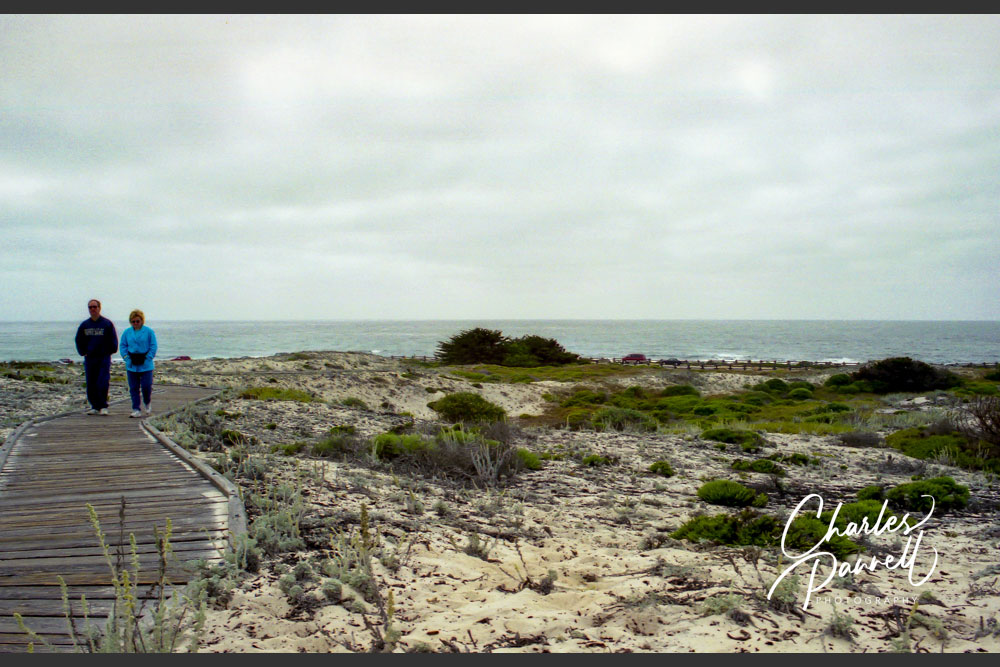
Of course the best thing to do at Asilomar is to enjoy the natural surroundings. The accessible Dunes Boardwalk begins near the Crocker Dining Complex and travels over the dunes for a quarter-mile to the rocky ocean shore. And if you’d like a longer hike, the Coast Trail begins just north of the conference center. This accessible one-mile trail runs along the coast and offers some gorgeous ocean views. If, on the other hand, you’d like to explore the beach, a beach wheelchair is available for loan at the front desk. In the end, there’s no shortage of ways to enjoy this accessible slice of the Monterey Peninsula.
Barrier-Free Travel California National Park Road Trips for Wheelchair-Users and Slow Walkers
If a trip to Portugal is on your travel wish-list, then check out this wheelchair-accessible villa in the Algarve. The four-bedroom unit can accommodate up to seven adults and two toddlers. It’s equipped with an accessible bathroom that’s outfitted with a with a roll-in shower with grab bars and a hand-held showerhead. A shower-commode chair and a toilet-riser are also available; and the bathroom also has an accessible vanity area as well as a lowered mirror. There’s good access to all the public spaces including the fully equipped kitchen and the patio and BBQ area. And the swimming pool is even equipped with a battery-powered lift.
Airport transfers from the Faro airport are also included with this wheelchair-accessible Portugal villa rental. They are available in a wheelchair-accessible Renault Kangoo. There are two of these vehicles, and one can accommodate four passengers and a wheelchair, while the other can take three passengers and a wheelchair. Both vehicles have ramps and tie-downs. And although they do not rent the vehicles, they are available for use with the rental of the villa.
There is also a variety of medical equipment available for rent. The list includes, power wheelchairs, manual wheelchairs, scooters, walkers, an alternating pressure mattress, a bath lift, an electric hoist and oxygen equipment. And if you need nursing care, that can also be arranged. It’s a very accessible and inclusive rental package.
A new United Airlines wheelchair sizer tool was recently unveiled. This digital tool enables wheelchair-users to select flights that can accommodate their specific assistive devices. Why is this important? Well, some larger wheelchairs will not fit through certain aircraft cargo doors without being titled to the side or back. And in some cases, tilting those wheelchairs could seriously damage them.
The Wheelchair Sizer Tool
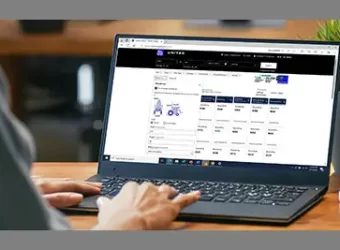
So how does this new United Airlines wheelchair sizer tool work? Well basically you enter your flight criteria on the United Airlines website or app, then all the flights that meet your criteria are returned. Next you click on the “wheelchair” tab in the top right, and enter the dimensions and battery type of your wheelchair. Finally, click on “check size” and the tool will return all the flights that can accommodate your wheelchair.
And here’s the great part. If you aren’t able to take your preferred flight because your wheelchair won’t fit through the cargo door, and there are other more expensive flights that can accommodate your wheelchair, you can get a refund of the fare difference.
New United Airlines Wheelchair Sizer Tool Result of ACAA Complaint
So why did United Airlines develop this new wheelchair sizer tool? Well, it was all the result of an Air Carrier Access Act (ACAA) Complaint, and a subsequent settlement agreement between the Department of Transportation (DOT) and United Airlines.
The original ACAA complaint that triggered the DOT investigation was filed by Engracia Figueroa. Unfortunately United Airlines damaged her customized wheelchair and left her sitting in an airport wheelchair for five hours. And perhaps if she knew that she had other flight options, she would have taken an alternate flight, where her wheelchair didn’t have to be twisted, turned and tilted to fit through the cargo door. And all that manhandling was what damaged her $30,000 assistive device.
Sadly Ms. Figueroa’s story had a tragic ending. United initially refused to replace her wheelchair, and although Ms. Figueroa fought this decision, it took a toll on her. She subsequently developed a pressure sore as the direct result of improper seating, and by the time United Airlines finally agreed to replace her wheelchair, it was too late. Ms. Figueroa died from a subsequent infection on October 31, 2021.
Trial Program at IAH
Another provision of the DOT settlement agreement requires United Airlines to implement a six-month pilot program at George Bush Intercontinental Airport (IAH). This trial program will explore additional equipment and service options that can be used to accommodate passengers who have had their customized wheelchairs damaged or delayed.
Specifically, this program focuses on the time frame between a customer’s arrival at the airport and the time that United returns their wheelchair or provides an appropriate loaner. The goal is to make extended waits — like Ms. Figueroa had — safer and more comfortable. To that end, United is equipping their IAH loaner wheelchairs with Permobil cushions, in order to improve comfort and stability. Additionally, the airline is also reimbursing customers for transportation expenses, should there be an extended wait for the return of their assistive service. That way they can opt to wait in a more comfortable setting, such as a hotel or their own home.
The DOT has agreed to close its investigation of the ACAA complaint filed by Ms. Figueroa, in return for the implementation of these new wheelchair policies. An although it’s great to see these improvements, they wouldn’t be in place had it not for Ms. Figueroa’s ACAA complaint. So remember that the next time you encounter access problems while flying. Filing an ACAA complaint won’t personally help you, but it could help effect change. You can file a ACAA complaint at https://secure.dot.gov/air-travel-complaint.
And lest you think that it’s no big deal, remember that the ACAA has been in effect since 1986. We shouldn’t still be having these problems today. File that complaint if you encounter access-related issues .
Located in Northern Oregon, the Historic Columbia River Highway parallels Interstate 84 and runs from Troutdale to The Dalles. This scenic two-lane road, which is also known as Highway 30, snakes through the Columbia River Gorge and offers some spectacular windshield views. And although Interstate 84 is the quicker way to traverse the gorge, Highway 30 is definitely the more picturesque choice.
Granted, there’s no shortage of bold scenery along the entire length of the 75-mile route; however the 10-mile segment between Vista House and Horsetail Falls is a don’t-miss side trip for wheelchair-users and slow walkers. Known as the waterfall corridor, this segment includes a number of wheelchair-accessible viewpoints, trails and historic stops, and offers a closer look at some of the beautiful cascades along the way.
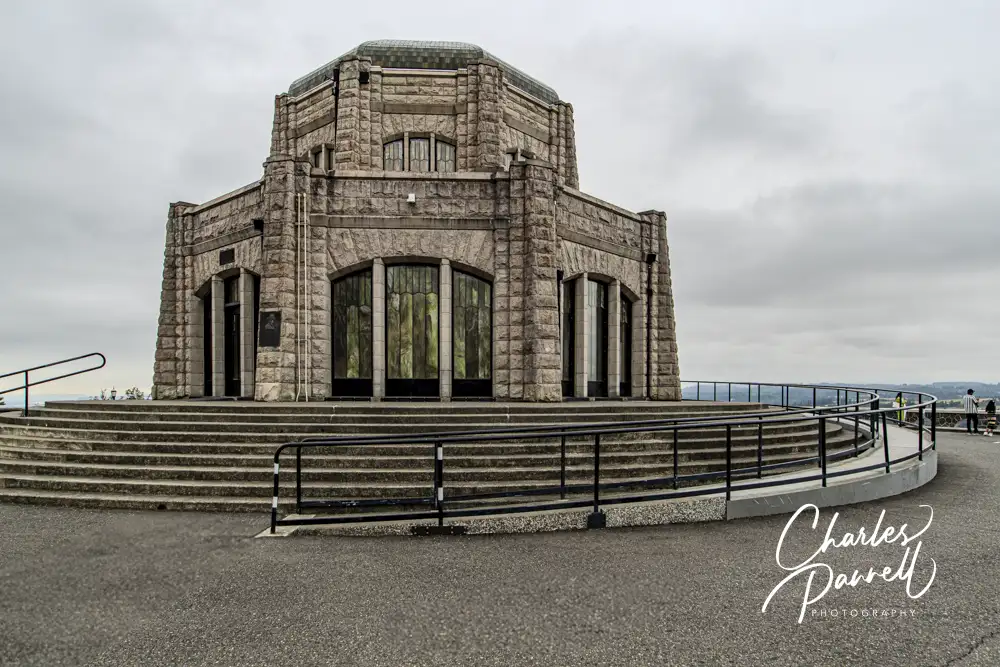
Vista House
The Vista House on the Columbia River Highway Waterfall Corridor
Finding the waterfall corridor is easy. Head east from Portland on Interstate 84, then take exit 22 at Corbett and turn right. From there just follow the signs, and make a left on the Historic Columbia River Highway. This portion of the road winds through the forest for about three miles, before it heads uphill to Vista House at Crown Point (www.vistahouse.com).
Built in 1916 as a rest stop and observation tower, Vista House is a fitting starting point for the drive, as it was also the site of the 1916 dedication of the highway. There’s accessible parking near the front, with ramp access around to the back entrance. There’s level access through the automatic doors and plenty of room to maneuver around the main floor of this architectural treasure. Perched some 600 feet above the Columbia River, Vista House is lined with marble floors and filled with stained glass windows.
Listed on the National Register of Historic Places, this historic building also includes a cleverly hidden wheelchair lift. Designed to blend in with the architecture, the lift allows wheelchair-users and slow walkers access to the restrooms, exhibits, gift shop and cafe that are housed in the lower level. The building is usually open from Friday to Monday, but it depends on available staffing. And even if the building isn’t open you can still peer inside. There’s also a great river view near the back entrance.
Latourell Falls
Latourell Falls is located 2.5 miles up the road, in the verdant Guy W. Talbolt State Park. There’s accessible parking with level access over to a viewing area, where you can get a gander at the majestic falls, as it tumbles 224 feet down over columnar basalt pillars. There’s a trail to an upper viewing area, but it’s steep and not wheelchair-accessible. Still you can get a great view from below.
There’s also an accessible vault toilet at this stop. And if you’d like to enjoy lunch alfresco, there’s an accessible picnic table located near the parking lot.
Bridal Veil Falls
Bridal Veil Falls, which is located two miles up the road, is also worth a stop. Although the trail to the the falls is steep and has steps, there’s another accessible trail that offers a good river view. There’s accessible parking in the large lot, with level access over to the trailhead. The trail to the right goes up to the falls, while the accessible Overlook Trail on the left leads over to the river. There’s also an accessible vault toilet near the trailhead.
The half-mile Overlook Trail has a few bumps along the way, but it’s still doable for most wheelchair-users and slow walkers. It winds through the woods, passes a picnic table and then skirts the river. There are a few places where you can get good view of the Columbia River, before the trail winds back through the woods to the beginning. It’s a pleasant stroll, and definitely worth a stop.
Wahkeena Falls
As you continue along Highway 30, Wahkeena Falls is located three miles up the road. Accessible parking is available on the left, above the picnic area. There’s also an old restroom with an accessible stall in the picnic area; however it’s best to drive down if you need to use it, as the road is pretty steep.
The accessible trail to the falls viewpoint is located across the street. The 200-foot paved trail is fairly level and winds over to the perfect vantage point. You can’t see these falls from the road, but there’s a great view of them at the end of the accessible trail.
Multnomah Falls
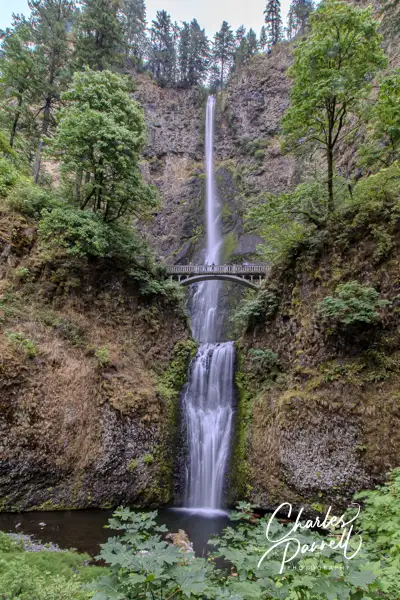
By far the most popular waterfall along the route is Multnomah Falls, which is located a half-mile from Wahkeena Falls. There’s accessible parking in the small lot across from Multnomah Falls Lodge, with level access over to the lower viewing area. Across the street, there’s a paved walkway that leads about 200 yards to the upper viewing area. Although this is a good option for power wheelchair-users, it’s a bit steep for manual wheelchair-users and slow walkers. Still you can get a nice view from the lower vantage point.
There’s level access to the lodge, which houses a visitor center and a gift shop on the lower level; and offers elevator access up to the restaurant on the second floor. Accessible restrooms are also located on the lower level. And if you drive by slowly, you can get a nice view of the falls from Highway 30.
There’s also a parking area located off of Interstate 84 for this popular stop. Just take exit 31 and follow the signs. There’s plenty of accessible parking in the lot; however the path over to the Highway 30 parking area is steep — especially near the bridge — so it’s not a viable option for most folks. The best bet is to park in the Highway 30 parking area. It should also be noted that there is no vehicular access from the Interstate 84 parking area to the Highway 30 parking area; so if you use the Interstate 84 parking area you won’t be able to drive to the Historic Columbia River Highway from there.
Multnomah Falls Timed Use Permit
During the peak summer season, a Multnomah Falls Timed Use Permit is required in order to park in the parking lot off of Interstate 84. The permit is required from late May to early September from 9 AM to 6PM. One permit per car is required, and the permits are checked on the path from the parking lot to the falls.
The permits are available for $2 at www.recreation.gov. They are valid for entry during a one-hour time frame, and if not used they will expire at the end of the issued time. For example, if you buy a permit for 1:00 PM and have not used it by 2:00 PM it will expire at that time. That said, you can spend as much time at the falls as you want, as long as you enter within the specified time frame.
The bulk of the permits are available 14 days in advance; while a smaller batch is released two days prior to the arrival date. Permits are not sold on site, so make sure to get one ahead of time. Additionally, just because you have a permit, does not mean you are guaranteed a parking space.
Horsetail Falls
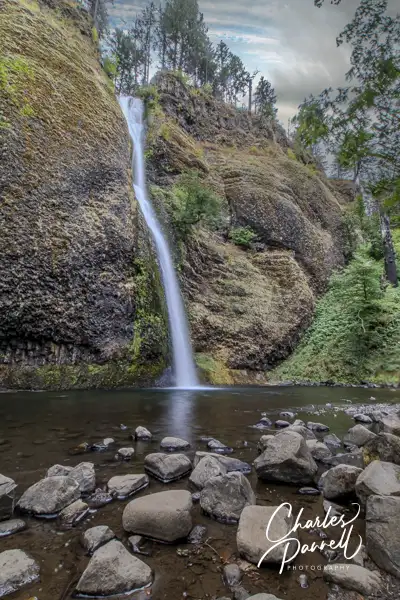
Last but certainly not least on this Historic Columbia River Highway drive is Horsetail Falls, which is located 2.5 miles from Multnomah Falls. There’s accessible parking in the lot across the street from the falls. From there a short paved level trail leads 150 feet over to a nice viewpoint. There are also a few picnic tables near the viewpoint, and although there are no services at this stop there’s a bench to sit and enjoy the falls. As an added bonus, you can also get an excellent view of Horsetail Falls from Highway 30 or even from the adjacent parking lot.
After you’d had time to enjoy the falls, continue east on Highway 30 to Dodson, and hop on Interstate 84. From there you can either circle back to Portland, or continue east to explore more of Oregon. Either way, this scenic drive is well worth the short detour.
Latourell Falls
Bridal Veil Falls
Multnomath Falls
Horsetail Falls
Historic Columbia River Highway Travel Tips
Although the scenic waterfall corridor is a must-do on any Oregon road trip, there are a few things you can do to make your visit go smoother.
First and foremost, try and arrive early in the day. The route gets extremely crowded in the afternoon, and parking places — even accessible spots — are hard to come by.
The early bird rule applies double for the Multnomah Falls area. Even if you don’t plan to stop, that section of the route routinely backs up after 11 AM, as people sit in the road and wait for available parking spots.
It’s also a good idea to travel from west to east along the route. Most of the e-bike rentals begin at Cascade Locks and head west along Highway 30; and since there aren’t any alternative trails they have to ride in the road along the waterfall corridor. This tends to slow down the traffic that’s going in the westerly direction, and even backs it up at some spots.
There aren’t many services along the waterfall corridor, so pack along water and snacks. There are however a lot of pleasant picnic spots to enjoy a quiet breakfast or lunch.
Summer is the most crowded season along the Columbia River Gorge, so try to visit in the off season. The peak flow seasons for the waterfalls are winter and spring, which are usually less crowded.
Fall is also becoming a busy time along the route, as the fall foliage show is spectacular. It’s especially crowded on the weekends, so try to visit mid-week if possible.
Finally, take your time and stay a while to enjoy the Columbia River Gorge. For a fun getaway, spend the night in an accessible treehouse at nearby Skamania Lodge.
Barrier-Free Travel Washington National Parks for Wheelers and Slow Walkers
Located just outside the South Entrance of Yosemite National Park (www.emerginghorizons.com/yosemite-national-park), Tenaya Lodge at Yosemite (tenayalodge.com) has long been a favorite pick for park visitors. And although this luxury property boasts a robust selection of accessible guest rooms, the wheelchair-accessible Waybound Yosemite (https://www.waybound.com/) cabins (called havens) located next door, offer guests a secluded glamping experience. Add in the Tenaya Lodge accessible bus for tours of Yosemite Valley, and you have all the ingredients for a perfect national park getaway.
The Waybound Yosemite Concept
Located a short drive from Tenaya Lodge, the Waybound Yosemite havens offer a bevy of creature comforts combined with the personalized services and perks of a full-service resort. Nestled in a sugar pine and incense cedar forest, the havens exude a dual theme of exploration and community. They inspire guests to explore Yosemite’s great outdoor areas, and then invite them to commune with their fellow travelers and share their adventures in the intimate public spaces dotted throughout the Waybound Yosemite complex.
The cornerstone of the complex is The Commons, an exclusive communal retreat with an expansive deck that offers a panoramic forest view. There’s accessible parking nearby, with plenty of room to maneuver a wheelchair inside The Commons. Waybound Yosemite guests check-in at The Commons, and receive a welcome lemonade and a home-made cookie before proceeding to their havens.
The Commons also features a full service bar and restaurant which serves breakfast and dinner. Add in a coffee counter, a general store and a s’more bar in the evenings, and you have everything you could possible need.
Accessible Explorer Cabins
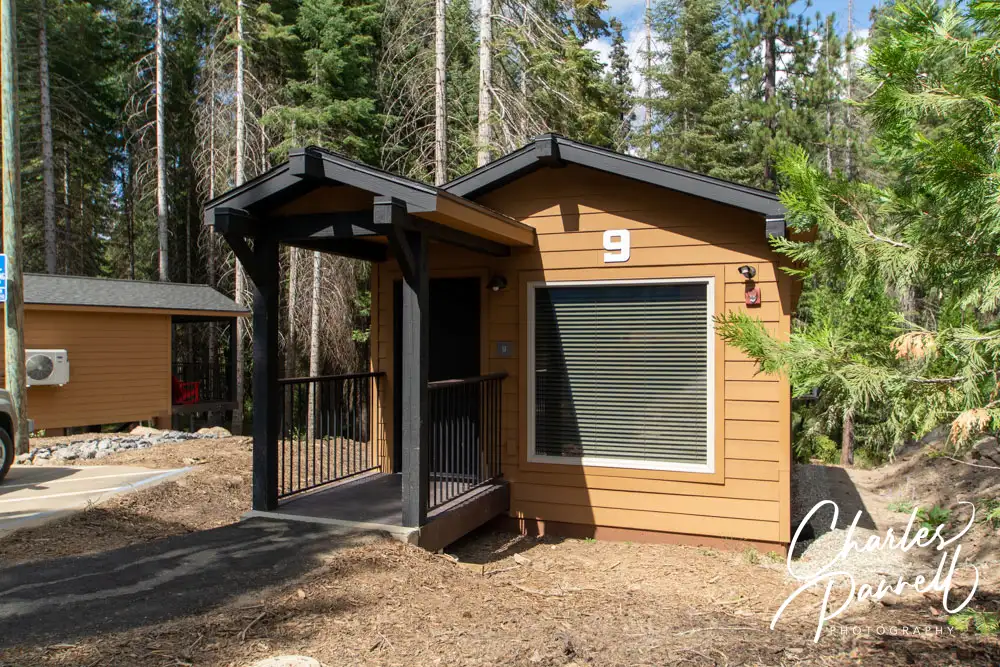
There are five wheelchair-accessible havens at Wayside Yosemite — Havens 9, 17, 24, 34 and 42. Haven 9, which is a premium accessible cabin is located a short walk from The Commons. Accessible parking is located next to the two-bedroom unit, with level access to the front door. Access features include wide doorways, lever handles, lowered environmental controls, good pathway access and plank floors for easy rolling.
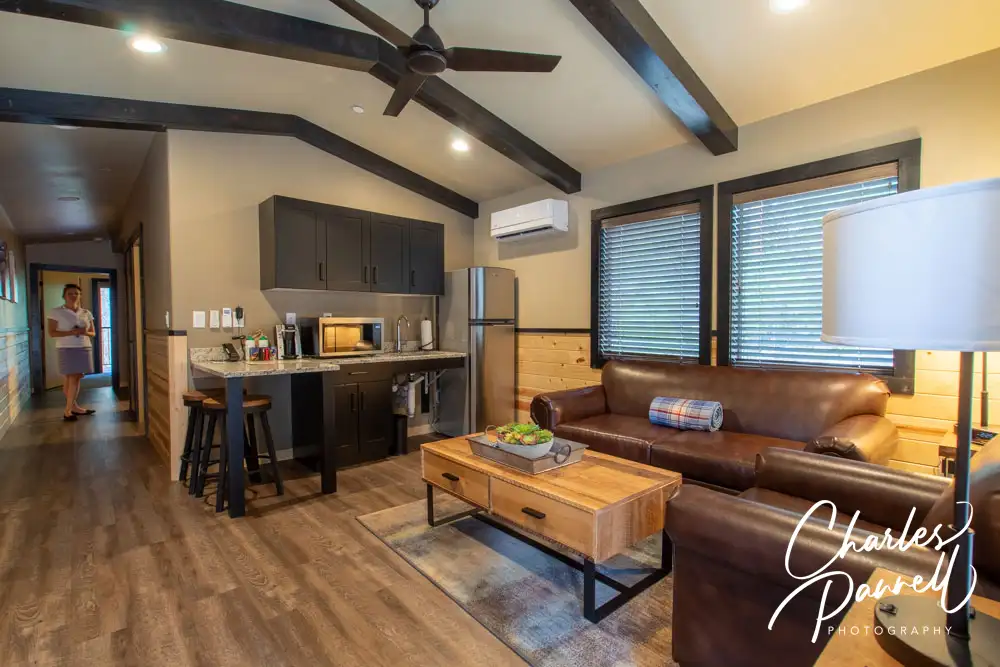
The living area is furnished with a 11-inch high sleeper sofa and an easy chair, which are nestled in front of a cozy gas fireplace. The adjacent kitchenette is equipped with a sink, a microwave, and a refrigerator. It also boasts counter seating with two bar stools.
Living Space in Haven 9
Master Bedroom in Haven 9
Second Bedroom in Haven 9
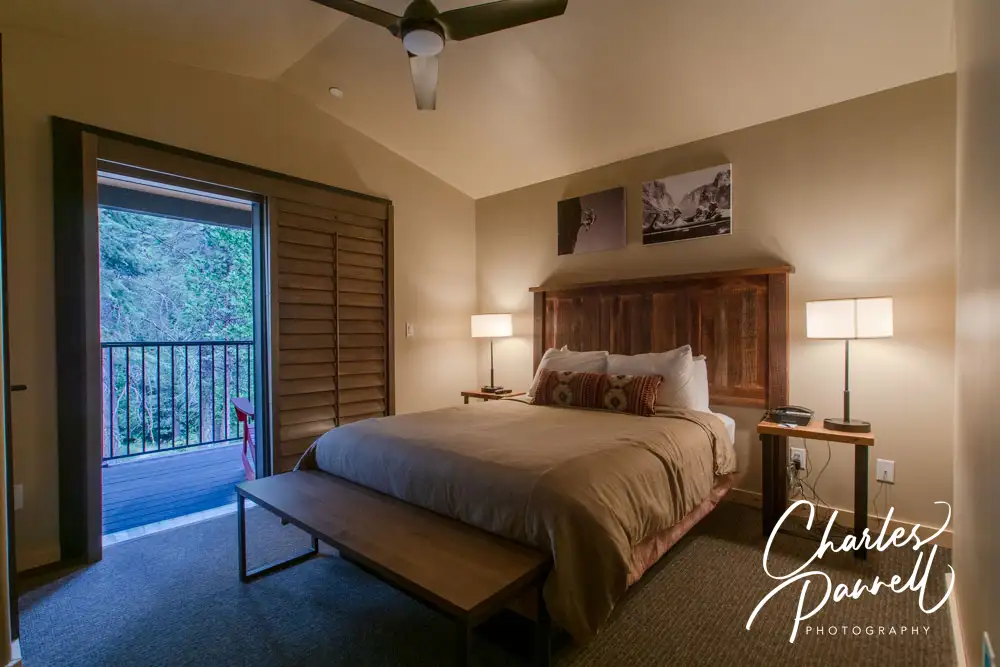
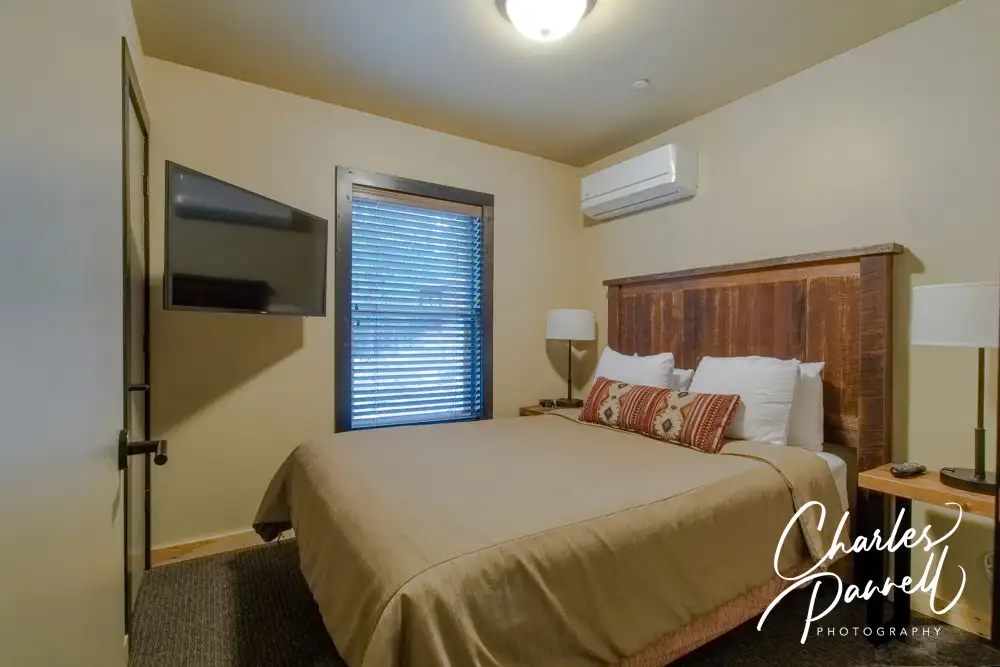
The master bedroom is furnished with a 23-inch high queen-sized bed with wheelchair access on both sides, a chest of drawers and two night stands. There’s level access out to the roomy back deck, which offers a sweeping view of Big Creek, and is furnished with two Adirondack chairs. The second bedroom is a bit smaller, and it’s also furnished with a 23-inch high queen-sized bed. There’s room enough for a manual wheelchair on one side, but this bedroom is really best suited for a slow walker.
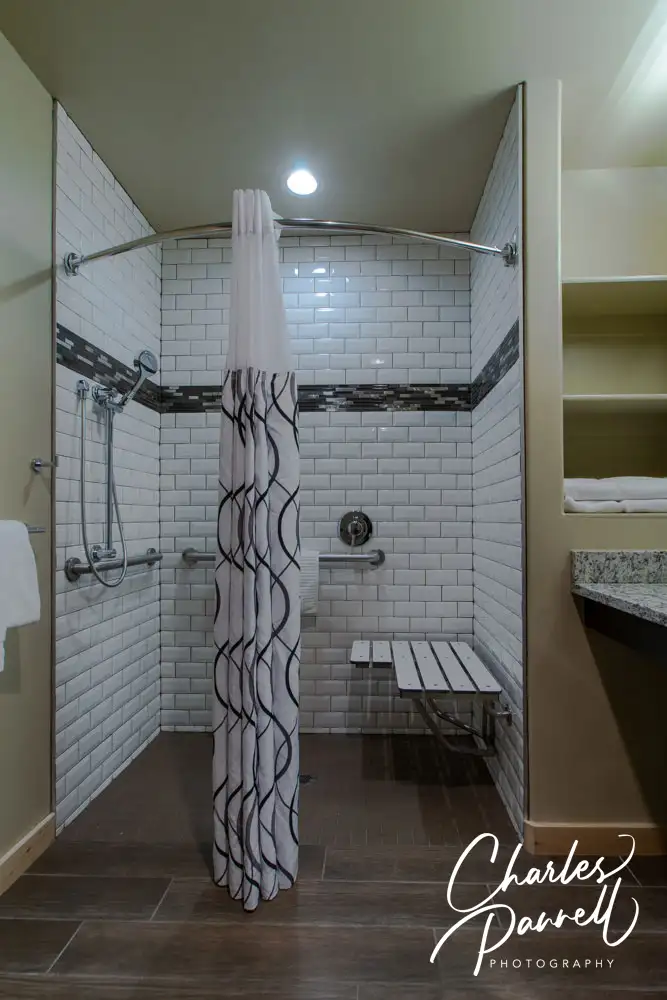
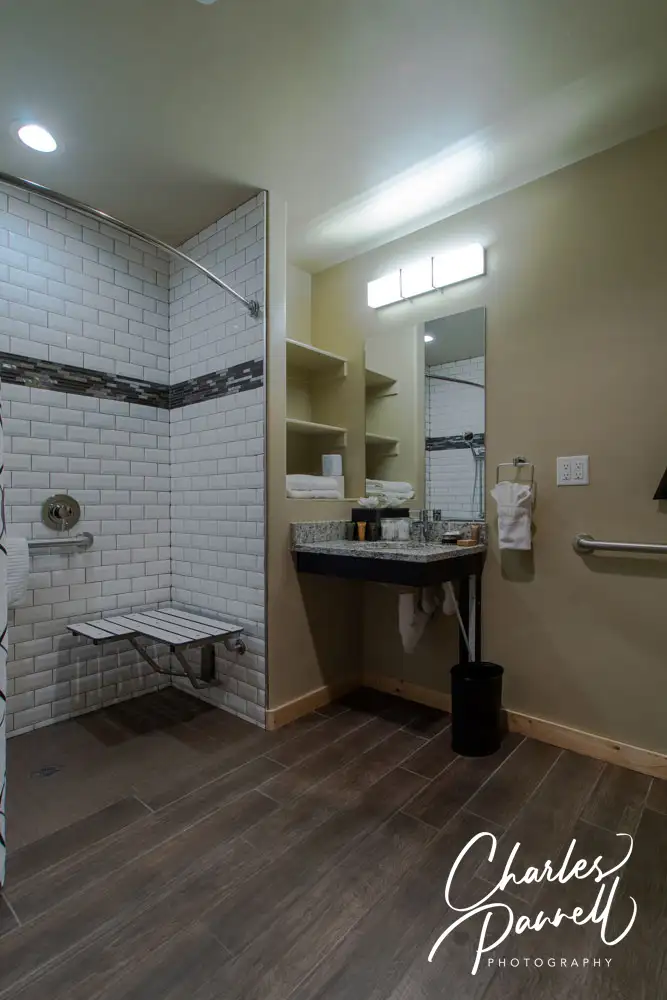
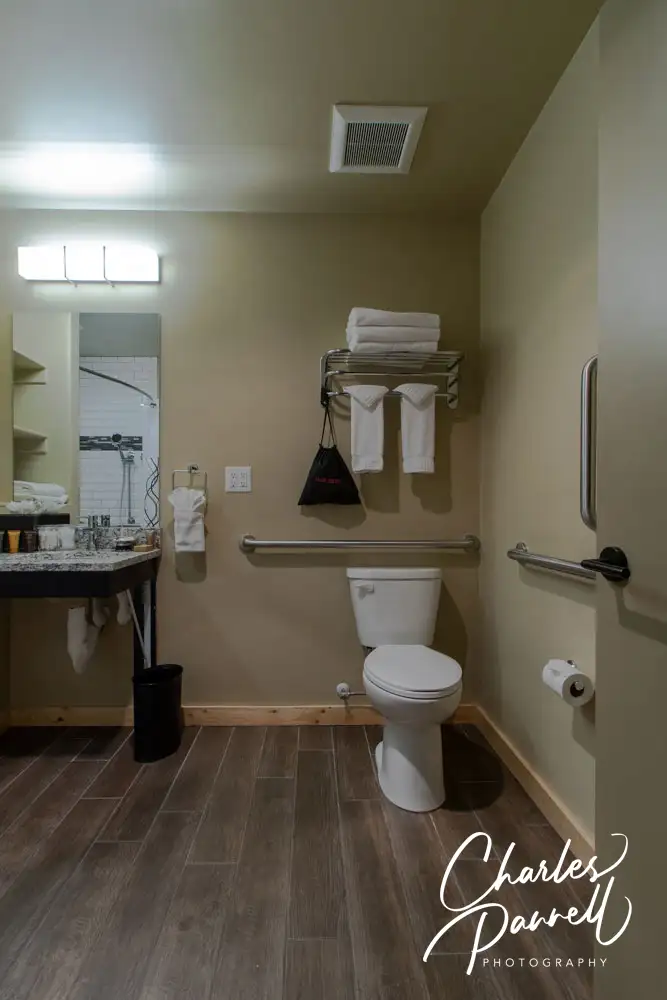
The spacious bathroom features a full five-foot turning radius. It’s equipped with a roll-in shower with grab bars, a hand-held showerhead and a fold-down shower seat. Other access features include a roll-under sink with a lowered mirror, and toilet grab bars on the back and left walls (as seated).
Shower in Haven 9
Sink in Haven 9
Toilet in Haven 9
Haven 42 is also an accessible premium cabin, and Havens 17, 24 and 34 are accessible deluxe cabins. They all have the exact same access features and furnishings as Haven 9; but the deluxe cabins have a porch instead of a back deck.
Tour Yosemite Valley
Even if you don’t stay in one of the wheelchair-accessible havens at Waybound Yosemite, you’ll still want to book a tour of Yosemite with Tenaya Lodge. And the good news is, they have a luxurious wheelchair-accessible bus that can accommodate everyone.
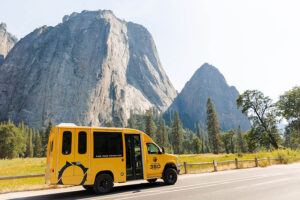
Accessible Tenaya Lodge tour vehicle
The accessible tour bus features lift access and is equipped with wheelchair tie-downs. Wheelchair-users and slow walkers can opt to stay in their own wheelchairs or transfer to one of the comfortable bus seats. The day long Yosemite Valley tour includes stops at Tunnel View, Bridalveil Fall, Half Dome, Yosemite Falls and Valley View. And you’ll also have some time to spend in Yosemite Valley to ride the shuttle bus and explore more of the park.
You just can’t beat the convenience of a Tioga Lodge Tour, as you can dodge the traffic and parking woes, and still manage to see all of the major Yosemite Valley sites in one day. It’s the perfect choice if you have limited time in the park. So book a Tenaya Lodge tour on your next Yosemite visit, for a perfectly accessible seamless travel experience.
Barrier-Free Travel Yosemite, Sequoia and Kings Canyon National Parks for Wheelers and Slow Walkers
is now available. And I’m happy to report that there’s been improved access in — and around — all three parks.
The second edition includes updated information on:
Accessible trails and attractions
Access upgrades, details and photos of all in-park lodges
Accessible lodging options in gateway communities
Barrier-free campgrounds
Accessible bus, snowcoach and boat tours
Accessible shuttles to and around the parks
Insider access tips
Fly-drive suggestions with accessible rental vehicle resources
National park discounted pass information
This national park access guide was a challenging title for me, as of course Charles and I made numerous treks to all three parks (which we always do); but this time we also had to work our travels around our roles as owner/builders while finishing the construction of our new home. To say that it was delicate balancing act is a huge understatement. And although I wrote a good deal of the book at a picnic table on-site while supervising the construction, I’m pleased to announce that we are now finally settled in our new abode. The other good news is now we are even closer to Glacier, Yellowstone and Grand Teton National Parks, so it will be easier to update future changes.
Access Improvements Galore!
There are of course a lot of changes since the first edition of this national park access guide, but they are good changes. For example Mammoth Hot Springs Hotel renovated their main lodge rooms, and they now have five accessible guest rooms, including three with roll-in showers. And outside the Parks, the new William Bridger Cabins and Glacier Cabin Village both have nice accessible units with roll-in showers.
The in-park concessionaires are doing a great job too, from Xanterra’s accessible Glacier Red Bus Tours to the accessible boat tours down in Grand Teton offered by Jenny Lake Boating. Access is really improving thanks to their efforts.
So grab a copy of my new edition and plan an accessible road trip this year. And don’t forget to get your required entrance permit for Glacier National Park. Plan ahead to avoid disappointment!
Every Spring professional frog teams from around the world flock to the heart of California Gold Country, to compete in the Calaveras County Frog Jump. Held on the third weekend in May in the tiny hamlet of Angels Camp, this competition first debuted in the pages of Mark Twain’s short story, “The Celebrated Jumping Frog of Calaveras County”.
As the story goes, a local man who was somewhat of a compulsive gambler bet a stranger that his frog would win a jumping contest. The stranger subsequently sabotaged the gambler’s frog, by filling its mouth with heavy lead bullets which rendered it too heavy to jump. And although the colorful characters in Twain’s tome were a product of the author’s vivid imagination; legend has it that the inspiration for this work came from a tale overheard in an Angels Camp tavern.
The first “modern” frog jump was held back in 1928; and today this popular event has evolved into a four-day celebration, which is now part of the Calaveras County Fair. And although access at the first frog jump was probably pretty difficult for wheelchair-users and slow walkers, today things have evolved so now everyone can enjoy this popular event. So make plans now to attend the famous, fun and festive Calaveras County Frog Jump.
Calaveras County Fair Basics
Held at the Calaveras County Fairgrounds, this small town fair is filled with fun activities and events. From the Youth Parade on Thursday morning to the Destruction Derby on Sunday afternoon, there’s no shortage of family friendly activities to be had.
There’s accessible parking near the fairgrounds entrance with level access over to the fairgrounds. Inside some of the pathways are steeper than others, but most are doable for manual wheelchair-users and slow walkers. And of course, there are also accessible restrooms on the grounds.
If you’d like to save a few bucks on parking and skip the traffic then park your car at Save Mart in Angels Camp and take the free Calaveras Connect shuttle directly to the fairgrounds. Access is excellent on all Calaveras Connect vehicles, as they offer lift access and wheelchair spaces. And the drivers, who are extremely friendly, are happy to lend a hand if you need assistance. For more information about the shuttle schedule and hours, visit www.calaverasconnect.org/.
Another way to save time at the gate is to purchase your tickets online at www.frogtown.org. Sometimes the line backs all the way out to the parking lot at this popular event; and if you have your tickets in hand you can just stroll past that long line to the entrance gate.
Once inside there’s no shortage of entertainment, from shows and skits for the kiddos to live music foe everyone. And there’s level access to the livestock area which is filled with chickens, goats, pigs and cows; as well as the inside exhibits which feature everything from artwork and baked goods to quilts, preserves and a smattering of local businesses. And of course there’s no shortage of fair food to whet your appetite.
On Your Mark, Get Set, Jump!
Of course the highlight of the fair is the Calaveras County Frog Jump. There are two frog jumping stages at the fairgrounds — the Main Stage and the Lily Pad. The serious competition takes place on the Main Stage, but anyone can jump their frog for fun on the Lily Pad. A lot of first timers practice on the Lily Pad, before they move on to the Main Stage.
The competition begins when a frog jumper places his frog on the starting pad. After that he’s not allowed to touch him; however he can jump, yell, sing, hop, or do whatever he can to get the frog to jump. After three jumps the distance is measured from the starting pad to the final landing spot. It’s entertaining to watch the frog jumpers as each one has their own unique method of getting their frog to jump. The current record is 21 feet 5¾ inches, which was set by Rosie the Ribiter in 1986.
The competition begins on Thursday, and the top 50 frogs compete in the finals on Sunday afternoon. And the winner gets bragging rights, and a $5000 prize if they beat the current record jump. And when they’re not competing the frogs stay in the luxurious Frog Spa, which is located near the competition area.
The Calaveras County Frog Jump is a fun and accessible event. Make plans to spend the whole weekend, and enjoy some of the other accessible offerings in the area.
Barrier-Free Travel California National Park Road Trips for Wheelchair-Users and Slow Walkers





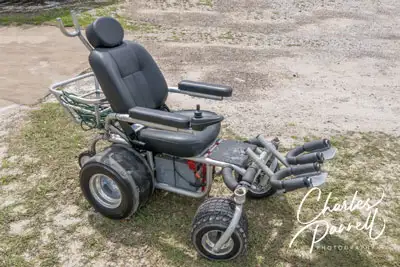 If you’ve always dreamed of enjoying some fun and sun on the beach, but thought it was impossible because you use a wheelchair, then think again. Thanks to an enterprising man on the Gulf Coast, power beach wheelchairs on Alabama beaches are a reality for wheelchair-users and slow walkers..



 If a trip to Portugal is on your travel wish-list, then check out this wheelchair-accessible villa in the Algarve. The four-bedroom unit can accommodate up to seven adults and two toddlers. It’s equipped with an accessible bathroom that’s outfitted with a with a roll-in shower with grab bars and a hand-held showerhead. A shower-commode chair and a toilet-riser are also available; and the bathroom also has an accessible vanity area as well as a lowered mirror. There’s good access to all the public spaces including the fully equipped kitchen and the patio and BBQ area. And the swimming pool is even equipped with a battery-powered lift.
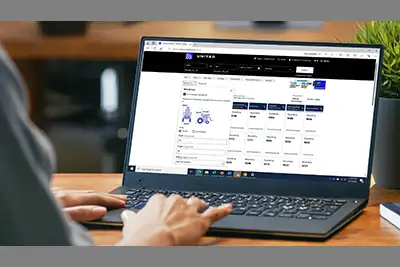 A new United Airlines wheelchair sizer tool was recently unveiled. This digital tool enables wheelchair-users to select flights that can accommodate their specific assistive devices. Why is this important? Well, some larger wheelchairs will not fit through certain aircraft cargo doors without being titled to the side or back. And in some cases, tilting those wheelchairs could seriously damage them.



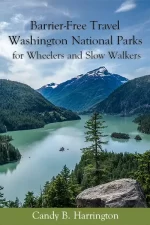
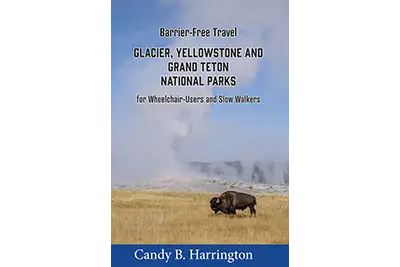 I’m thrilled to announce that my newest national park access guide was just released. The second edition of Barrier-Free Travel; Glacier, Yellowstone and Grand Teton National Parks for Wheelchair-Users and Slow Walkers (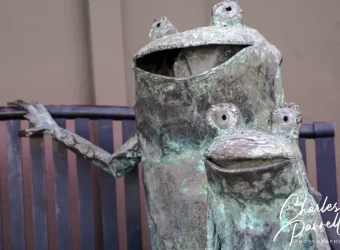
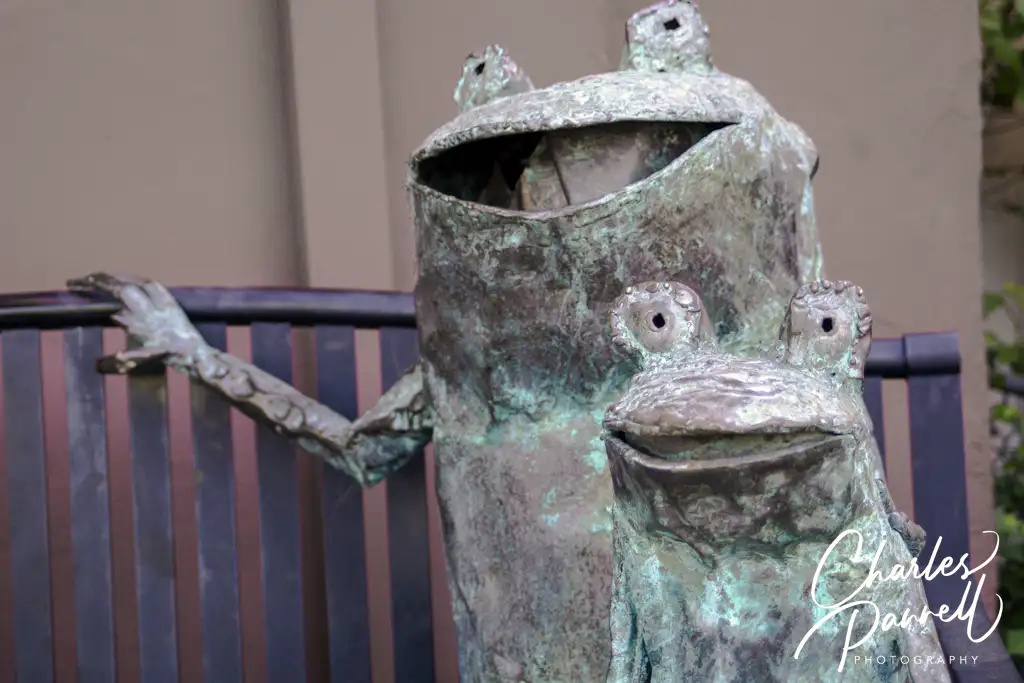 Every Spring professional frog teams from around the world flock to the heart of California Gold Country, to compete in the Calaveras County Frog Jump. Held on the third weekend in May in the tiny hamlet of Angels Camp, this competition first debuted in the pages of Mark Twain’s short story, “The Celebrated Jumping Frog of Calaveras County”.