As a travel writer since 1977, Candy Harrington has been writing about accessible travel exclusively since 1996. She’s the founding editor of Emerging Horizons, and the author of the popular Barrier-Free Travel national park series. With thousands of bylines to her credit, Candy hits the road often, in search of new accessible travel finds. Candy and her travel photographer husband Charles Pannell reside in NE Washington, where they tend to their chicken flock and enjoy a rural lifestyle.
The Transportation Security Administration (TSA) recently announced that travelers who do not present a REAL ID or another acceptable form of identification at the airport, will need to pay $45 to use TSA Confirm ID in order to board the aircraft. The REAL ID law was signed more than 20 years ago, and although it has technically been enforced since May 7, 2025, passengers who previously lacked REAL IDs were given warnings and subjected to enhanced screenings. Beginning February 1, 2026, those travelers will now be required to pay a fee for TSA Confirm ID in order to board the aircraft. Passengers who go this route can also expect delays.
What is TSA Confirm ID?
TSA Confirm ID is a fee-based option to confirm the identity of travelers who lack a REAL ID or other acceptable identification. It costs $45 and takes approximately 30 minutes. It can be completed at the airport, but according to the TSA, it will also be available at www.tsa.gov after the initial launch. That way travelers who lack a REAL ID can get a TSA Confirm ID before they get to the airport, and avoid unwanted delays.
According to the TSA about 94% of airline passengers already have a REAL ID or other acceptable form of identification. Says TSA representative Adam Stahl, “The vast majority of travelers present acceptable identification like REAL IDs and passports, but we must ensure everyone who flies is who they say they are. Beginning February 1, travelers who do not present an acceptable form of ID at our security checkpoints and still want to fly can pay a $45 fee and undergo the TSA Confirm.ID process. This fee ensures the cost to cover verification of an insufficient ID will come from the traveler, not the taxpayer.”
How Do You Get a REAL ID?
Of course, it’s easier – and cheaper in the long run – to get a REAL ID. The process is pretty simple. Just go to your state DMV or motor vehicle licensing website to find out the specific documentation that you need.
Generally, you must provide documentation showing:
Full Legal Name
Date of Birth
Social Security Number
Two Proofs of Address
Some states have additional requirements, and some agencies require an appointment to get a REAL ID.
After you’ve filled out the required paperwork, and submitted the appropriate fees, your photo will be taken, and in most cases you’ll have your REAL ID in a few weeks. It’s a pretty simple process.
To be honest, I have had REAL ID in three states, and it’s pretty easy in most cases. My first REAL ID was in California shortly after the program was launched. Suffice it to say that it needed some improvement, and it took me the better part of the afternoon to complete the process, This was mainly because a lot of employees were unfamiliar with this new program. Gladly that’s not the case today.
My second experience was in ID, and that went quickly, as did my final one in WA. Sadly, a REAL ID in one state does not qualify as documentation for a REAL ID in another state. You have to produce all the original documentation again, which makes no sense to me, as it is a nation-wide program. In any case, getting a REAL ID today is a pretty easy process.
What Other Forms of ID are Acceptable?
Although REAL IDs are one form of acceptable identification, there are many other options that the TSA accepts. Listed below are the acceptable forms of ID in order to pass the TSA checkpoint to board the aircraft.
State-issued Enhanced Driver’s License (EDL) or Enhanced ID (EID)
S. Citizenship and Immigration Services Employment Authorization Card (I-766)
S. Merchant Mariner Credential
Veteran Health Identification Card (VHIC)
All travelers without an acceptable ID, including those who present a non-REAL ID-compliant state driver’s license or ID, will be referred to the optional TSA Confirm.ID process for identity verification upon TSA check-in and prior to entering the security line.
For more information about REAL ID or the security screening process, visit TSA.gov/real-id.
So be prepared to show your REAL ID on Feb 1, or else be subjected to additional screening and fees. Plan ahead!
Eagle Lake Bridge on Historic Carriageway in Acadia National Park, Maine
Acadia National Park is known for its historic carriage roads. They were commissioned by John D. Rockefeller Jr., who preferred to travel on motor-free byways by horse and carriage. Built between 1913 and 1940, the roads feature stone-faced bridges, impressive waterfalls and scenic cliff side views. And then there are the granite stones that were used as guardrails, which are known a “Rockefeller’s teeth”. Today 45 miles of these auto-free roads still traverse the park; and although you can certainly walk or roll along them,there are also two wheelchair-accessible Acadia National Park excursions that everyone can enjoy.
Ride A Trike
First up in the wheelchair-accessible Acadia National Park excursions are the wheelchair-accessible trike rides presented by MDI Wheelers (mdiwheelers.org). These rides are conducted on electric assist trikes piloted by volunteers. The pilots peddle and maneuver the trikes from the back, and the passengers sit in the front in a passenger seat that looks somewhat like a wheelchair.
The rider transfers from their wheelchair to the passenger seat, and is then secured with a safety harness. The rider also wears a helmet. The trikes have a weight limit of 225 pounds, and if a rider cannot transfer independently they must provide their own assistance.
The rides begin at Eagle Lake, and family members and friends are invited to ride along on their own bikes. And just to make sure everything goes off as planned, two volunteer safeties ride along next to the MDI Wheelers trike on standard bicycles. The trike rides are only offered during the summer months, weather permitting, and they are free.
For more information about the rides, visit the MDI Wheelers website. And to schedule a ride, use their contact form on the website or give MDI Wheelers a call at (207) 288-3511.
A Wheelchair-Accessible Acadia National Park Carriage Ride
If you’d prefer a more traditional tour on the carriage roads in Acadia National Park, then schedule an outing with Acadia by Carriage (acadiabycarriage.com). This company offers wheelchair-accessible carriage rides along this historic park roads; and thanks to a generous donor, wheelchair-users and their companions get a discounted rate.
The accessible horse-drawn carriage features ramp access in back, and plenty of room for a wheelchair. There’s also room for an additional two to three passengers on board on the bench seats. And since safety is a top priority, there’s a tie-down to secure the wheelchair. The folks at Acadia by Carriage are huge proponents of inclusion, and they can accommodate both manual wheelchairs and power wheelchairs.
The carriage rides depart from Wildwood Stables, which is located just off Park Loop Road. The Island Explorer Bus, which is wheelchair-accessible, also stops at Wildwood. The wheelchair-accessible carriage rides last between one and two hours. For more information or to book a ride, call Acadia by Carriage at (207) 600-7204 , or drop them an e-mail at info@acadiabycarriage.com.
So make it a point to explore the carriage roads on your next visit to Acadia National Park. They’re more accessible than you think.
Located along the St. Helena Highway, Bothe Napa State Park (napaoutdoors.org/parks/bothe-napa-valley-state-park/) is easy to overlook, especially if you’re winery hopping along this popular Napa County thoroughfare. That said, it’s not only a nice place to stop for a picnic or to enjoy a short hike; but if you’re up for an adventure, it’s also an excellent place to overnight. Although the park offers wheelchair-accessible campsites, it also boasts a comfortable wheelchair-accessible yurt. Granted, this yurt is pretty basic — some would even describe it as rustic — however it provides a quiet, off-the-beaten-path lodging option in what can often be described as a crowded and overly congested area of the state.
Sleeping in a Wheelchair-Accessible Yurt
Inside Yurt 26 at Bothe Napa State Park
There are two campgrounds and yurt areas in the park, but this accessible yurt (26) is located away from the Group Campground, in the quieter Ritchey Creek Campground. There’s plenty of room to park on a level dirt pad in front of Yurt 26, with ramp access up to the front door. Access features inside the yurt include a wide doorway, wooden floors and ample space to navigate a wheelchair. Furnishings include a 21-inch high queen-sized bed with wheelchair access on both sides, four folding cots, and a table with two benches.
You’ll need to supply your own bedding, sleeping bags, pillows and towels; and since the yurt lacks electricity it’s also a good idea to pack along a lantern, flashlights and a camp stove. And although the mattress is certainly adequate, if you prefer more support you might also want to bring an air mattress.
Outside, there is a short accessible path over to a picnic table and a storage locker. It’s the perfect place to enjoy the outdoors, sip some wine, and relax as the sun sets. As an added bonus, it’s also very dark in the park, and with no ambient light you can really enjoy the night sky.
The bathhouse is just a short walk away. A family restroom with a roll-under sink and toilet grab bars is located in the front section of the bathhouse, while the private pay showers are located on the side. The accessible shower room includes a roll-in shower with grab bars, a built-in shower bench and a lowered showerhead. There’s plenty of room for an attendant in the large shower room, and it also features a spacious changing area with lowered hooks.
A Nice Picnic Stop
Picnic Grounds at Bothe Napa State Park
Even if you don’t spend the night in the wheelchair-accessible yurt, make plans to stop in for a picnic lunch and explore the park. The bulk of the accessible picnic tables are located in the day use area, which is located just down the park road from the visitor center. Accessible parking is located near the tables, with paved pathways to the tables and the accessible restrooms. If you’d prefer a more secluded repast, drive all the way to the end of the park road, park in the accessible parking spot, and feast at one the tables in the level shaded area.
Pioneer Cemetery at Bothe Napa State Park
Save some time for a short walk to the Pioneer Cemetery on the accessible trail, which begins near the picnic tables at the end of the road. The hard-packed dirt loop winds around the restored graveyard, which dates back to the mid 1800s. There are benches to sit and rest along the way, while you gaze at the plots surrounded by quaint white picket fences. The trail then loops back through the woods to the site of the historic White Church, before it returns to the picnic area.
Last but not least, make sure and stop at the Native American Garden, which is located on the left side of the visitor center. The accessible pathway begins near the back of the building and winds through a natural garden filled with plants that were important to the first people of the area — the Wappo. Although a few of the species are labeled, the visitor center also has a plant guide to enhance your understanding of the native people. It’s just a short trail — only 150 yards or so — but it’s a pleasant stroll to top off your Bothe Napa State Park visit.
Trail to the Native American Garden at Bothe Napa State Park
Barrier-Free Travel California National Parks Road Trips Travel Ideas for Wheelchair-users and Slow Walkers

The best way to see old town Santa Fe is on foot. That said, there are more than a few access obstacles in the historic heart of the city near the Plaza — an area that dates back some 400 years. On the other hand, with a little advance planning and careful route selection, it’s still possible to see the cultural highlights of this area with minimal walking. With that in mind, here’s a barrier-free Santa Fe walking — or rolling — tour, with stops at a number of accessible cultural attractions along the way.
St. Francis Cathedral
Inside The Cathedral Basilica of St. Francis of Assisi
First up on the wheelchair-accessible Santa Fe walking tour is St. Francis Cathedral (cbsfa.org/), which is just a block from the Plaza. Just head east on Palace Avenue, then turn south on Cathedral Place. St. Francis Cathedral is on the left — you can’t miss it.
Built by Archbishop Jean Baptiste Lamy between 1869 and 1886, this Santa Fe landmark is the mother church of the Archdiocese of Santa Fe. And although there are steps up at the front of this Romanesque Revival building, there’s also ramp access on the left side. Inside, there’s barrier-free access throughout the church, with accessible seating in the chapel.
The center aisle is lined with Corinthian columns, and accented with graceful arches. A massive baptismal fountain sits near the center of the church, and the intricately carved main altar is a sight to behold. Top it off with the stations of the cross, an impressive collection of historic paintings, and stained glass windows that were imported from France, and you have a truly magnificent sanctuary.
Museum of Contemporary Native Arts
The Museum of Contemporary Native Arts
The Museum of Contemporary Native Arts (iaia.edu/mocna/), which is located across the Street from St. Francis Cathedral, is often overlooked by visitors, but it’s truly a must-see on any Santa Fe visit. And there’s a discounted admission for disabled visitors, and no charge for caregivers.
Although there are steps up to the front entrance, there’s curb-cut access and a barrier-free pathway to that same entrance from San Francisco Street. Inside, there’s plenty of room to maneuver a wheelchair through the spacious galleries which display select works from a 7,500-object collection of contemporary native art. From paintings, textiles and cultural arts, to sculptures, ceramics and jewelry, there’s something for just about everyone.
There’s also level access out to the first-floor courtyard which boasts an impressive collection of public art, and to the adjacent galleries which host a wide variety of rotating exhibits. And if you like what you see, don’t forget to stop in at the well-stocked gift shop on the way out.
Loretto Chapel
The Miraculous Staircase of the Loretto Chapel
From the Museum of Contemporary Native Arts, head south on Cathedral Place and take a right on Water Street and a left on the Old Santa Fe Trail, to what many folks consider one of the most mysterious sights in town — the Loretto Chapel (lorettochapel.com/). There’s level access to this beautiful chapel, where visitors can also admire the stained glass windows, the stations of the cross, the Italian-made altar, and of course the famous staircase to the choir loft that lacks any visible support.
The story behind the creation of the staircase is an age-old mystery. According to legend, the sisters of the chapel prayed to St Joseph — the patron saint of carpenters — for a way to access the then stair-less choir loft. Shortly thereafter an unknown carpenter appeared and constructed the spiral staircase, and left without payment. That was in 1878, and although a railing was added over the years for safety, the staircase remains as it was constructed — without any center or side support. Visitors can linger on as long as they want in the chapel, and enjoy the beauty of it all.
Palace of the Governors
Old Governors Office in the Palace of the Governors
One of the highlights of old Santa Fe is the Palace of the Governors (palaceofthegovernors.org), which was constructed in the early 17th century as Spain’s seat of government over what’s now known as the American Southwest. Designated as a Registered National Historic Landmark in 1960, today this historic building houses part of the state’s history museum.
As an added bonus, the stroll from the Loretto Chapel is very scenic. Just follow the Old Santa Fe Trail north past San Francisco Street, along the Plaza and over to the Palace of the Governors. Alternatively, you can cut through the Plaza; however even though the Plaza pathways are wide and level, there are some uneven brick sections that may be problematic for wheelchair-users.
You can’t miss the Palace of Governors, as it’s usually lined with a gaggle of Native American vendors selling their wares. And although that’s certainly worth a stop itself, it’s also worth a look inside. Access to the interior of this historic adobe structure is through the Lincoln Street entrance to the New Mexico History Museum, which is located next door on Lincoln Street. So save some time to the peruse the inside of this historic building which is filled with objects that have been unearthed by archaeologists, including pottery, utensils and weapons. The exhibits span two floors, with elevator access to the second floor, and there’s always an interesting rotating exhibition or two in the mix.
New Mexico History Museum
Fred Harvey exhibit in the New Mexico History Museum
The New Mexico History Museum (nmhistorymuseum.org), which is located just around the corner, offers an equally impressive historic collection. There’s level access to the front door and ramped access to the exhibits. Wheelchairs are available for loan at the front desk, and there’s plenty of room to maneuver a wheelchair through the exhibition spaces, which feature a variety of artifacts that chronicle the history of the state.
Starting with the early settlers and Coronado, and moving on to the Mew Mexico Missions, the Santa Fe Trail and even the Santa Fe Harvey House, the museum offers a comprehensive look at the history of the indigenous people, Spanish Colonization and early travel and commerce in New Mexico. And combined with the Palace of the Governors, this modern museum gives visitors a good overview of the colorful — and sometimes contentious — state history.
New Mexico Museum of Art
The New Mexico Museum of Art (nmartmuseum.org), which is located just a block west of the Palace of the Governors, is also worth a stop. It’s just a short level roll down the street, and there’s curb-cut access to the wide level sidewalk along Palace Avenue, and level access over to the museum’s front entrance. There’s barrier-free access to all the galleries, and elevator access to the second floor.
This museum first opened in 1917, and many of the works that were exhibited on opening day are still part of the permanent collection. A good variety of rotating exhibitions are also presented throughout the year. And don’t miss the courtyard, which is dotted with murals by William Shuster. These frescoes, which were commissioned by the Federal Emergency Relief Agency in 1934, were created to honor the Pueblo Indians. It’s quite an impressive collection.
Georgia O’Keeffe Museum
Georgia O’Keefe’s paint box in the Georgia O’Keefe Museum
Last but not least on this wheelchair-accessible Santa Fe walking Tour is the Georgia O’Keefe Museum (www.okeeffemuseum.org). From the New Mexico Museum of Art, continue west on Palace Avenue, take a right on Grant Street, and then turn left on Johnson Street. The Georgia O’Keeffe Museum is just a half-block up on the right.
Although O’Keeffe was born in Wisconsin, she fell in love with New Mexico when she visited Santa Fe in 1917. By 1934 she was spending her summers at Ghost Ranch, about an hour north of Santa Fe; and in 1949 she took up permanent residence in the state. To say she was a local favorite is an understatement. The museum was opened 11 years after her death in 1997, to honor her art and share it with the public.
Today there’s excellent wheelchair access throughout the galleries in the adobe building, which is a work of art itself. Admission is free for people with a disability, and half-price for their caregivers. There’s also a loaner wheelchair available at the front desk.
The museum’s permanent collection consists of over 3,000 O’Keeffe works which span the length of her career, from 1915 to 1984. The galleries are divided by decade and the works include everything from paintings of her beloved New Mexico, and large scale depictions of flowers, leaves and other natural forms, to New York cityscapes. Add in some rotating exhibits and you have a truly spectacular museum — and reason enough to add Santa Fe to your cultural bucket list.
Stay Near the Plaza
Living Area in Suite 102 at the Chimayo Hotel
If you’re looking for an accessible hotel near this wheelchair-accessible Santa Fe walking tour, then look no further than the Chimayo Hotel emerginghorizons.com/a-wheelchair-accessible-santa-fe-lodging-choice/. It’s just a two-minute walk from the Palace of the Governors, on Washington Street. This historic property boasts a comfortable accessible suite, and it’s a great place to base yourself to explore old town Santa Fe. You can start this walking tour in the morning, have lunch, then take midday break at the hotel, before continuing your tour in the afternoon. Comfort, convenience and access, the Hotel Chimayo has it all. So check it out on your next Santa Fe visit.
Barrier-Free Travel Utah National Parks for Wheelchair-users and Slow Walkers
The Cathedral Basilica of St. Francis of Assisi on the Santa Fe Pick-Up Shuttle Route
If a trip to Santa Fe is in your future, then check out the Santa Fe Pick-Up (santafenm.gov/public-works/transit/santa-fe-pick-up), the free Santa Fe accessible shuttle.. Funded in partnership with Tourism Santa Fe, the Santa Fe Transit Department and NCRTD, this free shuttle bus runs from the the railroad station to downtown, with stops at popular sites along the way. A complete schedule is available on the website. The buses are all equipped with wheelchair ramps and tie-downs, and the drivers are available to assist wheelchair-users. So check out this free Santa Fe accessible transportation option on your next visit. And once you get off the bus, here’s a wheelchair accessible route to explore the Plaza area (https://emerginghorizons.com/a-wheelchair-accessible-santa-fe-walking-tour/).
Barrier-Free Travel the Grand Canyon for Wheelchair-users and Slow Walkers
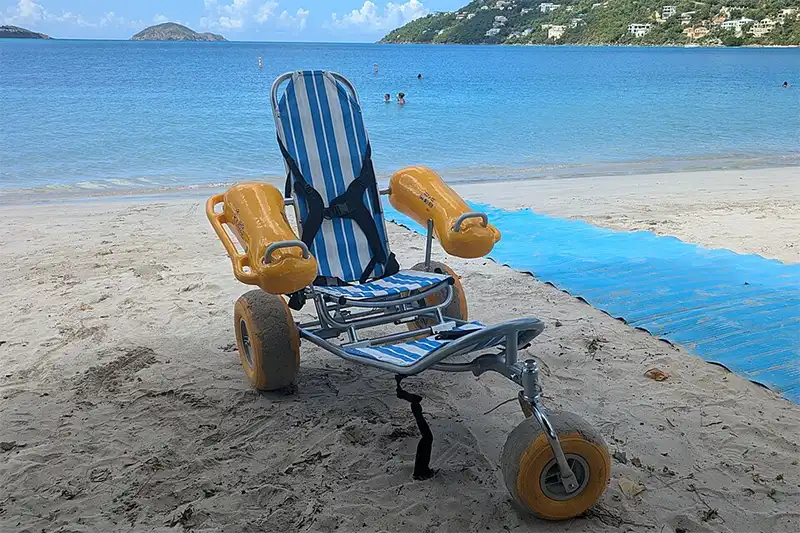
If you’d like to explore some of the more rugged trails and beaches in Southeastern Texas, then pick up this Texas Tow & Go track chair from David’s Chair in Huntsville. Although most track chairs are required to be used in specific places, this loaner comes with a trailer so you can tow it to the location — or locations — of your choice.
This track chair, which has a maximum capacity of 350 pounds, is located at the 10 Mile Ranch in Huntsville, Texas. Reservations are required to borrow the track chair, which comes with a fully enclosed trailer that has ramp access in the rear. In order to tow this trailer you’ll need a vehicle with at least a 1,500-pound towing capacity, that has a 2-inch ball and a straight 4-prong trailer hookup with safety chains. The driver must provide a current drivers license and proof of insurance. Tow & Go reservations must be submitted at least two weeks in advance, and the reservations may not exceed seven days. This Texas Tow & Go track chair is a great option for an active vacation. For more information or to make a reservation, visit davidschair.org/request-tow-n-go-chair/.
Barrier-Free Travel 22 Accessible Road Trips Driving Vacations for Wheelers and Slow Walkers
Although there’s no train station in Yosemite National Park, with a little advance planning it is possible to plan a wheelchair-accessible Yosemite rail excursion. Here’s what you need to know to ride the rails to Yosemite National Park.
Hop Aboard Amtrak
Amtrak Gold Runner
The best way to take a wheelchair-accessible Yosemite rail excursion is to hop aboard Amtrak’s Gold Runner. This route runs through the Central Valley from Oakland to Bakersfield, and offers bus connections from Los Angeles, Sacramento and San Francisco. The train also stops in Emeryville, Richmond, Martinez, Antioch, Lodi, Stockton, Modesto, Denair, Merced, Madera, Fresno, Hanford, Corcoran and Wasco. And it’s easy to transfer to Yosemite via YARTS at the Merced Amtrak Station.
All Amtrak trains feature ramp or lift boarding, wheelchair-accessible seating and large accessible restrooms. Wheelchair-users can remain in their own wheelchair or transfer to a coach seat for the journey. The Gold Runner can accommodate manual and power wheelchairs up to a maximum width of 29.5 inches, and an occupied weight of up to 600 pounds. Special accessibility requests can be submitted at www.amtrak.com/contact-us/email.html (click on accessibility request) at least 72 hours prior to travel, or by calling (800) 872-7245. On-the-spot accessibility requests can usually be accommodated if they do not present a safety issue.
The Gold Runner route features coach seating, free WI-FI, and food for sale on board. Amtrak offers a 10% discount to passengers with a disability and one companion. For more information about Amtrak’s Gold Runner route, visit www.amtrak.com/san-joaquins-train.
Take YARTS to Yosemite
YARTS bus in Yosemite Valley
It’s about a three-hour trip from Oakland to Merced, and a two-hour trip from Bakersfield; plus an additional, 3.5-hour bus connection from Bakersfield to Los Angeles. Amtrak has partnered with YARTS to provide a bus connection from the Merced Amtrak Station to Yosemite, and that transfer is included with your Amtrak ticket.
All YARTS buses feature lifts and accessible seating; however it’s important to note on your Amtrak reservation that wheelchair-accessible seating is required. Alternately, call (877) 989-2787 at least 48 hours in advance to secure an accessible seat. Additionally, reduced fares are available to people with a disability and seniors over 62 years old.
The Highway 140 YARTS route runs from the Merced Amtrak Station to Yosemite Valley with stops in Catheys Valley, Mariposa, Midpines and El Portal. Stops in Yosemite Valley include the Yosemite Valley Visitor Center, Yosemite Valley Lodge and Curry Village. This route runs year-round, and it takes 2.5 hours to get from the Merced Amtrak station to Yosemite Valley.
The Highway 140 YARTS route is an excellent choice for folks with lodging reservations at Yosemite Valley Lodge or Curry Village; however this route also stops at accessible properties outside of the park. Two excellent accessible lodging choices on the route are the Yosemite Bug and AutoCamp Yosemite.
The Yosemite Bug (www.yosemitebug.com/) is located in Midpines and features a large wheelchair-accessible guest room with a roll-in shower. Located nearby, AutoCamp Yosemite (autocamp.com/location/yosemite/) offers wheelchair-accessible accommodations in custom designed luxury travel trailers. And both properties have daily YARTS connections to the national park.
Getting Around Yosemite
Yosemite Shuttle
Passengers who take a wheelchair-accessible Yosemite rail excursion have several options to get around the park. First and foremost is the free Yosemite shuttle system.
There are currently two shuttle routes in the valley — the Valleywide Shuttle and the East Valley Shuttle. The former stops at Yosemite Valley lodges, campgrounds, restaurants and trailheads, while the latter calls on Yosemite Village, Curry Village, the Pines Campgrounds and the eastern Yosemite Valley trailheads. All shuttle buses are equipped with wheelchair lifts and tie-downs, and can accommodate wheelchairs up to 24 inches wide and 46 inches long. The lifts have a weight limit of 750 pounds.
Aramark (www.travelyosemite.com) — a Yosemite lodging concessionaire — also operates several tours. The popular Valley Floor Tour is conducted in an open-air tram and offers good views of the surrounding landscape. Although not all trams are accessible, wheelchair-users can request a lift-equipped one with 48 hours notice. And if you’d like to explore more of the park, opt for four-hour Glacier Point Tour or the day-long Yosemite Grand Tour. Accessible buses for these tours are also available with 48 hours advance notice.
Finally, if you’d like to get a little exercise, then rent a handcycle at the bike stands at Yosemite Valley Lodge or Curry Village and explore the 12 miles of bicycle paths in Yosemite Valley. Most of the bicycle paths are wheelchair-accessible except for a short patch near Housekeeping Camp.
So leave the car at home, and get out and ride the rails to Yosemite National Park. It’s a fun and wheelchair-accessible way to travel.
Barrier-Free Travel Yosemite, Sequoia and Kings Canyon National Parks for Wheelers and Slow Walkers
Located just a block from the historic Santa Fe Plaza, the Hotel Chimayo (www.hotelchimayo.com) takes its name from a Northern New Mexican town that dates back to the 17th century. And although this upscale boutique hotel offers a bevy of modern creature comforts, it also celebrates the history and culture of its namesake village with traditional architecture, hand-crafted furnishings and original artwork. And the good news is, historic and accessible aren’t mutually exclusive at the Hotel Chimayo. So check out this wheelchair-accessible Santa Fe lodging pick on your next southwestern sojourn.
Historic Yet Accessible
The Hotel Chimayo features brick steps that grace the historic front entrance; however there’s easy access to a ramped entrance on the left side of the building. Alternatively, accessible parking is located in an underground garage, with elevator access up to the lobby.
There’s barrier-free access throughout the lobby, which is adorned with Viga ceilings, hand woven-textiles and a collection of retablos — small religious paintings — that are incorporated into the design of the massive brick fireplace. Add in a large crucifix on the mantle, an adjacent hand-carved altar, and a collection of Spanish colonial wooden furniture, and you get a real feel for historic Chimayo.
A Comfy Accessible Suite
Living Room in Suite 102 at the Chimayo Hotel
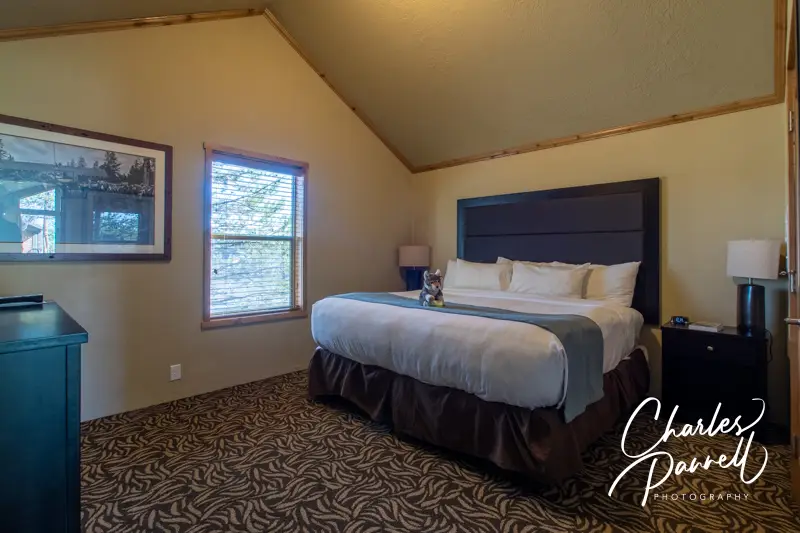
Room 102 — an ADA junior fireplace suite — is located near the front lobby, just off a brick courtyard that’s accented with colorful bunches of hanging chilies. Access features in the spacious suite include wide doorways, lever handles, good pathway access, and low-pile carpet for easy rolling.
The large living room in this comfortable suite features a wood burning fireplace that comes complete with firewood. It’s surrounded by comfortable furniture, and it also include a refrigerator and a wet bar. A 28-inch high king-sized bed with wheelchair access on the right side (as you face it), is located in a separate alcove. Other furnishings include a chest of drawers and a TV. Top it off with a lowered closet rod and you have a very accessible suite.
Bedroom in Suite 102 at the Chimayo Hotel
There’s barrier-free access to the adjacent bathroom, which has a tile floor and a full five-foot turning radius. It’s equipped with a roll-in shower with grab bars, a hand-held showerhead and a fold-down shower bench. The tile shower is nicely designed for access and it includes shower controls that are located within easy reach of the shower bench. The toilet grab bars are located on the back and left walls (as seated), and the bathroom also has a roll-under sink and an angled mirror.
Bathroom in Suite 102 at the Chimayo Hotel
It’s a very accessible and comfortable suite; and as an added bonus it also includes some historic photos and custom artwork. In fact more than 70 Chimayo artists created the artwork and furniture that adorns this property; and that’s quite a tribute to the small town.
The Public Areas
There’s good access to the public areas of this wheelchair-accessible Santa Fe lodging choice as well. There’s level access to the Low ‘n Slow Bar, which is located on the second floor. And the decor is worth a visit by itself. True to the low rider theme, it’s decked out with diamond-tuck upholstered seats, chrome chain-link steering wheel tables, hubcaps, vintage photos and the odd piece of car memorabilia here and there. It’s a fun place to stop for a cocktail or grab one of their yummy “hawt” pizzas
Best of all, you just can’t beat the location of the Hotel Chimayo, as it’s within rolling distance of all the major attractions. You can park your car for the duration of your stay, and explore the historic district on foot. And if you want to take a break during the day, your comfortable room is just steps away. Good wheelchair access, comfortable rooms, and a prime location makes the Hotel Chimayo is an excellent wheelchair-accessible Santa Fe lodging choice.
Barrier-Free Travel the Grand Canyon for Wheelchair-users and Slow Walkers
If you’re looking for wheelchair-accessible Los Cabos transportation, then look no further than Transcabo. This local company can provide accessible transfers between the airport to any hotel or residence in Los Cabos or the surrounding area. Private accessible shuttle services are available to the major hotels between San Jose del Cabo, the Corridor and Cabo San Lucas. The lift-equipped accessible vans can accommodate five passengers, and they have plenty of room for luggage. You can order an accessible van on the website, without any additional phone calls. Visit www.transcabo.com for more information or to book your accessible van.
Barrier-Free Travel Yosemite, Sequoia and Kings Canyon National Parks Travel Ideas for Wheelchair-users and Slow Walkers
Although swamps are generally not a top destination choice for wheelchair-users, Everglades National Park (www.nps.gov/ever) may well be the exception. Located in South Florida, this vast track of protected wetlands spans over 1.5 million acres and attracts backcountry enthusiasts from around the world. Granted, the undeveloped areas of the park are not wheelchair-accessible; however there are still plenty of Everglades options for wheelchair-users and slow walkers. In fact, two particular areas of the park – Royal Palm and Shark Valley – boast a bevy of boardwalks and trails for visitors of all abilities.
Royal Palm
The Anhinga Trail in Everglades National Park
First up on our wheelchair-accessible Everglades visit is Royal Palm, which is located about 20 miles southwest of Florida City. Named for the former state park that grew into the Everglades, this area offers two accessible trails that give visitors a good overview of the native wildlife. There’s plenty of accessible parking in the large lot, with level access to the accessible restrooms, visitor center and gift shop.
The Anhinga Trail – one of the most popular trails in the park — is located behind the visitor center. This .8-mile loop trail begins as a paved path, before it transitions to a wide level boardwalk around the sawgrass marsh. A shaded viewing platform is located midway along the boardwalk, and there’s ample opportunity to catch a glimpse of alligators, turtles and a wide variety of wading birds. And if you get tired, no worries, as there are plenty of benches along the way too. Keep a lookout for the namesake Anhingas, that can be seen in abundance drying their colorful wings in the sun, or perched peacefully in the trees along the trail.
The Gumbo Limbo Trail is also worth a stop while you’re in the area. This .4-mile loop trail begins behind the visitor center, and travels through a tropical hardwood hammock. There are plenty of interpretive plaques along this paved trail; and although the pavement has a few cracks here and there, it’s still quite doable for most folks. The gumbo limbo trees, with their unique peeling red bark, offer shelter to a variety of avian life; and the royal palms, ferns and air plants add a bit of diversity to the forest. It’s a refreshing stroll, especially on a hot day.
The Gumbo Limbo Trail in Everglades National Park
Take a Tram Tour
The Shark Valley Tram in Everglades National Park
Shark Valley is another area of the park worth a visit on a wheelchair-accessible Everglades itinerary. It’s located north of Royal Palm, on the Tamiami Trail (Highway 41), about 40 miles west of Miami. And although it doesn’t have any sharks, and it’s really not much of a valley, the sawgrass marsh supports a healthy freshwater ecosystem.
There’s barrier-free access from the accessible parking area to the visitor center, which is the departure point for the popular Shark Valley Tram Tour (www.sharkvalleytramtours.com). This two-hour tour is led by a naturalist who points out some of the hidden treasures in the Everglades. The tour stops at the halfway point at a 45-foot high observation tower, where visitors can get a bird’s eye view of the surrounding swamp. Even better, the tower includes a gently sloping ramp that allows wheelchair access to the top deck.
The tour is conducted in an open-air tram, which can be configured for wheelchair access. There’s ramp access up to the accessible car, which features two wheelchair spaces with tie-downs. Advance notice is required for accessible tours, and reservations can be made by calling (305) 221-8455. And since there are no facilities along the way, it’s a good idea to use the accessible restrooms at the visitor center before the tour. It’s also a good idea to bring along some water and a snack, as there aren’t any concession areas along the tour route either.
Explore Shark Valley
Shark Valley Trail
The road that the tram tours runs along — Shark Valley Loop Road — is flat and paved, and it’s also a good choice for wheelchair-users who don’t opt for the tram tour. There’s a fair amount of bicycle traffic along the road, but it’s pretty wide, so there’s plenty of room for everyone. Be sure and stop and look in the grass alongside the road, as it’s not unusual to find alligators there. And if you hear something growling at you from the water, don’t be alarmed, as it’s probably only the mating call of the harmless pig frog.
The Bobcat Boardwalk, which is located behind the visitor center, is also a good place to get a look at – and have a listen to – the swamp inhabitants. This wide level .5-mile boardwalk winds over the marsh and through a mature gumbo limbo forest. There’s a wheelchair accessible overlook along the way, and although you may hear bobcats rustle in the underbrush, they are usually pretty shy. That said, it’s still a good place to spot alligators, and the forest canopy provides a welcome respite on sunny days.
Big Cypress National Preserve
The Kirby Storter Boardwalk in Big Cypress National Preserve
Although it’s not part of the Everglades, save some time to stop at the Kirby Storter Roadside Park on your way to or from Shark Valley. Part of the Big Cypress National Preserve (nps.gov/bicy/), this accessible rest area is located about 30 miles west of Shark Valley. It features accessible parking, with accessible vault toilets nearby, and level access to a shaded picnic area.
After you’ve had a bite to eat, take a stroll along the half-mile accessible Kirby Storter Boardwalk. There’s level access to the boardwalk which travels through a young cypress marsh, before it transitions to a mature pop ash and red maple forest dotted with orchids. The forest canopy shades the trail until it opens up to a full swamp at the end of the boardwalk. There are interpretive signs along the way, and a bench to enjoy the swamp view at the end. It’s a good place to spot alligators, especially during mating season. And since many people pass right on by this scenic stop, you may even have it all to yourself. It’s a great way to top off a wheelchair-accessible Everglades visit.