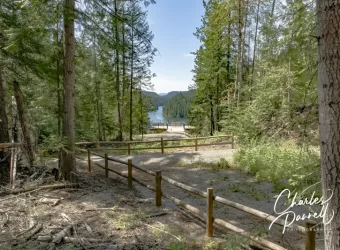
Sometimes wheelchairs and Mother Nature just don’t mix. Although access to natural areas has greatly improved over the years, some panoramic views are still out of reach to wheelchair-users and slow walkers. Fortunately that’s not the case on the Pend Oreille River in Northeastern Washington. In fact, thanks to the efforts of Seattle City Light and the US Forest Service, there are three well developed wheelchair-accessible Pend Oreille River viewpoints near Metaline Falls. Add in a few short trails, some interpretive exhibits and a nice mix of wildlife, and it’s a great place to slip away and enjoy mother nature for a few hours.
Vista House
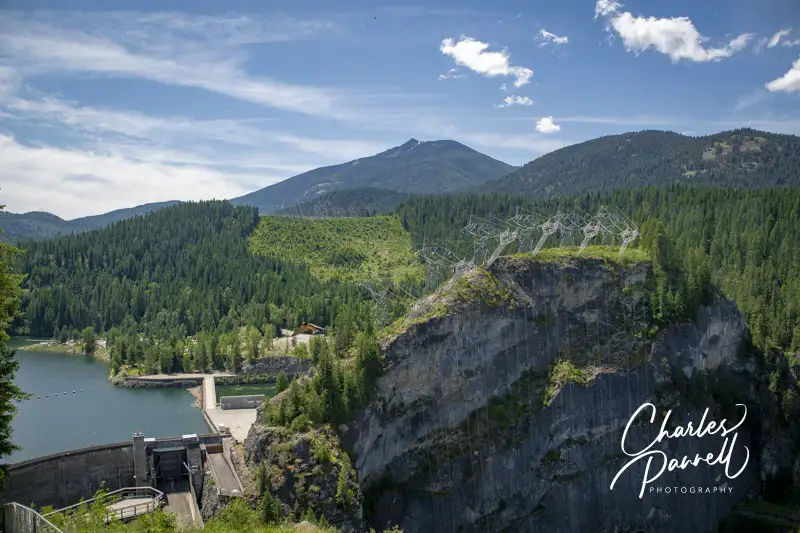
Boundary Dam on the Pend Oreille River Viewed From Vista House
Vista House, which is the first wheelchair-accessible Pend Oreille River view, is located just south of the Nelson-Metaline border crossing along the International Selkirk Loop (emerginghorizons.com/the-international-selkirk-loop-for-wheelchair-users-and-slow-walkers/). From Highway 31, (the International Selkirk Look) turn west on East Side Road near Crescent Lake. As soon as you turn on to East Side Road you’ll be captivated by the view of Crescent Lake on the left, and as you drive through the forest, you’ll see bits and pieces of it along the way. Continue along the road for about two miles, until you reach Vista House at the end of the line.
There’s plenty of accessible parking in the lot, with barrier-free access to Vista House and the nearby accessible restrooms. Vista House is a small interpretive center that overlooks Boundary Dam. There’s level access to the building, which houses a few exhibits; but to be honest the best views can be had from the outside.
There’s a standard picnic table on the left side of the building, with room at the end for a wheelchair. There are also built-in benches that line the deck area which can be used for a picnic. From the left side of Vista House you’ll get a view of the dam, and if you roll around to the right side of the building you’ll get a nice view of the Pend Oreille River.
There’s also a quarter-mile trail that leads down to a lower viewpoint, but because of the elevation change it’s really not doable for wheelchair-users. Some slow walkers may be able to do it, but take some time to evaluate the slope before you give it a try. Still, the view from top is reason enough to put this stop on your list. Even better — it’s not crowded.
Peewee Falls Overlook
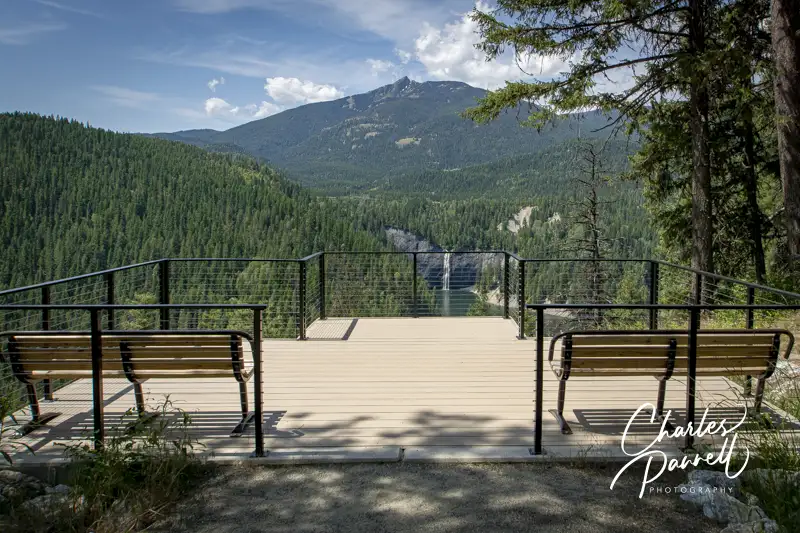
Viewpoint at Peewee Falls
As you head back to Highway 31, be sure and stop at the Peewee Falls Overlook, which is about a mile from Vista House. The turn is well marked, and the dirt road is maintained and doable in a standard vehicle. It may be a bit dusty, but that’s just part of the rustic ambiance.
There’s plenty of accessible parking at the Peewee Falls Overlook in the large paved lot, with barrier-free access to the nearby accessible vault toilets and accessible picnic tables. From the picnic area, a hard-packed dirt trail covered in crushed gravel leads down to the viewpoint.
Peewee Falls cascades down into Boundary Lake, which was formed by the creation of the Boundary Dam on the Pend Oreille River. It’s not a massive waterfall — hence the name — but the lake isn’t very crowed and the whole view is rather calming. It’s a pleasant quarter-mile round trip stroll to the viewpoint; and again, this stop is minus the crowds.
Riverside Canyon Overlook
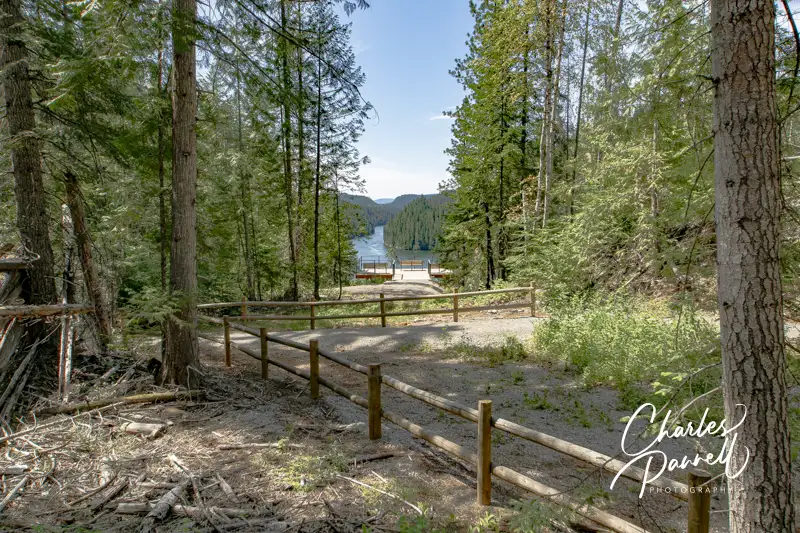
Trail to Riverside Canyon Overlook
Last but not least, save time for a stop at Riverside Canyon Overlook on your Pend Oreille River drive. From Peewee Falls, continue back to Highway 31 and head south. Make a right on Forest Road 172, about five miles down the road. Although it’s hard to spot the street sign, the turn is well marked by a brown “Riverside Canyon Overlook” sign. Continue down the dirt road for another mile and follow the signs to the overlook parking lot.
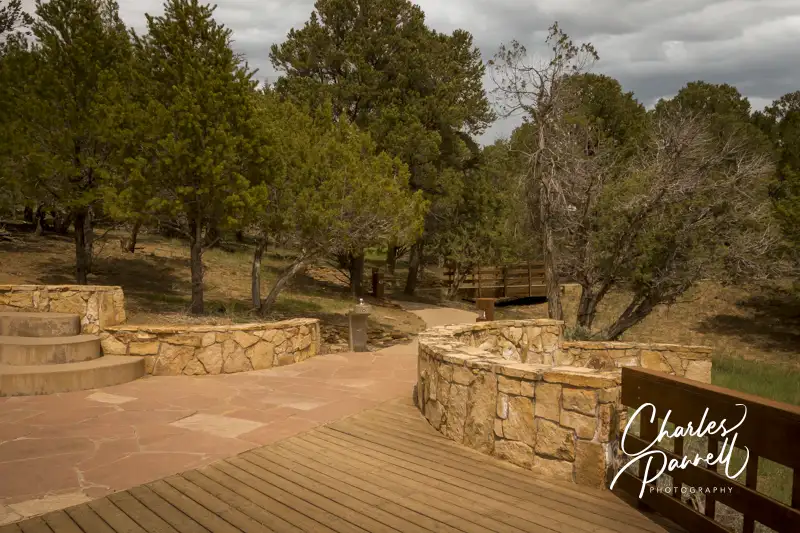
There’s accessible parking near the accessible vault toilets, and a level path over to the accessible picnic tables. From the picnic area a hard-packed dirt trail covered in crushed gravel leads down to the viewpoint. It’s a .4-mile one-way hike, although you can get a slight glimpse of the view from the half-way point. That said, the best view of the river is from the accessible viewing platform at the end of the trail. Although the trail is accessible it’s not level, and there are several uphill and downhill sections along the way. Still it’s within code, with spaces to rest in between the uphill sections. Additionally, you can get a good view of Hooknose Mountain from the parking lot.
After you’ve had a good dose of Mother Nature along the Pend Oreille River, you can continue on along the International Selkirk Loop, take a hike at the Mill Pond Site, and maybe even stop for a bite to eat in Metaline Falls. There’s really no shortage of accessible choices in this scenic neck of the woods.
Barrier-Free Travel Washington National Parks for Wheelers and Slow Walkers
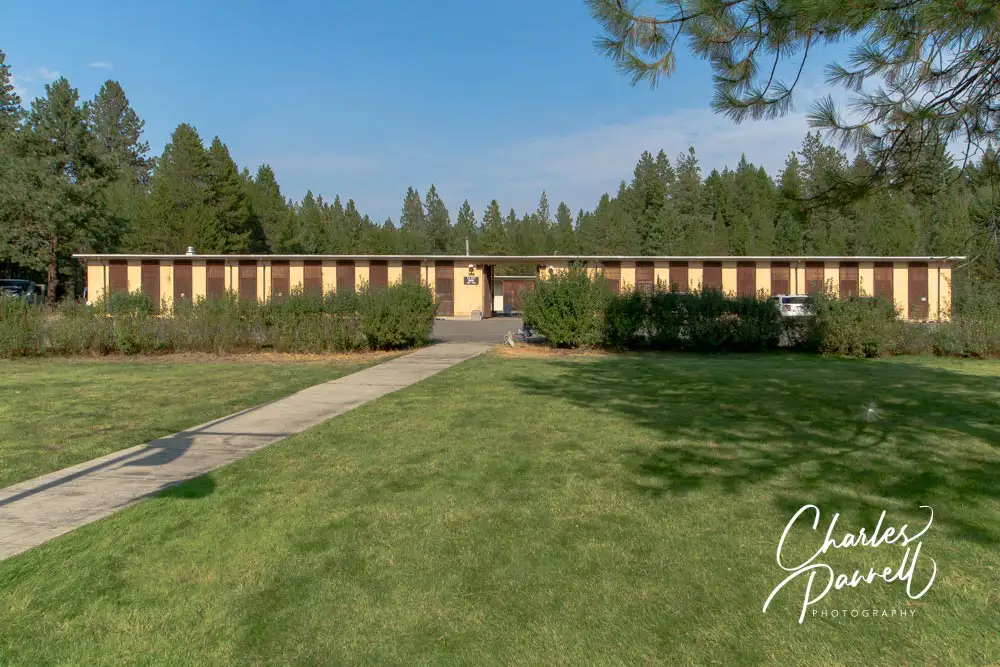
Located in the Idaho panhandle, Farragut State Park (parksandrecreation.idaho.gov/parks/farragut/) was once the site of the second largest WWII naval training facility in the country. At its peak the base housed over 100,000 people and included the largest hospital in the Pacific Northwest. Today the foundations of some former buildings, as well as the relatively intact brig are all that remain of this once bustling base.
And as with many historic buildings with a colorful history, rumblings of paranormal activity in and near the former brig pepper the media. Haunted or not, it’s still a great destination for anybody interested in WWII history; and as an added bonus, it also boasts a comfy wheelchair-accessible camping cabin perched on the shore of Lake Pend Oreille.
A Little History
Although far northern Idaho seems an odd location for a naval base, there’s a sound reason behind the choice. Safety. After the attack on Pearl Harbor, the powers that be wanted a base site that was impervious to air or sea attacks. And since this chunk of real estate between Coeur d’Alene and Sandpoint is surrounded by mountains and far from the ocean, it proved an excellent choice.
Named after the famous admiral, Farragut Naval Training Facility occupied over 4,000 acres at its peak. Recruits would arrive in cattle cars and complete 13 weeks of basic training with classes in seamanship and warfare. Field training for gunners consisted of recruits firing wooden “practice shells” at navy aircraft as they swooped down over Lake Pend Oreille. And after they graduated they were sent into battle.
Recruits that broke the rules ended up in the brig. Most inmates were housed in four- or six-man cells, and were were assigned to hard labor, which included smashing boulders into gravel with sledgehammers, or sawing firewood by hand. Those that were convicted of more serious offenses were held in solitary confinement, until they were transported to the federal prison in Treasure Island, CA.
The base was also home to German POWs in 1945. They were treated as soldiers, not prisoners and assigned landscaping, firefighting and cooking tasks. The POWs were not housed in the brig, but lived in separate quarters near the modern day entrance of Farragut State Park. They did however, cook for prisoners in the brig; and it was reported that the quality of the meals greatly improved after their arrival.
Visit the Brig
The Brig at Farragut State Park, Idaho
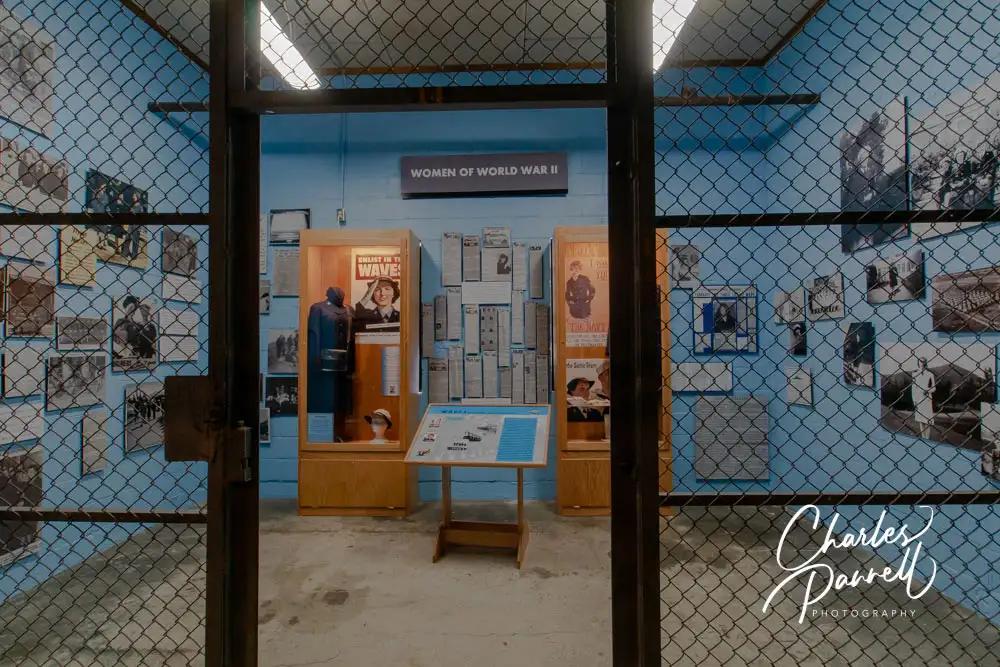
The Museum at the Brig offers a good overview about life at Farragut Naval Training Facility. Accessible parking is located near the entrance, with level access to the courtyard, and barrier-free access to the brick cellblock. The exhibits begin with a short 20-minute orientation film which details the history of the facility. A few cells are set up as they would have been in WWII times, while others contain exhibits about the construction of the facility, the training the took place there, and the social lives of the workers and recruits. There are also exhibits about the POWs and the WAVES, as well as a good overview of WWII. Throw in a large collection of weapons, uniforms and personal items of the recruits, and you have a comprehensive look at life at Farragut Naval Training Facility.
Inside the Museum at the Brig in Farragut state Park, Idaho
Don’t miss the vintage vehicles on display in the courtyard, and the historic exhibits in the opposite wing. And if you have kids in tow, be sure and stop in at the junior ranger activities center on the far side of the courtyard.
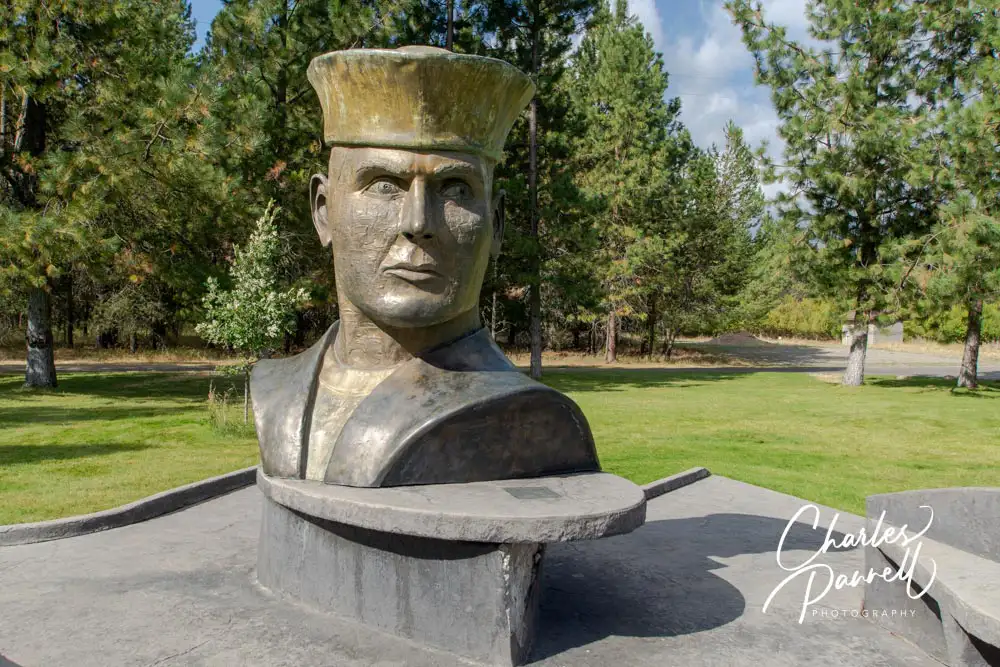
Save some time for a short visit to Memorial Park, located across the street from the brig. There’s barrier-free access to the small park which features a unique statue of a sailor. The bust stares soberly into space, while smaller faces of a multitude of sailors cover his face. It’s said to represent the different recruits that help make a soldier during his training.
Spend the Night
The Syringa Cabin at Farragut State Park, Idaho
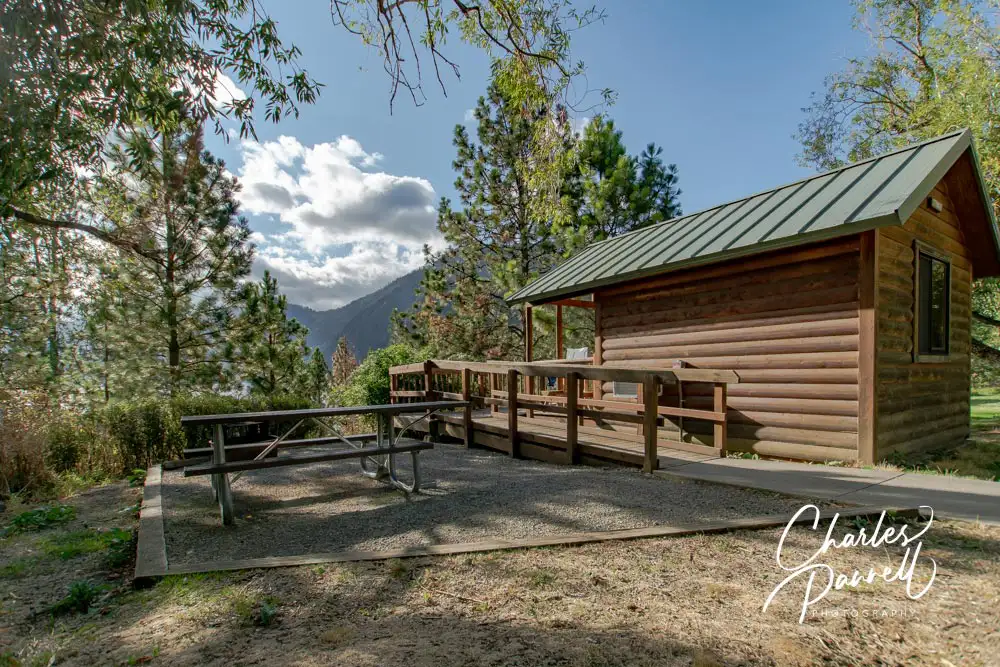
In contrast to the stark brig, the Syringa camping cabin offers a pleasant spot to spend the night at Farragut State Park. It’s located near the end of the South Road, nestled in a forest that overlooks Lake Pend Oreille. There’s no accessible parking for the cabin, but there’s level parking in the asphalt lot next to the accessible vault toilet. From there it’s a 200-foot walk on a level sidewalk to the cabin. Alternatively you can parallel park in a level area about 150 feet from the cabin.
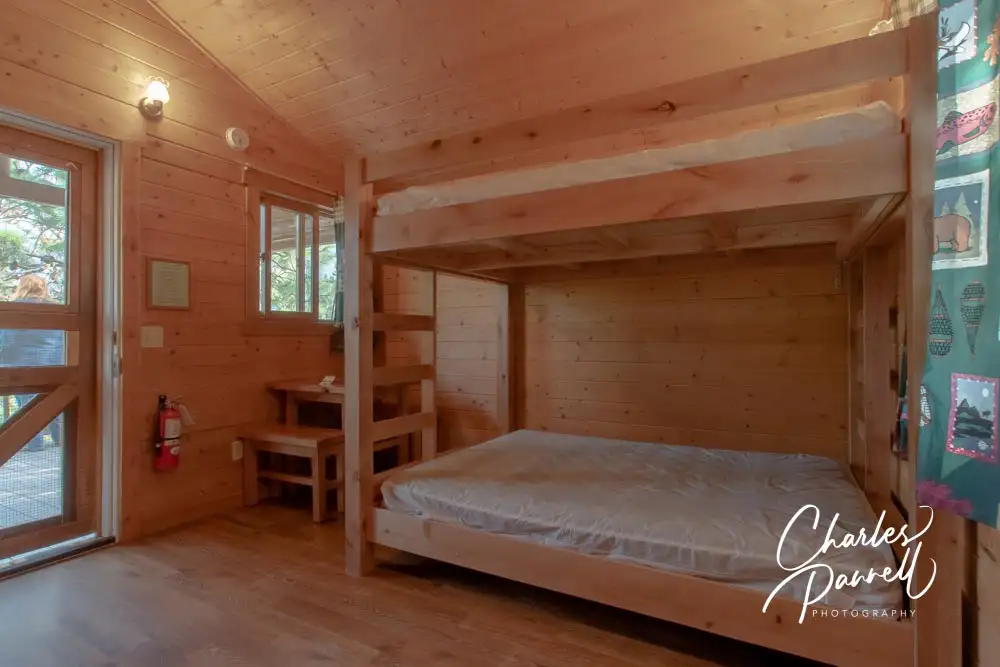
There’s ramp access to this basic camping camping, which includes a spacious deck with a swing and a table. The cabin features a wide front door, and offers plenty of room to maneuver a wheelchair inside. It’s furnished with a simple 17-inch high double bunk bed (bring your own bedding) and a table with two benches. It also includes lights, an air conditioner and an electric outlet.
No cooking is allowed inside the cabin, but there’s a large accessible table and a raised fire ring next to the deck. All in all, it’s a comfortable and affordable place to spend the night. Even better — since there are only four cabins in this area of the park, and the gate closes at dusk, you’ll almost have things to yourself at night.
Inside the Syringa Cabin at Farragut State Park, Idaho
Haunted or Not?
Is Farragut State Park really haunted? Most reports of paranormal activity center around the brig. These include sightings of orbs, objects moving, and the ghostly clanging of cell doors. Several folks have also reported the apparition of a bald man in a prison uniform in the brig, and a man wearing a navy uniform wandering along the shore.
Although the brig is cold and dank, I didn’t see any apparitions during my visit, but I was haunted by the history of the building. It was chilling at times, but it was on a more historical level rather than a ghostly level. That’s not to say there’s no paranormal activity there; just that I didn’t experience anything otherworldly on my visit.
Some strange occurrences have also been reported in Memorial Park. Several people have reported that the statue turned its head and looked at them. To be honest, the statue is a little unsettling, as the somber stare of the sailor seems to follow you as you move throughout the park. But no, I didn’t see the statue actually move. That said as Charles got into the car he excitedly exclaimed, “You want to hear something creepy? My camera recognized that statue as a face instead of an object?”. Haunted or haunting? You decide.
Barrier-Free Travel
Utah National Parks for Wheelchair-users and Slow Walkers
There’s no shortage of scenic beauty in the Pacific Northwest, but the Mount Hood Infinity Loop in Northwestern Oregon offers more that its fair share of eye candy. The route begins about 20 miles east of Portland as it follows Highway 84 alongside the Columbia River, then heads south through vineyards and farmland to majestic Mount Hood. Finally it circles back north through conifer forests, and offers a picturesque side trip through a waterfall corridor.
The 135-mile loop takes about three hours to drive straight through; however it’s best to spend a few nights in the area, take your time and enjoy the stops along the way. And although the route travels through the mountains and other harsh terrain, there are plenty of wheelchair-accessible stops along the way. So get ready to hit the road and enjoy a wheelchair-accessible slice of the scenic Mount Hood Infinity Loop.
Well Dam!
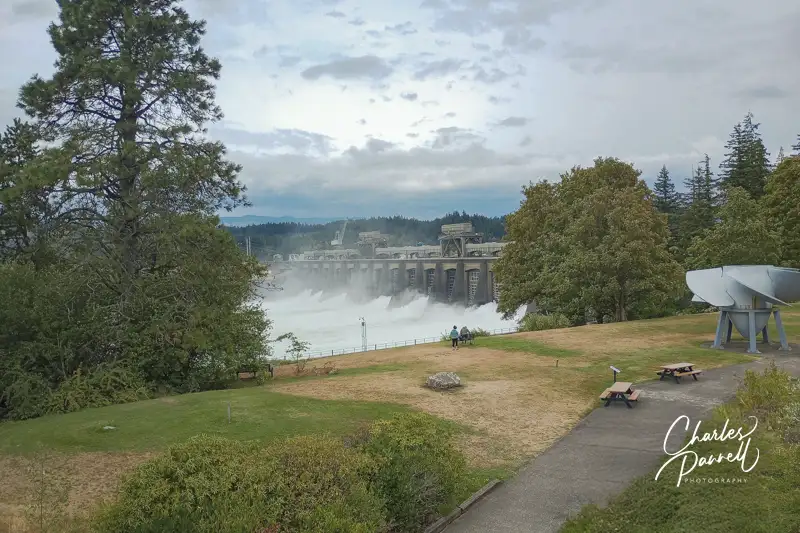
Bonneville Dam on the Mount Hood Infinity Loop
The first stop stop on this accessible Mount Hood Infinity Loop is Bonneville Dam (www.nwp.usace.army.mil/bonneville/). Built in 1938 by the Army Corps of Engineers, the site features the dam, two powerhouses, a spillway, a navigation lock, fish ladders and a fish hatchery. Just take exit 40 from Highway 84 and follow the signs. Bear right at the security gate and head over to the Bradford Island Visitor Center.
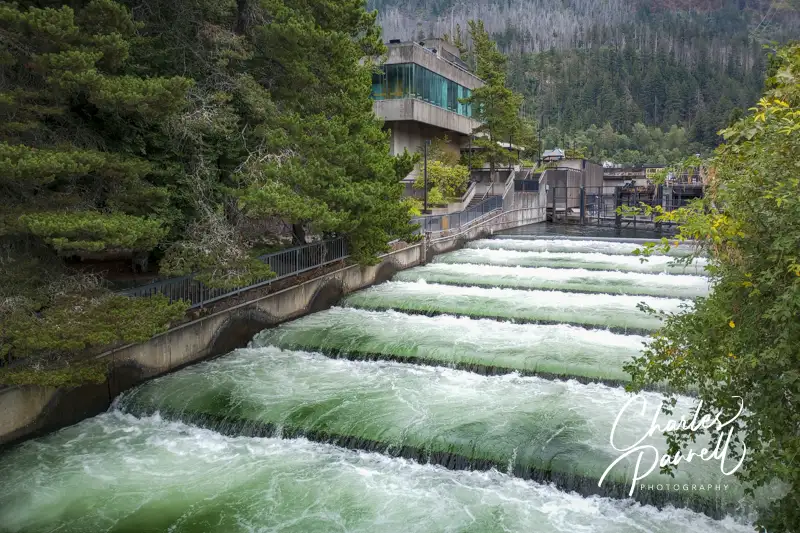
There’s accessible parking in the visitor center lot, with level access to the building. Inside, there’s plenty of room to navigate a wheelchair and there are accessible restrooms around the corner. This fourth-floor lobby serves as an information and welcome center. Start your visit with an elevator ride down to the third floor to watch a movie about the dam; then continue on down to the first floor to see some interpretive exhibits and viewing windows on the fish ladders. Complete your visit with a trip to the roof for a birds-eye view of the dam.
The navigation locks are located a short drive away, with accessible parking in front. There’s ramp access up to the viewing platform and lock visitor center. The visitor center has a collection of exhibits that explain the operation of the locks. And if you’re lucky, a ship will pass through and you’ll see them in operation.
Save some time for a stop at the fish hatchery, which includes accessible parking and paved access around the outside display ponds. There’s barrier-free access to the visitor center, which details the operations of the hatchery. There’s also level access to the nearby gift shop. It’s a pleasant and accessible walk through the shaded grounds around the ponds — and don’t forget to feed the trout.
Fish ladder at the Bonneville Dam on the Mount Hood Infinity Loop
The View From Washington
Bridge of the Gods
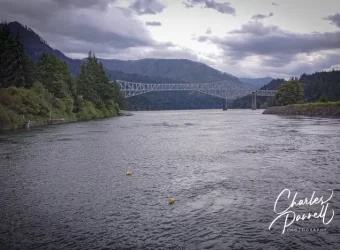
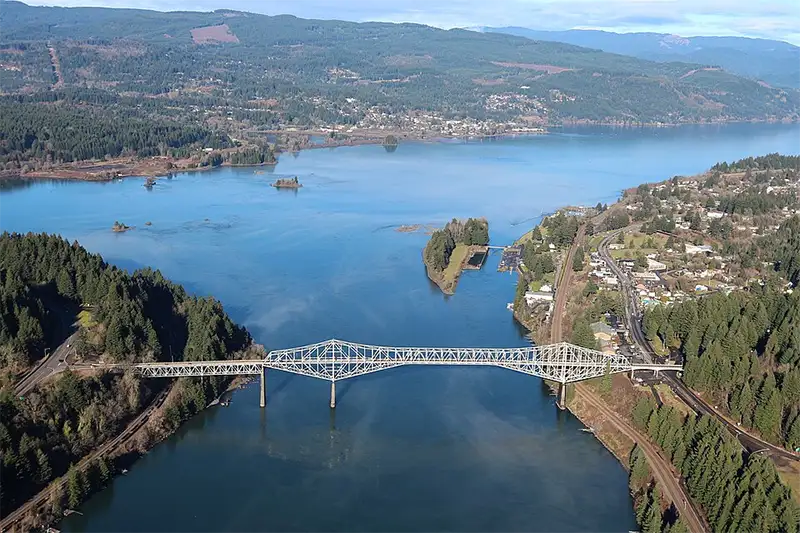
As you continue east on Highway 84, you can’t miss the Bridge of the Gods (www.portofcascadelocks.gov/bridge-of-the-gods). Originally constructed in 1926, this cantilever bridge had to be raised 44 feet after Bonneville Dam was completed. Subsequently, Charles Lindbergh flew under it in true daredevil fashion in 1927.
Although you’ll get a better view of it from afar, it’s also worth a short detour to cross this historic structure. From Highway 84, take exit 44 and follow the signs. This two-lane toll bridge, which is just 22 feet wide, spans the Columbia River and connects Oregon with Washington.
Of course once you cross over to the Washington side, you’ll have good view of the bridge, the Columbia River, and the Oregon side of things. A pleasant place to enjoy that view is Skamania Lodge (www.skamania.com), more specifically the Cascade Dining Room at Skamania Lodge. It’s a nice spot for a leisurely brunch, as it overlooks the Columbia River with views of the lush pine forests on the Oregon side. Menu offerings range from brioche bread French toast and a crab eggs Benedict to steelhead tacos, a pacific crab roll and a delicious seafood salad. The choices are tasty and the view is exceptional.
Stay a Spell
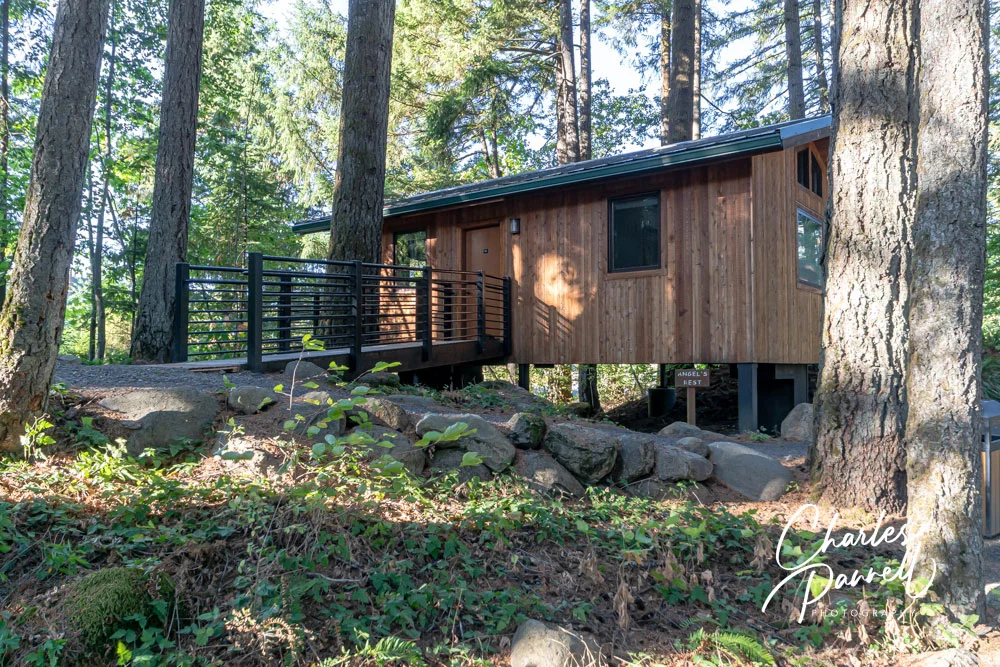
Angels Rest Accessible Treehouse Suite at Skamania Lodge, Oregon
Skamania Lodge also makes an ideal home base for a multi-day Mount Hood Infinity Loop excursion. Access is excellent throughout the property, which offers accessible lodge rooms with either a roll-in shower or a tub/shower combination. And if you’d like something a little different, spend the night in the treetops in a wheelchair-accessible treehouse (emerginghorizons.com/sleep-in-a-wheelchair-accessible-treehouse-at-skamania-lodge/).
The newest addition to the accessible lodging inventory at Skamania Lodge is a luxurious wheelchair-accessible cabin. https://emerginghorizons.com/relax-in-a-skamania-lodge-wheelchair-accessible-cabin/. Nestled away in the treehouse section of the property, this spacious cabin includes a large bathroom with a roll-in shower, a compact kitchen, a separate bedroom, a cozy fireplace and a spacious deck with a firepit — and it’s all wheelchair-accessible.
Vintage Autos & Aircraft Galore
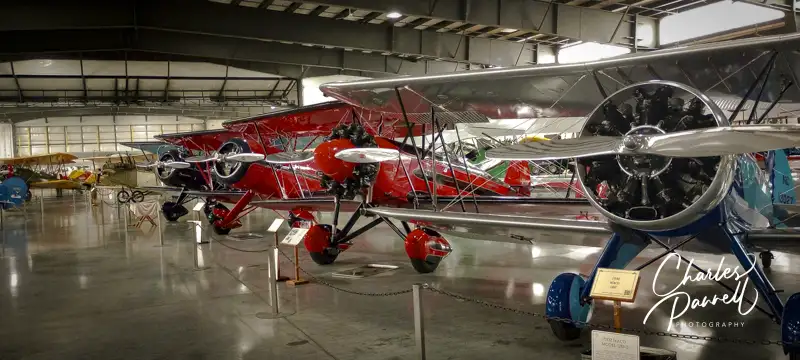
Planes at The Western Antique Aeroplane and Automobile Museum
After a Skamania Lodge visit — or overnight stay — cross back over the Bridge of the Gods and continue east on Highway 84. Take exit 62 about 20 miles down the road, then follow Country Club Drive and Barrett Road to the Western Antique Aeroplane and Automobile Museum www.waaamuseum.org. It’s a pleasant 25 mile drive, as the scenery transitions from the Columbia River landscape to the farming and agricultural region around Mount Hood.
There’s accessible parking near the museum entrance, with level access over to the building. The large collection is housed in three adjacent hangers, which have cement floors and plenty of room to maneuver a wheelchair. There’s also an accessible restroom on site, barrier-free access to the gift shop, and a power wheelchair available to rent.
The thing that makes this massive auto, aircraft and motorcycle museum unique, is that most of the collection is flyable or drivable. And besides the aircraft and autos, you’ll find vintage furniture, appliances, toys and decorations woven between them. This museum houses much more than airplanes — it includes everything that flies, from balloons to gliders — and it also features a substantial Wright Brothers exhibit. And don’t miss the oldest Boeing aircraft, a 1928 40C mail plane — and yes it still flies.
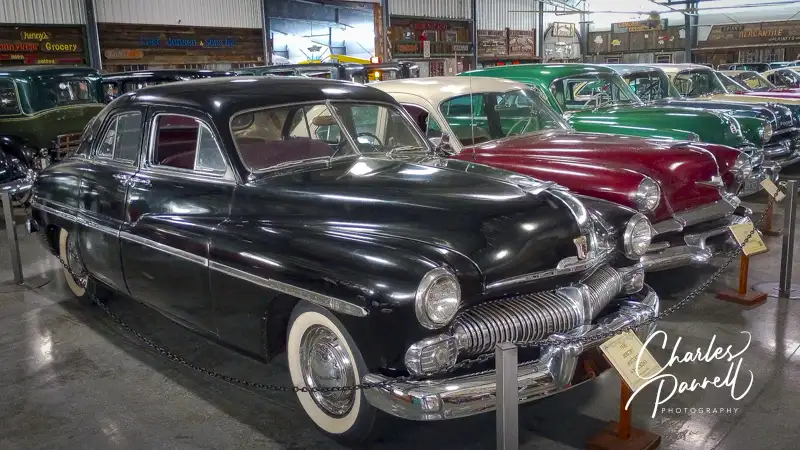
A second hangar is devoted to military planes and includes a large collection of military equipment, from radios and MREs to bicycles, scooters and even a jeep. The final hangar is filled with over 130 cars, including a 1914 electric car, a Studebaker and a Locomobile. And if you get tired, there are plenty of spots to sit and take a break along the way. It’s an excellent and often overlooked museum.
Autos at the Western Antique Aeroplane and Automobile Museum
At the Summit
Timberline Lodge at Mount Hood, Oregon
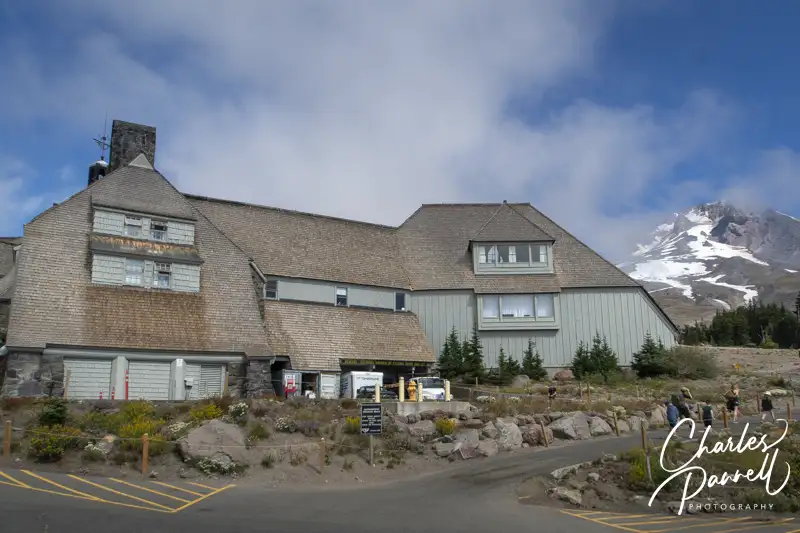
One of the highlights of the Mount Hood Infinity Loop, is a visit to Timberline Lodge (www.timberlinelodge.com) at the summit. From the Western Antique Aeroplane and Automobile Museum follow Odelle and Davis Drive to Highway 35 south, then take Highway 26 east to the Timberline Highway. From there it’s just a six mile drive; however the road has up to a 10% grade with numerous switchbacks along the way. Timberline Lodge is located at 6,000 feet, and it’s not unusual to see snow there, even in the summer.
Known as the showplace of Works Projects Administration projects, Timberline Lodge was dedicated in 1935 by President Roosevelt. The consulting architect, Gilbert Stanley Underwood, who designed national park lodges in Yosemite and Bryce Canyon, was known for using natural materials to help his buildings blend in with their surroundings. The Underwood style caught director Stanley Kubrick’s eye, and he ultimately used aerial shots of the property in the opening scenes of The Shining.
And although the drive is certainly scenic, the best plan of action is to enjoy a little time on top, look around the lodge and have lunch. There are two different parking areas on top. The lot close to the lodge is reserved for overnight guests, while the one further away is for day visitors. And the walk to the lodge is uphill from the day-use parking. Still if you stop at the guard shack and tell them you have a disabled passenger they will let you drive in and drop them off. Although there are steps up to the front entrance, there’s plenty of accessible parking near an elevator that takes you up to the lobby level. It’s a pleasant place for a midday break.
Mount Hood History
Mount Hood Cultural Center & Museum
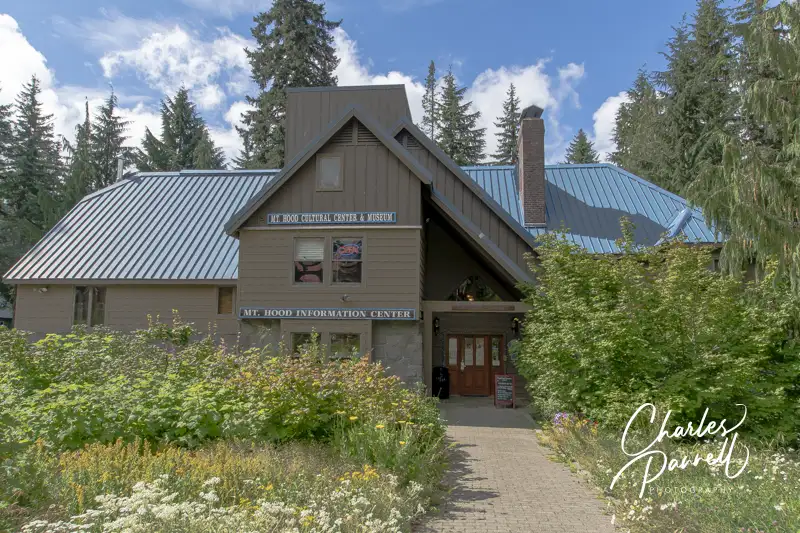
After you get descend from the mountaintop, take a little time to learn about some local history at the Mt. Hood Cultural Center & Museum mthoodmuseum.org. To get there, continue east on Highway 26, then make a right on Government Camp Loop, about a quarter-mile down the road. The Mt. Hood Cultural Center & Museum is on the left, with street parking in front.
Accessible parking is located near the museum, with level access over to the building. And although the museum occupies several floors, there’s elevator access between them.
Downstairs, there’s an information center and a gallery that focuses on the history of the ski area and the local ski and recreation clubs. Upstairs there’s a gallery that showcases the works of Mount Hood area artists, and another one that boasts a large collection of skis and details the history of skiing. There’s also a gallery that focuses on the early exploration of the area and one that includes exhibits about the natural history and the regional flora and fauna. All in all this small museum offers a good primer of the area, with volunteers on hand to help you plan your visit, and loads of free brochures available to map out your travels.
Take a Hike
Cascade Streamwatch Trail in the Recreation Area
If you’d like to get out and enjoy a hike or two, head on over to the Wildwood Recreation Site www.blm.gov/visit/wildwood-recreation-site, which is on Highway 26 about 13 miles east of the Mt. Hood Cultural Center & Museum. This site has two accessible trails and a nice picnic area. And although there is a day-use fee at this area, the America the Beautiful Access Pass (emerginghorizons.com/how-to-get-a-lifetime-national-park-pass/) is also good there.
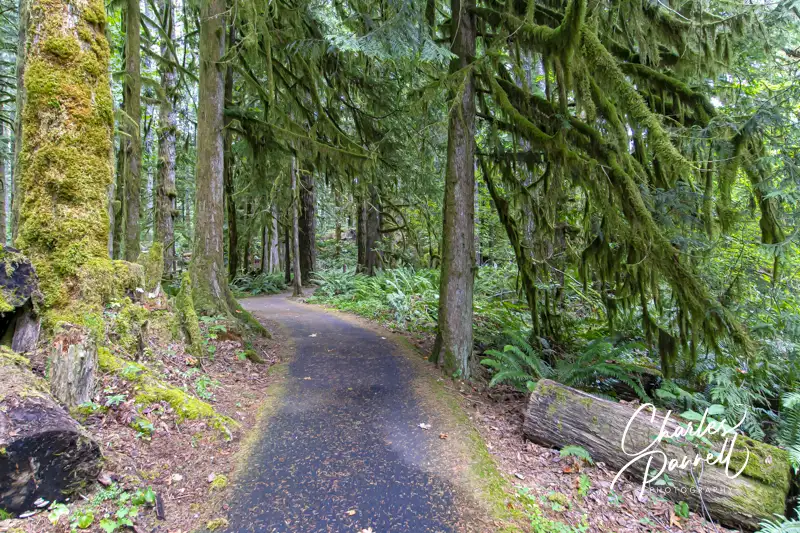
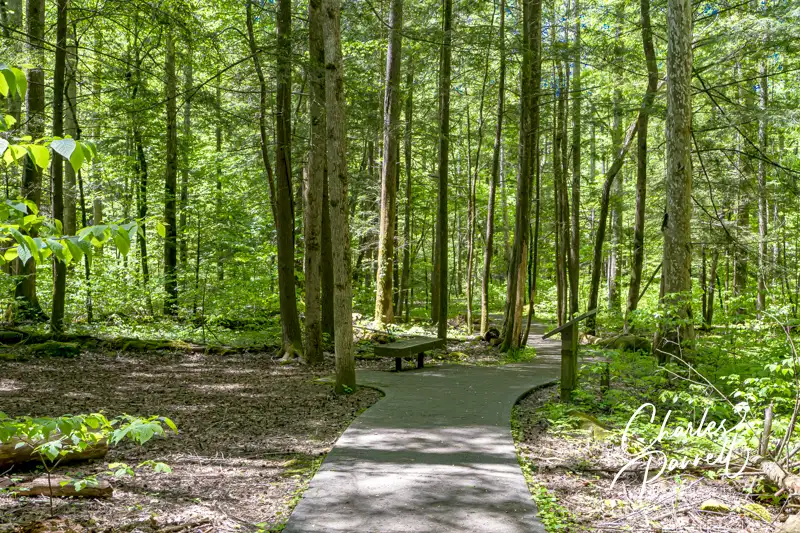
The Cascade Streamwatch Loop is located all the way at the end of the the main park road. There’s accessible parking near the accessible restrooms, and level access over to the trail. Make a right just past the amphitheater and follow this .75-mile paved loop through the alder and conifer forest. Be sure and take a slight detour near the beginning of the trail to the underwater viewing window, where you can see the hidden side of the river ecosystem. After you rejoin the main trail, continue alongside the Salmon River and loop back to the beginning. There are benches to rest along the way, and the picnic area near the pavilion includes an accessible table on level ground. It’s shaded by the trees, and a very pleasant place to take a break.
The equally accessible Wetlands Loop can be accessed from the next parking lot. Although there is a connector trail from the Cascade Streamwatch Loop, it’s steep and not accessible. Accessible parking and restrooms are located near the trailhead, with level access over the .75-mile trail. It begins as a paved trail, crosses the river and continues as a boardwalk through the cattail marsh, before it reconnects to the paved trail and loops back to the parking area.
Million Dollar View
Jonsrud Viewpoint on Highway 36
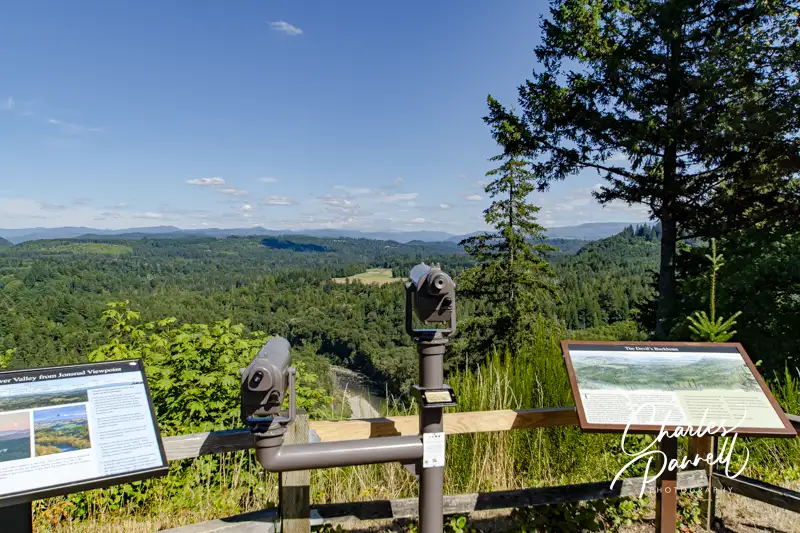
You’ll catch fleeting glimpses of Mount Hood from Highway 26, but for a great photo op continue east along the thoroughfare to an often overlooked viewpoint. It’s located about four miles down the road in Sandy. Turn north at the Walmart on Bluff Road, then continue on for about a mile to the Jonsrud Viewpoint, on the right.
There’s accessible parking near the viewpoint, with curb-cut access to a brick path to the overlook. From there you’ll get what’s billed as “one of the best views of Mount Hood in Oregon.” There’s also a wheelchair-height viewing scope, which allows folks who are color blind to view the vivid scenery of the Sandy River Valley. This neighborhood overlook is also the perfect spot to wait out the clouds and for an unobstructed view of Mount Hood. It’s a great little detour.
Tracking Sasquatch
North American Bigfoot Center
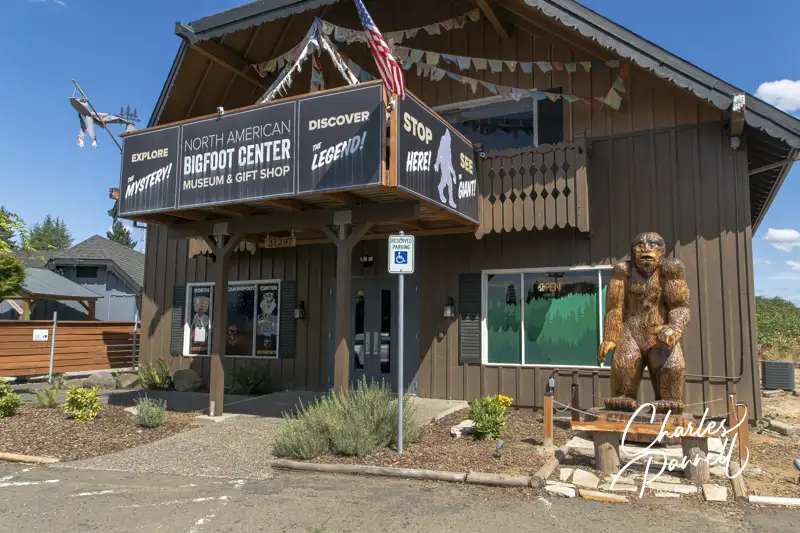
Once you’re back on Highway 26, continue east for five miles to Boring, and make a stop at the North American Bigfoot Center northamericanbigfootcenter.com. Located just off the highway it’s easy to find — turn in at the Chevron, then wind past Chester’s Pub to the back of the parking lot. You can’t miss this eclectic attraction, as the entrance is marked with a giant Bigfoot statue.
There’s accessible parking and a level entrance to the museum, which houses Bigfoot evidence and artifacts from around the world. There’s plenty of room to navigate a wheelchair throughout the galleries, and to roll up to a life-sized Sasquatch (named Murphy) for a photo.
The galleries are filled with photos, films and descriptions of first-person sightings of Bigfoot from around the world. From Vietnam and Australia, to Western Sumatra, California and of course the Pacific Northwest, there are Bigfoot stories from nearly every corner of the world. There’s also a robust collection of Bigfoot artifacts, including, footprints, handprints, fingerprints and even hair (in a Nutella jar). And if you’d like some first-hand information on Bigfoot, the museum is staffed with experienced field researchers who are happy to share their stories. Don’t miss the gift shop, which has a solid collection of Bigfoot books, clothing and assorted trinkets. Even if you don’t buy anything, it’s quite entertaining to browse through the assorted offerings.
A Waterfall Detour & More
Bridal Veil Falls
After you’ve had your Sasquatch fix, continue east on Highway 26 to Troutdale and make a quick stop at Barn Hall (www.facebook.com/THSkingofroads/). Although this small museum has limited hours (check the website), it includes some interesting exhibits about the history of the area. The barn itself was constructed in 1988 by the Troutdale Historical Society, and 10 years later they opened their doors. The exhibits change up a bit every few years, but they always focus on the history of the Columbia River Gorge.
There’s no striped parking in the gravel lot, but depending on the crowds, it’s usually possible to parallel park an adapted van, with room to deploy the ramp. There’s barrier-free access to the museum, and plenty of room to maneuver a wheelchair inside. Although it’s a small museum, it’s definitely worth a stop if you can catch it open when you’re in the area.
To complete the Mount Hood Infinity Loop, hop on Highway 84 and continue east. There is, however, a highly recommended short scenic waterfall detour along the way (emerginghorizons.com/explore-the-historic-columbia-river-highway-waterfall-corridor/). From Highway 84 take exit 22 at Corbet, then follow Corbet Hill Road south on this short section of the Columbia River Highway. The two-lane road meanders past five waterfalls, and it’s especially scenic during the spring runoff. You can drive straight through or stop and linger along the way. Either way, it’s a worthy side trip. And when you’re through, hop back on Highway 84 and continue on your way. It’s the perfect ending to any Mount Hood Infinity Loop scenic drive.
Barrier-Free Travel Washington National Parks for Wheelers and Slow Walkers
Although there’s no shortage of fun attractions in Pigeon Forge and Gatlinburg, sometimes it’s nice to take a break from the city. Fortunately these popular tourist hubs are just a stone’s throw away from the incredibility scenic Great Smoky Mountains National Park (www.nps.gov/grsm/). The good news is, even though this Appalachian gem is America’s most visited national park, there’s still plenty of room to spread out and enjoy a quiet slice of Mother Nature. So pack a picnic lunch and plan a day away from the hustle and bustle of the city, and enjoy a wheelchair-accessible Smoky Mountain day trip
Get Your Bearings
Getting to the park is easy. From Pigeon Forge, just follow Highway 321 south to Gatlinburg, then head west on Highway 441. And once you get to the park, make sure your first stop is Sugarlands Visitor Center.
There’s plenty of accessible parking in front, with level access over to the main building, and to the accessible restrooms on the far side. Inside there’s ample room to maneuver a wheelchair through the small museum and bookstore, and to the ranger information desk. There’s also level access and accessible seating in the theater, where a 20-minute film about the park is shown throughout the day. It’s the perfect place to get a good overview of the park and pick up a few maps. The one thing you won’t find at the Sugarlands Visitor Center — or anywhere else in the park — is a fee collection station, as there is no entrance fee for Great Smoky Mountains National Park.
Take a Wheelchair-Accessible Smoky Mountain Hike
Sugarland Valley Nature Trail in Smoky Mountain National Park, Tennessee
Unfortunately the trail at Sugarlands Visitor Center is not accessible, due to rocks and ruts along the way. That said there is a nicely accessible option just down the road — the Sugarland Valley Nature Trail. It’s located just south of the Sugarlands Visitor Center on the east side of Newfound Gap Road.
This nicely accessible trail was made possible through a public-private partnership, with $60,000 in federal funding and $90,000 in private donations. There’s plenty of accessible parking near the trailhead, and level access over to the paved half-mile loop. Along the way interpretive plaques describe the natural features of this area, which includes a greater variety of salamanders than anywhere else in the world.
It’s also a great place to spot wildlife, including deer, wild turkeys and even bear. And there’s even some unintended evidence of the robust bear population, as a bear tracked through the wet concrete when the trail was built. There are also a few rock chimneys from old cabins along the way, and you just can’t beat the view of the West Prong of the Little Pigeon River. It’s a nicely shaded walk, so it’s an ideal choice for a hot day.
A Scenic Drive to Remember
Roaring Fork Motor Trail in Smoky Mountain National Park, Tennessee
Finally, get an entirely different view of the forest on the Roaring Fork Motor Nature Trail, located just outside of Gatlinburg. It’s easy to find — just follow Highway 441 east from the Sugarlands Visitor Center, and turn right at Stoplight #8 on Historic Nature Trail (Airport Road). You can’t miss it — Bubba Gump’s is on the corner. Continue along the road till you hit Cherokee Orchard Road. Bear right on Cherokee Orchard Road, which will take you to the one-lane Roaring Fork Motor Nature Trail.
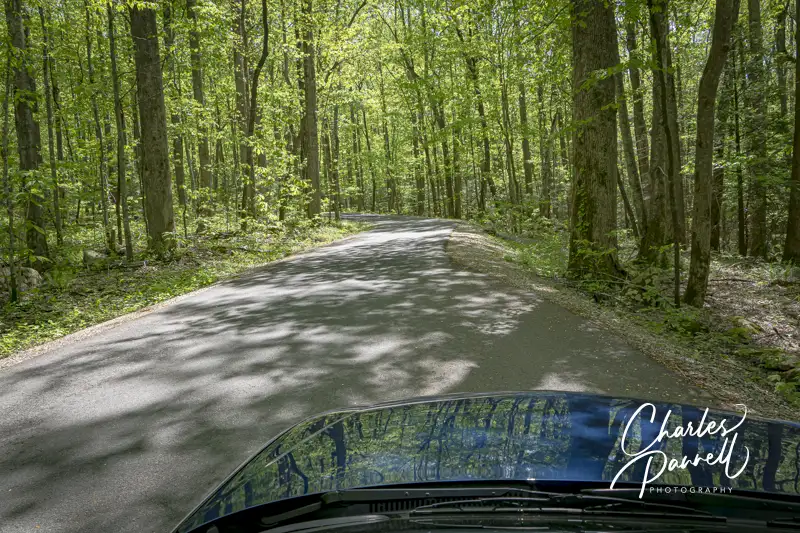
This 5.5-mile loop drive winds through the forest and offers a quiet look at the national park. Pick up a brochure at the beginning of the drive to learn more about the history and ecological diversity of the area. Best of all, RVs and buses are not permitted on this drive, so it’s a great way to dodge the crowds.
The drive begins in a dense hardwood forest filled with chestnuts, oaks, maples and magnolias. The trees arch over the road in places; and in season you’ll even get a glimpse at the tulip trees in bloom. The road passes by 25-foot high Grotto Falls before it transitions into a hemlock forest. Old log cabins dot the landscape, and there’s even a grist mill along the way. Last but not least, the route eases past the “place of a thousands drips”, which becomes a mini-waterfall in wet weather. It’s a very pleasant drive, but it’s important to note that the road is closed in the winter. Additionally, it’s an absolutely gorgeous fall foliage route.
Nicknamed the “Switzerland of America”, Ridgeway State Park (cpw.state.co.us/state-parks/ridgway-state-park) is one of Colorado’s often overlooked gems. Located off of Highway 550, about 15 miles south of Montrose, it offers stunning views of the San Juan Mountains, and borders a five-mile stretch of the Uncompahgre River. And the good news is, thanks to a bevy of accessible trails, a loaner track wheelchair, a water wheelchair and even a wheelchair-accessible paddleboard, it’s now possible to plan a wheelchair-accessible Ridgway State Park getaway. Top it off with spending a night or two in a wheelchair-accessible yurt, and you have all the ingredients for a perfectly accessible outdoor excursion.
Explore the Forest
One of the largest areas of the park, Dutch Charlie, is the perfect spot to enjoy a wheelchair-accessible Ridgeway State Park visit. It includes the visitor center, several accessible trails, an accessible beach area, and a campground.
There’s accessible parking in front of the visitor center, which is located just off of Highway 550. The visitor center features level access to a variety of interpretive exhibits, a ranger information desk and accessible restrooms.
Overlook Trail at Ridgway State Park
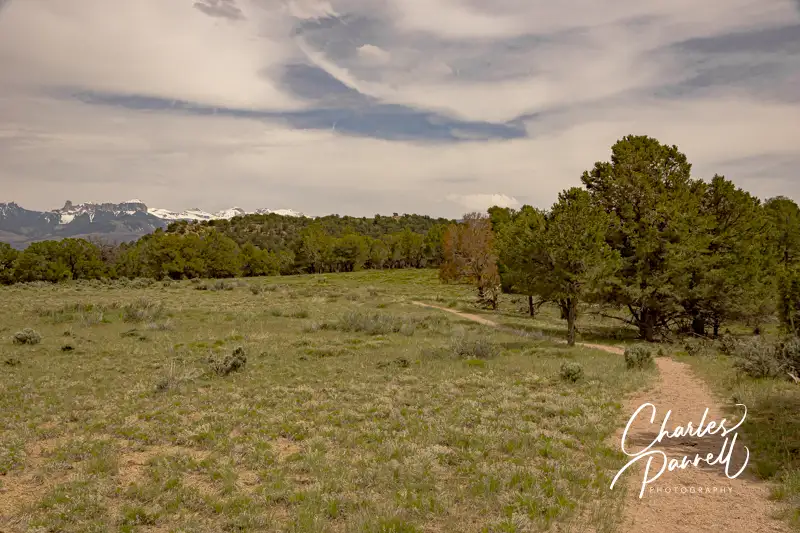
There are two accessible trails near the visitor center. The Overlook is a short 600-foot paved trail that leads over to a vantage point that offers a good view of the Ridgway Reservoir. The Forest Discovery Trail also begins near the visitor center. This .6-mile hard-packed dirt loop is wide and fairly level; however there are some rough spots and ruts along the way. Additionally it can get pretty muddy after a storm, but it’s usually passable in a loaner track chair.
Forest Discovery Trail at Ridgway State Park
Two loaner track chairs are available at the visitor center, however advance reservations are required. Staff members are not allowed to assist with transfers to the track chair; and a park volunteer must accompany all track chair-users on their excursions. The excursions can include the Forest Discovery Trail, as well as several other trails in the park. Track chairs must be reserved at least one week in advance on the park website, or by calling (970) 626-5822. It’s a great way for wheelchair-users and slow walkers to explore the park, but plan ahead to avoid disappointment.
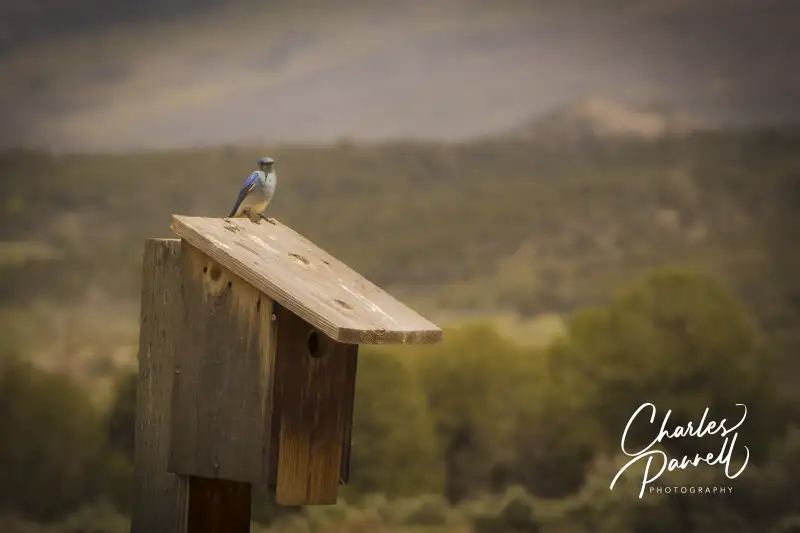
Bluebird on the Discovery Forest Trail at Ridgway State Park
Hit the Beach
Mobi-mat at Mears Bay BeachBeach at Ridgway State Park
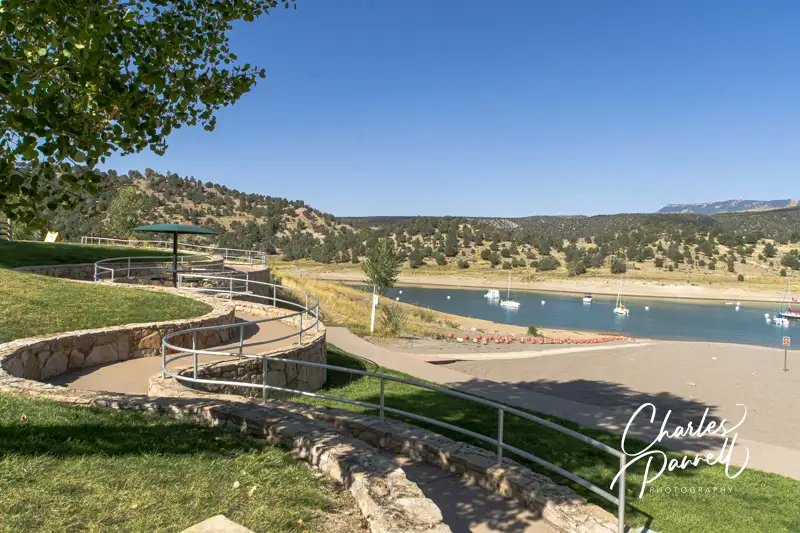
If you prefer the beach to the forest, them head on over to Mear’s Bay, which is just a short drive from the visitor center. There’s accessible parking near the marina, with level access over to the office and the accessible picnic tables on the adjacent deck There’s also ramp access down to the beach, which has a 300-foot Mobi-Mat to the water.
If you’d like to go into the water, a loaner MobiChair is available to use at the Mears Bay swimming beach. This floating wheelchair can travel over the sand or on the Mobi-Mats and go into the water. It is not self propelling, so users need someone to push the MobiChair.
And for more water fun, check out the loaner SOLFiesta wheelchair-accessible paddleboard. This massive paddleboard measures 15 feet six inches long by five feet six inches wide. There are tie-downs for a wheelchair in front, and room for a passenger behind it. And there’s still plenty of room in back for the requisite guide who maneuvers the paddleboard.
There’s no charge to use the Mobi Chair or the accessible paddleboard, but advance reservations are a must. They can be made on the park website or by calling (970) 626-5822. And just like the track chair reservations, they must be made at least a week in advance.
Finally, if you’d like a short walk while you’re in the area, then check out the Mears Bay Trail. This one-mile paved trail has a maximum grade of 4% , and runs alongside the lake. It’s not really too scenic in dry years when the lake is low, but if it’s a normal rainfall year it’s very pleasant.
Spend the Night
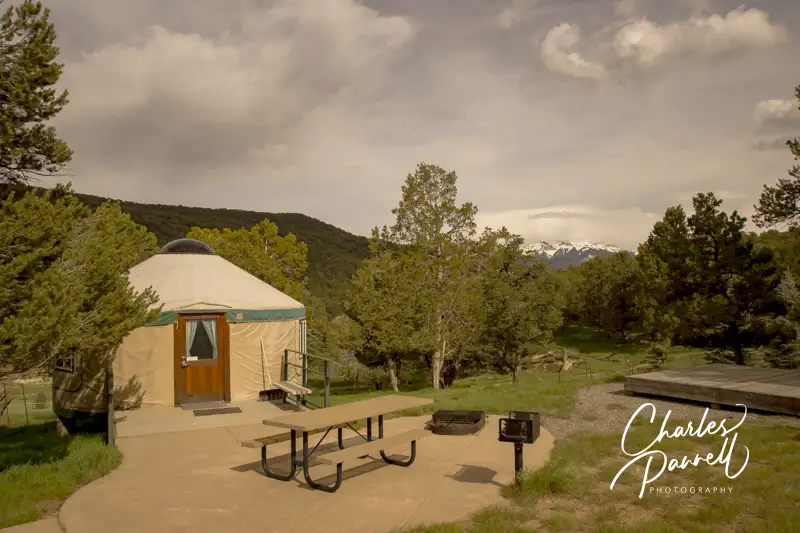
Yurt 10 in Dakota Terraces Campground at Ridgway State Park
Top off your wheelchair-accessible Ridgway State Park adventure with an overnight stay in the park. Book a night or two at the accessible yurt in the Dakota Terraces Campground, which is located midway between Mear’s Bays and the visitor center,
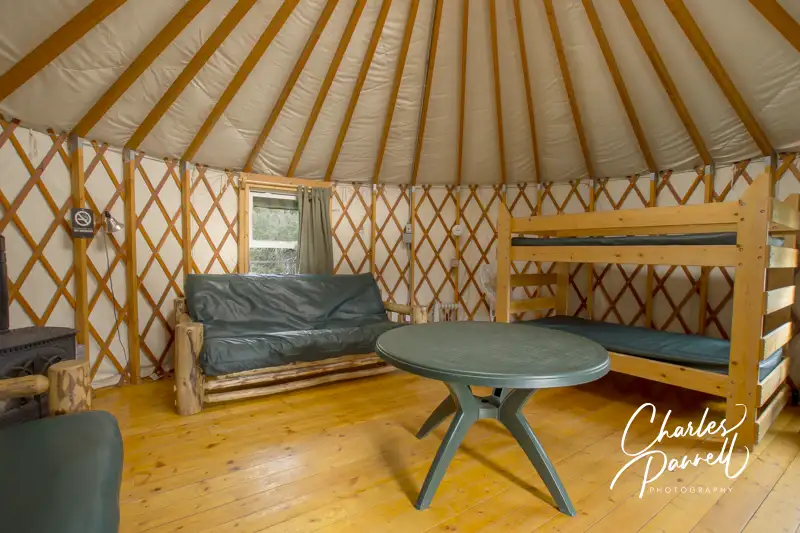
Accessible yurt 10 is located in Loop A of the campground. This round canvas structure offers accessible parking in front, with a paved pathway to the front porch. Access features include a threshold ramp, a wide entrance door, and good pathway access throughout the yurt.
The yurt is furnished with two queen futons (bring your own bedding), a bunk bed and a table and chairs. The kitchenette has a small counter, and it includes a microwave and a refrigerator. And although there isn’t a bathroom in the yurt, it does have electricity, an overhead light and a stove for heat. Outside, there is an accessible picnic table, a grill on a cement pad, and a 15-inch high tent platform.
Inside Yurt 10
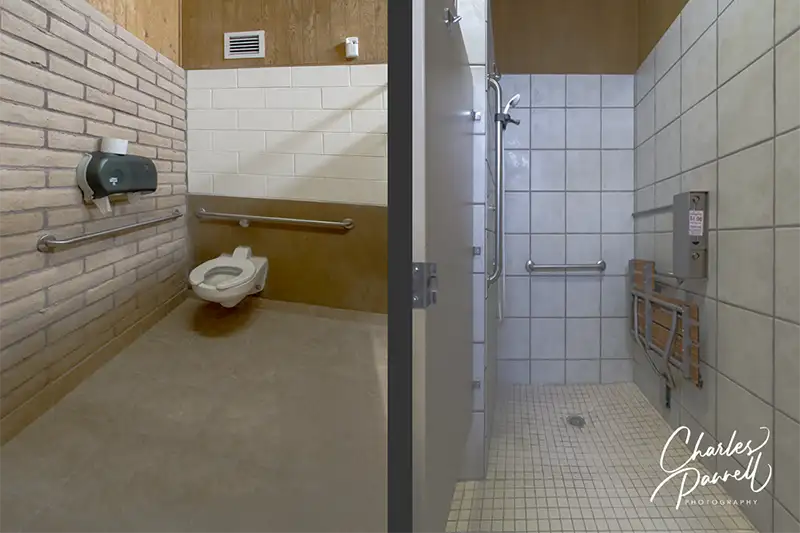
An accessible restroom is located next door, with accessible parking in front of the building. Accessible pay showers are available in the camper services building near the beginning of Loop A.
Toilet and Showers in the Camper Services Building
So save the trouble of pitching a tent and give yurting a try for a night – or two – in Ridgway State Park. It’s a comfortable and affordable way to extend your visit to wheelchair-accessible Ridgway State Park.
Barrier-Free Travel the Grand Canyon for Wheelers and Slow Walkers
Although the Enchanted Highway sounds like a scene straight from the pages of a Lewis Carroll tome, in reality it’s a sculpture-dotted scenic byway located smack dab in the middle of rural North Dakota. And it’s definitely worth a short detour on any trek through the Peace Garden State.
The brainchild of local resident, Gary Greff, this project began on one of Greff’s treks through South Dakota. He spotted a crude sculpture of a farmer with a makeshift hay bale alongside the road, and noticed that people stopped to photograph the creation. That was Greff’s “Eureka moment”. He figured that if he created a whole highway full of sculptures, then tourists would visit his hometown of Regent. And he figured the best way to do that was to make the sculptures larger then life. To that end he enlisted the help of local farmers who were masters at welding, and he set out to create the giant metal sculptures that dot the Gladstone-Regent Highway, off Interstate 94, just east of Dickinson.
The route can be taken as a side trip off the interstate, or used as a one-way north or south route as an alternative to Highway 85. It’s just 32 miles long, but allow for time to stop and enjoy Greff’s colorful creations that all depict some aspect of prairie life. And the good news is, you don’t even have to get our of your vehicle to enjoy the sculptures. That said, all of the sites (except Whirly Gigs) have level parking in dirt lots, and standard picnic tables in level areas. So pack along a picnic lunch, and prepare to linger on and enjoy the artistic creations along the Enchanted Highway.
Geese in Flight – Mile 0
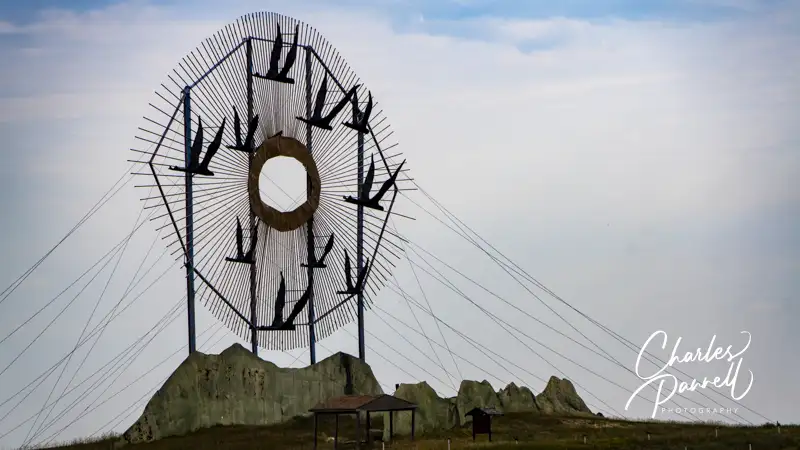
Geese in Flight on the Enchanted Highway, North Dakota
The first sculpture you’ll come across is Geese in Flight; in fact this piece marks the northern entrance to the Enchanted Highway at exit 72 off of Interstate 94. To be honest this piece is best seen from afar, so head south at the exit, and then pull over on the dirt road on the west side of the road. From there you’ll spot the sculpture, which depicts a flock geese flying around what appears to be a setting sun.
Deer Crossing – Mile 3
Deer Crossing on the Enchanted Highway, North Dakota
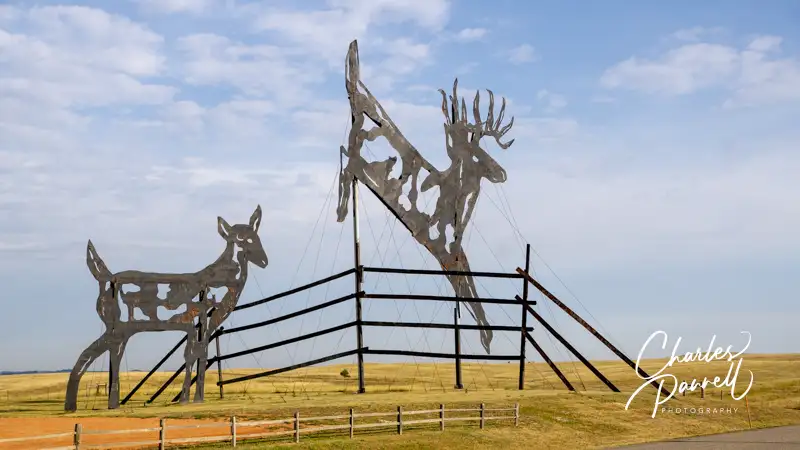
Next up is Deer Crossing, which is located just past Gladstone on the west side of the road. This massive piece depicts a pair of deer jumping over a fence, and measures in at a whopping 50 feet in height. As an added bonus, a small Maze of Enchantment is located near the sculpture. There’s level access to this easy maze, which features pathways that are wide and level for wheelchair-users and slow walkers. There’s fun for the whole family at this stop!
Grasshopper in the Field – Mile 15
Grasshopper in the Field on the Enchanted Highway, North Dakota
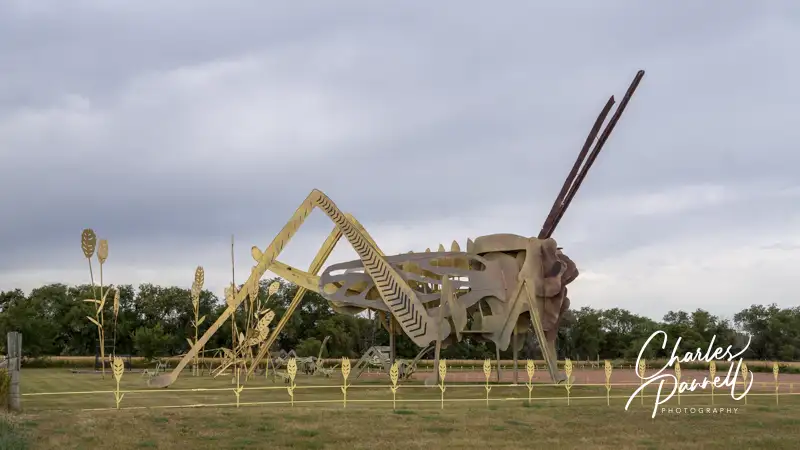
What collection of prairie-themed sculptures would be complete without a few grasshoppers? To that end Grasshopper in the Field — which is located 12 miles south of Deer Crossing — certainly solidifies the theme. This piece features one large grasshopper with several juveniles in a wheat field. Better yet, they are all surrounded by a cute little wheat picket fence. Greff got creative in the design phase of this piece, as he collected grasshoppers one summer and froze them for models. He wanted to make sure he got the colors just right, and he did a great job. A jungle gym and a few whimsical grasshopper bouncy toys round out this creative installation.
Fisherman’s Dream – Mile 19
Fisherman’s Dream on the Enchanted Highway, North Dakota
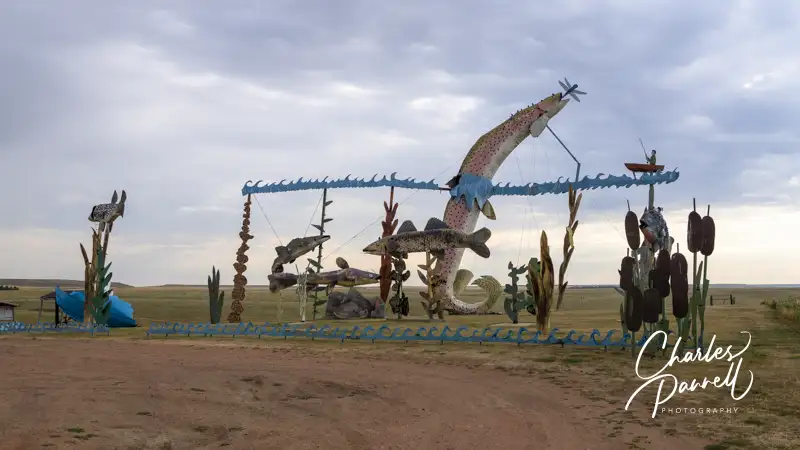
Fisherman’s Dream, which is located four miles down the road, depicts a scene only an avid fisherman can really appreciate. The sculpture includes a pond complete with cat tails and a large underwater fish population, with a fisherman trolling in a small boat on the surface. A larger-than-life rainbow trout is literally jumping out of the water in pursuit of a circling dragonfly, just off the bow of the boat. And an empty-handed fisherman just stands there awestruck. The giant trout is so large that its tail curls around the other fish and rests the bottom of the pond. Considering the epic proportions of the fish, this piece is definitely well named.
Pheasants on the Prairie – Mile 24
Pheasants on the Prairie on the Enchanted Highway, North Dakota
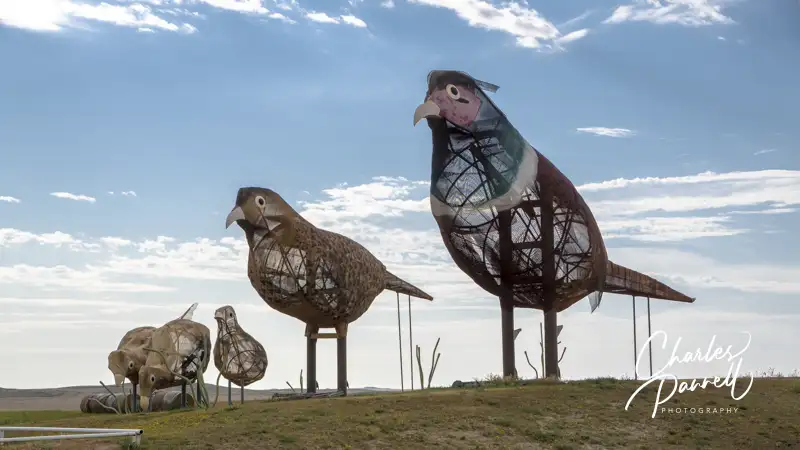
Just five miles down the road, you can’t miss Pheasants on the Prairie. which features mom, dad and three juvenile birds. They’re doing what pheasants do best — sit in the field. The birds are more than just one-dimensional stick figures though, as they’re fashioned out of a metal frame, covered with screen, and painted in realistic pheasant colors. It’s a striking scene.
Teddy Rides Again – Mile 26
Teddy rides Again on the Enchanted Highway, North Dakota
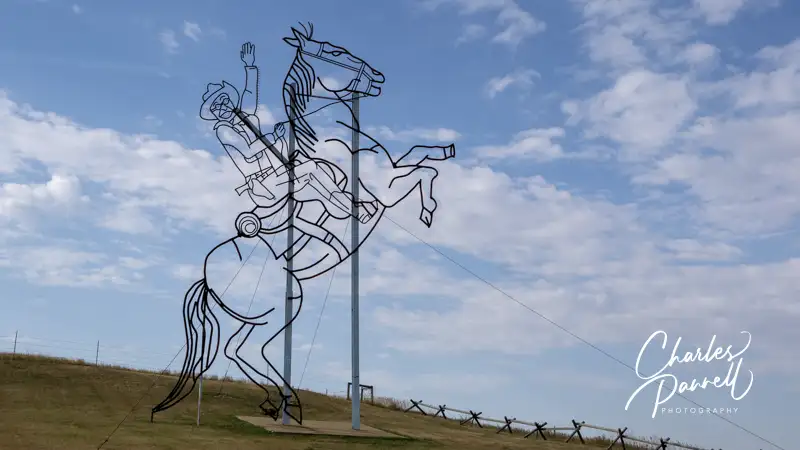
In true North Dakota fashion, Teddy Roosevelt is featured in the next piece, which is located just two miles south of the pheasant family. The sculpture, which depicts the profile of the former president on a bucking horse, was chosen by the Enchanted Highway Committee and designed by the North Dakota University Art Department. There’s also a small stagecoach on a level area in front of the sculpture, for kids — or adults — to climb in and explore.
Tin Family – Mile 30
The Tin Family on the Enchanted Highway, North Dakota
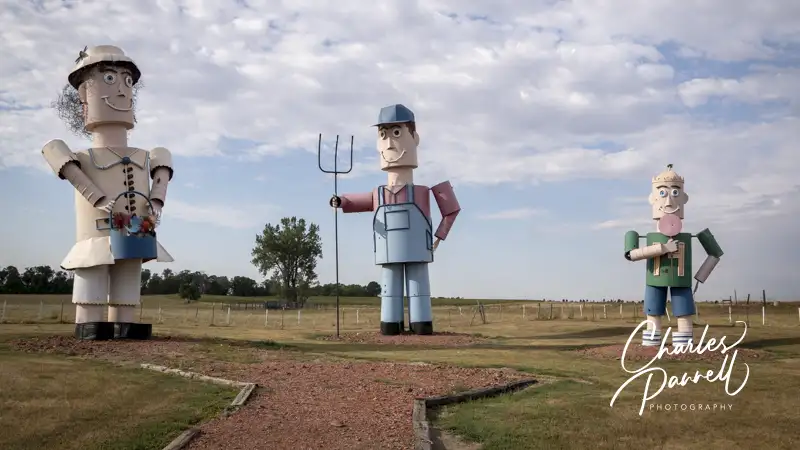
The Tin Family, which depicts a typical prairie farm family, is located four miles south of Teddy and his mount. Local farmers donated the tanks from which the family was crafted, and supplied the manpower to weld them all together. Mom is outfitted in her dress and carrying a basket of flowers, dad is clad in his overalls with pitchfork in hand, and junior is dressed in jeans and a jersey with a firm grip on his lollipop. And in true prairie style, they are bordered by a quaint white picket fence. Not only is this the first sculpture that was constructed along the route, but it’s also a local favorite.
Whirly Gigs – Mile 32
Whirly Gigs on the Enchanted Highway, North Dakota
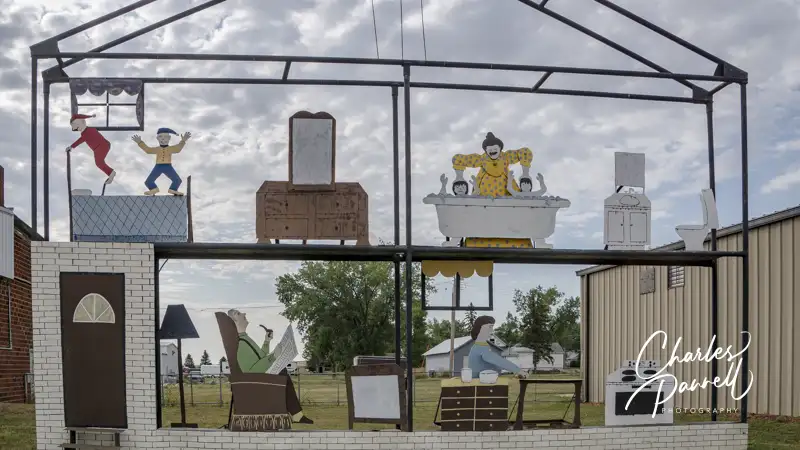
The Enchanted Highway ends two miles south on the main drag in Regent, with the only kinetic sculpture in the collection — Whirly Gigs. At first glance the frame house looks like a static piece; but once you press the green button it all comes to life. The kids jump on the second-floor bed, while another pair of youngsters splash in the upstairs tub, and mom rolls out some dough in the kitchen downstairs while dad reclines in his favorite chair. The sculpture is located next door to the Enchanted Highway Gift Shop, which has several stairs up to the entrance. There’s level street parking on the road nearby and a steep curb-cut up to the sculpture. Still, you can appreciate this — or any piece along the Enchanted Highway — from afar; so don’t hesitate to enjoy this artistic detour on your next road trip
Barrier-Free Travel Glacier, Yellowstone and Grand Teton National Parks for Wheelchair-Users and Slow Walkers
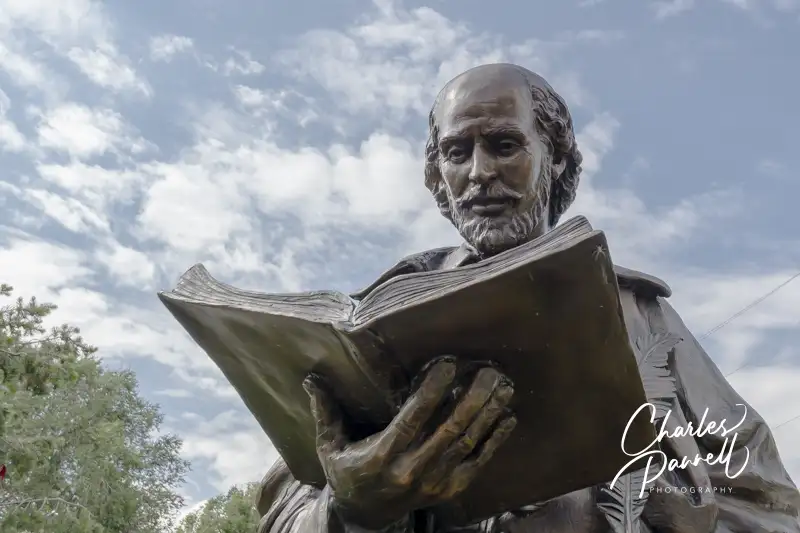
Held in Cedar City, the annual Utah Shakespeare Festival (www.bard.org) is one of the oldest and largest Shakespeare festivals in the country. Plays typically run from June to October, while free greenshows, play orientations and seminars are held before and after the productions. It’s a fun option for the whole family, and since it runs for five months there’s plenty of flexibility for planning. Additionally it’s a very inclusive event, as all the theaters and venues at the Utah Shakespeare festival are accessible to wheelchair-users and slow walkers.
And although the lineup changes every year, here’s what’s on tap for 2025.
The Importance of Being Earnest — June 20 to October 4
Steel Magnolias — June 21 to October 4
As You Like It — June 18 to September 6
Macbeth — June 16 to September 4
A Gentleman’s Guide to Love & Murder — June 19 to October 3
Dear Jack, Dear Louise — July 11 to October 4
Anthony and Cleopatra — June 17 to September 15
Get your tickets early for these popular productions, They are available at www.bard.org or 800-PLAYTIX.
Wheelchair Access at the Utah Shakespeare Festival
Randall L. Jones TheatreWheelchair access is first rate at the Utah Shakespeare Festival, starting with the traditional Engelstad Shakespeare. This outdoor venue features ramp access to the main level, and elevator access up to the balcony. Wheelchair-users have a wide choice of seats, with accessible spots available in the front and rear orchestra, as well as the balcony. Accessible parking is located a short roll away on Shakespeare Lane, and the theater also includes accessible restrooms.
The Eileen and Allen Anes Studio Theatre features equally good access. Accessible parking is available on Shakespeare Lane, and a drop-off area is located next to the theater on University Avenue. There’s barrier-free access to the building, with accessible seating available in the front rows. Additionally, there’s a barrier-free path to the concession area and the accessible restrooms.
Last but certainly not least, the Randall L. Jones Theatre also offers accessible parking on nearby Shakespeare Lane. There is level access to the theater from the back patio, with accessible seating available in the back orchestra section. There’s also level access to the concession area and the accessible restrooms in this theater.
A Bevy of Free Events Too!
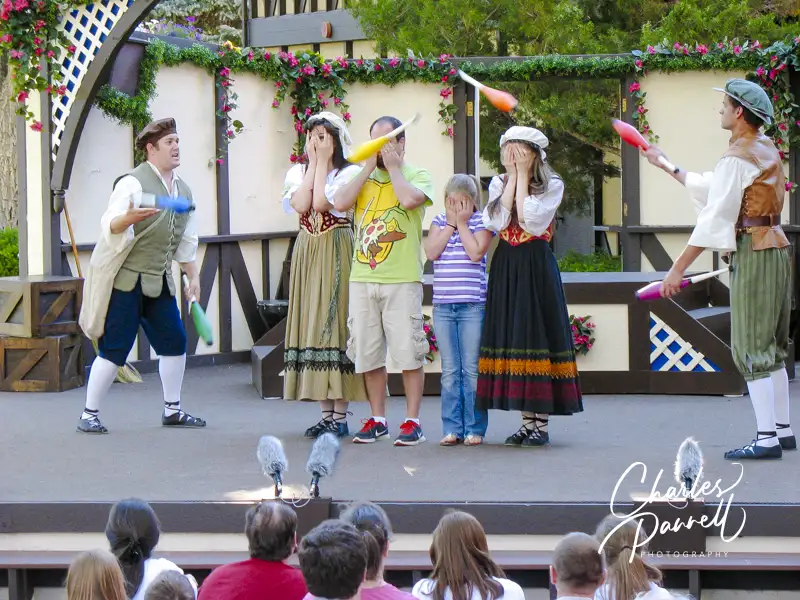
Greenshow at the Utah Shakespeare FestivalAlthough you have to purchase tickets to see the plays at the Utah Shakespeare Festival, there are also a number of free events.
At the top of the list are the informative Play Orientations. These sessions are held prior to the plays, and they help folks get a good overview about the productions. They are conducted by theater experts, and questions are welcome at all seminars. It’s a great preface to any Utah Shakespeare Festival production.
If you’d like to gain insight or ask questions about a performance, then plan to attend a Play Seminar, held the morning after the performance. Audience members have a chance to ask the actors and directors about specific points in plays, and the whole process invites a deeper understanding of the presented works.
And then there are the Prop Seminars and Costume Seminars. These popular programs are held a few days each week and they delve into some of the props and costumes used in the current productions. It’s not unusual to find out about a few inside secrets at these informative sessions.
Actor Seminars and Producer Seminars are also held a few days each week. This is your chance to ask the actors questions about their roles, or to discover how the festival is pulled together.
Finally, one of the most popular events — the Greenshows — are presented nightly before the evening productions. These lively presentations put you in a real Shakespearean mood, as they include lots of singing, dancing and storytelling. And there’s ample opportunity for audience participation, which makes it fun for the whole family. It’s a great prequel to any Utah Shakespeare Festival performance.
And the good news is, all the seminar venues are wheelchair accessible. So come and join the fun at the Utah Shakespeare Festival!
Barrier-Free Travel Utah National Parks for Wheelchair-users and Slow Walkers
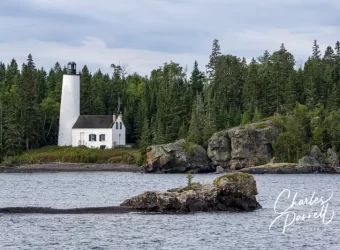
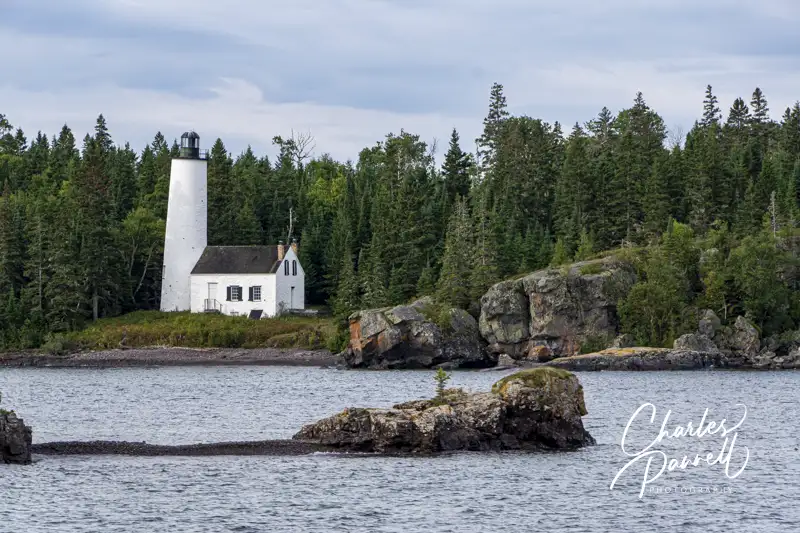
Located in the middle of Lake Superior in Isle Royale National Park, Rock Harbor Lodge (www.rockharborlodge.com/) is probably the most difficult national park lodge to get to, as it’s a six-hour cruise from the mainland. That said the journey over is a scenic adventure itself, and the Ranger III ferry has wheelchair access to the lower deck and an accessible restroom aboard (www.nps.gov/isro/planyourvisit/ranger-iii-info.htm). And once you dock at Isle Royale National Park, you’ll be rewarded with the rugged beauty at this remote retreat. Even though the island itself is rather rustic, Rock Harbor Lodge offers spacious rooms for a comfortable and relaxing Isle Royale wheelchair-accessible retreat.
An Isle Royale Wheelchair-Accessible Room with a View
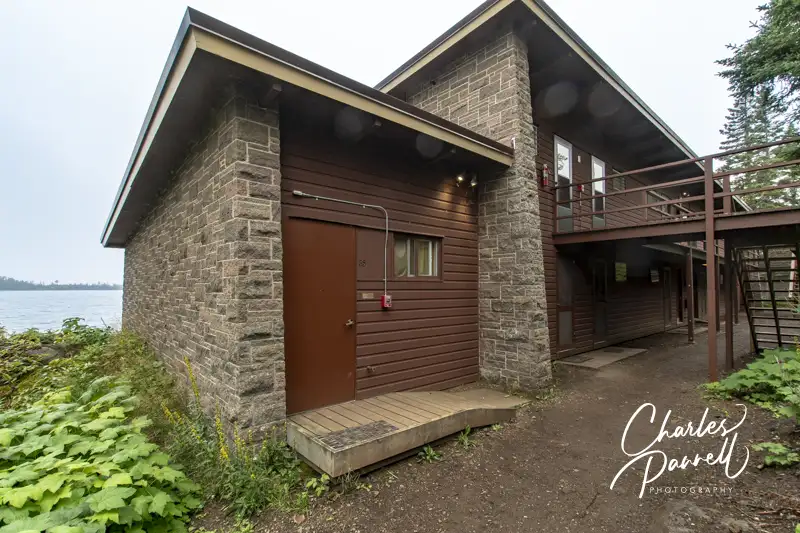
Entry to room 35 at Rock Harbor Lodge
Located along the Lake Superior shore, Rock Harbor Lodge is a .3-mile walk from the boat dock. There’s a paved level path alongside the marina, but golf cart transportation is available for guests who cannot manage the distance. And although there are a few steps up to the front door of the main office at the lodge, the back entrance is ramped.
There are three wheelchair-accessible rooms at Rock Harbor lodge, including room 35 which is located in the Chippewa Building, right behind the main office. There’s ramp access to the front door, with enough space for a wheelchair to maneuver inside the room. Access features include wide doorways, lever handles, a lowered clothing rod and low-pile carpet for easy rolling.
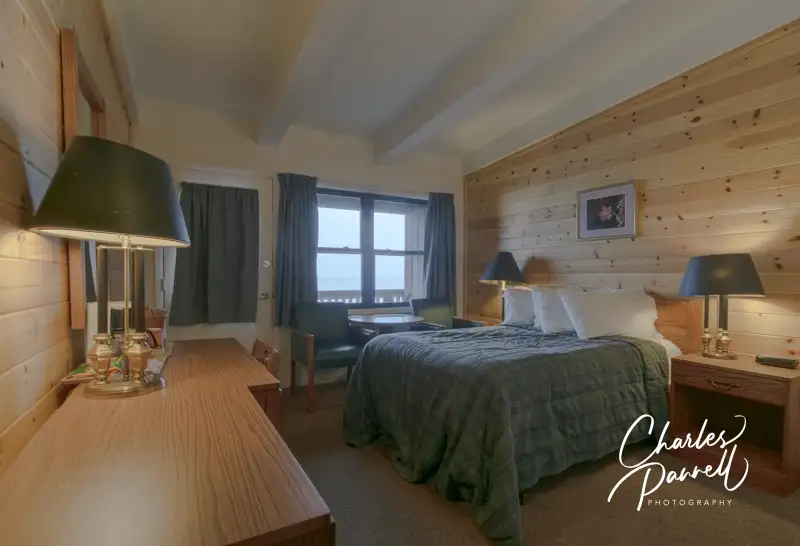
Room 35 at Rock Harbor Lodge
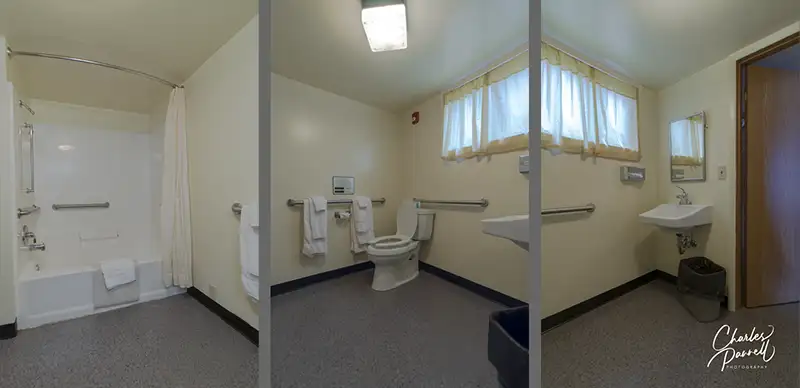
The room is furnished with a 26-inch high open-frame double bed with wheelchair access on the right side (as you face it), a night table, a desk with a chair, a small chest of drawers, and a table with two chairs. The bathroom features a full five-foot turning radius and is equipped with a tub/shower combination with grab bars. The toilet grab bars are located on the back and right walls (as seated), and the bathroom also includes a roll-under sink with an angled mirror. A portable shower bench is available, but make sure to request one when you make your reservation, so it will be in your room when you arrive.
Bathroom in room 35 at Rock Harbor Lodge
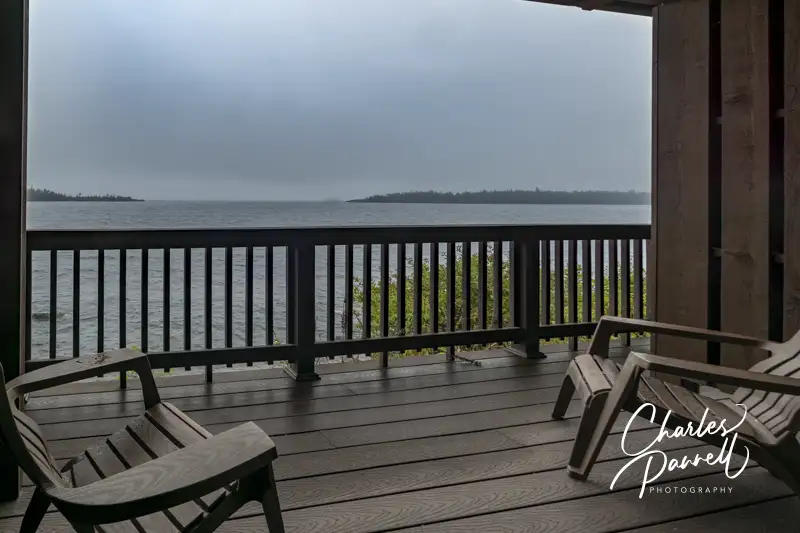
There’s also barrier-free access to the roomy back porch, which is furnished with two Adirondack chairs. Truly one of the best features of this corner room is its location, as the porch allows for an unobstructed view of the waves crashing on the rocks below, and a peek at the barrier-islands across the harbor. It’s definitely an Isle Royale wheelchair-accessible room with a view.
Back porch in room 35 at Rock Harbor Lodge
Eat Drink and Be Merry
There’s good access to the public facilities at this Isle Royale retreat as well. An accessible dirt pathway leads from the accessible room over to the Lighthouse Restaurant and the Greenstone Grill, which are located next to the main office. The grill offers bar service and a light menu of burgers, sandwiches and pizzas; while the restaurant serves up some hearty entrees. There’s barrier-free access to both establishments; but if you’d prefer a bit more privacy you can always order a pizza to go and enjoy it on your back porch.
There’s also ramp access up to the Rock Harbor Auditorium, where evening ranger programs are presented. The dirt path over to the ramp is a little bumpy, but it’s doable with a little assistance.
And although the bulk of the island has inaccessible trails, the cement walkway along the marina offers some good wildlife viewing opportunities. Even though this walkway is well trafficked, it’s not unusual to spot moose along the trail. Even if you don’t happen to see them, the lake view itself is stunning. And that’s reason enough to stay a spell at this remote but pristine national park lodge.
Barrier-Free Travel the Grand Canyon for Wheelers and Slow Walkers
Road trips are an excellent vacation choice for wheelchair-users and slow walkers. Not only can you take things at your own pace on a road trip, but you can also map out a custom itinerary that includes accessible attractions, rest stops and lodging choices. Plus you can pack along all of your equipment, and you don’t have to worry about wheelchair damage by airline baggage handlers.
Additionally, a wheelchair-accessible road trip is are a great way to explore small towns that are often overlooked on large group tours. And although some small towns may lack accessible facilities, that’s not the case across the board. With that in mind, here are 36 towns across America that have wheelchair accessible lodgings, attractions and even trails. Some are along less traveled byways, some are near national parks, and some are located on popular road trip routes; however they’re all worthy of consideration on your next road trip adventure. So add them to your itinerary on your next wheelchair-accessible road trip.
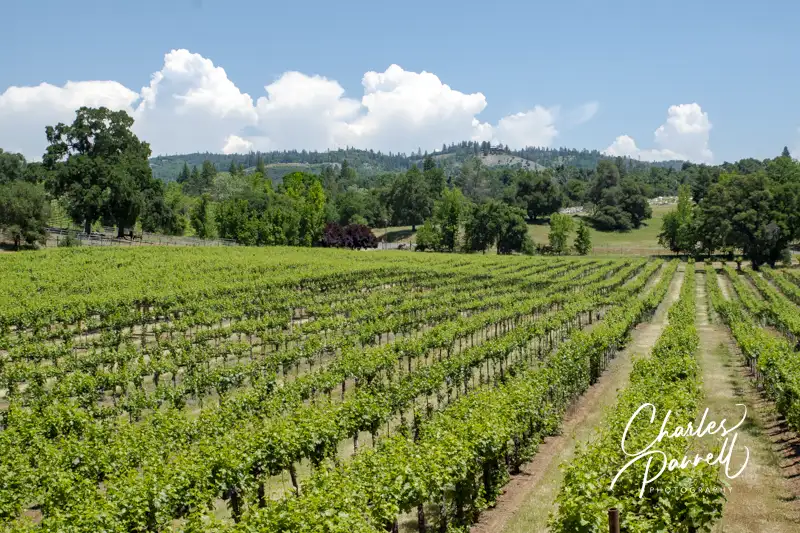
Calaveras County played an integral part in the California Gold Rush, as folks flocked to the area in hopes of striking it rich. Today the 49ers are long gone; however there’s another rush in this famous county — a wine rush, of sorts. The mining equipment of yesteryear has been replaced with vineyards and tasting rooms, as over two dozen wineries now dot the county.
And there’s no better place to enjoy the fruits of the harvest then in the tiny hamlet of Murphys. Located two hours southeast of Sacramento, this quaint town is a wine lovers paradise, as it boasts a gaggle of tasting rooms along the main drag. And even if you can’t walk or roll very far, there are still some excellent choices along this wheelchair-accessible Murphys wine tasting route.
Getting Around Downtown
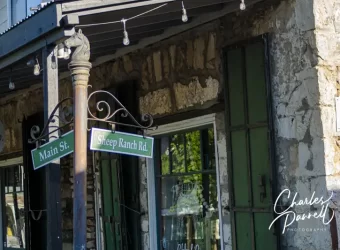
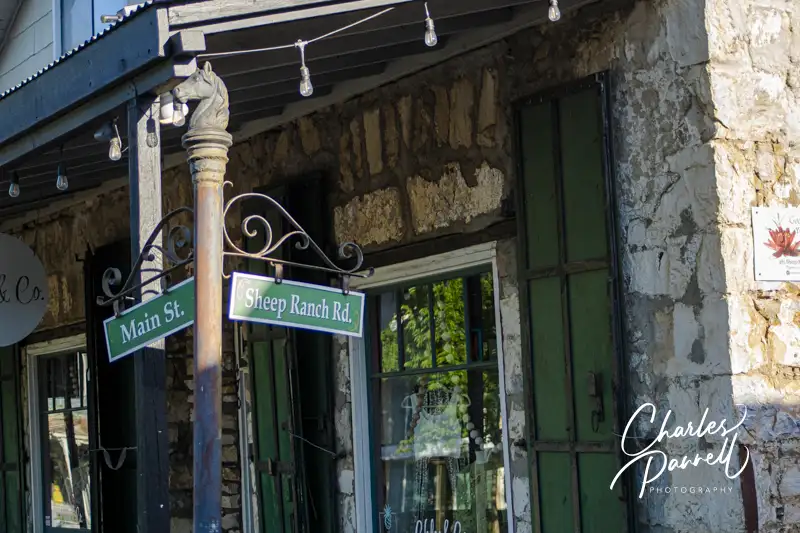
Street Signs and Historic Building in Downtown Murpyys
Although Murphys is a historic town, access upgrades have been added over the years. Accessible parking can be difficult to locate, but the Murphys Creek Theater lot on Algiers Street has the largest number of accessible parking spots. The lot is located about 150 yards off of Main Street, but manual wheelchair-users may require some assistance getting up the steeper section of Algiers Street to access the main drag.
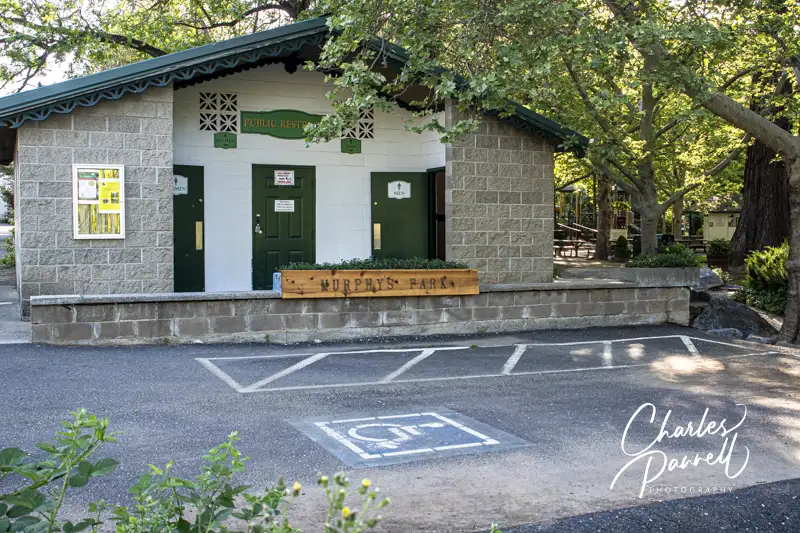
There is also one accessible parking spot next to the City Park restrooms, just down the street from the theater. Additional accessible parking is available in the public lot on Church Street and in the lot behind the Victoria Inn, both of which offer level access to Main Street. And if you can’t walk far, there are two tasting rooms close to accessible parking in Country Square on Main Street.
Most of the sidewalks in town are relatively free of obstructions, and once you get on Main Street, everything is pretty level. Although there are a few steps here and there, it’s still possible to navigate downtown in a wheelchair. Granted, some shops are housed in historic buildings with one or two steps, but all of the tasting rooms mentioned below have barrier-free access.
City Park restrooms in Murphys, California
Take a Wine Stroll
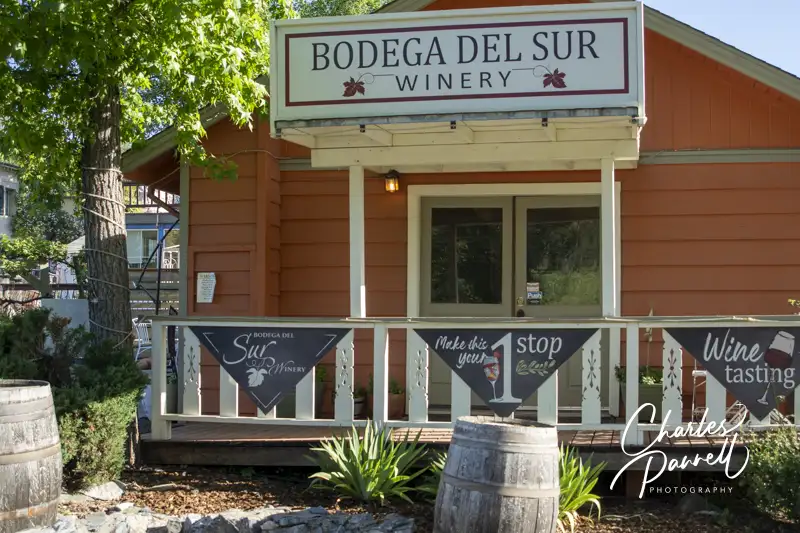
Bodega del Sur in Murphys, California
The Bodega del Sur (bodegadelsur.com) tasting room, which is located on Algiers Street just shy of Main Street, makes a good first stop on any wheelchair-accessible Murphys wine tasting stroll. There’s level access to the tasting room with plenty of room for wheelchairs and scooters inside. This boutique winery features wines made from locally grown grapes, with a decidedly Latin influence.
The Tanner Winery (tannervineyards.com) tasting room is a short walk away on the corner of Algiers and Main Streets. There is level access to the tasting room, where samples of Cabernet Sauvignon, Carignane, Barbera, Mourvèdre and several blends can be had.
Wrap up your Murphys wine tasting stroll at Newsome Harlow (nhvino.com), which is located on Main Street, near Church Street. The tasting room offers level access through the courtyard, with plenty of room to roll around inside. A Murphys favorite, this winery is heavy on the reds and it produces some excellent Zinfandels.
Stay Put and Sip
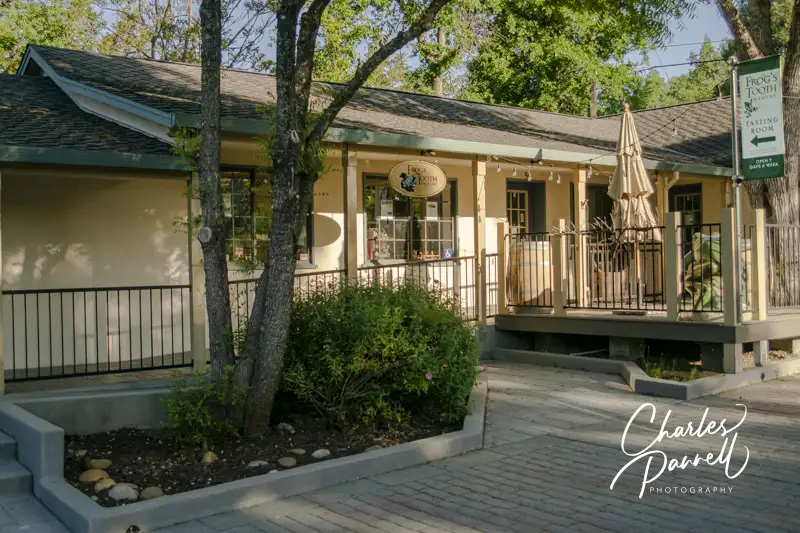
If all that strolling is a bit too much for you, you can also opt to park close to a few tasting rooms in Country Square. Accessible parking is located off of Main Street, but it can only be accessed by vehicle from the back entrance. From Main Street, turn north on Church Street, then make a left at the stop sign. Country Square is the third driveway on the left, past Murphys Pourhouse and Murphys Professional Center. And as luck would have it, the accessible parking space is right across from the Frog’s Tooth
There’s ramp access up to the Frog’s Tooth tasting room and the adjacent deck. Inside you’ll find wood floors, plenty of room to maneuver a wheelchair and a lowered bar. Frog’s Tooth is known for their small batch locally produced wines. Favorites include Tempranillo, Syrah, a variety of red blends, Viognier, Sauvignon Blanc and Rose.
And if you’d like to try another winery, Jazz Cellars (jazzcellars.com/) is located just across the courtyard from Frog’s Tooth. There’s barrier-free access to this tasting room, which features wide doorways and level access. Have a taste of their award-winning Barbera, Viognier, Sauvignon Blanc, Zinfandel or Syrah. And in keeping with their name, you can also often find live music at Jazz Cellars. It’s a great way to top off any wheelchair-accessible Murphys wine tasting stroll.
Barrier-Free Travel Yosemite, Sequoia and Kings Canyon National Parks for Wheelers and Slow Walkers