Population 177
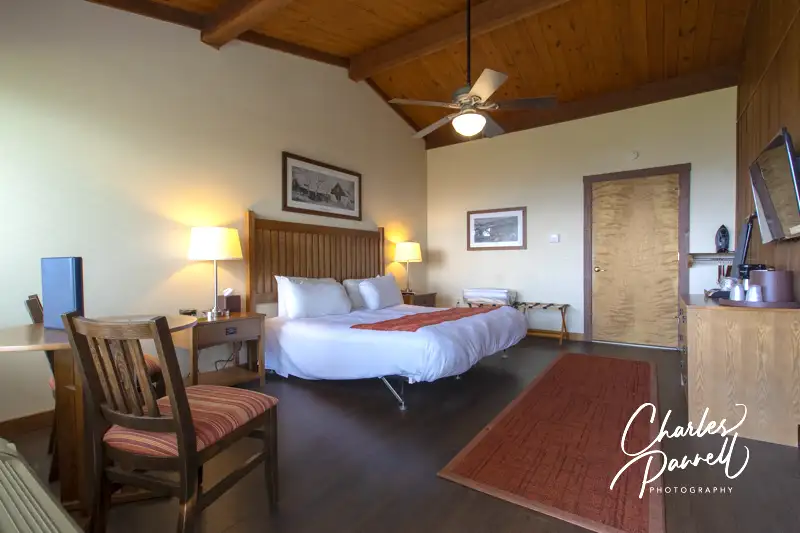
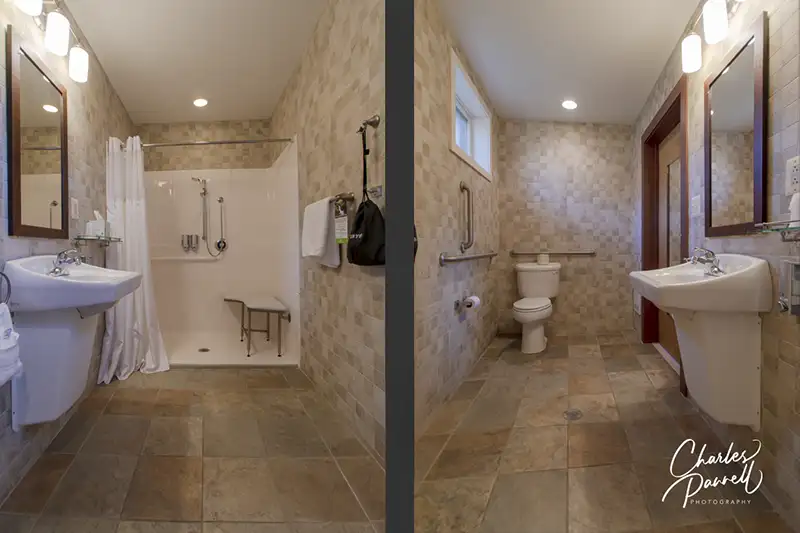
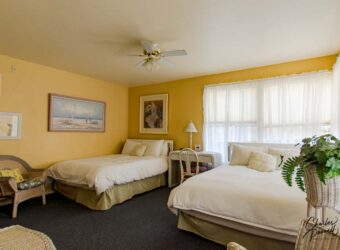
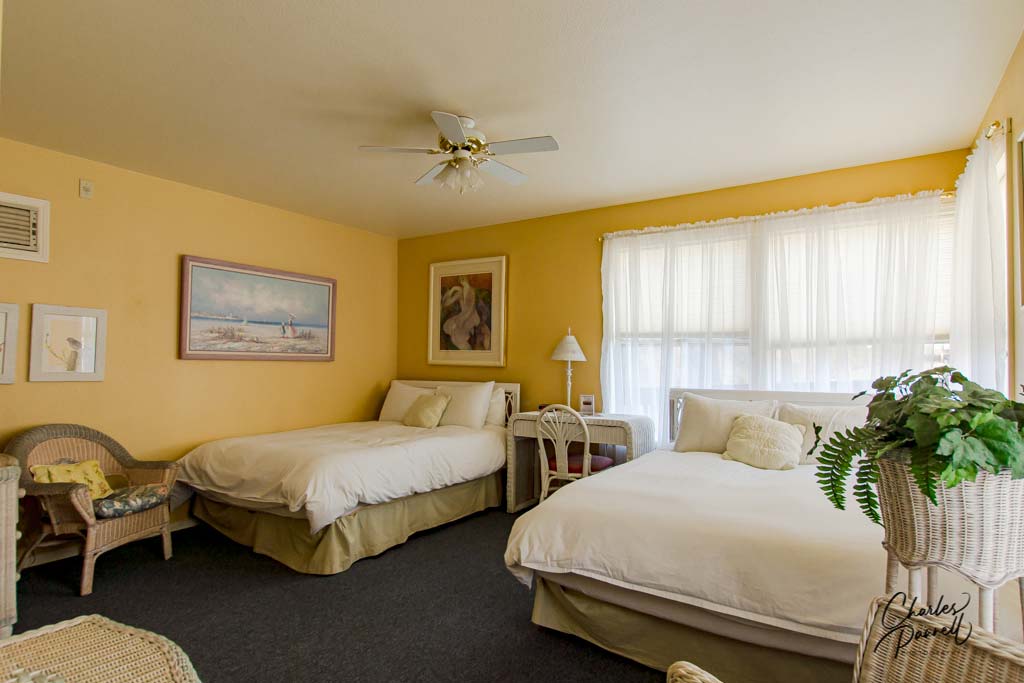
Last but certainly not least, Midpines makes a great stop on a Yosemite road trip — plus it’s the perfect home base for day trips to the park. And there are not one, but two wheelchair-accessible properties in town. The Yosemite Bug (www.yosemitebug.com) tops the list, as this rustic mountain resort offers a wheelchair-accessible room that’s furnished with two queen beds and has a bathroom with a roll-in shower.
And if you’d like to try something different, AutoCamp Yosemite (www.emerginghorizons.com/autocamp-yosemite-a-comfortable-wheelchair-accessible-home-base) offers several accessible glamping options. Their custom built wheelchair-accessible X Suite is reminiscent of an upscale RV. It’s furnished with a small galley, and includes a queen-sized bed and a bathroom with a roll-in shower. Alternatively they also have two accessible Classic Suites and an fully furnished accessible glamping tent. And the YARTS (yarts.com) shuttle stops at the Yosemite Bug in Midpines, which allows folks to sit back and enjoy the ride to the park, and skip the sometimes long entrance lines.
Located in Northwestern Virginia, Shenandoah National Park (www.nps.gov/shen) encompasses nearly 200,000 acres of protected lands, including 79,000 acres of wilderness, and a slice of the Appalachian Trail. Truly you don’t even have to get out of your car to enjoy Shenandoah’s majesty, as impressive windshield views can be had just about anywhere along the 105-mile length of Skyland Drive. That said, the park is worth more than a quick drive-through. The good news is, that if you’d like to stay and linger on, Skyland mountain lodge offers some nice wheelchair-accessible accommodations, close to one of the most accessible trails in the park.
A Room With a View
Located near milepost 41, Skyland (www.goshenandoah.com), which was originally known as Stony Mountain Camp, dates back to 1888. And although there have been a few changes to the property since George Freeman Pollock originally broke ground, the natural beauty of the surrounding forest remains unchanged. Listed on the National Register of Historic Places, this mountain lodge has also added numerous access upgrades over the years.
Accessible parking is located near the lodge office, with an accessible cement pathway down to the front door. Accessible room 14 is located near the office, with accessible parking nearby. This large corner room not only offers excellent access, but also boasts a lovely valley view.
Room 14 at Skyland in Shenandoah National Park
Access features include wide doorways, wood floors, lever handles, a lowered closet rod, and good pathway access. Furnishings include a 19-inch high open-frame king-sized bed with wheelchair access on both sides, two night tables, a chest of drawers and a table with two chairs. And if you want to catch up on the news, there’s also a television in the room.
The bathroom features a full five-foot turning radius, and it’s equipped with a roll-in shower with grab bars, a hand-held showerhead, and a fold-down padded shower bench. The toilet grab bars are located on the back and right walls (as seated), and the bathroom also has a roll-under sink and a lowered mirror. Add in shower controls located within easy reach of the shower seat, and a lowered towel hook near the sink, and you have a very accessible room.
Bathroom in Room 14 at Skyland in Shenandoah National Park
And out on the semi-private front porch, there’s plenty of room to maneuver even the largest wheelchair or scooter. It’s the perfect place to sit back and enjoy the sunset, or to just relax after a busy travel day.
Take A Hike
Access to the public areas of Skyland — which are located next to the office — is equally impressive. There’s barrier-free access to the day lodge, with level access over to the Mountain Room taproom, gift shop and grab-and-go food kiosk. Accessible restrooms are located just off the lobby; and there’s ramp access down to the Pollock Dining Room, which also offers a great view of Shenandoah National Park. Not only is Skyland a great place to spend the night, but it’s also a very accessible spot to grab a bite to eat during the day.
Limberlost Trail in Shenandoah National Park
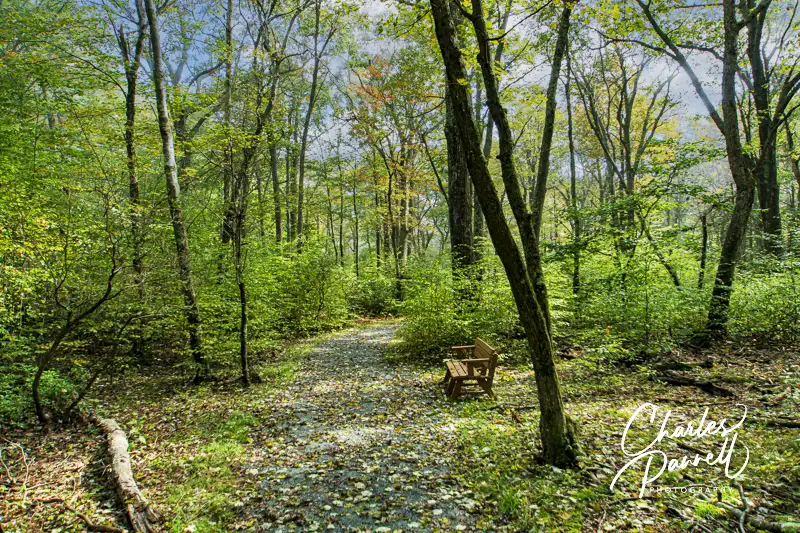
Additionally, Skyland is located close to the nicely accessible Limberlost Trail. There’s accessible parking near the trailhead, with level access over to this hard-packed dirt trail covered with decomposed granite. The 1.3-mile trail begins in an oak-filled wooded area with ferns and mountain laurels; before it transitions to a wetlands boardwalk, and then crosses the river and loops back to the trailhead.
This area is especially beautiful in June, when the mountain laurels are in bloom, but it also makes for a pleasant hike in the spring and fall. And you can enjoy all of this beauty, just steps from the lodge. It’s definitely worth an overnight stay at Skyland, on your next visit visit to Shenandoah National Park.
El Capitan, the southern-most point of the Guadalupe Mountains
Named for the mountain range that dominates the landscape, Guadalupe Mountains National Park (www.nps.gov/gumo/) contains the four highest peaks in Texas, and boasts an impressive share of backcountry acreage. If all that sounds a little foreboding for wheelchair-users and slow walkers, then think again.
The park also contains a historic stage stop as well as the ruins of an 1800s ranch — both of which are wheelchair-accessible. They can be easily reached from Highway 62/180, which runs from El Paso to Carlsbad and passes through the southwest section of the park. Not only is Guadalupe Mountains National Park a destination by itself, but it also makes a nice add-on to a Carlsbad Caverns visit. Either way, it’s a good choice for wheelchair-users and slow walkers who want to explore a bit of southwest history.
Pinery Stage Station
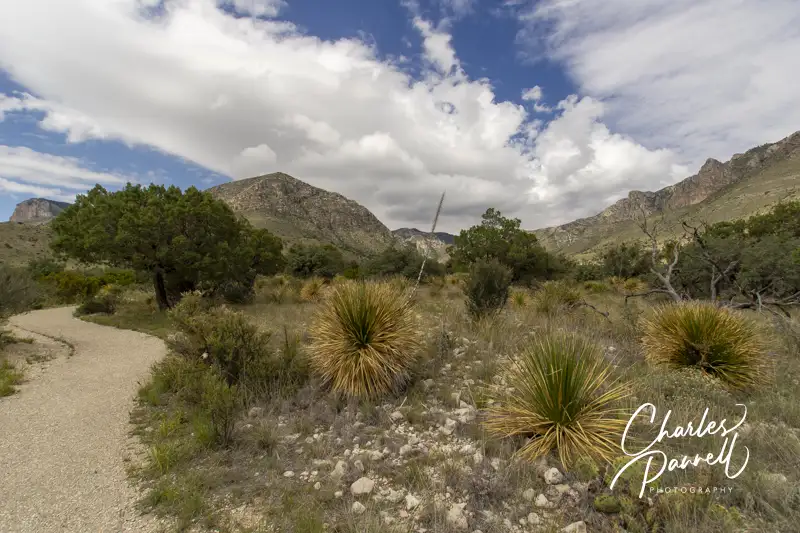
The Pinery Trail in Guadalupe Mountains National Park
The Pinery Visitor Center makes a good first stop in the park. Located just off the highway, there’s accessible parking in front, with barrier-free access to the building. Inside there’s plenty of room to maneuver a wheelchair around the exhibits and ranger information desk, and level access to the accessible restrooms.
But the real attraction — The Pinery Trail — starts just outside the visitor center and leads over to the site of the former Pinery Stage Station. The paved accessible trail is dotted with benches, while interpretive plaques that detail the desert plants line the walkway.
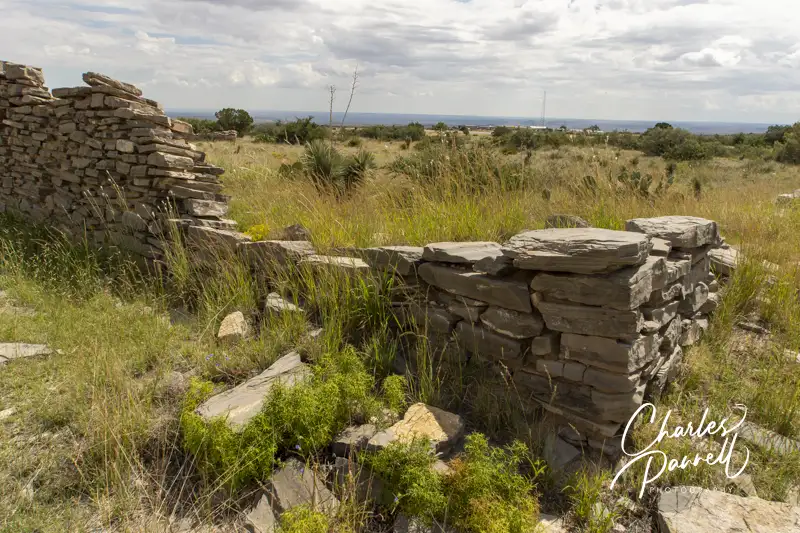
The trail ends at an interpretive plaque that explains the importance of this one-time stage stop. Built in 1858, the stop was named for a nearby stand of pines, and since it had an abundant water source it was one of the most favored stations along the 2,800-mile mail route from St, Louis to San Francisco. It’s about a .7-mile round trip hike from the visitor center, however if you can’t manage the distance, there’s also a pullout along the highway near the stage stop. Although the Butterfield Overland Mail Coach only operated for a little over two years, it should be noted that it never missed a run — even in adverse weather.
Ruins of the Pinery Stage Station
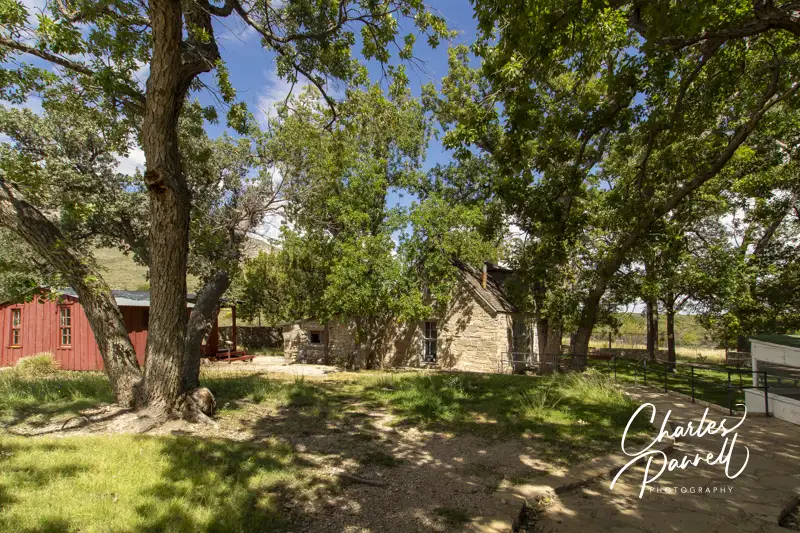
Frijole Ranch History Museum
Frijole Ranch History Museum
Another must-see in Guadalupe Mountains National Park is the Frijole Ranch site, which is located just up the highway. Accessible parking is located near the accessible vault toilet. And since there are accessible picnic tables in a nearby covered pavilion, this stop is also a good spot for a lunch break.
The accessible Manzanita Spring Trail begins near the parking area, and leads over to the Frijole Ranch History Museum — an open-air exhibit which focuses on the history of this parcel, which was first settled by the Radar brothers in 1876. It was later acquired by the John Thomas Smith family in 1906. They grew apples, peaches, apricots and other fruits, and transported their harvest by wagon to Van Horn — a two-day ride away. The Smith farmhouse still stands, and it’s furnished as it would have been in the early 1900s. The Smith family operated the orchard until 1942, and it later served as a ranger residence, before it was added to the National Register of Historic Sites.
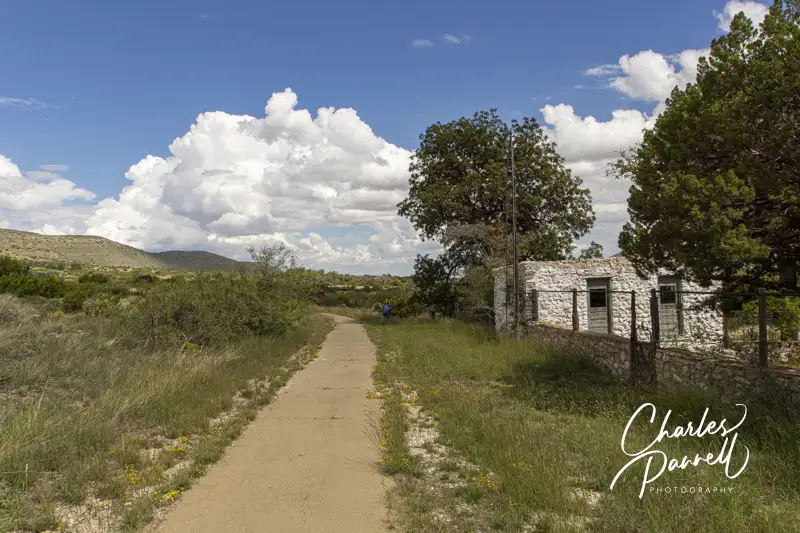
The paved undulating trail continues on past the old farmhouse and ends at Manzanita Spring. It should be noted that there’s a short 15-foot section of the trail that has rocks and dirt along it, from a washout. The good news is, that section is at the beginning of the trail, and if you can make it past that, you won’t have any problems completing the trail. On the other hand, if it’s been repaired, this trail is entirely passable for wheelchair-users and slow walkers. All it all, it’s a one-mile round trip hike that offers an interesting look at the farming history of the area.
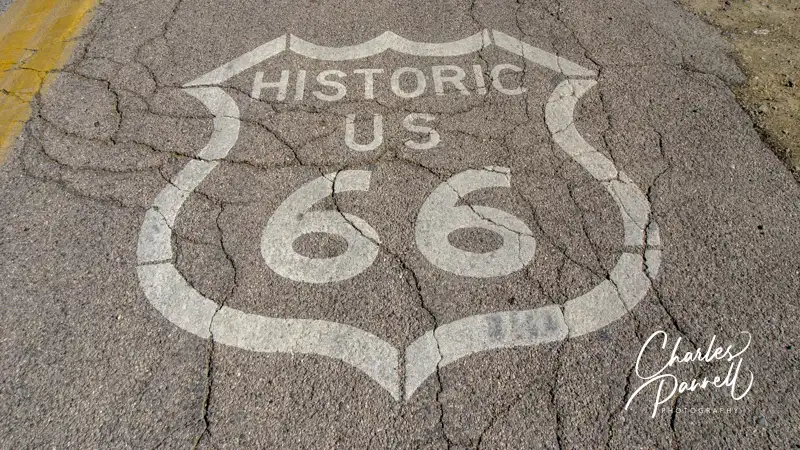
Route 66 — which ran from Chicago to Los Angeles — was given its official numerical designation in 1927. Back then it was just a new moniker for a network of roads that crisscrossed the nation. As Americans embraced road trips in the early 1930s, the route blossomed. Motor courts, diners and roadside attractions sprung up along the way, and business was booming. Nicknamed the Mother Road by John Steinbeck, Route 66 also beckoned Dust Bowl residents to head west in search of prosperity.
Today this historic route has been largely replaced by Interstate 40, however it’s still possible to drive along a few sections of the original Mother Road in Arizona. And although it’s a historic route, it’s still a viable option for wheelchair-users and slow walkers. So hop off the interstate on your next drive through the Grand Canyon State, and experience a taste of a wheelchair-accessible Route 66 road trip.
The Oatman Highway
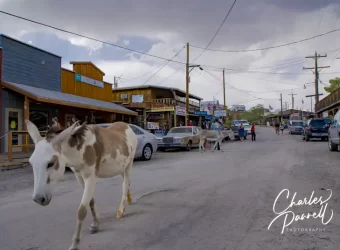
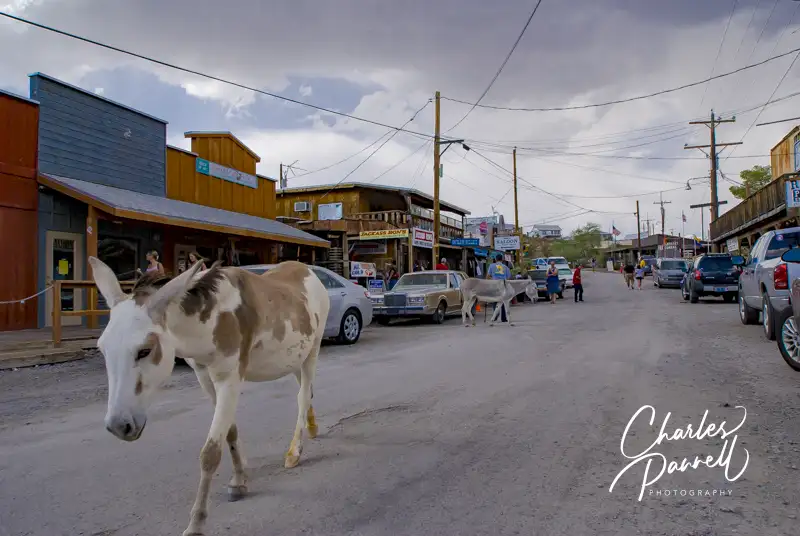
Burro in Oatman, Arizona
This historic route begins on the Oatman Highway. Just take the Topock exit from Interstate 40 after you cross over the Colorado River and enter Arizona. This part of your wheelchair-accessible Route 66 road trip winds through the Black Mountains, crosses Sitgreaves Pass and offers remnants of a bygone era.
Oatman (www.oatmangoldroad.org), which was founded in 1906 to support nearby gold mining camps, is located 35 miles up the road. Today the town celebrates its rough and tumble past and retains a distinctive wild west flavor. Daily gunfights are held in front of the Oatman Hotel (check the town website for times). Accessible parking is located near the Post Office and there are accessible public restrooms on the east end of town.
And then there are the burros. Years ago the miners used burros to work the gold mines, and today their descendants roam the streets of Oatman. A word of warning — watch were you walk or roll because there are a lot of them. And if you’d like to feed them, there’s no shortage of places that sell burro food. All in all, Oatman is a fun stop, and although some of the shops have steps, there are also restaurants, stores and attractions that have level access.
After you leave town, the narrow road winds up to Sitgreaves Pass. Hairpin turns and sheer drop-offs are the norm on this stretch of the route, and there’s also a noticeable lack of guard rails along the way. On the plus side, there’s no shortage of spectacular windshield views, including one at the summit, and another on the way down near the Mile-30 marker.
Cool Springs
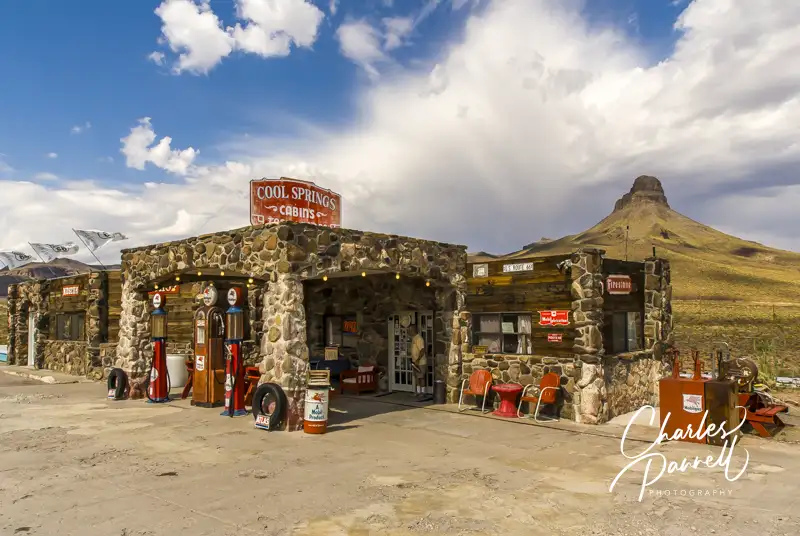
Cool Springs, Arizona
As you continue on this wheelchair-accessible Route 66 road trip, the road winds down Gold Hill and passes the remnants of Ed’s Camp, before it reaches Cool Springs. Barely a wide spot in the road, this rest stop was a welcome sight to road weary travelers back in the day. Hollywood also discovered it in 1992, when it was used as a filming location for Jean-Claude Van Damme’s Universal Soldier. Sadly it was demolished in the final scenes of the movie; however it was later sold and rebuilt to resemble the original 1926 incarnation.
Parking is available in a level dirt area, with barrier-free access to the main entrance of the gift shop and museum. And even though there is one step inside, there’s also access to the raised area of the building from a second accessible entrance.
The makeshift museum offers up a quirky collection of found objects that includes everything from an old gas pump and tools, to oil cans, photos, toys and even vintage post cards. There’s also a t-shirt shop, jewelry counter and a decent selection of Route 66 souvenirs peppered around the memorabilia. Outside, there’s an old 1935 rusted out Nash Sedan to the left of the store. And of course the old gas pump which rests under a restored stone canopy.
Kingman
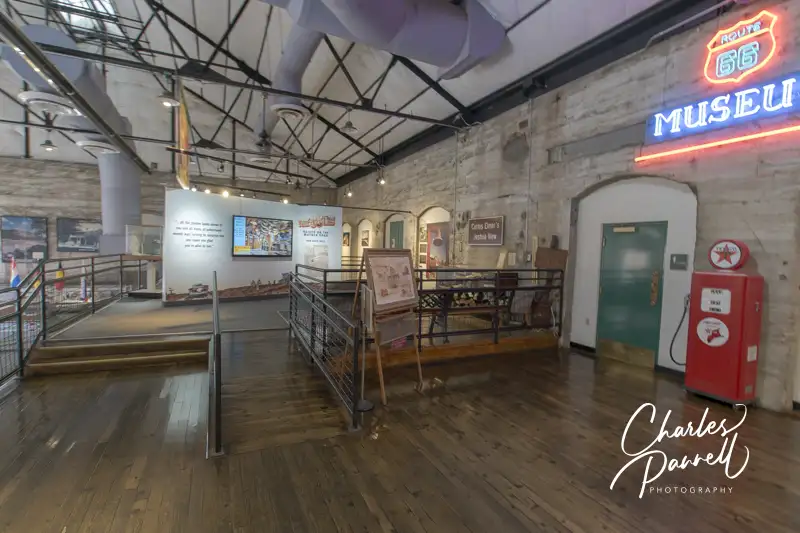
The Powerhouse Museum in Kingman, Arizona
It’s about a 25-minute drive from Cool Springs to Kingman — the largest city on this wheelchair-accessible Route 66 road trip. The road straightens out and parallels Interstate 40 before it enters town. After that, it turns to the right at the Powerhouse, and becomes Andy Devine Avenue.
The Powerhouse is definitely worth a stop as it’s home to the Powerhouse Route 66 Museum (www.explorekingman.com/attraction-Powerhouse-Route-66-Museum).
There’s elevator access to this kitschy museum, which is located on the second floor. Highlights include information on the Dust Bowl immigrants and the origin of the ubiquitous Burma shave signs. The Historic Route 66 Association of Arizona also has a room filled with exhibits and information about the era. Top it all off with a 1950 Studebaker, and some vintage storefronts, and you get a real feel for the era.
And if you’d like to grab a bit to eat in a nostalgic diner, then stop in at Mr. D’z Route 66 Diner, which is just across the street. Accessible parking is on the side with level access to this retro eatery, which is famous for their burgers and ice cream confections.
After lunch, continue east on Andy Devine Avenue. After you pass the airport, the road narrows to two lanes and transitions to the remnants of Route 66. Along the way you’ll pass vintage Burma Shave billboards, roadside attractions and some fun photo ops. As an added bonus, this section of your wheelchair-accessible Route 66 road trip is fairly level and straight.
Hackberry
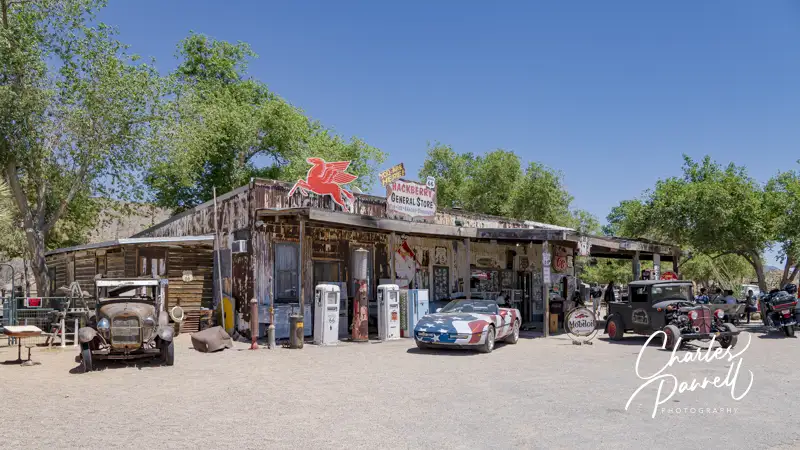
The Hackberry General Store
About a half-hour down the road you’ll come upon Hackberry, home of the Hackberry General Store (www.facebook.com/profile.php?id=100043125116622). This restored building features a vintage gas station, a souvenir shop and another great photo opportunity. There’s just a dirt parking area in front, but it is level and there’s usually plenty of room to parallel park an adapted vehicle.
Outside, there’s a treasure trove of memorabilia including some rusted out old cars, signs, tools and even a mock-up of a vintage garage. There’s level access to the store which offers souvenirs, cold drinks and snacks. And although the restrooms are not accessible, the men’s room is worth a look as it’s tastefully decorated with vintage pinup posters. Even if you can’t go all the way in, take a gander at the interior from the doorway.
Valentine
Accessible Tram at Keepers of the Wild Animal Park
The tiny hamlet of Valentine is just five miles up the road. If the landscape along this stretch of the road looks familiar, it’s because the tire change scene from Easy Rider was filmed there. Although there are a few remnants of an old hotel and gas station in Valentine, the big attraction is Keepers of the Wild (www.keepersofthewild.org).
Keepers of the Wild houses over 150 exotic and indigenous animals that were rescued or abandoned. This non-profit animal sanctuary has a strict no breeding policy, with a strong focus on advocacy, education and protection. As part of their educational outreach, the facility is open to the public, and all admission fees go directly to the care of the animals.
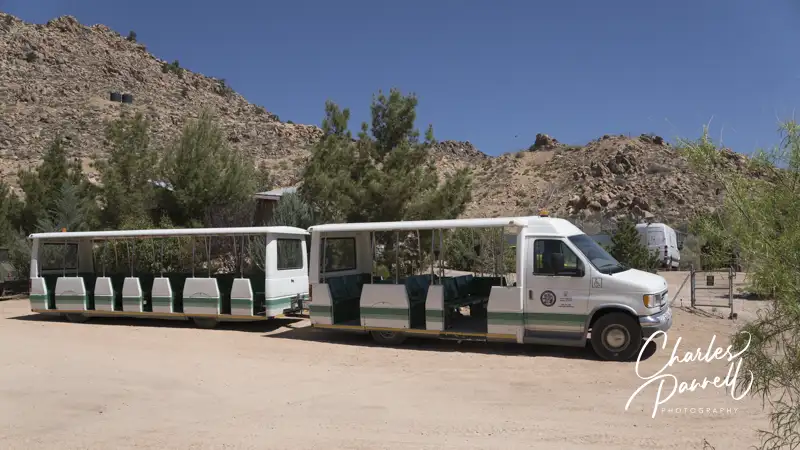
Although visitors are welcome to walk around the sanctuary and check out all the habitats, the best way to learn about the animal residents is to also book a Guided Safari Tour. The standard safari tour vehicles are not wheelchair-accessible, but an open-air wheelchair accessible tram is used for wheelchair-users. There’s room for two wheelchairs aboard the the tram, and it’s also a good option for slow walkers who can’t access the traditional safari vehicle.
The tram tours are conducted several times each day; however the prime tour time is at 3:30, as that’s feeding time for the animals. The tour guides are great about pointing out natural animal behaviors and answering questions, but they also tell fascinating tales about how some of the current residents came to the facility. Save some time to explore the sanctuary on your own too. Some of the lower dirt pathways are accessible in good weather. It’s a great attraction, and the staff is well versed in access issues.
Peach Springs
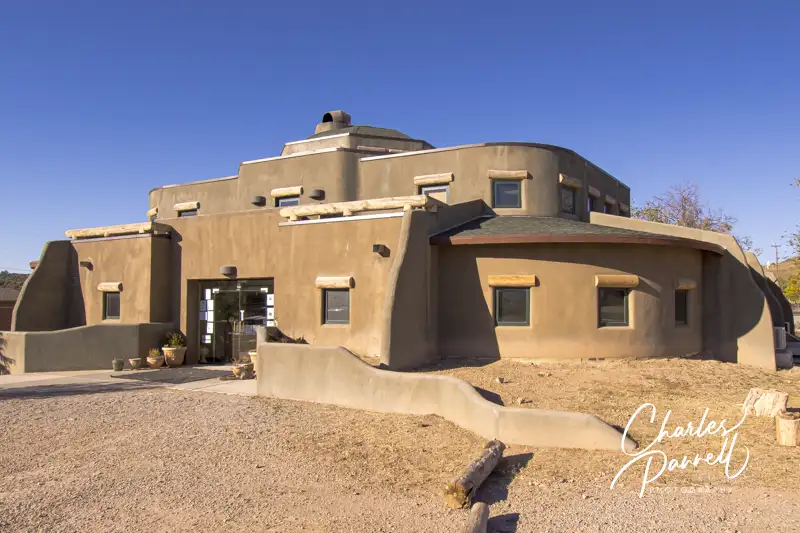
Hualapai Cultural Center in Peach Springs, Arizona
Next up on your wheelchair-accessible Route 66 road trip is Peach Springs, which is just 20 minutes east of Valentine. Located on Hualapai land, it boasts a hotel, a restaurant, a gas station, a cultural center, and a few vintage buildings.
Built on the site of the Qumacho Cafe, the Hualapai Cultural Center may be of interest to some folks. Accessible parking is available on a concrete slab on the left of the building, with level access to the front door. Although there’s no formal tour, the receptionist is happy to show visitors around and answer questions. The cultural center features a nice collection of native artwork, as well as baskets, pottery and other items created by the young people of the tribe.
Remnants of the past can be seen at the Osterman Gas Station, which is located between the Hualapai Cultural Center and Hualapai Lodge. This former Shell station, which was built by Oscar Osterman in the 1920s, did a robust business during the boom days of Route 66. Sadly when the Mother Road was decommissioned, business died off and eventually the business was closed. The building was placed on the National Register in 2012.
Located across the street from the historic Osterman Gas Station, Walapai Market features level access and includes a deli, a bakery and a wide selection of grocery items. And, if you’d prefer to sit down and take a break, the Diamond Creek Restaurant at nearby Hualapai Lodge offers a menu filled with Native American specialties and traditional American favorites. Either way, you won’t go away hungry.
Grand Canyon Caverns
Grand Canyon Caverns
Grand Canyon Caverns (gccaverns.com) which is just 10 minutes down the road is also worth a stop. A large sign marks the entrance to the mile-long flag-lined road that leads to this family-owned attraction. Take a few minutes to have a look at the vintage automobiles near the beginning of the road that’s aptly named Radiator Springs.
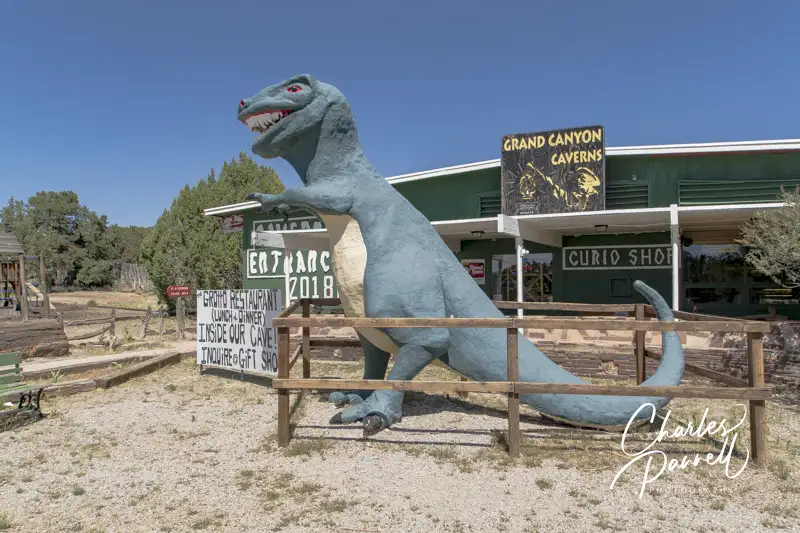
Although there’s no accessible parking at Grand Canyon Caverns, the large lot is paved, and there’s usually plenty of room to parallel park an adapted van. And don’t forget to snap a photo of the large dinosaur that guards the entrance to this vintage attraction. From the parking area, there’s level access over to the ramped entry to the restaurant, and barrier-free access to the ticket counter next door.
Although none of the cavern tours are technically wheelchair-accessible, the 45-minute guided tour may work for some wheelchair-users and slow walkers. This tour travels about a quarter-mile on paved trails, and although manual wheelchair-users may need some assistance with some of the grades, it’s doable for some folks. There’s elevator access down to the cavern entrance, and although there are 15 steps at the beginning of the tour, there’s also an alternate step-free route. It’s best to check the website before making plans as the tours are not always offered, but it’s still a fun stop without the tour.
Even if you don’t do the tour, be sure and stop in for a bite to eat at The Caverns Grill, which offers a nice selection of homestyle meals and of course cheeseburgers, fries and yummy desserts.
Seligman
“Downtown” Seligman, Arizona
Known as the birthplace of the “preserve Route 66 movement”, Seligman (seligmanazchamber.com/visit-seligman) is located about a half-hour from Grand Canyon Caverns, at the end of the east section of Route 66. It’s the home town of Angel Delgadillo, the founder of the Historic Route 66 Association, and the man who spearheaded efforts to restore part of the Mother Road.
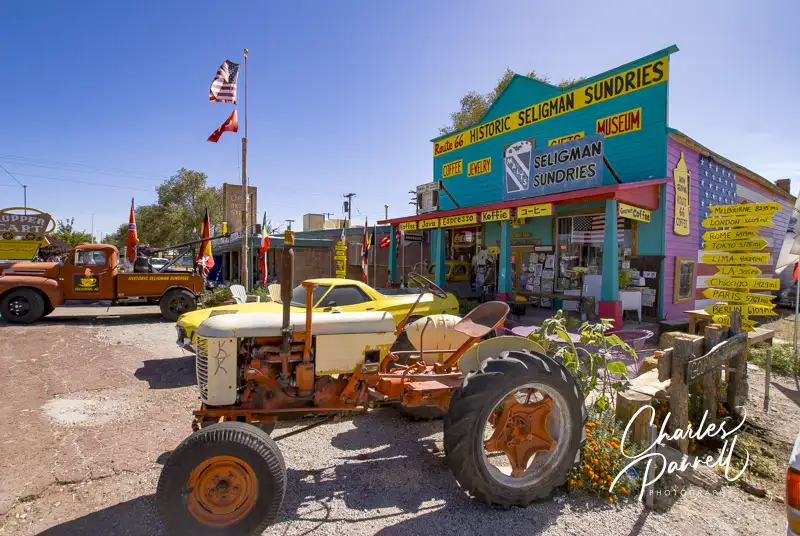
Street parking is the norm in Seligman; but the good news is that sidewalks and curb-cuts have been added for better access. Many of the historic buildings have been converted to gift shops, and although a few have a step or two at the entrance, a good number of them also offer level access. It’s fun to just stroll down the street and look at the different storefronts. Make sure and stop in at Degadillo’s Snow Cap (www.facebook.com/p/Delgadillos-Snow-Cap-100063560350919/) which was built from scrap lumber by Juan Delgadillo in 1953. There’s level access from the street to the counter — where you can place your order — and plenty of room for a wheelchair or scooter on the large patio dining area.
There’s also a nice collection of vintage cars behind the restaurant in a level area, as well as more tables for overflow dining. From Seligman, you can easily hop back on Interstate 40 and continue your drive through Arizona. And if you’re headed to the Grand Canyon (emerginghorizons.com/grand-canyon-national-park/), it’s less than two hours away from the end of this wheelchair-accessible Route 66 road trip detour.
Barrier-Free Travel the Grand Canyon for Wheelers and Slow Walkers
827 Montoya Boulevard
Gallup, NM
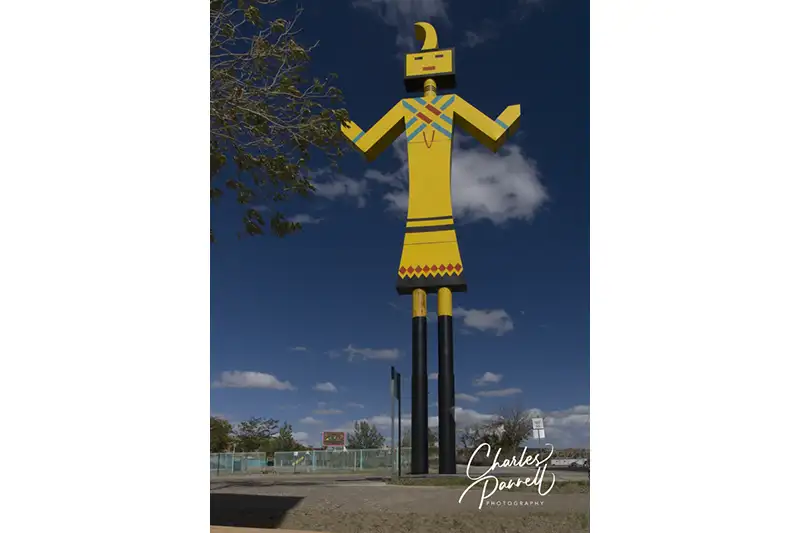
A must-stop along Interstate 40 is the Giant Kachina in Gallup, NM. At one time this classic Route 66 icon welcomed weary travelers to Gallup, but sadly the welcome signs are gone today. Just take exit 22 from Interstate 40, drive north on Ford Drive, then make a left on Montoya Boulevard. The statue is on the right, next door to the Fire Prevention Office, There’s plenty of room to park, and a nice level area to get out and take in this beauty. There are even a few covered picnic tables in the parking lot if you’d like to take a longer break. And while you’re in the area, don’t miss the historic El Rancho Hotel (www.emerginghorizons.com/el-rancho-hotel)
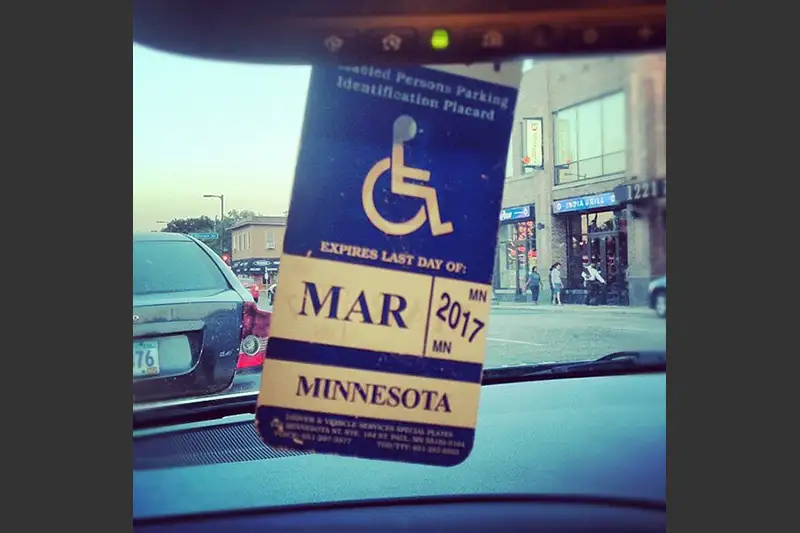
I have a accessible parking placard that was issued to me in CA, and I’d like to take a few road trips out of state. First I’d like to hit the road and travel across the US and visit some national parks along the way. After I have the hang of a road trip, I’d like to fly to Europe, rent a car and explore Germany, Austria and Switzerland. My one big question is, can I use my parking placard in other US states as well as in Europe, or do I need to get other permits? Also can you tell me where I can find out about accessible parking regulations in Europe?
Using an Accessible Parking Placard in the US
For the most part, a parking placard issued in any US state is good in all 50 states. The one big exception to this rule is New York City. Although out-of-state placards are good in New York state, you cannot use them to park on the street in New York City. You can however use out-of-state placards in accessible spaces in off-street lots in New York City.
In order to park on the street in New York City, you need a New York City Parking Permit for People with Disabilities (NYC PPPD). This permit allows people with a severe permanent disability to park at most curbside locations in New York City. It is available to both city residents and non-city residents who have a severe disability that affects their ability to walk. This permit is generally for people who are unable use public transportation, and require the use of a private vehicle.
In order to obtain a NYC PPPD your disability must be certified by your personal physician, as well as a New York City physician designated by the Department of Health and Mental Hygiene Medical Certification Unit. For more information about the NYC PPPD, visit nyc.gov/html/dot/html/motorist/pppdinfo.shtml.
Your parking placard is also valid in Europe, so definitely take it with you. In 1997 the European Conference of Ministers of Transport (ECMT) passed Resolution No. 97/4, on Reciprocal Recognition of Parking Badges for Persons with Mobility Handicaps. As of Jan. 1, 1999, travelers from associate countries, including the USA and Canada, are also included in this resolution.
The resolution requires permit holders to “display a document that shows the international symbol for persons with disabilities, as well as the name of the holder of the document,” in order to receive reciprocal parking privileges in ECMT countries. And most European countries honor this reciprocal agreement.
Bear in mind that accessible parking regulations vary from country to country, so it’s best to review them before you travel.
Have a great trip!
Barrier-Free Travel Yosemite, Sequoia and Kings Canyon National Parks for Wheelers and Slow Walkers
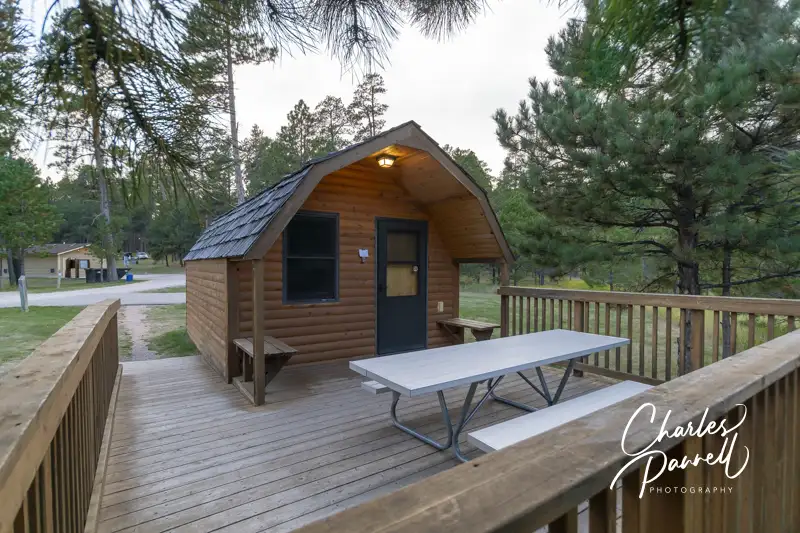
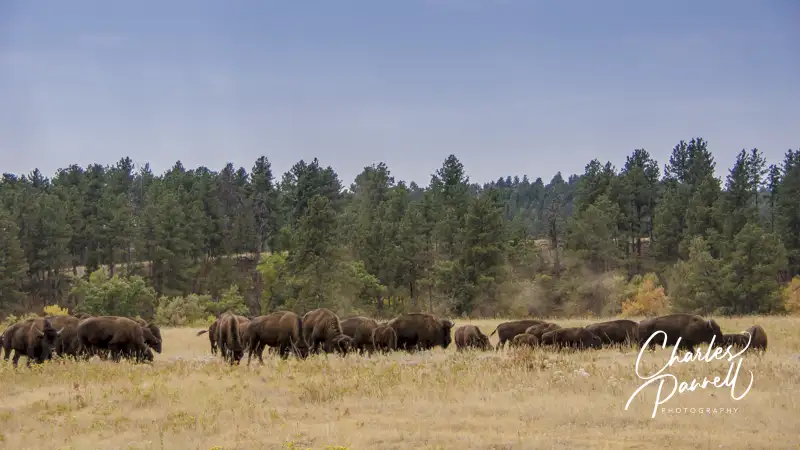
Although there’s no shortage of accessible lodging options in and around Custer State Park (gfp.sd.gov/parks/detail/custer-state-park/), there’s something to be said for foregoing the creature comforts and spending the night in a a more natural setting. That doesn’t mean you have to rough it though. Quite the contrary, as these wheelchair-accessible camping cabins at Custer State Park offer a number of modern amenities. And you just can’t beat the location — just a few miles north of the West Entrance to Wildlife Loop Drive in the Blue Bell Campground.
Comfortable Camping Cabins
To be honest, the Blue Bell Campground is easy to miss, as it’s hard to see the sign for it when you are heading south on Highway 87. The turn is located just past Blue Bell Lodge on the left– look for the stables. After you turn in, you’ll see the sign pointing to the campground. Just follow the sign to the camping cabins.
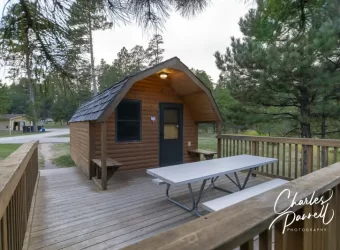
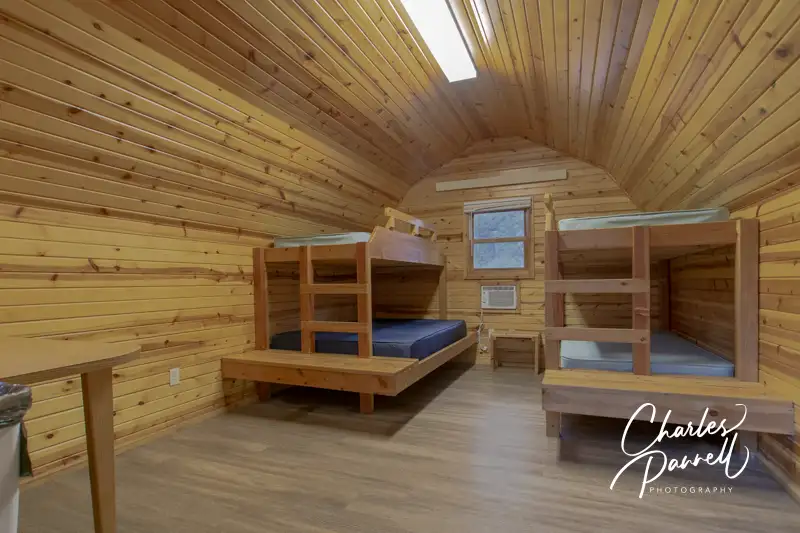
Cabins 14 and 15, which are located across from the showerhouse, are the wheelchair-accessible camping cabins. They each have a paved parking area in front, with level access over to the ramped front deck. The one-room cabins boasts a level threshold, a wide door and wood flooring for easy rolling. They are furnished with two 23-inch high bunk beds with room for a wheelchair between them. One lower bunk is a double, while the rest are twins. Linens are not provided so make sure and pack along some sheets or a sleeping bag. Other furnishings include a table and a bench, a storage shelf and a coat hook.
Inside Cabin 15 at the Blue Bell Campground in Custer State Park
As an added bonus each cabin also has two electric outlets. overhead lighting, heating and air conditioning. Plus, there’s an accessible picnic table on the spacious deck, and a raised grill next to each cabin. And the cabins are located in a verdant pine forest, in a quiet campground.
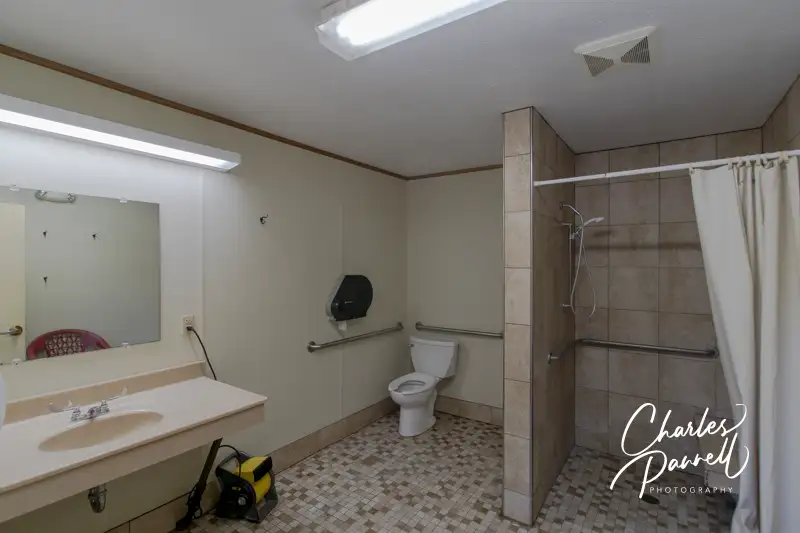
There’s an accessible family shower in the showerhouse. It’s equipped with a roll-in shower with grab bars, a hand-held showerhead and a fixed shower bench. Other access features include a full five-foot turning radius, toilet grab bars on the back and right walls (as seated) and a roll-under sink.
Bathhouse at the Blue Bell Campground in Custer State Park
Located about 240 miles north of Anchorage and 120 miles south of Fairbanks, Denali National Park (www.nps.gov/dena/index.htm) is one of the crown jewels of the 49th State. One of Alaska’s eight national parks, Denali occupies just over six million acres of wild land bisected by a seasonal road. And if all that sounds a bit rugged for your taste, rest assured it is possible to plan a wheelchair-accessible Denali visit. Granted, scaling the 20,310 namesake mountain may not be on your to-do list; however the park also offers a nice selection of wheelchair-accessible trails, attractions and tours suitable for non-mountaineering visitors.
Getting There
A top concern about a wheelchair-accessible Denali National Park visit is actually getting to the park. Although there’s no airport there, Denali is easily accessible by rail and car. The peak visit time is from late May through early September, but that’s primarily because of the train schedules and the unpredictable weather. Still if you have a vehicle, and a bit of a sense of adventure, late spring and fall can also be beautiful times to enjoy Mother Nature’s majesty in Denali.
Alaska Railroad
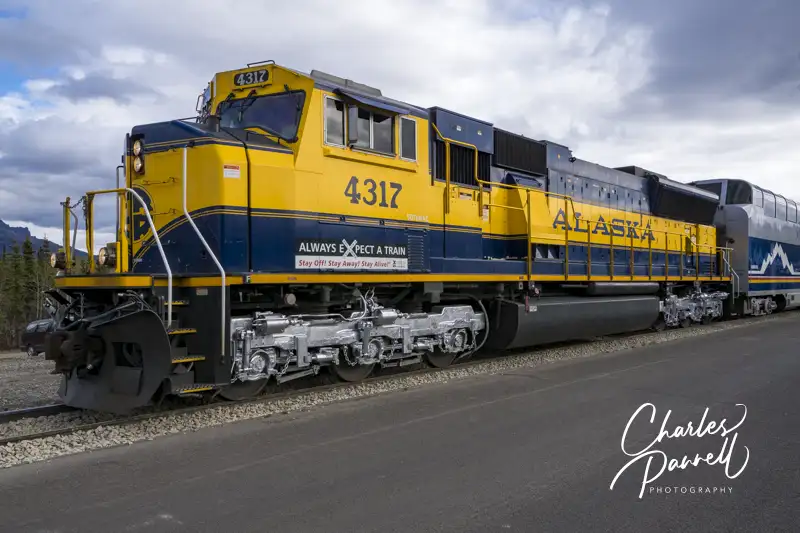
Daily train service is available from Anchorage and Fairbanks on Alaska Railroad’s (www.alaskarailroad.com) Denali Star during the summer months. The northbound train departs from Anchorage, and takes three hours to get to Denali. It stops in Wasilla and Talkeetna along the way. The southbound Fairbanks to Denali nonstop route takes four hours to get to Denali. And the good news is, all the stations include lift boarding, and the GoldStar Dome Cars feature elevator access, accessible seating and accessible lavatories downstairs. Additionally, most of the major cruise lines also offer cruise tour packages that include a Denali stop, on their own accessible railcars.
If you’d prefer to drive, accessible rental vans are available in Anchorage from Alaska Mobility (www.alaskamobility.com). After you pick up your van, just hop on The George Parks Highway (Highway 3). Also designated as a National Scenic Byway, this well traveled route runs between Fairbanks and Anchorage, and offers access to the park. The drive on this well maintained paved road is doable in a day from Anchorage; but plan for extra time as there’s no shortage of viewpoints and roadside stops along the way. And for information on places to stop en route, visit themilepost.com, an excellent Alaska road trip resource.
Wheelchair-Accessible Denali Shuttles
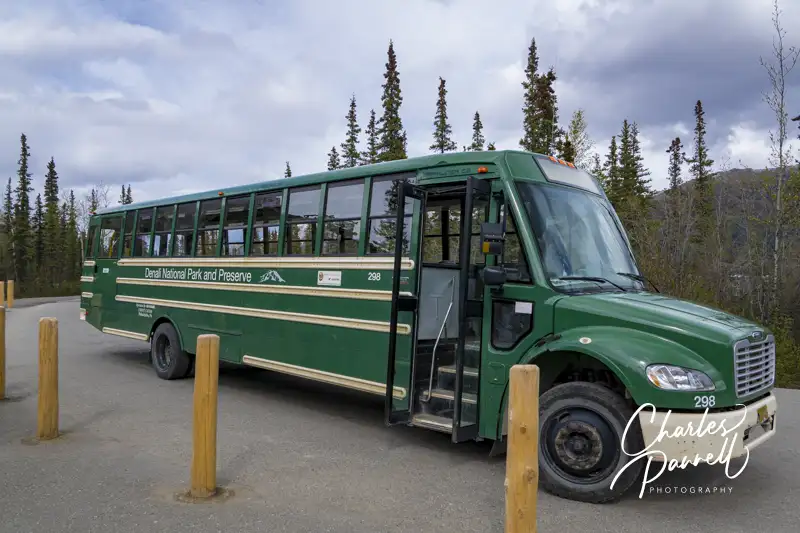
Accessible shuttle bus
Another wheelchair-accessible Denali feature is the free accessible shuttle bus system. After the winter snow is cleared in late spring, the road into Denali National Park is open to private vehicles to the Savage River area. Transportation further into the park is only available from concessionaires, and it’s largely dependent on road conditions.
That said, the free shuttle bus system operates in the Riley River area near the park entrance, and in the Savage River area 15 miles down the road. And all of the shuttle buses and shuttle bus stops wheelchair-accessible. The Savage River Loop and the Riley Creek Loop shuttles run all day and stop at a number of trails and attractions along the way. The Sled Dog Demonstration Shuttle, which runs from the Denali Visitor Center to the sled dog kennels, departs 40 minutes prior to the demonstrations, and returns shortly after they are completed.
The shuttle bus schedule is available at www.nps.gov/dena/planyourvisit/courtesy-shuttle-buses.htm, and it’s also posted at all the shuttle stops. Printed schedules are not available in the park, and cell phone service is limited, so it’s best to save a screen shot of the schedule for planning purposes.
Riley Creek Hikes
McKinley Station Trail
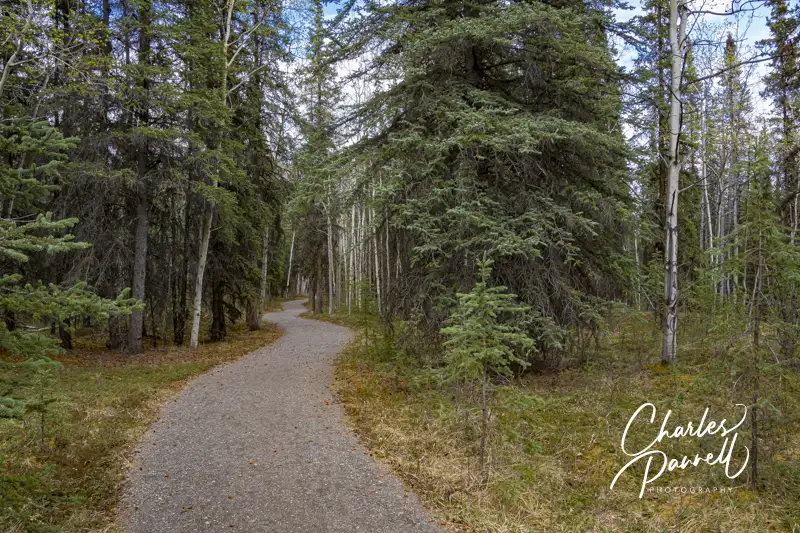
If you’d like to try a hike in the Riley Creek area, then hop on the shuttle, get off at the Riley Creek Campground and explore the McKinley Station Trail. This 1.6-mile hard-packed dirt trail runs from the campground to the visitor center. Although it’s not completely level, it offers an undulating — and accessible — route through the forest. There are also a few accessible boardwalk sections along the way. Be forewarned though — there’s a short cut to the visitor center about half-way along the route, but it goes straight uphill. Stick to the original trail for a gradual accessible path to the visitor center.
If you’d prefer a shorter walk, check out the Spruce Forest Loop, which is located right behind the visitor center. This .15-mile trail meanders through the forest, and offers visitors a good introduction to the vegetation and wildlife found in the park. It’s also very convenient, as you can just take the shuttle to the visitor center and hop on the trail from there.
Sled Dog Demonstration
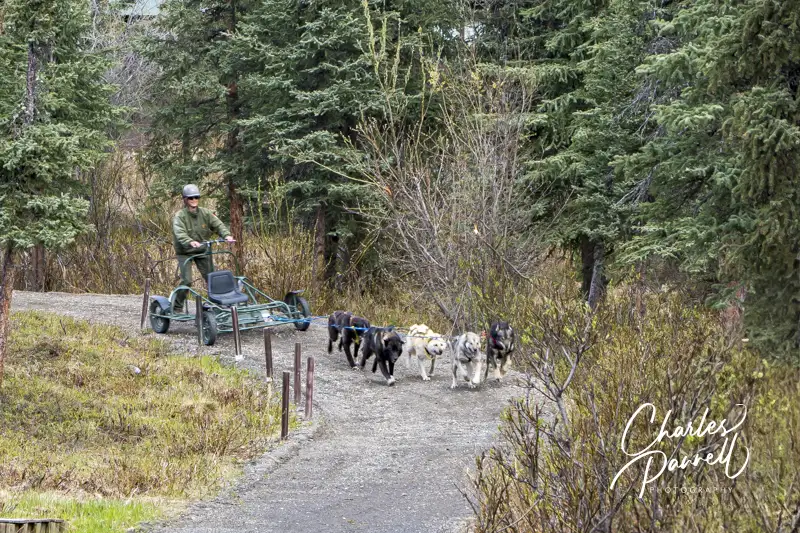
Sled dog demonstration
The Sled Dog Demonstration is another wheelchair-accessible Denali must-do. Although accessible shuttle service is available from the visitor center, you can also drive over to the kennels. There’s plenty of accessible parking available at the kennels; however it’s a longer jaunt from the parking lot than it is from the bus stop, so slow walkers might want to opt for the shuttle. It should also be noted that the Roadside Trail that runs from the visitor center to the kennels has a steep grade and numerous obstructions, and it’s definitely not an accessible option to get to the kennels.
The sled dog demonstration is fun to watch, as the team is hitched to a wheeled sled that speeds around a dirt track. Accessible seating for wheelchair-users and slow walkers is available in the front, so everyone is guaranteed a good view. A ranger is on hand to answer questions about the sled dogs — which are still used in the winter in the park — and folks can walk though the sled shed and around the kennels after the demonstration. Best of all, there’s no charge for this educational demonstration.
Savage River Hikes
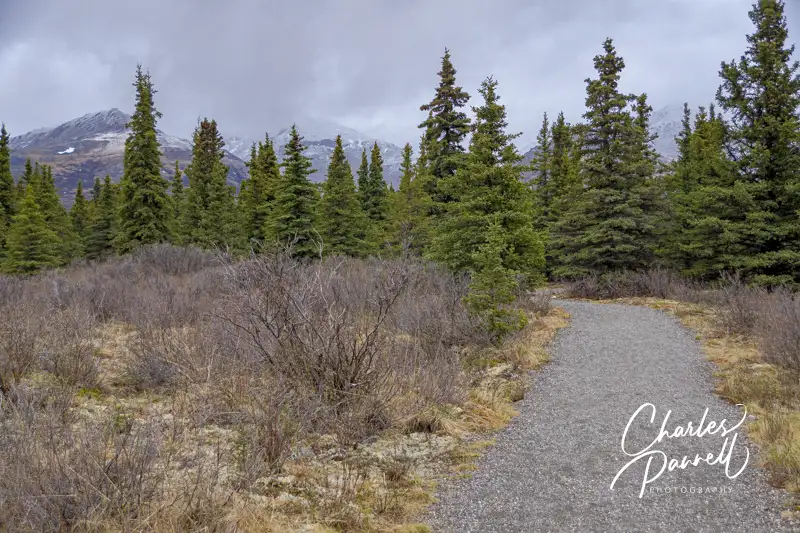
Mountain Vista Trail
Last but not least, save some time to explore the Savage River area of the park, which offers a few accessible trails, and some great scenery. The shuttle stops at the Mountain Vista and Savage trailheads; and if Mount Denali is “out” (not obscured by cloud cover), you’ll get a great view from several vantage points along the way.
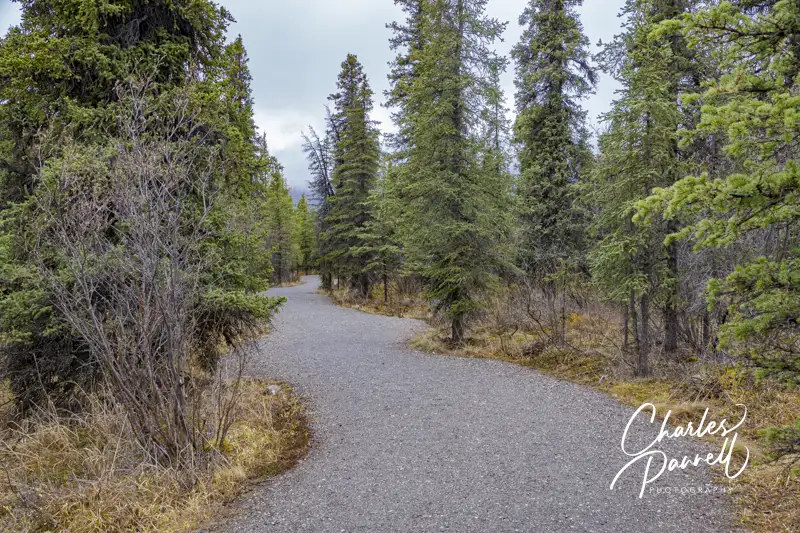
The Mountain Vista Trail is the most accessible trail in the area. This .6-mile hard-packed dirt trail begins near the shuttle stop, behind the accessible vault toilets and picnic shelter. It winds through the tundra, and offers several impressive views of the Alaska Range along the way. And you never know what wildlife you’ll run across, so keep your ryes peeled. Pack along a picnic lunch and enjoy it at one of the accessible tables at the picnic shelter, while you wait for the shuttle to Savage River.
Savage Cabin Trail
The shorter Savage Cabin Loop begins just to the left of the Savage River Campground shuttle bus stop, near the accessible vault toilet. The .3-mile loop is fairly level — with a few undulations — and is covered in compacted gravel. Midway along the route, you’ll find a historic cabin that was constructed by the Alaska Road Commission in 1924. It was originally used as a ranger cabin, but today it’s an interpretive site. Although the cabin isn’t accessible, you can still get a good glance at the inside from the doorway. And the docent programs are usually presented outside, in an accessible space. Even if there aren’t any docents at the cabin it still make a nice stop on this short jaunt.
Wheelchair-Accessible Denali Lodging Resource
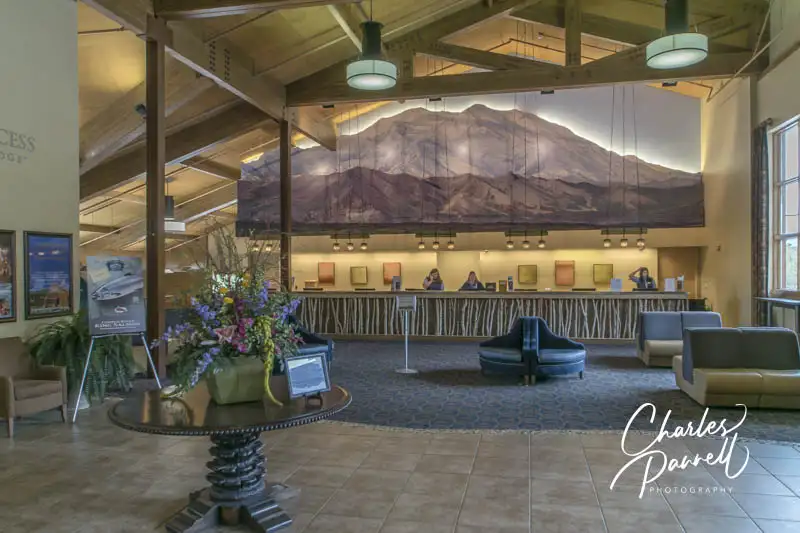
Lobby at the Denali Princess near Denali National Park
Of course, the final piece of the access puzzle in Denali National Park is lodging. There are no hotels or lodges in the park, but the campground has accessible spaces, and there are a number of accessible lodging choices nearby. Visit emerginghorizons.com/wheelchair-accessible-denali-lodging-options for more information.
Barrier-Free Travel Glacier, Yellowstone and Grand Teton National Parks for Wheelers and Slow Walkers
Road trips are a great way to travel. You can take things at your own pace, pack along all the gear you need, and you don’t have to worry about the airline losing your luggage. And there’s no better way to see some Western US national parks than on a road trip. This epic itinerary begins and ends in Las Vegas and visits nine national parks along the way. The whole route is 1880 miles long, but the longest drive is only 4.5 hours. You can do the whole itinerary, or just tackle a portion of this national park road trip. Either way, it’s a great spring, summer or fall travel choice
The Basics
Although this national park road trip begins in Las Vegas, you don’t have to be a local to give it a try. If you live close you can drive and spend a few days in town before hitting the road. Alternatively, you can grab a flight to Las Vegas and rent an accessible van to explore the national parks.
The good news is, accessible taxis are widely available in Las Vegas. At the airport just join the taxi queue, and the dispatcher will get an accessible cab for you. It’s a quick and easy process, and you don’t have to arrange for accessible transportation ahead of time. If you plan to spend a few days in the city prior to your road trip, most hotels will call for an accessible taxi for you.
Next, order an accessible van from one of these companies in advance, and you’re all set to hit the road.
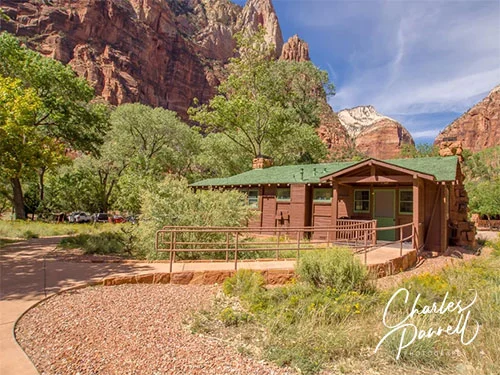
For an easy first-day drive, just take Interstate 15 to Hurricane, and then follow Highway 9 to Zion National Park (emerginghorizons.com/zion-national-park/). The drive takes about 2.5 hours, and there’s some great scenery along the way. Hop on the wheelchair-accessible park shuttle at the Zion Visitor Center and explore the park, and then spend the night at a wheelchair-accessible cabin at Zion Lodge.
Zion National Park to Bryce Canyon National Park
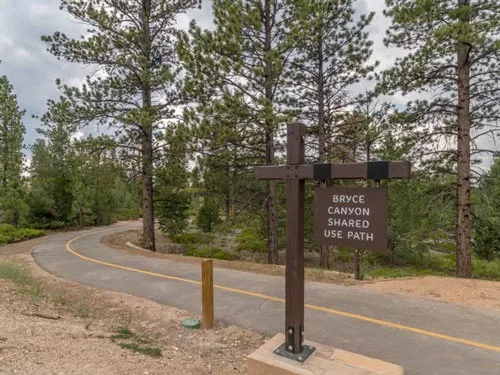
Shared use trail in Bryce Canyon National Park
From Zion, take Highway 9 to Mt. Carmel Junction and then hop on Highway 89 north to Highway 12 east. Save some time to stop along Highway 12 at the Red Canyon Visitor Center and take a stroll along the accessible Red Canyon Bicycle Trail. Continue on Highway 63, and follow the signs to Bryce Canyon National Park (emerginghorizons.com/bryce-canyon-national-park). If you drive it straight through, it will take about two hours. And there’s no shortage of accessible things to do in the park, including a roll or stroll along along the Bryce Multiuse Trail.
Bryce Canyon National Park to Capitol Reef National Park
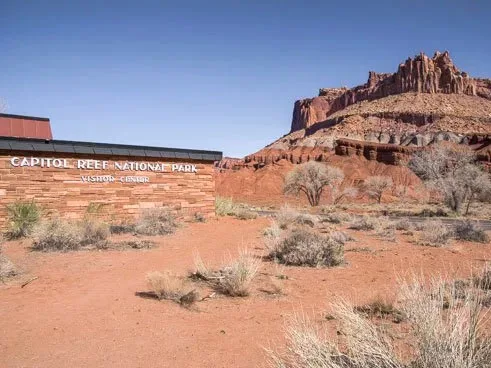
Visitor Center in Capitol Reef National Park
To continue along on your national park road trip, backtrack on Highway 63 and make a right on Johns Valley Road, which becomes Highway 22. Next, make a right on Highway 62, and another right on Browns Lane, then head east on Highway 24 through Torrey to Capitol Reef National Park (emerginghorizons.com/capitol-reef-national-park). It’s a scenic two-hour drive. Pick up a map at the visitor center, then take a driving tour of the park. And don’t miss the petroglyphs along Highway 24.
Capitol Reef National Park to Canyonlands National Park
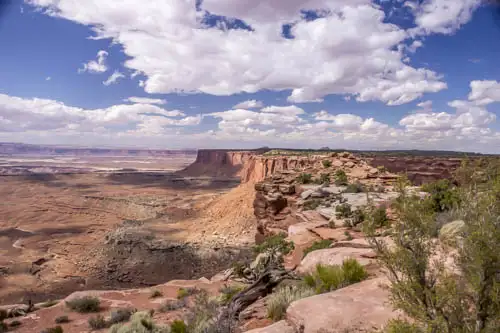
Vista in Canyonlands National Park
The next leg of your national park road trip is about a 4.5-hour drive. From Capitol Reef continue east on Highway 24, then take Interstate 70 east, and Highway 191 south to Highway 63. This will lead you to the Islands in the Sky section of Canyonlands National Park (emerginghorizons.com/canyonlands-national-park). This large mesa “island” rises 1,000 feet above the adjacent land and is surrounded by the Colorado River and Green River. And if you don’t fancy camping out in the park, Field Station Moab (emerginghorizons.com/field-station-moab-a-breath-of-fresh-air) has some comfortable accessible rooms, and it’s just a 30-minute drive away.
Canyonlands National Park to Arches National Park
Devil’s Garden Trail in Arches National Park
For the next leg of your national park road trip, take Highway 313 back out to Highway 191 and continue south to Arches National Park (emerginghorizons.com/arches-national-park). It’s a short 35 minute drive. Stop at the visitor center, then take a driving tour of this beautiful park. Don’t miss the trail at Balanced Rock, Wall Street, the trail to the petroglyphs at Wolfe Ranch, and the Windows Section of the park. Although this park offers some spectacular scenery, advance planning is a must, as timed entry reservations are now required (emerginghorizons.com/national-park-entrance-reservations-required-in-2024). And remember, reservations are not available onsite — you need to purchase them online, ahead of your visit.
Arches National Park to Black Canyon of the Gunnison National Park
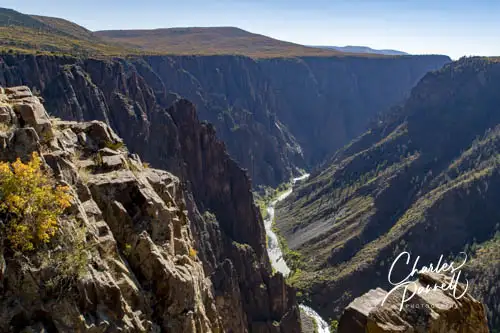
Black Canyon of the Gunnison
The next segment of your national park road trip takes about 2.5 hours. From Arches National Park backtrack north on Highway 191 to Interstate 70 east, then take Highway 50 east to Highway 92 in Delta, to the Black Canyon of the Gunnison National Park (www.nps.gov/blca/index.htm) entrance. There’s no shortage of scenic views on the seven-mile scenic drive along the south rim of the canyon. Even better — most of the viewpoints are wheelchair-accessible. And when it’s time to bed down for the night, there’s a comfy accessible yurt in Ridgeway State Park, which is about a half-hour away.
Black Canyon of the Gunnison National Park to Mesa Verde National Park
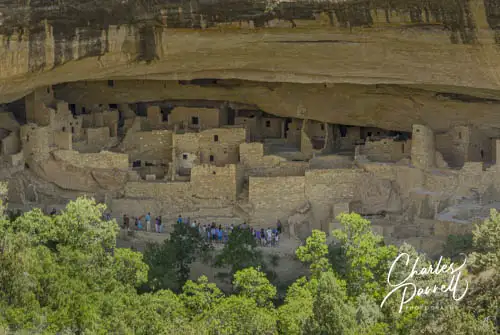
Mesa Verde National Park
To continue your national park road trip, take Highway 50 east to Interstate 550 to Ridgeway. From there take Highway 60 to Highway 145 south to Cortez. To complete this four-hour journey follow Highway 160 to Mesa Verde National Park (www.nps.gov/meve/index.htm). Highlights at Mesa Verde include the scenic Mesa Top Loop Drive, Chapin Mesa Archeological Museum, and the ruins at the Far View Sites. And if you’d like to spend the night in the park, Far View Lodge has some nice accessible rooms with roll-in showers.
Mesa Verde National Park to Petrified Forest National Park
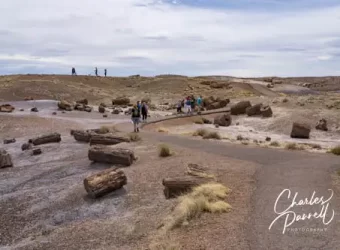
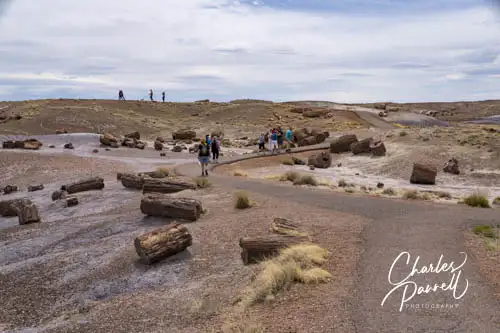
The Crystal Forest in Petrified Forest National Park
From Mesa Verde, backtrack on Highway 160 to Cortez, then head south on Highway 491 to Interstate 40. Go west on the interstate and take exit 311 to reach Petrified Forest National Park (www.nps.gov/pefo/index.htm). The Painted Desert is located near the north entrance, and it features expansive views and a former Harvey House (The Painted Desert Inn). The Crystal Forest is worth a stop near the central part of the park, and don’t miss the Rainbow Forest near the South Entrance. And when you’re done, just exit the south entrance and head north to rejoin Interstate 40.
Petrified Forest National Park to Grand Canyon South Rim
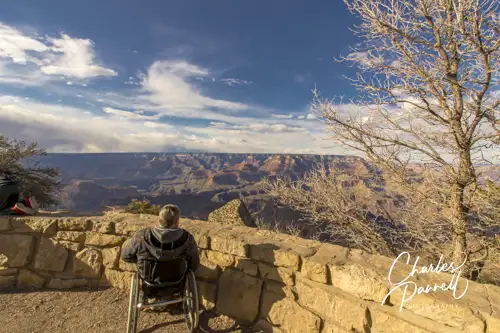
Grand Canyon National Park
After you rejoin Interstate 40, head west and take exit 165 in Williams, then follow Highway 64 to Grand Canyon National Park (emerginghorizons.com/grand-canyon-national-park). It’s a scenic three-hour drive. There’s no shortage of accessible things to do on the South Rim, but for a scenic overview of the whole park, take a wheelchair-accessible flightseeing tour on Grand Canyon Scenic Airlines (www.scenic.com). The 45-minute flight departs from Tusayan, and features ramp access and plenty of room to transfer to a seat. And with the large windows on the plane, you won’t miss a thing. For another great view, check-in to Thunderbird Lodge — the only property in the park that offers wheelchair-accessible rooms with canyon views.
Grand Canyon South Rim to Grand Canyon North Rim
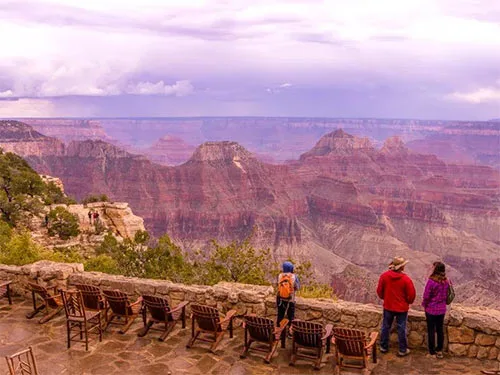
View from the North Rim Grand Canyon Lodge
The last stop on your national park road trip is just a four-hour drive away. From the Grand Canyon Visitor Center, follow the South Entrance Road to Desert View Drive and head east. In Cameron go north on Highway 89, and connect to Highway 89A in Jacob Lake, then just follow Highway 67 south to the Grand Canyon North Rim (www.nps.gov/grca/planyourvisit/north-rim.htm). The great thing about the North Rim is that it doesn’t attract as many visitors as the South Rim. And after the day visitors are gone, it’s just you and the other lodge guests. Grand Canyon Lodge North Rim has a variety of accessible cabins, many which are equipped with roll-in showers. So plan to spend a few days and enjoy the beauty of the North Rim.
Grand Canyon North Rim to Las Vegas
Fabulous Downtown Las Vegas
To complete your national park road trip, take Highway 67 back out to Highway 89A and head north. Next, travel west across the Kaibab Reservation on Highway 389, which turns into Highway 59 when you cross into Utah. Finally, take Highway 9 to Interstate 15 west and circle back to Las Vegas. It’s just a 4.5 hour drive, with lots of great scenery along the way.
Barrier-Free Travel
Utah National Parks for Wheelchair-users and Slow Walkers
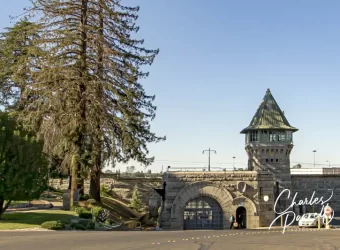
Driving along Prison Road the sight of the massive granite walls of Folsom State Prison are unmistakable, as you approach the nation’s first maximum-security prison. Interestingly enough, the granite for the walls was quarried by the prisoners, and the imposing structure was later built by inmates back in the early 1900s. That’s just one of the fun facts you’ll learn on a visit to the Folsom Prison Museum (www.bighouseprisonmuseum.org).
To be honest, visiting the museum is a tad bit intimidating, as it’s located just inside the prison grounds. That said, I timidly approached the guard after following the “museum” signs that led to the prison entrance, and hesitantly stammered, “I’m looking for the museum”. I heaved a giant sigh of relief when the guard cracked a smile and enthusiastically directed me to the museum entrance, located just beyond the checkpoint.
Accessible parking is located across the street from the checkpoint, and there’s a level pathway over to the ramped museum. Inside, quarters are a bit tight in the historic structure, however there’s still room enough to maneuver a wheelchair around the exhibits. The tiny restroom is not accessible — so plan ahead — and there’s about a half-inch step down to the Johnny Cash room, but again it’s all quite manageable.
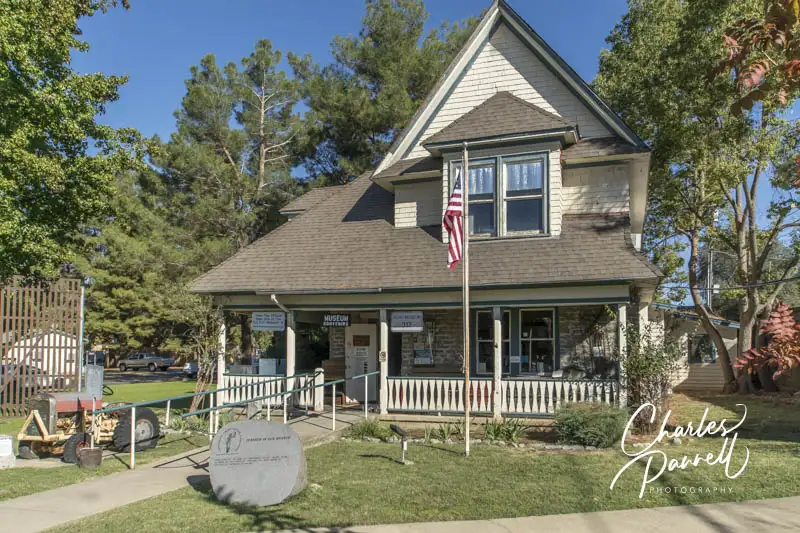
The Folsom Prison Museum
Folsom Prison Museum
Operated by retired correctional officers, the museum features an impressive collection of weapons, shackles and confiscated items. Highlights include a hand-crank Gatling gun, a substantial number of inmate-crafted firearms, and even a homemade bomb. Add in some old gas masks, an operating table and Rick James’ guitar, and you have a very eclectic collection. There’s also a sizable display of things made from everyday items by the inmates, including a purse made from potato chip bags, a Ferris wheel crafted from a quarter-million toothpicks, a hangman’s noose made from toilet tissue and a number of creative soap bar carvings. A large collection of California license plates also adorn one wall in this room, just to remind folks where they are all manufactured today.
There’s also a room devoted to Johnny Cash, who visited the prison and recorded a live album there in 1968. There’s a load of photographs of Cash and his wife at the prison, along with his own “gag” mug shot and even some stationary from the Sacramento hotel where he stayed. It’s definitely a must-see for any Cash fan.
Granted this small museum doesn’t warrant a dedicated trip to Folsom; however if you’re heading to South Lake Tahoe on Highway 50, it’s definitely worth a stop. Just take the Folsom Boulevard exit, turn left and then make a right on Natoma Street. From there turn left on Prison Road which dead-ends in the visitor parking lot. And when you’re back on your way to Lake Tahoe, take note of the granite mileage markers along the road, as those were also crafted by Folsom Prison inmates.
Barrier-Free Travel Yosemite, Sequoia and Kings Canyon National Parks for Wheelers and Slow Walkers

 Population 177