If a trip to Barcelona is in your future, then check out this excellent wheelchair-accessible Barcelona resource (www.barcelona-access.com). A project of Barcelona Turisme, this informative website includes detailed information about accessible sights, transportation, accommodations and resources in Barcelona.
The website features a search engine to find wheelchair-accessible sights throughout the city, including museums, World Heritage sties, monuments and even beaches. You can search the database by disability type, attraction or location. There’s also a helpful section about accessible transportation, with tips on how to get to and from the airport as well as details on accessible bus and train transportation. And if you’d like to spend a few nights, there’s also a link to the TUR4all database of accessible properties in Barcelona. Add in some helpful resources on adaptive sports, accessible taxis and travel agents who can plan an accessible itinerary and you have an excellent wheelchair-accessible Barcelona resource.
Barrier-Free Travel Yosemite, Sequoia and Kings Canyon National Parks for Wheelers and Slow Walkers
Chance Baker is a self-admitted tinkerer. He picked this up while doing garage projects with his dad when he was young, and honed his skills when he joined the Marine Corps and became an avionics technician. After his discharge, he built bicycles with electric motors and power recumbent scooters, before he designed the Beach Buggy — a power beach wheelchair.
Today he’s the owner of Beach ‘N Buggys, which offers sales and rental of his designs on the Alabama Gulf Coast. And as an added bonus, with the help of a Marine buddy Baker has donated his Beach Buggys to disabled veterans.
Beach Buggys
Baker has three different styles of Beach Buggys available for rent in Fort Morgan, Gulf Shores, Orange Beach and Peridido Key. They are available for daily rental, but discounts are available for longer periods.
The Lobster is a mid-size model that is adequate for most people, while the Heavy-Duty Lobster is the best choice for heavier folks. And the Sand Flea is a good pick for lighter kids and young adults. All of the Beach Buggy models can be operated independently, and they all will fit through doorways and pool gates. They are also narrow enough to allow access to the boardwalks, so you can fully enjoy the beach. For more information, or to reserve a Beach Buggy, visit beachnbuggys.com/.
Barrier-Free Travel 101 Accessible Vacations Travel Ideas for Wheelers and Slow Walkers
If a visit to the City of Brotherly Love is in your future, then surf on by visitphilly.com/accessibility, and check out this Philadelphia access guide. This joint project between Visit Philadelphia and Art-Reach – a local disability advocacy organization — offers wheelchair-users and slow walkers hard-to-find access information about the capital city. It contains details about accessible public transportation, taxis, and favorite attractions; and features a helpful section filled with local resources. There’s also a short section which lists some favorite accessible hotels, along with contact information for more specific access details. Information about local wheelchair and medical equipment rentals and accessible parking is also included. Best of all, this Philadelphia access guide has an excellent FAQ section, which offers helpful tips, such as details on the Access Philly Card, which offers discounts to cultural attractions to people with a disability. An excellent resource filled with information to help disabled visitors get around and enjoy all the Philadelphia has to offer.
Barrier-Free Travel Glacier, Yellowstone and Grand Teton National Parks for Wheelchair-Users and Slow Walkers
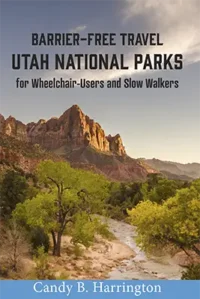
If you’re planning to visit Utah’s Mighty Five National Parks, and wondering if they are wheelchair-accessible, then pick up the newest edition of Candy B. Harrington’s Barrier-Free Travel; Utah National Parks for Wheelchair-Users and Slow Walkers. This essential resource offers essential insider tips to plan a wheelchair-accessible Utah national parks getaway.
Wheelchair-Accessible Utah National Parks
This new edition includes:
Updated information on new access additions.
Fly-drive trip planning information, including accessible van rentals.
Access details and photographs of 33 wheelchair-accessible properties, including all in-park lodging options.
Information about ranger-led tours, loaner wheelchairs and the free America the Beautiful Access Pass.
The scoop on how to nab free accessible bus tours in Bryce Canyon National Park and Zion National Park.
Detailed access information on accessible trails, viewpoints, picnic areas and attractions — in and near the parks.
Information about barrier-free camping options in all the parks.
Insider tips on where to go for the best windshield views, accessible picnic spots and sunset photos.
This inclusive title is the most recent addition to Harrington’s national park series; and although it’s written for wheelchair-users and slow walkers, stroller moms will also appreciate the access information in this guide. It will help everyone plan a truly accessible Utah national parks vacation.
Says Harrington, “I’m very excited to report that Utah National Parks not only added more accessible features since my last edition, but they also maintained the ones they already had. I’m particularly happy to see the access improvements in the Pa’rus Trail as well as the continued upkeep of the accessible Bryce Canyon Shared Use Path.”
For more information wheelchair access in Utah’s National Parks, visit emerginghorizons.com/barrier-free-travel-utah-national-parks-for-wheelchair-users-and-slow-walkers/ and order your copy of Harrington’s newest access resource today.
Barrier-Free Travel Utah National Parks for Wheelchair-users and Slow Walkers
I use a power wheelchair and I’m thinking about taking a cruise with my husband. I’ve never traveled before but a cruise really appeals to me. Are cruise ships wheelchair-accessible? And if so, will they work for my power wheelchair? I’d also appreciate any tips you have for planning a wheelchair-accessible cruise.
Access on the High Seas
The good news is that many cruise ships are wheelchair-accessible. Part of the reason is because they have responded to a growing market, and part of the reason is due to litigation. More specifically, there are two court cases that helped form the access requirements on cruise ships that call on US ports.
First and foremost is Spector v Norwegian Cruise Line. On June 6, 2005 the US Supreme Court decided in favor of the plaintiffs in this case, and ruled that the Americans with Disabilities Act applies to all foreign-flagged cruise ships that call on US ports. This ruling, however, fell short of requiring specific access guidelines for vessels.
Then in 2015 the Justice Department reached a settlement with Carnival Cruise Lines that provided the access standards for ships — even foreign flagged ships — that call on US ports. They must have fully accessible cabins, which are dispersed throughout the various classes of accommodations. These cabins must have 32-inch wide doorways, include accessible pathway access and turning radius, and have an accessible bathroom. And the reservation system must allow passengers with a disability to reserve an accessible cabin, and guarantee that accessible cabin reservation.
Cruise Planning Tips & Tricks
It’s great to have these standards, and to be honest, most cruise ships go above and beyond as far as access is concerned. That said, it does take a little more advance planning to book an accessible cruise.
First and foremost — start early. Even though cruise ships have accessible cabins, they are limited and they go quickly. Keep tabs on your cruise and try and book your cabin as soon as it’s released. It’s the best way to get the accessible cabin you need.
Also, remember to ask a lot of questions about the accessible cabin. They differ from cruise line to cruise line, and even on ships on the same cruise line. Always ask about access details that are important to you, such as bed height, toilet height and grab bar placement. And if you still have questions, ask them to e-mail you some photos. When you inquire about access, you might also want to include the pertinent measurements for your power wheelchair because just saying “wheelchair” can lead to a wide variety of interpretations. The good news is, you will find that many cruise ships can accommodate your power wheelchair.
It’s also a good idea to search for accessible shore excursions first, before you decide on a cruise. Some ports have more accessible options than others. It’s also prudent to book these accessible excursions directly with the provider as early as possible. Many cruise lines use the same providers and if you wait for them to book them, they may already be booked. Plan ahead to avoid disappointment.
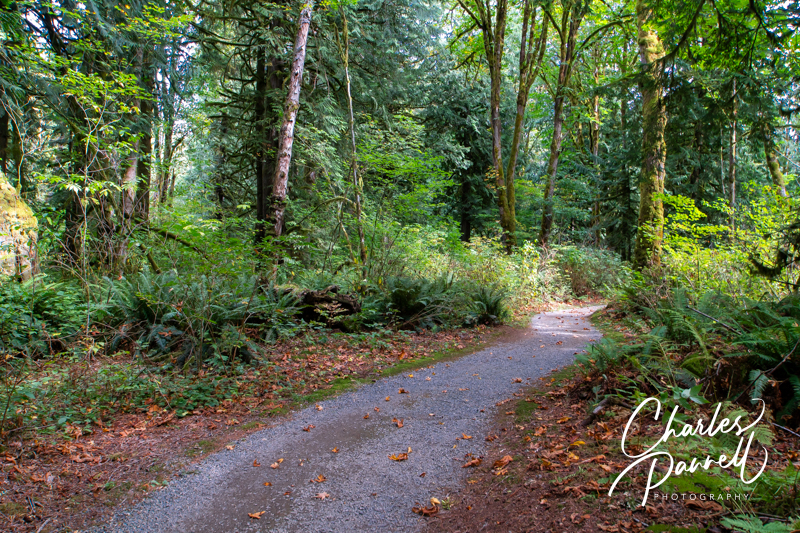
Although it’s relatively easy to determine if a building is wheelchair-accessible (stairs vs. a level or ramped entry), it’s a bit more difficult to evaluate the accessibility of a trail. At first glance it might appear that if a wheelchair-user can manage a trail, then it must accessible, right? Well, not exactly, because not all wheelchair-users have the same ability. And then there are slow walkers. What if they can’t manage the trail.
Old growth trees are magnificent. Standing near the base of one of these stately giants, you can gaze up and see its branches reach skyward; and if you’re lucky, you might also spot a forest creature frolicking among them. But have you ever wondered what the view is like from some 200 feet up one of these ancient trees? Well, thanks to Leo Fisher, founder of Tree Climbing at Silver Falls (www.treeclimbingatsilverfalls.com/adaptivetreeclimbing), everybody — including wheelchair-users, slow walkers and folks with multiple mobility issues — can experience the splendor of life in the forest canopy in Northwestern Oregon.
An Innovative Concept
Leo comes from a long line of Swiss mountaineers, so it’s no surprise that he started rock climbing at an early age and then became an arborist. After a short stint in law school, he decided he preferred the forest to the courtroom, so he set out to share his love of these stately giants with others. And that’s why he founded Tree Climbing at Silver Falls.
Make no mistake about it, Leo didn’t just hang up his shingle and proceed to offer recreational climbs in Silver Falls State Park. It took over two years of environmental reviews and extensive work with the park management before they could even begin. In the end, because Leo and his crew respect and protect the fragile old growth ecology, they were given the green light. And inclusion was on Leo’s mind from the beginning, as he wants everyone to be able to enjoy this sport.
For most climbs, wheelchair-users are transferred from their wheelchair to a full body harness, with adequate back and neck support. The ascender, which is also attached, is controlled by climbers on a phone app, and they can go up and down at their own speed. And if they lack hand control the ascender can be remotely controlled by the leader. If for whatever reason you cannot get our of your wheelchair, the team can attach a harness to your wheelchair to enable you to climb; however this rarely happens, as most folks can be accommodated in the full body harness.
Most slow walkers who don’t need extra back or neck support can usually use a standard harness and a power ascender. In the end, wheelchair-users and slow walkers can be accommodated in a variety of ways, with everything customized to each individual participant.
The Wheelchair-Accessible Tree Climbing Experience
Tree Climbing at Silver Falls State Park, Oregon
Leo’s wheelchair-accessible tree climbing experience begins on his website, with a detailed questionnaire about each climber’s abilities. It’s important to be honest about your abilities and limitations (especially the weight questions), so that the the team can craft the most optimal experience for you.
The tree used for the accessible climbs is located near the Howard Creek trailhead in Silver Falls State Park. There’s a large level parking lot nearby with an accessible porta-potty; and folks can drop off wheelchair-users and slow walkers near the trailhead close to the tree. It’s a short 50-foot walk or roll on a wide level dirt trail to the accessible climbing site.
All climbs begin with a short orientation and then a safety briefing. Then folks start with a short 10-15 foot climb, with an assistant at their side. The climbers set their own pace, and go up and down at a speed comfortable for them. Each climb is different, and the assistant is there to help out when needed, mostly for guiding climbers and getting branches out of their way. Climbers spend about two hours in the tree, and the whole experience lasts between three and four hours. And of course, there’s plenty of time for photos.
Participants are encouraged to bring along some water and snacks, and of course a sense of adventure. Additionally, if you want to get a group of friends together, there’s room for eight climbers at the accessible climbing site. So get ready to enjoy a day in a old growth giant and learn about the forest ecosystem. It’s truly a once in a lifetime experience — and it’s accessible.
Located about 20 miles southeast of Salem, Silver Falls State Park is the crown jewel of the Oregon State Park system. There’s no shortage of majestic waterfall views, and if you’d like to get a closer look, there are also several wheelchair-accessible trails to explore. Add in accessible picnic areas, restrooms, food service and visitor facilities, and you have the complete package. And if you’d like to spend a few nights, there’s a nice selection of wheelchair-accessible cabins nears the rivers edge. So pack the car and get ready to experience a cornucopia of natural beauty at Silver Falls State Park.
South Falls District
South Silver Falls
The South Falls District is the most developed area of the park. It features accessible parking in the main lot, near the accessible restrooms and the information board. A wide paved trail leads to the left past the South Falls Café to the stone circle. From there bear left and continue along past the Nature Store. Take the next left and follow the trail out to the viewpoint. This is the closest view of the South Falls, and it’s about .25 from the parking lot. There is a small wall along the rim, and depending on the season some foliage may obstruct your view, so continue along the paved trail for a better vantage point.
After you return to the main trail, take the next left for a better falls view. This viewpoint is about .3 from the parking lot, and a bit downhill, but there’s a bench and a clear view at the end.
The trail past this point is not accessible, but if you head back towards the parking lot you can see the other side of the area. This time, take the right trail from the parking area and wind around the back of the South Falls Cafe and past the second set of restrooms to the Stone Kitchen Shelter on the right. Constructed by the CCC in 1936, this community kitchen was renovated in 2005. There’s an accessible pathway that leads past a picnic area to the right and up to the kitchen, and bypasses the steps in front.
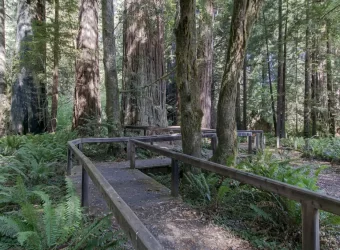
And just past the Stone Kitchen Shelter, there’s a nice accessible boardwalk that winds through the forest. The access ends after the boardwalk, but it’s still a nice little jog through the forest. And a pleasant place to have a picnic lunch.
North Falls District
The North Rim Trail in the North Canyon District
The North Canyon District also has some accessible features, as this area recently underwent a major renovation. It’s located just past the north entrance to the park, and it should not be confused with the North Falls parking area, which is located further south along the road.
There’s accessible parking in the large lot with level access to the accessible restrooms and picnic area. There are a number of tables on the grass under the trees, plus one accessible table near the parking lot with an accessible drop-off are nearby. There’s no shortage of picnic choices here.
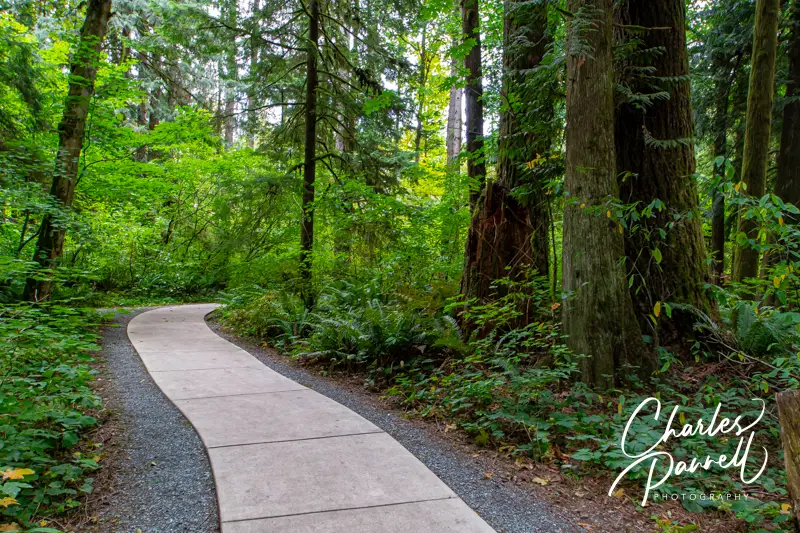
The North Rim Trail begins just to the left of the restrooms. This wide hard-packed dirt trail is covered with crushed rock in the beginning, and then transitions to a dirt trail. It winds through the forest and passes the North Canyon Nature Play Area, where kids can play on nature-themed play equipment. There’s also another picnic area along the route, which is in a level dirt area and has room at the end of the tables for wheelchairs. It’s a more secluded option than the main picnic area.
The trail continues along through the forest, crosses a bridge and has a minimal elevation gain. At about the .6-mile point, there’s an accessible viewpoint with an interpretive plaque and a nice view of the North Falls. After that the trail loses its access, as there are steps, ruts, and elevation gains. Still it makes for a nice 1.2-mile out-and-back hike through the forest, and it offers a great view at the end.
A Taste of Mother Nature
South Falls Trail
The South Falls Campground also boasts a doable trail for many folks. You can access the trail in two places — near the campground entrance and campsite 2, or near the amphitheater and campsite 41. The entrance near campsite 2 has a bridge with about a three-inch step, but there is also an alternate entrance from the campground road.
The whole trail is about 1.25 miles long, but only the end sections are doable, as the middle has narrow pathways, rocks and other obstacles, steep sections and some overgrown foliage. From each entrance the trail is doable for about .4 mile. These sections boast a wide trail in good repair, that meanders along a stream and through the forest with a minimal elevation gain. It’s a good trail for birders, as there’s no shortage of wildlife along the way. Best bet is to take the trail as far as you can manage, and then double back. It’s a beautiful taste of nature.
And if you’d like to spend the night in the campground, accessible campsites 58, 60, 86 and 91 feature a paved driveway, a raised grill, an accessible picnic table and are near the accessible restrooms. As an added bonus, campsite 91 also has a covered picnic table. If you want to bring your rig, campsites 2, 3 and 4 are accessible sites with power. To be honest, this is a pretty level campground and most of the campsites are doable for wheelchair-users — the big difference is the distance from the bathrooms.
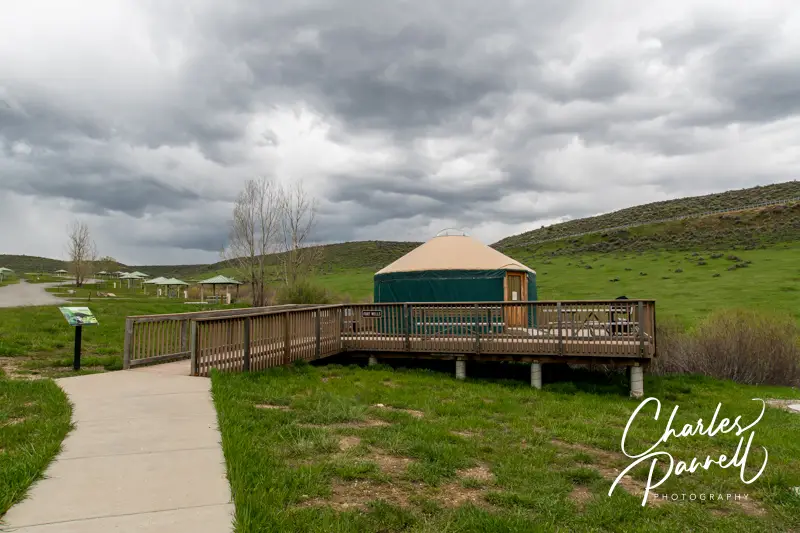
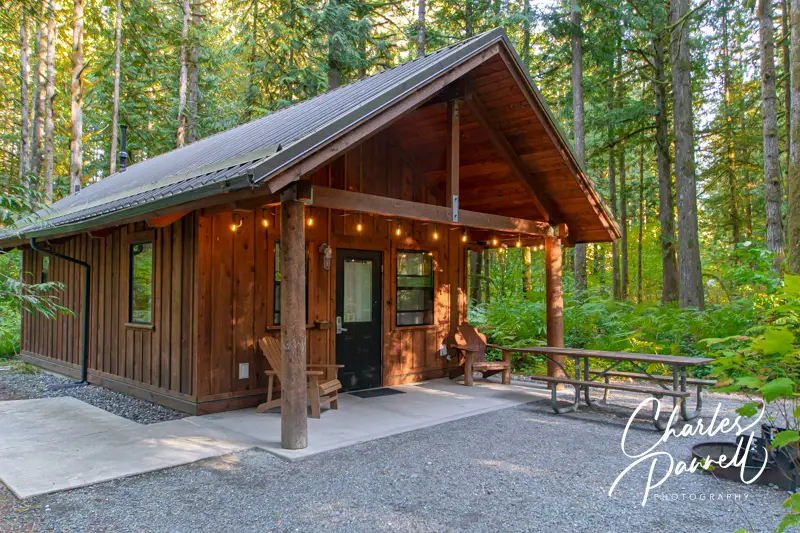
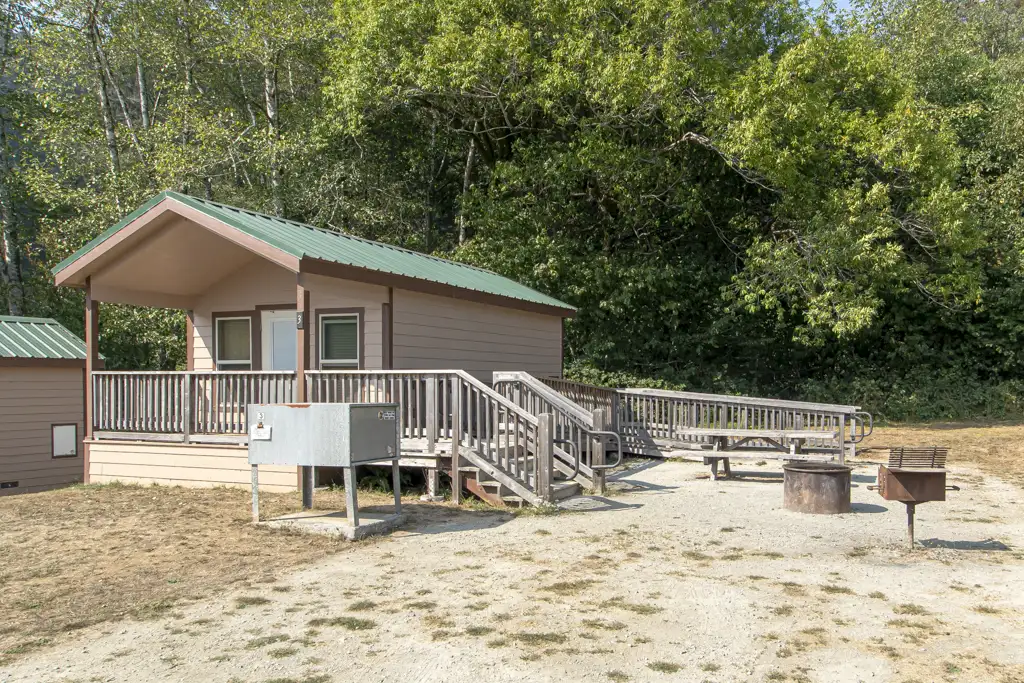
If you want to overnight in the park, but don’t really want to pitch a tent, then consider one of these wheelchair-accessible camping cabins. Located in the cabin village, Cabin 1 is the most private. It features a wide paved driveway and ramped access up to the front porch.
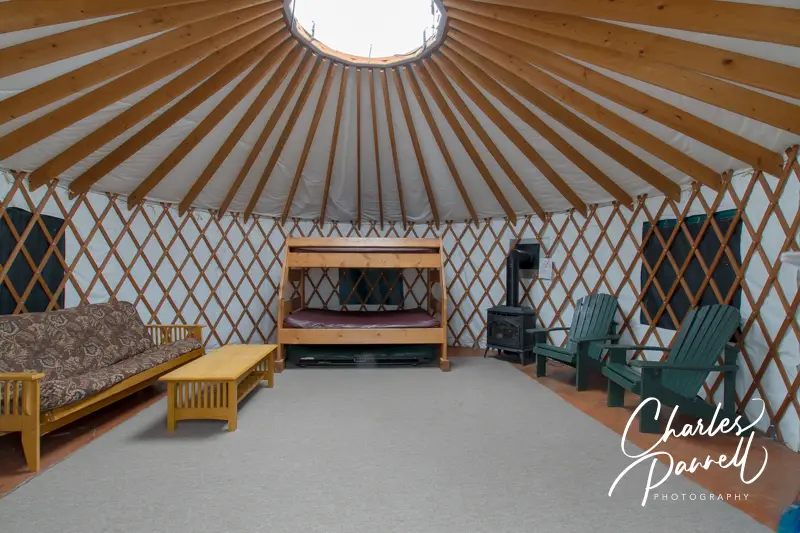
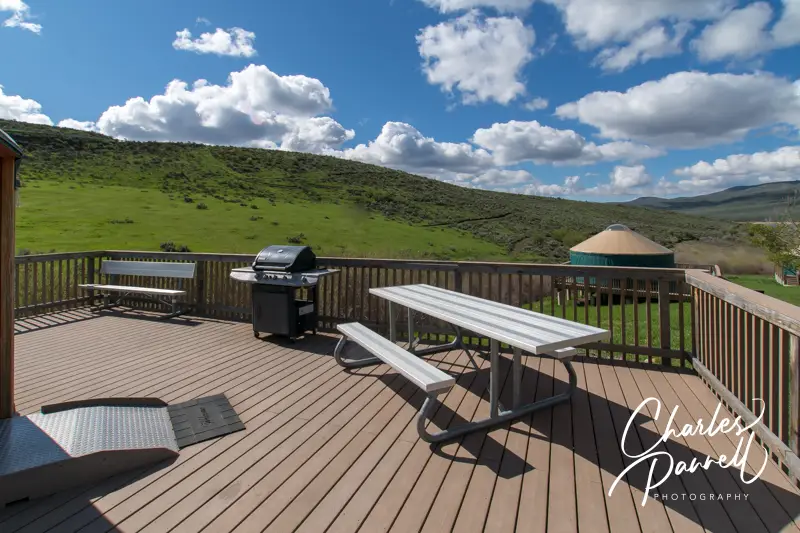
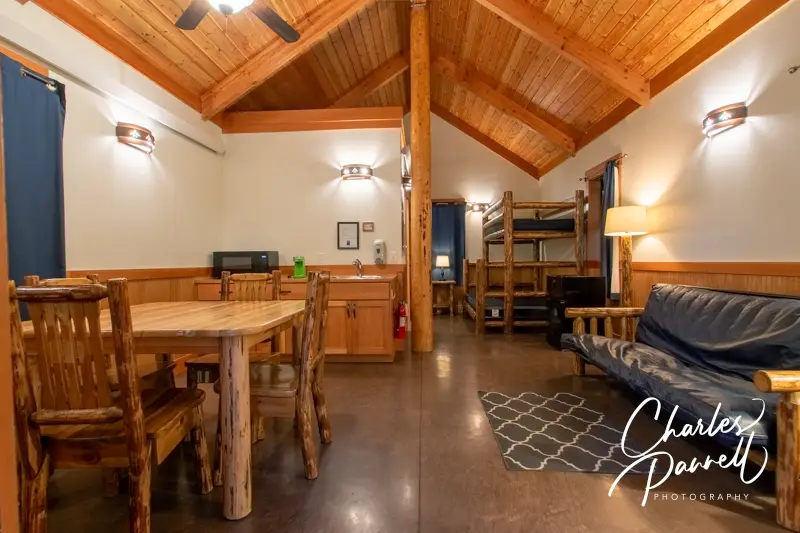
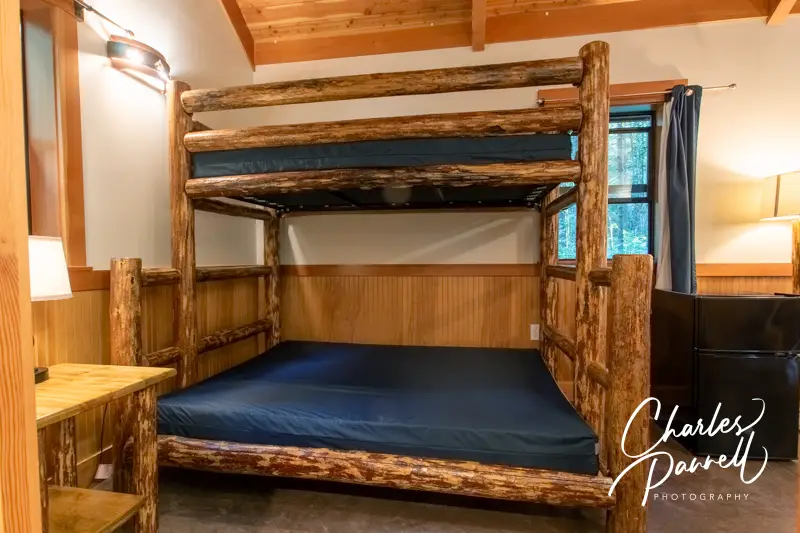
This two-room cabin features electricity, lights, a heater, and plenty of room to maneuver a wheelchair. The front room is furnished with a table with four chairs and a 19-inch high futon; while the other room includes a bunk bed (20-inch high bottom bunk) and a 24-inch high double bed. And outside there’s an accessible picnic table, a raised grill and plenty of room to roll around the level site. This cabin can sleep six, and does not allow pets.
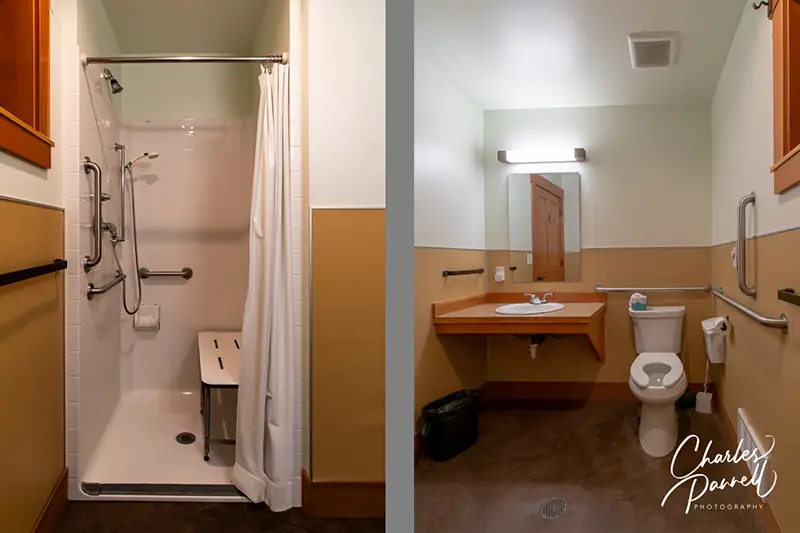
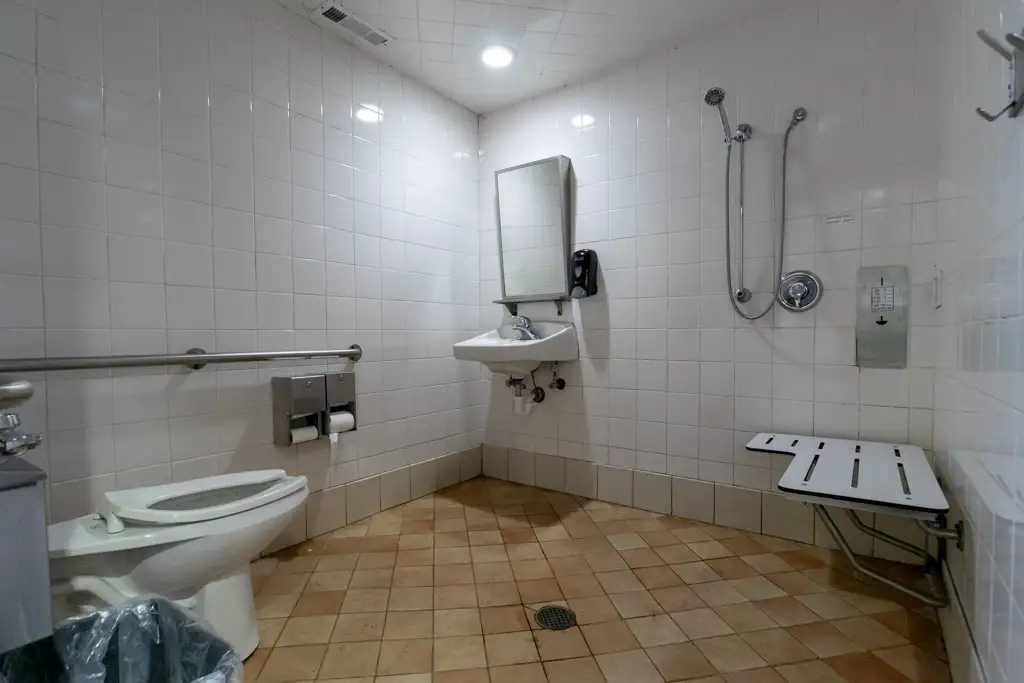
The shower house is about 120 feet away, and it includes a private room with a roll-in shower with grab bars, a fold down shower seat and a hand-held showerhead. It also has a small changing area and a roll-under sink with a lowered mirror. The bathroom is next door and includes a toilet with grab bars on the back and left walls (as seated), a urinal and a roll-under sink.
Cabin 1
Inside Cabin 1
Bedroom in Cabin 1
Toilet and sink in Showerhouse
Shower Room in Showerhouse
Cabins 3,4 and 7 are also accessible choices in the cabin village. They have the same access features as cabin 1, and they all sleep six and don’t allow pets. Cabin 3 has a large accessible deck, cabin 4 has a side ramp and a large porch, and cabin 7 is the closest to the bathroom.
Additionally, there’s an accessible cabin in the campground (19) which sleeps four people and accepts pets. It’s not as private as those in the cabin village but it’s still a nice accessible place to overnight in Silver Falls State Park.
Cabin 2
Cabin 4
Cabin 7
Barrier-Free Travel California National Park Road Trips for Wheelchair-Users and Slow Walkers
View from Room 103 at the View Hotel – Typical of all Rooms
Monument Valley Tribal Park (navajonationparks.org/tribal-parks/monument-valley/) is a must-stop on any Southwestern road trip. Located on the Arizona-Utah border, this chunk of Navajo land boasts an impressive collection of sandstone formations towering as high as 1,000 feet above the rich red desert. And there’s no better place to stay in Monument Valley than at The View Hotel (monumentvalleyview.com). Not only does this property have a spacious wheelchair-accessible guest room, but it also offers panoramic desert views from private balconies.
Stay a Spell
Located off scenic Highway 163 at the end of Monument Valley Road, The View Hotel is pretty hard to miss, as there aren’t many structures in the area. And that’s also part of its beauty – isolation.
There’s plenty of accessible parking in front of the property, with level access to the lobby. Room 103, which features wide doorways, a lowered peephole and lever handles, is located just around the corner. It’s furnished with a 28-inch high king-sized bed, with wheelchair access on both sides. An easy chair, desk, refrigerator, microwave and a chest of drawers round out the furnishings.
Room 103 at the View Hotel
The bathroom is equipped with a roll-in shower with a built-in shower bench, grab bars and a hand-held showerhead. There is a slight one-inch lip on the shower threshold, but most people won’t have any problems with that. And with the full five-foot turning radius in the bathroom, there’s plenty of room to navigate even the largest wheelchair. The toilet blocks the transfer space to the shower bench, but if you can manage the slight shower lip on the opposite end, it shouldn’t be a problem.
Bathroom in Room 103
And then there’s the view from the balcony. It’s the perfect spot to enjoy a sunset.
There is good access throughout the public areas of the property as well, with elevator access to The View Restaurant and The Trading Post gift shop on the second floor. There’s also a loaner wheelchair available at the front desk.
Explore Monument Valley
Monument Valley
Known as “the place where the earth meets the sky”, there’s no shortage of scenic spots to enjoy in Monument Valley. The best place to begin your visit is at the Welcome Center and Navajo Market, which are located near the park entrance on Monument Valley Road.
Accessible parking is available in front of the Welcome Center, with level access up to the front door. Inside, there are interpretive exhibits about the history of the area, and about the many films and commercials that were made there. There’s barrier-free access throughout the building, and to the terrace out back, which offers a panoramic view of the Mitten Buttes and Merrick Butte. As you survey the landscape, you’ll begin to understand why so many westerns were filmed there. Next door there’s also accessible parking near the Navajo Market, which features a variety of local vendors, and boasts everything from artwork and jewelry, to baskets and even wood carvings. There is level access to many of the shops, and although some are a bit small, most vendors will happily bring items out to you.
Don’t miss the scenic 17-mile drive through Monument Valley. The unpaved and bumpy road begins near the hotel; and although four-wheel-drive isn’t required, it’s not advised for low clearance vehicles. Make sure and plan an adequate amount of time to complete the drive though, as you you can only go 5 mph. It’s also best to avoid the drive in the rain.
Finally, it’s important to remember that Monument Valley is on Navajo land, so national park passes are not valid there. There is an entrance fee to drive over the land, even if you are a hotel guest.
Barrier-Free Travel Utah National Parks for Wheelchair-users and Slow Walkers
Located in Northeastern Oklahoma, the Keystone Ancient Forest (www.sandspringsok.gov/175/Keystone-Ancient-Forest) is home to 500-year old cedars, 330-year old majestic oaks and over 80 species of butterflies. As an added bonus the preserve is filled with eagles, migratory birds, deer and other wildlife. The 1,380-acre parcel has received recognition from The Nature Conservancy and it’s the first Oklahoma property to become a member of the Old Growth Forest Network. And although the forest has a few natural barriers for wheelchair-users and slow walkers, track chairs are now available for loan.
Track chairs have tank tires instead of standard wheels and they can navigate over obstacles that most wheelchairs can’t manage. The track chairs can be taken on the Childers Trail, the Fire Road and the Frank Trail. If you cannot transfer to the track chair on your own, you must bring somebody to help you. And while you’re in the preserve, all pets must be on a six-foot leash.
The track chairs are available by advance reservation at sandspringsok.org/FormCenter/Case-Community-Center-10/Track-Chair-Request-Form-98. After the form is completed and the waiver is signed, someone from the Keystone Ancient Forest will get back to you to confirm your reservation and to answer any questions. For more information, call (918) 246-7795.
Barrier-Free Travel National Park Lodges for Wheelers and Slow Walkers