As a travel writer since 1977, Candy Harrington has been writing about accessible travel exclusively since 1996. She’s the founding editor of Emerging Horizons, and the author of the popular Barrier-Free Travel national park series. With thousands of bylines to her credit, Candy hits the road often, in search of new accessible travel finds. Candy and her travel photographer husband Charles Pannell reside in NE Washington, where they tend to their chicken flock and enjoy a rural lifestyle.
There’s a certain seductive allure to Sedona. Some folks come for the mystical experience, while others enjoy gallery hopping. And then there’s the scenery. You just can’t beat the red rock formations that literally surround this Northern Arizona enclave. And the good news is, a good chunk Sedona’s red rock beauty is accessible to wheelchair-users and slow walkers.
Red Rock Scenic Byway
Red Rock Scenic Byway
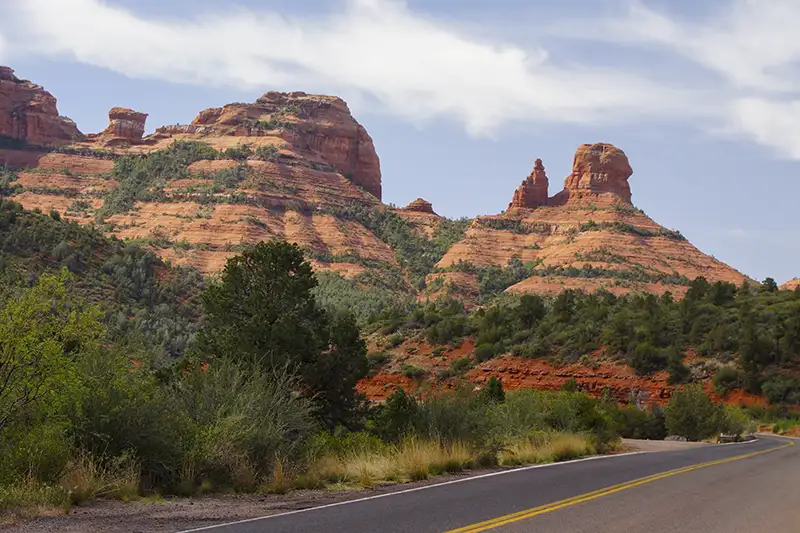
One of the best ways to enjoy Sedona’s red rock beauty is to take a drive on the Red Rock Scenic Byway. This popular route is located off of Interstate 17. Just take exit 298, and once you cross the Dry Beaver Creek bridge, the show begins.
The 7.5 mile scenic drive, which winds through the majestic landscape, is often referred to as a “museum without walls”. As you pass Oak Creek Village, the scenery becomes more dramatic. Bell Rock, one of Sedona’s four vortices, is located just past Oak Creek Village on the right. You can’t miss it. Bell Rock is one of the more accessible red rock formations, as the upper part of Bell Rock Trail is wide, level and made of hard-packed dirt. It’s doable for most wheelchair-users, however you can also get a great view of the iconic formation from the parking lot overlook.
Be sure to stop at nearby Courthouse Butte to admire the expansive scenery. And don’t miss the Chapel of the Holy Cross (chapeloftheholycross.com), which is built into the red rock buttes. There are a few accessible parking spots near the sanctuary, and golf cart transportation is available from the remote parking area. The chapel features ramp access, but some manual wheelchair-users may require assistance because of the pitch. Still it’s worth a stop even if it closed, just for a view of the impressive front facade.
Just up the road, the Red Rock Scenic Byway ends at Highway 89A. All in all it only takes 20 minutes to drive the route, but allow for extra time for lots of photo stops. And even though a Red Rock Pass is required for hikers, it’s not required for quick photo stops of 15 minutes or less.
Red Rock State Park
Mesquite Interpretive Loop
Red Rock State Park (www.azstateparks.com/red-rock), which is located on Highway 89A South is also worth a visit. There are a two accessible trails in the park, but they don’t offer much shade, so it’s best to go early in the day.
Accessible parking is located near the visitor center, with ramp access down to the building. Inside there’s plenty of room to maneuver a wheelchair around the gift shop, ranger information desk and interpretive exhibits. Accessible restrooms are located near the front door, and there’s also level access to the theater and classroom next door. And don’t miss the hummingbird garden on the back patio.
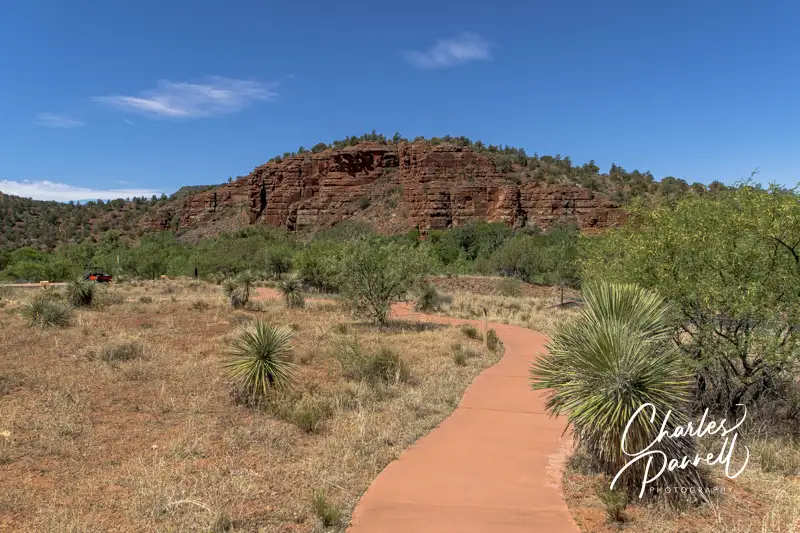
The accessible Mesquite Interpretive Loop begins near the parking lot. This short trail features a paved level pathway around garden filled with native plants. There’s a shaded picnic area with accessible tables near the trail; and there’s also a shade structure located in the middle of this quarter-mile trail.
The longer Bunkhouse Trail begins behind the visitor center. Although you can access it from the parking lot, that pathway has a steep grade. Alternatively, there’s level access to the trail from the hummingbird garden. The paved trail is fairly level, although there’s a bit of a grade in the beginning. Power wheelchair-users won’t have a problem, but some manual wheelchair-users may require assistance. There are also some cracks along the paved trail, but other than that it’s fairly smooth rolling.
At about the .2-mile mark there’s an accessible hard-packed dirt trail down to the Kingfisher Bridge, which provides a pleasant — and shaded — view of Oak Creek. From there a hard-packed dirt path follows the creek for another .2 mile before the trail loses its access. All in all it’s a pleasant mile-long out-and-back hike.
Slide Rock State Park
Pendley Homestead House on the Pendley Homestead Trail
Finally, if you’d like to hit a local favorite, head on over to Slide Rock State Park (azstateparks.com/slide-rock). It’s located 20 minutes north of Red Rock State Park on Highway 89A. This park provides access to Oak Creek, and it takes its name from the rocks that many folks use as slides to get into the water.
Unfortunately the path down to the creek is not accessible, but there is a short trail that offers a scenic overlook of the canyon. That said, the admission is pretty steep ($20 to $30 per car, depending on the season) for just that trail; however if you have an Arizona State Park Pass, this park makes a nice lunch stop.
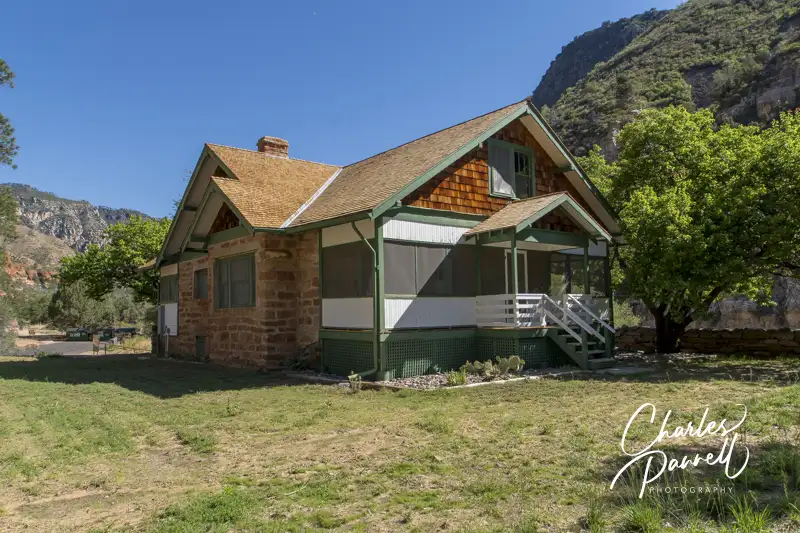
There’s accessible parking near the shaded picnic area — which has several accessible tables — and barrier-free access over to the Pendley Homestead Trail. This paved level trail leads past a small store, and by a display of vintage farming equipment, over to the old homestead which features a tractor display in the adjacent barn.
The trail then connects with the Cliff Top Trail which has a 75-foot paved path out to an accessible overlook that offers an expansive view of Oak Creek Canyon. All in all it’s about a quarter-mile round trip, and it makes for a nice stroll before of after lunch. And if you’d prefer to skip the hike, this piece of Sedona’s red rock beauty is easily visible from the the picnic area.
Barrier-Free Travel the Grand Canyon for Wheelchair-users and Slow Walkers
Fred Harvey is a bit of a legend in the hospitality industry. Back in 1876, long before railroad dining cars were part of the rolling stock, he realized the need for restaurants along the major rail routes. To remedy the situation, he negotiated a contract with the Santa Fe Railroad, and opened the first of many Harvey Houses in Topeka, Kansas along the rail line. These restaurants were known for their generous portions and quality furnishings, and of course the Harvey Girls, who fed hungry passengers in the time it took to service the trains and change the crews. As time went on, Harvey expanded his empire to include hotels and resorts, and at the time of his death he operated 47 restaurants and 15 hotels.
And although many of these historic properties have faded into oblivion, you can still find remnants of the Harvey empire throughout the Southwestern US. Some buildings are in ruins, while others have been renovated; and there are even a select few where you can spend the night. And although access wasn’t a consideration during Fred Harvey’s lifetime, thanks to some access upgrades, today wheelchair-users and slow walkers can enjoy some of the remaining properties. So check out these historic Harvey Houses on your next road trip through the Southwestern US.
Casa Del Desierto Barstow, CA
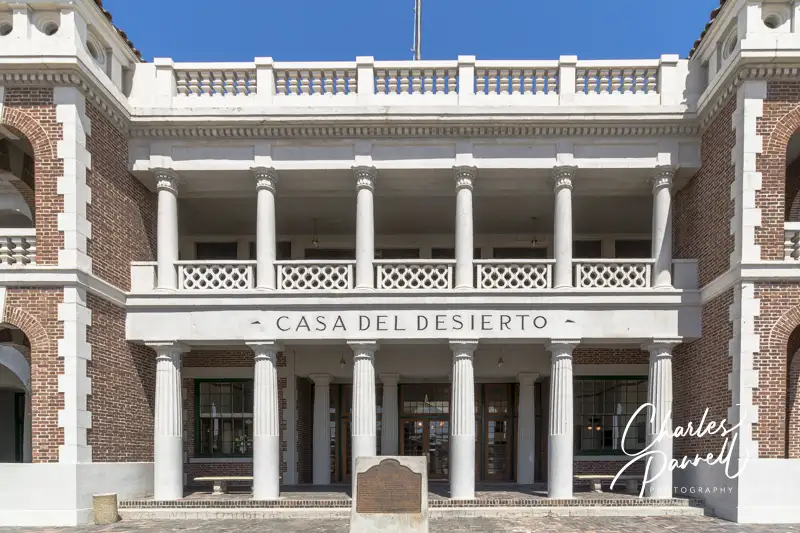
Casa Del Desierto in Barstow, California
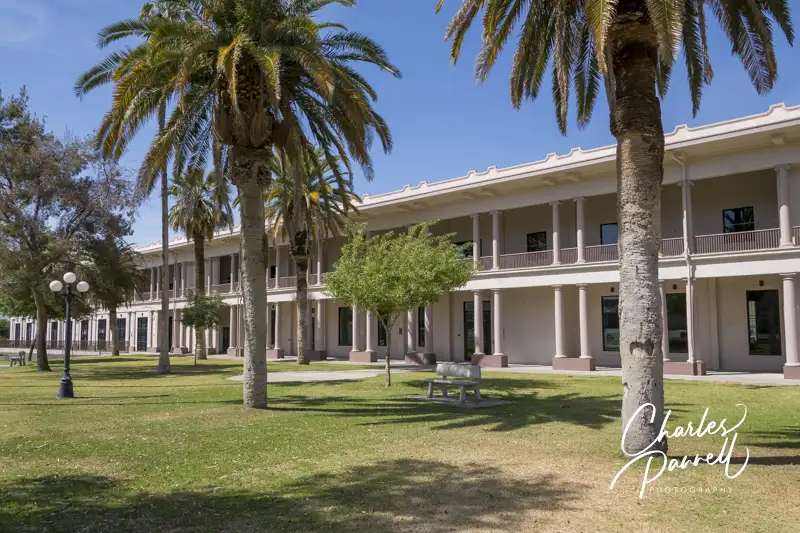
Located in Southern California, Casa Del Desierto was considered the crown jewel of the Harvey House chain. It opened its doors in 1911, and not only did it house a restaurant, but it also provided comfortable overnight accommodations for passengers on the the Atchison Topeka and Santa Fe Railway. The building was renovated in 1999, and today it houses the local visitor center as well as the excellent Western America Railroad Museum (emerginghorizons.com/western-america-railroad-museum/) – both of which have good wheelchair access. And if you’d just like to stop by and glance at the exterior of the historic structure, you can do that too.
Kelso Depot Kelso, CA
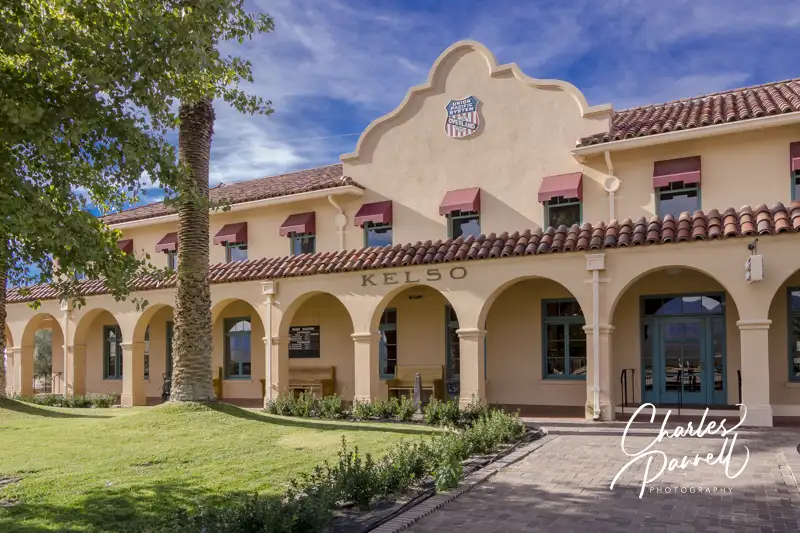
Kelso Depot in Mojave National Preserve, California
Located in the Mojave National Preserve, Kelso Depot (nps.gov/moja/planyourvisit/visitorcenters.htm wasn’t a Harvey House, but it’s definitely worth a mention. It was constructed in 1924 by the Los Angeles & Salt Lake Railroad as competition for the popular Harvey Houses operated by the Santa Fe Railroad. Today it houses the visitor center for the Mojave National Preserve. It also has several restored rooms that are open to the public. These include the baggage room, ticket office and two dormitory rooms. Accessible parking is available in the parking lot, with level access to the depot buildings. And even if the building isn’t open, you can still get a gander at the lunch counter, vintage desks and old equipment through the large front windows. Additionally, the restrooms are always open, so it’s a good spot to take a rest break.
El Garces Needles, CA
El Garces Intermodal Transportation Facility in Needles, California
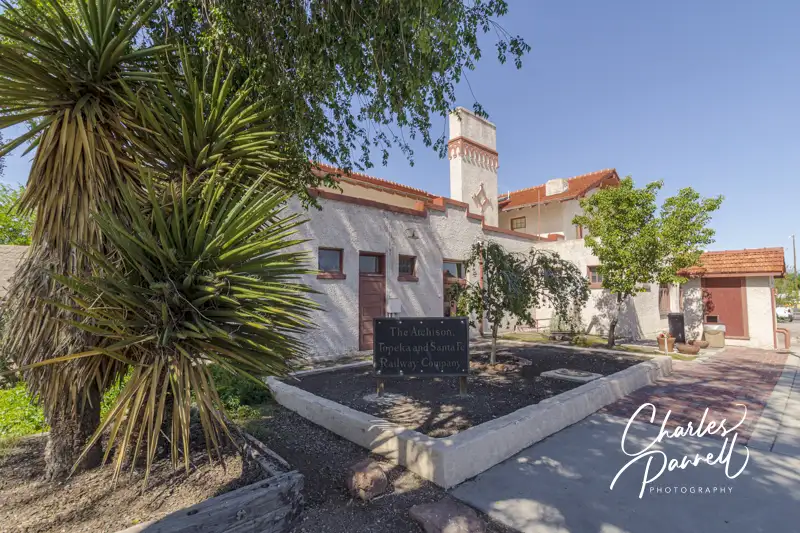
Named for Father Francisco Garces — the first European to cross the Mojave Desert — El Garces (nps.gov/places/el-garces.htm) was once said to resemble a Greek temple. This Southern California train depot housed a hotel and restaurant. After the depot was closed, it fell into disrepair and was subsequently shuttered. Fortunately the City of Needles came to the rescue in 1999, and purchased the building; which was added to the National Register of Historic Places in 2002. In 2014 the city embarked on an ambitious $5 million renovation project to restore this Needles landmark to its former glory. Today the finished project transports visitors back to the golden age of rail travel, and makes a nice stop on an Route 66 road trip.
There’s accessible parking on the side with level access over to the front of the depot, which is surrounded by tall palms and flanked by stately white columns. Although the building is only sporadically open, visitors can still get a look at the restored interior through the large glass windows. There’s also barrier-free access around to the back — track side — of the building, and level access to the back door. A majestic fountain dominates the courtyard near the back door, and it’s a pleasant spot to rest and admire the building. And like the front, large windows line the back of the building, so it’s easy to get a peek inside.
Santa Fe Depot Kingman, AZ
Santa Fe Depot in Kingman, Arizona
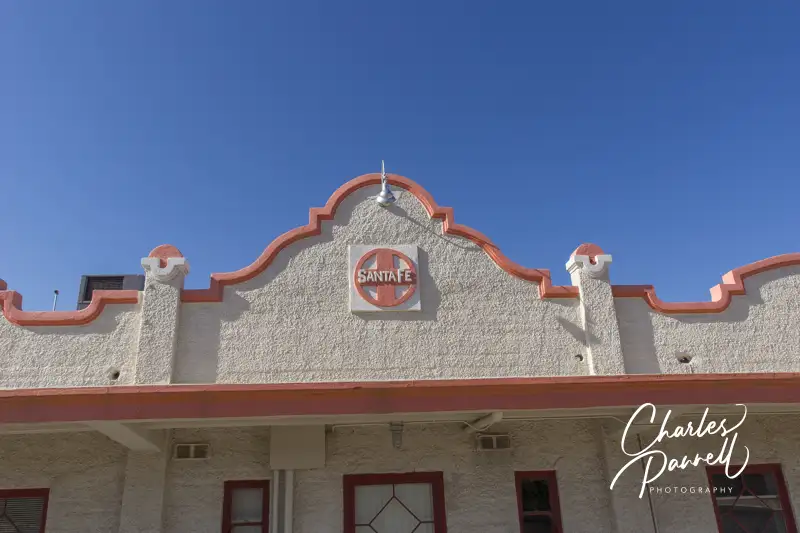
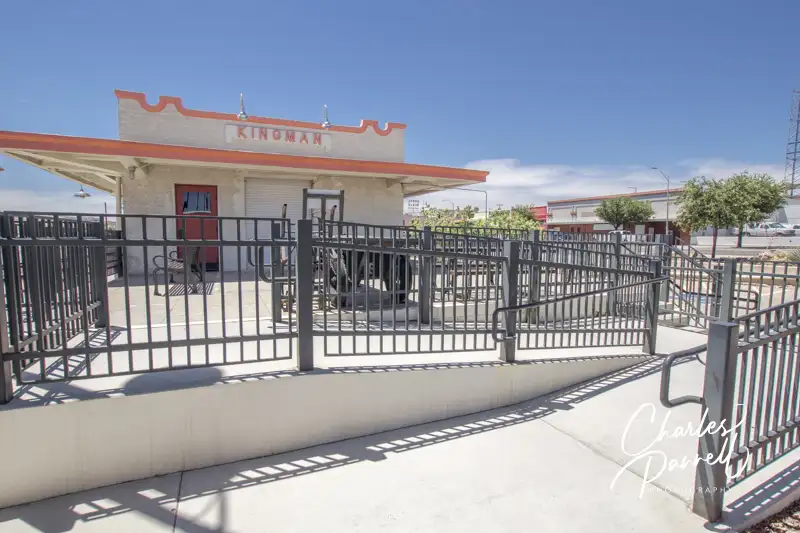
The beautifully restored Santa Fe Depot is located on the corner of 4th Street and Andy Divine Avenue in downtown Kingman. Unfortunately the Santa Fe Eating House, which was staffed by Harvey Girls, has been demolished. It once sat across from the Santa Fe Depot, but today all that’s left of it are a few remnants of the foundation. Still it’s worth a stop to see the depot.
Accessible Entrance Near Parking
There’s accessible parking in the small lot, with ramp access up to the 1907 depot. The Kingman Railroad Museum (kingmanrailroadmuseum.com) is located on one side of the building, while the Amtrak waiting room is located on the other side. There’s level access to the depot and the museum, and there are accessible restrooms inside the depot. It’s definitely worth a stop for history buffs, as the building is on the National Register of Historic Places.
Fray Marcos Hotel Williams, AZ
Depot at the Fray Marcos Hotel in Williams, Arizona
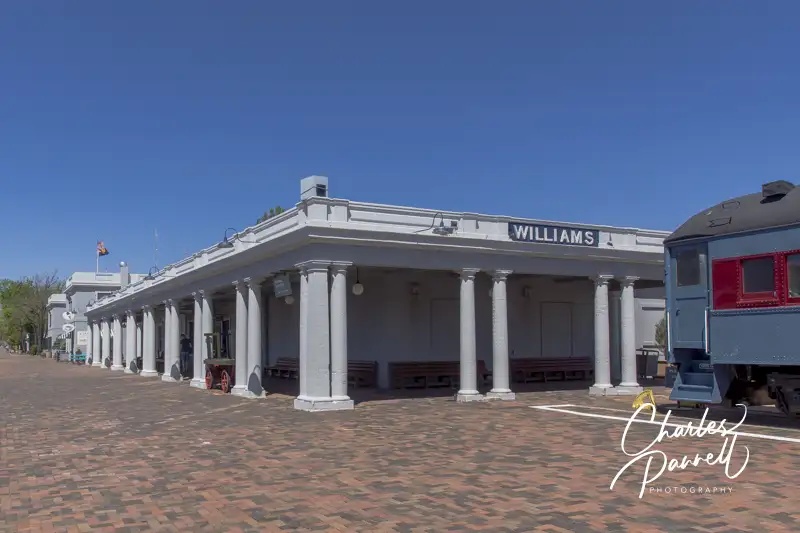
The Fray Marcos Hotel, and the adjoining depot were opened in 1908. This Harvey House had 43 guest rooms at its peak. Today the depot is still in operation, while the former hotel houses the Grand Canyon Railway (thetrain.com) administrative offices. Accessible parking is located near the Williams Depot, with level access to the track side of the station. Take some time to admire the exterior, then pop inside for a look at the former Indian Building — you can’t miss it, as it’s the room with the massive fireplace.
The old hotel lobby is adjacent to the Indian Building, next to the stairs that lead up to the Grand Canyon Railway offices. There are some old photographs in the lobby, and the room exudes a definite historic vibe. Although the depot is deserted most of the day, traffic picks up when the daily Grand Canyon train arrives and departs. Still with a little advance planning, you’ll have the place to yourself.
El Tovar & Bright Angel Lodge Grand Canyon National Park, AZ
El Tovar
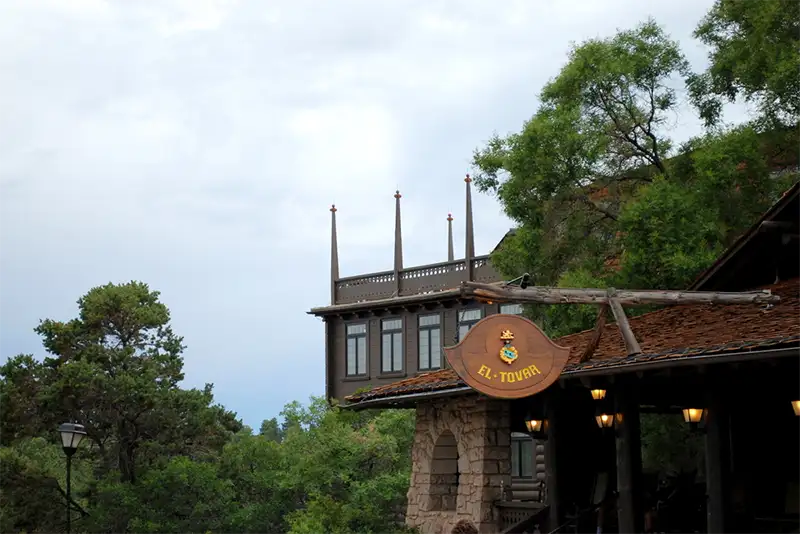
Grand Canyon National Park, which is located north of Williams, is home to two historic Harvey Houses. Perched on the south rim of the canyon, El Tovar and Bright Angel Lodge both feature Mary Colter’s signature southwestern touches.
El Tovar (grandcanyonlodges.com/lodging/el-tovar-hotel) first opened in 1905, and although it was considered a luxury hotel, guests still shared one bathroom at the end of the hall. Today the property boasts modern access features, including a ramped accessible entrance on the canyon side, and several wheelchair-accessible guest rooms.
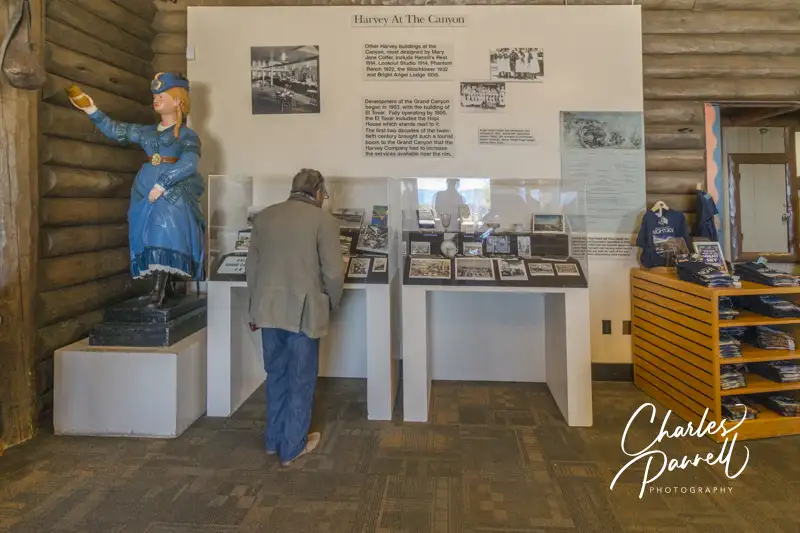
Harvey House Exhibit in the Bright Angel History Room
Bright Angel Lodge (grandcanyonlodges.com/lodging/bright-angel-lodge-cabins) was constructed in 1935 as a budget alternative to the El Tovar. Although there are no accessible rooms at the Bright Angel Lodge, it’s still worth a visit to see the Harvey House exhibit in the Bright Angel History Room. There’s good wheelchair access throughout the Bright Angel History Room, which features artifacts from the two Harvey Houses, as well as old photos, an 1880 Harvey House dinner gong, and even a vintage Harvey Girl uniform. It also includes information and photos from a Harvey Indian Detours excursion, which took train passengers on overnight trips to nearby Native American sites.
La Posada Winslow, AZ
The La Posada Hotel in Winslow, Arizona
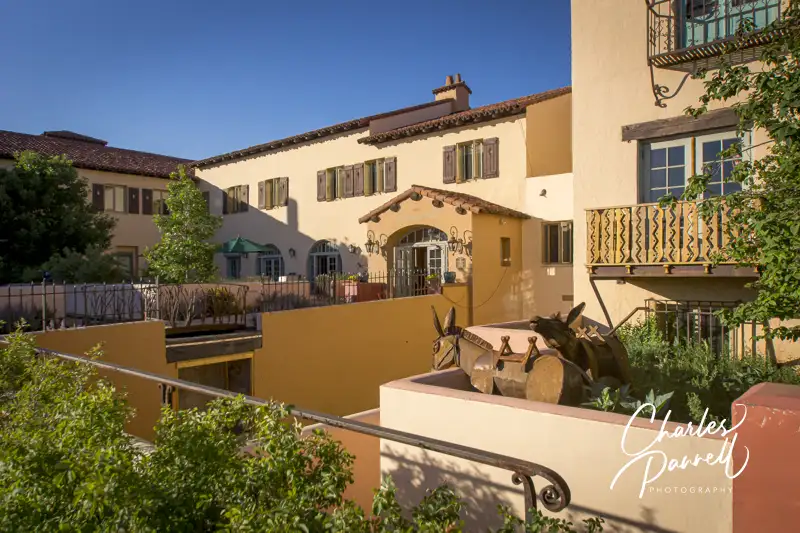
Over in Winslow, Arizona, La Posada (laposada.org) was added to the Harvey family in 1929. And although Mary Colter received wide recognition for her Grand Canyon buildings, she always considered La Posada her masterpiece. Access is good throughout this historic property, with accessible parking in front, and a level sidewalk to the front entrance.
Even if you don’t overnight there, make sure to stop and enjoy a short walking tour, as the property is filled with lots of nooks and crannies that contain historic photos and artifacts. Although the building lacks an elevator, the majority of the artifacts are located on the first floor. Out back, the Affeldt Mion Museum is housed in the 1930 depot, and contains exhibits about the history of the Las Posada, Fred Harvey and Mary Colter.
The Turquoise Room, which faces the railroad tracks, once served as the Harvey House lunch room. Today the menu offers a good selection of southwestern and traditional favorites. And for a real nostalgic feel, the waitresses are even dressed in in traditional Harvey House uniforms. Additionally, if you’d like to spend the night at the Las Posada, they also have a nice wheelchair-accessible guest room on the first floor.
Painted Desert Inn Petrified Desert National Park, AZ
Painted Desert Inn in Petrified Forest National Park, Arizona
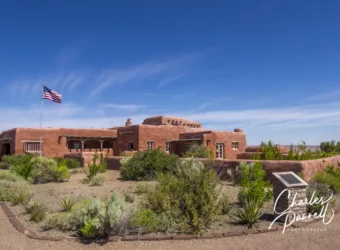
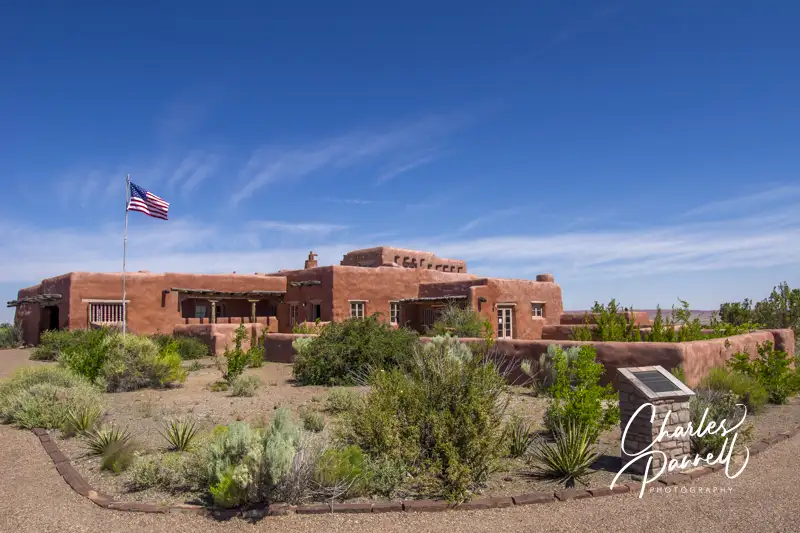
Located east of Winslow, the Painted Desert Inn (nps.gov/pefo/learn/historyculture/pdi.htm) officially opened in 1940 on the site of the former Stone Tree House, which once provided Route 66 travelers with food, souvenirs and lodging. Sadly the war brought an end to the boom days and the Painted Desert Inn was closed in 1942. Five years later the Fred Harvey Company took over management and hired Mary Colter to renovate the property; and the legendary Harvey Girls were brought to the Petrified Forest.
The property operated until 1963, but the inn was saved from the wrecking ball due to a massive public outcry. Finally in 1987 it was declared a National Historic Landmark, and the property was rehabilitated and returned to its former glory. Today you can see the old dining counter and lunch room, complete with vintage place settings. Access has also been improved over the years, with level access to most areas of the inn, and plenty of room for wheelchairs and scooters. After you’re done browsing through the inn, don’t miss the colorful desert view from the accessible viewpoint in back of the inn.
Belen Harvey House Belen, NM
Belen Harvey House in Belen, New Mexico
This 1910 Belen Harvey House (harveyhousemuseum.org) once contained a large lunch room, a formal dining room, a newsstand and an upstairs Harvey Girls dormitory. Today it houses a museum and an adjacent restaurant. There’s good access throughout the museum which contains lots of Harvey House memorabilia, including old photos, dishes, uniforms and even menus. There’s also a number of exhibits about the history of the railroad, and even some old railroad equipment on display. There’s no elevator access to the second floor, but the bulk of the exhibits up there focus on Belen history, rather than the Harvey Houses. As an added bonus the museum is staffed by volunteers who love to talk about the Harvey House heyday.
The Whistle Stop Café is also worth a stop while you are there. This casual eatery includes home made treats like muffins, carrot cake, cobbler and a variety of soups. Everything is delicious, and all proceeds from the café go to help support the museum.
Puye Rest House Espanola, NM
Puye Rest House in Espanola, New Mexico
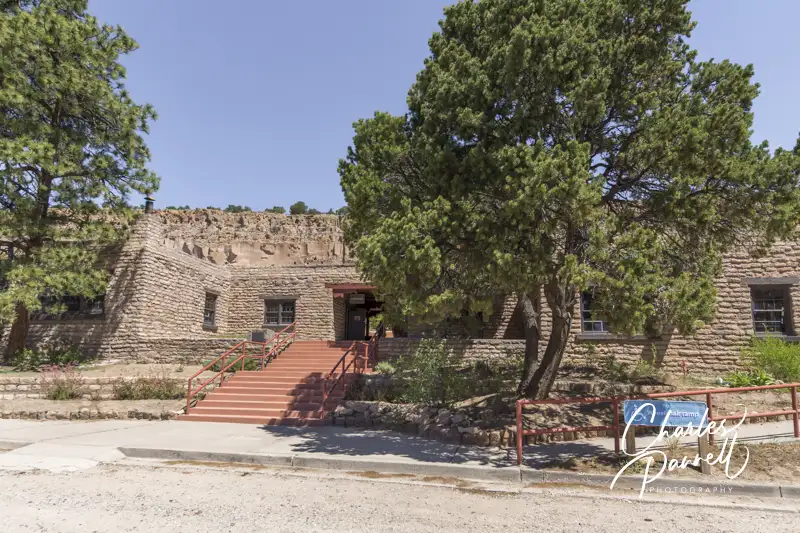
Located well off the main train line in the Santa Clara Pueblo, this Harvey House was part of the Indian Detours program. Built on tribal land in the 1920s, the Puye Rest House (puyecliffdwellings.com/tours/harvey-house) hosted guests who traveled on the “Chili Line”, and were then transferred to the Santa Clara Pueblo in covered wagons in the early years, and in Model Ts in later years. The tours operated from 1925 to 1939, and the big attraction of this location was the hilltop cliff dwellings in back of the hotel.
Today the two buildings that made up the Harvey House are now an interpretive center and a gift shop, and although the cliff dwellings aren’t accessible, the buildings are very doable for wheelchair-users and slow walkers. Most of the exhibits in the interpretive center are focused on the history of the Santa Clara Pueblo, and the excavation of the cliff dwellings in 1907. Still it’s a chance to go inside the historic Harvey House building. There’s also a nice view of the cliff dwellings from the back porch. And if you just want to look at the outside of this historic building, it’s definitely worth the drive.
Castaneda House Las Vegas, NM
The Castaneda Hotel In Las Vegas, New Mexico
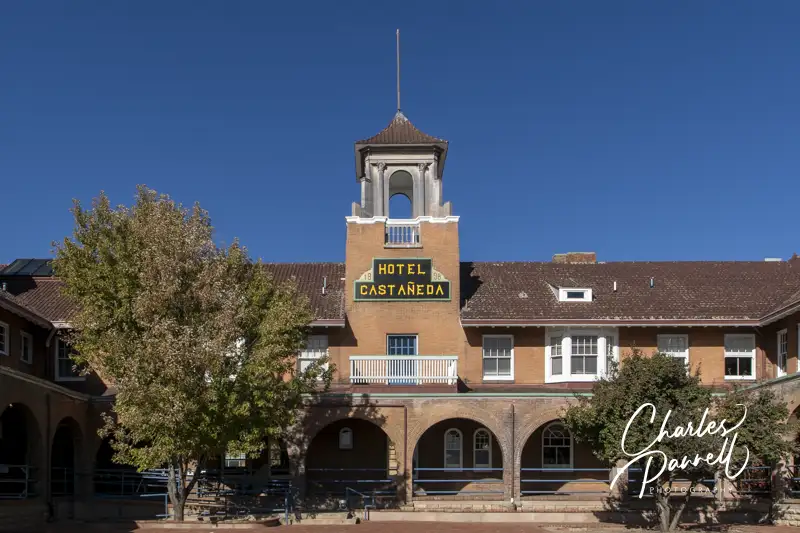
Last but certainly not least on our Harvey Houses of the Southwest tour is the Castaneda House (emerginghorizons.com/the-castaneda-hotel-a-wheelchair-accessible-harvey-house/), which opened in 1898. It closed in 1948 and was shuttered until a local investor purchased it in 2019. Today the restored property has the ambience of yesteryear, with the access features of modern times.
The Mission Revival style building once housed 37 guestrooms, a 108-seat dining room a 51-seat lunch counter, and a cluster of railroad offices. Today the renovated property has 22 suites; and if you look carefully in the rooms, you can see vague outlines of the former room borders on the floors. The hallway doors to the original rooms were also left intact — some now go to storage rooms, while others are merely decorative. And there’s also a nice wheelchair-accessible guest room with a roll-in shower. All in all, the Castaneda Hotel features the charm of the yesteryear, and the comforts and access features of today.
Barrier-Free Travel the Grand Canyon for Wheelchair-users and Slow Walkers
The Transportation Security Administration (TSA) recently announced that travelers who do not present a REAL ID or another acceptable form of identification at the airport, will need to pay $45 to use TSA Confirm ID in order to board the aircraft. The REAL ID law was signed more than 20 years ago, and although it has technically been enforced since May 7, 2025, passengers who previously lacked REAL IDs were given warnings and subjected to enhanced screenings. Beginning February 1, 2026, those travelers will now be required to pay a fee for TSA Confirm ID in order to board the aircraft. Passengers who go this route can also expect delays.
What is TSA Confirm ID?
TSA Confirm ID is a fee-based option to confirm the identity of travelers who lack a REAL ID or other acceptable identification. It costs $45 and takes approximately 30 minutes. It can be completed at the airport, but according to the TSA, it will also be available at www.tsa.gov after the initial launch. That way travelers who lack a REAL ID can get a TSA Confirm ID before they get to the airport, and avoid unwanted delays.
According to the TSA about 94% of airline passengers already have a REAL ID or other acceptable form of identification. Says TSA representative Adam Stahl, “The vast majority of travelers present acceptable identification like REAL IDs and passports, but we must ensure everyone who flies is who they say they are. Beginning February 1, travelers who do not present an acceptable form of ID at our security checkpoints and still want to fly can pay a $45 fee and undergo the TSA Confirm.ID process. This fee ensures the cost to cover verification of an insufficient ID will come from the traveler, not the taxpayer.”
How Do You Get a REAL ID?
Of course, it’s easier – and cheaper in the long run – to get a REAL ID. The process is pretty simple. Just go to your state DMV or motor vehicle licensing website to find out the specific documentation that you need.
Generally, you must provide documentation showing:
Full Legal Name
Date of Birth
Social Security Number
Two Proofs of Address
Some states have additional requirements, and some agencies require an appointment to get a REAL ID.
After you’ve filled out the required paperwork, and submitted the appropriate fees, your photo will be taken, and in most cases you’ll have your REAL ID in a few weeks. It’s a pretty simple process.
To be honest, I have had REAL ID in three states, and it’s pretty easy in most cases. My first REAL ID was in California shortly after the program was launched. Suffice it to say that it needed some improvement, and it took me the better part of the afternoon to complete the process, This was mainly because a lot of employees were unfamiliar with this new program. Gladly that’s not the case today.
My second experience was in ID, and that went quickly, as did my final one in WA. Sadly, a REAL ID in one state does not qualify as documentation for a REAL ID in another state. You have to produce all the original documentation again, which makes no sense to me, as it is a nation-wide program. In any case, getting a REAL ID today is a pretty easy process.
What Other Forms of ID are Acceptable?
Although REAL IDs are one form of acceptable identification, there are many other options that the TSA accepts. Listed below are the acceptable forms of ID in order to pass the TSA checkpoint to board the aircraft.
State-issued Enhanced Driver’s License (EDL) or Enhanced ID (EID)
S. Citizenship and Immigration Services Employment Authorization Card (I-766)
S. Merchant Mariner Credential
Veteran Health Identification Card (VHIC)
All travelers without an acceptable ID, including those who present a non-REAL ID-compliant state driver’s license or ID, will be referred to the optional TSA Confirm.ID process for identity verification upon TSA check-in and prior to entering the security line.
For more information about REAL ID or the security screening process, visit TSA.gov/real-id.
So be prepared to show your REAL ID on Feb 1, or else be subjected to additional screening and fees. Plan ahead!
Eagle Lake Bridge on Historic Carriageway in Acadia National Park, Maine
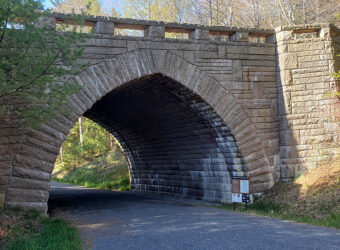
Acadia National Park is known for its historic carriage roads. They were commissioned by John D. Rockefeller Jr., who preferred to travel on motor-free byways by horse and carriage. Built between 1913 and 1940, the roads feature stone-faced bridges, impressive waterfalls and scenic cliff side views. And then there are the granite stones that were used as guardrails, which are known a “Rockefeller’s teeth”. Today 45 miles of these auto-free roads still traverse the park; and although you can certainly walk or roll along them,there are also two wheelchair-accessible Acadia National Park excursions that everyone can enjoy.
Ride A Trike
First up in the wheelchair-accessible Acadia National Park excursions are the wheelchair-accessible trike rides presented by MDI Wheelers (mdiwheelers.org). These rides are conducted on electric assist trikes piloted by volunteers. The pilots peddle and maneuver the trikes from the back, and the passengers sit in the front in a passenger seat that looks somewhat like a wheelchair.
The rider transfers from their wheelchair to the passenger seat, and is then secured with a safety harness. The rider also wears a helmet. The trikes have a weight limit of 225 pounds, and if a rider cannot transfer independently they must provide their own assistance.
The rides begin at Eagle Lake, and family members and friends are invited to ride along on their own bikes. And just to make sure everything goes off as planned, two volunteer safeties ride along next to the MDI Wheelers trike on standard bicycles. The trike rides are only offered during the summer months, weather permitting, and they are free.
For more information about the rides, visit the MDI Wheelers website. And to schedule a ride, use their contact form on the website or give MDI Wheelers a call at (207) 288-3511.
A Wheelchair-Accessible Acadia National Park Carriage Ride
If you’d prefer a more traditional tour on the carriage roads in Acadia National Park, then schedule an outing with Acadia by Carriage (acadiabycarriage.com). This company offers wheelchair-accessible carriage rides along this historic park roads; and thanks to a generous donor, wheelchair-users and their companions get a discounted rate.
The accessible horse-drawn carriage features ramp access in back, and plenty of room for a wheelchair. There’s also room for an additional two to three passengers on board on the bench seats. And since safety is a top priority, there’s a tie-down to secure the wheelchair. The folks at Acadia by Carriage are huge proponents of inclusion, and they can accommodate both manual wheelchairs and power wheelchairs.
The carriage rides depart from Wildwood Stables, which is located just off Park Loop Road. The Island Explorer Bus, which is wheelchair-accessible, also stops at Wildwood. The wheelchair-accessible carriage rides last between one and two hours. For more information or to book a ride, call Acadia by Carriage at (207) 600-7204 , or drop them an e-mail at info@acadiabycarriage.com.
So make it a point to explore the carriage roads on your next visit to Acadia National Park. They’re more accessible than you think.
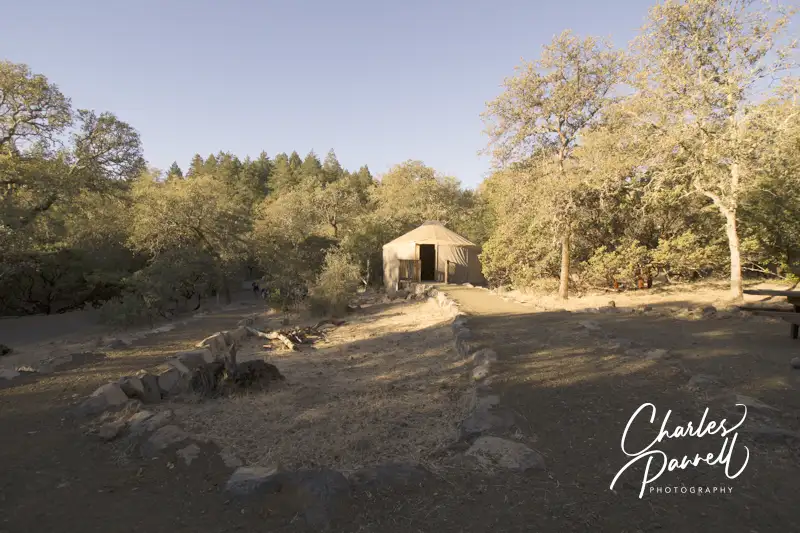
Located along the St. Helena Highway, Bothe Napa State Park (napaoutdoors.org/parks/bothe-napa-valley-state-park/) is easy to overlook, especially if you’re winery hopping along this popular Napa County thoroughfare. That said, it’s not only a nice place to stop for a picnic or to enjoy a short hike; but if you’re up for an adventure, it’s also an excellent place to overnight. Although the park offers wheelchair-accessible campsites, it also boasts a comfortable wheelchair-accessible yurt. Granted, this yurt is pretty basic — some would even describe it as rustic — however it provides a quiet, off-the-beaten-path lodging option in what can often be described as a crowded and overly congested area of the state.
Sleeping in a Wheelchair-Accessible Yurt
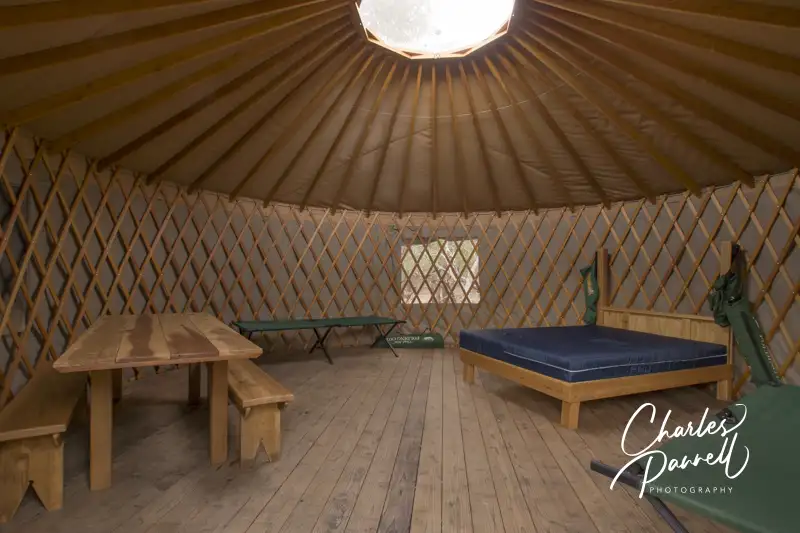
Inside Yurt 26 at Bothe Napa State Park
There are two campgrounds and yurt areas in the park, but this accessible yurt (26) is located away from the Group Campground, in the quieter Ritchey Creek Campground. There’s plenty of room to park on a level dirt pad in front of Yurt 26, with ramp access up to the front door. Access features inside the yurt include a wide doorway, wooden floors and ample space to navigate a wheelchair. Furnishings include a 21-inch high queen-sized bed with wheelchair access on both sides, four folding cots, and a table with two benches.
You’ll need to supply your own bedding, sleeping bags, pillows and towels; and since the yurt lacks electricity it’s also a good idea to pack along a lantern, flashlights and a camp stove. And although the mattress is certainly adequate, if you prefer more support you might also want to bring an air mattress.
Outside, there is a short accessible path over to a picnic table and a storage locker. It’s the perfect place to enjoy the outdoors, sip some wine, and relax as the sun sets. As an added bonus, it’s also very dark in the park, and with no ambient light you can really enjoy the night sky.
The bathhouse is just a short walk away. A family restroom with a roll-under sink and toilet grab bars is located in the front section of the bathhouse, while the private pay showers are located on the side. The accessible shower room includes a roll-in shower with grab bars, a built-in shower bench and a lowered showerhead. There’s plenty of room for an attendant in the large shower room, and it also features a spacious changing area with lowered hooks.
A Nice Picnic Stop
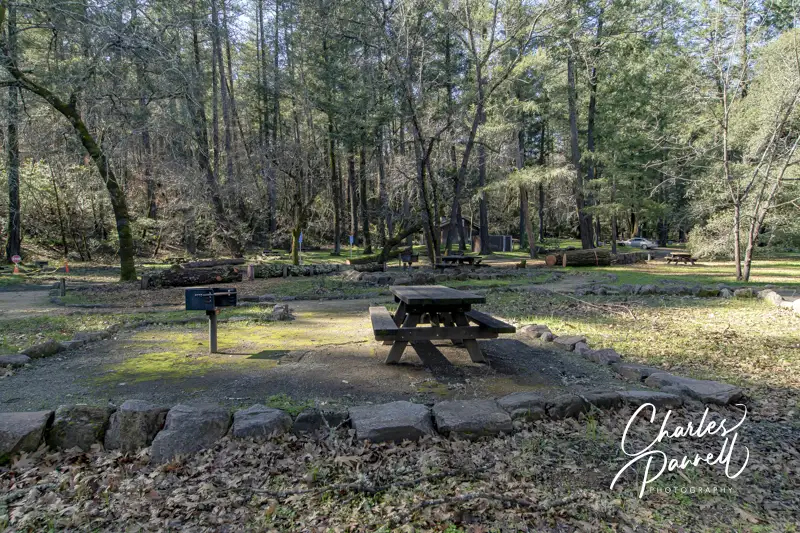
Picnic Grounds at Bothe Napa State Park
Even if you don’t spend the night in the wheelchair-accessible yurt, make plans to stop in for a picnic lunch and explore the park. The bulk of the accessible picnic tables are located in the day use area, which is located just down the park road from the visitor center. Accessible parking is located near the tables, with paved pathways to the tables and the accessible restrooms. If you’d prefer a more secluded repast, drive all the way to the end of the park road, park in the accessible parking spot, and feast at one the tables in the level shaded area.
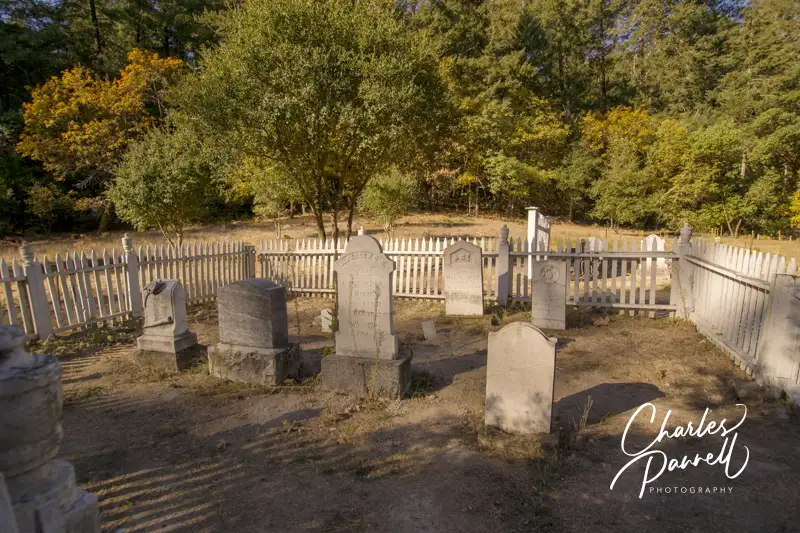
Pioneer Cemetery at Bothe Napa State Park
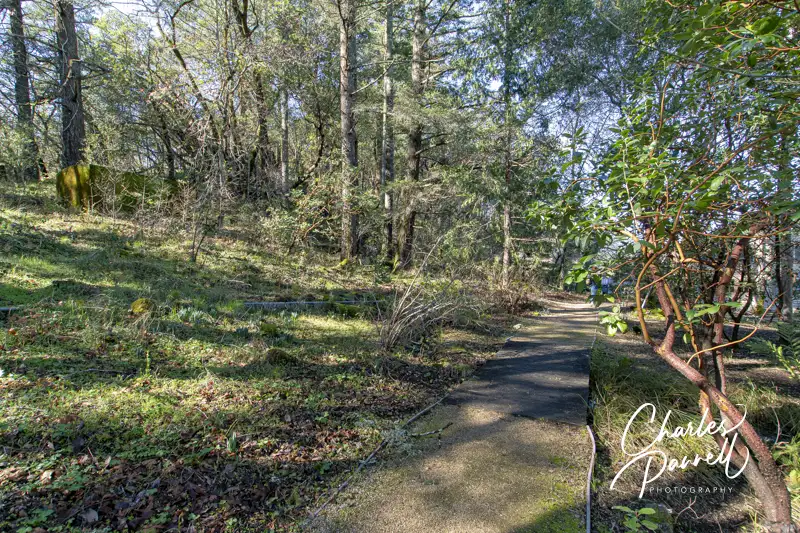
Save some time for a short walk to the Pioneer Cemetery on the accessible trail, which begins near the picnic tables at the end of the road. The hard-packed dirt loop winds around the restored graveyard, which dates back to the mid 1800s. There are benches to sit and rest along the way, while you gaze at the plots surrounded by quaint white picket fences. The trail then loops back through the woods to the site of the historic White Church, before it returns to the picnic area.
Last but not least, make sure and stop at the Native American Garden, which is located on the left side of the visitor center. The accessible pathway begins near the back of the building and winds through a natural garden filled with plants that were important to the first people of the area — the Wappo. Although a few of the species are labeled, the visitor center also has a plant guide to enhance your understanding of the native people. It’s just a short trail — only 150 yards or so — but it’s a pleasant stroll to top off your Bothe Napa State Park visit.
Trail to the Native American Garden at Bothe Napa State Park
Barrier-Free Travel California National Parks Road Trips Travel Ideas for Wheelchair-users and Slow Walkers
The best way to see old town Santa Fe is on foot. That said, there are more than a few access obstacles in the historic heart of the city near the Plaza — an area that dates back some 400 years. On the other hand, with a little advance planning and careful route selection, it’s still possible to see the cultural highlights of this area with minimal walking. With that in mind, here’s a barrier-free Santa Fe walking — or rolling — tour, with stops at a number of accessible cultural attractions along the way.
St. Francis Cathedral
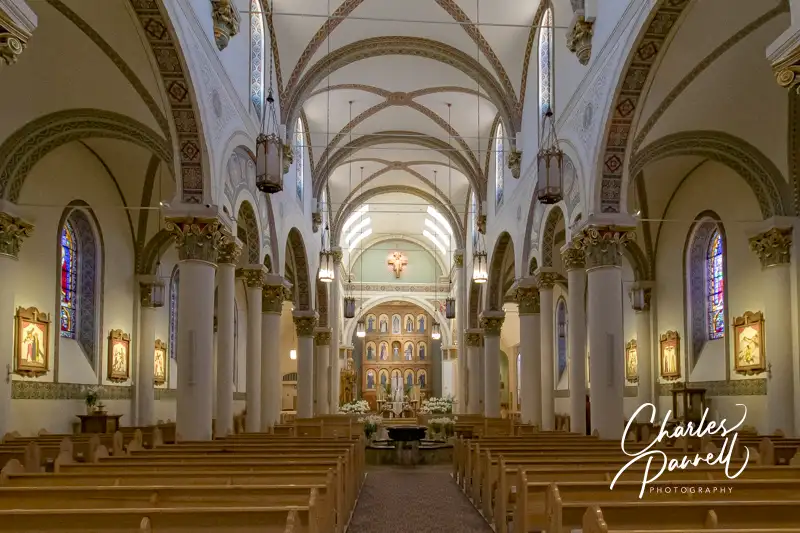
Inside The Cathedral Basilica of St. Francis of Assisi
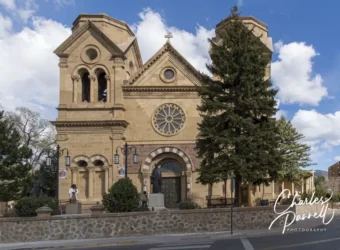
First up on the wheelchair-accessible Santa Fe walking tour is St. Francis Cathedral (cbsfa.org/), which is just a block from the Plaza. Just head east on Palace Avenue, then turn south on Cathedral Place. St. Francis Cathedral is on the left — you can’t miss it.
Built by Archbishop Jean Baptiste Lamy between 1869 and 1886, this Santa Fe landmark is the mother church of the Archdiocese of Santa Fe. And although there are steps up at the front of this Romanesque Revival building, there’s also ramp access on the left side. Inside, there’s barrier-free access throughout the church, with accessible seating in the chapel.
The center aisle is lined with Corinthian columns, and accented with graceful arches. A massive baptismal fountain sits near the center of the church, and the intricately carved main altar is a sight to behold. Top it off with the stations of the cross, an impressive collection of historic paintings, and stained glass windows that were imported from France, and you have a truly magnificent sanctuary.
Museum of Contemporary Native Arts
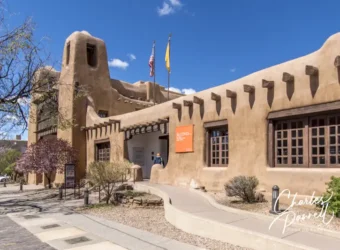
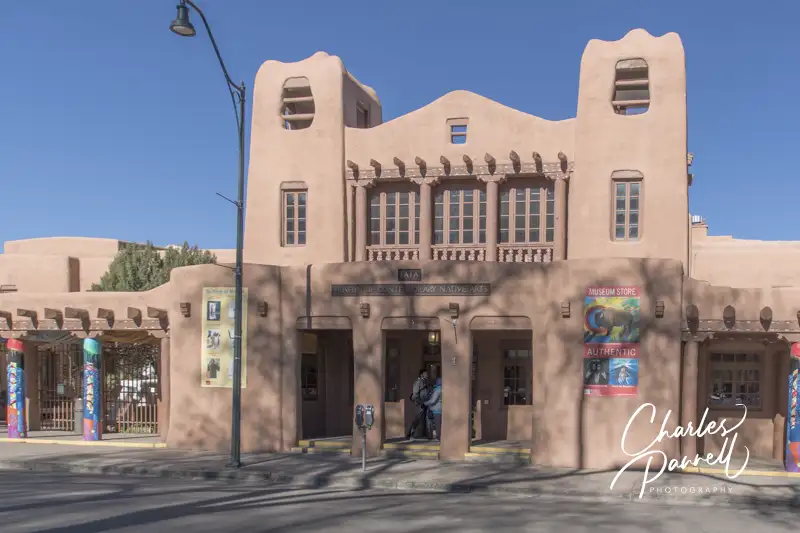
The Museum of Contemporary Native Arts
The Museum of Contemporary Native Arts (iaia.edu/mocna/), which is located across the Street from St. Francis Cathedral, is often overlooked by visitors, but it’s truly a must-see on any Santa Fe visit. And there’s a discounted admission for disabled visitors, and no charge for caregivers.
Although there are steps up to the front entrance, there’s curb-cut access and a barrier-free pathway to that same entrance from San Francisco Street. Inside, there’s plenty of room to maneuver a wheelchair through the spacious galleries which display select works from a 7,500-object collection of contemporary native art. From paintings, textiles and cultural arts, to sculptures, ceramics and jewelry, there’s something for just about everyone.
There’s also level access out to the first-floor courtyard which boasts an impressive collection of public art, and to the adjacent galleries which host a wide variety of rotating exhibits. And if you like what you see, don’t forget to stop in at the well-stocked gift shop on the way out.
Loretto Chapel
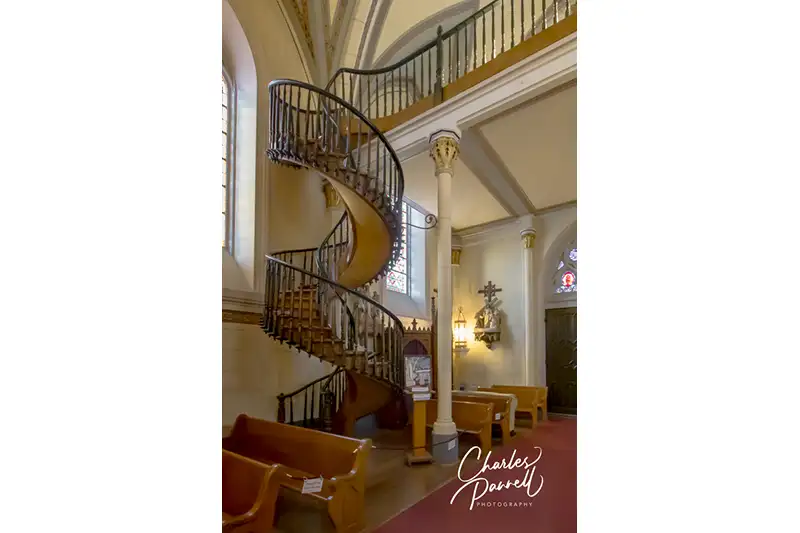
The Miraculous Staircase of the Loretto Chapel
From the Museum of Contemporary Native Arts, head south on Cathedral Place and take a right on Water Street and a left on the Old Santa Fe Trail, to what many folks consider one of the most mysterious sights in town — the Loretto Chapel (lorettochapel.com/). There’s level access to this beautiful chapel, where visitors can also admire the stained glass windows, the stations of the cross, the Italian-made altar, and of course the famous staircase to the choir loft that lacks any visible support.
The story behind the creation of the staircase is an age-old mystery. According to legend, the sisters of the chapel prayed to St Joseph — the patron saint of carpenters — for a way to access the then stair-less choir loft. Shortly thereafter an unknown carpenter appeared and constructed the spiral staircase, and left without payment. That was in 1878, and although a railing was added over the years for safety, the staircase remains as it was constructed — without any center or side support. Visitors can linger on as long as they want in the chapel, and enjoy the beauty of it all.
Palace of the Governors
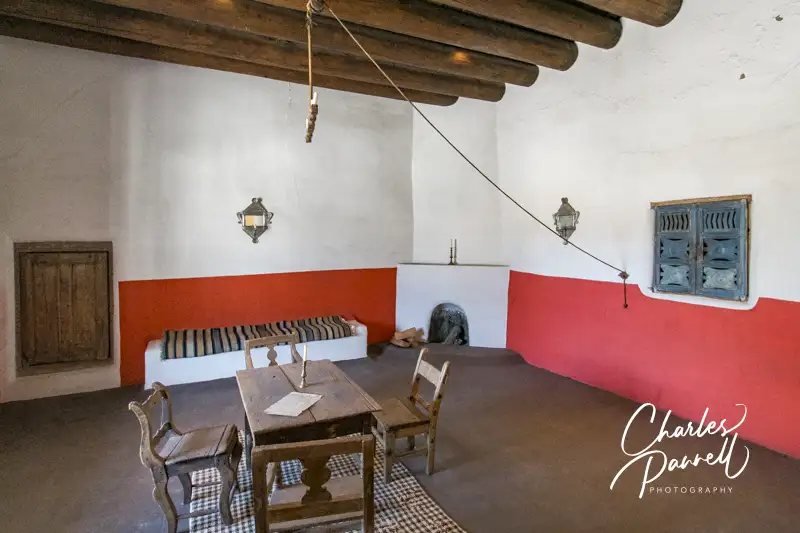
Old Governors Office in the Palace of the Governors
One of the highlights of old Santa Fe is the Palace of the Governors (palaceofthegovernors.org), which was constructed in the early 17th century as Spain’s seat of government over what’s now known as the American Southwest. Designated as a Registered National Historic Landmark in 1960, today this historic building houses part of the state’s history museum.
As an added bonus, the stroll from the Loretto Chapel is very scenic. Just follow the Old Santa Fe Trail north past San Francisco Street, along the Plaza and over to the Palace of the Governors. Alternatively, you can cut through the Plaza; however even though the Plaza pathways are wide and level, there are some uneven brick sections that may be problematic for wheelchair-users.
You can’t miss the Palace of Governors, as it’s usually lined with a gaggle of Native American vendors selling their wares. And although that’s certainly worth a stop itself, it’s also worth a look inside. Access to the interior of this historic adobe structure is through the Lincoln Street entrance to the New Mexico History Museum, which is located next door on Lincoln Street. So save some time to the peruse the inside of this historic building which is filled with objects that have been unearthed by archaeologists, including pottery, utensils and weapons. The exhibits span two floors, with elevator access to the second floor, and there’s always an interesting rotating exhibition or two in the mix.
New Mexico History Museum
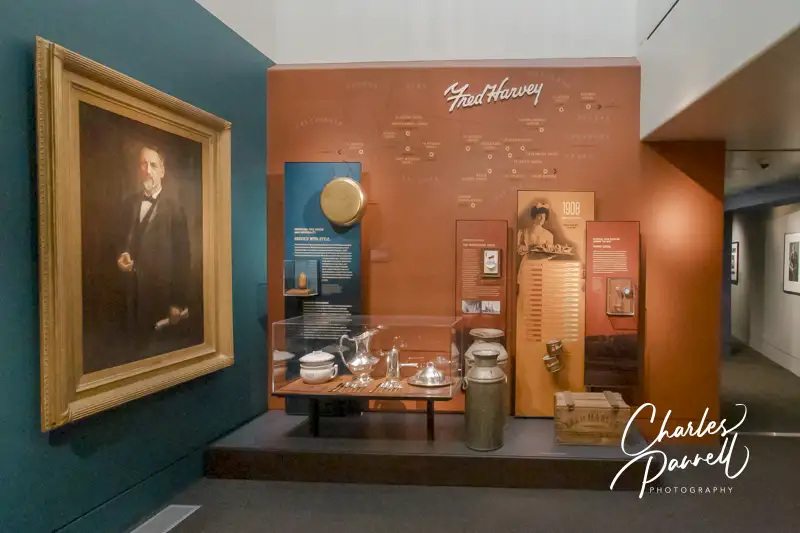
Fred Harvey exhibit in the New Mexico History Museum
The New Mexico History Museum, which is located just around the corner, offers an equally impressive historic collection. There’s level access to the front door and ramped access to the exhibits. Wheelchairs are available for loan at the front desk, and there’s plenty of room to maneuver a wheelchair through the exhibition spaces, which feature a variety of artifacts that chronicle the history of the state.
Starting with the early settlers and Coronado, and moving on to the Mew Mexico Missions, the Santa Fe Trail and even the Santa Fe Harvey House, the museum offers a comprehensive look at the history of the indigenous people, Spanish Colonization and early travel and commerce in New Mexico. And combined with the Palace of the Governors, this modern museum gives visitors a good overview of the colorful — and sometimes contentious — state history.
New Mexico Museum of Art
New Mexico Museum of Art
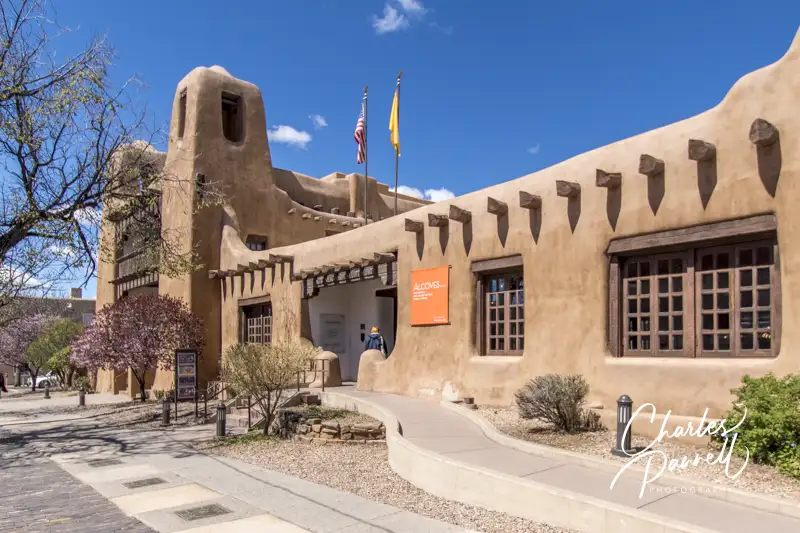
The New Mexico Museum of Art (nmartmuseum.org), which is located just a block west of the Palace of the Governors, is also worth a stop. It’s just a short level roll down the street, and there’s curb-cut access to the wide level sidewalk along Palace Avenue, and level access over to the museum’s front entrance. There’s barrier-free access to all the galleries, and elevator access to the second floor.
This museum first opened in 1917, and many of the works that were exhibited on opening day are still part of the permanent collection. A good variety of rotating exhibitions are also presented throughout the year. And don’t miss the courtyard, which is dotted with murals by William Shuster. These frescoes, which were commissioned by the Federal Emergency Relief Agency in 1934, were created to honor the Pueblo Indians. It’s quite an impressive collection.
Georgia O’Keeffe Museum
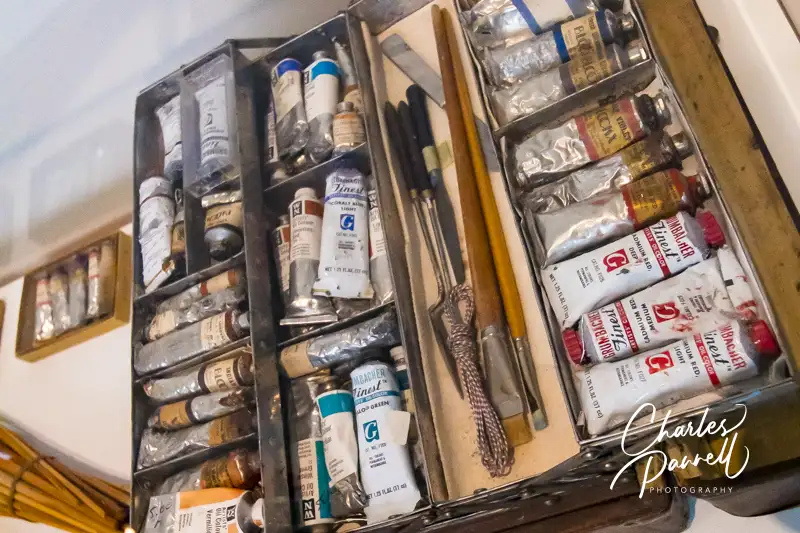
Georgia O’Keefe’s paint box in the Georgia O’Keefe Museum
Last but not least on this wheelchair-accessible Santa Fe walking Tour is the Georgia O’Keefe Museum (www.okeeffemuseum.org). From the New Mexico Museum of Art, continue west on Palace Avenue, take a right on Grant Street, and then turn left on Johnson Street. The Georgia O’Keeffe Museum is just a half-block up on the right.
Although O’Keeffe was born in Wisconsin, she fell in love with New Mexico when she visited Santa Fe in 1917. By 1934 she was spending her summers at Ghost Ranch, about an hour north of Santa Fe; and in 1949 she took up permanent residence in the state. To say she was a local favorite is an understatement. The museum was opened 11 years after her death in 1997, to honor her art and share it with the public.
Today there’s excellent wheelchair access throughout the galleries in the adobe building, which is a work of art itself. Admission is free for people with a disability, and half-price for their caregivers. There’s also a loaner wheelchair available at the front desk.
The museum’s permanent collection consists of over 3,000 O’Keeffe works which span the length of her career, from 1915 to 1984. The galleries are divided by decade and the works include everything from paintings of her beloved New Mexico, and large scale depictions of flowers, leaves and other natural forms, to New York cityscapes. Add in some rotating exhibits and you have a truly spectacular museum — and reason enough to add Santa Fe to your cultural bucket list.
Stay Near the Plaza
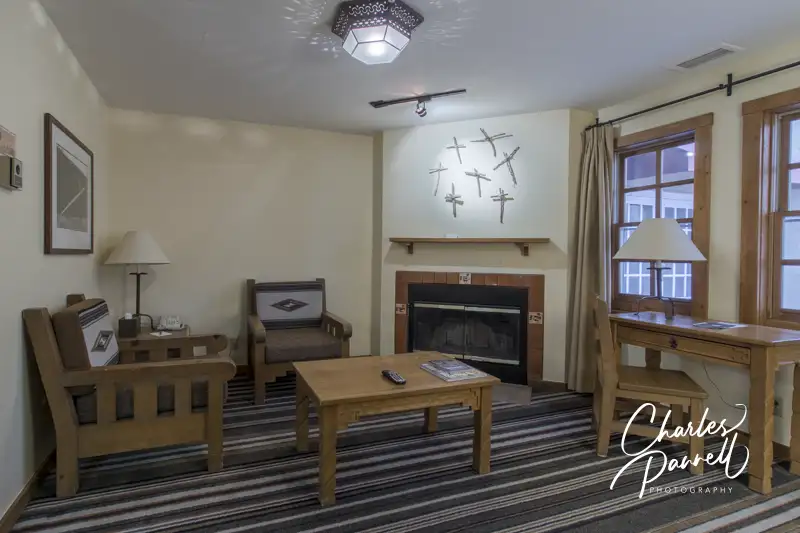
Living Area in Suite 102 at the Chimayo Hotel
If you’re looking for an accessible hotel near this wheelchair-accessible Santa Fe walking tour, then look no further than the Chimayo Hotel emerginghorizons.com/a-wheelchair-accessible-santa-fe-lodging-choice/. It’s just a two-minute walk from the Palace of the Governors, on Washington Street. This historic property boasts a comfortable accessible suite, and it’s a great place to base yourself to explore old town Santa Fe. You can start this walking tour in the morning, have lunch, then take midday break at the hotel, before continuing your tour in the afternoon. Comfort, convenience and access, the Hotel Chimayo has it all. So check it out on your next Santa Fe visit.
Barrier-Free Travel Utah National Parks for Wheelchair-users and Slow Walkers
The Cathedral Basilica of St. Francis of Assisi on the Santa Fe Pick-Up Shuttle Route
If a trip to Santa Fe is in your future, then check out the Santa Fe Pick-Up (santafenm.gov/public-works/transit/santa-fe-pick-up), the free Santa Fe accessible shuttle.. Funded in partnership with Tourism Santa Fe, the Santa Fe Transit Department and NCRTD, this free shuttle bus runs from the the railroad station to downtown, with stops at popular sites along the way. A complete schedule is available on the website. The buses are all equipped with wheelchair ramps and tie-downs, and the drivers are available to assist wheelchair-users. So check out this free Santa Fe accessible transportation option on your next visit. And once you get off the bus, here’s a wheelchair accessible route to explore the Plaza area (https://emerginghorizons.com/a-wheelchair-accessible-santa-fe-walking-tour/).
Barrier-Free Travel the Grand Canyon for Wheelchair-users and Slow Walkers
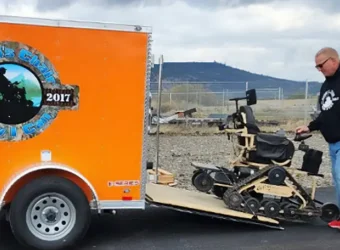
If you’d like to explore some of the more rugged trails and beaches in Southeastern Texas, then pick up this Texas Tow & Go track chair from David’s Chair in Huntsville. Although most track chairs are required to be used in specific places, this loaner comes with a trailer so you can tow it to the location — or locations — of your choice.
This track chair, which has a maximum capacity of 350 pounds, is located at the 10 Mile Ranch in Huntsville, Texas. Reservations are required to borrow the track chair, which comes with a fully enclosed trailer that has ramp access in the rear. In order to tow this trailer you’ll need a vehicle with at least a 1,500-pound towing capacity, that has a 2-inch ball and a straight 4-prong trailer hookup with safety chains. The driver must provide a current drivers license and proof of insurance. Tow & Go reservations must be submitted at least two weeks in advance, and the reservations may not exceed seven days. This Texas Tow & Go track chair is a great option for an active vacation. For more information or to make a reservation, visit davidschair.org/request-tow-n-go-chair/.
Barrier-Free Travel 22 Accessible Road Trips Driving Vacations for Wheelers and Slow Walkers
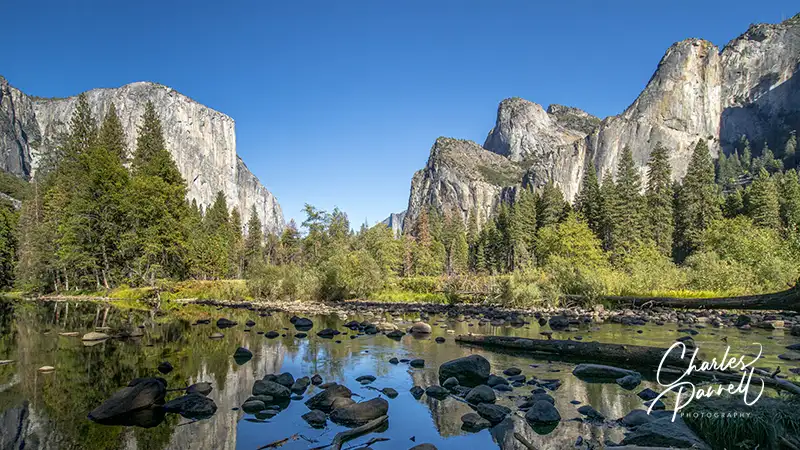
Although there’s no train station in Yosemite National Park, with a little advance planning it is possible to plan a wheelchair-accessible Yosemite rail excursion. Here’s what you need to know to ride the rails to Yosemite National Park.
Hop Aboard Amtrak
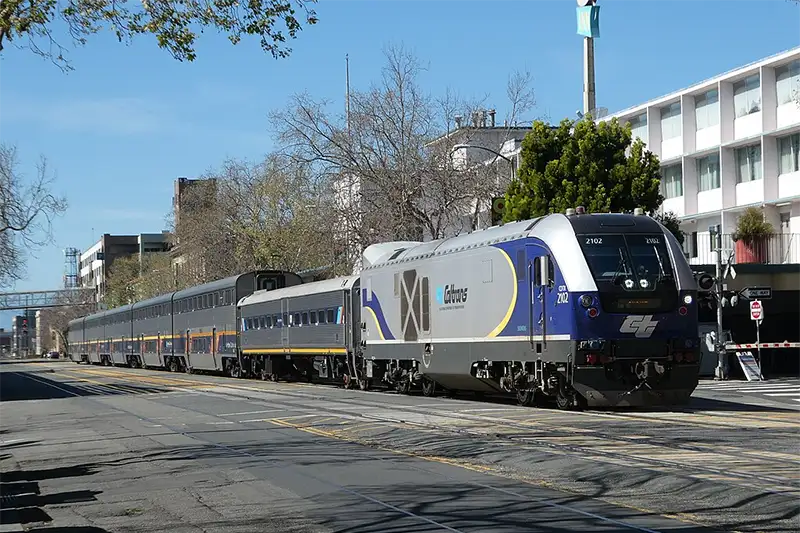
Amtrak Gold Runner
The best way to take a wheelchair-accessible Yosemite rail excursion is to hop aboard Amtrak’s Gold Runner. This route runs through the Central Valley from Oakland to Bakersfield, and offers bus connections from Los Angeles, Sacramento and San Francisco. The train also stops in Emeryville, Richmond, Martinez, Antioch, Lodi, Stockton, Modesto, Denair, Merced, Madera, Fresno, Hanford, Corcoran and Wasco. And it’s easy to transfer to Yosemite via YARTS at the Merced Amtrak Station.
All Amtrak trains feature ramp or lift boarding, wheelchair-accessible seating and large accessible restrooms. Wheelchair-users can remain in their own wheelchair or transfer to a coach seat for the journey. The Gold Runner can accommodate manual and power wheelchairs up to a maximum width of 29.5 inches, and an occupied weight of up to 600 pounds. Special accessibility requests can be submitted at www.amtrak.com/contact-us/email.html (click on accessibility request) at least 72 hours prior to travel, or by calling (800) 872-7245. On-the-spot accessibility requests can usually be accommodated if they do not present a safety issue.
The Gold Runner route features coach seating, free WI-FI, and food for sale on board. Amtrak offers a 10% discount to passengers with a disability and one companion. For more information about Amtrak’s Gold Runner route, visit www.amtrak.com/san-joaquins-train.
Take YARTS to Yosemite
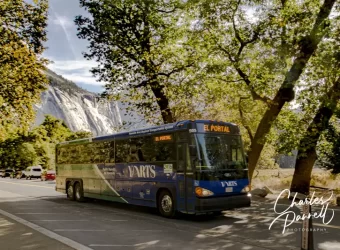
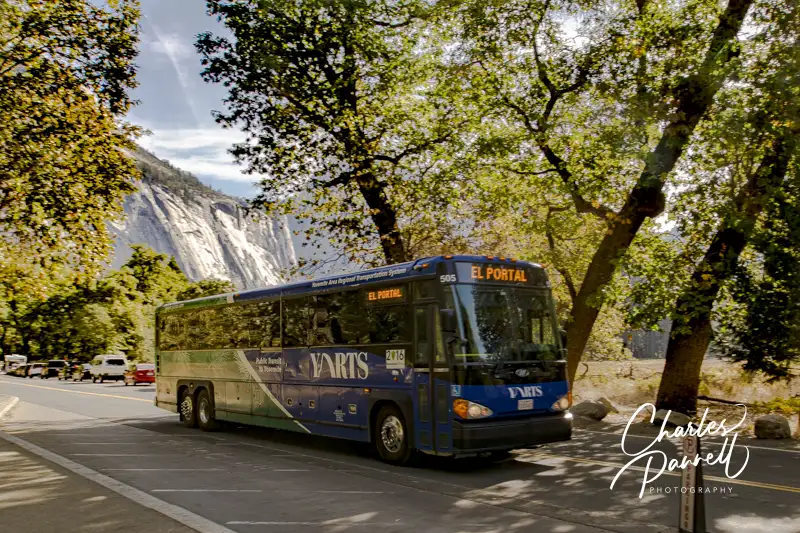
YARTS bus in Yosemite Valley
It’s about a three-hour trip from Oakland to Merced, and a two-hour trip from Bakersfield; plus an additional, 3.5-hour bus connection from Bakersfield to Los Angeles. Amtrak has partnered with YARTS to provide a bus connection from the Merced Amtrak Station to Yosemite, and that transfer is included with your Amtrak ticket.
All YARTS buses feature lifts and accessible seating; however it’s important to note on your Amtrak reservation that wheelchair-accessible seating is required. Alternately, call (877) 989-2787 at least 48 hours in advance to secure an accessible seat. Additionally, reduced fares are available to people with a disability and seniors over 62 years old.
The Highway 140 YARTS route runs from the Merced Amtrak Station to Yosemite Valley with stops in Catheys Valley, Mariposa, Midpines and El Portal. Stops in Yosemite Valley include the Yosemite Valley Visitor Center, Yosemite Valley Lodge and Curry Village. This route runs year-round, and it takes 2.5 hours to get from the Merced Amtrak station to Yosemite Valley.
The Highway 140 YARTS route is an excellent choice for folks with lodging reservations at Yosemite Valley Lodge or Curry Village; however this route also stops at accessible properties outside of the park. Two excellent accessible lodging choices on the route are the Yosemite Bug and AutoCamp Yosemite.
The Yosemite Bug (www.yosemitebug.com/) is located in Midpines and features a large wheelchair-accessible guest room with a roll-in shower. Located nearby, AutoCamp Yosemite (autocamp.com/location/yosemite/) offers wheelchair-accessible accommodations in custom designed luxury travel trailers. And both properties have daily YARTS connections to the national park.
Getting Around Yosemite
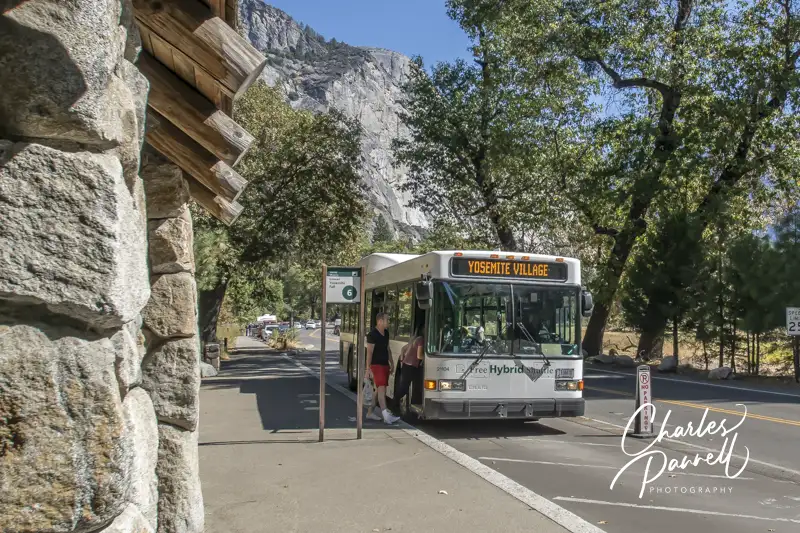
Yosemite Shuttle
Passengers who take a wheelchair-accessible Yosemite rail excursion have several options to get around the park. First and foremost is the free Yosemite shuttle system.
There are currently two shuttle routes in the valley — the Valleywide Shuttle and the East Valley Shuttle. The former stops at Yosemite Valley lodges, campgrounds, restaurants and trailheads, while the latter calls on Yosemite Village, Curry Village, the Pines Campgrounds and the eastern Yosemite Valley trailheads. All shuttle buses are equipped with wheelchair lifts and tie-downs, and can accommodate wheelchairs up to 24 inches wide and 46 inches long. The lifts have a weight limit of 750 pounds.
Aramark (www.travelyosemite.com) — a Yosemite lodging concessionaire — also operates several tours. The popular Valley Floor Tour is conducted in an open-air tram and offers good views of the surrounding landscape. Although not all trams are accessible, wheelchair-users can request a lift-equipped one with 48 hours notice. And if you’d like to explore more of the park, opt for four-hour Glacier Point Tour or the day-long Yosemite Grand Tour. Accessible buses for these tours are also available with 48 hours advance notice.
Finally, if you’d like to get a little exercise, then rent a handcycle at the bike stands at Yosemite Valley Lodge or Curry Village and explore the 12 miles of bicycle paths in Yosemite Valley. Most of the bicycle paths are wheelchair-accessible except for a short patch near Housekeeping Camp.
So leave the car at home, and get out and ride the rails to Yosemite National Park. It’s a fun and wheelchair-accessible way to travel.
Barrier-Free Travel Yosemite, Sequoia and Kings Canyon National Parks for Wheelers and Slow Walkers
Located just a block from the historic Santa Fe Plaza, the Hotel Chimayo (www.hotelchimayo.com) takes its name from a Northern New Mexican town that dates back to the 17th century. And although this upscale boutique hotel offers a bevy of modern creature comforts, it also celebrates the history and culture of its namesake village with traditional architecture, hand-crafted furnishings and original artwork. And the good news is, historic and accessible aren’t mutually exclusive at the Hotel Chimayo. So check out this wheelchair-accessible Santa Fe lodging pick on your next southwestern sojourn.
Historic Yet Accessible
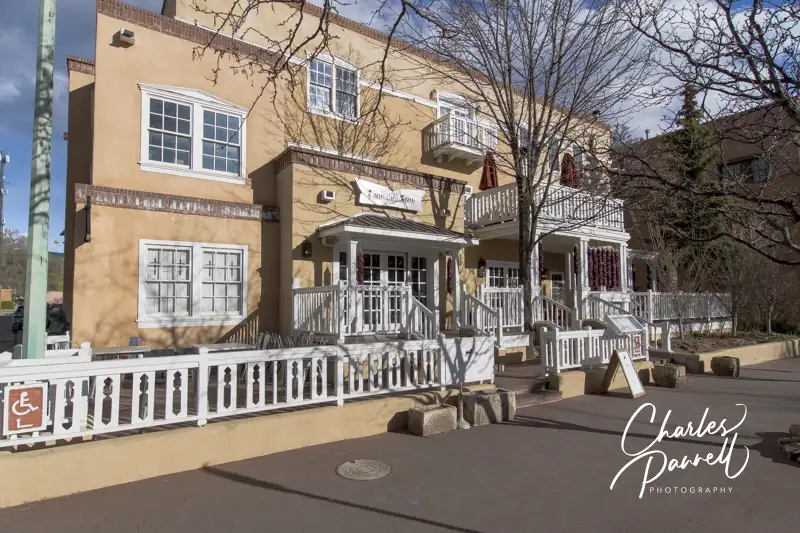
The Hotel Chimayo features brick steps that grace the historic front entrance; however there’s easy access to a ramped entrance on the left side of the building. Alternatively, accessible parking is located in an underground garage, with elevator access up to the lobby.
There’s barrier-free access throughout the lobby, which is adorned with Viga ceilings, hand woven-textiles and a collection of retablos — small religious paintings — that are incorporated into the design of the massive brick fireplace. Add in a large crucifix on the mantle, an adjacent hand-carved altar, and a collection of Spanish colonial wooden furniture, and you get a real feel for historic Chimayo.
A Comfy Accessible Suite
Living Room in Suite 102 at the Chimayo Hotel
Room 102 — an ADA junior fireplace suite — is located near the front lobby, just off a brick courtyard that’s accented with colorful bunches of hanging chilies. Access features in the spacious suite include wide doorways, lever handles, good pathway access, and low-pile carpet for easy rolling.
The large living room in this comfortable suite features a wood burning fireplace that comes complete with firewood. It’s surrounded by comfortable furniture, and it also include a refrigerator and a wet bar. A 28-inch high king-sized bed with wheelchair access on the right side (as you face it), is located in a separate alcove. Other furnishings include a chest of drawers and a TV. Top it off with a lowered closet rod and you have a very accessible suite.
Bedroom in Suite 102 at the Chimayo Hotel
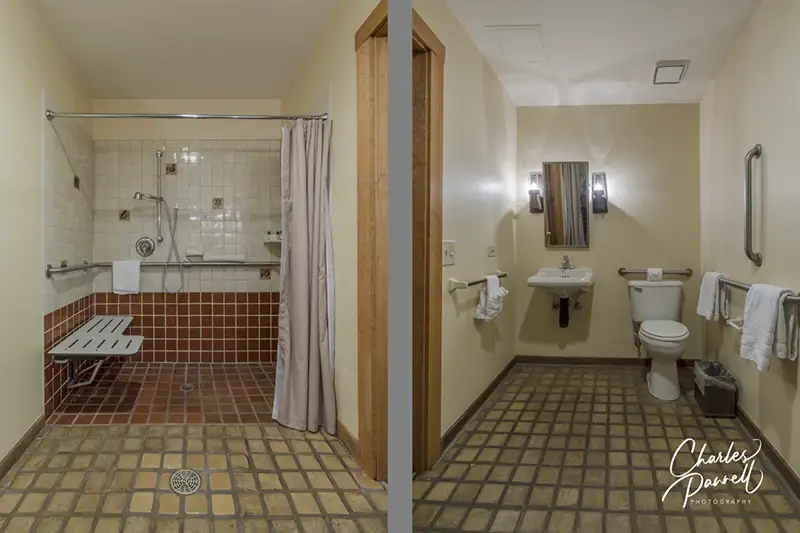
There’s barrier-free access to the adjacent bathroom, which has a tile floor and a full five-foot turning radius. It’s equipped with a roll-in shower with grab bars, a hand-held showerhead and a fold-down shower bench. The tile shower is nicely designed for access and it includes shower controls that are located within easy reach of the shower bench. The toilet grab bars are located on the back and left walls (as seated), and the bathroom also has a roll-under sink and an angled mirror.
Bathroom in Suite 102 at the Chimayo Hotel
It’s a very accessible and comfortable suite; and as an added bonus it also includes some historic photos and custom artwork. In fact more than 70 Chimayo artists created the artwork and furniture that adorns this property; and that’s quite a tribute to the small town.
The Public Areas
There’s good access to the public areas of this wheelchair-accessible Santa Fe lodging choice as well. There’s level access to the Low ‘n Slow Bar, which is located on the second floor. And the decor is worth a visit by itself. True to the low rider theme, it’s decked out with diamond-tuck upholstered seats, chrome chain-link steering wheel tables, hubcaps, vintage photos and the odd piece of car memorabilia here and there. It’s a fun place to stop for a cocktail or grab one of their yummy “hawt” pizzas
Best of all, you just can’t beat the location of the Hotel Chimayo, as it’s within rolling distance of all the major attractions. You can park your car for the duration of your stay, and explore the historic district on foot. And if you want to take a break during the day, your comfortable room is just steps away. Good wheelchair access, comfortable rooms, and a prime location makes the Hotel Chimayo is an excellent wheelchair-accessible Santa Fe lodging choice.
Barrier-Free Travel the Grand Canyon for Wheelchair-users and Slow Walkers