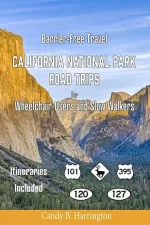
As a travel writer since 1977, Candy Harrington has been writing about accessible travel exclusively since 1996. She’s the founding editor of Emerging Horizons, and the author of the popular Barrier-Free Travel national park series. With thousands of bylines to her credit, Candy hits the road often, in search of new accessible travel finds. Candy and her travel photographer husband Charles Pannell reside in NE Washington, where they tend to their chicken flock and enjoy a rural lifestyle.
Thanks to the folks at Open Road Access (openroadaccess.co.uk/airport-hire/), wheelchair-accessible rental vans at UK airports are now available. This local company provides service to all the major UK airports, including Heathrow, Gatwick, Manchester, Liverpool, Birmingham and Edinburgh. You can rent a vehicle for a day, a week, or even longer; and the quoted price includes breakdown coverage, comprehensive insurance and unlimited mileage. Open Road Access will deliver the vehicle to your arrival airport, and you can just drop it off there at the end of your stay. And they will also provide a thorough orientation of the vehicle, so you will be comfortable driving it on your holiday.
Rental vehicles come in a variety of sizes and include the Ford Connect, Renault Traffic, Peugeot Horizon and Ford Custom. They all come outfitted with ramps or lifts and tie downs, so you can just roll in and go. Their small vehicle has room for one wheelchair-user and four more passengers, while the medium vehicle can accommodate one wheelchair-user plus four or five additional passengers. And their large vehicle can accommodate one or two wheelchair-users plus four to five other passengers. All vehicles also have ample space for baggage and additional equipment.
And with 24/7 customer support you can have a worry-free holiday. For more information about these wheelchair-accessible rental vans at UK airports, check out the Open Road Access website or give them a call at +44 300 045 4505.
Barrier-Free Travel 101 Accessible Vacations Travel Ideas for Wheelers and Slow Walkers
Toledo’s Wildwood Preserve Metropark (metroparkstoledo.com/explore-your-parks/wildwood-preserve-metropark/) now has two models of track chairs and some adaptive bicycles for loan. Bisected by the Ottawa River, this 493-acre park is well known for its varied terrain and well developed trail system. And thanks to the Wildwood Preserve Track Chair Loaner Program, everyone can now explore all the nooks and crannies of this popular park.
Track Chairs and Trikes
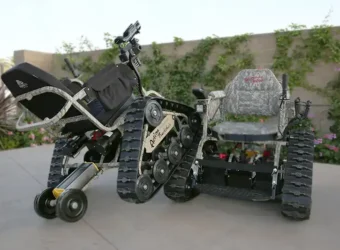
The Wildwood Preserve Track Chair Loaner Program includes one Action Trackchair with a 22-inch wide seat. It’s outfitted with a four-point harness, a seatbelt extension, armrest pockets, an oxygen tank holder and an attendant control. There is no weight restriction on this chair.
The park also has a GRIT Freedom Chair, a recumbent trike and an upright trike to loan.
All of the track chairs and trikes must be reserved at least three business days in advance. They are available for loan in three-hour increments, and all track chair-users must bring along a companion to accompany them on their hikes. The companion must be able to assist with transfers, as park employees are not allowed to help.
The loaner track chairs and trikes can be picked up at the maintenance area in the park, which is close to a number of trails. The closest ADA parking is located at Metz Stables. Accessible restrooms are also located at Metz Stables and near the playground.
Mount Rushmore is a bucket list item for many folks. It’s also makes a great stop on any Black Hills road trip. And although the stately presidential carvings are indeed a sight to see, there’s also a scenic drive with lots of wildlife viewing opportunities nearby. And the the good news is that Mount Rushmore — like the majority of US National Parks and monuments — includes some upgraded access features. So don’t forget to make a stop at wheelchair-accessible Mount Rushmore on your next trip through South Dakota.
Mount Rushmore for Wheelchair-Users
Avenue of the Flags at Mount Rushmore National Memorial, South Dakota
Located just 35 minutes from Rapid City, Mount Rushmore (www.nps.gov/moru/) was sculpted by the father-son team of Gutzom and Lincoln Borglum. It took them 14 years to complete the intricate carvings of the four presidents — Washington, Jefferson, Roosevelt and Lincoln. And as a result of their hard work, the sculptures have stood the test of time.
Although there’s no entrance fee to Mount Rushmore, there is a fee to park in the garage. Accessible parking is available in the garage, with ramp and elevator access up to the main level. Additionally, there’s a drop-off area right in front of the main entrance. Loaner wheelchairs are available at the Information Center, which is located near the main entrance, just across from the restrooms (which are also accessible).
There is barrier-free access down the Avenue of the Flags to Grand View Terrace, where you’ll catch your first glimpse of the four presidents. From there, take the left entrance to the Presidential Trail, which travels past the Lakota Indian Heritage Village to four alcoves with optimal views of each president. The trail is paved and level, and the accessible portion ends at the Upper Terrace, where you’ll get another good view of the mountain. From there you’ll have to double back, as the trail continues downhill with lots of steps along the way. Still, the quarter-mile accessible stretch offers the best views of the presidential carvings.
There’s also elevator access to the amphitheater and the Lincoln Borglum Visitors Center, on both sides of Grand View Terrace. And if you’ve worked up an appetite, the Carver’s Cafe along the Avenue of the Flags is wheelchair-accessible.
A Scenic Drive and More
Little Devil’s Tower and Cathedral Spires on the Needles Highway Scenic Drive in Custer State Park, South Dakota
After your wheelchair-accessible Mount Rushmore visit, save some time to enjoy one of the most scenic drives in the state. From Mount Rushmore, follow the signs back to Highway 16A, then head towards Custer State Park. Along the way you’ll pass through three one-lane tunnels, and get some absolutely gorgeous windshield views of the scenic Black Hills. Have your camera ready as you exit the second tunnel, as it’s a great vantage point for the iconic shot of Mount Rushmore.
After your visit, be sure to take a cruise along the Needles Highway Scenic Drive. At the end of Wildlife Loop Road, take a right on Highway 87 and follow the signs. Named for the needle-like formations and cathedral spires that dot the landscape, the route traverses a Ponderosa Pine forest and passes through three narrow tunnels.
There are lots of spots to stop and enjoy the view, but make sure and use the pullout right before tunnel five, for a great view of Little Devil’s Tower and Cathedral Spires. After that, you’ll get up-close-and-personal with the spire-like formations, as the road cuts right through them. It’s a once-in-a-lifetime drive, and a great way to end a wheelchair-accessible Mount Rushmore visit.
As one of the most popular national parks, Yellowstone tends to attract the bulk of its visitors during the peak summer season. And although crowds can detract from the pristine natural beauty of Mother Nature, there are a few ways to dodge the crowds in Yellowstone.
First off, get an alpine start no matter when you visit; and if possible try and plan your trip in the shoulder seasons for a less crowded experience. And although Old Faithful is a must-see, seek out some of these less touristed spots in the park to avoid the masses. And the good news is, all of these sites are good choices for wheelchair-users and slow walkers.
White Dome Geyser on Firehole Lake Drive
White Dome Geyser on Firehole Lake Drive at Yellowstone National Park
A scenic ride along Firehole Lake Drive tops the list of ways to dodge the crowds in Yellowstone. This one-way loop drive begins about a mile south of Fountain Paint Pot, along the road to Old Faithful. You can drive the route straight through, as many of the geysers and hot springs are visible from the road; or opt to stop at the pullouts along the way and get a closer look at the thermal features.
As an added bonus, it’s not unusual to spot bison along the first section of the drive; and there’s nothing quit like hearing their eerie grunts and groans from the boardwalks of the nearby geysers. Even better — the route is pleasantly devoid of the bus loads of tourists that frequent the other area attractions, as larger vehicles are not allowed on this road. And finally, most visitors completely pass it by in their rush to get to Old Faithful.
Gull Point Road Unnamed Picnic Area
Gull Point at Yellowstone National Park
Eating alfresco in a national park is a great experience, but unfortunately some of the more popular picnic areas in Yellowstone are packed to the brim. That said, this little gem — that unfortunately lacks a name — usually makes for a pleasant lunch stop. It’s located near the Bridge Bay (north) end of Gull Point Road, about a half-mile north of the turnoff to the Gull Point Picnic Area.
There are just two tables there, but they are located on a level pad and they offer a great view of the lake and the surrounding mountains. Parallel parking is available on a level asphalt area, just steps from the tables, so this spot is especially good for folks who can’t do distances. And even though the tables lack extensions, there’s still room on the end for a wheelchair. There are no restrooms at this picnic area, but don’t let that deter you, as you can always use the accessible ones down the road at the Bridge Bay Marina.
West Thumb Geyser Basin Boardwalk
West Thumb Geyser Basin at Yellowstone National Park
Next up on the list of ways to dodge the crowds in Yellowstone is a visit to West Thumb Geyser Basin. Located just north of Grant Village, this geothermal area offers a short wheelchair-accessible boardwalk. The half-mile trail begins near the accessible parking area, and leads around the inner loop. Along the way it passes by the thumb paint pots and offers a good view of the central basin with the mountains in the background. There are benches to sit and rest along this fairly level boardwalk trail, and accessible vault toilets are located in the parking lot.
The longer outer loop in this geothermal area is not accessible because of a steep grade, and it may be dangerous for wheelchair-users. Still the inner loop offers a good look at the unusual geothermal features. Although West Thumb Geyser Basin isn’t devoid of visitors, it not nearly as crowded as the geothermal areas near Old Faithful.
North Rim Trail
River View on the North Rim Trail at Yellowstone National Park
A portion of the North Rim Trail located near the Brink of the Upper Falls is wheelchair-accessible, and most people opt for the brink instead of this trail. To find the trail, take the turnoff to the Brink of the Upper Falls, which is located midway between North Rim Drive and South Rim Drive along the road to Lake Village. From the parking lot follow the sign to the brink, but instead of bearing left and heading downhill, continue straight ahead at the fork.
The path to the right is the North Rim Trail, which offers an equally impressive falls view. The paved trail leads through the woods for a half-mile, before it crosses over the historic Canyon Bridge and offers a great view of Chittenden Bridge in the distance. This trail loses its access because of a steep grade just before Chittenden Bridge, but it still makes for a lovely 1.6-mile out-and-back-hike.
Frying Pan Spring
Frying Pan Spring in Yellowstone National Park
This small hot spring is located north of Norris Campground on the west side of the road to Mammoth. It’s easy to drive right by it, and many folks do exactly that. There’s no striped parking in the pullout, but there’s usually enough room to parallel park an accessible van in the small paved area.
A 400-foot level boardwalk leads from the parking area over to this unusual spring, that’s roughly shaped like a frying pan. There’s also a bench at the end of the boardwalk, if you’d like to sit and admire the view. You’ll most likely have this site to yourself too, as it’s not included on any of the park maps, and it really doesn’t look like much from the road.
Forces of the Northern Range
Forces of the Northern Range Boardwalk in Yellowstone National Park
Last but certainly not least on the list of ways to dodge the crowds in Yellowstone, is to check out the Forces of the Northern Range boardwalk. Tucked away along the road between Tower Junction and Mammoth Hot Springs, the trail is only marked by a small brown “self-guided trail” roadside sign. And most folks just zip right on by it.
The half-mile accessible boardwalk winds through the sagebrush and shrub-lined landscape and features scenic views of Yellowstone’s Northern Range in the distance. Interpretive plaques that detail the flora, fauna and geology of the area are dotted along the boardwalk, and several short spurs lead out to secluded areas that are lined with benches, so folks can sit back and admire the scenery. And even though it’s a short trail, because of the spurs and vegetation, it doesn’t feel crowded, even when there are a lot of people out there. It’s a very well designed trail, with magnificent views of the surrounding landscape.
Barrier-Free Travel Glacier, Yellowstone and Grand Teton National Parks for Wheelchair-Users and Slow Walkers
Dedicated to the rivers and fish of the Methow Valley, Homestream Park is a spot to pause, reflect and observe. And since it’s just off Highway 20, it makes for a good stop. That said, unless you have an accessible parking placard, there’s no vehicle parking in this urban oasis. There’s level access from the accessible parking area over to a covered and uncovered picnic area. And the good news is, both areas have accessible tables.
A short .2-mile trail runs along the river and loops back to the picnic area. And along the way it’s dotted with works by sculptor Smoker Marchand. These sculptures focus on the salmon and the original inhabitants of the Methow Valley. About half of the level hard-packed dirt trail is accessible, and there are several benches to sit down and take a break along the way. After the halfway point there are nine boulders along the trail, which represent the nine dams that the salmon encounter on their journey to the Pacific Ocean. Some slow walkers may be able to get around the boulders, but most spaces are too tight for wheelchair-users, so you’ll have to double back. Still it’s a nice spot to stop, enjoy a picnic, and peruse the sculptures.
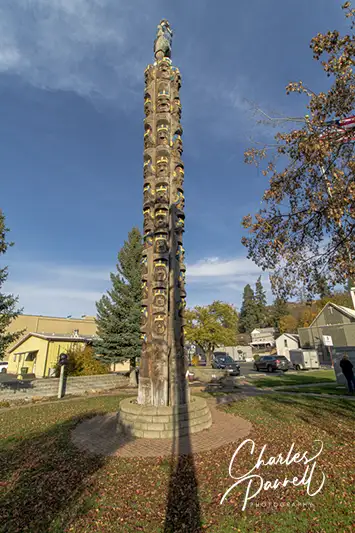
Created by local artist Barry Stromberger, this giant metal yellowjacket sculpture sits on a 15 foot pole in Twisp Commons Park. What makes it unique is that it was crafted from a 1951 Plymouth Cranbrook that was pulled from the Methow River, in an effort to improve the salmon habitat. Why a yellowjacket? It’s widely believed that the name of the town (Twisp) comes from the Okanagan word txʷəc’p, which supposedly translates to yellowjacket or wasp. And in keeping with the theme, the local high school also has a yellowjacket as a mascot.
There’s accessible parking in front of the Methow Valley Community Center across the parking lot from the sculpture. And if you need local visitor information, there’s ramped access to the building which has a nice selection of Methow Valley brochures and maps in the lobby. It makes a nice quick stop off of Highway 20.
Located in the Sierra Nevada foothills, just 133 miles east of San Francisco, Calaveras County is the perfect spot to slip away for a weekend wine tasting getaway. The pace is slower than some of the more famous California wine regions, and the winemakers are unpretentious and happy to chat about their wines. It’s a relaxing and refreshing experience. And although there’s no shortage of tasting rooms in the area, Ironstone Vineyards tops the list for location, variety and wheelchair access
Ironstone Vineyards
Vineyards at the Ironstone Winery
Getting to Calaveras County is easy. From the Bay Area head east on Interstate 5 to Stockton, then continue east on Highway 4. As you leave the city you’ll feel the stress melt away while you cruise along this country byway. About an hour down the road, just outside of Murphys, make a left on 6 Mile Road. Ironstone Vineyards (www.ironstonevineyards.com) is about three miles down the road — you can’t miss it.
There’s plenty of accessible parking at this popular winery, with level access over to the tasting room. Owned by the Kautz family, this vineyard grows a variety of fruit, including Cabernet Franc, Symphony, Cabernet Sauvignon and Merlot. Visitors can choose five tastes from the daily menu, to see what strikes their fancy. There’s also a store, a lakeside park, a museum , and even an amphitheater in the complex. And access is good throughout the complex, with elevator access to all floors, level thresholds and paved pathways.
Estate tours are also available, and most of the stops on this walking tour feature level access. And if you can’t manage the walk, golf cart transportation is also available. Highlights of the tour include the 44-pound gold nugget in the Heritage Museum, the 1,200-pipe organ in the Alhambra Music Room and the spectacular seasonal flower gardens. Ironstone Vineyards is definitely more than just a winery.
Disabled passengers who travel on domestic planes, trains, buses or ferries within Canada may be eligible for free caregiver fares under the One Person One Fare regulation (otc-cta.gc.ca/eng/highlights-one-person-one-fare-policy-decision). This regulation mandates that domestic carriers cannot charge a disabled person for their caregiver’s fare, if that caregiver’s assistance is required during their journey. In 2008 this regulation was challenged in the Supreme Court of Canada, but in the end the rule was upheld. There are of course a few restrictions; so here’s what you need to know to get free caregiver travel under the One Person One Fare regulation.
The Program
One Person One Fare mandates free caregiver travel it you fall under the requirements of the regulation. First off, the passenger needing assistance has to be disabled as defined by the Canada Transportation Act. That definition includes “any impairment, including a physical, mental, intellectual, cognitive, learning, communication or sensory impairment — or a functional limitation — whether permanent, temporary or episodic in nature, or evident or not, that, in interaction with a barrier, hinders a person’s full and equal participation in society.”
Furthermore, the passenger has to require assistance with their personal care or safety during the flight. This can include assistance with:
Eating
Taking medication
Using the washroom
Orientation or communication
Responding to an emergency
One Person One Fare doe not apply if you just need assistance boarding, help with your luggage or attendant care at your destination. This regulation generally applies to people with severe disabilities who cannot travel alone.
The Process
So how do you get free caregiver travel under the One Person One Fare regulation? First and foremost, check the website of your transportation carrier, as most have detailed instructions on the documentation required for the One Person One Fare exemption. Most carriers have a “fitness to travel” form that needs to be filled out by a physician. This form has detailed questions about your medical condition and limitations. A separate doctors certificate may also be required.
It may take the carrier between 48 and 96 hours to get back to you after you have submitted your forms, And if they have any questions, then the whole process will take even longer. It’s essential to plan ahead and allow adequate time to get the required forms completed and signed.
Granted, the first time that you fill out the documents is time intensive, but the good news is, that you don’t have to do it for every trip. Ask your carrier to keep a copy of the documentation on file, and save a copy for yourself, just in case. The documentation is good for three years, so it you travel with the same carrier you won’t have to resubmit it during that time.
One Person One Fare helps more folks get out and travel domestically. So the next time you travel within Canada, don’t forget to make advance plans for your free caregiver travel under this program. It may take a little extra planning, but it’s worth it in the long run.
Barrier-Free Travel 22 Accessible Road Trips for Wheelers and Slow Walkers
Located near the Intersection of Interstate 84 and Highway 97 in rural Washington, Maryhill State Park makes a great rest stop on any Columbia River road trip. With great views of the majestic river, this 81-acre park offers a nice selection of picnic sites, as well as a variety of overnight camping options. Granted it’s a great choice for a quick hop-off-the-highway lunch break, but because of its proximity to some unique roadside attractions, this Southern Washington gem is also an optimal pick for an overnight stay. So hop off the Interstate on your next Columbia River road trip, and stay a spell at Maryhill State Park (parks.wa.gov/find-parks/state-parks/maryhill-state-park).
Eat and Sleep
Maryhill State Park has both RV sites and tent sites, with good access in both. Tent Sites 52 and 53 are accessible, and they are located near the accessible restroom and shower house. Both sites have accessible van parking, a level tent site, an accessible picnic table and a raised grill. There’s also a paved path from each site to the restroom, which includes a large accessible stall with grab bars. Each side also has a roomy compartment with a roll-in shower with with grab bars, a lowered showerhead and a fold-down shower seat. Best of all, the showers are free.
Tent Camping Site 53 at Maryhill State Park, Washington
The accessible RV site (51) is located near the day use area. It has a paved driveway, an accessible picnic table, and a standard grill. It’s a short walk away from the accessible restroom, but not as close as the tent sites. This site was an addition to the property and it sits outside of the RV loop, and on the plus side it doesn’t neighbor any other RV sites. All of the accessible sites in the park require proof of disability — such as an accessible parking placard — in order to occupy them. It should also be noted, that there’s some freeway noise and train noise in this park.
There’s also a nice picnic area in the park, with a Columbia River view. There’s accessible parking near the accessible restrooms. It’s about a 30-foot roll over a level grassy patch out to the closest picnic table. Although it’s a standard table on a cement pad, there’s room for a wheelchair at the end. It’s a pleasant place to stop for lunch on the road.
Art Appreciation 101
The Maryhill Museum of Art
If you’re spending the night at the park, be sure and plan a visit to the Maryhill Museum of Art (www.maryhillmuseum.org), which is just up the road. The museum building was originally the home of Sam Hill. Hill’s goal was to establish a Quaker community — named after his daughter Mary — on his land; however due to a lack of irrigation it never came to fruition. He later donated his home, which subsequently became the Maryhill Museum of Art. It was dedicated by Hill’s friend Queen Marie of Romania in 1926.
There’s accessible parking in front, with a long ramp up to the museum entrance. If the slope and length of the ramp are too much for you, there’s an accessible entrance on the lower level on the left side of the building. Just follow the sidewalk around to the door, and ring the bell. Inside there’s good pathway access throughout the museum, elevator access to all levels and accessible restrooms on the ground level and lower level.
Variety is the key word at this museum, which also offers some interesting visiting exhibitions. Don’t miss the Queen Marie of Romania gallery near the entrance, which includes the gown she wore to the coronation of Nicholas II in 1896. The ground level features a substantial collection of indigenous peoples artifacts, including an extensive basket display. And in contrast, the opposite wing offers and equally diverse Rodin exhibition. Round things out with a display of over 80 chess sets and related works of art, and the contemporary Stevenson Wing that’s lined with windows, for the full Maryhill Museum of Art experience. And don’t forget to take a stroll along the accessible paths outside, to take in some of the garden sculptures and enjoy a Columbia River view.
Rodin Sketch of Cambodian Dancer at the Maryhill Museum
A Little Vino
Bistro at the Maryhill Winery
When it’s time for a break, be sure and stop in at the Maryhill Winery (www.maryhillwinery.com), which is just a mile west of the museum. Established in 1999 by Craig and Vicki Leuthold, Maryhill Winery is one of the largest wineries in Washington state. Their first vintage was released in 2001, and since then they’ve garnered over 4,000 awards. They are known for their Washington state varietals, but they also produce some equally impressive blends.
And you just can’t beat their location, high above the Columbia River. Accessible parking is available right next to the entrance. You have two choices here — you can have a bite to eat in the bistro, or you can do a tasting flight in the bistro or the tasting room. Personally I recommend lunch in the bistro, followed by a tasting flight. The menu includes sharable snacks, sandwiches, salads and pizza, and you just can’t beat the Columbia River view.
That said, there’s also level access to the adjacent tasting room, with several lowered tables located near the windows. If Mother Nature isn’t cooperating, it’s another way to snag a great river view while tasting the wines. And with an accessible restroom just around the corner, you have everything you need at Maryhill Winery.
A Historic Museum
The Presby Museum in Goldendale, Washington
For a different view of the area, head north on Highway 94 and stop in at the historic Presby Museum (www.presbymuseum.com) in Goldendale. Located on the corner of Broadway and Grant, this spacious home was built by Winthrop B. Presby in 1902. He lived there with his second wife Zoe from 1903 to 1915. After that the mansion served as a boarding house for teachers and railway workers, before it was sold to the Klickitat County Historical Society in 1962. Today it’s home to the Presby Museum, where visitors can step back in time and get a taste of yesteryear.
There’s accessible parking to the right of the museum, in the driveway between the museum and the Carriage House. And although steps grace the front facade there’s a wheelchair lift on the side of the house. The first floor of the home is wheelchair-accessible, but the second and third floors can only be accessed by stairs. That said, some of the most interesting pieces are on the first floor.
A larger-than-life pump organ dominates the parlor, which also includes a Victrola and a pianola (a type of player piano). Across the way Mr. Presby’s office includes some interesting artifacts, including a clock from the 1800s and some period law books. The only original piece of furniture — a sideboard hutch — can be found in the dining room. And the kitchen has a gaggle of vintage utensils as well as a wood stove and a washing machine. It’s an interesting peek into the early 1900s.
Finally, the Carriage House and the Annex, have a small one-inch step, and they include everything from a vintage printing press to relics from an old schoolhouse. They’re definitely worth a visit, and if you have questions, just ask the docents.
Don’t Forget Stonehenge
Last but not least, don’t leave the area without a visit to the Maryhill Stonehenge replica (emerginghorizons.com/stonehenge-memorial) down near the Columbia River. At first glance it seems an odd location for this monument, but the reason for the choice was due to misinformation. Sam Hill designed the monument in 1918, as a memorial to local men who perished in the Great War. At that time Hill believed that the original Stonehenge was used as a place for human sacrifices. And he reasoned that the human sacrifices at Stonehenge were not unlike the loss of life in WWI.
And although the replica was designed to look like the original, because of the difference in latitude and different alignment, the Maryhill rendition cannot be used as a astronomical calendar. Still it’s definitely worth a stop, as there’s level access to the entire monument. And like many of the other Maryhill stops, you’ll also get a great Columbia River view from the monument.
Barrier-Free Travel Washington National Parks for Wheelers and Slow Walkers
Established in Yosemite National Park in the 1930s, the National Park Junior Ranger Program has a long history of introducing kids to the ecology, wildlife and geology in US National Parks. Available at most national lands, the premise is pretty simple. Kids pick up a field manual at the ranger station, complete the age-appropriate activities in it, then return it to the ranger and get a patch, badge or other rewards. And of course, they are also sworn in as a junior ranger.
And although the National Park Junior Ranger Program is targeted at kids between and 5 and 13, it’s also for the young at heart. Truth be told, anyone can take part in this fun and educational program, even if you don’t have any kids in tow. Case and point, is my own up-close-and-personal experience of earning my coveted junior ranger badge in Isle Royale National Park. And to be honest, it was harder than it looked at first.
My National Park Junior Ranger Program Experience
My junior ranger journey began with a happenstance encounter with two ladies who I fondly nicknamed Thelma and Louise, aboard the USS Voyageur in the national park of the same name. Thelma and Louise were about my age and they were having quite the animated conversation about a magazine they were both perusing. Upon closer inspection I saw that the magazine was actually a junior ranger field manual for Voyageurs National Park. I was intrigued, as I always thought that the Junior Ranger program was reserved for kids, so I wandered over and struck up a conversation.
As it turned out Thelma and Louise were visiting national parks across the country and racking up junior ranger badges along the way. And the park rangers absolutely loved it, as the field manual activities and questions make participants — no matter what their age — think and learn about our national parks.
Thelma and Louise were thrilled when they completed their Voyageurs junior ranger field manual, and they were ceremoniously sworn in before the tour boat docked. As Thelma later told me, “I’ve really learned so much doing this, and the questions are not as easy as you might think. You have to pay attention, study the exhibits and listen to the rangers to get the right answers. It’s such a fun way to learn.”
Over the next few days I observed several other adults with junior ranger field manuals in hand, so when we rolled up to Isle Royale National Park I decided to give it a try. To my amazement the ranger at the Houghton Visitor Center didn’t even bat an eye when I requested a junior ranger field manual with nary a kid in tow.
Earning My Junior Ranger Badge
Then the real work began. I opened my field manual, and although there were some easier activities for younger kids, some of the exercises for older kids took some definite critical thinking. For example, I had to learn about the fish in Lake Superior and then name and describe a new species that I was tasked to create. I also had to learn a little about the Native Americans that once inhabited the area, and figure out what natural mineral was abundant on the island. There of course was the requisite maze that tested my knowledge of “leave no trace camping”; and a short quiz to determine what kind of a ranger I would be in real life.
Once I got to the park, I had to go out in search of traces of wildlife, then illustrate my findings and make an educated guess as to what type of animal left the trace evidence. When I returned to the Houghton Visitor Center the ranger checked my work, put on his hat and swore me in as a junior ranger. I then received my junior ranger badge and a super cool moose eraser.
Looking back on my experience, I heartily recommend it for national park visitors of all ages. Even if you don’t go the full nine yards and get the official badges, you’ll still learn a lot about the national parks you visit by completing the activities in the junior ranger field manuals. Best of all, there’s a different junior ranger field manual for every national park, and there’s no cost for the field manual or the badge. And as proven by my recent accomplishment, you really can be a junior ranger at any age.
Barrier-Free Travel the Grand Canyon for Wheelers and Slow Walkers