Located in the Central California Sierras, Kings Canyon National Park is just a short drive from Sequoia National Park. It’s composed of two distinct regions — Grant Grove and Cedar Grove. These two regions are connected by the Kings Canyon Scenic Byway, which runs through a section of the Sequoia National Forest between them. Grant Grove is known for its giant sequoias, while Cedar Grove boasts some magnificent granite canyons. And both areas feature an abundance of wildlife and some spectacular windshield views.
Insider Tips
For a bird’s eye view of the park, head up to Panoramic Point. The two-mile road to the viewpoint is located on the far side of the visitor center parking lot. Just follow the signs to John Muir Lodge, and make a sharp right just before you reach the lodge. At the end of the one-lane winding road there’s accessible parking and a paved path out to the viewpoint, which also offers a glance at Hume Lake, Spanish Mountain and Mt. Goddard in the distance. It’s definitely worth the short walk.
Grant Grove Cabins offers a nicely accessible rustic cabin, which is furnished with two queen-sized beds and includes a covered patio with a picnic table and a small wood stove. An accessible bathhouse, with family restrooms and a roll-in shower, is located nearby. It’s a nice choice for folks who enjoy nature, but don’t really want to pitch a tent.
Grizzly Falls Picnic Area, which is located along the Kings Canyon Scenic Byway, makes an excellent lunch stop. A short paved loop leads from the parking area to several accessible picnic tables on cement pads. As an added bonus, there’s a great view of the falls from any of the picnic tables and even the parking area.
The hottest, driest and lowest point in North America, Death Valley is the largest national park in the lower 48 states. And with over three million acres of wilderness area, there’s a huge diversity in the flora and fauna throughout the park. From majestic sand dunes and salt flats, to snow capped peaks, a lush oasis and even a massive crater, there’s something for just about everyone at this remote national treasure.
Insider Tips
A stop at Badwater – the lowest point in the US — is a must do on any Death Valley itinerary. There’s boardwalk access out to the salt flats, and from there you can roll as far as you like. It’s best to hit this area in the morning though, as it can get quite hot later in the day. Additionally, don’t forget the insect repellent, as the biting flies that are common in Death Valley really like this area of the park – especially in the summer.
Many visitors flock to Zabriskie Point and Dantes View, off of Highway 190; while most folks entirely pass up the scenic 20 Mule Team Canyon Drive, which is located between the two. This 2.5-mile scenic drive winds up and down the colorful eroded badlands, and offers an off-the-beaten-track experience without having to trek through the desert for days.
Although there’s no shortage of food offerings at Furnace Creek, head on over to Timbisha Shoshone land and try something different for lunch. Just follow the signs to Timbisha Village Tacos from highway 190, between the Furnace Creek Inn and Furnace Creek Ranch. There aren’t many choices on the menu – Indian tacos, burritos, taco salad and shaved ice – but the food is tasty and the prices are reasonable. And although their hours vary, they are usually open for lunch. To-go food is also available.
Located south of the John D. Rockefeller, Jr. Memorial Parkway and north of Jackson, Wyoming, Grand Teton National Park encompasses over 310,000 acres filled with glacial lakes and bordered by the magnificent Teton Range. There’s no shortage of wildlife in the park either, and visitors commonly encounter elk and bison along the park roads. No mater where you travel in this rugged mountain park, there’s an abundance of scenic windshield views along the way. Grand Teton National Park is truly one of the great – and often overlooked — natural treasures of the American West.
Insider Tips
Although the Jenny Lake Scenic Drive is a must-do, most folks entirely miss a beautiful accessible stroll along the way. The access point is near the end of the drive, at a pullout on the right which boasts an accessible parking spot. From there, a paved service road winds a half-mile through the woods to the campground, and then continues along a .16-mile path to the ranger station. From there, you can connect to the accessible portion of the Jenny Lake Trail. As an added bonus, this route isn’t listed on any park maps, so it’s largely devoid of visitors. Plus it’s very accessible.
For a look at the most iconic structure in the park, head over to the Mormon Row Historic District. Located off of Antelope Flats Road, this historic district dates back to the 1890s when Mormon families began to establish homesteads in the area. The historic T. A Moulton Barn, which has adorned many a calendar, is located just across from the parking area. Even if you can’t walk far you, can still enjoy this historic wooden structure framed by the towering Tetons.
Colter Bay Village Cabins offers two accessible cabins, each with a roll-in shower. Cabin 458 is double the size of cabin 456, yet since both these cabins have the same bed configuration and are in the same rate category they rent for the same price. Cabin 458 is definitely a hidden treasure of a deal!
Miami Beach wheelchair access just got a little bit better, thanks to the availability of loaner beach wheelchairs and the installation of Mobi-Mats and swim ropes.
Power and manual beach wheelchairs are available for loan at Beach Patrol Headquarters at 1001 Ocean Drive, and the Beach Patrol location at South Pointe Park. They are available on a first-come basis from 9 AM to 6 PM from February to October, and from 9 AM to 4:30 PM from November to January. Although there’s no charge to use the beach wheelchairs, visitors are asked to leave something of value (drivers license, wheelchair, etc.) as a security deposit, to ensure the return of the equipment.
The manual beach wheelchairs can go into water up to six inches deep, but the power beach wheelchairs, cannot enter the water. For more information, or to check on the availability of the beach wheelchairs, call (305) 673-7714.
Miami Beach also has Mobi-Mats installed at a number of their beaches. These hard-surfaced mats allow slow walkers and wheelchair-users to travel over sandy sections and offer barrier-free access to the beach. Additionally, a number of beaches are also equipped with swim ropes. For more information, and details about the Mobi-Mat and swim rope locations, visit www.miamibeachfl.gov/city-hall/public-works/ada/beach-wheel-chair-access/. So get out and enjoy the improved Miami Beach wheelchair access.
When I first started writing about wheelchair-accessible travel some 30 years ago, I was definitely the odd duck in the pond. I remember approaching tourism reps and explaining my niche — travel for wheelchair-users and slow walkers. Usually the response was a polite smile, a nod, a deafening silence or the ever so popular, “we have accessible restrooms in our visitor center” reply.
While I certainly don’t long for those days, it seems that things have come full circle today, and now wheelchair-accessible travel is the cool niche. Diversity is “in”. And although this visibility is a good thing, it’s a double-edged sword. Everyone wants accessible travel content, but the majority of folks don’t want to take the time to appropriately research it, which unfortunately has led to a glut of misinformation. And the internet has made it easy to cobble together articles by cherry picking “facts” from online “resources” that may or may not have been properly researched.
So how do you separate the wheat from the chaff as far as reliable and accurate wheelchair-accessible travel content is concerned? Truth be told there’s not one sure-fire test, but here are a few tips that will help you weed out those poorly researched pieces — ones in which the writers have never actually visited the destinations in question — and direct you to the more useful and accurate access resources.
In this day and age of outsourcing tasks, writing is no different. In fact there are many sites online that offer custom content for as little as $5. And to be honest, who can blame people for going the economical route when getting content for a website? The thing is, you get what you pay for, and in many cases this content is being crafted by folks who speak very little English, and just put their finished work through an on-line translator. And of course, for $5 their research is almost non-existent.
And with the increased usage of Artificial Intelligence to craft articles, credible content is getting harder and harder to find. So, if you start to read an article that makes little sense, keeps repeating the same thing in different ways, or begins to sound like those e-mails that you receive from that Nigerian prince who wants to give you millions, chances are the content is not well researched.
Shower at the Little River Inn, Mendocino County, California
There’s just no way to get around this requirement. That said, all photos are not created equal, as far as website usage is concerned. Be clear, I’m not talking about quality here, but instead photo content. Be wary of wheelchair-accessible travel articles that only show the beautiful glossy tourism photos, and have no specific access photos.
For example, if an article talks about an accessible hotel, but includes a photo of the well manicured gardens under the hotel sign, but fails to feature any photos of the accessible rooms, that’s a huge tip-off that the writer has never been in the accessible room. Chances are they are getting their access information second-hand, which in most cases is incorrect, or at the very least inaccurate. Look for photos that accurately depict access.
Candy enjoys a Moroccotini at the El Morocco in Desert Hot Springs, California
Although the jury is still out on whether you actually have to visit a destination to write a general travel article about it, there is absolutely no way you can pen a wheelchair-accessible travel piece without a site visit. Unfortunately some people are taking shortcuts and gleaning information from online sites and putting it into their accessible travel articles — all without ever leaving their desk. This of course leads to a lot of misinformation, and then that content is subsequently copied by others and repurposed into more inaccurate articles. It’s a vicious cycle.
So how do you tell if a writer has been to a destination? Well some folks just come right out and tell you, while others weave it subtly into their narrative. And then some folks tell it with detailed photos or stories about their trips. Beware of any article that reads like a travel brochure and gives absolutely no indication that the writer ever visited the destination. Also watch out for articles that continually quote websites — “xyz.com says that the Acme Hotel has accessible rooms with roll-in showers” — as that sometimes indicates the writer has not visited the destination to check out the access first-hand.
And then there are the influencers, who are paid to promote specific destinations. Some influencers present honest reviews, while others just praise destinations and post photos of themself frolicking on the beach in a designer outfit with perfectly coiffed hair. Be wary of any article that paints a picture of a “perfect” destination, without at least taking some of the drawbacks or access shortfalls into consideration. There is no one destination that’s perfect for everyone.
Covering wheelchair-accessible travel is not as easy as it looks — trust me on this one. Not only do you have to do site inspections, but you have to know what to look for. There’s no shortage of places that I’ve visited that claimed to be wheelchair-accessible, but instead had one or two steps at the entrances. And let’s not even talk about the B&B that had two two-by-fours as an entrance ramp. Suffice it to say that if an article only says that a place is wheelchair-accessible, but gives no other concrete access details, chances are either the writer has not visited the place, or they have absolutely no idea about the access needs of wheelchair-users and slow walkers. And remember, everyone’s access needs are different.
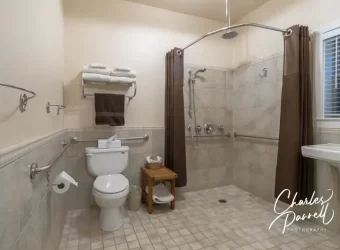
Bathroom at the Olea Hotel in Glen Ellen, California
If an article gives little more than the catch phrase “ADA compliant” as the entire access description for a hotel, chances are the writer didn’t visit the property. Additionally, since the average traveler has no idea of the actual ADAAG regulations (https://www.access-board.gov/ada/), that phrase is pretty meaningless. For example, let’s say you are looking for a hotel with a roll-in shower and you read in an article that a certain hotel is “ADA compliant”. Chances are you’d probably assume that hotel has a roll-in shower — and that assumption might be incorrect. According to the ADAAG, only hotels with over 50 rooms are required to have accessible rooms with roll-in showers; so if the hotel only had 45 rooms that “ADA compliant” property would probably only have accessible rooms with tub/shower combinations. And a detailed access description — instead of a short catch phrase — would have clarified that fact.
Don’t automatically rule out an article that includes archaic — by US standards — terminology, like “handicapped” and “infirmed”. Although it would tend to show a lack of understanding if these words were used by someone in the US, they are the norm in some developing countries. Look beyond the words for a true understanding of access issues.
For example if the article assumes that all wheelchair-users can walk and that one or two steps won’t be a problem, then that person does not understand the realities of life in a wheelchair. Moreover, that lack of understanding will most likely result in an inappropriate evaluation of the access. On the other hand, if you find an article by someone who doesn’t quite get the language right, but still has a good understanding of access needs, it may actually provide some important access information on a less-touristed region of the world.
Accessible Red Bus in Glacier National Park, Montana
In order to evaluate access, you need to look at the big picture. Be cautious of destination articles that don’t include access information about ancillary services, such as public transportation. If the author has traveled to the area, they most certainly know about the availability of accessible public transportation, and understand the importance of including this detail in the article.
I’ve seen many an accessible travel article filled with flowery prose, about areas that I know have no accessible public transportation. The authors mention the sandy beaches and gorgeous sunsets, yet fail to acknowledge there is no accessible way to get from the airport to the hotel. Conversely, watch out for articles that claim a destination is accessible because it has an accessible bus system, yet lacks any concrete access details about lodging or attractions.
Finally be wary of roundup articles and listicles. These short pieces are all the rage with editors today, and most have a catchy title like “25 of the Best places to X”. Although they are fun to read, they generally contain very little substantive information; as the writer usually didn’t visit the destinations.
Instead these articles are filled with access information gleaned from the internet and combined with flowery prose from tourist brochures. That said, some legitimate travel writers — myself included — sometimes pen roundup pieces that contain useful access information. In the end, the key is in the access details — look for them. If they are missing or glossed over, that article is probably chock full of misinformation.
If you are looking for wheelchair-accessible airport transfers in Puerto Vallarta, then look no further than Puerto Vallarta Transportations (puertovallartaairporttransportation.com/puerto-vallarta-handicap-transportation). This local transportation provider has a ramped van that can accommodate even the largest power wheelchair and scooter. Wheelchair-users can stay in their own wheelchairs (and use the tie downs) or opt to transfer to the van seat. The van can accommodate one wheelchair-user and five other passengers, or two wheelchair-users and three other passengers. Top it off with bi-lingual drivers, and an accessible van with plenty of room for all your luggage, and you have a winning combination. For more information about wheelchair-accessible airport transfers in Puerto Vallarta, visit the Puerto Vallarta Transportations website or drop them an e-mail at info@puertovallartaairporttransportation.com.
Named for the prolific yucca plant that’s found within its borders, Joshua Tree National Park features two distinct desert ecosystems within its 800,000-acre expanse. From cholla and ocotillo cactus, to unusual rock formations sculpted by the harsh desert winds and torrential rains, this Southern California national park is filled to the brim with unique plants and animals. And although the landscape may appear a bit foreboding, rest assured there are a number of wheelchair-accessible trails and attractions in this desert wonderland. Add in a nice collection of scenic drives that offer some some jaw-dropping windshield views, and you have an excellent choice for wheelchair-users and slow walkers.
Insider Tips
The Oasis of Mara, which is located near the North Entrance, offers an accessible half-mile loop trail. Honey mesquite trees dot the desert landscape, which is bordered by mountains in the distance, while a ring of California Fan Palms mark the presence of water — the oasis. Be sure to take a close look in the underbrush near the palms for some Gambel’s Quail, as it’s one of their favorite haunts.
Located on Pinto Basin Road, just a few miles south of the Park Boulevard intersection, the Cholla Cactus Garden boasts a quarter-mile trail through a mature cholla forest. There are a few ruts here and there, but for the most part, they are pretty easy to dodge. There’s also a one-inch lip up to the boardwalk sections of the trail, but most folks can manage it with a little assistance. Even if you can’t do the whole trail, you’ll be surrounded by chollas just by walking 10 feet into the forest.
The Bajada Nature Trail, which is located in the south area of the park, is the oldest accessible trail in the park. This quarter-mile trail passes through the bajada — a broad slope of alluvia material at the base of a mountain — and offers a wonderful view of the surrounding desert. There are interpretive plaques along the way, and although there are a few sandy patches here and there, all-in-all this 1998 “all access trail” has held up fairly well.
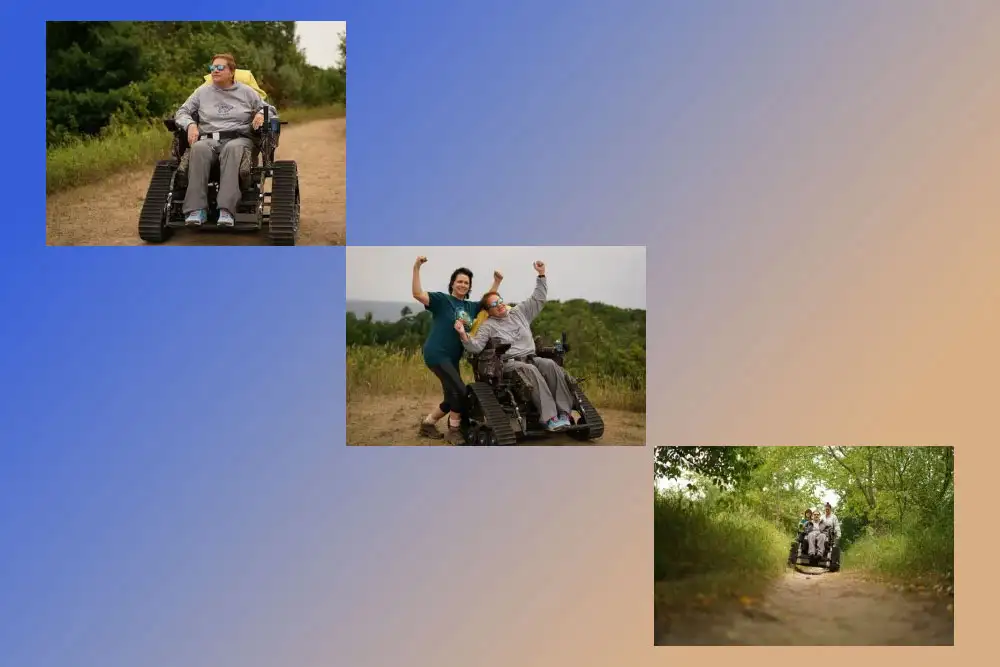
If you’ve thought of visiting a Minnesota State Park, but felt you couldn’t navigate the terrain, then check out these loaner track chairs available at Minnesota State Parks. Unlike standard wheelchairs, these power track chairs have tank tracks rather than wheels, and they are excellent for use on inaccessible trails.
There’s no charge to borrow a track chair, but track chair-users will be required to sign a liability waiver. No verification of disability — such as an accessible parking placard or doctor’s note — is required. Although all locations have a transfer board, park staff are not allowed to assist with transfers, so if you can’t transfer independently you’ll need to bring along assistance. And don’t forget to pack along a water bottle and some snacks, as they are not usually available along the more rugged trails.
Advance reservations are required, so call the park directly to make sure the track chair is available on your desired date. Track chairs are available at the following Minnesota State Parks.
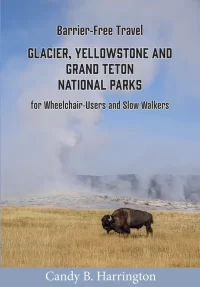
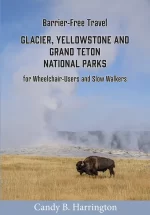
If you’re planning a Western States road trip and are wondering about wheelchair access in Yellowstone, Glacier and Grand Teton National Parks, then be sure and pick up a copy of Candy B. Harrington’s newest access guide, Barrier-Free Travel; Glacier Yellowstone and Grand Teton National Parks for Wheelers and Slow Walkers. Be it a three-day getaway to a single park, or a two-week adventure to all three national parks, this handy resource includes the detailed information and authoritative resources needed to help slow walkers and wheelchair-users plan the perfect visit.
Wheelchair Access in Yellowstone, Glacier and Grand Teton
This comprehensive second edition includes:
Accessible trail and attraction information
Photos and access details of all in-park lodges
Accessible lodging options in gateway communities
Barrier-free campgrounds
Accessible bus, snowcoach and boat tours
Accessible shuttles to and around the parks
Insider access tips
Fly-drive suggestions with accessible rental vehicle resources
National park discounted pass information
This inclusive title is the most recent addition to Harrington’s national park series; and although it’s written for wheelchair-users and slow walkers, stroller moms will also appreciate the access information in this guide. It will help everyone plan a truly accessible Yellowstone, Glacier and Grand Teton National Park road trip.
Says Harrington, “I’m especially excited about the accessible lodging improvements since the first edition of this title. Mammoth Hot Springs Hotel renovated their main lodge rooms, and they now have five accessible guest rooms, including three with roll-in showers. And outside of the parks, there are some excellent accessible choices at two new properties — William Bridger Cabins in Gardiner and West Glacier Cabin Village.”
According to Harrington, park concessionaires are placing an increased emphasis on accessibility. “From Xanterra’s accessible Glacier Red Bus Tours to the accessible boat tours down in Grand Teton offered by Jenny Lake Boating, there really are a lot of options for slow walkers and wheelchair-users in the parks,” she notes.
If you’re looking for wheelchair-accessible transportation in Budapest, then look no further than Paratrans (paratrans.hu/en). This local company can provide an accessible vehicle with a driver who is familiar with the city, for airport or rail station transfers as well as city excursions. Their Renault Master is outfitted with a ramp and tie downs, and it can accommodate three wheelchair-users and five additional passengers. And if you need room for another wheelchair, it can be reconfigured to accommodate four wheelchair-users and four additional passengers. For more information about wheelchair-accessible transportation options in Budapest, call Paratrans at +36 30 900 1603 or e-mail them at info@paratrans.hu.