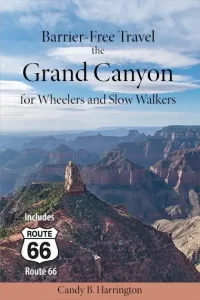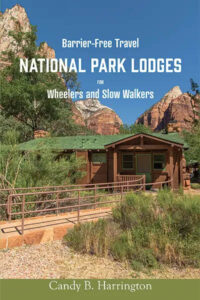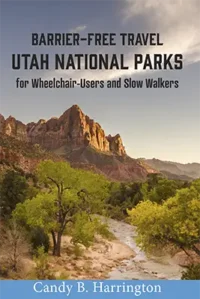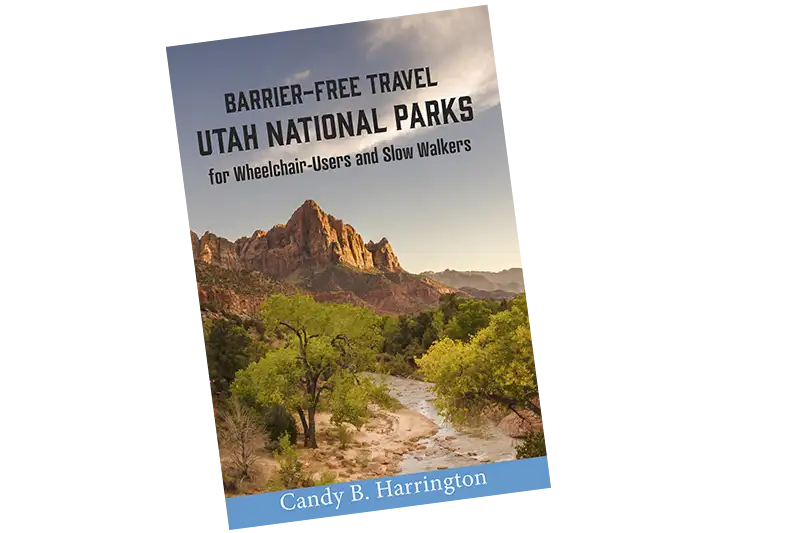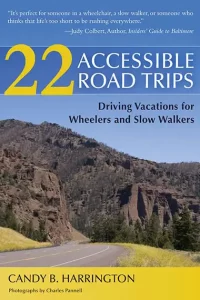
If you’re planning to visit Utah’s Mighty Five National Parks, and wondering if they are wheelchair-accessible, then pick up the newest edition of Candy B. Harrington’s Barrier-Free Travel; Utah National Parks for Wheelchair-Users and Slow Walkers. This essential resource offers essential insider tips to plan a wheelchair-accessible Utah national parks getaway.
Wheelchair-Accessible Utah National Parks
This new edition includes:
Updated information on new access additions.
Fly-drive trip planning information, including accessible van rentals.
Access details and photographs of 33 wheelchair-accessible properties, including all in-park lodging options.
Information about ranger-led tours, loaner wheelchairs and the free America the Beautiful Access Pass.
The scoop on how to nab free accessible bus tours in Bryce Canyon National Park and Zion National Park.
Detailed access information on accessible trails, viewpoints, picnic areas and attractions — in and near the parks.
Information about barrier-free camping options in all the parks.
Insider tips on where to go for the best windshield views, accessible picnic spots and sunset photos.
This inclusive title is the most recent addition to Harrington’s national park series; and although it’s written for wheelchair-users and slow walkers, stroller moms will also appreciate the access information in this guide. It will help everyone plan a truly accessible Utah national parks vacation.
Says Harrington, “I’m very excited to report that Utah National Parks not only added more accessible features since my last edition, but they also maintained the ones they already had. I’m particularly happy to see the access improvements in the Pa’rus Trail as well as the continued upkeep of the accessible Bryce Canyon Shared Use Path.”
For more information wheelchair access in Utah’s National Parks, visit emerginghorizons.com/barrier-free-travel-utah-national-parks-for-wheelchair-users-and-slow-walkers/ and order your copy of Harrington’s newest access resource today.
Barrier-Free Travel Utah National Parks for Wheelchair-users and Slow Walkers
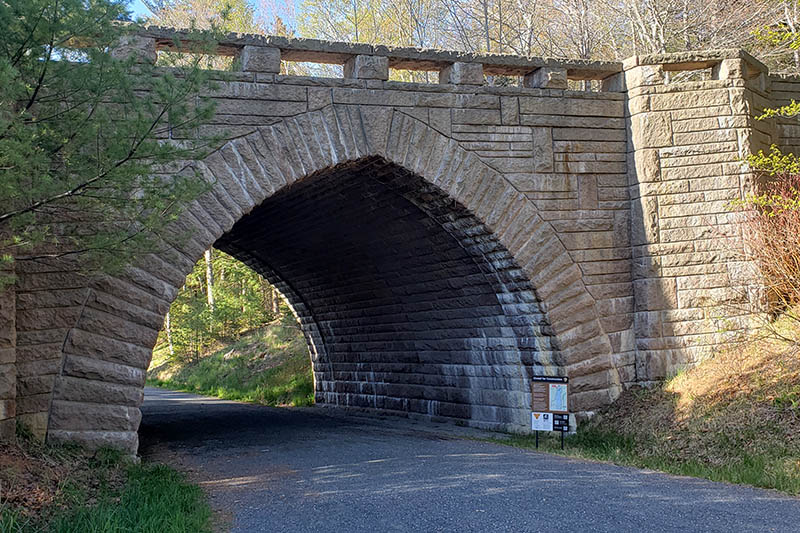
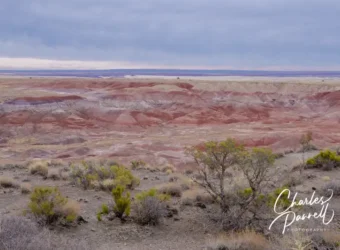
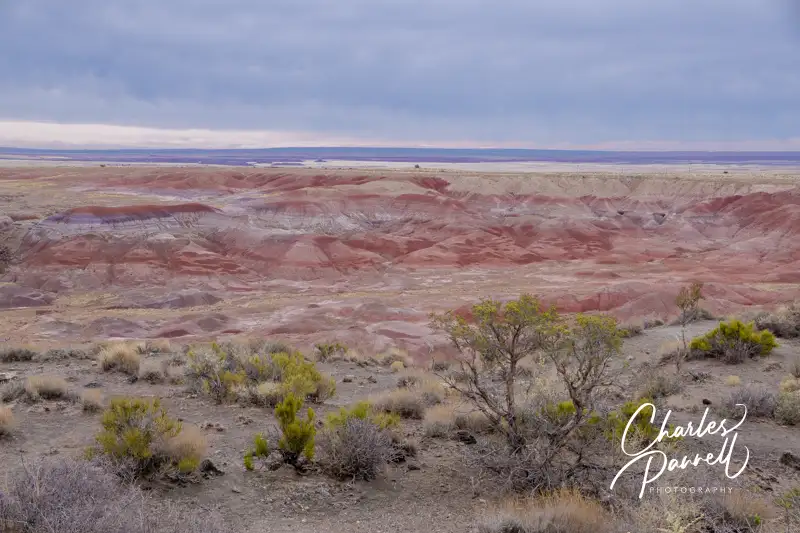
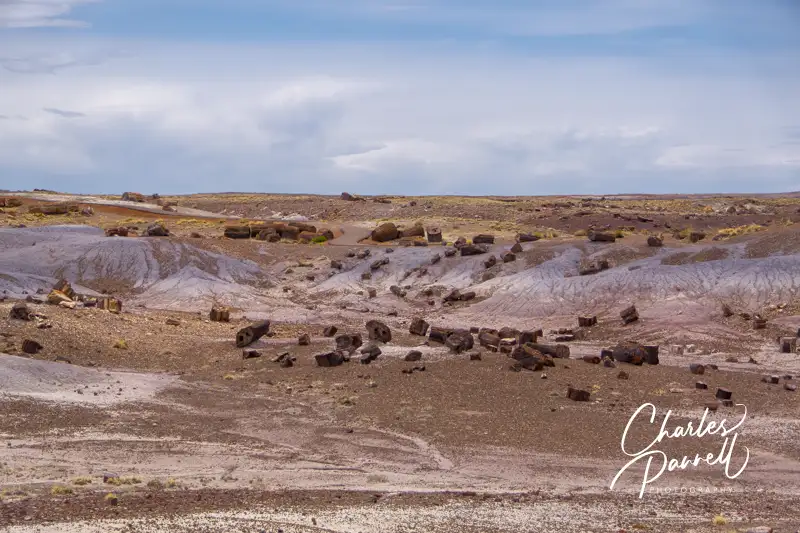
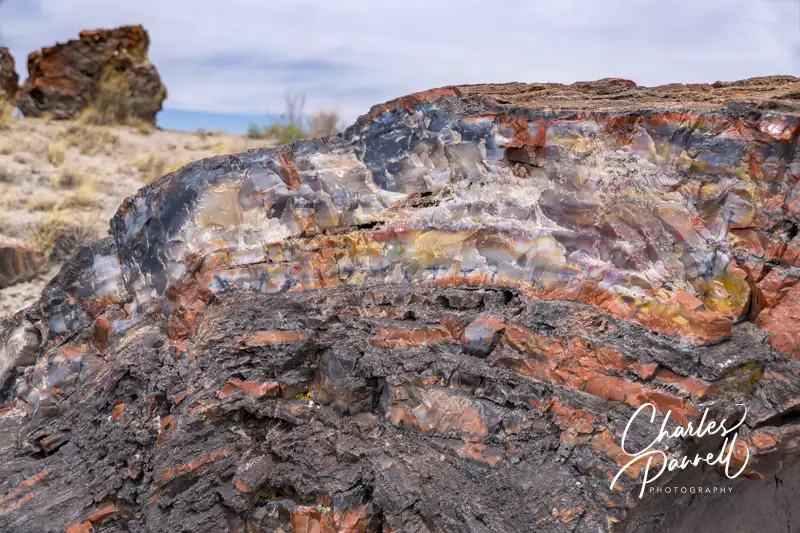
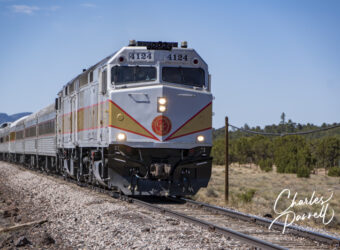
Located about an hour east of Winslow, Petrified Forest National Park (www.nps.gov/pefo/) boasts the largest concentration of petrified wood in the world. Not only does this Arizona gem offer some dazzling desert scenery, but it also includes a number of accessible trails and overlooks for wheelchair-users and slow walkers. And since the park is located right off Interstate 40, it’s an excellent addition to any Grand Canyon road trip.
The Basics
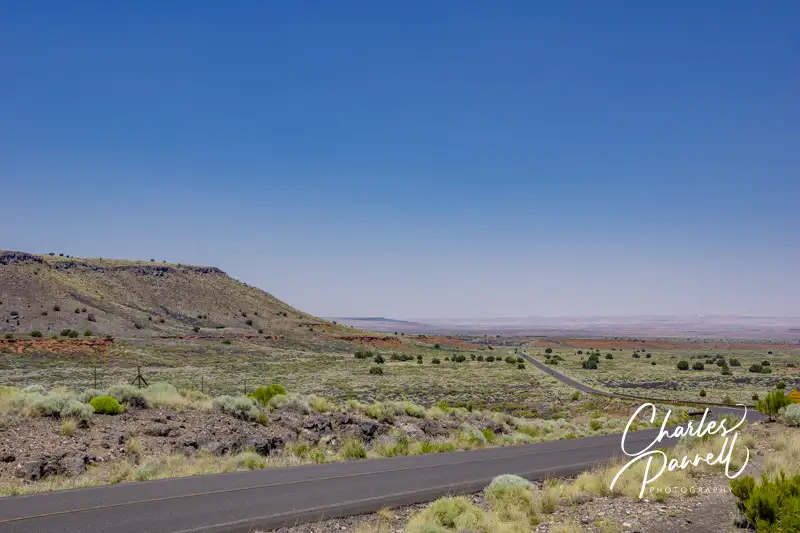
Windshield View on Highway 180
It’s easy to do a one-way jaunt through the park, stop at a few trails and viewpoints along the way, then reconnect to the highway and continue on your journey. If you’re traveling east, take the Highway 180 exit (exit 285) and use the south entrance of the park; and if you’re traveling west, take exit 311 and use the north entrance. Either way, after you’ve explored the 28-mile route, it’s simple to hop back on the interstate.
The whole drive takes an hour without any stops, and although there are some wonderful windshield views along the way, there are also some very scenic turnouts and sights that are definitely worth a stop. It should also be noted that the gates to this national park open at 8:00 a.m. and close at 5:00 p.m., so plan accordingly to avoid disappointment.
The Painted Desert Visitor Center, which is located near the north entrance, makes a good first stop in the park. Accessible parking is located near the entrance, with level access to the building. Inside there’s a small gift shop, a ranger information desk and accessible restrooms. Pick up a park map, then head out to explore this national treasure.
Views and More
View at Tawa Point
Although there are no shortage of scenic views in the Petrified Forest National Park, make sure and stop at Tawa Point, just past the north entrance, for that first expansive view of the Painted Desert. Accessible parking is located near curb-cut access up to a short .1-mile paved trail out to the viewpoint. The last 20 feet of this path is a bit steep for manual wheelchair-users; however you can get a good view of the colorful desert from any place along the trail, or even from the parking lot.
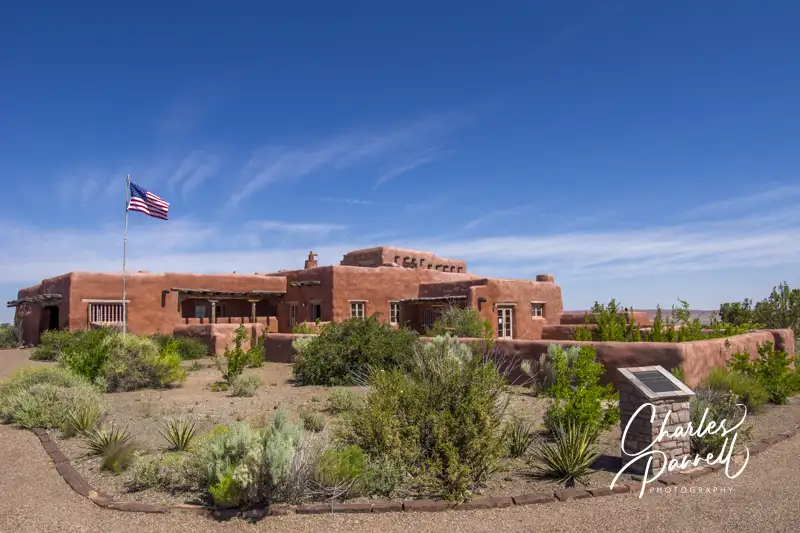
The Painted Desert Inn, which is located just a half-mile up the road, is also worth a stop. This former Harvey House features accessible parking, and level access to the building. There inn houses a number of historic exhibits, but you just can’t beat the panoramic desert view from the second floor of this split-level structure. Additionally, there’s a 300-foot paved level pathway out to nearby Kachina Point, which offers an equally impressive desert view.
Painted Desert Inn
Another worthwhile stop is Puerco Pueblo, which is a few miles up the road, just past the railroad tracks. Accessible parking with curb-cut access up to the sidewalk is located near the accessible vault toilets. From there it’s about a 200-foot walk out to a .3-mile paved trail that circles the ruins of these ancestral Puebloan homes which were occupied from 1250 to 1380.
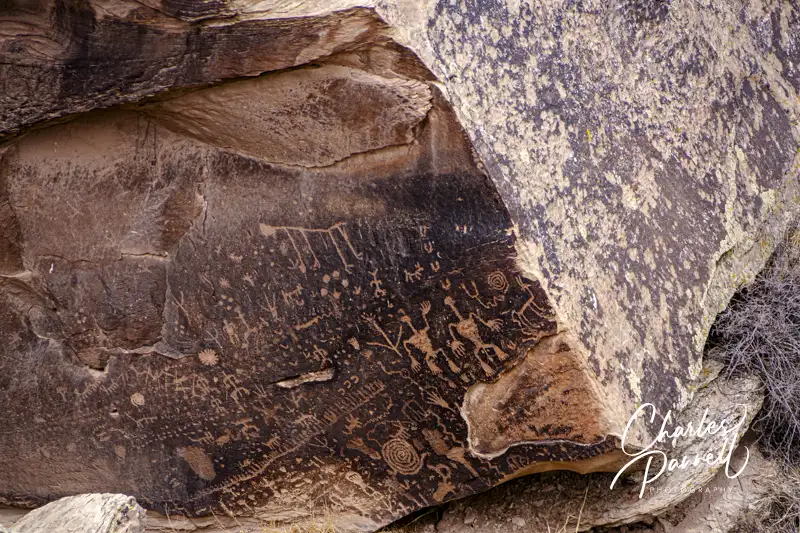
And don’t miss Newspaper Rock, which is short drive down the road. That site features a 200-foot paved level trail out to some Puebloan petroglyphs, which were created 2,000 years ago. There’s an accessible spotting scope at the overlook, which offers a good view of the 650-plus petroglyphs.
Petroglyphs on Newspaper Rock
Petrified Wood Galore
Crystal Forest
There’s also a substantial collection of petrified wood sites — such as the Crystal Forest — along the main park road. Although a paved .8-mile trail leads past the petrified logs at this site, it’s got a section or two of 20% grade, so it’s not a good choice for wheelchair-users and slow walkers. That said there is a 400-foot paved level path that leads out to the trailhead, that offers a good overview of the remains of this ancient forest.
Rainbow Forest Visitor Center
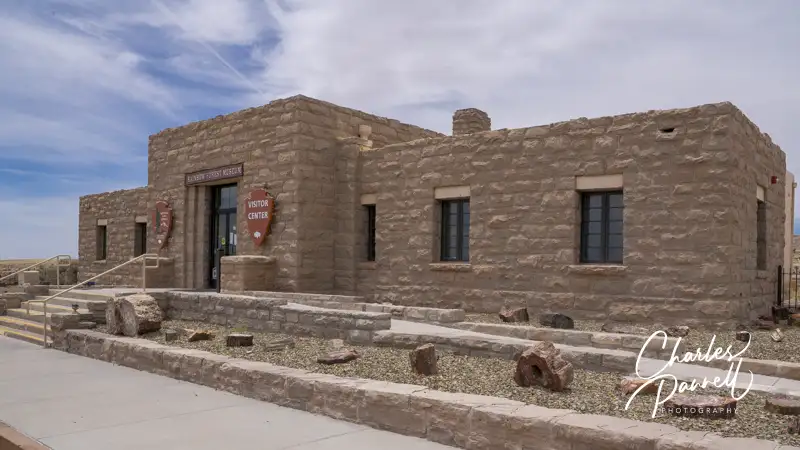
Finally, don’t miss the Rainbow Forest, which is located just north of the south entrance. There’s accessible parking near the Rainbow Forest Visitor Center, with ramp access up to the front door. Inside there’s barrier-free access to the interpretive exhibits, ranger information desk and accessible restrooms. There’s also plenty of room for wheelchairs and scooters in the theater, where a movie about the park is shown throughout the day.
The Giant Logs Trail is located out back, and although this paved trail starts out level, the access ends 600 feet later at the Mather plaque, where steps block the rest of the route. Still, there’s a good view of the site from this point, or even from the back of the visitor center.
And if you’d like to grab a bite to eat before you hit the road, stop in at the curio shop at the far end of the parking lot. There’s level access to the shop, which offers snack items, gifts and souvenirs. All in all, Petrified Forest National Park is well worth the short detour off the interstate.
Planning a family reunion can be quite a challenge, especially if it’s a multi-day event that requires overnight lodging. On the other hand, a large house or cabin allows folks to visit and reminisce for the entire weekend. And although finding a reunion house is one thing, finding one that is wheelchair-accessible can be an added challenge. And in that respect Stanford House (www.conservancyforcvnp.org/experience/plan-your-visit/retreats-lodging/) — which is located in Northeastern Ohio’s Cuyahoga Valley National Park (https://www.nps.gov/cuva/index.htm) — fills the bill perfectly.
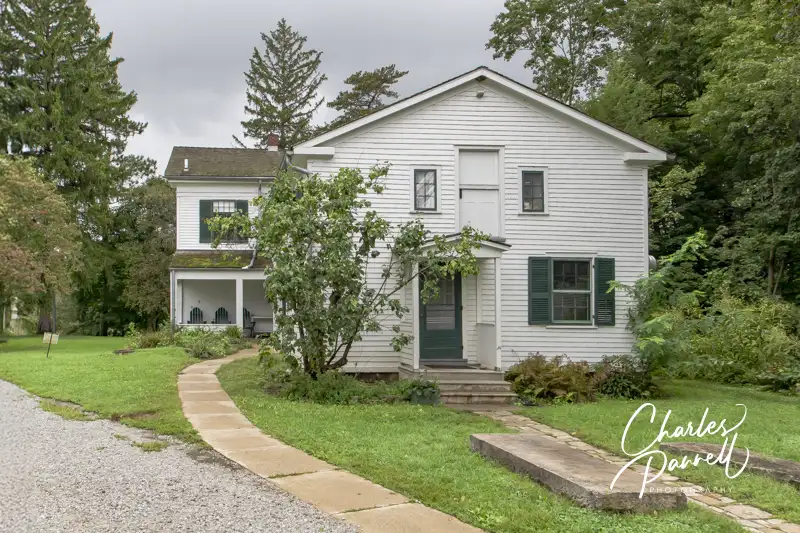
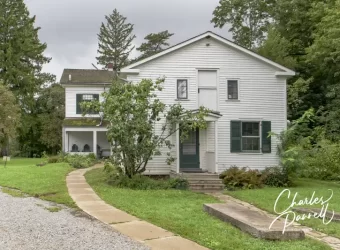
Historic Stanford House
Located near Boston Mills Visitor Center, Stanford House was built in 1843 and can accommodate up to 30 overnight guests. And the good news is, access features have been added over the years to this historic home, so today it’s a great multigenerational lodging choice.
There’s accessible parking in front of the two-story home, and a barrier-free pathway over to the front porch. The grand old home features wide doorways, wood floors, good pathway access and wheelchair access on the first floor. The home is decorated with vintage wallpaper, stately wood moldings and historic chandeliers; while several comfortable rocking chairs line the accessible front porch.
The living room is furnished with a sofa, two love seats, a settee and a few chairs; and there’s still plenty of room to maneuver a wheelchair or scooter around the period pieces and reproductions.
Living Room in the Stanford House
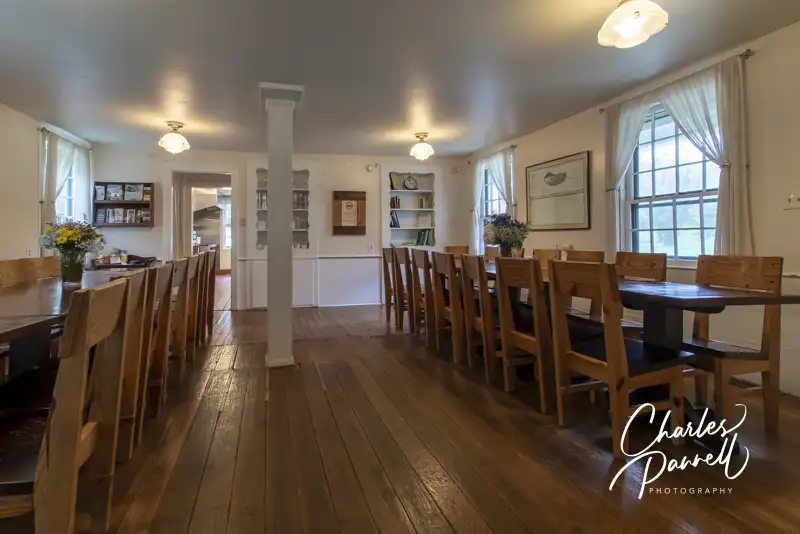
The dining room is massive and it includes two long wooden tables which each can each seat 30 people. There’s a small hutch which is filled with cups, plates, glasses and dishes; and the adjacent commercial kitchen is equipped with a refrigerator, freezer, microwave, and just about every small appliance and utensil you can imagine. And if you’d like to dine outside, there’s level access to a picnic table on the lawn, and the nearby fire circle.
Dining Room in the Stanford House
Access Features Galore
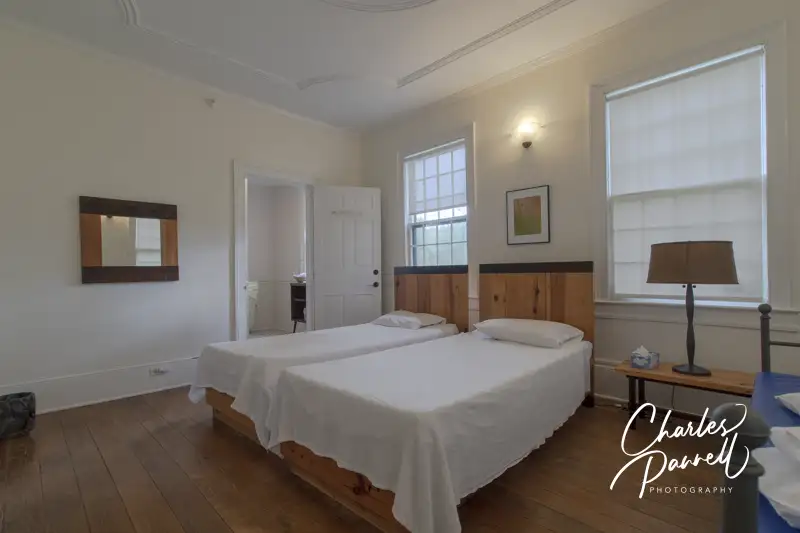
Although the bulk of the dormitory style sleeping areas are located upstairs, there’s also a wheelchair-accessible suite located on the first floor. It’s furnished with two 19-inch high twin beds (which can be pushed together) with access on both sides, as well as a trundle daybed. Truly wheelchair-users have their choice of beds in this home. Top it off with a lowered bedroom mirror and you have a nice accessible room.
Ground Floor Accessible Suite
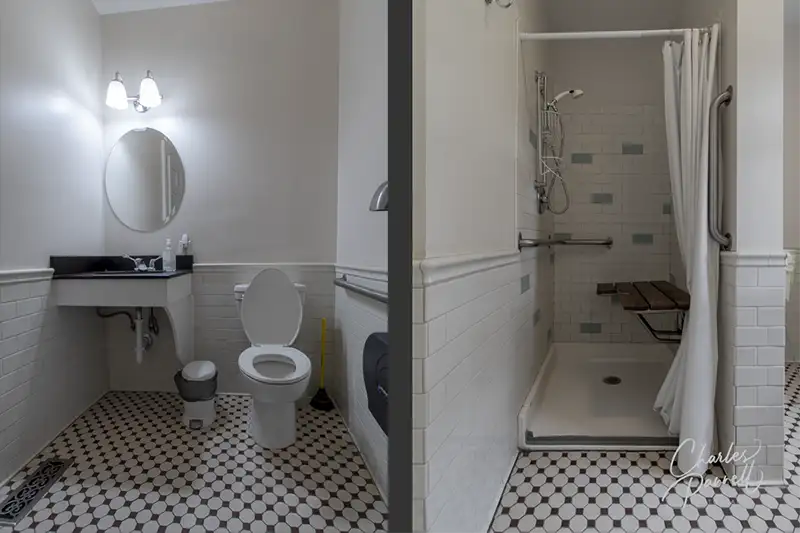
The adjacent bathroom features a full five-foot turning radius and is equipped with a 36-inch square transfer-type shower, with a fold-down shower bench, grab bars and a hand-held-showerhead. There’s ample floor space in front of the shower to transfer to the shower bench, and level access to roll-in to the unit. Other bathroom access features include a roll-under sink, and a toilet with a grab bar on the left side (as seated).
Bathroom in the Ground Floor Accessible Suite
The access features are well done, and truly this wheelchair-accessible suite will work for folks with a wide range of mobility disabilities. Additionally, the home is secluded and private, so your group will have the area all to yourself.
Explore Cuyahoga Valley National Park
Boarding the Cuyahoga Valley Scenic Railroad
Stanford House also makes perfect home base for daily jaunts to some of Cuyahoga Valley National Park’s accessible attractions. At the top of the list is the Canal Exploration Center, which is located on the north end of the park. There’s accessible parking with level access to the front entrance of this former 1800s tavern, which now houses a store and an information center. And since the paved wheelchair-accessible towpath runs right in front of the building, you can take an accessible hike in either direction.
Brecksville Nature Center, which is located near the Station Road Bridge, is also worth a stop. Accessible parking is located next to an accessible picnic table, so pack along a lunch and enjoy a midday break. From there it’s a .15-mile walk on an accessible trail to the nature center. Accessible restrooms are located next door, and there’s level access to the nature center, which features a number of interpretive exhibits. The building also boasts floor-to-ceiling windows that overlook the garden bird feeders. It’s an excellent place to sit back and enjoy some of the 200-plus different avian visitors that have been spotted in the park.
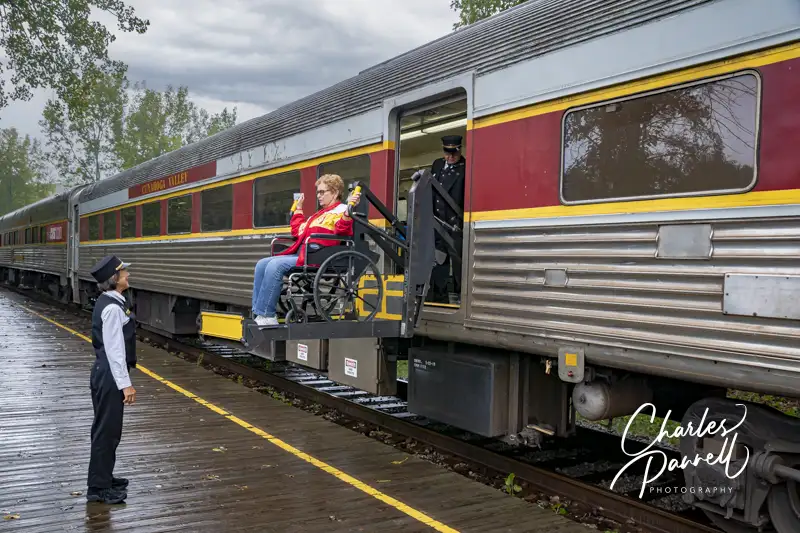
And don’t miss a ride on the Cuyahoga Valley Scenic Railroad (www.cvsr.org). The three-hour scenic excursion winds through the park, and offers visitors a good overview of the area. Even better, the train has a lift-equipped car with plenty of wheelchair seating, and an accessible restroom. The trip begins at the Rockside Station in Independence and heads south along the Cuyahoga River, before it winds its way down to the Akron Northside Station. After that, it turns around and heads back to the Rockside Station. It’s a great way to explore Cuyahoga Valley National Park, and you just can’t beat the views.
With 63 parks in the US National Park System, it’s really hard to choose a favorite. That said, wheelchair-access plays a big part in my top choices. But there has to be more than just access to a visitor center or a few overlooks to make my list. Diversity also plays into my choices, but so does the quality of the visit. Accessible overnight lodging has to be in that mix too.
And let’s not forget about the price of popularity. Sadly, with so many visitors flocking to some of these national treasures, sometimes it feels like you are lined up for a popular ride at an iconic theme park at some national parks. That definitely takes away from the natural experience. So taking that all these factors into consideration, here are my five favorite wheelchair-accessible national parks .
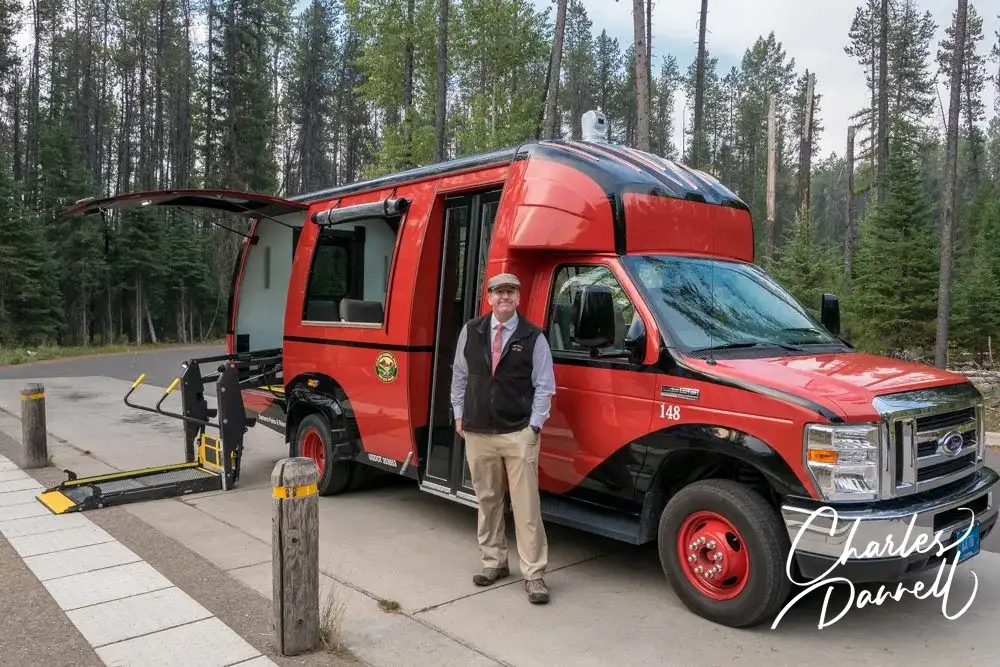
Glacier National Park (emerginghorizons.com/barrier-free-travel-glacier-yellowstone-and-grand-teton-national-parks-for-wheelchair-users-and-slow-walkers/#itin-1) tops my list of wheelchair-accessible national parks, not only for the beautiful scenery and variety of accessible lodging choices, but for its ease of access without a vehicle. That’s right, you can take the Amtrak Empire Builder to this iconic national park, and then hop on the visitor shuttle to your in-park lodge and then book a Red Bus tour to see the park. And the good news is, that all of these transportation options are wheelchair-accessible. Plus, you don’t have to worry about getting an entrance reservation (emerginghorizons.com/national-park-entrance-reservations-required-in-2024/) if you stay in the park. So ditch your car and visit this Montana gem this summer!
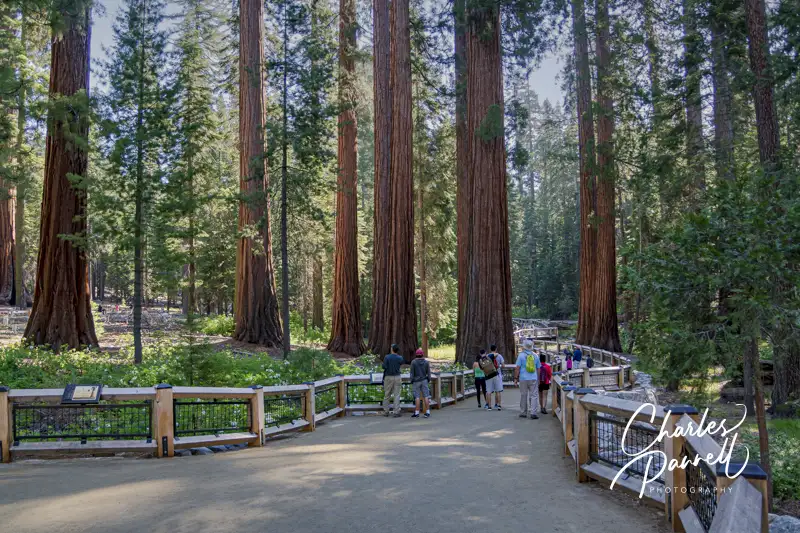
Big Trees Loop at Mariposa Grove in Yosemite National Park
Yosemite (emerginghorizons.com/barrier-free-travelyosemite-sequoia-and-kings-canyon-national-parksfor-wheelers-and-slow-walkers/#itins holds a special place in my heart, as I grew up near there and spent a good chunk of my adult life in the area. Nothing beats the grandeur of Yosemite Falls or Half Dome; however Yosemite Valley can get extremely crowded, even in the off season. One way to dodge some of the crowds is to plan an excursion to a non-valley site. And my top pick for that is Mariposa Grove. Located near the South Entrance of the park, Mariposa Grove is home to over 500 mature giant sequoias. And thanks to upgrades over the years, there are two wheelchair-accessible trails through this often overlooked corner of the park.
Next up on my list of favorite wheelchair-accessible national parks is Shenandoah National Park. This Northwestern Virginia national park is chocked full of beautiful views, and the wildflower blooms in the summer are absolutely gorgeous. There’s also a beautiful 1.3-mile accessible trail that runs through a wooded area and over a boardwalk. And the trail is close to Skyland, an excellent choice for wheelchair-accessible lodging. The property boasts a spacious accessible room with a roll-in shower and the restaurant offers more great views. It’s the perfect spot to unwind and spend a night or two.
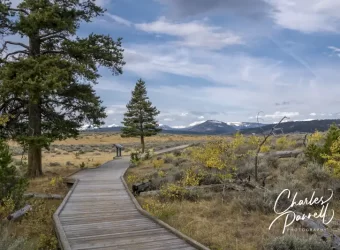
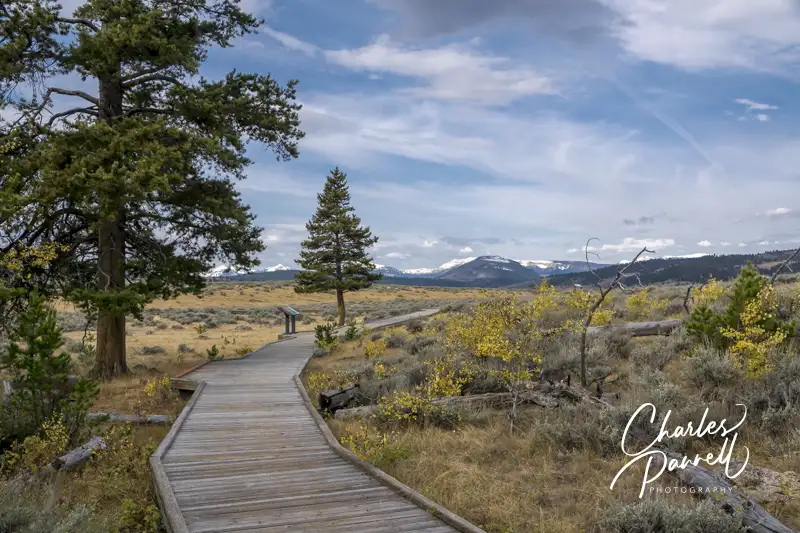
Forces of the Northern Range Boardwalk in Yellowstone National Park
I love Yellowstone National Park (emerginghorizons.com/barrier-free-travel-glacier-yellowstone-and-grand-teton-national-parks-for-wheelchair-users-and-slow-walkers/#itin-1), and I’m not alone with that opinion. It’s an incredibly busy national park. That said, if you get there early you can enjoy a somewhat uncrowded experience at Old Faithful, one of the park’s biggest draws. But there’s much more to see beyond the iconic geyser, and even a few places that are a little off-the-beaten-path. Some of my wheelchair-accessible favorites are West Thumb Geyser Basin, Frying Pan Spring and the Forces of the Northern Range Boardwalk. And one of my friends even had an accessible hunting adventure there (emerginghorizons.com/a-disabled-hunting-adventure-stalking-big-game-out-west/). Truly, they sky’s the limit as far as accessible things to do in the nation’s first national park.
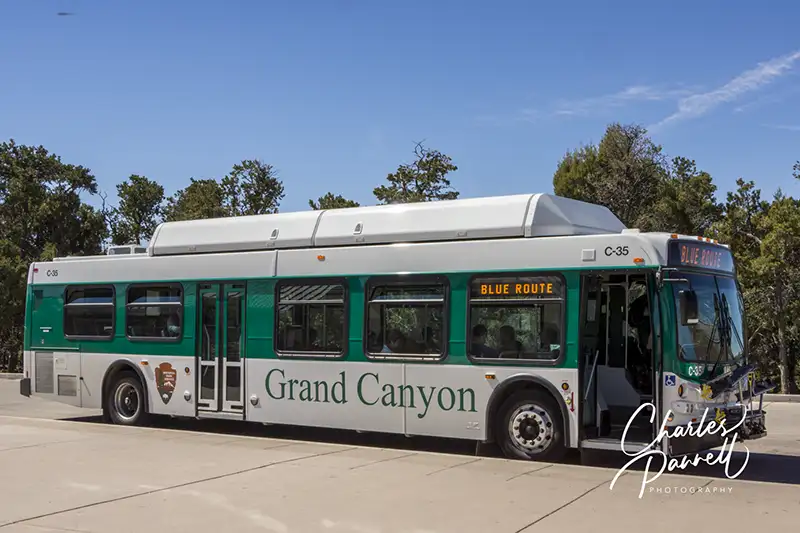
Rounding out my list of favorite wheelchair-accessible national parks is and oldie but goodie — Grand Canyon National Park (emerginghorizons.com/the-grand-canyon-for-wheelers-and-slow-walkers/#itin-1). More specifically, the South Rim of this iconic national park. I love it not only because of the accessible canyon views and lodging options, but also because it’s another national park that you can see without a car. You can take Amtrak’s Southwest Chief to Flagstaff and connect with an accessible shuttle to the park. Alternately, you can take an Amtrak thruway bus to Williams and hop on the equally accessible Grand Canyon Railway and ride it to the park. Add in an overnight at the Grand Canyon Railway Hotel, and you have a truly accessible car-free Grand Canyon package. And once you’re in the park, there’s an accessible shuttle that stops at the most popular South Rim sites. Enjoy the scenery and leave the driving to someone else in this beautiful national park.
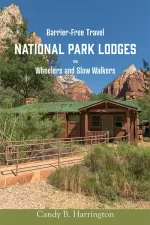
Barrier-Free Travel National Park Lodges for Wheelers and Slow Walkers
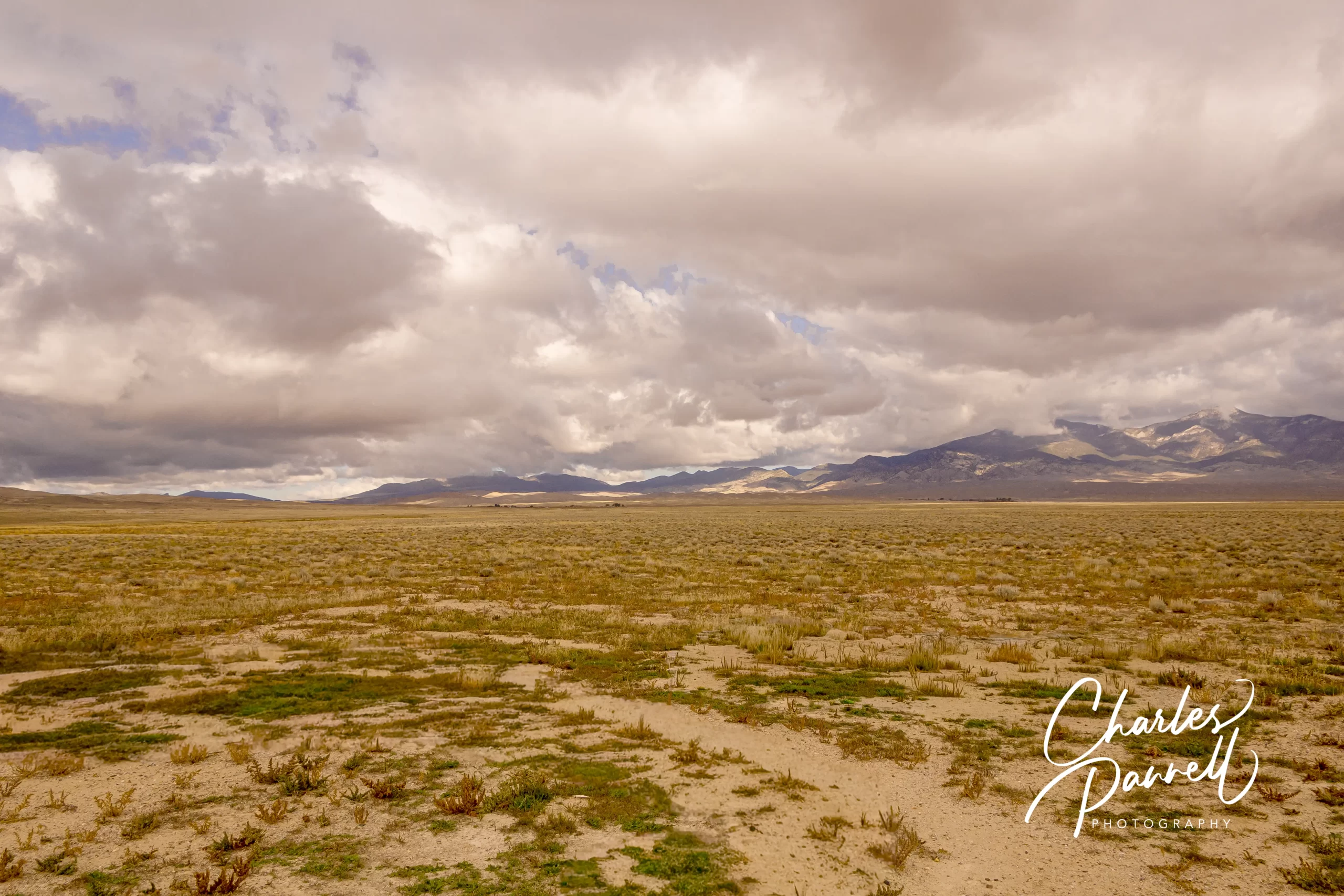
Located just off what’s often been called “the loneliest road in America”, Great Basin National Park (nps.gov/grba/) is the epitome of remote. Named for the dry and mountainous basin between the Sierra Nevada and Wasatch mountain ranges, this Eastern Nevada national park offers a diverse landscape, from subterranean caverns to high alpine peaks. And as one of America’s least visited national parks, it’s the perfect place to take a welcome break from hectic city life. The good news is, even though parts of this park are quite rugged, it still offers plenty of places for wheelchair-users and slow walkers to admire Mother Nature’s handiwork.
Get Your Bearings
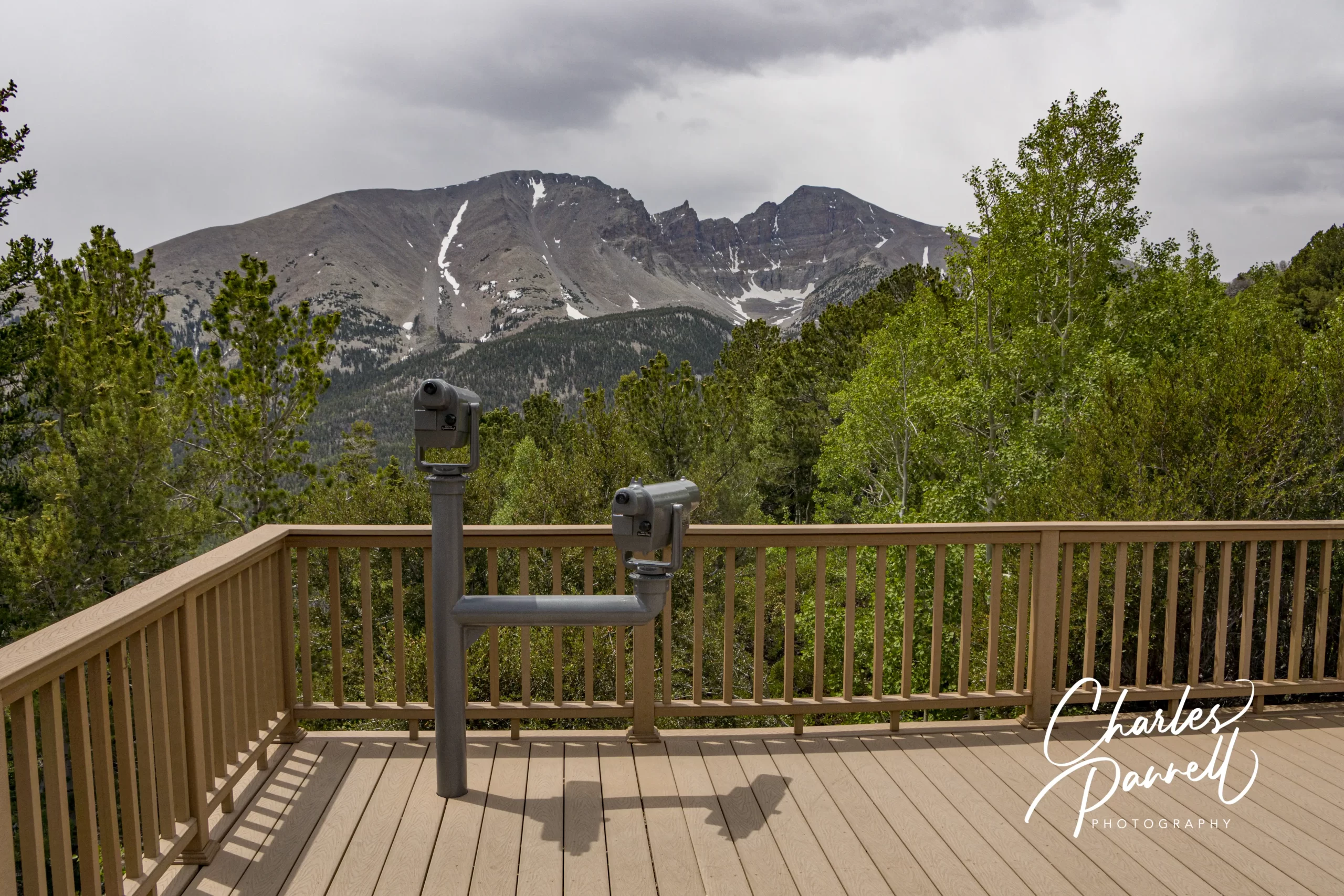
Wheeler Peak Viewpoint
One of the most accessible ways to enjoy Great Basin National Park is to take the 12-mile scenic drive up to Wheeler Peak. The best place to begin your adventure is at the Great Basin Visitor Center, located on Highway 487 in Baker. There’s accessible parking in front, with level access to the visitor center. Inside there’s plenty of room to navigate a wheelchair around the interpretive exhibits. This is a good place to get your bearings, pick up a park map and get first-hand information from the rangers on duty.
From the visitor center, continue along Highway 488 until you reach the park. Just past the park entrance, make a right turn on Wheeler Peak Scenic Drive. This winding road hugs the mountain as it passes through several ecosystems on the way to the summit. The landscape is dotted with sagebrush, before it gives way to a pinion juniper woodland, and then transforms into a conifer forest. There’s no shortage of great windshield views along the way, and there are several scenic viewpoints where you can admire the sweeping vistas. And although the road is paved, the average grade is eight percent, and vehicles and trailers longer than 24 feet are prohibited. On the plus side, that means you won’t see any tour buses at the top.
Enjoy the View
Sky Island Forest Trail
There are several scenic viewpoints along Wheeler Peak Scenic Drive, that are definitely worth a stop. First up on the drive is the Osceola Ditch trailhead, which is located just past Lehman Creek campgrounds. There’s plenty of room to parallel park in the asphalt pullout, with level access over to the interpretive panel about the Osceola Ditch. This 18-mile flume dates back to 1890, when it was built to carry water to the nearby gold mining operation. Although the mines saw some success in the beginning, they shut down in 1905, but some remnants of the Osceola Ditch still stand.
Just up the road you’ll find two viewpoints which offer great views of the vast Great Basin. Mather Overlook is just a short drive off the main road, and it features level access to the viewing deck, which has a wheelchair-height scope. There is also an accessible vault toilet and a picnic table on a cement pad at this overlook. Wheeler Peak Overlook also offers level access to a viewing deck with a wheelchair-height scope, where you’ll get an excellent view of the Wheeler Peak Glacier.
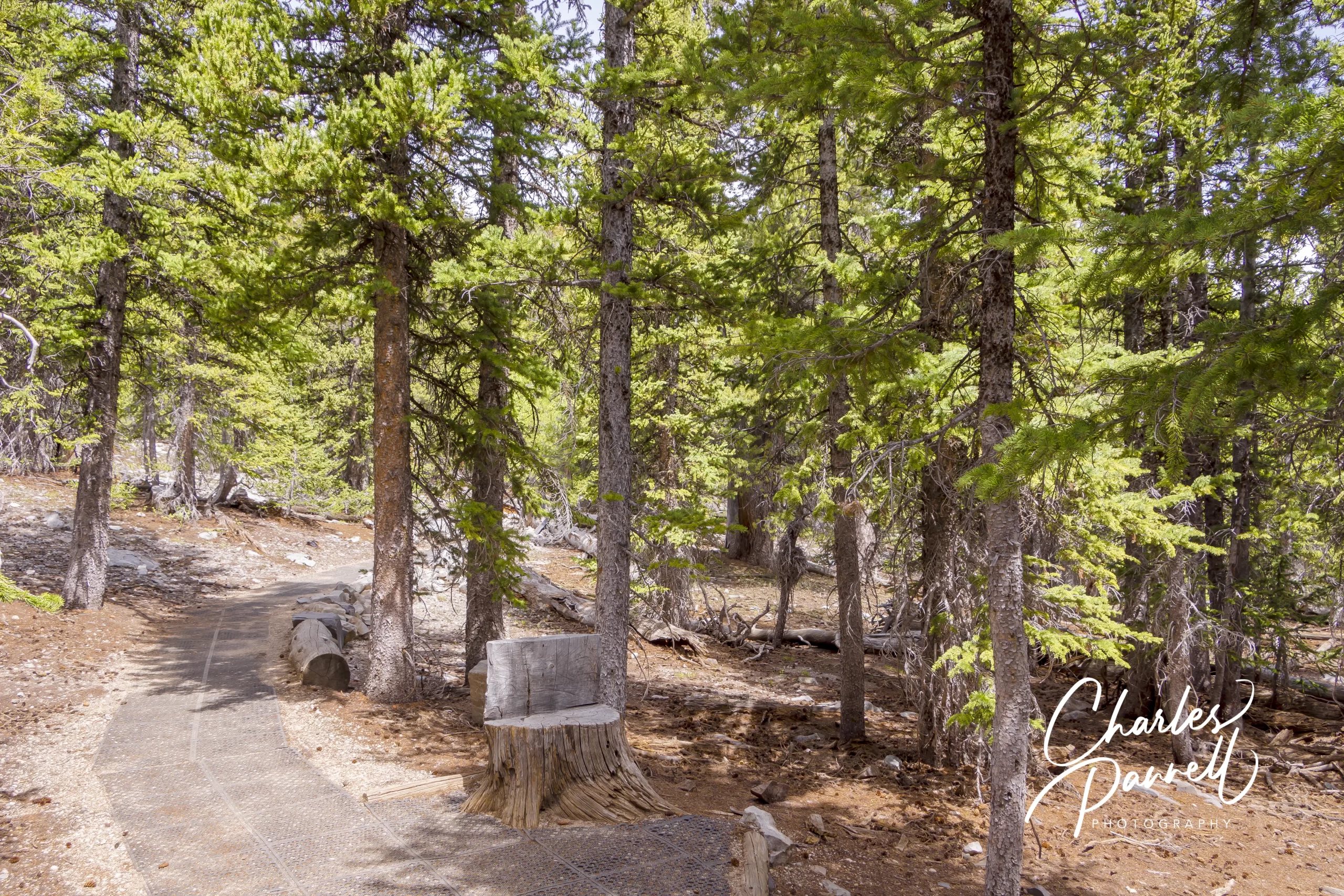
Up at the top there is accessible parking in the Bristlecone Parking Lot, with level access to the Sky Island Forest Trail. This .4-mile loop is very nicely done, with rubber mats and boardwalk sections to make it accessible in all weather. The maximum grade along the 32-inch wide trail is eight percent, and there are benches along the way to stop and rest. Interpretive plaques dot the trail, which winds through a fir and pine forest. Located at 10,000 feet, this trail offers a unique opportunity for wheelchair-users and slow walkers to explore the sub-alpine forest.
The Wonder Down Under
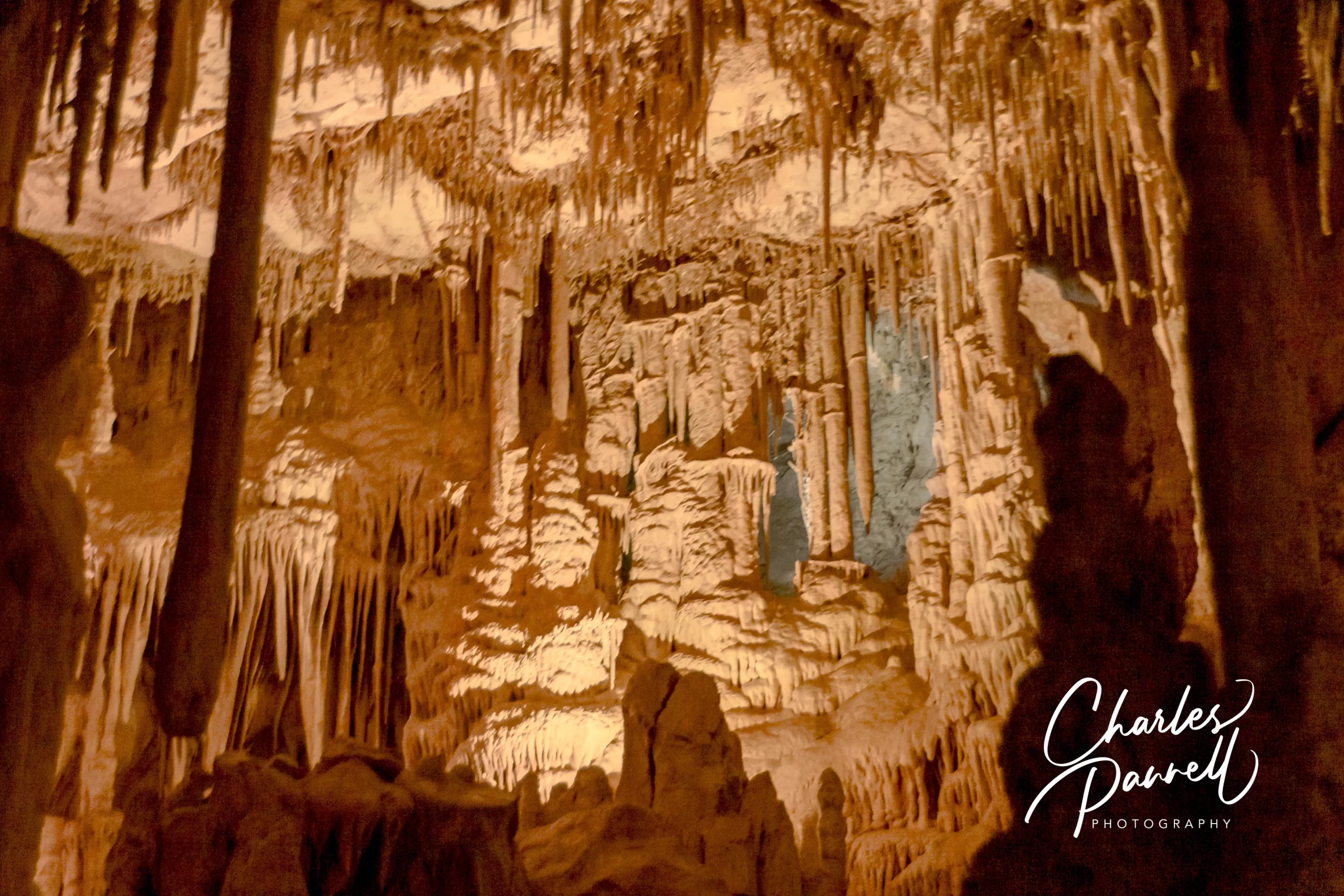
The Gothic Room at Lehman Caves in Big Basin National Park
There’s another side to Great Basin National Park – a subterranean side. After you finish the scenic drive, head down to Lehman Caves for an entirely different view of the park. Located at the end of Highway 488, the Lehman Caves Visitor Center offers accessible parking, with a ramp up to the back entrance. Inside, there’s barrier-free access to the visitor center and gift shop.
Although there are 76 steps on the regular cave tour, a special “mobility tour” is also available. Although not 100 percent accessible it may work for some wheelchair-users and slow walkers. The tour is actually a shorter version of the regular tour, and people who can’t manage the steps and grade just go to the first room — the Gothic Room — and then return to the visitor center.
There’s level access on a paved pathway to the cave entrance, but there’s a five-to-eight-percent grade to the Gothic Room. Wheelchair-users must be accompanied by a companion who can push them in and out of the cave. And although it may sound a bit restrictive, it’s a good opportunity for some wheelchair-users and slow walkers to get a look at the fabulous stalactite and stalagmite formations inside the cave.
The availability of the mobility tour is dependent on the staffing, as there has to be an extra ranger to take wheelchair-users and slow walkers back early. For more information on the mobility tour or to find out about availability, call (775) 234-7517. Tickets for this tour are not available online, but it’s definitely worth the extra effort to make arrangements for the mobility tour in advance.
Located in Southwestern South Dakota, Badlands National Park (www.nps.gov/badl) features a rugged landscape dotted with an almost otherworldly collection of geological formations. The windshield views of the convoluted rock formations are spectacular, so you don’t even need to get out of your vehicle to enjoy it all. On the other hand, if you’d like to linger a bit, there are plenty of wheelchair-accessible Badlands options; including numerous trails and overlooks along the way. And there’s even an accessible lodge to spend the night.
Take a Hike
Fossil Exhibit Trail in Badlands National Park
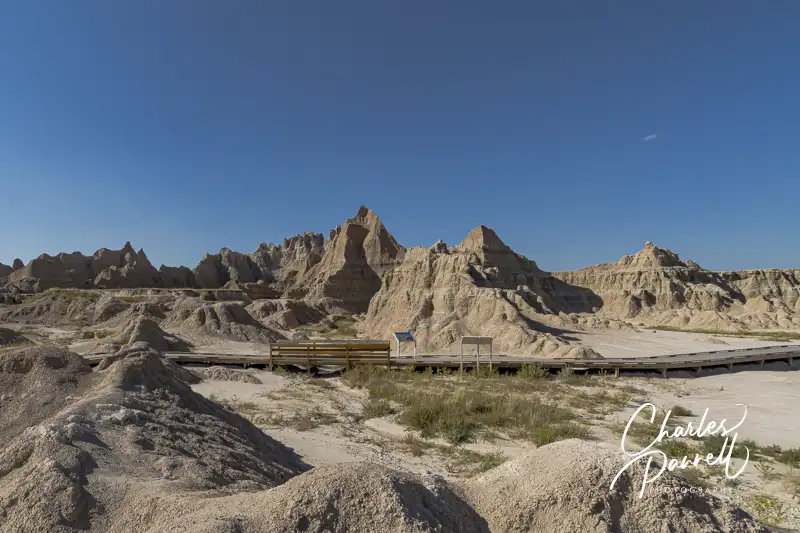
Although the landscape looks foreboding, it’s easy to plan a wheelchair-accessible Badlands trip. To get a good overview, take a drive along Badlands Loop Road, where you’ll find a number of wheelchair-accessible viewpoints and pullouts that aren’t even marked on the park map.
There are also several accessible trails along Badlands Loop Road, including the Window Trail and the Door Trail, which are just a short drive from the visitor center. Both trails can be accessed from the same parking lot, which includes accessible parking and an accessible vault toilet.
The Window Trail is located on the south side of the parking lot. The level boardwalk leads out to a natural window that looks out on eerie hoodoo-like formations off in the distance. It’s a pleasant quarter-mile out-and-back stroll.
Viewing Platform at the End of the Windows Trail in Badlands National Park
The Door Trail is located at the other end of the parking lot, near the much needed shade structure. The level boardwalk snakes between a break in the Badlands Wall — called The Door — and opens up to a sweeping sandstone canon view at the end. It’s a .75-mile round-trip hike.
Start of the Door Trail in Badlands National Park
And don’t miss the Fossil Exhibit Trail, which is located near White River Valley Overlook. Accessible parking and an accessible vault toilet are located near the trailhead. This quarter-mile boardwalk features low bumpers for unobstructed views, and includes interpretive panels that describe the extinct creatures that once roamed the area. Examples of fossils are also located along this nicely accessible loop trail.
Each trail offers a different look at the varied landscape, but don’t forget the sunscreen, as shade is in short supply in this neck of the woods
Stay a Spell
To ramp up your wheelchair-accessible Badlands experience, plan to spend at least one night at Cedar Pass Lodge (www.cedarpasslodge.com). Not only is it one of the newer properties in the national park system, but it’s also conveniently located right next door to the Ben Reifel Visitor Center.
Designed to resemble the rustic 1928 Cedar Pass cabins, this modern incarnation includes all the creature comforts that travelers expect today. It has several accessible cabins, including cabin 101, a duplex model.
Access features include ramp access to the front porch, wide doorways, excellent pathway access, a lowered clothing rod, and wood floors for easy rolling. The interior is equally striking and includes walls paneled with beetle-kill pine from the Black Hills, and furnishings that are hand-crafted from Lodgepole pines.
Furnishings include a 23-inch high bed with wheelchair access on both sides, a table, two chairs, a refrigerator and a microwave. There’s also level access out to the spacious back deck, which is a great place to enjoy the sunset.
The bathroom is furnished with a roll-in shower with grab bars, a hand-held showerhead and a padded shower bench. The toilet grab bars are located on the back and right walls (as seated), and the bathroom also includes a roll-under sink and a lowered mirror. And like the rest of the cabin, there’s plenty of room to maneuver even the largest wheelchair or scooter around the bathroom.
Cabin 101 at Cedar Pass Lodge in Badlands National Park
Image 1 of 4
There’s also good access to the public areas of the property, including the gift shop, registration area and the restaurant. The only in-park lodging option in Badlands National Park, Cedar Pass Lodge makes a great home-base for any wheelchair-accessible Badlands visit. And you just can’t beat the scenery!
Walk-through Tree at Mariposa Grove in Yosemite National Park
Located near the South Entrance to Yosemite National Park, Mariposa Grove is a must-see on any Yosemite visit. The bulk of the Yosemite crowds tend to gravitate to Yosemite Valley, and this large stand of sequoias remains overlooked by many visitors. That said, if you want a little one-on-one time with Mother Nature, then Mariposa Grove is just the place for you. Granted, it takes a bit of extra planning to get there, but this stately grove is definitely worth a visit. So head south, bypass the crowds and enjoy a visit to wheelchair-accessible Mariposa Grove on you next Yosemite adventure.
A Few Logistics
Getting to Mariposa Grove isn’t difficult, but you need to be aware of a few things. This secluded grove of over 500 mature giant sequoias previously housed a number of commercial operations including a tram tour and a gift shop. These facilities — along with the asphalt pathways around the trees — were removed in a massive renovation project designed to preserve the ecological integrity of the grove. Today there are natural trails and boardwalks through the grove — with nearly a mile of accessible routes — but aside from a few restrooms, there are no developed facilities in the area.
The Welcome Plaza, which is located near the South Entrance, is the starting point for most Mariposa Grove visits. In order to lessen visitor impact on the trees, vehicle traffic is not permitted in the grove. Instead, wheelchair-accessible shuttles take visitors from the Welcome Plaza to the Mariposa Grove Arrival Center, where the accessible Big Trees Trail begins. If however you’d like to drive, and you have an accessible parking placard, you can bypass the shuttle and take your personal vehicle aIl the way to the Mariposa Grove Arrival Center. That said, it’s important to note that the road to the grove is closed to all vehicle during the winter months, as it’s not plowed.
Additionally, if you are planning a visit during the peak summer season, you’ll also need an entrance reservation to see the Mariposa Grove. This entrance reservation is in addition to any national park pass that you may have. For more information about entrance reservations, visit this helpful site. Plan ahead to avoid disappointment, as entrance reservations are not available at the park.
Hike the Big Trees Loop
Big Trees Loop at Mariposa Grove in Yosemite National Park
The Mariposa Grove Arrival Center marks the beginning of the wheelchair-accessible Big Trees Loop. Accessible parking, restrooms and a water bottle filling station are located near the trailhead; and there’s barrier-free access from the shuttle bus stop and accessible parking area over to the .3-mile Big Trees Loop.
The wide, hard-surfaced trail has excellent wheelchair access, and also includes level boardwalk sections over the wetlands areas. There are plenty of benches to sit and rest along the way, and a number of interpretive panels provide information about the grove. Although the trail loops back around to the parking lot, there is a short accessible jag out to the Fallen Monarch — a sequoia that came down more than 300 years ago. Even if you can’t do the whole loop, take some time to enjoy the sequoia forest on the boardwalk near the beginning of the trail.
Enjoy the Grizzly Giant
Grizzly Giant at Mariposa Grove in Yosemite National Park
Visitors with an accessible parking placard can also drive over to the trailhead for the accessible portion of the Grizzly Giant Loop. This trail can also be accessed from the Mariposa Grove Arrival Center; however that portion of the trail is not wheelchair-accessible, so it’s best to drive to the accessible trailhead..
From the accessible parking area it’s a level .1-mile walk through the forest to the Grizzly Giant Loop, and another 425-foot stroll on a wide level trail out to the Grizzly Giant. The California Tunnel Tree, which was carved out as a novelty for stagecoaches in 1895, is another 425 feet down the trail. It’s a nice photo op and you can still walk or roll through this giant today.
After the California Tunnel Tree, the trail continues back through the forest to the Mariposa Grove Arrival Center; however it loses its access in another 425 feet, due to rocks and a steep grade. Still it’s a lovely 2/3-mile out-and-back stroll, and it offers visitors a very accessible overview of the lower grove.
Although the accessible part of the Grizzly Giant Loop is a bit longer than the Big Trees Loop Trail, it’s worth the short trek. And no matter how far you hike, the wheelchair-accessible Mariposa Grove is definitely worth a stop on any Yosemite itinerary.
Barrier-Free Travel California National Park Road Trips for Wheelchair-Users and Slow Walkers
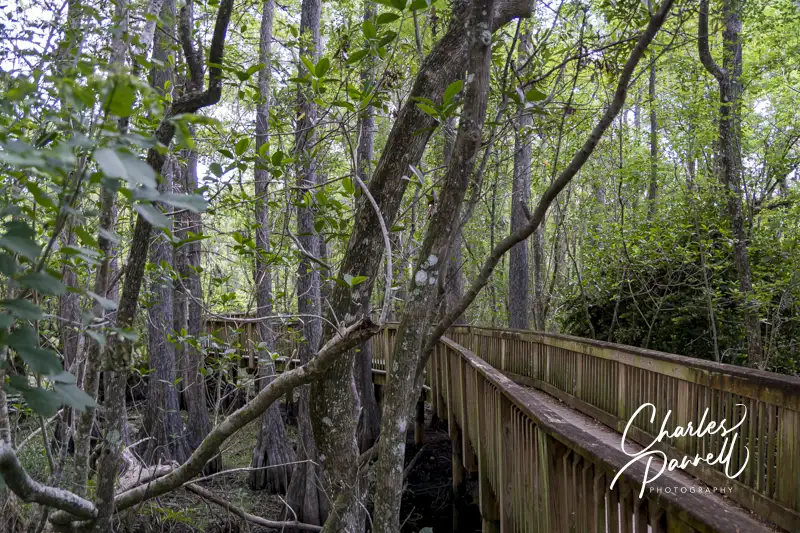
Located in Northwest Washington, Mount Rainier towers 14,410 feet over the surrounding alpine meadows. And when the “mountain is out” it’s visible from as far away as Seattle, Portland and even Vancouver. That said, there’s nothing like a close look at this active volcano, which can be had from Mount Rainier National Park , as well as aboard a local rail excursion. Although it’s only possible to access these sites in the summer season, due to snow and road closures; they are definitely worth a visit. So take some time to to check out these wheelchair-accessible Mount Rainier views on your next Washington national park road trip.
Kautz Creek Boardwalk
Located about three miles east of the Nisqually Entrance to Mount Rainier National Park, the Kautz Creek Boardwalk is one of the newest accessible trails in the park. There’s accessible parking near the picnic area, with level access to the .1-mile boardwalk across the street. The boardwalk leads through a section of forest that’s still recovering from a 1947 glacier generated debris flow, and it ends in a crushed granite viewing area with a few benches. And on a clear day, you just can’t beat the Mount Rainier view from there.
Henry M. Jackson Visitor Center
Next up on our list of wheelchair-accessible Mount Rainier views is the Henry M. Jackson Visitor Center, which is located about 14 miles up the road in Paradise. This area of the park was named by an early settler who reportedly exclaimed “Oh, what a paradise!” when she first saw it. And it’s a fitting description. There’s accessible parking in front of the building, with barrier-free access to all areas of the visitor center. The visitor center offers a 360-degree panoramic view of the area, but you’ll also get a great Mount Rainier view if you just step out the back door. And if you hit this stop at the right time in the summer, you’ll also be treated to a nice view of the wildflower-filled meadows.
Reflection Lake Pullout
The next stop is about 3.5 miles up the road at the Reflection Lake Pullout. Although the lake is on the left side, the most accessible viewpoint is located on the right. The small parking area includes an accessible parking place with curb-cut access out to the viewpoint. And you just can’t beat the stunning reflection of Mount Rainer in the water. This is also a great stop for folks who have trouble walking, as you can get a nice windshield view from the pullout.
Sunrise Visitor Center
Mount Rainier viewed from Sunrise Visitor Center
The highest point in Mount Rainier National Park which can be reached by vehicle is located in Sunrise, about 60 miles northeast of the Nisqually Entrance. And it just makes sense that you’ll get a good mountain view from this 6,400 foot vantage point. Although the front entrance to the Sunrise Visitor Center has steps, there’s an accessible side entrance. There are a number of interpretive exhibits inside, but the main attraction is the view. You’ll get an absolutely jaw-dropping glimpse of the mountain from the spotting scope on the far side of the room. It’s definitely worth the drive! Plan ahead though, as the visitor center is generally only open from July through mid-September, as the road closes after the first substantial snowfall.
White Pass Scenic Byway
Mount Rainier viewed from White Pass Scenic Byway at Milepost 147.6
This scenic route, which is also known as Highway 12, is located south of Mount Rainier National Park. It runs from Naches in the east to Interstate 5 in the west. The shady lane is relatively uncrowded and there are several places to stop along the way for views of the forest and river. That said, there’s a killer Mount Rainier view at the pullout near mile marker 147.6. This is an undeveloped viewpoint with no striped parking and a gravel parking lot; however you can still get an excellent view of the mountain from your car. Additionally, if there’s room you can always parallel park next to the viewpoint and lower your ramp on the sidewalk. There are a few interpretive plaques there, but the real star of the show is Mount Rainier. And if you want to connect to the park, just take Highway 123, which goes up to the Ohanapecosh.
Highway 410
This viewpoint is nestled away on Highway 410 south of Snoquera, shortly after you enter Mount Rainier National Park. It can easily sneak up on you, so be on the lookout for it as you see fewer and fewer trees on the west side of the road. The small turnout is located between mileage markers 63 and 64. There’s no paved parking, but you can park parallel in the wide turnout near the viewpoint. The parking area is mostly gravel, but you can still get a good view from inside your vehicle. If you don’t stop, then at least slow down to admire the impressive mountain view. And if you miss it, no worries, as there’s no shortage of Mount Rainier views as your continue south. Just keep your eyes open.
Mt. Rainier Scenic Railroad
The Nisqually River Viewed from Mount Rainier Railroad
Last but not least on our list of wheelchair-accessible Mount Rainier views, is the impressive vista that can be seen aboard the Mt. Rainier Scenic Railroad (mtrainierrailroad.com). This seasonal train excursion departs from the Elbe depot, which is just 15 minutes from the Nisqually Entrance. There’s accessible parking near the depot, with barrier-free access to the building. Accessible restrooms are located next door, and there are plenty of accessible pathways around the outside depot area, and lift access to the train. This scenic excursion travels along the Nisqually River and offers no shortage of photo worthy views. And there’s an announcement right before you round the corner for that iconic Mount Rainier view. It’s a great excursion to add to any Mount Rainier visit.
Barrier-Free Travel Washington National Parks for Wheelers and Slow Walkers
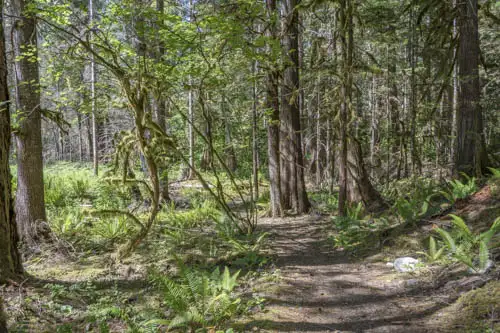
In the spring of 2025 a wildfire destroyed a wooden trestle in a non-operational section of the Mt. Rainier Scenic Railroad (mtrainierrailroad.com). Even though this trestle was not along the scenic rail route, it still was an operational setback for the railway, as crews had to clean up the damage and evaluate the safety of the tracks. The good news is, after a brief shut-down all is well and this iconic railway is up and running. Not only is this classic rail excursion a great addition to any Mount Rainier visit, but it’s also a good choice for wheelchair-users and slow walkers. And as the folks at the railway say, “The fire destroyed a bridge. It didn’t stop the railroad.”
All Aboard!
The Mt. Rainier Scenic Railroad station is located in Elbe, which is just a 15-minute drive from the Nisqually Entrance to Mount Rainier National Park. The historic Little White Church of Elbe sits near the back of the parking area, and adds to the nostalgic atmosphere of the experience. Accessible parking is located near the entrance of the parking lot, with level access over to the ticket office. And on the way, there’s a good photo op of a vintage locomotive in front of the station.
There’s level access to the station, with plenty of room to maneuver a wheelchair around the ticket office and through the adjacent gift shop. The ADA waiting area is located just outside the station, near the manual wheelchair lift. When it’s time to board, the manual lift is usually positioned next to a standard coach car, and the wheelchair- is lifted up to the car. From there, it’s just a short roll from the vestibule to the wheelchair-seating space at the front of the car. Slow walkers or anyone who has difficulty with stairs can also use the wheelchair lift.
According to the conductor, most wheelchair-users can be accommodated in the coach car; however some larger power wheelchairs may need to use the lift to board the baggage car. There’s no seating in the baggage car, which also contains the snack bar. There is however, an open doorway with a safety fence in the baggage car, so you can still get a good view of the passing scenery. The baggage car also has an accessible restroom. That said, the doorways on the connecting cars are narrow and the thresholds are uneven, so it’s best to use the facilities in the station if you are seated in coach.
Ride the Rails
View along the Mount Rainier Scenic Railway Excursion
Part of the ambiance of a Mt. Rainier Scenic Railroad excursion is the vintage rolling stock. The historic train cars are pulled by a Polson Logging No. 70 steam locomotive. This engine was built by the Baldwin Locomotive Works in 1922 for the Polson Logging Company. And today it still chugs along on these scenic excursions.
Passengers can choose from two excursions. The classic ride to Mineral is now joined by a new route to New Reliance. The routes alternate throughout the day, but both travel through the forest and offer scenic views of the countryside. And if the weather is cooperative, you’ll also get a good Mount Rainier view along the route. Once the train reaches its destination, the engine rolls back down a side track and hooks up to the other end of the train. And then it chugs back to the station.
Service is top-drawer too on the railway, with helpful attendants that point out the local attractions and weave in a little bit of history about the area along the way. All in all it’s a great ride, and a perfect Mount Rainier National Park side trip. Additionally, if you have any questions about access for your particular mobility device, just give them a call, as their customer service is excellent. And if you’ve worked up an appetite during your excursion, then stop by the Hobo Pizza Car after your ride. It’s located next door to the railway, and the converted railcar that serves as a dining room has ramp access. It’s a great finale to a Mt. Rainier Scenic Railroad visit.
Barrier-Free Travel Washington National Parks for Wheelers and Slow Walkers
The Freestone Inn, Mazama, Washington (near Eastern edge of North Cascades National Park)
Located about 40 miles from the eastern edge of North Cascades National Park, the Freestone Inn is a true wheelchair-accessible North Cascades retreat. This secluded Mazama property borders a placid private pond, and it’s the ideal spot to kick back, relax and rejuvenate. The property also makes a good home base for exploring the eastern side of the national park. And although the Freestone Inn only has 12 rooms and five suites, the powers-that-be have gone above and beyond as far as access for slow walkers and wheelchair-users is concerned.
An Accessible Room With a View
Room 1 at The Freestone Inn, Mazama, Washington (near Eastern edge of North Cascades National Park)
The good access at the Freestone Inn begins the moment you pull up to this lodge-style property. There’s accessible parking in front, ramp access up to the front porch, and barrier-free access over to the lowered key box, where you can complete your no-contact check-in. From there, a barrier-free path leads through the wide front door to accessible room 1, which is located just off the lobby.
Access features in the room include, wide doorways, lever handles, low-pile carpet for easy rolling and excellent pathway access. It’s furnished with a 27-inch high open-frame king-sized bed with wheelchair access on both sides. Other furnishings include a desk with a chair, a nightstand, a dresser, an easy chair and a refrigerator. And for those chilly nights, there’s a large electric fireplace in front of the bed.
The bathroom includes a full five-foot turning radius, and is outfitted with a tub/shower combination, with grab bars and a hand-held showerhead. There’s a built-in shower bench at the end of the tub, and if that won’t work for you, there’s also a portable shower seat in the oversized bathroom. The toilet grab bars are located on the back and right walls (as seated), and a decorative – but functional — roll-under sink rounds out the bathroom access features.
Bathroom in room 1 at the Freestone Inn, Mazama, Washington (near Eastern edge of North Cascades National Park)
There’s also a wide back door that leads out to one of the nicest features of this room – a wheelchair accessible porch with a sweeping water view. It’s furnished with a pair of Adirondack chairs, but there’s still plenty of room for even a large wheelchair. And if you’d like the chairs removed, just ask the staff, as they are happy to accommodate most any request.
Porch view at the Freestone Inn, Mazama, Washington (near Eastern edge of North Cascades National Park)
The Little Extras
The Freestone Inn is far from a chain hotel, in ambiance, amenities and service. First off it’s a quiet and relaxed property. Because of the low number of guest rooms and the expansive public space, you’ll never feel crowded there. And at times it feels like it’s your own private lakeside retreat.
One of the best features of the property is the pond that sits in the back of the inn. Even if you can’t manage the trail, it’s still a relaxing and refreshing feature to view from your private porch. There is a .4-mile path that circles the pond that some slow walkers may be able to navigate. It’s mostly hard-packed dirt, but there are a few short rocky spots along the way. It’s not a good choice for most wheelchair-users, but again, you can still enjoy it from your private porch.
There is Wi-Fi at the property, although to be honest it’s not really reliable. But you’re on vacation, so ditch the phone and enjoy Mother Nature. There are TVs in the rooms, but there’s no cable; however there’s a large selection of DVDs available to borrow.
And although the accessible room doesn’t have a microwave, there’s a shared kitchen down at the end of the hall. It has a microwave, sink, and a good supply of paper plates and utensils.
If you’d like to leave the cooking to someone else, then stop by Jack’s Hut, which is located across the parking lot from the inn. There’s good wheelchair access to this restaurant, which offers breakfast sandwiches in the morning, and pizza, beer and snacks in the afternoon. The food is yummy, the service is a great, and it’s the perfect way to top off any wheelchair-accessible North Cascades adventure.
Barrier-Free Travel Washington National Parks for Wheelers and Slow Walkers